Prologue
It’s a bit funny. Although the internet weather forecast rarely correspondents with reality, I check it anyway. Then I at least try to ignore it.
Last sunday, when Annika and I considered what to do, the forecast promised sun for two or three hours, but rain showers for the rest of the day. We decided to take the car to Norrbyn 40 km south from Umeå and the 11:30-ferry to the island Norrbyskär. If it really rained, I could at least try out my brand new rain jacket.
Sweden in a nutshell
11:20 we were on board of the ferry Norrbyskär and soon the little ship put out to sea. The trip didn’t take long, it’s only 2 km to the island. I just love boat trips, it always feels like holidays when you stand on the ship’s bow, feel the airflow and look at the blue sea.
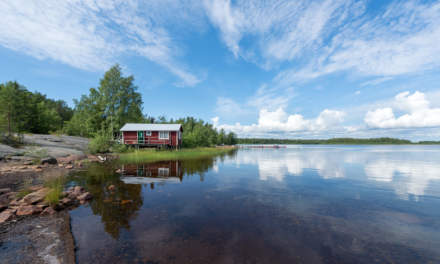
Norrbyskär consists of several islands connected with dams and as we experienced later even another possibility to cross the water. We went ashore with the other guests and headed left on the island Stuguskär. The way is framed by quite large brick houses. Most houses in Northern Sweden are made of wood and for us the brick houses looked more like a small coastal town in Germany, not a North Swedish island. The broad way ended soon, but a path continued through the forest and led us to a tiny bay. The single summer house standing on stilts brought us back to Sweden: it was wooden and painted red.

We continued to a place called Calmarn, another part of the island. The soil along the bay was brown and very bouncy. I had to look twice until I realised that the soil was neither sand nor mud. As many other places Norrbyskär had a huge sawmill in former times and this bay was completely covered with a thick layer of sawdust that gave you the feeling of crossing a huge trampoline when you walked on it.
We continued the path and entered the forest again. Soon we stood on the rocky north point of Calmarn, where we took the first rest. We sat down on a big rock, looked at the sea and enjoyed the blue sky and the warm sun. No rain in sight yet.
Now we went back the whole way until we almost were at the shipping pier again but continued the main road that connects the islands Stuguskär and Långgrundet. The street ends at a place surrounded by two white wooden houses and a bell tower. The entrance of the main building was labelled sommarkyrka – “summer church”. The ferries that connect the island with the mainland are going only between late april and early october – hardly more than 5 months, so probably this church is only active these months.
We went around the church where we found the Tannskärsstigen, a forest road on the peninsulas Tannskär and Truthållan. Sometimes the path was near the shore and you could see water lingering through the trees. Sometimes the path looked like leading through a huge and dense forest, even if Tannskär is hardly 500 meters in diameter.
It got warmer and warmer and we longed for a bath. The first beach was not actually crowded, but the nice places were occupied and so we continued our walk. The second bathing place wasn’t completely deserted neither, but big enough for us to find a place. A pair sitting on a wooden bench, some boats, some people on the pier, some kids in huge orange life jackets. We drank some water, ate some sweets and decided to take a bath.
Brr – the water was still really cold but so refreshing. So delightful! After the bath we laid down on the wooden pier and the sun dried us in a short time.
We continued the circular track and soon approached the summer church again. We went a bit back and crossed another dam to reach the island Stengrundet. Here’s a huge campground of the YMCA (in Swedish: KFUM). We had a look at the climbing crag where people with climbing harnesses and helmets climbed ladders and balanced on ropes, but soon we went to another shore were we had a look at the blue sea with its small and tiny islands.
We went back to the campsite, found another path through the forest and followed it, this time in direction north. The north peak of this island is extended by a quite long breakwater made of big rocks. Again a nice place to rest. In the east we could see the tiny island Burgrundet. It looked spooky. Some leafless dead trees and black birds. Crows? Dead man’s island? No, it weren’t crows, but cormorants sitting on the bare branches of the dead trees.
In the south we could see some wooden wrecks in the shallow water between Stengrundet and Långgrundet. On the satellite photos it looked like shipwrecks – almost like a ship graveyard. We went back – first along the shore then through the forest. It took a while but finally we found the path to the shore where we could see the wrecks of some twenty meter long wooden shipwrecks – an amazing view!
I already started to check the time because we wanted to reach the 18:15-ferry. The museum, which is not far away from ferry dock, was already in view and hardly hundred meters away, but on the other island. To reach the museum by foot we would have to go two kilometers to use the dam between the islands. But there happened to be an alternative:
When we looked at the shipwrecks we found a big wooden raft, tied to some cords that were fixed to the shore of both islands. Apparently it was possible to enter the raft and just pull oneself cross the water. After some considerations whether it would be (a) possible and (b) permitted we entered the raft, took the soaking wet cords and pulled ourselves over the water. It didn’t take long and we were able to hop on shore. We went into the museum, bought lemonade, strolled back to the ferry dock, sat in the warm sun (still no rain cloud in view) and waited for the ferry. A short boat trip to the mainland ended a wonderful day on the island(s) Norrbyskär.
Conclusion
This felt like an ideal day trip and – even though Annika and I both live in Sweden – a bit like Sweden in a nutshell: ferry trips and tiny islands, sailing boats and motor boats, a museum, a restaurant and a kiosk, stony and sandy beaches, huge rocks and forest paths, not to mention many flowers, ice cream and the first blueberries (still very sour!).
Conclusion: fully recommendable!
Official Site: visitnorrbyskar.se