Polar expedition AeN JC3 – day 10: twice on the ice and a sudden end

This article is part of the series “2022-02: Winter cruise KPH”.

Day 10 · 28 February 2022

Today we continue with ice station at P5 – short for “Process study station” at approx. 80.5° N 34° E.

To my delight I can join the scientists A. and B. on the ice this morning. Great! First they will do a transect measuring ice and snow depths along a path, then A. will examine snow. I will join them but without a specific task.

Right after breakfast the preparations start. We all have to dress up and equipment as well as snowmobiles have to be lifted from deck onto the ice. And then I stand on the Arctic sea ice a second time.

It’s -12½ °C, wind 8 m/s– good conditions for taking a walk. But before we start instruments have to be set up and activated.

While B. sets up the GEM-2 device, a multi-frequency broadband electromagnetic sensor to measure ice thickness, something happens. Our polar bear guard J. breaks through the ice. First up to the thighs, a second later to the hips. Exactly on the very snow mobile track that all use to walk to the different places. It could have happened to any of us. J. is lucky, he pushes himself out of the hole way within seconds. After this incident the ice hole is examined and the weak parts are removed. Now it is 2 m long but hardly 50 cm wide. Later it will be marked with flags to prevent others falling in.

J. stays almost completely dry and does not need to change clothes. So our small transect caravan is ready to depart.

  • A. comes first. With each steps he pushes the long staff of the Magnaprobe into the snow to measure and track the snow depths.
  • B. comes second. She pulls the pulka with the GEM-2 that continuously measures ice thickness as well as position and time.
  • J. comes third. As our bear guard he has a rifle on his pulka and safety equipment. He has to keep two metres distance to B’s pulka, the GEM-2 is sensitive.
  • I come fourth. I just follow in the same slow pace – slow enough to take some photos. I do not dare to leave the track after J’s involuntary “bath”.

Our destination is that black flag tied to the bamboo pole over there. How far it is? On the sea ice I do not have any clue. It could be 100 metres, it could be a kilometre. Distances are hard to guess.

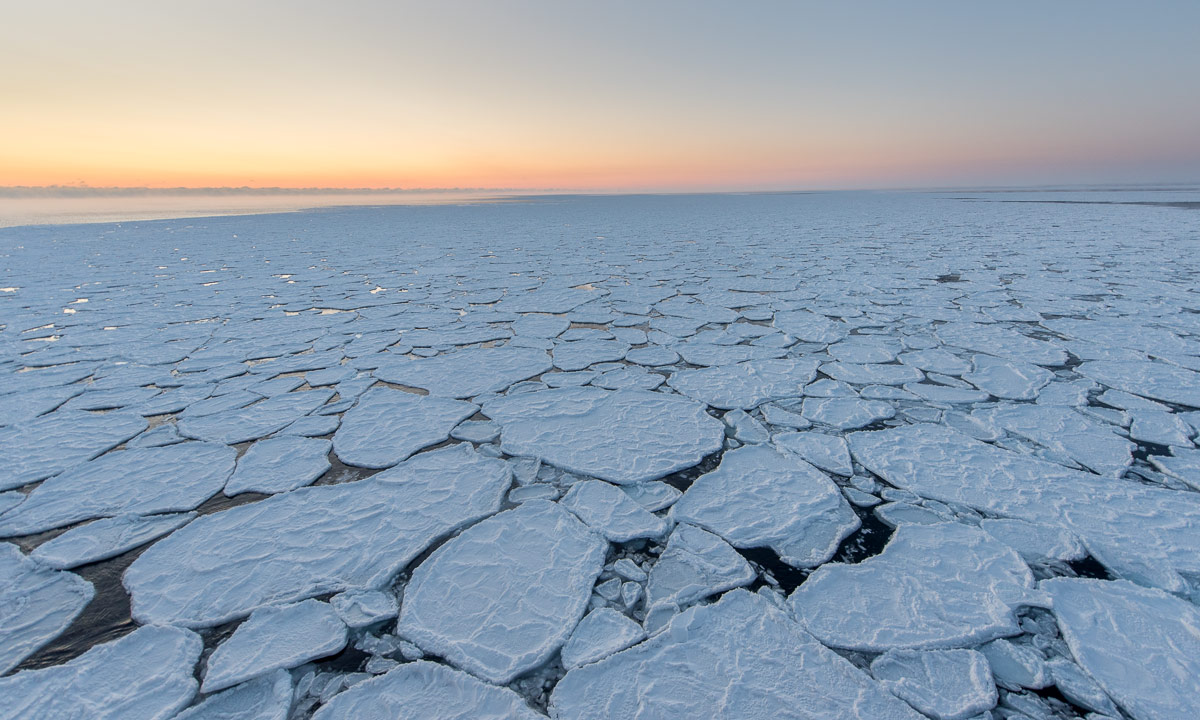
Our walk takes only 45 minutes but is extremely impressive. We leave the ship behind, therefore I only see the others, the sea ice, clouds and the low hanging sun that illuminated this Arctic scenery in the warmest colours. The next image is one of my favourites, but it cannot reproduce the „North Pole“ feeling I experienced on our triangle formed walk.

When I wrote „North Pole“ I started to smile. Yes, I would love to visit the North Pole someday. I doubt however that it looks different there than here. Being part of this quite inaccessible Arctic landscape  touches me deeply and I’ll never forget this impression. I envy A. and B. who will walk a lot on this expedition, mostly by foot, sometimes by skis. I cannot imagine a better job than doing this.

Are we on the ice the whole day? No. There’s breakfast 7:30–8:00, lunch 11:30–12:30 and dinner 17:30–18:30. At meal times there is no polar bear watches and so no people on the ice neither.

After lunch I am allowed to be on the ice a 3rd time, helping. I am in doubt if we are actually able to step on it because it became windier and the visibility was mediocre. And visibility is needed by the polar bear watches.

Visibility doesn’t seem an issue and soon I stand on the sea ice again. I am sent to another scientist that may need my help. Well, not yet– so let’s take a few short snapshots.

While I try to figure out how I can help someone is coming to us and says: „Grab your stuff and leave the ice immediately!“. I want to fetch my backpack but cannot find it. Probably someone else already took it. So I head back to the icebreaker – it’s near – where equipment is already loaded back to the ship. And there’s the backpack.

Soon I am on board again and learn what happened. It was not a polar bear as I suspected but a crack in the ice. It came from the distance and started to split our ice floe fast. The crack was not threatening us directly but a clear signal, that the ice is not safe anymore. Here a photo from one of the upper decks:

Later this day a small team in survival suits takes down the tents and fetches the rest of the equipment.

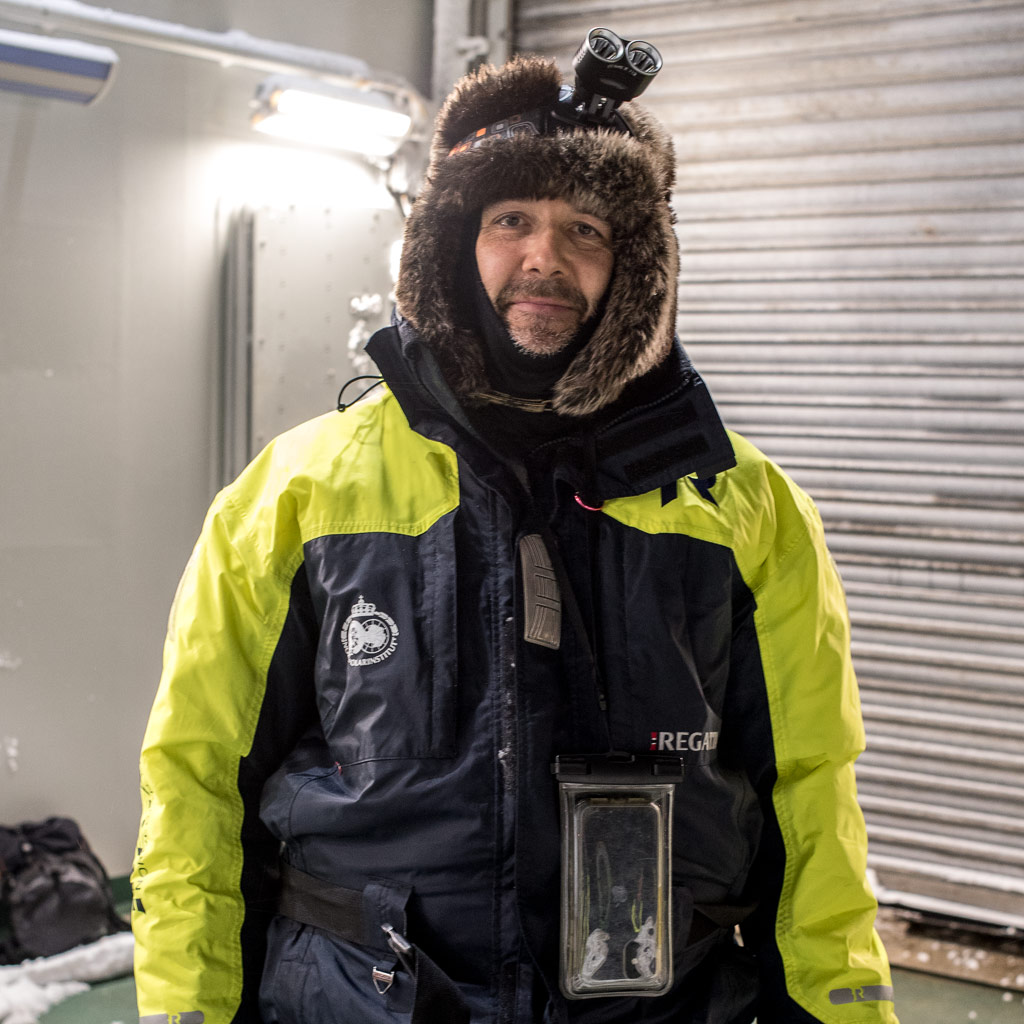
For me that feels like an extraordinary incident but the affected scientists take it easy. Seems to happen frequently. Some admit that they were surprised that this ice floe held so long. I do not say it loud but think for myself that I would have preferred wearing a survival suit to the Regatta suit to keep dry in the case of breaking through, but that’s not up to me to decide. And still – I do not have any experience on Arctic sea ice.

What shall I say. Two days ago I was afraid that I was not let on the sea ice and now I already have been there three times. I am very grateful to the cruise leader that gave me these opportunities while handling a zillion other things – many of them really important – at the same time! Thank you, G.!

Polar expedition AeN JC3 – day 9: P5, the first ice station

This article is part of the series “2022-02: Winter cruise KPH”.

Day 9 · 27 February 2022

Yesterday we have arrived at P5, our first ice station. In the night the ship left the ice for some plankton nets and trawl. Today morning it carefully moves back to the chosen ice floe. After breakfast the activities on the ice will start. A station with a tent quite near the ship, another one some hundred metres away and A. and B. who do transects of ice and snow depths will wander around somewhere. (A transect is a path along which a series of measurements of the same type is performed.)

A lot of people will be on the ice but not me. The meeting of the previous evening revealed that I will not the enter it today and my status for the next day (tomorrow) is “additional”. Although I understood that the cruise leader did not want to send all people directly onto the ice – especially since it is not very thick – I was disappointed.

After the meeting I tried to ask the cruise leader for the reasons but I communicated quite demanding and stressed her unnecessarily. Today I apologised to her. Even while I write this article I am ashamed for my behaviour. That was not my best hour.

Today I will be involved in the ice station anyhow, but from the ship.

Polar bear watch

Here in the northern part of the Barents Sea we are in the habitat of ursus maritimus – the polar bear. These animal are threatened and need our protection. At the same time they are dangerous and we have to protect ourselves. So the most important thing – both for humans and polar bears – is to avoid encounters on the ice.

That’s where the polar bear watches come in.

Before anyone may enter the ice already three polar bear watches stand on the bridge on deck 8. Each watch has a segment of ca. 150° to watch so that the segments overlap. Than the polar bear watch will have a single task for one hour: constantly watching the segment – with and without binoculars. As soon as a polar bear watch discovers a polar bear on the ice he/she uses the handheld VHF, a two way radio to make a radio call, for example “Polar bear at 10 o’clock, 1000 metres, moving to the ship”. All team leaders and ice bear guards and the cruise leader have a VHF as well and can discuss plans that mostly will result in leaving the ice.

Today I will have three polar watches. 9:30, 12:30, 14:30 +2h. Since I know that this task is very important I am quite nervous while I walk up the staircase to the bridge.

At least the windows that still were salt-encrusted from the storm two nights ago are cleaned. Good for the visibility.

The VHFs are also used to sign in and out people on the ice. As soon as someone enters it a call is emitted: “Bridge, bridge, this is A. B and C on the ice”. The same procedure when people are back on the ship. The person in charge is also on the bridge and will move magnets on a chart to keep track. A bit like a non-magic version of the Weasley Clock in Harry Potter. (Thanks Annika for this metaphor!)

At 9:30 I start my first watch at the port side of the ship. It is a good beginner place because it is farthest away from the ice stations. For one hour I constantly scan the ice from the open water at the stern to the ice at the bow. Sometimes I use the binocular and scan the horizon, sometimes I use my naked eyes to get a better overview. Sometimes I look down to the ship. Some of the ice floes look like polar bears but first they do not move (and soon I know them by heart) and then polar bears are not of this cold blueish white but more a yellowish, creamy colour.

These photos I made after my watch. My job is to watch the ice, not to take selfies for this blog or mobile photos through my binoculars. Yes, I use my own, because I love them more than those on the bridge. I realise that I own these binoculars for almost 40 years. The oldest piece of equipment I brought on this polar cruise.

The biggest challenge: Do not think! Don’t follow your thoughts. Because then you may still look through the binoculars but without paying attention. The 59th minute you do the same as in the 1st minute. Watch the ice. Watch the ice. And again, watch the ice!

So that’s my day. Watch the ice. Take a nap. Eat lunch. Watch the ice. Relax. Watch the ice. Fight tiredness. Eat dinner. Until …

MSS casts on the sea ice

… the cruise leader comes to my chair while I am eating fish, potato gratin and beetroot. She asks me if I was ready to go on the ice at seven. Tomorrow? No, today. What? I mean, of course! I shall follow Z. who will do three MSS casts to measure CTD (conductivity, temperature, depth) and turbulence in an ice hole. I shall dress very warmly. The first opportunity to be on the ice and see how this measuring works. Wow!

At 19:00 I stand outside on the deck waiting for the others. I have to stand outside because I’m dressed in two layers of wool and this non-breathing Regatta suit and I already started sweating while changing clothes.

Half an hour later the snowmobile has left me at the green tent. Officially I only got 30 seconds for taking photos – every extra minute will extend the observation time of the three polar watches – but since Z. has to do some preparations I have some minutes to take snapshots in the dark. And to feel very happy.

Then it’s my turn to help. While letting down the MSS needs some experience pulling up is just some mechanical work. Z. did the first one, I do the two others. Z. observes the computer display and signals me when I shall slow down. All I have to do is winding up. Easy work and time for a chat.

After the three measurements Z. is content and calls K. to fetch us with the snowmobile.

This activity from ship to sea ice and back to ship took less than an hour but I will never forget it. Standing in the dark on the ice of the Barents Sea on a place nearer to the North Pole than to my work town Tromsø is just impressive and I feel that I have a strong relation to it.

Next time however I will dress less warmly. It was only -15 °C outside and I had too much clothes on. Alone the Regatta suit is warm and the tent was heated to protect the sensitive electronics.

And you? If you had such an opportunity would you take it or do you prefer warmer locations?

And to those of you who have such an opportunity for me: contact me asap.

Polar expedition AeN JC3 – day 5: marine fauna · entering the ice · temperature drop

This article is part of the series “2022-02: Winter cruise KPH”.

Day 5 · 23 February 2022

12:30 – it gets colder

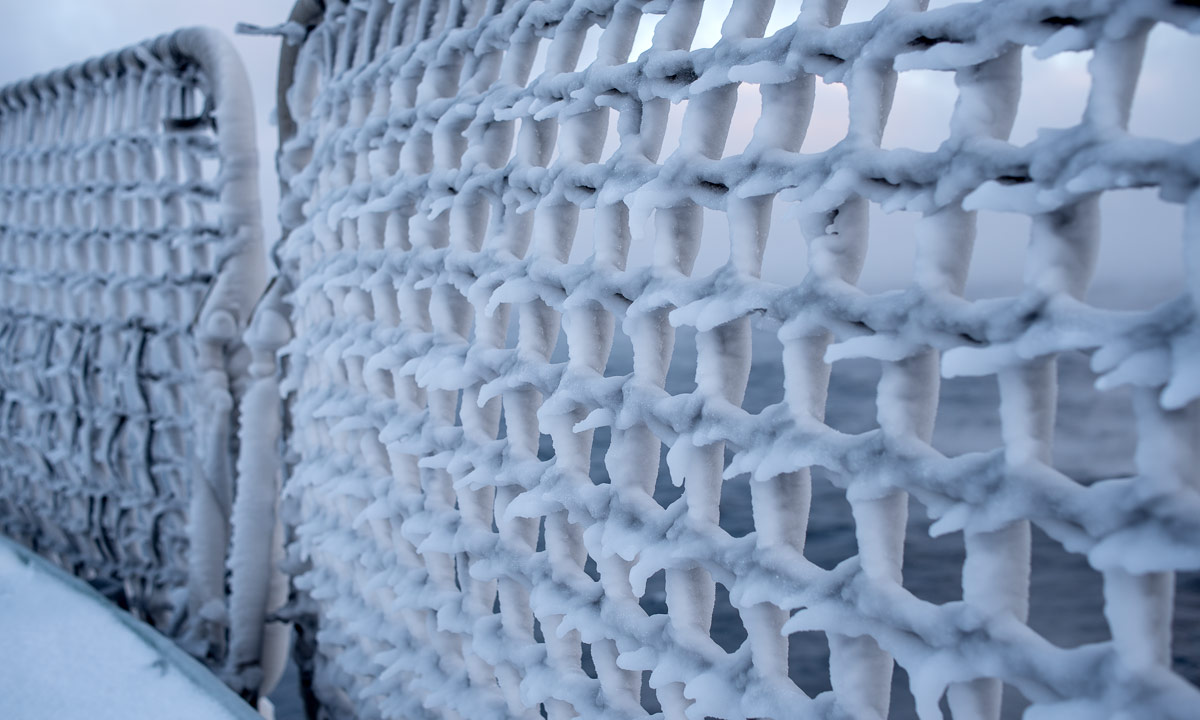
Over night it has become much colder and windier. Temperature has dropped to -17 °C and the relative wind speed has increased to 17 m/s (ca. 60 km/h). According to the wind chill formula that feels like -33 °C. The taut nets around the deck are covered with ice structures and ice fog hovers over the still open sea.

14:00 – marine fauna

A large trawl net is being pulled up. Scientist are waiting on deck, they look eager. What will the trawl reveal?

The net is up and the haul is emptied onto the deck.

At once the marine biologists gather round the catch and start browsing, identifying, sorting. I know some of the animals, but neither taxonomy nor latin name. It’s a childhood’s memory – me walking along the shore, my eyes glued to the soil to search for shells, jellyfish, worms, starfish. As a child I wanted to become a researcher but live has changed many times. Anyhow it finally brought me here on this polar expedition on Kronprins Haakon. But I digress, back to some photos of marine fauna and scientists:

I would love to know a bit more about the taxonomy of all these species but this will take some time and efforts, nothing you will get for free.

14:37 – the first sea ice

And there it is. The first sea ice is ahead.

The photo is awful. Noisy, underexposed two levels but I want it here in the blog. Not only for you but also for me because it’s the very first photo of sea ice on this cruise.

But there is more. While we continue north, soon the Barents Sea gets covered with pancake ice – called because of the rounded shapes of the ice floes – that soon make place for larger ice floes. That takes only 20 minutes.

(The images are not in chronological order for layout reasons)

For more than an hour I stand at the bow of the heli deck and watch the changes of the ice coverage. I love ice, I love the sea, I love cold winter and here I can get it all together. I feel happy! And cold it has become. Temperature -22 °C, relative wind speed 16 m/s resulting in a wind chill of -39 °C. The Canada Goose Snow Mantra parka starts to make sense. It shows what it can: keeping me warm under these conditions.

I use a pair of gloves and two pairs of mittens to keep hands and fingers warm. With one exception: Smartphone selfies. These I take bare-handed. While doing that the pinky of my right hand gets really cold and I will feel this for many hours. I’m lucky, the fingertip has no frostbite but I decide to stop making selfies in such harsh conditions. I love the arctic, but I play piano, too. I need my fingers. All of them.

15:59 – dinner pleasures

The haul caught a lot of animals, amongst others a lot of shrimps. Only some of them are needed for research. I help cleaning them, plucking away starfish and other species while a huge pot with salt water starts boiling. And at dinner we all get shrimps. Freshly caught in the Arctic. Delicious!

19:00 – photo shooting

A. a marine taxonomy expert asks me if he can borrow a tripod, he wants to take photos of some of the animals. Oops – I forgot the mount for attaching other cameras. I make another proposal: I’ll drop by and take pictures by myself. From this day I’m the “official court photographer” of non-microscopic animals. That’s work I really like. The first results are not the best, but I’ll share them anyhow:

Species identification taken from the cruise report of Andreas Altenburger. Thanks a lot!

21:30 – Sailing through the night

It’s dark. Ice has become thicker and you can hear the cracking and feel the vibrations from Kronprins Haakon breaking the ice. Again I stand on the heli deck looking ahead. Two strong spotlights illuminate the ice.

And for some minutes there is even a Northern light palely glowing in the sky.

While I stand there, happily watching the ice and the sky, muffled up warmly in my down parka and pants, temperature has dropped even more. -28 °C, windchill -44 °C.

temperate in °C | wind speed relative to the ship in m/s | resulting windchill in °C.


Polar expedition AeN JC3 – day 4: let the science begin!

This article is part of the series “2022-02: Winter cruise KPH”.

Day 4 · 22 February 2022 (part II)

18:14 on the bridge on deck 8. Some metres south of the 76th degree of latitude. People stand by the window, they are staring outside. Outside it’s dark. What are they looking for? What’s happening?

The activities for which we are doing this expedition have finally started. What activities do you realise on a scientific cruise? Collecting samples and data. For yourself and for others.

1 – Seaglider recovery

The very first activity is the recovery of a seaglider, an Autonomous Underwater Vehicle (AUV). It sends its position but still you have to locate it with your own eyes so that the icebreaker Kronprins Haakon can approach it. The recovery is much faster than excepted, already 15 minutes later the glider is on board. Anyhow it takes much more time to deactivate it, clean it thoroughly and most of all to dismantle it so that it fits into its huge plastic boxing that looks like an alien coffin.

To be honest, I don’t know for how long the glider drifted through the Barents Sea until we pulled it up. I don’t know neither what it measured and who will process this data. There is so much happening on this cruise that I do not manage to keep track of everything.

2 – CTD and water samples

There are a lot of abbreviations used on this cruise. One of them you hear frequently is “CTD”, which stands for conductivity, temperature, depth. A CTD is an electronic device that measures these three parameters constantly while it is winched down and up again. The conductivity is used to calculate the salinity, the relative amount of dissolved salt in the water. I will not go into details in this article because I’m not a scientist and I don’t want to write nonsense.

We have to talk about two more terms: “Moon pool” and “Niskin bottles”.

A moon pool is an opening in the floor of a ship deck to have access to water from inside the ship. Where this name comes from no one could explain.

When the moonpool is opened and the winch is ready the CTD is lowered into the water of the moon pool. And then it’s time for waiting – a quite common activity on the cruise. Time for discussions or just watching.

You see this “rosette” of dark, numbered cylinders? That’s Niskin bottles, used for sampling water. They can be opened and closed remotely so that it is possible to fetch water samples from different depths. These samples are used by chemists and marine biologists for different purposes. Since the chemists do the most delicate analysis they come first. The CTD rosette of Kronprins Haakon has 24 bottles. Today 22 of this bottles are filled, each one with water from a particular depth.

3 – plankton nets

It’s half past eight, when parts of the ship’s starboard hull is moved aside. Now it’s time for the first plankton nets. Marine biologists will work till long after midnight to bring down different nets for collecting zooplankton and phytoplankton. And there are many net types with different net sizes for different purposes. I have already worked with marine biological data so I know the names as bongonet or multinet. But now I see them first time in real life and learn about the different purposes and methods. Each net has not only its own construction but needs a distinct speed for being lowered and another one for being pulled up again.

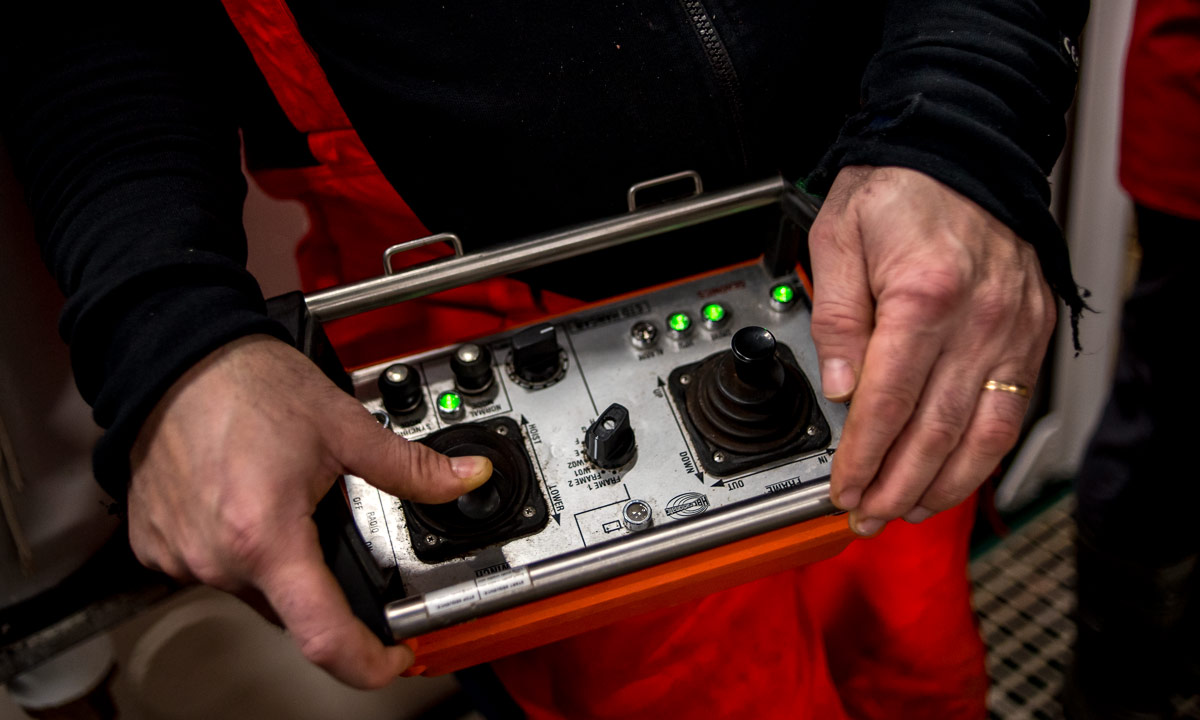
Not all plankton nets are taken from the starboard. Some are so heavy, they need the more powerful winch at the stern of the ship. One of these is the multinet, a combination of five nets for collecting plankton from different depth intervals.

The activities continued the whole night. According to the data the last one was finished at 6:31, one hour before breakfast. I however decided to go to sleep at half past twelve. It was not relevant for my work to watch every activity and I was really tired. I’m a morning lark, not a night owl.

And since this blog article is already quite long I make it optically even longer by finishing it with another photo featuring the multinet.

Sea ice field work training on the Sørbotn

Peacefully I wake up this morning. It is already light outside. WHAT? LIGHT? WHY? AND WHEN?

I check my mobile phone – the clock shows 8:01. SH**!!! At 7:45 we were supposed to meet at the Norwegian Polar Institute, at 8:00 we were supposed to leave there for a field work training on the sea ice. But not me. I have overslept!

We – that’s 5 instructors and round 20 participants of the Sea ice field work training arranged by the Norwegian Polar Institute and the Arctic University of Norway in Tromsø. I realise that my colleague M. already tried to reach me and ring back. I tell her that I will take my own car and hopefully make it to our destination with only a small delay.

Our destination – that’s Sørbotn, the southern tipp of the fjord Ramfjorden where the training will take place on the sea ice of the frozen fjord.

I manage to dress, make tea and pack in 20 minutes thanks to previous day’s preparation and a fondness for packing lists. Although I take it easy while driving (safety first!) I arrive less than 10 minutes late while the preparations are still in progress.

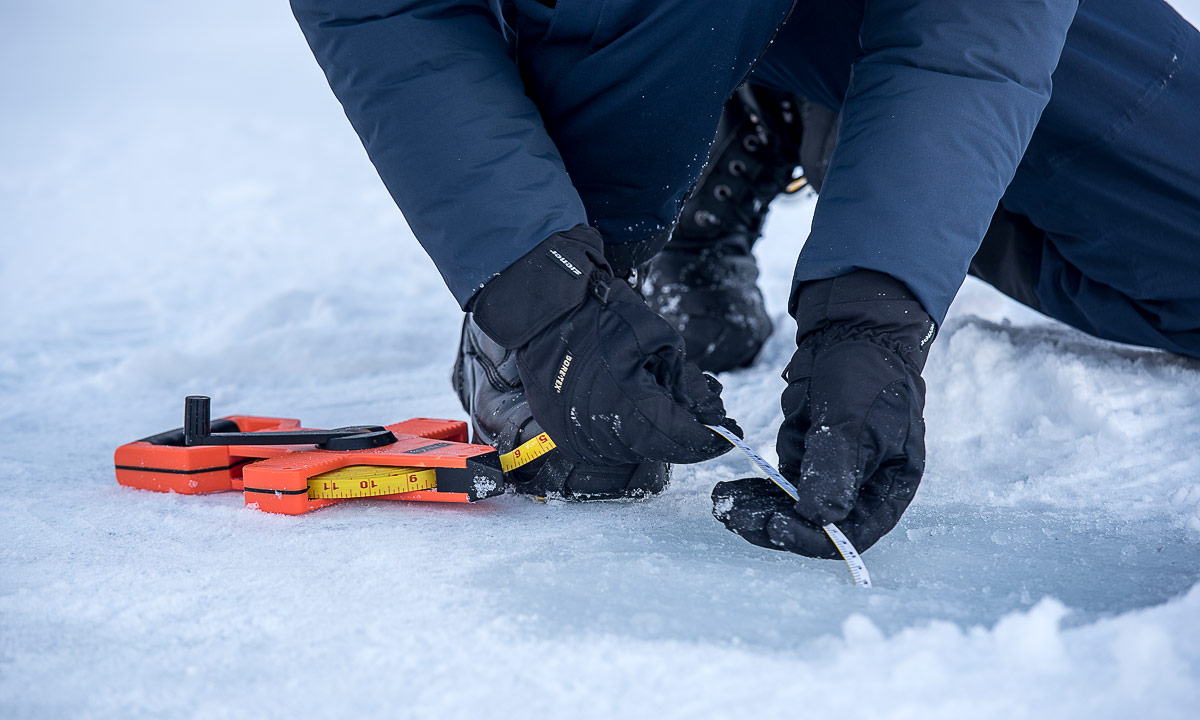
We are split in two groups. Our group will do measurements of ice and snow depths first and take ice core samples after lunch break. I won’t go here into details too much, because I’m a newbie to all this and I do not want to write half-understood nonsense. I’ll have to look up some details of today’s stuff later.

Although I drill holes in the ice, help calibrating the GEM2 device, measure temperatures in a freshly taken ice core and use a MagnaProbe to measure a transect of snow depths I have a lot of time to take photos, too. So, let’s just start with this.

Being on the ice with a bunch of nice people is not only a lot of fun but it will help me in doing my job at the polar institute. Part of it is to manage scientific data. The deeper my understanding on collecting data the better I can do my work. The most interesting thing today was observing the coexistence of advanced sensor technology paired with GPS tracking and the usage of rulers, pencils and paper as in the early days of polar research.


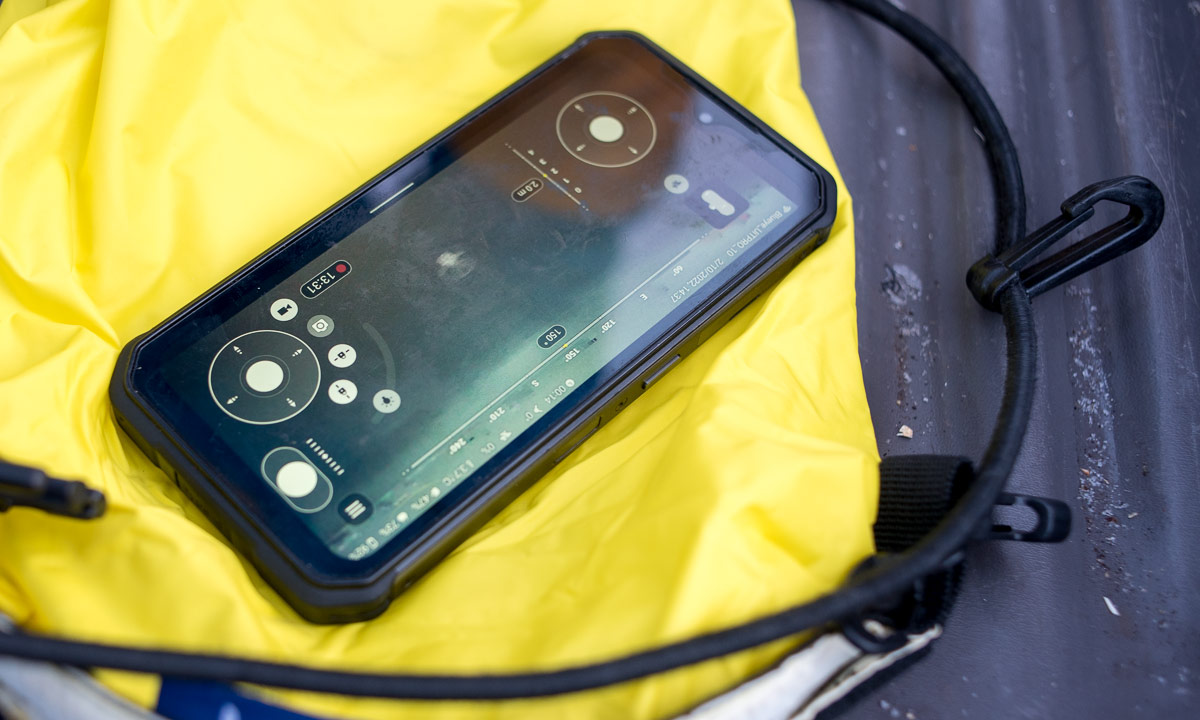
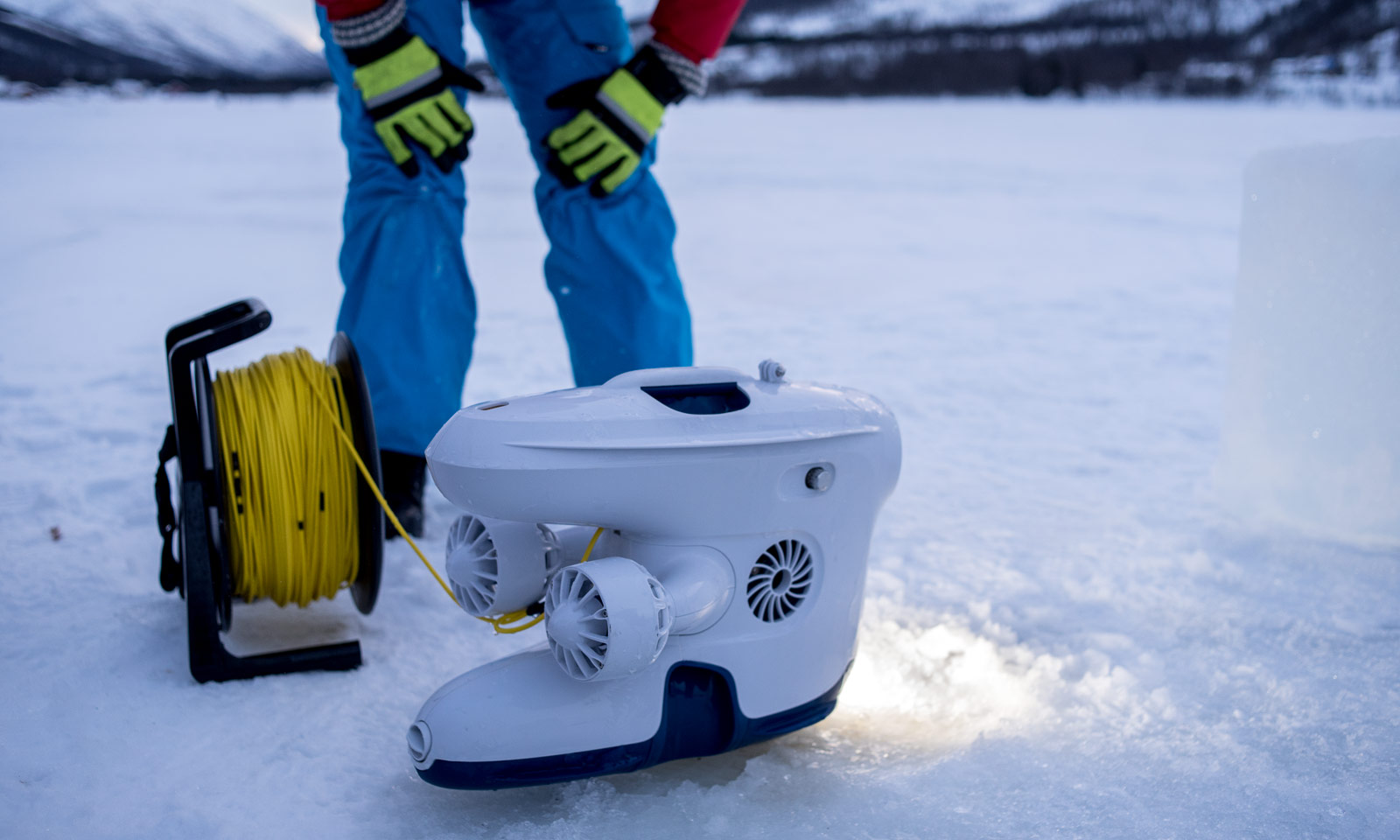
There was one thing I wasn’t involved in: The usage of a remote-controlled underwater drone. We clearly could see some fishes and jellyfish (do you spot it on the 1st image below?) on the live display. I know that it’s used for research, but I would love to have it just as a toy.

Hopefully this was not the last time that I was involved in field work this year. And perhaps we’ll be lucky with the weather again next time. For while we had calm conditions and even sunshine, wind drove heavy snow squalls over Tromsø just some hours after we called it a day.