Break at work II – ice paddling

Today has been another clear and calm day. It was colder than the day before with temperatures round -19 °C. Today’s plan was paddling, at least round Lillskär, the small skerry nearby.

Step 1 – fetching the kayak

I knew exactly where our kayaks are. They lay in the garden – hidden under a layer of powder snow. So the first part of my paddle tour was digging out my kayak.

Step 2 – dressing and get equipment

Survival suit · thick mittens · ice claws · smartphone · camera · waterproof bag for the camera · paddle. Just the basics, I won’t go far.

Step 3 – crossing the ice

After some frosty days the ice on the shallow bay seemed to be thick enough to support my weight. I walked over the ice dragging the kayak behind. At the edge of the bay there was an ice range that I had to cross. I entered the kayak and mostly I used my ice claws to drag myself forward. Sometimes the ice supported the weight of me in the kayak, sometimes we broke through. Although the ice range to cross was only 100 metres wide I had to take several breaks. Some to take photos, some to catch my breath.

Step 3 – paddling

Then I reached open water. Almost. The water was covered with a thin layer of transparent ice needles that made the water look crystallised. It slowed down the waves and I could hear the high-pitched clinking while I was paddling through. Very fascinating!

In addition to that the sea was smoking. When it is as cold as today, the surface water evaporates and quickly resublimes to tiny ice grains that build this moving fog that colours the sea in a pale white.

Step 4 – visiting an ice exhibition

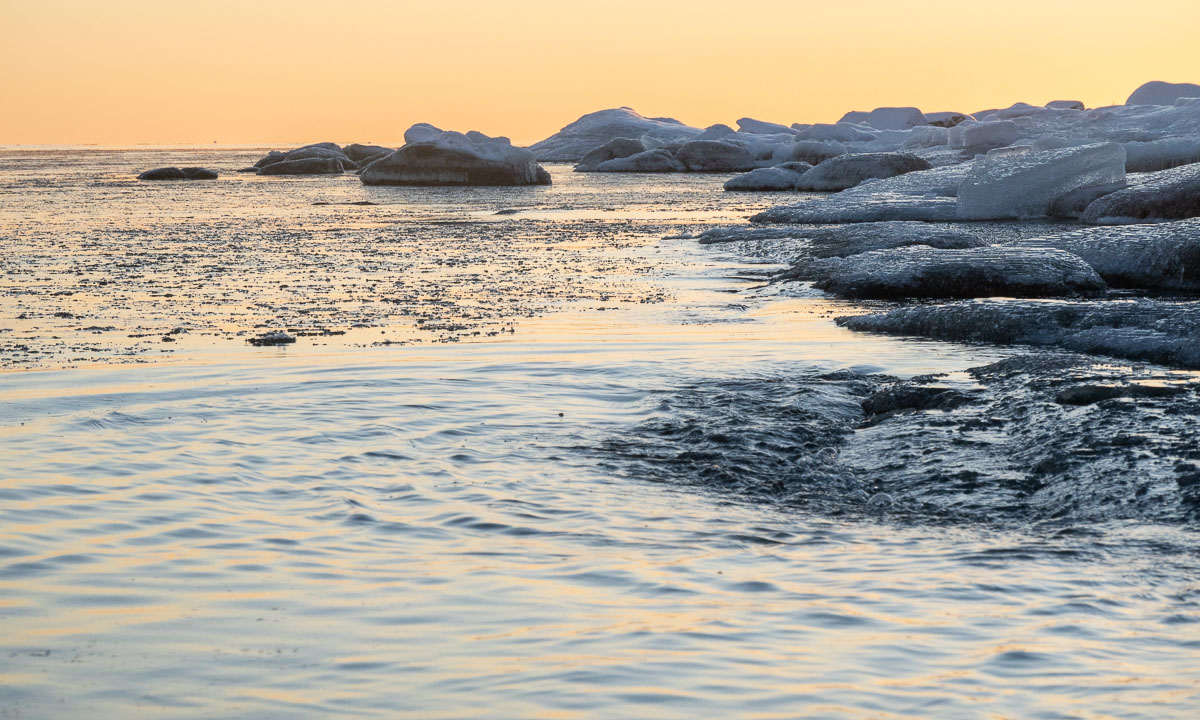
When I passed Lillskär I bent right to the mainland. There were some ice-coated rocks and thicker ice floes there – an extremely beautiful view in the low sunlight. I just went straight ahead. The first ice floes were split by my kayak, on the thicker once I had to use my ice claws again to move forward.

Step 5 – back to land

I realised, that my tour has taken much longer than planned, although the distance was tiny. I was clad in my survival suit, the kayak was on the ice and in 20 minutes my video meeting would begin. I had to hurry up!

The ice near the mainland was too thick to paddle through, but too thin to walk on. So, ice claws again. Not easy, when you lack trained arm and abdominal muscles. When I approached another shallow, I just left the kayak, splashed a bit trough soft ice and knee deep water until I reached the bay again.

From there I could walk on the ice and drag my kayak behind until I reached our property. I went to the house and transformed from paddle guy to IT guy as fast as possible. I informed my boss and colleagues that I would by 5 minutes late. That gave my the chance to take a hot shower, because I was freezing.

Did I miss anything of the meeting? No, the others had to fix audio and that took longer than my shower.

After the meeting, round 12:15 I walked out again to make a photo of the cloud bank and the sea smoke in the low winter sun.

Tomorrow shall be another cold and sunny day. Let’s see how I’ll spend my work break …

Finally it’s sunny again home in Sweden!

After a period of dull and cloudy weather that felt like ages the sun finally came out yesterday. Since I was flexible with working hours in the  morning I could make a small kayak tour.

The first part was easy. Since our house in Obbola is on the coast I only had to change my clothes and drag the kayak from the house to the bay. The bay was covered with ice. As usual I just sat in my kayak and started pushing myself ahead using ice claws. This works surprisingly well until you have a lot of water on the ice as I had yesterday. Although I wore neoprene gloves I got cold fingers. As usual this took some time but finally I reached open water.

It was then that I realised that I had forgot my paddle. Fortunately the bay is shallow and I could leave the kayak, step on the ice and carefully walk back to land to fetch the paddle. Some minutes later I sat in my kayak again ready to circle the island Bredskär. I watched the hooting whooper swans and even four flying goldeneyes, a species of ducks. At the northwestern tip of the island there was a small, slushy ice field, the rest was open water. The big freezing hadn’t started yet. When I reached the eastern side of the island I could watch the sunrise some minutes after 9 o’clock.

The last part of the otherwise calm tour was surprisingly wavy. When one breaking wave came out of nothing and of course directly from the side I was afraid that I could capsize but the wave just lifted me gently up half a metre and down again. I was lucky. Sometimes it’s nice to own a less agile but super stable boat.

Even it was only some degrees minus the kayak was covered with a layer of frost that glittered in the warm light of the sun. I just had to take another photo when I was back on land.

And then? After taking a hot shower I made it to the 10 o’clock meeting. In time!

Jämtland tour 22 – the landscapes

This article is part of the series “2022-08: Jämtland and Trøndelag”.

I’m sitting in the train to Umeå. We have a longer stop in Kiruna where the train changes direction. The other trains standing here are cargo trains that transport iron ore from the mines around. Temperature is -10 °C or lower and there are some centimetres of snow covering the ground. Winter finally has arrived in the Swedish fjäll.

I’m so glad to arrive home in Obbola tonight. I haven’t been there since July. Now I’ll stay until Christmas working from home for the Norwegian Polar Institute.

I’ve been however in Sweden in August, too. Not home but for a hiking tour with my sister and family together with my wife Annika.

This reminds me that I almost forgot to publish the last blog article about our hiking trip in the Jämtland. It will take more than seven more hours until I arrive in Umeå, so there’s plenty of time to start blogging now, as long as the mobile net allows. Earlier I’ve written about the cabins, some day trips, the trail and way marks. Today I want to show some photos of the landscape. Let’s go back three months in time. It is late summer in Sweden.

What I love about the Swedish mountains – the fjäll – is its variety. Not only in weather but also in landscapes. In the lowlands there are forests – mostly birch forests – but all Swedish cabins we visited lie above the tree line and here you have a wide view of the mountains, small and large lakes, rivers and streams, bogs and stone deserts. Let’s have a look.

15 August, our first day. The landscape is rising and we have left the forest behind. The trail between Storlien and Blåhammaren leads over many swamps and bogs and is wet and muddy.

16 August. We leave Jämtland and cross the border to Norway. The cabin Storerikvollen lies quite low and we descend through forests of crooked birches.

18 August. Still in Norway we take a resting day at Nedalshytta. I talk a walk along the lake Nesjøen. The water level is extremely low and so I can cross some mud fields that normally are under water. This landscape looks a bit hostile and is not typical for this region.

19 August. Again the terrain is wet and has many small lakes and water puddles. The mountains are hidden behind low hanging clouds.

We start hiking up the Ekorrpasset. Looking back we witness one of the most unphotographable landscapes I know. In reality it is an impressive view of a hilly terrain with uncountable lakes, ponds, streams and puddles. The photos however always look pale, blurred and boring.

Let’s not look back but ahead. The peak of the pass is more than 1300 metres high. That may not be much in the alps, but in these latitudes only few plant can survive these altitudes and so we walk through a desert of stones and rocks. Hidden in between some moss and the flower Ranunculus glacialis.

And let’s look aside. We pass the mighty Sylarna massif (1574 m) with its glaciers and rugged rocks. Impressive.

The Sylarna cabins lie lower. Grass and heather cover the ground presenting the landscape much more mellow, especially in the soft colours of dusk.

20 August. We leave Sylarna and continue to Gåsen. For that we have to hike through the valley of the river Handölan. Here we meet birch forests again. And some quite impressive rapids.

22 August. After a resting day in Gåsen we continue to Helags. The landscape is wide and broad. And where it is not too wet there are surely some reindeer around.

24 August. We are on our way to Fältjägaren, the last cabin of our tour. The weather is sunny and we are accompanied by the mountain Predikstolen (the pulpit) which shows itself from some of its many beautiful sides.

In the evening we stand outside watching the sunset and the incoming night. Soon the lakes are the only part of the landscapes visible. The rest is almost black.

25 August. Our last hiking day. On the other side of the valley we can see the gaps in the forests covering the mountain slopes. These are the ski slopes of Ramundberget where we’ll take the bus to Östersund. Back to civilisation.

And back to the present. I’m still sitting in the train. Where am I? Ah – half an hour left to Gällivare. Now I’m longing for a cold and snowy winter. But then I want to change ski boots with rubber boots and go for a hike again.

10 days in Scotland

This article is part of the series “2022-10: Autumn in Scotland”.

It has been years, since Annika and I were on holiday outside of Fennoscandia. This October we enjoyed a ten day journey to Scotland from which I just arrived in Tromsø yesterday.

For this article I chose 2 photos for each day. Some more articles will follow later.

6 October – Edinburgh

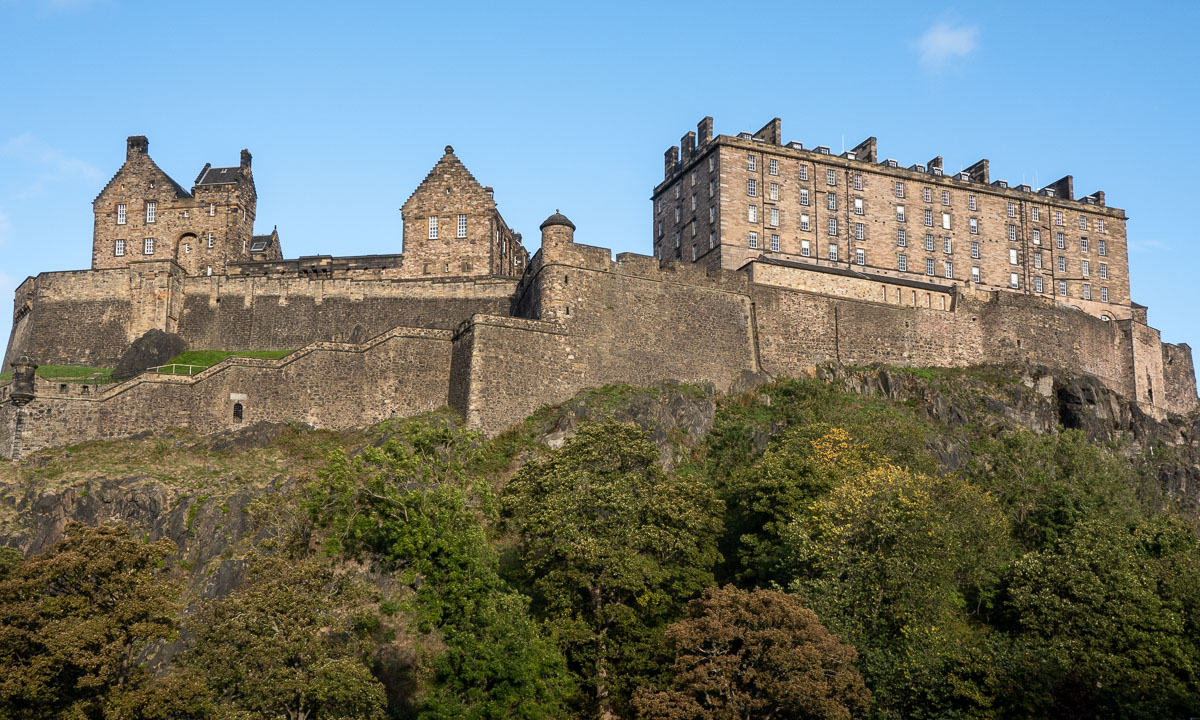
I landed in the late morning and have the rest of the day strolling through Edinburgh. Blue sky – so it can actual stop raining in  Edinburgh ;-). In the evening I wait for Annika who is taking the tram from the airport. Now it is raining. Finally we are together.

7 October – travelling to Ullapool

We have pre-booked train tickets to Inverness where we will spend three hours before taking the coach to Ullapool. Well, in theory. The trains do not go the whole way due to heavy rain flooding. The rest is operated by replacement buses. So much to rain in Scotland. In Inverness we catch the connecting coach to Ullapool and have even time for a pizza.

8 October – hiking in Ullapool

After two travel days we want to be outdoors and look for the hiking trail to the hill Meall Mor after a hand-drawn sketch. We find it. From the top we have a view to the town, the hills and mountains in sun, clouds and rain.

9 October – taking the ferry to Lewis

After breakfast we take our backpacks through rain and heavy winds to the ferry terminal just to learn that the ferry has been cancelled because of the gusts on the Minch – the straight between Ullapool and the Isle of Lewis. Luckily the afternoon ferry runs according schedule and we arrive in Stornoway at nine o’clock. Scotland premiere: We hire a car. Annika is driving. Left-hand traffic in darkness!

10 October – exploring Lewis

We explore Lewis by car. Great that Annika is brave enough to drive in Scotland (I’m not). Read the article The west coast of Isle of Lewis about this day.

11 October – Peat bogs and Northern Gannets

From Gearrannan Village we take a small way back to Stornoway. In the bogs you can see traces of peat mining. We give back the car, take the ferry back and are watching the elegant aerial manoeuvres of the Northern Gannets. In Ullapool we receive another car that we have hired for the next two days.

12 October – exploring Assynt

We start exploring Assynt, the region north of Ullapool. Read the article Stac Pollaidh about this day.

13 October – taking a bath

Finally – our first bath! At Achmelvich beach. I will write more about this day later …

14 October – travelling to Edinburgh

It is time to give back the rental car and travel back to Edinburgh. First by coach, then by train. This travel confirms my theory that Scottish coaches and trains are designed solely for transport, not for comfort.

15 October – flying back

Short ones, long ones – all holidays comes to their end. Annika takes me to the tram, again it’s me travelling first. What a wonderful holiday. Thank you, Annika!

Thursday paddling – 1 september

It was five weeks ago that I joined the Thursday paddling of my kayak club in Tromsø last time. That time we were only three paddlers, today we were 19. Could be the weather ;-)

One group of eight returned after a while, we others continued to the beach at Telegrafbukta where we took a longer break. While we had the wind in our backs on the way there, the wind already started to die down on our way back. Good luck! It was beginning to get dark, but many paddlers were prepared and had lights on their kayaks and themselves to be seen.

Some photos from today:

Takk for turen!

Mountains, sea and midnight sun

Yesterday at 18:00 I took the car to Elvenes on Kvaløya to start a small mountain tour. Well, mountain or hill – the summit of Grønnlibruna is only 401 metres above sea level. I chose this destination in the hope that it was not completely snowed over as the higher mountains still are.

I parked the car, walked the gravel path and stood before the first obstacle, the stream Finnelva. I did the same tour last November, where it was easy to cross. Now in the thawing period the water was at least 50 cm deep and quite fast . Too deep to cross here, even with rubber boots. Luckily I found a better place to ford a bit upstream. Soon I was in the forest. A very wet and muddy forest where I was not always sure whether I followed the way, crossed a swamp or waded in a brook. But this stopped when I gained a bit of altitude where old snow covered the forest floor.

As soon as was above the tree line the landscape changed again. There were some large snow fields but most of the ground was bare of snow and easy to walk on.

After 4 km of hike and some hundred metres in altitude I stood on the summit enjoying the circular view while the weather cleared up more and more.

I did not take a break but hiked down again. I enjoyed the weather and the fact that the birch trees start to turn green, at least in the lowlands. I crossed Finnelva a second time, now with a sturdy stick that I had found on my way. It’s much easier to keep balance with such a “third leg”. From there it was not far to my parked car that I reached round 21:30.

When I left the supermarket in Eidkjosen it was 22:00 and the sky was blue. It won’t get dark because the last sunset in Tromsø was more than a week ago. Since then we have polar days with 24 hours of daylight. I could drive home or …

I turned left. Left to the road 862 that leads to Sommarøya. Maybe I catch the midnight sun. Sometimes I had to drive slow because of the reindeers, sometimes I had to stop to take a photo …

… but round 23:00 I had crossed the bridge to the island Sommarøya and shortly after I parked at the sandy beach Steinsvika. I was not alone. People stood at the beaches, some lit a fire, some paddled kayak, some camped in the hills.

I checked an app when sun would be lowest. What? 0:45!? I forgot, that we had daylight saving time, so clocks were one hour ahead. I took my camera bag, some water and an old jacket, that I use to have in the car and walked to the northern tip of Kvalneset. Now I had a lot of time to just observe the sun hardly going down. After one and a half hour it was time: 0:45 – the sun was at its lowest position: 1.55°. The photo is completely unspectacular because it only shows a low sun, not the fact that the sun would not get lower than that this night.

I was glad about my jacket because it got a bit colder, I was tired and I sat there for almost two hours in total. At least I had chocolate! I waited for the sun to disappear behind the prominent silhouette of the island Håja.

Then I went back to the car and had about an hour drive back home. I wasn’t in bed before 3:30 but it was completely worth it. For a very good reason: I never ever saw the midnight sun in my life before! Although I have lived in Northern Scandinavia for more than 12 years I hardly was above the arctic circle in summer and then it was cloudy.

But it was more than just checking another item of my bucket list. It was just gorgeous to sit there and enjoy nature. I should do that more often and put the old sleeping bag back into my car. Just in case …

Polar expedition AeN JC3 – day 17 and 18: An incredibly beautiful day on the ice

This article is part of the series “2022-02: Winter cruise KPH”.

Day 17 and a bit of 18 · 7 and 8 March 2022

7 March

We have arrived at a place somewhere between Svalbard’s second largest island Nordaustlandet (14.443 km²) and the easternmost island Kvitøya (682 km²). No one lives permanently on these islands.

The ice experts have found an ice flow and examined it. The ice near the ship has some holes so the dress code is survival suits for the first time. In opposite to the formerly used Regatta suits they have attached boots and neoprene arm and neck cuffs. They shall keep you warm and dry in case you fall into cold water – or in our case break through the ice.

I am very interested to join and observe ice coring, a missing link on this expedition. I wasamhowever quite doubtful whether I will be allowed to enter the unreliable ice on this station. But I am lucky again, I may follow M. and L. onto the ice.

Earlier I was told that I may join the scientists taking ice cores but won’t get the opportunity to take ice cores by myself. That’s understandable. To my huge surprise – and delight! – plans were changed: L. shows me how to do it once and then it’s up to me to take five more ice cores. Give me snow or ice and something to play with and I’m happy ;-).

No, I’m no experiences ice corer after five cores. But at least I get an idea and a bit of a routine. In measuring snow depths, ice depths, the freeboard and writing down the values with a pencil. In mounting the large ice core attachment onto the electric drill and removing it after coring. In putting the ice core onto the gutter-shaped cutting board without flooding the electric drill or touching the snow (happened once – sorry!). While M. is cutting the core into slices and putting them into wide-necked plastic bottles I continue with my work. And I have to continue, because I’m still slow and M. shall not wait too long. I think, I could do that for weeks. Standing on the ice and drill cores out of the sea ice.

I have asked Pernille to take some photos from me while coring. These are probably the only photos that prove that I actually did something on the expedition beside of taking photos.

Photo credit: Pernille Amdahl, Nansen Legacy –tusen takk!

And the afternoon? I am allowed just to go onto the ice once more as long as I find some team lead to join. I find one and so get my 7th opportunity on this cruise. Two and a half more hours on the ice. I overhear a radio message. No polar bear warning but the information that our ice flow drifts with more than 2 km/h and the water depth is decreasing. This could damage instruments when they are too deep in the water.

Just some more photos:

And later, when we are on the ship again another polar bear approaches. This time it is a curious one that is very interested in the scientist’s equipment. And since it could harm the bear when it eats cables or plastic it is shooed away with a flare gun. **BANG**. It gallops some metres and then walks away. No polar bears were harmed and as far as I know no cables.

By the way – it was a good decision to use the survival suits. One of the scientists went through the ice today. All of a sudden and quite near the ship. It did not take long to pull the scientist out of the water but without the survival suit this would have been a very wet, cold and unpleasant experience.

8 March

The next day some additional measurements are done on the ice and then we leave last ice station of Arven etter Nansen JC3.

Ha det bra, Arctic sea ice. Farewell! It was a great pleasure to meet you and I definitely will miss you!

Polar expedition AeN JC3 – day 14 – 17: Travelling south

This article is part of the series “2022-02: Winter cruise KPH”.

Day 14 – 17 · 4 – 7 March 2022

4 March: after our second polar bear encounter we leave the ice station P7 at the 82th degree of latitude behind and slowly head south.

This journey will take more than two days although its only 250 km to sail. That’s because many scientific activities go on. Not from the ice but from the ship. Just an excerpt from the activity log:

  • CTD with water sample (19×)
  • Box core (4×)
  • Håv-trekk stasjon (2×)
  • Multinet (2×)

I help the benthos people in the lab and learn a lot, I discuss data matters with scientists, I edit photos. At the same time the character of this polar expedition has started to become a bit more leisure-like. A “no-talent show” is organised as well as a table tennis tournament. A quiz evening takes place and J. shows some of his favourite movies. And from time to time I stand on the helicopter deck and take new photos.

7 March: In the morning we arrive at a place between Svalbard’s second largest island Nordaustlandet and the island Kvitøya, that we already passed a week ago. Here we will have a last 24-hour ice station with the adhoc name SIce Kvitøyrenna.


Polar expedition AeN JC3 – day 12: ice station on the Arctic Ocean

This article is part of the series “2022-02: Winter cruise KPH”.

Day 12 · 2 March 2022

Yesterday we arrived at P7, the northernmost transect station on this cruise. Here, a bit north of the 82th degree of latitude and round about 3400 metres above the seabed of the Arctic Ocean we will start our second ice station today.

The morning I start with two polar bear watches. It snows and the visibility is not the best but still good enough to watch out for polar bears.

This is my workplace for 2×1 hour this morning:

And this is the workspace for some of the scientists:

After lunch I get another opportunity to join researchers on the sea ice.

I join Z. again and help her erecting the tent over the already existing ice hole. Then A. uses the hole – now in the tent – to test his ROV (short for remotely operated underwater vehicle). After that Z. continues with MMS measurements. I want to help her but J. who joined our team as well will do that. Z. says that I shall take photos, she never has time for that. Well, when I get a carte blanche to take pictures I use it!

Taking photos in the tent however is not easy. It is quite dark and there is a lot of moisture that my Nikon does not like at all. But here it’s not the technical quality but the motives that matter. (Says Olaf, the perfectionist who is still angry with himself that he did not made bigger efforts to get better photos.)

K., our polar bear guide looks quite impressive standing upright on the nearby ice ridge in front of a purple sky. And the sky is purple. In the Arctic winter it is the sun that colorises the landscape and blends purple and orange of clouds and sky with blue and turquoise of the ice to always new colour palettes.

K. gives my clearance to walk around a bit. To the ice ridge and 30 metres on the snowmobile track to the ship. I enjoy my gained freedom and take some photos of the ship, the sun, the ice, of K. driving snowmobile. And it is such a beautiful day!

More than two hours I am on the ice before we return to the ship. But before that I have to bore you with another selfie ;-)

This selfie is for you, my friend Chris. It was Chris that surprised Annika and me with a generous gift a few years ago: A balaclava for each of us knitted by her. One of these balaclavas now has been in the high Arctic. It is one of the garments I definitely will pick again when I should have another opportunity to travel way up north! Thank you, Chris!

Will I be on the sea ice the next day again? Yes, but first there’s another story to tell. Bear that in mind ;-)

Polar expedition AeN JC3 – day 6: sailing through the ice

This article is part of the series “2022-02: Winter cruise KPH”.

Day 6 · 24 February 2022

We are on our way to P4, our first ice station. P4 lies at 79.75 °N 34.00 °N, round 50 km southeast of the island Kvitøya (white island) that belongs to the Svalbard archipelago. This station is more north than Ny-Ålesund on Svalbard. The estimated time of arrival is tomorrow round lunch time.

However it is not granted that the ice will be safe enough to work on. In addition to that it will become stormy tonight and maybe the whole next day according to windy.com . So even when the ice is safe the weather conditions could be too harsh. So there are several uncertainties. We plan for the station but more we cannot do yet.

Today is a cold day with temperatures maximum of -25.0 °C and minimum of -30.5 °C. I’ve experienced colder temperatures many times in my live in different parts of Lapland, but then the wind was always calm. With the ongoing wind the resulting windchill lies between -36 °C and -49 °C. And windy is right: it starts getting windier in the evening.

temperate in °C | wind speed relative to the ship in m/s | resulting windchill in °C.

I take photos of marine animals, I learn the basics of ice observation but I stand outside quite often today. Watching the icebreaking polar research vessel Kronprins Haakon breaking through the ice. It is a great experience and I’m happy that I may participate.

But now, let the photos speak. The first I made at 3:50 in the night, the last ones at 19:10.