Polar expedition AeN JC3 – day 3 and 4: transit to P1

This article is part of the series “2022-02: Winter cruise KPH”.

Day 3 and 4 · 21 – 22 February 2022

Monday, 21 February

Yesterday afternoon we left Tromsø behind for the transit to P1. The program Arven etter Nansen has seven so called process study stations called P1 to P7. P1 is the southernmost station with the approx. coordinates 76° N 31°13′ E. That’s almost five degree more north then I’ve ever been in my live. And it is planned to reach P7 at 82° N later on this cruise. Will we make it?

ETA (estimated time of arrival) is set to tomorrow 8:00. So today is travel day.

After I woke up I take a short lookout on the helicopter deck before breakfast. This starts to be a personal tradition on this cruise. With -11 °C it is colder than the days before but wind is calm and the temperature feels still very moderate.

I expected that we had left the mainland far behind and would cruise through open sea. To my surprise I can see mountains and lights. Where are we!?

Internet reveals that we are just passing the island Melkøya near Hammerfest. Melkøya is illuminated by the lights of the processing plant Hammerfest LNG. Interesting!

After a rich breakfast I stand on the same deck again. Today I feel more like a cruise tourist then a data manager on a work trip. Even the photos look like beautiful but quite random pictures taken from a Hurtigruten ship.

And indeed the icebreaker Kronprins Haakon follows the very same route as the Hurtigruten ships. Aside from that we do not call any ports. (Spoiler: next port is Longyearbyen on Svalbard 18 days from now.)

What do you do on a transit day on sea? Participating the mandatory sea ice training for example. It’s from 9:00 to 14:00 with a lunch break and we are told a lot about the different risks we might be confronted with on this cruise.

What I know is cold weather. Hypothermia, frost bite. I tented at -35 °C, I skied in blizzard-like conditions. I guess I have a bit of experience.

What I hardly know is arctic sea ice. I’ve been on the ice of the northern Baltic Sea countless times, but that water has only the tenth of the salinity compared to the water of the Barents Sea. The sea ice is softer and the conditions are quite different.

I  definitely know nothing about polar bears and a lot of the training is learning the procedures to avoid contacts.  I’ll talk more about this in another blog article.

At 13:30 we meet at the quarterdeck and train the handling of throw bags. Inside the bag there is a rope attached to a hip belt. When someone breaks through the ice the rescuer can throw this bag. The person to be rescued catches the rope and can be pulled back to safety. By having a long rope it is possible to keep distance. This minimises the risk that the rescuer breaks through as well. I know this from kayak courses but I’m glad to give it some tries again. Yes, it’s me on the next photo.

Photo: Adam Steer, Norwegian Polar Institute

At 16:00 I go on deck 3 again. It has got dark and started snowing.

Later that day the arrival time for P1 has been postponed to 19:00, eleven hours later than the ETA before. So much to the letter E in ETA ;-) It is almost impossible to plan with conditions as unsure as in the Arctic.

Tuesday, 22 February

My sis has birthday today. Hooray! Will we still have internet that I can wish her a Happy Birthday? Don’t ask me why, but we have internet in this remote place and I can send her a message.

Again I am on the helicopter deck before breakfast. Three differences to the day before: The deck is covered with snow, it is slightly warmer and no land is in sight. Finally we have left mainland Norway behind. And more and more I’m able to realise that I am really on a scientific polar expedition!

Still it will take another 11½ hours until we reach P1. I use the time to finally start working. My goal on this cruise is to understand the flow of scientific data. Where do the unique IDs come from? Where location and time? How are physical samples tied to the digital data? And can I improve these processes? I ask many stupid question to scientists to get a basic understanding.

And since I cannot ask questions for 11½ hours – I don’t want to be thrown overboard by my “victims” – I use more time to stand outside and take pictures.

Dinner 17:30. I forgot what I ate but it was delicious! For sure, because every single meal has been delicious on Kronprins Haakon.

But after dinner it is time to recover a glider. This is the first scientific activity on this cruise. Finally!


Oh, what a beautiful sunrise!

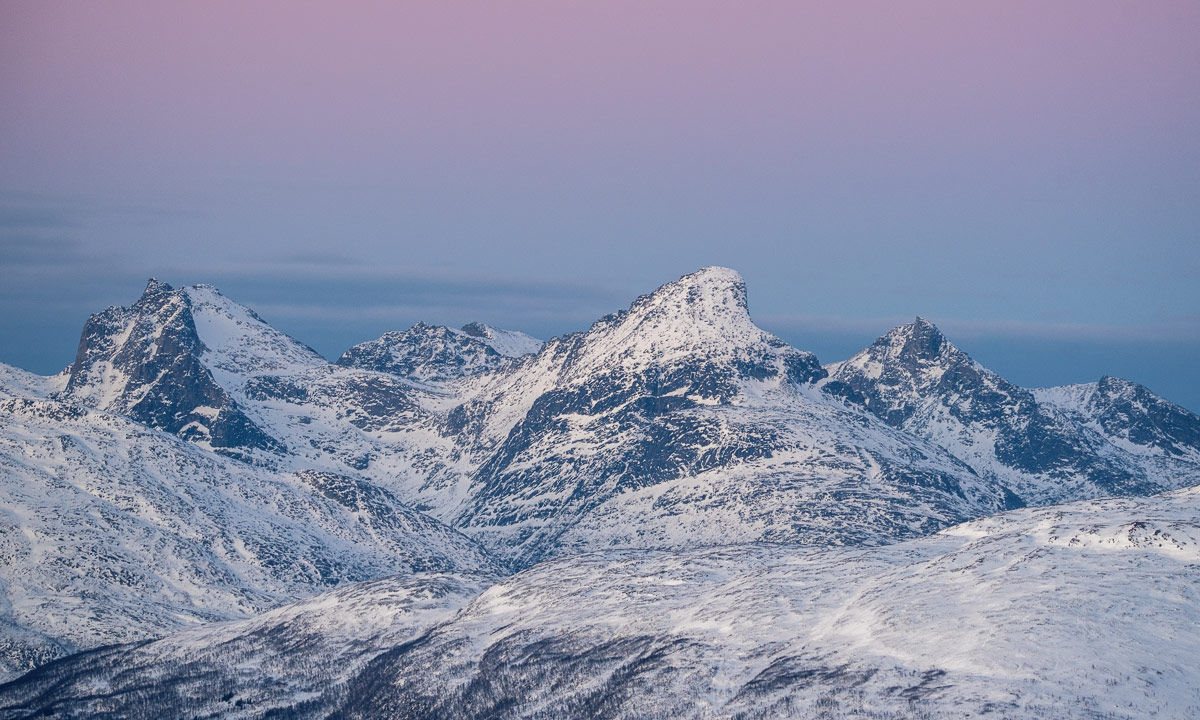
Mountains on Kvaløya photographed from Sydspissen, Tromsøya.

While the first images are made with a strong (though non-professional) telephoto lens (500–600 mm, ƒ/6.3), this gives a bit more impression of the mountains this morning:

The ice did not last long

The morning of 10 January is my the coldest this winter: -20.5 °C. A longer period of frost has frozen over the Baltic Sea earlier than usual. I stand at the shore by our house. Ice as long as I can see.

I follow the coastal line to take photos. Ice fog draws in.

When I return from my pre-work photo trip the temperature has risen to -15 °C and it gets warmer hour by hour. In the evening it’s only -3 °C and it has become stormy.

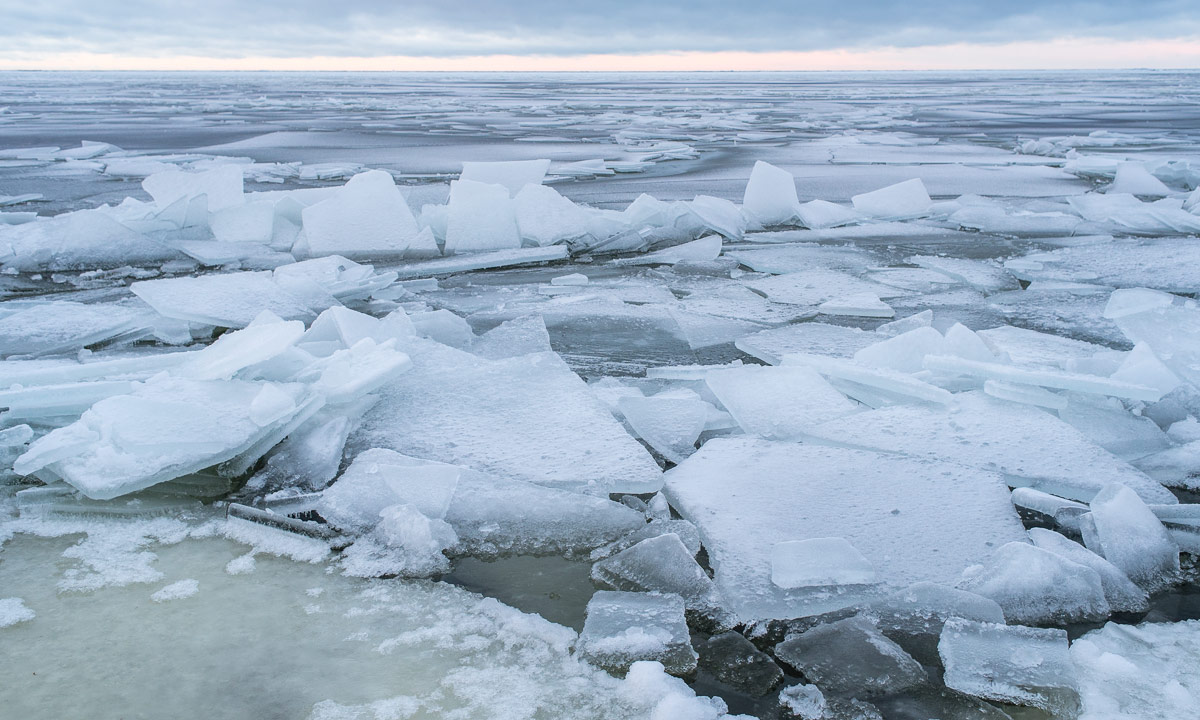
Two days later I’m out again. It thaws. The effects of the storm are visible: The wind pushed the ice shield ashore where the ice broke into countless pieces.

Movements at the horizon. Large waves roll along the sea and build an ice wall by the rocks south from the island Bredskärssten, 1300 metres from our house. I would love to take photos there but there’s no way for me to get there. It’s too windy for a hovercraft and I don’t own one. So I take mobile phone photos through my spotting scope.

The next day. Similar situation but now with the sun illuminating the splash that the waves throw at the ice walls. The thaw has melted the snow on the ice and made it wet. It twinkles and glistens in the sun. Beautiful to watch.

In the night it is stormy und gusty again.

14 January – the next day. As every day it is too dark in the morning to spot the sea. A small line of red at the horizon signalises the approaching sun. And there it is: 09:03 – sunrise.

Now I can see that beside of some leftovers by the shore all the sea ice has gone. Crushed by the waves and the storm and floated away. Now there’s open water from shore to horizon. Probably it will take some time until the Baltic Sea freezes over again.

And what can you do in open water? Correct – you can kayak!

It was just a very small tour round Lillskär. First it was just a lunch break again and then it was still very windy. Wind came from west and I didn’t want to drift to Finland ;-)

Kayaking however wasn’t dangerous. It’s easy to paddle against the wind – easier than side winds – if the distance is not too big. Probably more dangerous is the large, wet patch of blank ice in front of our house. Slippery as hell! Hopefully it gets colder and snowier soon.

Link to a Swedish article of the SMHI: Bottenviken snabbt avtäckt igen.

Four winter days in and round Obbola

OK guys, it’s Sunday afternoon and I’m too lazy to write long texts. I just show some photos of the last days where our German friend Medi joined Annika and me on various excursions with some notes.

Thursday, 6 January – skiing in Västermarks naturreservat

+++ Västermarks naturreservat, 50 km north from Umeå +++ a non-commercial forest made us climb over and under fallen trees that lay across the marked loop trail +++ by the trail a wooden cabin +++ time was too short to fire the oven but lighting candles is cozy, too +++

Friday, 7. January – lunch break skiing

+++ right next to our postbox (500 metres from our house) starts Spåret, a 3600 metre long forest trail +++ we use back-country skis to ski Spåret in my prolonged lunch break +++ we, that’s Dirk – guest for two nights – Medi and I +++ -12 °C, but my Anorak is too warm +++ I tie it round my hip +++ on the photo it looks like a skirt +++

Photo: Dirk Thomas

Me sking “Spåret” – Photo: Dirk Thomas

Saturday, 8 January — cross-country skiing on Olle’s Spår

+++ grey weather, -14 °C +++ the trees are covered with snow +++ black-and-white imagery +++ after some days of back-country skiing it’s nice to use cross-country skis on a real trail +++

Sunday, 9 January – Northern lights and sunrise

+++ 1 o’clock in the night +++ I check for Northern lights +++ we are lucky +++ Medi and Annika watch the aurora beside of the garage +++ I take some photos from our garden +++
+++ 8:20 in the morning +++ the Baltic Sea freezes over more and more +++ sunrise colours by the sea  +++ and then in our garden +++ watching sunrise while taking breakfast +++

Still Sunday, 9 January – Strömbäck-Kont

+++ just a short walk at one of Annika’s and my favourite places: Strömbäck-Kont +++ looking at the ice ridge by the sea +++

Still Sunday, 9 January – halo effects

+++ after lunch we are taking Medi to the airport +++ strong and colourful parhelion or sun dogs halos +++ the photo is taken at the airport +++ I am questioned by the security and show the taken photos to prove I’m not a spy +++

Sun salutation

While the polar night in Tromsø started in the end of November and continues for two more weeks there is no polar light home in Obbola which is 6 degrees south of Tromsø. So if there is clear sky, then there is sun.

After Christmas in Norway Annika and I arrived in Obbola some days ago. First the weather was cloudy and stormy but today  sky was quite clear. Therefore I could witness the sun today for the first time in more than a month. I only had to go 200 metres to the edge of our little bay Grundviken where I waited for the sunrise.

I love sunrises and sometimes I can stand up quite early to witness it. But today it was really special to watch the sun rise higher and higher up the sky while in Tromsø polar night still continues.

After breakfast we took the car to Byviken in Obbola to join the winter bath. Round 40 cars were parked there and a queue of winter bathers waited at the ice hole. Winter bathing has really become a popular sport within the last years. We decided to avoid the queue and continued to our favourite beach at Vitskärsudden where we had to climb over a wall of ice but then we were the only winter bathers. Air: -10 °C, no wind – perfect conditions. Great!

(Photos: Annika Kramer)

We may take another outdoor bath today, but then in the hot water of our friend’s hot tub. I guess this bath could take slightly longer than the previous one.

Fjellheisen and Fløya

Today I was too lazy to hike up a mountain. So I packed warm clothes and camera equipment and the car to the mainland. There I took the cable car Fjellheisen. From the mountain station I walked up the nearest top Fløya. Not a lot of snow there but the temperature of -12 °C (and of course the wind) made it feel quite wintry.

Some photos:

From autumn to winter – a tour to the Litjeblåmannen

This article is part of the series “2021-07: Back in Tromsø”.

My first concert with the chamber choir Ultima Thule was supposed to be today but due to the increasing COVID-19 cases in Tromsø the board decided to cancel the concert. That’s a pity but gave me a free day and the opportunity to continue with my #onceaweek project. I decided for a tour to the Litjeblåmannen (860 metres above sea level).

At 8:40 I have parked my car and start the tour. Temperature is -5 °C. Brr! I regret that I left my long johns home. That changes quickly when I take the first steep climb up the forest path and start to sweat. All trees have shed their leaves and are bare.

At 8:40 is sunrise. Half an hour later I can see the sun rise above the mountains. Ten minutes later I have left the birches behind and the landscape opens. I am gaining altitude and soon the path starts to cross the first snow fields.

Ten other minutes later snow and rocks start to dominate the landscape. It looks like winter. The autumn is left behind in the valley. I see a radio mast, part of the radio station on the Rundfjellet (472 m). Well, that was easy.

I decide to continue the tour. But where? The tour description mentions that I have to go down 50 metres. I hardly see any waymarks or a track but soon some foot steps that I follow. According to map and compass it’s the right direction. The terrain gets rockier, steeper and is partly icy but at least I spot some waymarks again. I stop to strap my spikes under the boots. Safety first! Less than an hour later I pass another radio station. I do not look closer because the terrain behind the building is very steep.

The terrain continues being steep and rocky but after a while I reach a plateau. Now it’s winter. Beside of some tufts of grass covered with frost there’s only snow and rocks.

From now on it’s much simpler to walk on this snow covered plateau and soon I reach the mountain summit Botnfjellet (844 m).

That’s however not my destination. Well, the summit of Litjeblåmannen looks far away but it takes only 20 more minutes to go there.

Break! Summit selfie!

The fur hood is not only for looking wintry on the selfie. It was colder than expected and after the selfies I put on my down pullover. Checking the temperature at Tromsø airport and subtracting 0.6 °C per 100 metres altitude I guess that the temperature is round -7 °C. The wind makes my mind change about wearing long johns a second time.

I eat a bit of chocolate and drink some Sprite before the frost transformed it into slush. I’m completely alone and I haven’t met anyone yet. It’s just beautiful up here with views on snowy mountain chains everywhere but on the snowless lowlands and the fjords as well.

After 20 minutes break I start my way down. First I follow my own tracks until I met the first mountain hiker today. Now I follow her steps. Does she know a better way?

Some impressions from the way down:

While I descend more and more the sun starts to set. I hike cross-country. Less and less snow covers the ground until I reach a terrain consisting of terraces of wetlands and dense birch thickets. The wetlands are easy to cross, since the ground is mostly frozen and I have rubber boots. The birch thickets however take some time to squeeze through. Looking back I can see purple clouds indicating that the sun already has set.

At 14:40 I arrive at the car. -4 °C. According to my app I walked 15 km and 1120 metres in altitude. I started before sunrise and arrived after sunset. This gives me the right to be very lazy the rest of the day. The blog article I want to write anyhow.

I met three persons in total:

  • A woman in my age in clothes that probably have been used on countless tours for many years,
  • A young woman in a grey woollen sweater hiking up quite fast while talking loudly on her cell phone.
  • A packed sleeping bag on a stone in the wetlands. A sleeping bag with a book. Wait! No, it’s a hood with a book. Wait! No, it’s a person leaning against a large rock reading. In the middle of some wet slope on the island Kvaløya. People here really like being outdoors.

So much for today. And now I have to stretch!

Appendix:

I just went to the kitchen and felt, that the outside light had changed. It had! It had snowed some centimetres and is still snowing. Everything is white. Beautiful!

Winter weekend in Kusfors

Annika and I used the weekend to visit good friends in Kusfors. While it was still autumn home in Obbola by the sea, the inland experienced an onset of winter with 20 cm of snow and frost below  -10°C. And so did we in Kusfors.

There’s a reason why it’s a good idea to change to winter tyres already in October.

Morning paddling in Obbola

I’m home in Obbola – 6:20 – it’s still quite dark.

The sky is clear – hardly any wind – frost at -4.5 °C. – my kayak lies at the shore.

A good opportunity to do some pre-work kayaking and watch the sunrise at sea.


The last cold morning?

A clear blue sky, -20 °C – this may be the last cold morning here in Obbola. I was up early and went to the coast to catch the sunrise. The sea, where I paddled yesterday afternoon was completely frozen over again. Patches of ice fog drifted by – a clear sign that other parts of the sea are open (and that it’s cold). The fog partly hid the island Bredskärssten.

When did you watch your last sunrise? Do it again! It’s always fascinating to see the sky and the clouds change colours– from soft pink to deep purple, from crimson red to bright orange. The sunrise position has moved more and more westwards. Now it’s behind the larger island Bredskär. The sun illuminated the drifting fog in spots of orange.

Now in mid-March the sun rises much faster than in midwinter and soon the colours went pale. Time to go back and to warm up. The parka and mittens kept me warm, but the ski pants were a bit too thin when sitting on the ice.