17 May aboard the ship Hermes II

Today it is 17 May, the Norwegian National Day. People say “Gratulerer med dagen!” (Happy Birthday!) to each other to celebrate Norway’s Birthday in the year 1814. The rest of the history I won’t tell here, you can read it better in the net, for example on Wikipedia.

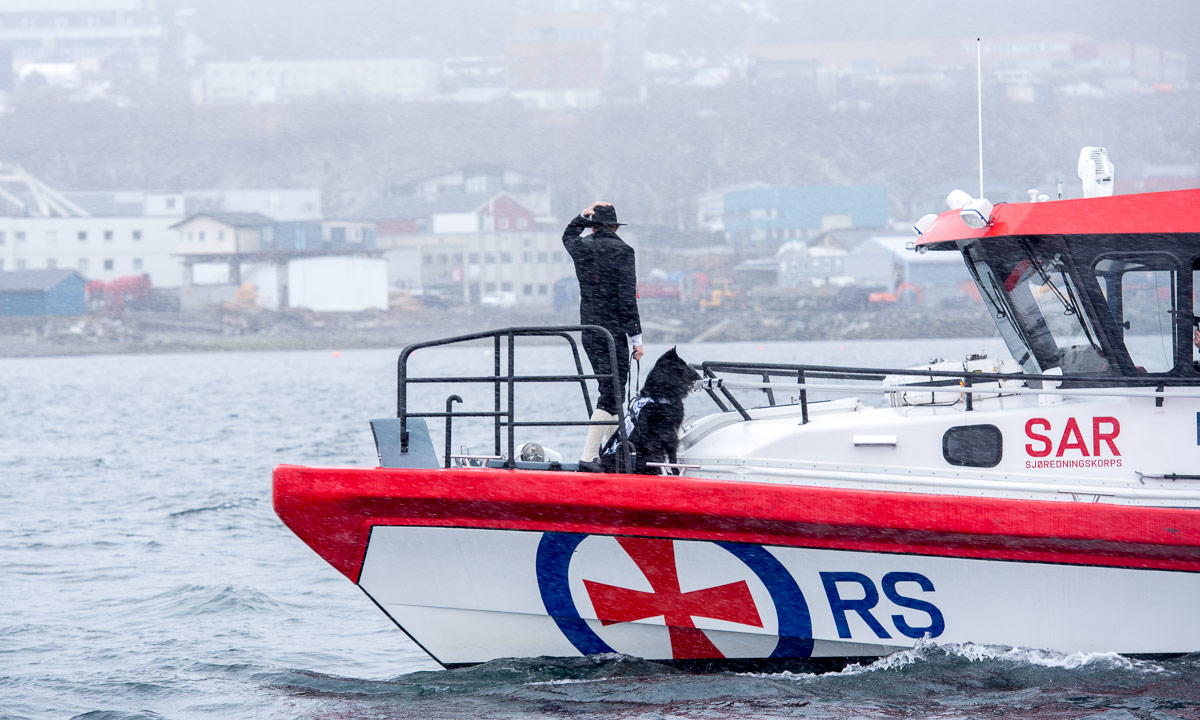
While I was in Sweden last year I am in Tromsø today and so I was able to join the celebrations. Last week I got an ad for joining the boat parade on the wooden boat Hermes II, build 1917. That sounded fun and I directly bought one of the extraordinary cheap tickets. Would be nice to be outside on the water this day. And so it was, even in snowfall and sleet and temperatures round 1–2 °C.

Hermes II lies in the very center of Tromsø. I’ve passed it many times, today I entered it at 10 o’clock. Slowly the boat filled up. Some women were clad in bunad. These traditional clothes are very beautiful but I doubt that they provide the best weather protection. Check the video linked below. Other people choose more pragmatic clothes to stay warm and dry. At 10:30 we departed, headed north and met other boats there. In a group of fifteen boats – Hermes II, some SAR boats, the rest private ones – we then headed back to the center. Nothing extreme, just a especially nice way to be outside.

Some photos from today:

Also on board was NRK, the Norwegian TV. I can recommend the video, even when you do not speak Norwegian.

Watch it here: 17. mai-feiring på båt i Tromsø (2:44, Norwegian).

Polar expedition AeN JC3 – day 12: ice station on the Arctic Ocean

This article is part of the series “2022-02: Winter cruise KPH”.

Day 12 · 2 March 2022

Yesterday we arrived at P7, the northernmost transect station on this cruise. Here, a bit north of the 82th degree of latitude and round about 3400 metres above the seabed of the Arctic Ocean we will start our second ice station today.

The morning I start with two polar bear watches. It snows and the visibility is not the best but still good enough to watch out for polar bears.

This is my workplace for 2×1 hour this morning:

And this is the workspace for some of the scientists:

After lunch I get another opportunity to join researchers on the sea ice.

I join Z. again and help her erecting the tent over the already existing ice hole. Then A. uses the hole – now in the tent – to test his ROV (short for remotely operated underwater vehicle). After that Z. continues with MMS measurements. I want to help her but J. who joined our team as well will do that. Z. says that I shall take photos, she never has time for that. Well, when I get a carte blanche to take pictures I use it!

Taking photos in the tent however is not easy. It is quite dark and there is a lot of moisture that my Nikon does not like at all. But here it’s not the technical quality but the motives that matter. (Says Olaf, the perfectionist who is still angry with himself that he did not made bigger efforts to get better photos.)

K., our polar bear guide looks quite impressive standing upright on the nearby ice ridge in front of a purple sky. And the sky is purple. In the Arctic winter it is the sun that colorises the landscape and blends purple and orange of clouds and sky with blue and turquoise of the ice to always new colour palettes.

K. gives my clearance to walk around a bit. To the ice ridge and 30 metres on the snowmobile track to the ship. I enjoy my gained freedom and take some photos of the ship, the sun, the ice, of K. driving snowmobile. And it is such a beautiful day!

More than two hours I am on the ice before we return to the ship. But before that I have to bore you with another selfie ;-)

This selfie is for you, my friend Chris. It was Chris that surprised Annika and me with a generous gift a few years ago: A balaclava for each of us knitted by her. One of these balaclavas now has been in the high Arctic. It is one of the garments I definitely will pick again when I should have another opportunity to travel way up north! Thank you, Chris!

Will I be on the sea ice the next day again? Yes, but first there’s another story to tell. Bear that in mind ;-)

Polar expedition AeN JC3 – day 1 and 2: Tromsø

This article is part of the series “2022-02: Winter cruise KPH”.

Day 1 and 2 · 19 – 20 February 2022

Oh, well – where to start? I’m still completely overwhelmed from the polar winter expedition Arven etter Nansen (The Nansen Legacy) with the icebreaking polar research vessel Kronprins Haakon that just ended three days ago.

Ok, perhaps it’s best to start with the beginning.

The beginning

It’s Saturday, 19 February 2022 early in the morning. I look at my baggage in my one-room flat. A huge suitcase, an even huger bag, my photo backpack and my bulky Canada Goose down parka plus winter boots.

Do I really have everything? Warm clothes? The helseerklæring – a medical certificate that proves me “seaworthy”? All camera equipment? All gloves and mittens? LAN-cable with adapter for Mac? My reading glasses? Passport? Woollen underpants? Balaclava?

I made a complete packing list, I packed twice(!) but still I’m a bit nervous. When I’m on the ship, it’s probably too late to organise left-behind things.

The taxi arrives at 8:15. It drives north to the harbour, opens the gate to the restricted area and continues directly to pier 25. I’m not alone. Other people that came by taxi or brought by private car and a lot of luggage are there, too. And there it is: Kronprins Haakon, my home for the next three weeks.

My cabin

I ascent the gangway – I have to go twice with all my luggage – and there is a reception. I tell my name and get my key card. I’m in cabin 385. I get a short description of where to find it. It is quite low on deck 3 and right in the front. These cabins are told to be the loudest when the ship starts breaking ice.

The cabin has a huge window. Wow! Behind the window: two bull eyes. As closed and locked as possible. So I won’t see anything from my cabin, but that’s ok. It’s pretty roomy with a desk, a small table, a small sofa and space to store your stuff. And a bathroom. I’ll share this cabin with P., a scientist.

Waiting

Next event: passport control through the police. Then: the first meeting. Here we learn, that departure is delayed, because a crane has to be fixed. Estimated time of departure: tomorrow after bunkering fuel.

While I can take it easy the scientists are busy. They don’t wear lab coats, they wear safety boots and helmets and use pallet jacks to put their equipment to the right places. And there is a lot equipment! Several containers full of it!

11:30 – lunch. Wow, the food is rich in variety and it tastes wonderful. I heard that many people gain weight on these cruises. Now I understand.

12:30 – group photo. That’s my job because I have all my camera equipment with me. Click. Click. Click.

13:00 – safety briefing. How to put on the survival suit in case of evacuation. I’m the guinea pig. And I hear a thing that photographers dream of: Almost every place on the ship is freely accessible. The quarterdeck at the ship’s stern, the helicopter deck at the ship’s bow, the bridge on level 8, the observation deck on level 9. Great! I use the spare time to stroll around a bit.

15:00 – safety training. We „muster“ which means we gather all in the mess – the same room where we eat – split into two groups and enter the life boats. These boats are equipped with everything you need to survive for some days but when you go to the toilet everyone can see it. Made for survival, not for comfort or privacy.

17:00 – dinner. 18:30 – a second meeting. 20:00 – the equipment of the polar institute is accessible: I fetch two pairs of boots and a floating overall size XL. A helmet I already have.

22:45 – bed time. First night on the ship. My bunk bed looks small but is comfortable and very cozy. Good night!

Day 2 – More waiting

I wake up. Do we move? I’m not sure. The internet reveals: we have moved and are now south of Tromsøya. Let’s go out onto the heli deck. Oh, what a beautiful morning!

The ships moves to the bunker station. There it will lie for many hours. Bunkering fuel takes time.

A lot of time. I help a bit here and there, but I cannot do so much. The scientists are extremely organised and mostly it’s faster for them when I do not try to help. At least I can carry some stuff around.

The departure is estimated for 16:00 but when we have dinner at 17:30 we still lay at the same place. I overhear that this delay is larger than usual. When will we start? Will this affect the planning? As most things on board I just don’t know. I’m the newbie.

The journey begins

17:54 – while I am eating my chilli con carne I feel a change in the ship. I look out of the window and almost shout out: „We are moving!“. Finally we are on our way!

After dinner I stand on the heli deck for a long time. I’m on the phone with Annika – maybe the last time for some weeks. I watch the ship going under the bridge Sandnessundbrua that connects Tromsøya and Kvaløya. I watch the Northern Lights. And I’m very happy. The journey begins!

Arctic research expedition with the Norwegian Polar Institute

This article is part of the series “2022-02: Winter cruise KPH”.

Kronprins Haakon is a Norwegian icebreaking polar research vessel. It was build 2018, can cut through one metre of solid ice, has 15 different laboratories on board and place for 35 scientists or other staff in addition to the crew.

Four days ago Kronprins Haakon had arrived in Tromsø. It was travelling 26 days since it left Cape Town, the only stopover on its return trip from Antarctica.

This morning I went on board of Kronsprins Haakon. Not as a visitor to look around but with a suitcase, an enormous bag full of warm clothes, a heavy camera backpack and my Canada Goose down parka. I will stay on board for three weeks to participate the winter cruise “Arven etter Nansen JC3” that will lead us to the Barents Sea east of Svalbard and a bit beyond.

What happened?

Some of you may know that I’ve been working as a data engineer at the Norwegian Polar Institute in Tromsø since autumn 2020. In this position I’m not only a software developer but a data manager of polar research data.

Three and a half weeks ago my colleague M. told me she would join the winter cruise and mentioned that there might still be an available place.

Of course I was very eager to participate. Beside of my private passion for the Arctic I wanted to get a deeper and hands-on understanding of the research data. Where does it come from? How is it measured? And how is it transferred to the digital world? And nothing would teach me better than joining this very winter cruise, where conditions could be quite rough.

I mentioned it to M., another colleague and he introduced me to the expedition leader. There I was told that there was indeed a vacancy on board and that I was welcome to join if my boss would agree.

Since then it had been crazy times with some organisation, a lot of worries and little sleep.

  • 1 Feb: My boss had to check the budget for my participation.
  • 4 Feb: A seafarer’s doctor examined me and gave me my helseerklæring – a medical certificate that proves me “seaworthy”.
  • 16 Feb: I had to take a PCR test and wait for the result for two days. Then I had to take another PCR test, but that’s a whole story in itself.
  • 18 Feb: I had to do a survival suit training in the Tromsøsundet.
  • 18 Feb: I had to pack clothes and equipment I will need on the cruise. Everything beside of two pairs of boots, a helmet, a floating suit and a survival suit. These are provided by the Norwegian Polar Institute.
  • 19 Feb (today): I took a taxi to the port of Tromsø. I was driven directly to Kai 25, took some photos and then went on board.
  • Still today: passport control through the police, a security briefing, lunch and dinner, carrying boxes to the labs, entering the rescue boat and some more …

The next weeks

When Kronprins Haakon will leave Tromsø tomorrow morning we will sail north. First destination is a point referred as P1. It is approx. 500 km east of Svalbard’s southern tip. From there we will continue heading north to the other stations, if weather and sea ice conditions allow it.

The northernmost position is planned to be approx. 82° N, somewhere in the Arctic Ocean. That’s more than 10 degrees of altitude further north than I’ve ever been and less than 900 km to the North Pole.

I’m so excited, that’s really way up north!

We will work both on the sea ice and on the ship using various measurement and sampling methods. Some of them I learned a bit last week but most of them I do not know yet. I’m a newbie. I’m here to learn. And hopefully I’ll learn a lot on this cruise.

After three weeks of tokt (Norwegian for “cruise”) we are supposed to arrive in Longyearbyen on 11 Mars. There I’ll take a flight back to Tromsø the same day.

I will not blog on this cruise because there will be a lot of work and hardly any reliable internet connection. But I’ll definitely take photos, both for the Norwegian Polar Institute and in private for this blog.

So, my dear readers, cross your fingers that I do not get seasick, we can reach our planned destinations and most of all that no one has Covid on board.

You can check the live position of the Kronprins Haakon on the map below. And you are welcome to leave a comment. See you again in mid-March when I’ll answer your comments and start posting articles.

23. Feb, 13:03: Just a short note: This map does not seem to work in polar regions. At time we have internet. Outside temperature -17.4 °C. Position round about 76°29′ N 31°11′ E.


Moving – Tromsø style

Today I move within Tromsø in a quite special way …

I moved long distances as from Munich to Skelleftehamn (2230 km) and shorter distances as from Essen Möserstraße to Droysenstraße (1 km). Now I have to move again.

My former landlord will sell the apartment where I lived when working in Tromsø. Therefore I had to find a new “work base camp”. And I found it, a flat of 30 m².

The first photo shows the old place, the second one the new place.

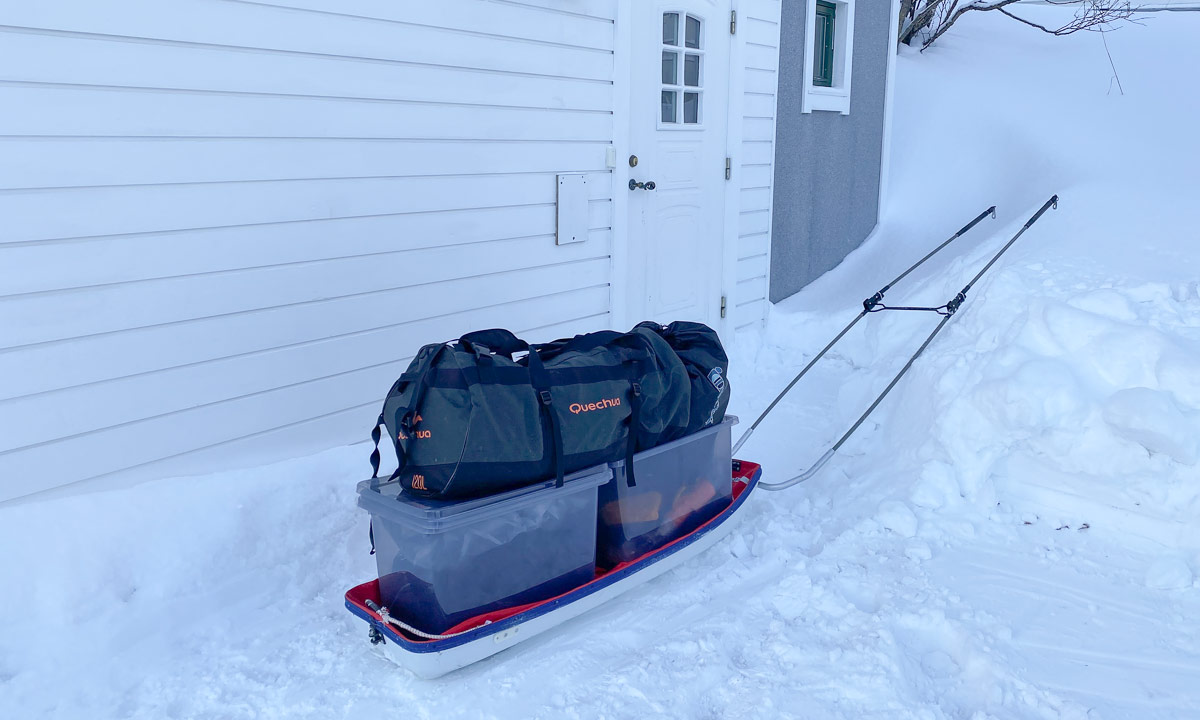
In case you do not know all houses on southern Tromsøya and you’re wondering what the pulka sled is about I’ll show you another photo:

That’s how I move today! By chance the new flat lies just on the other side of the street and I do not need my car. Weather and snow are fine and pulling banana boxes on the pulka works like a charm, especially since almost all my books, records, the grand piano and much more is in Annika’s and my house in Obbola in Sweden. So it’s mostly basic stuff and a lot of winter and outdoor equipment to move. I can take it easy and will be ready this evening anyhow.

I love moving like this!

Sea ice field work training on the Sørbotn

Peacefully I wake up this morning. It is already light outside. WHAT? LIGHT? WHY? AND WHEN?

I check my mobile phone – the clock shows 8:01. SH**!!! At 7:45 we were supposed to meet at the Norwegian Polar Institute, at 8:00 we were supposed to leave there for a field work training on the sea ice. But not me. I have overslept!

We – that’s 5 instructors and round 20 participants of the Sea ice field work training arranged by the Norwegian Polar Institute and the Arctic University of Norway in Tromsø. I realise that my colleague M. already tried to reach me and ring back. I tell her that I will take my own car and hopefully make it to our destination with only a small delay.

Our destination – that’s Sørbotn, the southern tipp of the fjord Ramfjorden where the training will take place on the sea ice of the frozen fjord.

I manage to dress, make tea and pack in 20 minutes thanks to previous day’s preparation and a fondness for packing lists. Although I take it easy while driving (safety first!) I arrive less than 10 minutes late while the preparations are still in progress.

We are split in two groups. Our group will do measurements of ice and snow depths first and take ice core samples after lunch break. I won’t go here into details too much, because I’m a newbie to all this and I do not want to write half-understood nonsense. I’ll have to look up some details of today’s stuff later.

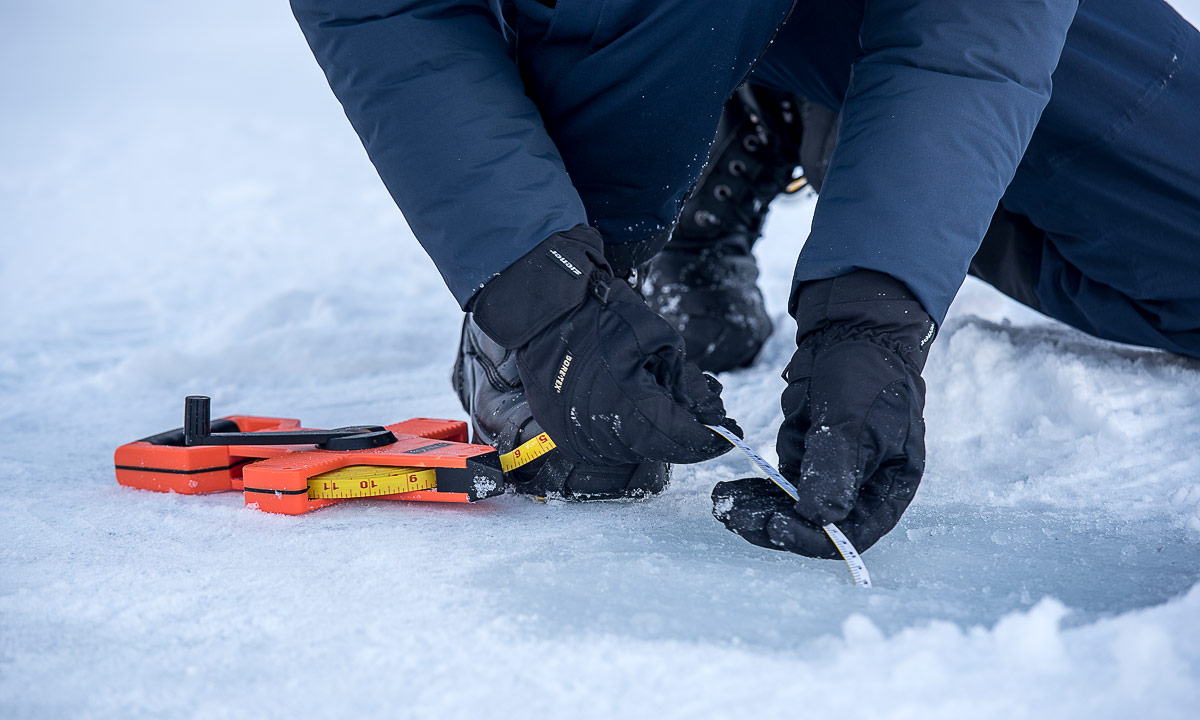
Although I drill holes in the ice, help calibrating the GEM2 device, measure temperatures in a freshly taken ice core and use a MagnaProbe to measure a transect of snow depths I have a lot of time to take photos, too. So, let’s just start with this.

Being on the ice with a bunch of nice people is not only a lot of fun but it will help me in doing my job at the polar institute. Part of it is to manage scientific data. The deeper my understanding on collecting data the better I can do my work. The most interesting thing today was observing the coexistence of advanced sensor technology paired with GPS tracking and the usage of rulers, pencils and paper as in the early days of polar research.


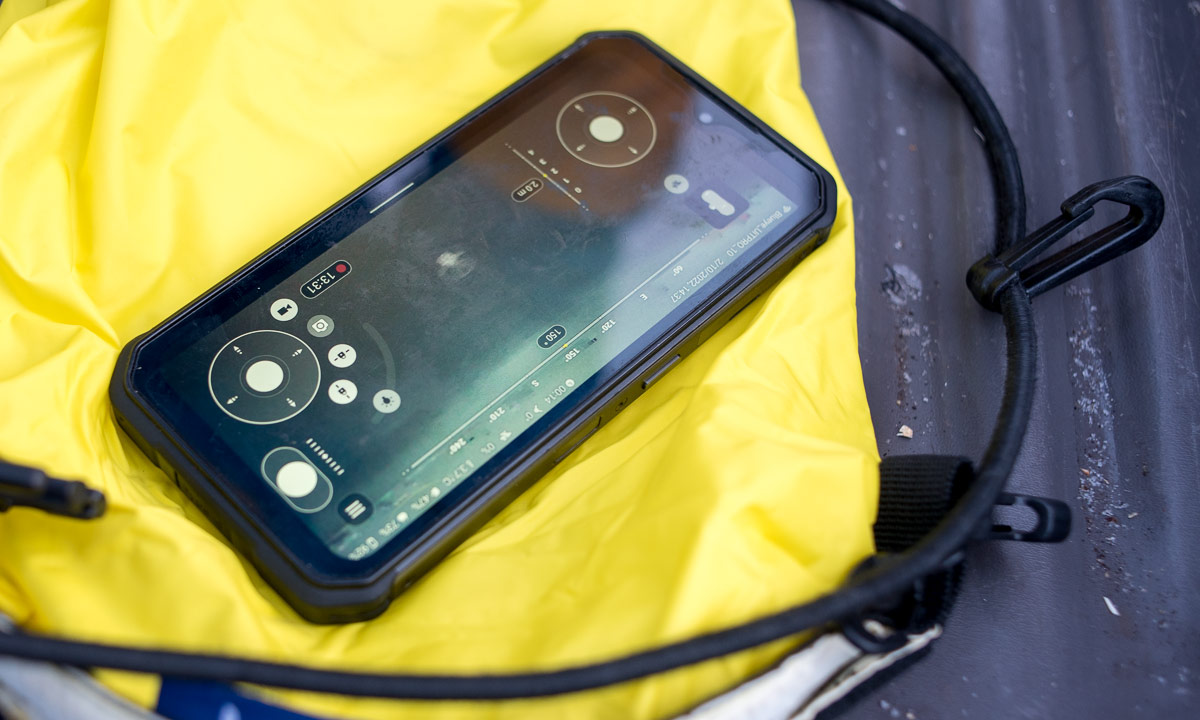
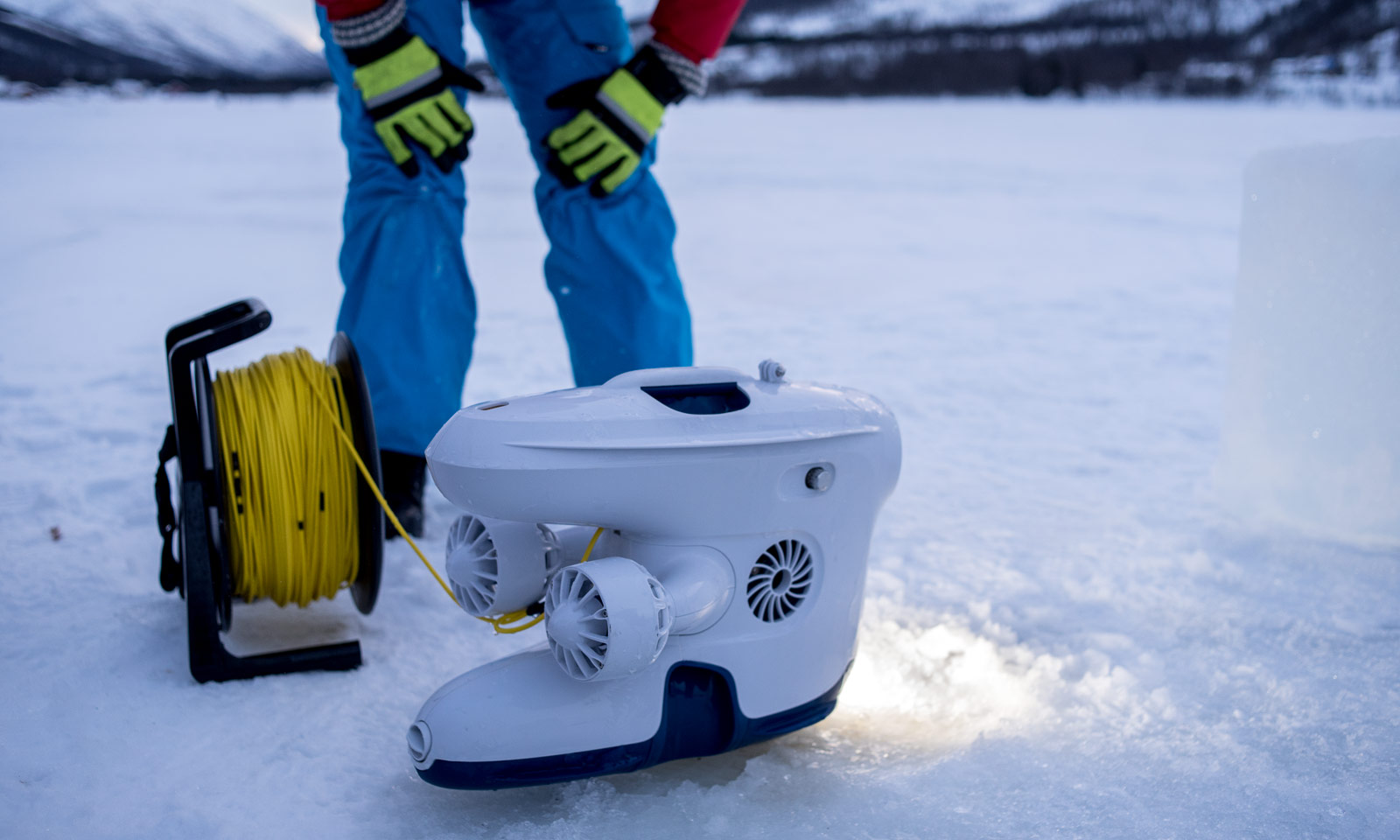
There was one thing I wasn’t involved in: The usage of a remote-controlled underwater drone. We clearly could see some fishes and jellyfish (do you spot it on the 1st image below?) on the live display. I know that it’s used for research, but I would love to have it just as a toy.

Hopefully this was not the last time that I was involved in field work this year. And perhaps we’ll be lucky with the weather again next time. For while we had calm conditions and even sunshine, wind drove heavy snow squalls over Tromsø just some hours after we called it a day.

A winter journey from home to work

Last Saturday I travelled to work. ObbolaTromsø, that’s round 1000 km – the reason why I do not commute weekly.  This time it is a bit suspenseful, because there are two obstacles on my way.

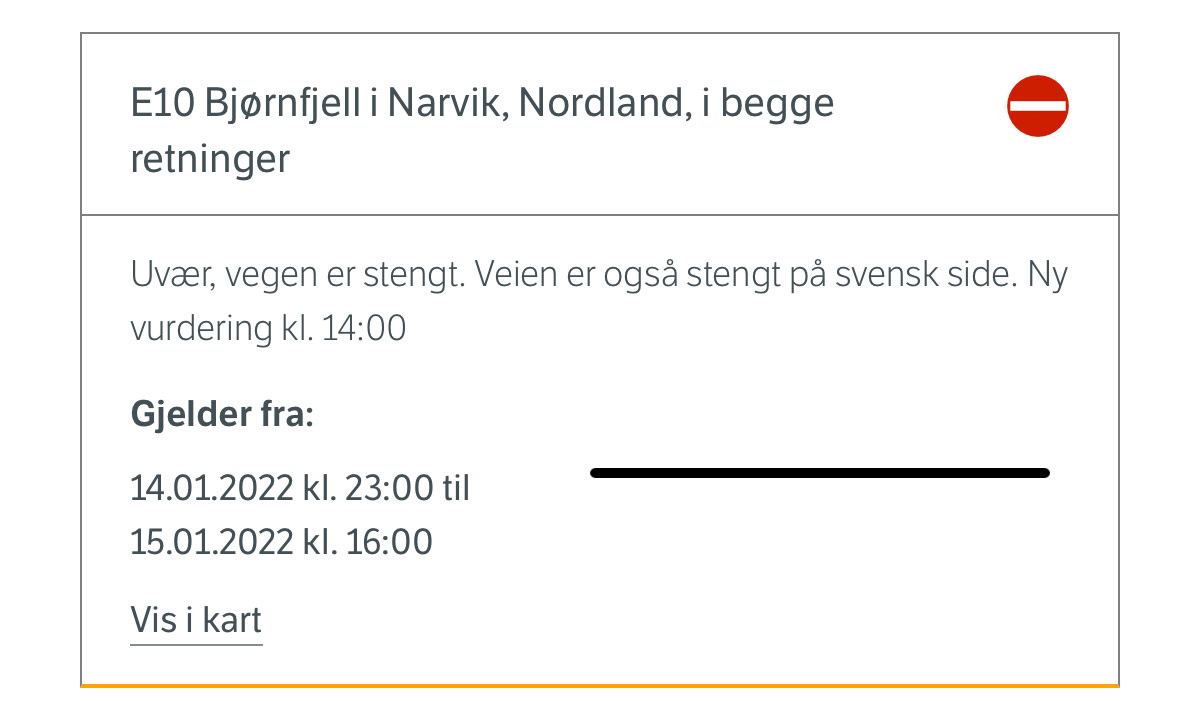
One obstacle is easy: taking a covid test at the test center. The other is much bigger: The road over the Bjørnfjell – the only road – has been closed for many hours due to stow storm conditions. Well, I start my journey anyhow. We’ll see.

At 5:30 in the morning Annika takes me to the train station in Umeå. The first 9½ hours were just a “normal” train journey beside of the train being mostly ahead of time. One change in Boden – nothing special, just long and a bit boring.

I leave the train in Abisko Turiststation where I parked my car. My car – will I find it or is it submerged under a pile of snow? To my relief hardly any snow covers my car. I already hoped so, because Abisko is known for its low precipitation because mountains in the west protect it from bad weather. Much more snow and rain fall on the other side of the mountain range and that’s exactly where I have to go through. Some minutes after leaving Abisko behind it starts snowing. Snowfall increased more and more but isn’t severe and the Swedish mountain road is open. Soon I cross the Norwegian border and …

… have to stop because of a lowered tollgate with a red blinking light. Beside of two trucks I am alone. I am relaxed because I know that the road has been opened for driving in convoy one hour ago (thanks internet!). I just have to wait for the large snowplough to fetch us.

After twenty minutes the tollgate went up and the red light goes out. That’s all that happens. I hesitate. And now? Do I have to wait? Or may I drive? I don’t dare and ask one of the Norwegian truck drivers. He answers I should just go ahead and so I do. The drive is snowy but not bad and soon I arrive at Bjørnfjell brøytestasjonen where the snowploughs are located and now also the Covid19 registration. I register myself, get a covid test and start taking photos while waiting for the result.

I take an image of a snowed in car. The snow plough driver goes to me and asks for what purposes I take photos. “Just for my blog.” “Ah ok, just curious.” Good to talk to him, because so I learn that beside of the mountain passage behind Bjerkvik road conditions are good. Here they got a lot of snow the last 24 hours and one of the cars looks like this:

After round 20 minutes I get a ping ♪. It’s an SMS with a link to my test result. Negative :-). 260 km to go, that’s four hours when conditions were good.

The first 100 km the road conditions are good and weather is ok. The next photo shows how driving looks like.

The next hour it snows a lot. Sight is still good. To my left and right everything is covered with snow, from the largest church to the smallest branch of a tree. Winter wonderland.

Then it starts to get nasty. Snowfall intensifies more and more and the snow has the consistence of superglue. My windscreen wipers hardly manage to push away the gluey snow and finally I have to turn into a side road and de-ice the wipers. Scratch, scratch … . I’m not alone. In front of me a car with a driver doing the same. Behind me another car stops. Am I in the way? No, just another scratch, scratch. On the other side of the side road another one.

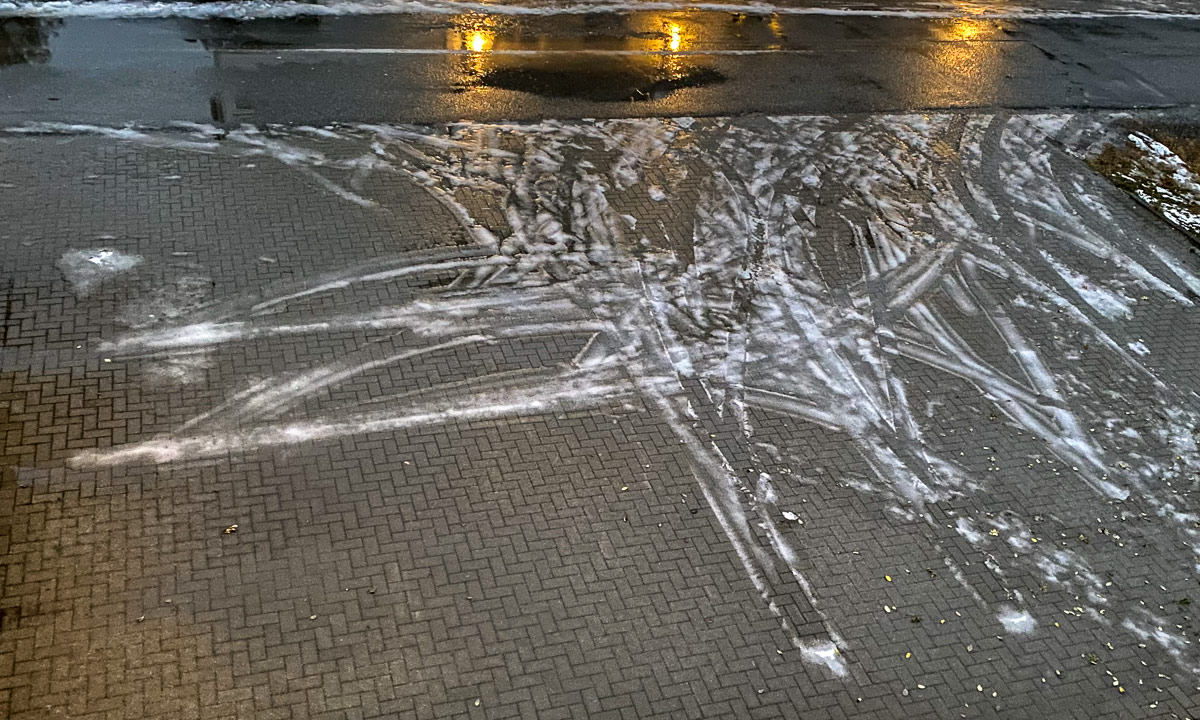
I still have some holes to peek through but it is extremely tiring to drive car through the night like that. Alas, after two hours I drive over the large concrete bridge Tromsøbrua and am on the island Tromsøya. Apparently Tromsø’s snow removal has given up. The minor roads are covered with 20 cm of snow with deep tyre tracks. I understand more and more why most Norwegians have cars with all-wheel drive (and so have I).

22:45. I make a last stop at the supermarket nearby that is open until 23:00. I’m lucky because Norwegian supermarkets close on Sundays. By the way: the supermarket’s parking place is in much better condition than the roads.

One other minute driving and I arrive at my flat in Tromsø after 17½ hours travelling. I’m tired but it takes another hour until I’m relaxed enough to sleep. Next week I’ll walk …

No whales today

To the left the Brim Explorer, a boat located in Tromsø for amongst other whale watching. To the right the tourists waiting to be boarded. The boat is fully booked, I am not alone.

Before leaving an announcement: The crew will try its best but it’s not granted that we reach the waters where the whales are. Anyone is free to leave and given a full refund. Most people stay and so do I. First of all I’m not surprised, as another tour operator already cancelled today’s tour. And then I just want to be a day on the water. Whales of course would be a nice extra.

To the left Tromsøbrua, the bridge that connects Tromsø with the mainland. To the right the safety on board drill, that everyone had to join.

And then we’re off.

To make it short: What we didn’t get today was whale sightings. What we got today was rough weather in the open parts. The boat was rolling and pitching like a cork in the waves. More than one passenger got sea sick. The unpredictable movements of the boat and the dim light under the grey sky made photographing a bit adventurous. Several times I was forced in and one passage even the doors were locked. The rest I was outside, partly taking photos, partly just looking around and letting the wind blow around my nose.

Conclusion: an awesome tour even without whales. If you want to participate as well: take your warmest clothes with you. And those of you that just want to stay home and look at some whale photos may read my article about Whale watching in Andenes. Enjoy.

Note to myself: TromsøyaRingvassøya/ReinøyaVannøyaNordfugløyaArnøya/LaukøyaSkervøya/KågenLyngenReinøyaTromsøya

Tønsnesvarden

On Tuesday we got some snow in Tromsø. On Wednesday it already has melted away. But last night a bit of snow arrived.

Today I chose a shorter tour from my book “På tur in Tromsø” (On tour in Tromsø) because I just wanted an easy hike, not a full-grown mountain tour. The weather agreed with me.

By the sea only a bit of wet snow and sleet covered the ground but already 50 meter higher the gravel path was covered with 10 cm of snow. Deep tyre tracks were carved in the snow. This part of the tour was very easy. Just follow the road up until you reach the radio unit on the Tønsnesvarden (281 m) and try not to slip, because under the snow there are some icy patches.

This summit has a big radio station on its top. Even in the increasing snow fall is was quite visible. Now I walked through 20 cm of snow. After an hour I arrived at the radio station, where I met the creator of the deep tyre tracks: A six-wheeled ATV.

It wasn’t cold but a windy. It snowed more and more and the wet snow glued itself to my jacket. On my way back I left the main road and followed a small path on my digital map on my iPhone. I stopped in a forest of birches with thin and long stems. I loved the motive, but my Nikon camera gave up in this wet weather. The lens was fogged up in the inside and in the dense and wet snowfall I didn’t dare to change lens. One photo worked out ok anyhow:

Soon I realised that some of the paths drawn on the map did not exist in reality (at least not in winter) while others that exist were not part of the map. So I went cross-county through pathless terrain, partly dens forest, partly wetlands with many small streams to cross. It took only 15 minutes until I reached the other gravel road leading down again. Now the iPhone was in charge for making pictures.

I followed the path down. With each metre altitude I lost there was less snow on the ground and the snow fall became more and more sleet. When I arrived at my car my anorak was soaking wet. Having seat warmers in a car is a great feature after such a tour.

For the records: 6.5 km, round 300 metres in altitude. Temperature round 0°C.

Appendix 1:

When I show pictures of mountain tours and hilly hikes it is easy to forgot, that Norway has not only mountains but the sea, too. This is an iPhone snapshot I took from some metres from my parked car. What you cannot see is the mountains of the island Kvaløya, 3.8 km away. They are hidden in the snow clouds.

Appendix 2:

What do you do with photos taken with a fogged up lens? You start to experiment. I mean, the photo is spoiled anyhow. But the result of today’s experimentation turned out nice in my opinion.

Three summer days in Råneå

(Oops, I’ve become lazy with blogging. This happened already a week ago!)

Last week Annika and I used our one-week holiday to visit friends in Råneå – 300 km from home, 100 from the Finnish border. Three days – three sections.

Thursday – getting wet

After a sunny morning a large cloud front approached Råneå, bringing thunderstorms, heavy rain and hail. It was short-lived and probably only some strawberries were harmed. (Or was it a snail that tasted them?). In the afternoon it cleared up and we spent some time by (and in) a bathing lake.

Friday – kayaking

We had booked the day before. Four kayaks (three single, one double) and a canoe. On tour: four children between 5 and 13 and five (more or less) grown-ups. We have booked for three hours and decided to paddle through a small creek and then take the Råneå river back to the boat rental by the sea. I have paddled quite a lot on the sea but hardly on rivers, streams or creeks. A great experience!

Saturday – open air concert

Annika and I had heard Daniel Wikslund before. On this day he played two open-air concerts in Överkalix – the first one on a large wooden raft on the river Råneälven. It was wonderful to listen to his folk-inspired music from the a small jetty, the water or even from the raft. It was his first concert since February 2020 due to the covid  restrictions. Hard times for musicians!

You see the wooden keyboard instrument? That’s a pump-organ (Swedish: tramporgel). We’re lucky to have such an instrument in our house soon. Today we’ll meet friends that will help us with the transport from the previous owner’s summer cottage by the sea up the hill to the gravel road and then to our house. Wish us look, that the transport succeeds.