Second kayak tour 2016

What a contrast to the first kayak tour six weeks ago: Last time dry suit, today t-shirt. Last time between ice floes, today birches with fresh leaves. Last time Baltic Sea, today the river Skellefteälven.

I put my kayak onto the new two-wheeled dolly (the old one broke down) and dragged it to the small bay Killingörviken, where I started my today’s tour. First I paddled along the harbour, then I turned right into the channel Kejsar Ludvigs Kanal. It always reminds me a bit of the “Ruhrgebiet” in Western Germany, where I lived for eleven years. After the last tunnel waited the Sörfjärden.

There I left harbour and industry behind and considered, where to go. The tour into the Nördfjärden wan, since it was windier than expected and I didn’t want to cross the Sörfjärden. So I paddeled upstream.

After a while the peninsula Örviken to my left ended. That’s where the Nördfjärden starts. I knew the first part and paddled to one of the rotten wooden piers. Luckily I realised that there were also under water parts – there were almost everywhere. I slowed down to avoid a collision with one of the big rusty underwater-nails. Finally I came to one of the four old platforms that probably formed an old pier, too – many, many years ago.

Now it was not far to the small island Gustavsgrönnan, where I made a short break. The whole shore is wet and covered with reeds, that lay flat on the ground.

I continued my tour by surrounding the island and paddled to the islands Stensgrönnan and Björnsholmen. To these islands you can drive by car and I was curious, if there would be a bridge or a tunnel to allow me continuing my trip.

First try Stensgrönnan: No chance! A solid dam connects the island to the main land.

Second try Björnsholmen: A small chance … . This island is connected to Stensgrönnan by bridge, but it looked really low. I didn’t believe I could manage to squeeze me underneath it until the end, but it worked. I had to bend my upper body onto the kayak and drag myself forward slowly by hand.

(Reminder to myself: This tour works only when water level is ±0. 20 cm more water and I wouldn’t fit under the bridge. 20 cm less and paddling could be hard due to the shallow water round the islands.)

Now I paddled downstream, which was not as much help as expected since the wind increased and came right from the front. But soon the bridge of the Sundgrundsleden was in view, the tiny cabins ashore and the dry dock with the read ship that I already saw on the way there.

I was a bit exhausted when I turned left to enter the bay Kurjoviken on the other side of Kallholmen. Now I was almost home, I just have to take the tiny tunnel “Lappstrupen” and I’m …

… well, that didn’t work. Due to roadworks this tunnel was completely blocked. Can I traverse the tunnel anyway? No. Do I want to walk and get the jetty? Neither. So I returned to the open water again and had another two kilometres against the wind until I entered the Kejsar Ludvigs Kanal again.

Now I headed back to my starting point. Another kilometer to go and I was onshore again. Phew – the last part was exhausting!

Today’s tour: Round 19 km total. (3.2 km extra because of the blocked tunnel Lappstrupen.)

Blue sky, blue sea – opening the kayak season

Finally the Baltic Sea round the peninsula Näsgrundet has been open and free of ice. Time to open the kayak season!

To Näsgrundet it’s just a 2.8 km walk from home. The kayak is tied onto a small two-wheeled dolly. I wear the same waistbelt, that I use for my pulka. Hereby I can walk and drag the kayak behind me without using my arms.

Soon I reached the peninsula and dragged the kayak onto the surrounding ice shield. After putting on my dry suit, lifejacket, neoprene boots, gloves and balaclava I was dressed for the first paddling. Perhaps I looked a bit overdressed, but despite of the springlike air temperatures it’s still winter paddling – the water is as cold as it can be.

I paddled along the ice shelf, that still connects the islands BredskärKlubben and Flottgrundet with the main land. The ice is soft and starts to get transparent, but it’s still quite thick.

Soon I reached Klubben and paddled along the icy coast.

From Klubben it’s just 200 metres to Flottgrundet and from that it’s only 500 or 600 meters to Gåsören

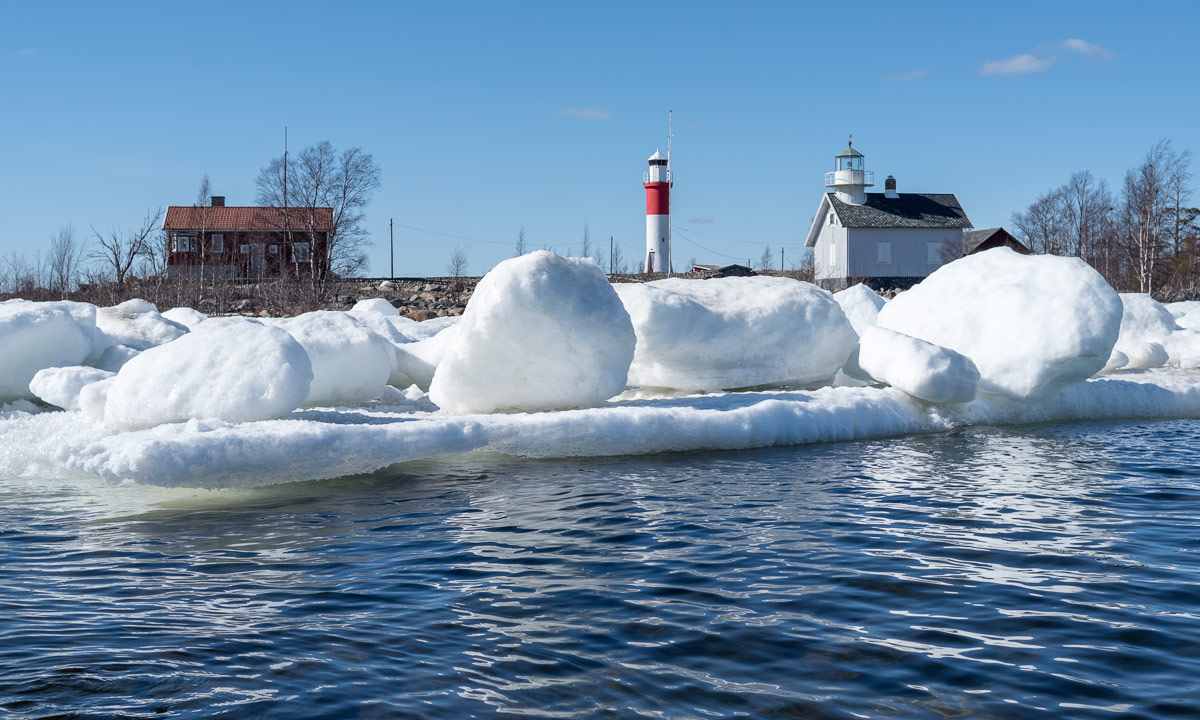
… at least, if you take the direct way. I preferred a detour to paddle between the ice floes. It’s a great experience. Some ice floes are quite big and welcome resting spots for ducks, geese and seagulls. Others are so tiny, that they are hardly visible, especially if they are completely transparent and clear. They sparkle and glitter like huge diamonds.

After some detours I headed to Gåsören, circuited it to look for a good anchorage and went on land (or better said, on ice) to make a small rest.

After I stilled my hunger and thirst I entered my kayak again and returned to the Näsgrundet, this time on the direct way, which is round about two kilometres. When I got out from my kayak and stepped onto the ice that surrounds the peninsula, I heard a noise: A snow mobile crossed the same ice shield I paddled along some hours ago – in same distance to the open water. Spring, meet winter!

After taking of the lifejacket and dry suit I went home, dragging the kayak behind again and enjoying the springlike temperatures. No warm jacket anymore, no woollen cap – no gloves and no warm boots. Round 40 °C warmer than 12 weeks ago – glorious!

Spying the land

Tomorrow I thought about paddling through the freshly snowy winter landscape. Is it realistic? Let’s check:

A: the snow warning

smhi (Swedish Meteorological and Hydrological Institute) released a class 1 warning for tonight: 10 – 15 cm snow should fall at the coastal areas of Västerbotten. But actually it’s too warm, most of the precipitation has come as sleet and rain. Probably we will have a centimeter of wet snow tomorrow, not much more.

B: the sea ice cover

smhi has another warning, this time for the sea: “higher than 80 cm above mean sea level.” – I took the car to Storgrundet and smhi was right: Parts of the beach are submarine now. But unfortunately the high water didn’t break the sea ice. The ice near the shore is quite soft, I could paddle through. But the rest? Will I manage to break through or do I have to give up?

C: the forecast

At 7:00 it will be clear sky and -6 °C. Nice weather, but at this time it’ll be pitch dark; sun rise is round 9:15. According to the forecast it will be cloudy at 9:00 and start to rain at 13:00. Not enough with that, smhi had another warning for tomorrow: wind will be round 30 knots, that’s round 60 km/h – too much for my kayaking abilities.

Let’s summarise: Hardly any snow, the ice maybe to thick to break, windy + cloudy + some rain later on. I guess, my kayak will stay in the garage tomorrow.

An overnight stay on the island Gåsören

Saturday

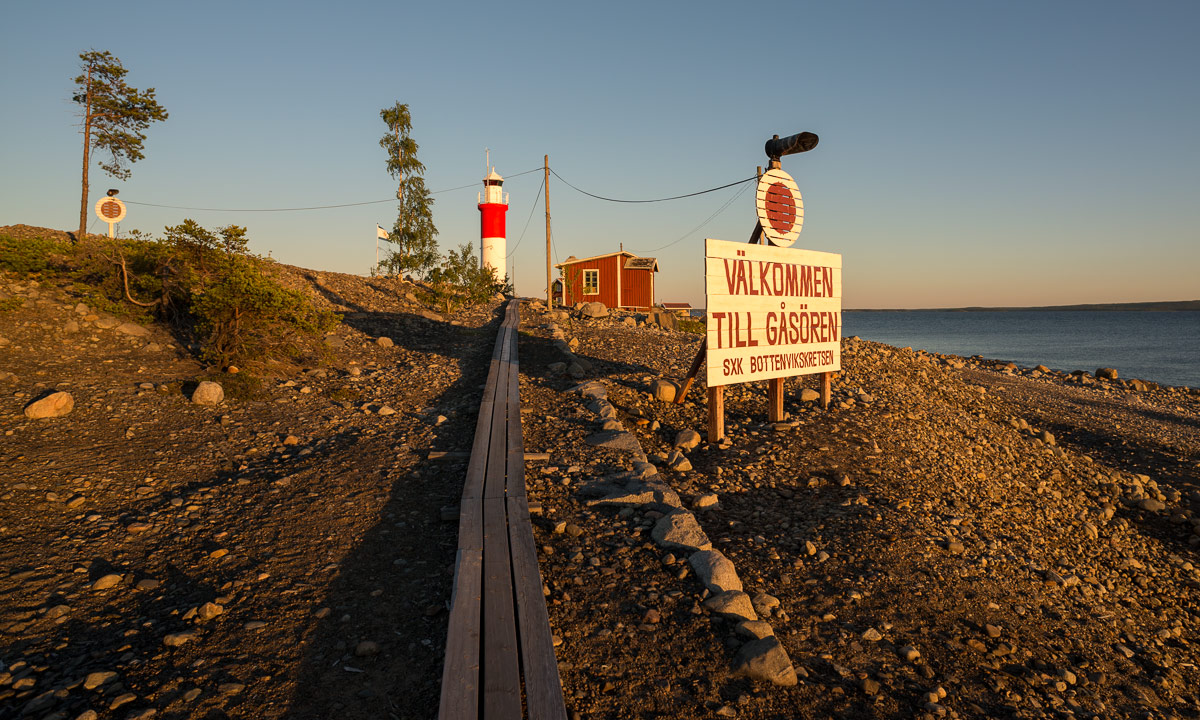
The advantage of short kayak trips with overnight stay: you can start quite late. It was 7 p.m. when I started pulling my loaded kayak from home to shore. A quarter later I sat in the kayak and started paddling. It’s only four, five kilometres to the island Gåsören that shone in the warm light of the evening sun.

The first thing to do: Put up the tent before sundown. The second thing to do: Taking a picture of the lighthouse before sundown. The stomach reminded me of thing number three: Preparing food and eating. Todays dinner: Graved salmon on fire roasted bread à la plein air.

I was quite curious if I would catch the first polar light. The short term forecast of Soft Serve News wasn’t too bad. But even if the sun already went down round 9 o’clock – two and a half hours earlier than eight weeks ago – I still had to wait for the sky getting darker. After a while however I could see the first faint greenish garlands. My first Northern Lights of the season 2015/16! Great!

But then I saw something in the sky that I thought was much more fascinating: Right above the red coloured northern sky I could see a layer of lucent clouds. They looked really strange because there weren’t red or purple – they were pale white! I never saw something like that before. They looked extremely far away, almost extraterrestrial. I wondered if this perhaps could be noctilucent clouds – clouds that are found in extremely high altitudes of round about 80 kilometres. I stayed awake for a long time, I just couldn’t tear my eyes away from this wonderful phenomenon. Two pictures of the clouds:

Of course I checked my hypothesis directly, when I went home. Yes – I guessed right. My first noctilucent clouds ever. I was really lucky and I’m happy that I could see them just from my tent.

But let’s leave the Mesosphere and go back to earth again. If you tent on the island Gåsören, you can see other lights, too. Lights of civilisation: The peninsula Rönnskär is quite nearby. On Rönnskär there is Boliden Rönnskär, one of the most efficient copper smelters. You think industry is unsightly and ugly? Well, not Rönnskär by night in my opinion:

Sunday

I woke up in broad daylight although it was only half past five. I took one halfhearted picture out of my tent and then I started reading.

I started the book “Norwegen der Länge nach” written by Simon Michalowicz that was published just some weeks ago. Simon hiked from the Southern tip of Norway to the North Cape – round about 3000 kilometres.

I read in the tent – I read sitting in front of the island’s sauna — I read sitting or lying on a floating boat bridge, only interrupted by a short bath in the Baltic Sea. I followed Simon’s tour and just couldn’t stop reading. It was noon when I finally finished the book. If can warmly recommend it to all German readers that love Scandinavia or are interested in hiking. There’s a website as well: www.simonpatur.de.

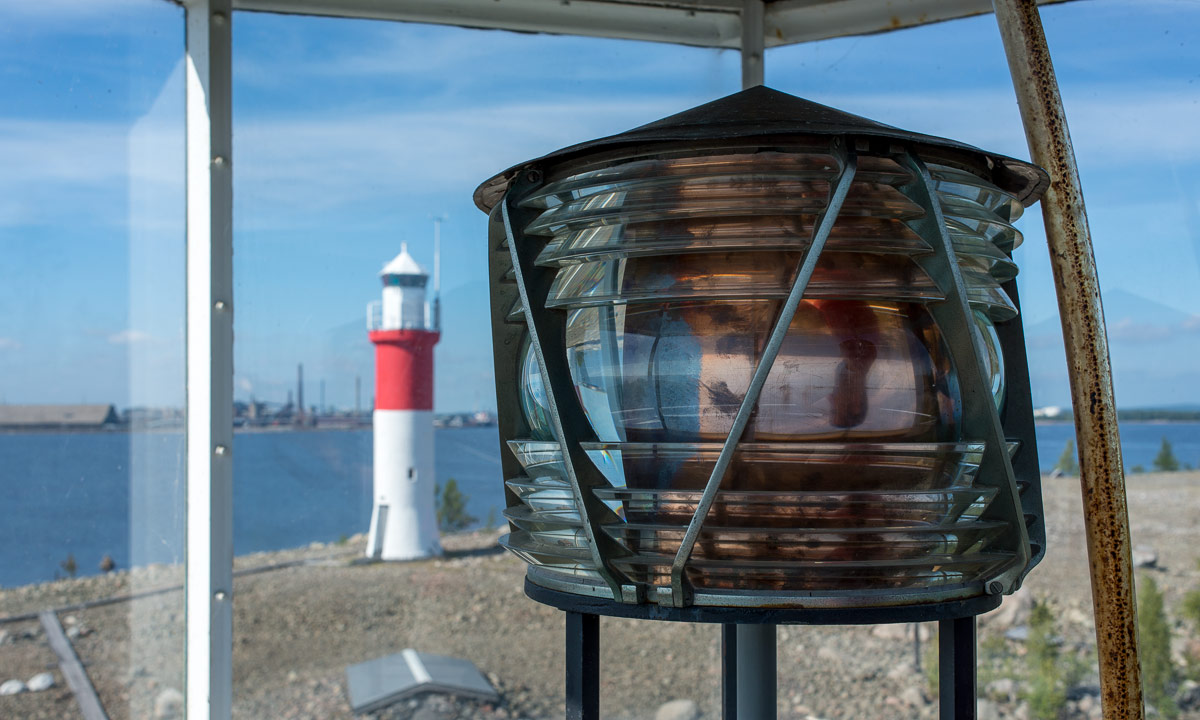
I wasn’t alone on the island. Some people hired the old lotshus – the pilot’s house for an overnight stay. The first motor boats came in for a day visit. And both summer cottages – there’re only two on Gåsören – were used, too. From T. who owns one of the cottages I learned that it was international lighthouse day today. So before I packed all my stuff together and paddled home I went up the two stairs in the old lighthouse and made a last photo.

I was home again half past two. Many experiences and a good book in less than twenty hours – that’s a fine weekend.

Translation:

EnglishGermanSwedish
Noctilucent cloudsLeuchtende NachtwolkenNattlysande moln

Umiak I

It started like many kayak trips: I put out to sea at the tiny beach Storgrundet without any plans at all. Unlike yesterdays weather forecast it was a nice and sunny day, although not very warm. Since the sea was calm I paddeled along the seaward sides of the islands Storgrundet and Brottören, crossed the Bredskärsviken to the islands Norrskär and Bredskär, continued at the east side of Flottgrundet and headed to Gåsören, probably my favourite island nearby. Some photos:

But much more fascinating than nature, birds and islands was the moment when I looked at the horizon and saw the faint but large silhouette of a big ship. The blurred outline looked more like a fata morgana than a real object. But I wasn’t the only one watching the ship. Two tugboats came from the port to bring the ship into port.

T., whom I met on the Island Gåsören knew the ship. It’s Umiak I, an ice breaker, that can break 1.5 meter ice and still going 6 knots (ca. 11 km/h). Impressing! I do like summer, but I really adore winter and started dreaming of travelling with the Umiak I in winter and cutting through solid ice.

Later today I made a better image of the ship in port.

It’s at least so famous, that it has its own Wikipedia page! I looked at Shorelink as well, to get some more information:

  • Cargo: 9257 tons copper concentrate
  • Coming from: Edwards Cove via Brunsbuttel

Of course I had to look up Edwards Cove, too. Never heard the name before. If the internet is right, Edwards Cove is a harbour west-northwest from Nain in Labrador, Arctic Canada. If the ship would go back the same way, I guess I would ask for a lift.

Links:

Some images of a short kayak tour

Today I took a short tour from the small boat harbour Killingören, just 650 meters away from my house. After taking the Kejsar Ludvigs kanal – a small channel, that splits the peninsula Rönnskär – I headed to the small island Kalkgrundet, where I landed my kayak. In the shadow of the trees there’re still some patches of snow left – up to 30 centimetres. I guess it’s the leftovers of a huge snowdrift.

I walked round the island and saw a Canada goose swimming nearby. One more step and I saw another one fleeing from land to sea. It was really near but I didn’t see it before it fled. I took some photos and continued my walk. Then I saw the reason why the geese didn’t just swim away: They were nesting. Sorry, my geese, I didn’t know this. I took a very quick photo of the nest and continued walking round the small island. When I was round the corner I peeked back and could see the geese going on land again.

I continued my kayak tour to an old pier at the shore of Örviken. From the distance it looked quite stable, but when I came closer I could see that it was ruinous and many of the wooden logs wobbled in the tiny waves.

I crossed the Sörfjärden and entered the bay Kurjoviken.  I could see the bright coloured blossoms of the marsh-marigold (Caltha palustris). I love these flowers and when I was home again two hours later I visited the place from land to make some photos. Here they are:

Paddling round Storgrundet

Two weeks ago the sea between the island Storgrundet and the mainland was still partly ice covered. Today I paddled round Storgrundet and couldn’t discover any ice left. The view of the blue sea almost looked like spring, but it didn’t felt like spring at all, it was very windy and chilly. When I left the protected bay I tried to make some photos but soon gave up since I was blown back ashore faster than I could take my camera out of its pocket. I only made a selfie on which it’s quite visible that – measured by temperature – spring hasn’t come far yet.

At the outside of the island I didn’t had a chance to release the paddle for a photo, too high were the waves. I regretted soon that I paddled without spray deck, because some of the bigger waves made it into my kayak. The next photo I made in a sheltered bay, where the water finally was calm enough and I could empty my kayak with a sponge (it wasn’t so much water, that came in).

Some hours later …

I had a look at “kanotudden” (literally: the canoe bay), a bay of the river Skellefteälven, where the ice is finally gone, too. Almost. There is some leftover ice, mostly crushed to small bits that were jingling and clanging with each arriving wave. But even the small bits were still solid enough to bear a wandering wagtail looking for food.

The canoe club, which is located at kanotudden still seems to be in hibernation, I’ll have to check later …


A short kajaktour to the island Norrskär

What a contrast – two days ago I skied through the snowy winter forest in Äkäslompolo in Finland, today I paddled on the Baltic sea under a blue sky with two friends and it almost felt like spring.

Hans, Stefan and I met at the pilot house, where the Baltic sea is completely free of ice. We paddled to the island Klubben and started to round it, but a thick layer of old ice still lay between Klubben and Bredskär.

So we turned left, and paddled along Bredskär and Norrskär.

On the outer side of Norrskär we went ashore and took a fika, a break with drink and food.

On the outer side the waves were a bit higher and sea spray splashed ashore.

The old ice has a fascinating structure, it’s like a mosaic of thin vertical sticks. If you smash it, it splinters into many pieces, but the sticks are quite stable.

After the break we continued our tour and paddled along the southeast peaks of the islands Storgrundet, Brambärsgrundet and Vorrgrundet. Here we had a bit more waves. More than twenty whooper swans rose when we came closer – a spring sign. But on the ice between Storgrundet and Brambärsgrundet people still stood on the ice, perhaps there were ice fishing.

Now we were on the way back and the waves got smaller again. The ice edge is quite fascinating. The ice itself is still quite thick but at the edge the underwater ice got a lot of holes and looks like a frozen sponge.

Three weeks ago I stood on the thick ice between the mainland and the island Bredskär and it was possible to go to the islands by snowmobile. Today we paddled through the open water, but on the remaining ice in the small boat harbour Tjuvkistan you could still see some snowmobile tracks and they were quite fresh.

Soon we arrived again at our starting point, a short but very pleasant tour. Thank you, Stefan and Hans!

They packed their car and I put the boat onto the small cart and started to go home, dragging the kayak behind. (Foto: Stefan)

The air was still cold – round +3 °C – but the sun already got a lot of power and it feels much warmer. On my way home I discovered another spring sign: The first blooming flower, a tussilago. Spring is here!


Opening the kayak season

“4:45” showed the clock when I woke up this sunday. Seventy minutes later I stood at the shore – just on time to see the sunrise. My kayak still was fixed on its cart with paddle, camera and dry suit inside.

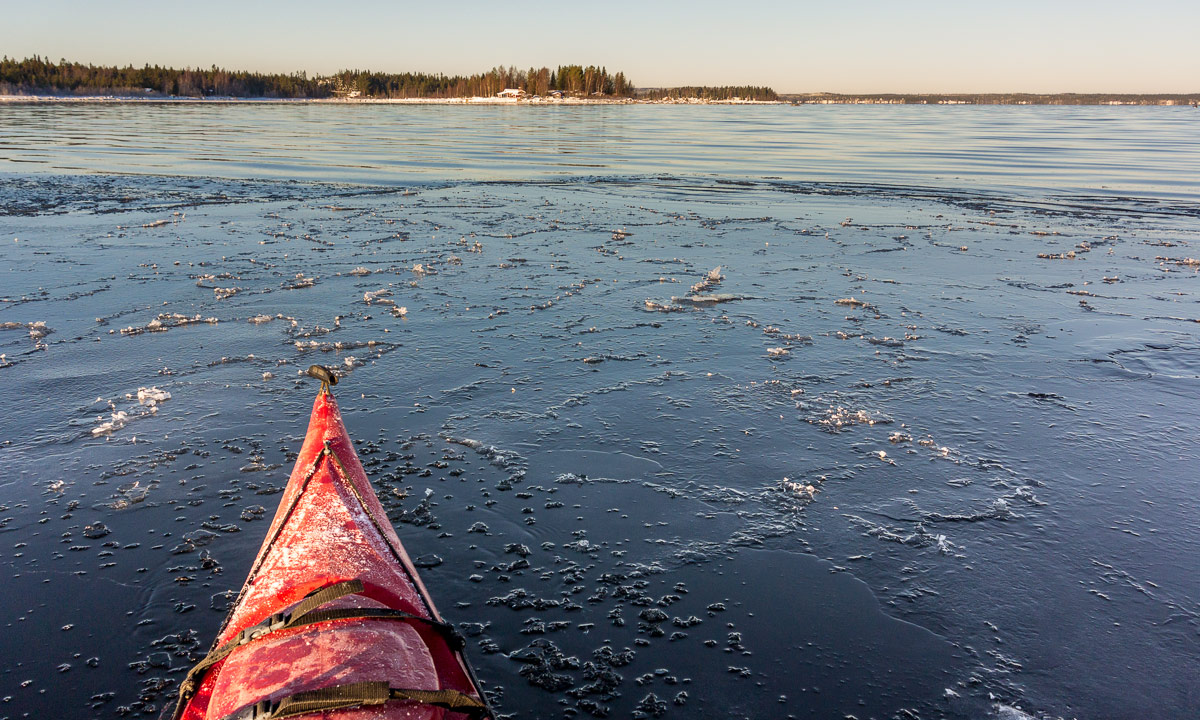
I put on the dry suit, pushed the kayak into the water and started the tour. When I left home it was -6 °C and parts of the sea where covered with thin new ice. Thin enough to melt under the day but thick enough to give me a hard time to break through with the kayak.

I’m always a bit nervous when I stick my paddle into the ice. Will it break one day? But until now it went well. Sometimes it was easier to take the hand and pull the kayak ahead. And sometimes, when the ice got really thick I used the paddle to hack small holes into the ice that I used as handles for pulling me forward.

But after a time I reached open water and paddled along some old ice floes that were much, much thicker.

And a bit later I came to the huge icy surface, that lays between the mainland and the islands Norrskär and Bredskär. I got out and stepped onto the ice. I think, this is the first time that I stepped onto the sea ice from my kayak. I wasn’t nervous, first of all is this old ice really thick, I should guess at least 30 centimetres, probably more. Then I always wear my completely waterproof immersion suit when I make a kayak trip in winter.

After a short break I continued the tour and headed to the island Gåsören. On the outer shore there were some impressive ice floes left.

It took a while until I could go ashore, because I had to cross another field of new ice. I took a longer rest and took of the dry suit. Ugh! Like always I sweated in the thick neoprene suit and now I smelled like a dead Puma. I took on some other clothes and first it was quite chilly. The spring sun however had enough power to warm me up and soon I took of my gloves and cap.

Most snow has melted and beside of the ice covered rocks at the eastern bank Gåsören almost looked like spring was here.

After a while I dressed for paddling again, entered the kayak and returned to the starting place. With the last ice behind I had a beautiful view of the islands Klubben, Flottgrundet, Gråsidan and Nygrundet. With the blue sky and the blue sea I had the feeling of leaving the winter behind me and paddle into the spring.

When I was home again the thermometer showed +7.3 °C. Almost spring!