A short kajaktour to the island Norrskär

What a contrast – two days ago I skied through the snowy winter forest in Äkäslompolo in Finland, today I paddled on the Baltic sea under a blue sky with two friends and it almost felt like spring.

Hans, Stefan and I met at the pilot house, where the Baltic sea is completely free of ice. We paddled to the island Klubben and started to round it, but a thick layer of old ice still lay between Klubben and Bredskär.

So we turned left, and paddled along Bredskär and Norrskär.

On the outer side of Norrskär we went ashore and took a fika, a break with drink and food.
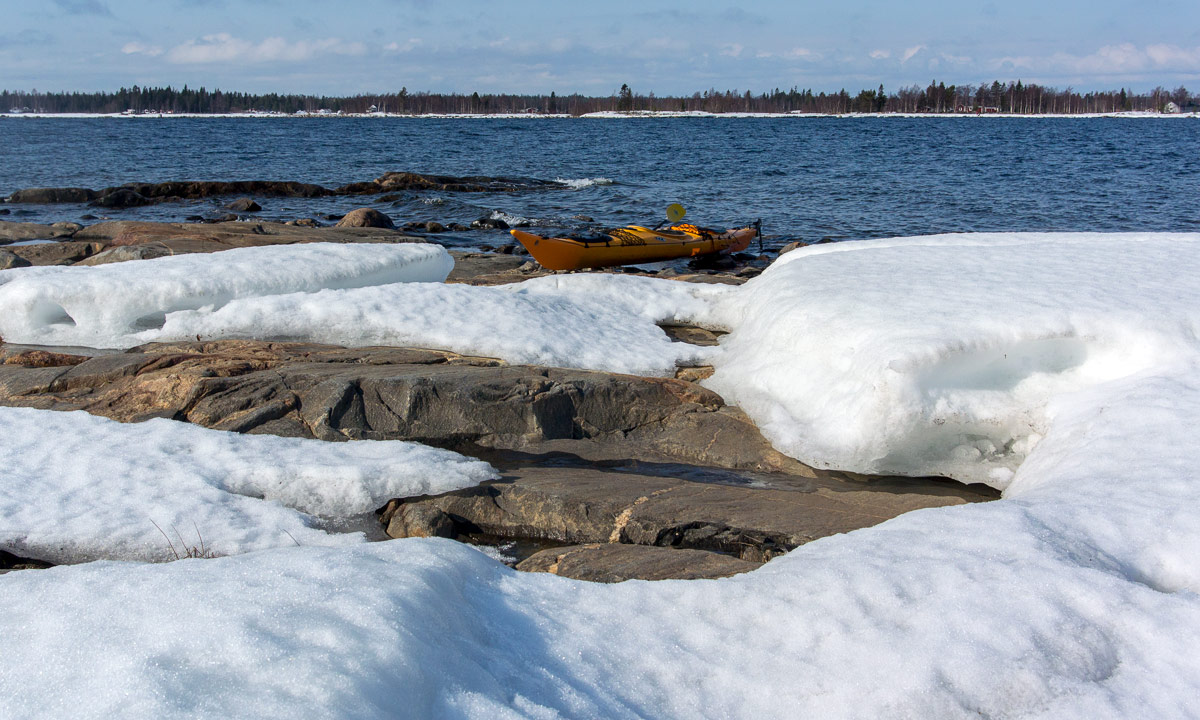
On the outer side the waves were a bit higher and sea spray splashed ashore.

The old ice has a fascinating structure, it’s like a mosaic of thin vertical sticks. If you smash it, it splinters into many pieces, but the sticks are quite stable.

After the break we continued our tour and paddled along the southeast peaks of the islands Storgrundet, Brambärsgrundet and Vorrgrundet. Here we had a bit more waves. More than twenty whooper swans rose when we came closer – a spring sign. But on the ice between Storgrundet and Brambärsgrundet people still stood on the ice, perhaps there were ice fishing.

Now we were on the way back and the waves got smaller again. The ice edge is quite fascinating. The ice itself is still quite thick but at the edge the underwater ice got a lot of holes and looks like a frozen sponge.

Three weeks ago I stood on the thick ice between the mainland and the island Bredskär and it was possible to go to the islands by snowmobile. Today we paddled through the open water, but on the remaining ice in the small boat harbour Tjuvkistan you could still see some snowmobile tracks and they were quite fresh.

Soon we arrived again at our starting point, a short but very pleasant tour. Thank you, Stefan and Hans!

They packed their car and I put the boat onto the small cart and started to go home, dragging the kayak behind. (Foto: Stefan)

The air was still cold – round +3 °C – but the sun already got a lot of power and it feels much warmer. On my way home I discovered another spring sign: The first blooming flower, a tussilago. Spring is here!


Opening the kayak season

“4:45” showed the clock when I woke up this sunday. Seventy minutes later I stood at the shore – just on time to see the sunrise. My kayak still was fixed on its cart with paddle, camera and dry suit inside.

I put on the dry suit, pushed the kayak into the water and started the tour. When I left home it was -6 °C and parts of the sea where covered with thin new ice. Thin enough to melt under the day but thick enough to give me a hard time to break through with the kayak.

I’m always a bit nervous when I stick my paddle into the ice. Will it break one day? But until now it went well. Sometimes it was easier to take the hand and pull the kayak ahead. And sometimes, when the ice got really thick I used the paddle to hack small holes into the ice that I used as handles for pulling me forward.

But after a time I reached open water and paddled along some old ice floes that were much, much thicker.

And a bit later I came to the huge icy surface, that lays between the mainland and the islands Norrskär and Bredskär. I got out and stepped onto the ice. I think, this is the first time that I stepped onto the sea ice from my kayak. I wasn’t nervous, first of all is this old ice really thick, I should guess at least 30 centimetres, probably more. Then I always wear my completely waterproof immersion suit when I make a kayak trip in winter.

After a short break I continued the tour and headed to the island Gåsören. On the outer shore there were some impressive ice floes left.

It took a while until I could go ashore, because I had to cross another field of new ice. I took a longer rest and took of the dry suit. Ugh! Like always I sweated in the thick neoprene suit and now I smelled like a dead Puma. I took on some other clothes and first it was quite chilly. The spring sun however had enough power to warm me up and soon I took of my gloves and cap.

Most snow has melted and beside of the ice covered rocks at the eastern bank Gåsören almost looked like spring was here.

After a while I dressed for paddling again, entered the kayak and returned to the starting place. With the last ice behind I had a beautiful view of the islands Klubben, Flottgrundet, Gråsidan and Nygrundet. With the blue sky and the blue sea I had the feeling of leaving the winter behind me and paddle into the spring.

When I was home again the thermometer showed +7.3 °C. Almost spring!


Kajak home

Two photos from a small kayak trip today: Between these two photos lie round 2.5 kilometer, enough for a change from idyllic islands to grey industry, and 30 minutes, enough for a weather change with gathering dark clouds and increasing wind.

But it’s the same tour, the “bring-the-kayak-back-into-the-garage-tour”. Yes, I could have gone to the tiny private beach where my kayak lay under the summer, take it and just drag it homewards. But that’s boring. So I paddled it to the small boat harbour Killingörviken, which is quite nearby from my house. The tour is just 6.5 kilometer long but shows the different sides of Skelleftehamn: The beautiful small islands with forest and summer houses, the open sea, the industry on the peninsula Rönnskär, the small but active port and last not least the small boat harbour that probably won’t see any boat before April next year. Season is over.

We’ll see when kayak season will be over. As long as parts of the Baltic Sea are clear of ice I’ll try to be out, but that may change quite soon. At least the kayak is back in the garage where it is sheltered from the upcoming winter weather.

Breaking the ice

6:15 rang my iPhone alarm and woke me up, far too early for a Saturday, but I made up a plan yesterday when I took pictures from the ice: I want to see the sunrise. From my kayak! I took a short breakfast, packed my camera, water, a snack and my immersion suit and drove to the small Storgrundet beach again. Half of the sea between the island and land was covered with ice.

immersion-suitSome minutes later I sat in my kayak and started my trip. It was harder to get ahead than expected. Even if ice was just three to five millimetres thick you could easily lay down the paddle without braking it. And so I had to prick the blade through the ice to force me forward. The cracking sounds of the ice smashed by my kayak reminded me on the tour with the “Arctic Explorer”, an ice breaker in Piteå. But I’m not sure if I would break as little as a single centimetre with the blade of my paddle. The immersion suit that I wore for protection in case of flipping over or falling into the icy water is quite alike the survival suits on the Arctic Explorer, too. You can lie in ice water for quite a long time without even freezing. But moving in it is hard because the neoprene is quite thick and stiff and the attached gloves are not very comfortable.

The sky was mostly clear, just some clouds in the east gleamed in warm early pre-sunrise colours. And far afield just over the horizon you could see a big wall of grey clouds. The locals call this clouds vinterväggen (The winter wall), since this is a typical cloud pattern in the winter months. It was awesome to be out, feeling the chilly air in the face, listening to the cracking sounds of the fresh ice and watching the changing sunrise colours reflecting on the icy surface.

But the ice gave me a quite hard time and so I decided after a while not to round another island but to head back to the beach and perhaps take another nap after the short last night. Therefore I turned my kayak and paddled back. I could see the channels of open water that the boat cut into the ice on my way there. I tried to use these channels to make paddling simpler, but it hardly help. Not the boat is the problem but the blade. Finally I went ashore again after one of the shortest kayak trips ever. But it was completely worth it!

Autumnal kayak tour

Today morning weather was calm with a grey sky, but later it brightened up a bit and I decided to take a kayak trip. Summer kayaking with just a life vest over your t-shirt are definitely past for this year, since both air and water where chilly. It always takes a bit of time before I finally sit in the kayak: Emptying the kayak from this weeks rain fall, dressing, fixing map and compass as well as the camera and finally dragging the boat into the water.

Minutes later I paddled round the northwest point of the island Storgrundet which lies off the coast of Skelleftehamn. The birches on the island where almost completely leafless, only the rowan trees still wear their many-coloured leaves and bright red berries.

On the outer side of Storgrundet the sea was a bit wavy and I tried to make pictures of the waves flooding the bow of my kayak. But I wasn’t lucky because when bigger waves came I felt safer with the paddle in both hands.  I landed on the small island Brottören, hardly more than a flat pile of stones, some birches, rowan trees and a shallow pond. On one of the bigger rocks I found a twig with rowan berries and I wondered if a human or a bird laid it onto this stone.

I continued in calmer sea between Brottören and Storgrundet where I had a nice view on the Island Norrskär with many coloured trees. Alas the sun hid behind clouds again.

Since weather was a bit dull I didn’t continue to other island but returned to the tiny sandy beach where my kayak has been laying since summer. The sharp tracks of the keel where the only tracks I left today.

Protected against wind and waterTo protected against wind and weather and – much more important – I use a dry suit. I bought it second hand, it is too big and not at all breathable. This could be a problem on longer tours since you start sweeting and getting means getting cold. The head was protected by a balaclava – there may be prettier things – because on the open sea it’s always a bit windy and chilly. And even if I love cold and even rough weather, I don’t like to freeze.

On my wish list: A neoprene balaclava – much better when it gets wet, and a better dry suit for kayaking, but those are extremely expensive and cost up to 1000 Euros.