A ski tour in the Kvikkjokk mountains – day 1

This article is part of the series “2018-02: Ski tour near Kvikkjokk”.

Day 7 of the winter journey 2018

I’m really glad, that my friend Jonas and I managed to realise a ski tour this year. It’s our 3rd ski tour together, but the last one was five years ago. A long time. Actually we had planned for eleven days, but due to severe snow falls between Gävle and Sundsvall two weeks ago the whole train traffic was cancelled and Jonas arrived more than two days later than planned.

On Wednesday, 7 February we left Solberget and took my car to Jokkmokk, where we bought food for nine days. Anything from muesli (with powdered milk), tea and chocolate to pasta with pesto, salami, potato mash and much more. Have a look:

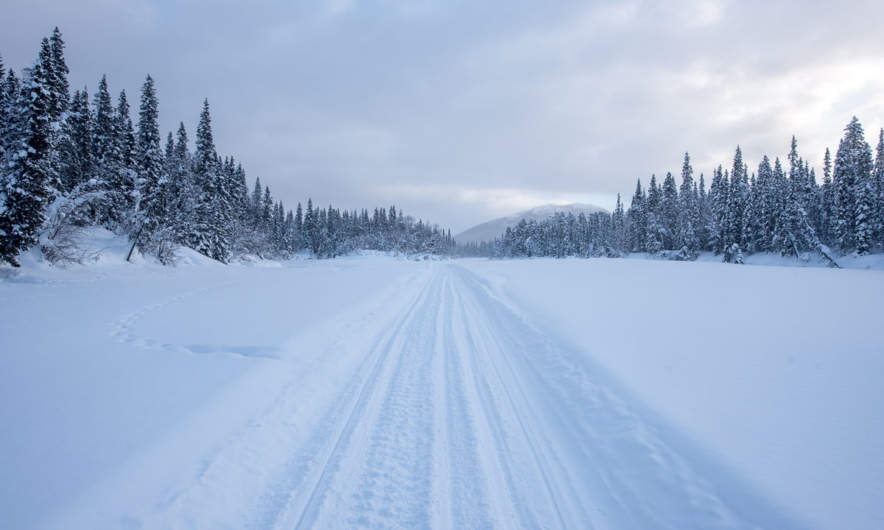
After taking a lunch we continued to Kvikkjokk. The weather was sunny and the temperatures sank below -20 °C. In Kvikkjokk we packed our pulkas, transport sledges you carry behind, locked the car, put on the skies and started our tour. First along a road, then on a snow mobile track. We didn’t come long when we met a local with a snow shovel who asked for our plans. He looked at our heavy loaded pulkas and mentioned that we would have a hard time in pathless terrain. He said, that it was 100 cm of snow in Kvikkjokk and 150 in the mountains.

I reparked my car – another tip of the local – and we started our tour again. With his permission we used his private snowmobile track that led us to the river where it joined a larger snowmobile track. It already had been starting to get dark and our plan was to find a place for our tent quite soon. We weren’t alone on the river – two moose (mother and calf) stood on the river some hundred metres away. We waited until they left and continued. The river slopes were quite steep and after we had decided to leave the river we had to put off our skis and drag the heavy pulkas up through hip deep snow. Exhausting! At least we found a nice little clearing in the forest for our first night in the tent.

As usual we started to tramp down the snow with our skis to make it stable enough to bear the weight of tent and ourselves after some time. This snow however was so loose that it seemed impossible to us to erect the tent on top of it. Therefore we digged down half a meter (making round 6 cubic meters of snow to dig) and erected the tent in the hole. The temperature had continued to fall, now down to -25 °C. Finally the tent was “ready for occupation” and we were eager to eat something warm.

After Chinese noodles with some asian ready-made sauce we left the tent and watched the amazing clear starry night. The milky way gleamed over half the sky and Sirius had just started to rise on the eastern horizon. What a wonderful first night!

… and a cold one. When we started to sleep the temperature had fallen to -30 °C. Jonas and I have huge down sleeping bags and we had it warm and cozy anyway. I just had problems to sleep because I don’t like sleeping on my back and always have trouble to fall into sleep the first two, three nights when tenting.

Next morning: Clear blue sky, some feathery clouds that just started to colour purple. Jonas’ thermometer at the pulka showed -34 °C. It was completely calm and we decided to cook outside. Cooking in the morning mainly means boiling water for tea and for making milk for the muesli. I was glad about my warm mukluk boots, down pants and my puffy down parka. And finally the sun rose over horizon and trees.

Today we would continue westward to the mountain lodge Njunjes and probably sleep there.

Photo #1 and #6 in this blog article are made by Jonas Balbasus.

That arctic feeling

Have a look at the following photo:

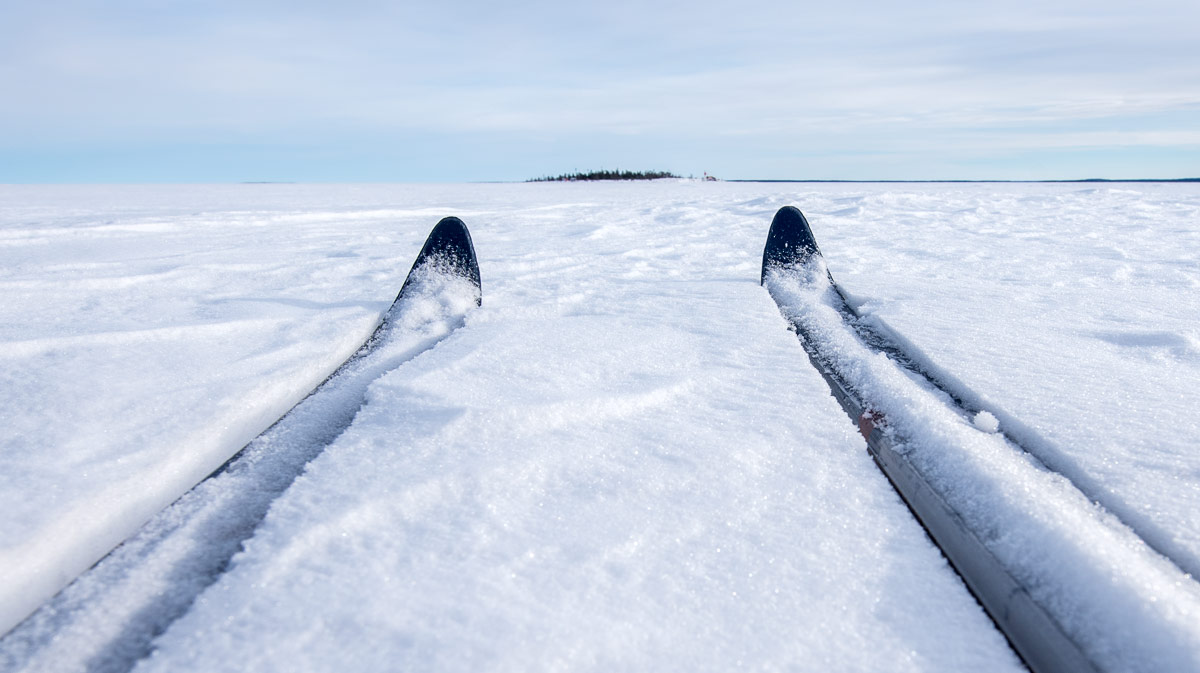
It could have been taken at some spot at the Arctic Sea, couldn’t it? But it wasn’t. I made that photo just today, only 2 km away from home!

Today I wanted to test whether the camera backpack worked well together with the waist harness of my pulka. Therefore I made a small ski tour. First I crossed the ice between mainland and the island Storgrundet. The water between mainland and island is well protected and always calm. Therefore the ice is about 40 cm thick and more than safe to cross. I crossed the forested island, which is partly less than 200 meters wide and soon stood on one of the snow drifts at the outer shore. Beside of some smaller other islands and an old boat shed all I could see was clouds, snow, and ice.

There were many thick ice floes along the shore, but the ice between them was hardly a centimetre thick. No surprise, since large parts of the sea had been free of ice last week. I pierced the new ice with a stick and measured 60 cm water beneath. Not life-threatening, but I definitely didn’t want to get soaked and therefore sticked to the shoreline of Storgrundet. That’s where I took the photo above.

The other photo? Yes, that’s me with my Norrøna jacket (light and windproof), my Lowepro camera backpack and my Fjellpulken pulka. The test succeeded: pulka and backpack do work well together! Good to know for the ski tour in the Swedish mountains that I’ll start next week …

Question: Do you see the mistake I’m making on the 2nd photo? Please comment.

Varning! Isvak!

The river Skellefteälven between Skellefteå and the coast of the Baltic Sea. That particular place is called Stackgrönnan. On warm summer weekends the café is quite crowded. In winter it’s closed.

This sunday however the small snow covered way is crowded, even though it’s mid-January. Many cars are parking, many people are standing around, warmly dressed for winter. Some of them have bags or rucksacks with them.

The Skellefteälven is completely frozen and covered with snow. Snowmobile tracks lead to the opposite riverside. On the river ice there are signs round a cordon.

They say “Varning! Isvak!” – “Warning! ice hole!”. And there is an ice hole indeed, four square meters big. Some people stand around with spearlike tools and remove the last thick ice blocks from the hole.

So that ice hole seems to have a purpose and it has: It’s an ice hole maintained by the association Mörkrets och Kylans Glada Vänner, or in english Happy Friends of Cold and Darkness.

I’ve been member of this association almost from the beginning and had the pleasure, honour (, and work) of being part of the organisation team for the very first Swedish Winter Swim Championship in Skellefteå in 2012. It was the coldest day of the winter with temperatures below -30 °C, but that’s another story …

Back to the plot: All people have come to take a winter bath or at least to cheer to those who do. Annika and I have winter-bathed before but not yet this winter. We aren’t the only one’s who want to take a bath, there are at least 30 others and the changing rooms are stuffed with people, some wearing winter parkas and warm boots, others just their swimwear and a cap. The same outside: Woollen mittens and down jackets on the one side, wet semi-nude bathers with towels on the other side.

And what is in the ice hole? One winter bather after the other. First looking tensed or even shocked, since the water temperature is round 0 °C (and yes, that’s cold!), then relaxed and happy because the body releases endorphins. But have a look by yourself:

After the last bather – most people and cars already have gone – wintry silence starts to set in again. The snow covered tables and benches are still untouched and the fairy lights round the big flag pole are on. Temperature is -11 °C. If you ask me, a perfect winter day.

Appendix one

On 17 February 2018, the Open Scandinavian Championship which is a part of the World Cup will be held in Skellefteå for the seventh time. And you can apply!

Appendix two

Evidence photos of me in the ice hole? Thanks to Annika, who took photos with her mobile they exist. Var så god:


Hampstärnsstugan

There’s a hiking trail from Umeå to the lake Tavelsjö, the so-called Tavelsjöleden. The first stop after 5 km is the mountain hut Hampstärnsstugan. Today it opened for the first time this season and served waffles and some other snacks.

While Annika and I had used our new cross-country skis the last days (lightweight, slim and fast) we decided to use our sturdy back-country skis today since we didn’t know anything about the trail conditions.

The trail however was almost perfect, we just had to follow the railway-like ski tracks. We would have been much faster with the other skis, but we just enjoyed being outside and of course the warm chocolate and waffles in the stuga.

While we skied round 10 km, most of the families probably came by car. It was fun to watch the small children on their sledges and toboggans dashing down the slopes, even though we had to jump away several times to avoid collision.

I love being outdoors far, far away from civilisation, but it’s great as well to be able to make such short holiday trips just out of town.

Opening the skiing season 2017/18

Today I had another day off and since the weather was sunny and nice but too windy to kayak, I opened the skiing season today. It was just 4.3 km but a good start to try out my brand new skis. Oh my, they are quite fast and it will take some time till I’ll get used to them. The snow wasn’t perfect neither but it was fun anyway.

Thanks to Y. in Umeå for her purchase advice and for her professional waxing!

Thanks to Friluftsfrämjandet Skelleftehamn for preparing the ski track in Skelleftehamn!

Kayakvideo – my thing – winter kayaking in Skellefteå

Last summer I was asked by filmmaker Johan Granstrand if I would be interested in making a small film about my winter paddling. I felt honoured to be asked and gladly accepted.

Despite to this year we got a lot of snow already in the beginning of November last year. Since weather was nice (and cold) we decided to make the film on November 12, exactly one year ago.

I already blogged about this day in my post “Kayak – is it a boat or a sledge?”. Some weeks ago I got the permission to share the link to the video and that’s what I do today.

“Min Grej – Kayaking i Skellefteå på vintern” on Vimeo.

(I really like this film but I don’t like listening to me talking. My Swedish sounds awfully!)

Late autumn paddling

It’s so nice to kayak on a sunny summer day, wearing just shorts and t-shirt, feeling the warm breeze, taking a bath and having dinner on a warm sunlit rock by the sea.

I wonder, why I hardly do that! This summer I paddled exactly twice – once in May, once in June. Now it’s November!

When I saw the thin layer of ice at Storgrundet this morning I was kind of alarmed – the days of paddling this year are numbered.

I fought a while with my weaker self but finally it was me who won. I put on my drysuit, neoprene boots, hood and gloves, took my little waterproof camera and fetched my kayak from the garage. The weather was still a bit sunny and temperature round -4 °C. (According to the weather forecast it should have been cloudy for hours, temperatures above zero and rain on its way. But well, the Swedish weather forecasts are hardly reliable.)

It took less than ten minutes till I reached the small bay Killingörviken where I launched my kayak. Within this short time period clouds have been approached from the sea covering half the sky.

The first 70 meters were hard work. Even when the ice is only 7 mm thick it’s not easy to paddle through because you have to break the ice not only with the kayak itself but with the paddle as well to be able to push forward. But soon I reached open water, crossed the street and reached the larger bay Kallholmsfjärden, home of the port Skellefteå Hamn. At the rear the sky was still blue but in front of me dark clouds approached and soon it started to snow …

No! Wrong! It didn’t snow. Snow stayed home and sent his asshole cousin: Freezing rain. (Rain indeed, sometimes the weather forecast is right.)

I thought back to the time, where I had lived in Essen. In that time I used to say “winter is coming, the rain is getting colder”. And so it felt today. It was chilly, wet, grey, twilit and dull. A typical autumn day in Essen. Or winter day. Or … . But I get off the point …

Anyway when I crossed all the bridges that traverse the channel Kejsar Ludvigs kanal, my mind wandered back again. Here it even looked like Essen.

But there are differences. First of all I never paddled in Essen and then Skelleftehamn is a coastal town which means that you reach the sea in less than no time:

Near the coast there was another layer of ice and again I had to cut through. My plan was to paddle round the peninsula Kallholmen, meaning that I would have to cross the sheltered bay Kurjoviken. Would I manage it or would the ice shield be too thick to be easily crossed? Well, I’ll see …

I paddled along the southern side of Kallholmen. There was hardly any wind and hardly any waves. Time to stop photoing and just enjoying the motion. Kurjoviken however came nearer and when I went round the west tip my misgivings became true. The whole bay was iced.

I gave it a try and started paddling through ice a third time this day. Already after ten meters the ice was 10 mm thick and I knew that I had 500 meters more to go. I decided to give up my original plan and returned. Backwards since it’s hardly possible to turn in ice.

It was still grey and quite dark, but it stopped raining and there was a a silver lining on the horizon.

It started to rain again. The raindrops were so tiny that I hardly could see the drops impacting the water surface. The surrounding looked hazy and mysterious and it was hard to guess distance and size of other objects.

“Is there a man standing on a rock amidst the sea? Or is it just a rock? Did it move or not? It moved! Is it a bird? I’m not sure. Yes, it’s a seabird, perhaps a cormorant. And the four dark spots ahead? Is it small rocks? Or big rocks? Or seals? Or trees far away in the haze?” Probably it was trees, that spot was further away than excepted.

Finally I reached “Ice Shield II” were I used the ice-free channel that I created an hour before. A second time I paddled along Kejsar Ludvigs kanal and reached the harbour.

A second time I crossed the bay, reached “Ice Shield I” and soon went ashore.

Well, let’s say I tried to go ashore. It was easy to leave the kayak but hard to go up the shallow slope, since the cold rain had instantly become ice on the still frozen ground and it was extremely slippery. Did you ever tried to drag a trolley with a kayak behind on freshly frozen streets? With neopren shoes made for water, not for ice? One patch on the street was so slippery that I really felt stuck. I could not move in any direction but finally I made it and some time later I arrived home.

My plan for 2018: Much more kayaking. In sun or rain, night or day – doesn’t matter as long as it’s save.


30 August: Kungsleden day 11 – Abiskojaure—Abisko (15 km)

This article is part of the series “2017-08: Kungsleden hike”.

The night in Abiskojaure was anything but restful. Too many people in the room, some of them quite reckless and the air was too warm and stuffy. Very early we got up. I took a short stroll to the beach of the lake Ábeskojávri. Then we had breakfast and at already 8:10 we left Abiskojaure to begin our last hiking day. There was another good reason to start early: eating lunch in the restaurant of the Abisko Fjällstation, the Abisko Mountain Station!

This part of Kungsleden is easy to walk and planked footpaths led over the wet parts. With every kilometre of walking we came nearer to civilisation. More hikers with large backpacks, more day trippers, the first private stuga (cottage) and more and more other ways and paths. A signpost to a camp, fifty pupils resting – some of them preparing noodles with their Trangria camping stoves, the sound of a train running through Abisko. Civilisation (and lunch!) definitely came nearer and nearer.

When we had started that morning we had walked first by the lake Ábeskojávri and since then we followed the river Ábeskoeatnu. Near Abisko the river flows through an impressive canyon.

Another train transporting iron ore, this time we could see it. We walked barely another twenty minutes before we came to the northern end of the Kungsleden (most people use that as a starting point and hike southwards) in Abisko. A wooden portal invited us to a “we made it” selfie.

We crossed the railway line, then the road – European route E10 connecting Å i Lofoten i Norway and Luleå in Sweden – went another 200 metres and entered the large main building of the Abisko Mountain Station. We booked a four bed room and then we headed for lunch that we enjoyed very much, especially the fresh salad buffet.

The rest of the day we enjoyed the other luxuries of civilisation as electric light, WiFi or hot showers. It was so nice to have such things again. Anyhow we looked at the stamps we got on hour hiking trip – one from each hut:

Teusajaure – Kaitumjaure – Singi (two nights) – Sälka – Nallo (two nights) – Vistas – Alesjaure – Abiskojaure

What a fantastic tour we had made together! Thank you Katrin, Thank you Annika, thank you Andi! Perhaps we’ll manage to do such again.

Here you can read all articles of our wonderful tour on a single page. It will take some time for even if I didn’t mention all of the experiences we had on this trip, it was much to tell anyway:

Kungsleden hike 2017-08