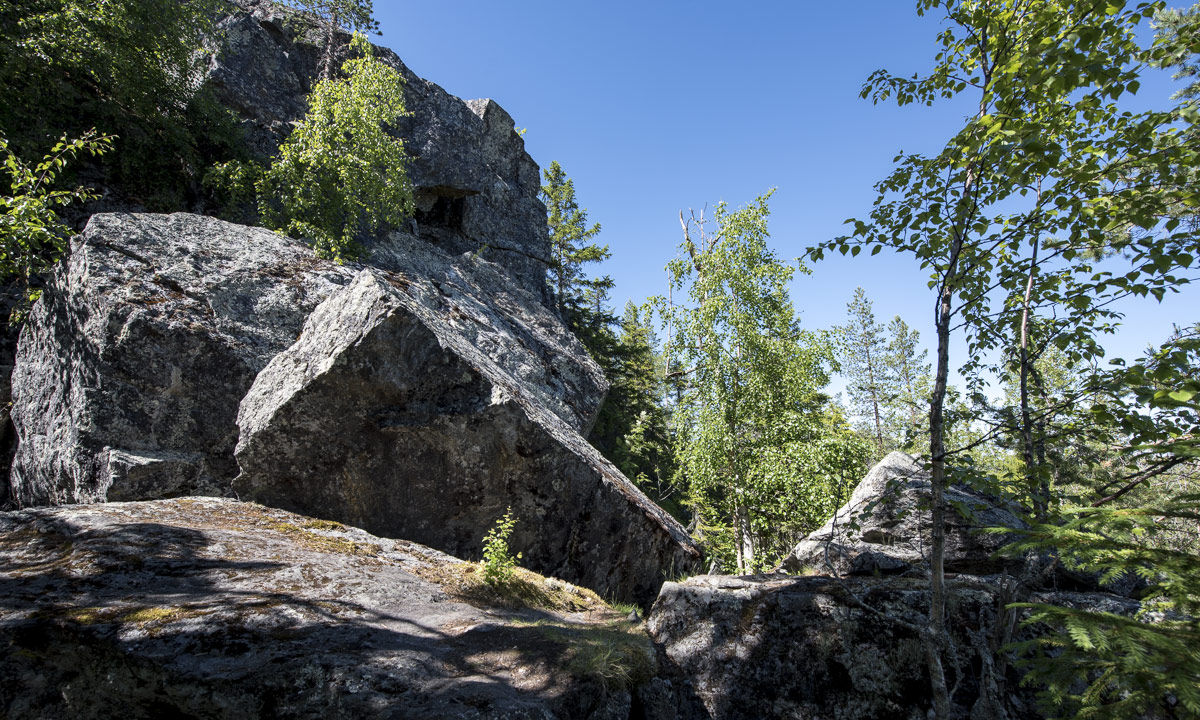
Skiing from Skelleftehamn to Skellefteå

In summer 2015 I tested the Kraftleden, which connects Skelleftehamn, where I live, with the town of Skellefteå. I’d found it not worth to go, since it was both a bit boring and in bad shape (thickets, boggy ground …).

Anyway Kraftleden was originally a cross-country ski trail, not a hiking trail and when I read that the trail is well-prepared for the Kraftloppet – a cross-country ski competition that takes place next weekend – I thought about giving it a second chance, this time on skis.

I started at the very same starting point as 20 months before. Temperature was round -13 °C, perfect for skiing.

After I followed the scooter trails some hundred metres I reached the electrical power line, name giver of the Kraftleden and starting point of the well-prepared ski trail.

(Power line in Swedish is “kraftledning”, which sounds quite similar to “Kraftleden”, meaning “the power trail”.)

And that’s what the first part of the Kraftleden looked like: A straight on ski trail under a power line. As in summer I found it a bit boring but the fantastic prepared ski trail compensated the slightly dull surrounding. I cursed a bit, because my own cross-country skis are really old and sooo sloooow. So I decided to ignore the fact, that I was slow and moved like a troll and to enjoy the great weather instead. And weather was just great!

Perhaps two hours later I could see the first houses of Morö backe, a district of Skellefteå, but it took me almost another hour (including finding the right way), until I finished my tour at Vitberget, Skellefteås ski centrum.

Now I unmounted my skis and took a promenade into the center, where I visited a friend, had a lunch and then took the bus back to Skelleftehamn.

Conclusion: The Kraftleden is nice to ski in winter, when prepared. Today I went it the first time, but definitely the last time with my ancient skis. I have to buy new ones.


Winter on the Vesterålen

This article is part of the series “2017-02: Northern Norway”.

I’m sitting in a small mobile home in Nordnes near Røkland, Saltdalen, Norway. This morning Annika and I left Haukenes on the Vesterålen, where we had visited friends for some days. It had been gorgeous days, not only because it’s always fun to visit friends, but because of the fabulous winter weather we got those days.

Arrival

Last friday we left the Hurtigruten ship in Stokmarknes that we entered in Vardø two days before. My friends told us that there hadn’t been any snow one week before, but since then almost half a meter snow had fallen and snowfall hadn’t stopped yet.

Saturday

It snowed another ten centimetres the night and it continued snowing in the morning.

Sometimes the Norwegian weather forecast is right and so it was this day: As predicted it cleared up and promised to be a nice and sunny day later on. Annika and I took our skis and joined J. and B. together with Frits, the dog, on a ski promenade right behind their house . J. and B. returned after a while, we continued through the forest to the boggy valley Dalmyra over which we returned. Two small streams we had to cross with our skis but they were narrow enough to be crossable without problems.

Back again I looked at the snowy mountain range of the Lofoten that you can see from my friends house. The sinking sun changed colours of the snowy peaks every moment, from bright white to pale yellow, to “peach”, to orange, to colour shades I’m not able to name.

Sunday

Another sunny day awaited us. Annika and I planned to ascend the Hovden, a mountain, not high (285 – 323 m) but steep. So we left home our skis and took snowshoes, first to hike on snow covered ways and paths to Marka, were we went up the Hovden. Phew, that was quite exhausting.

Annika went back while I continued a bit, first along the waymarks, then using my GPS.

I just love being above the treeline in Norway, where the view is wide and includes snow covered mountains and solitary trees just as blue coloured open fjords.

I descended the top and came to the small lake, where I took a break with water and „Kvikk Lunsj“ chocolate.

The descend from the lake was far from being optimal, I chose a very steep passage and it took a while and some concentration until I was on sea level again, were I walked back to my friends house, first on a minor road, than across a snow covered bog.

Monday

I might bore you, but even this day the weather was fantastic. Annika and I followed a tip of J., took the car to Sandnes and skied to Årneset, a place by the bay Årnesbukta. Here’s a cosy cabin were you can seek shelter, when weather is bad and a row of beautiful sandy beaches. I never ever skied along sandy beaches and open water and I really enjoyed this ski premiere.

Tuesday

Our last day on the Vesterålen and guess what: Weather was great again! Anyway I was quite lazy, so Annika and I didn’t use skis or snow shoes but the car to drive round the southern part of the island Langøya on which my friends – now our friends – live. Some impressions:

That was our last day on the Vesterålen. Thank you, J. and R. for your hospitality. I hope, you’ll visit us in Sweden someday. You’re more than welcome!

Tomorrow we’ll continue our return journey, first 40 km to the Norwegian—Swedish border, than round 380 km home to Skelleftehamn.


4×4 winter impressions of Kirkenes

This article is part of the series “2017-02: Northern Norway”.

Kirkenes – the harbour

While Annika and our friends in Kirkenes enjoyed their breakfast in the Hotel Thon I took a short promenade along the Johan Knudtzens gata to take some pictures. Already the view from the hotel terrace over the fjord is quite impressive and shows the beauties of the arctic nature while the harbour shows the more practical sides of living here: fishing, both commercially and just for fun.

A hike onto the top of the Lyngberget

After the breakfast we took the car to Jakobsnes and a bit further to take a promenade up the mountain Lyngberget, which lies on the other side of the Bøkfjorden. Here you can have a wide view over the whole town of Kirkenes – at least as long it doesn’t snow, as it did on our way back. I just love these wintry landscapes where you have views over fjell and fjord, but the wind was quite chilly and soon we looked like the participants of an arctic expedition.

The Huskies of the Kirkenes Snowhotel

Today we played tourists and visited the Kirkenes Snowhotel, which is just some hundred metres away. The Snowhotel has 180 Huskies including the seniors plus 30 puppies. The huskies are like we humans – some are working, some are resting, some are curious and some are shy. But they are all very kind and friendly.

Inside the Kirkenes Snowhotel

I slept in tents, in igloos and outside in wintertime. I even slept in the Kirkenes Snowhotel two years ago. This time Annika and I enjoy sleeping in the inside of our friends house (Thank you for your great hospitality, Christine and Ørjan) but gave the Snowhotel a visit. And it was worth it – especially the lounge with it carved ice blocks is very impressive.

Tomorrow we’ll leave this fine place, take the car to Vardø in the North (yes, that’s still possible!) and take the Hurtigruten from there to our next destination.

Winter Paddling

Yesterday I haven’t had the time, but today I finally opened the paddling season 2017. Normally I would expect the Baltic Sea to be completely ice covered at this time of the year, but warm and windy weather has prevented that until now.

First I was unsure whether I should paddle today because of a wind warning (more than 14 m/s), but when I looked at the Baltic Sea this morning the wind already had calmed down. Some hours later my kayak lay on some old ice floes ready to depart.

I put on my waterproof neoprene suit, entered the kayak and started to paddle along the icy coast. It felt a bit like late April – open water, hardly any snow left on land, just -2 °C and only the coast was covered by a thick layer of old ice. That impression changed when I came to the Bredskärsviken between the mainland and the islands Klubben, Bredskär and Norrskär. Here the water surface was covered with ice. Not with large ice floes as in springtime, but with crushed ice of all thicknesses between 1 mm and 15 cm. I entered the zone of crushed ice which made my kayak bumping against some thick underwater ice floes I didn’t see in time but soon I was amidst the drifting crushed ice.

It took me some minutes to leave that ice zone, even if it was only some meters to the open sea. I continued paddling southeastward along the rim of the drifting ice. I could see two people crossing the solid ice between the island Bredskär and the mainland. The ice on that part of the Bredskärsviken had been solid for weeks since it is sheltered by the wind.

… in contrast to myself. I felt the wind freshen more and more and the waves got more and more vivid when I paddled along Klubben heading for the island Flottgrundet. Here I decided to cancel the tour and to turn back. Probably a good idea, because now I really had to work against the high wind. You could see the wind blowing tiny ripples onto the already wavy water and more than once I got my face sprayed by water and wind. I couldn’t rest longer than for four seconds without floating back and the thick neoprene of my drysuit may be great for staying safe but not for a workout like this. Soon I was quite exhausted.

Finally when I was almost back ashore I “parked” my kayak in the drifting ice to make some more photos. The ice stopped me from drifting back. Next time when I’m in the need of a rest period I shall remember that.

In this segment the crushed ice was some centimetres thick. Because of the waves had been constantly pushing and pressing the ice together parts of it stood upright. An odd view.

The last stage of my short kayak trip was less exhausting since so near ashore the wind was less strong and soon I was on land again. A nice first kayak trip 2017.

What happened next?

  • I undressed the neoprene suit, put on pants, boots and a softshell jacket
  • I put on the belt with an attached rope and carabiner
  • I pulled the kayak over the ice and up the embankment to the street where I put it on the cart
  • I fixed the carabiner to the kayak and went home pulling the cart with the hip like a five meter long red dog
  • Home again I hung up the neoprene suit for drying, changed clothes and had a meal

Sport

I do ski tours with pulka in Lapland, I paddle in the wintertime, people following my blog must think, that I’m quite sporting and athletic.

Hahaha! Hahahahaha! HAHAHAHAHAHAHAHA!!

I’m not kidding. My weight is way more than average, my condition is poor and some of my muscles show less activity than a sloth hanging in a tree.

The good thing: It’s possible to change substandard fitness and that’s one of my big issues for 2017. I started to exercise daily – not much yet, it’s more to get used to it than to optimise training – and I started to do cross-country skiing. Kind of real cross-country skiing.

Normally when I ski I take my fjällskidor – my nordic touring skis – and go my own way through nature. This is great for outdoor experiences but it’s more like going for a walk than like something you could seriously call “sport”. On the other side I have to admit that I found skiing in a readymade cross-country ski trail always quite boring.

Well, it’s not boring any longer when you try to be faster. Beside of my poor condition I realised  that my ski technique is quite basic, too. That’s why I started cross-country ski school in Skellefteå this week. Hopefully they will help me improving my technique. Of course we have to train by ourselves between the lessons.

There are worse things than practising skiing when the weather is as fine as it was this weekend: Blue sky, hardly a breeze and temperatures round -15 °C. Perfect conditions! So Annika and I tried some ski trails in and round Umeå. I really liked Olles spår, which is round 10 km and extremely easy terrain. When we arrived yesterday morning we looked at the parking place. It was stuffed with cars and skiers seemed to be anywhere – waxing the skis, warming up, preparing. We learned that there was a competition on Olles spår but that we could use it anyway. And so we did.

I tried to use better technique and to be faster as usual, which was both exhausting and refreshing. For the first time in my life I had the feeling I would do some cross-country skiing instead of taking a promenade just with skis attached to my feet. Anyway, most of the people were twice as fast with half the effort.

Much room for improvement …

Today we looked for ski trails round Strömbäck-Kont which I like for the beautiful scenery. Anyway we didn’t find a good one. The first place didn’t have a ski trail at all, the second place had one, but it was quite poor, since there was much less snow than in the town of Umeå. So we continued to the forest Stadsliden, and checked one of the trails there. Really nice, too, especially since it is in the city zone of Umeå. There were many skiers too but it never felt crowded.

And now to something completely different: The Baltic Sea starts to freeze over again. I had been ice covered before this winter but strong winds broke the ice cover apart.

I had a look in Skelleftehamn this evening and could see the moon was reflected on a thin layer of blank ice covering the Baltic Sea. The same view in Strömbäck-Kont some hours earlier: Ice covered rock coast and a thin layer of fresh sea ice – less than two days old – stretching from shore to the horizon.

So: no paddling tomorrow, it’s winter.

The first days of new year

The weather on 30 December was just awful: +8 °C and rain! That’s not at all the weather that you want to present when you expect friends from Germany who want to stay here for a week full of Scandinavian winter experiences! Even New Year’s Eve it was warm, the snow on the streets turned into wet ice that was so slippery, that it was hardly possible to move without spikes under the boots. But finally the sky cleared up, we could see bright and beautiful Northern Lights and it started to get colder.

Yesterday we went to the coast and crossed the ice to the island Storgrundet. At the outside of the island the Baltic Sea was still open with one a bit of icy slush drifting on the surface.

I’ve been at the coast quite often, it’s not very special for me even if weather and ice varies. Yesterday afternoon however we made something I never did before since I’ve lived in Skelleftehamn: We grilled sausages and stick bread over open fire. It had started snowing a bit but it wasn’t too cold with temperatures round -7 °C.

5 cm of snow fell over night. Medi, Annika and I drove to Vitberget to enjoy the first cross country skiing in 2017 today. It was colder than the day before, between -10 °C and -15 °C. After we finished our tour it started to snow.

It’s great to be outdoors, it’s great to meet good friends, but the combination of that is just marvellous!

The Sunmountain

I have stopped counting the times I was in Solberget, the beautiful wilderness retreat in Swedish Lapland. This time I was asked if I want to join a three day first aid course in Solberget. Since my last one was long ago I accepted gladly.

The course, arranged by the German Outdoorschule Süd, was both intense and fantastic and I’m glad that I was able to participate. I stayed another day after the course to make a ski tour. It has snowed quite a lot in Lapland in November and round about 60 cm of snow covered the forest soil. I started the tour at 8:30 – an hour before sun rise. The air was crisp and cold with temperatures round -15 °C. I borrowed a pair of wooden Tegsnäs skis. They are long and broad and fit to every boot which makes them ideal for the powdery snow in the Northern forests. I crossed the street and entered the narrow forest path that leads to the hill which bears the same name as the wilderness retreat: Solberget – the Sunmountain. I crossed the Solbergsvägen, which was covered with a half metre of snow and soon went slightly uphill through the old forest with its mighty spruce and pine trees.

Even though I didn’t take the smoothest way up it didn’t take long until I arrived at the top of the Solberget, which is 459 meters above sea level. I ignored the cozy mountain hut and went straight to the old fire lookout tower which provides a unique 360 degree view over the landscape.

As fastly as I arrived at the tower as slowly I climbed it, since the handrails and the steps of the three ladders were covered with a thick layer of hard and crusty snow. Finally I was on the top of the tower, just in time to see the sun rising above the hilly horizon.

I stayed on the tower for more than an hour, happy to see the snow covered trees in the warm and ever-changing light of the low hanging winter sun. First the sun got free of the clouds and started to illuminate more and more of the scenery. The colours changed from a pale pink to shades of orange and many other colours I don’t have any name for. After a while a cloud layer approached from the north changing the mood of the landscape again. At the end almost the whole landscape was shadowy beside of the fog that still hung above the swampy areas in the southwest.

Finally the sun vanished behind the cloud layer. I climbed down the three ladders of the tower and continued my ski tour. First I headed southeast, then I turned more and more to the right while I descended the hill. After a while (and a bit of squeezing through the pathless thickets) I reached the Solbergsvägen again, however more in the south. This part of the path was completely untouched beside of a track of a hare that you still could guess under the fresh snow of the last day.

After a while I came to the turn-off to the swamp Solmyran which I followed a bit. The sun was low again and illuminated the snow in bright orange colours, while the snow in the shadows looked more blueish. There are many colours in winter, you just have to go out to spot them.

The photographer and his studio:

Links

I can highly recommend both a stay at Solberget and the first aid courses of the Outdoorschule Süd. In February you can combine the two, if you can speak and understand German.

Kayak – is it a boat or a sledge?

Today I was out and did some canoeing. There was a special reason for that: Johan from Sweet Earth wanted to make a short film about kayaking in wintry conditions for Skellefteå kommun, the municipality of Skellefteå. He asked me whether I wanted to be the canoeist and I accepted gladly. Since the weather forecast looked good for today we planned to make the film today.

And the weather was good – it was fantastic! When I woke up at 6 o’clock, the sky was still dark but starry and completely free of clouds. The thermometer showed -13.8 °C – the coldest temperature in Skelleftehamn this season. I was curious about Storgrundet, where it happened to be open water the day before. How would it look like today?

Some minutes later I stood on Storgrundet’s boat bridge and lit my strong flashlight. As almost excepted the water has completely frozen over last night and the rim of the new ice was about 3 cm thick. Too thick to break through with my kayak. Anyway, it could be less thick a bit farther away, I considered.

At 7 o’clock Johan arrived and we discussed the possibilities:

  • Plan A: starting at the Lotsstation farther away, where there’s open water and probably no ice at all, but perhaps less motives.
  • Plan B: trying to start at Storgrundet, where it might be impossible to kayak, but it would look nicer. And there would even be a Plan B2.

We decided for Plan A. I fetched the kayak from the garage and pulled it through the deep snow to the street where I put it onto the trolley. I pulled the kayak to the beach while Johan followed by car filming. Soon I arrived at Storgrundet’s parking place, but not Johan. Some minutes later my phone rang: Johan’s car got bogged down in the snow and he had to shovel it free. I returned to give him a push. Luckily his car was free soon again and we arrived at Storgrundet for sunrise.

I took off my winter anorak and slipped into my waterproof immersion suit – ugly but vital. I removed the kayak from the trolley and pulled it to the end of the boat bridge. Near the shore and round that boat bridge the ice was white, it was older and thicker. Some metres away it was transparent and you could see the sea bottom. That ice was less than 12 hours old. I positioned the kayak at the rim of the white ice that bore my weight and entered slowly the fresh ice. It took just some steps and – Splat! – the ice broke and I stood in chest deep water. Well, that came not unexpected. That’s why I had the waterproof suit on and my isdubbar round my neck.

“Isdubbar” or ice claws are sharp spikes with handles. These are attached to a cord to be worn round your neck. If you fall through the ice you can use the spikes of the ice claws to pull yourself out of the ice hole back to safety. A must have when going onto the ice in early winter or unknown terrain!

I managed to crawl onto the ice even without the ice claws, because the immersion suit has so much buoyancy. I put the kayak onto the little ice hole and climbed in. Unfortunately the kayak wasn’t heavy enough to break the ice. I tried and pushed, wiggled and jiggled until I managed to forge ahead perhaps ten meters. Anyway I only succeeded into bending down the fresh and soft ice, instead of breaking it. Since the paddle had zero grip on the wet ice I couldn’t steer at all and turning was completely impossible. Finally I gave up and pushed myself backwards with the glove protected hands.

When I came to the older and slightly higher ice I was kind of trapped. I couldn’t push myself backwards hard and fast enough to come up onto the safe ice surface. I tried several times and at last I just left the kayak – Splat! – went through the ice again, crawled onto the safe ice and dragged the kayak back to the boat bridge.

The result: Paddling on ice: round 25 m. Paddling in water: 0 m. Baths taken: 2. Photos taken: zero. I hope, that Johan filmed my abortive efforts. It will make me laugh watching it.

But as I said, there was Plan B2:

500 meters to the northwest the Baltic Sea is not in the lee of the island Storgrundet anymore. Here at the bay Flunderviken it usually takes much longer for the water to freeze over. While Johan had to take the save way on land I could go straight ahead by crossing the ice with my kayak in tow. First I had to plunge through soft ice and water again but then the ice was of the older and stronger kind and it was easy to get ahead. I knew, that Johan would be slower and I would had time to make some pictures.

Anyway even Plan B2 was in danger: Flunderviken was iced, too. At least I could see open water 100 or 150 meters ahead. Perhaps the ice would be weaker and I could go through the ice howsoever and reach open water. But first I had to wait for Johan who had to stomp through more than knee-deep snow to arrive. Time for another photo, time for going through the ice again, this time only knee-deep. Even here the ice was 3 cm thick – too thick to paddle.

Soon Johan arrived and I made my reservations. I didn’t believe in “ice-paddling” that far. Johan got an idea: Wouldn’t it possible to use the ice claws to push oneself forward? Well, I could try. The idea appeared to be brilliant. It was quite easy to push oneself forward, even it was hard work for my non-existing arm muscles. It went great until the ice got weaker and the kayak started to break it. Here it was hard to reach ice solid enough to pull oneself forward with the spikes. It took a long time and I had to take breath several times until I reached the last meters of the ice cover where ice was so thin that I could use the paddle again and finally I was free. Hip, hip, hooray!

Now I was able to paddle freely as on a warm summer day. Beside of the floating ice needles. Beside of wearing my heavy immersion suit. Beside of the snow that covered all shores. Beside of the ice crust on my kayak …

And beside of my exhaustion because of the struggles traversing the ice. Anyway I wasn’t here for a long tour but for being filmed. I didn’t want to get too far away from Johan who was landbound. Therefore I took just a short round and made some more photos before I started back.

I followed my old route where the ice already was cut and it was much easier to get ahead. Soon I reached the thicker ice – first still cracking under the weight of me and my kayak, then thick enough to bear us without any complaints – and then the shore where I had to plunge in into knee-deep water for the last time before I went ashore.

Conclusion

It was great fun testing out the limits of winter paddling in Skelleftehamn today. It won’t be the last time that I do such. However this is only possible with proper equipment. Without immersion suit or dry suit, isdubbar and such this tour wouldn’t have been possible at all.

So, folks: Be crazy and be safe!

And – as promised – the link to the video.

Taking advantage of the sun

Yesterday I took the car and drove to Umeå. The sky was blue and the sun was shining. Sounds nice, right? Well, it was nice but hard to drive. The sun melted the frost on the asphalt and the wet street reflected the low hanging sunlight. Sometimes it was really hard to see anything other than just a glaring white nothing.

Today the sky was blue and the sun was shining again. Sounds nice, right? Today it was nice since Annika and I took a longer stroll through the forests near Strömback south from Umeå.

The temperatures were above zero, but parts of the ground were still frost covered. We followed a path between Tjuvvarpet – a lake – and Matsund – part of the Baltic Sea. Anyway you could see neither lake or sea from the path since the forest was too dense and hid the waters which were just 100 meters away.

On the way back we made a short rest at a place on the lake near the hill Tjuvvarpberget. Most of the lake was still free of ice but near the rocky shore you could see the first covering of ice. It almost looked a bit wintry.

Apropos winter: If the weather forecast is right we will get at least 30 cm of snow in Skelleftehamn within the next eight days. Nevertheless I’m quite sceptical. Just two centigrade warmer and it will all pour down as rain.


Kayaking in the sunrise

“BING-BINGA-BINGA-BING-BING-BING-A-BINGA …!”

… yells the alarm on my mobile. I open my eyes, still partly caught in my dreams. Then I realise: It’s 5 o’clock in the morning and I’ve planned a paddle trip today. Out there it’s still pitch black and reluctantly I get up and get some breakfast. I’ve already packed the day before: dry suit – neoprene boots, gloves and hood – camera in a waterproof bag – water and chocolate. The compass and the live vest are already in the kayak. I leave, pulling my kayak behind on its trolley and the temperature is -4.5 °C – the coldest day since April. Round half an hour later I’m ready to start the tour. The sun hasn’t risen yet and some pink clouds hang in the blue sky.

At the sandy beach I drag the kayak into the water, lay the paddle on both the boat and the shallow ground to avoid tipping and climb in. I do some strokes, unfold the rudder that helps my steering the kayak and turn right. It’s low water and much more stones and rocks are visible as usual. I turn right again to paddle between the island Brambärsgrundet and the mainland. After that I turn left again and see the horizon and an archipelago of stones. I have to make my way through and more than once I hear the typical clicking sound, when the sea is so shallow, that the rudder at the rear touches ground and is lifted up.

The colours start to change: From light pink to something you could call apricot to warm orange. And then the sun starts to rise. It’s not that I’ve never seen sunrises before, but still I love to watch.

The sun rises a bit higher and starts to illuminate the colourful trees on the island Storgrundet which I’m approaching. Before I reach that island I turn right again and head to the open water. All I see in front of me is water, waves, the sky, clouds and midmost: the horizon. It looks like I just could paddle straight ahead to the horizon for ages. Probably it would take ages: it’s round 150 kilometres to the Finnish mainland.

So I turn left again and paddle along Storgrundets outer shoreline, go round the western peak and to the same beach were I started my tour one and a half hours before. A quite short, but pleasant kayak trip.

I go ashore and drag the kayak to the beach. It’s still below zero. The spray water on the kayak is frozen and there’s hoar frost on leaves and wood, especially in the shadowy places.

Now I exchange the dry suit for pants and jacket and the neoprene hood for a woollen cap. Dry suit and such is great for protection in case of falling into the cold water, but the “normal” clothes feel much more comfortable. I make a last photo of the beach and the island Storgrundet in the back, then I return home dragging the kayak behind.

At 9 o’clock I start my normal work.

“New Year’s resolution”: Be more outdoors in my everyday life, even if it’s short.