Arctic preparations

Have a look at these two images. They have something in common.

Both are related to my participation in the Arctic Ocean cruise in June. After the Nansen legacy cruise last year this will be my second scientific cruise to the Arctic with the Norwegian Polar Institute. And this time I’ve got extra tasks.

1. Drone flying

A scientist asked if I could fly a drone to map the ice stations. I didn’t have any experience in drone flying so I bought a private one to practise some weeks ago. In addition to that I made the Norwegian online course in drones (class A1 and A3) and the exam. Now I’m registered as a drone pilot in Norway, both in private and for the Norwegian Polar Institute. That was the easy part.

The interesting part starts when I shall take photos with latitude and longitude information from a drifting ice floe. But I’m not there yet (and quite happy that I have another month of preparation).

The drone photo above was taken in Norway. In Sweden it is a lot of paperwork to get permission for the publication of photos, especially when they show the sea as well. In Norway this is not the case, as long as you know the legal rules and restrictions.

2. Ice chart and weather info

To help both the cruise leader and the crew with planning it will be my job to provide them with current information. That’s ice charts coming from a SAR satellite and weather forecasts for e.g. wind, temperature and pressure. The data will be presented using the Open Source Geographic Information System QGIS. The screenshot above is just from a small learning session where I loaded in quite unrelated data as a topographical map of Svalbard, an ice chart from two days ago and current wind information.

The interesting thing will begin when we head north, leaving Svalbard behind. Then we do not have internet access anymore except sending and receiving emails through the slow and expensive Iridium network. So I cannot use all the cool QGIS plugins to gather data directly but I’ll have to send data requests per email and then receive the data later. This will be both interesting and challenging. I’m somewhere in the middle of being quite excited and pretty nervous.

Anyhow I wanted to have jobs and tasks and I’m glad I get the opportunity in a more active role than last year, were I was more like an observer. I guess, I’ll learn a lot.

Arctic Ocean, soon I’ll come!

Tussilago in Tromsø 2023

Yesterday I wrote I would write about Tussilago in Tromsø as soon as i see it. This morning I saw the typical yellow blossoms on my way to work. First a dozen, then a hundred, then a thousand. As early bloomers they apparently don’t have a problem with snow.

Addendum

Even some steps away from my doorstep almost hidden by the snow I found Tussilago.

Winterly Kvaløya

What a misjudgement! Since it was warm the last weeks I didn’t expect so much winter in Tromsø and around. It was a mistake not to take skis or/and snowshoes with me, when I visited the neighboring island Kvaløya today. And here everything was still snowy. Very snowy. So for example the tombstones on the graveyard in Henrikvik. Or a fence nearby, where only the edge looked out of the snow.

How many tombstone there are around? Hard to say. Some of the larger ones were quite visible while other parts of the graveyard were just a white sheet of snow. I’ll have to check in summer.

Although the temperatures were sub-zero the road by the coast was wet and free of snow. This changed when I turned into the road to Sommerøya, the summer island. Although the road is just 150 meters above sea level it was snow covered. During the snow showers it was hard to see the roadside and I slowed down a lot for every car that came my way.

Some other cars parked at the different parking places. Two skiers just started a tour. But I could hardly spot any fresh ski tracks and even some of the avalanche transceiver test station were quite snowed in. No wonder because parts of the lake Kattfjordvatnet are already open and the ice is not safe anymore.

On the other side of the water: a group of trees in the fresh, white snow. Not a single ski track could be seen. At least here ski season seems to be over.

On the other side walking through the snow is not the best idea neither, especially when there are deep, snow-covered ditches …

Back to Tromsø

Friday

This week spring has come to Umeå and Obbola. Temperatures above 15 °C make the snow melt every hour and the first Tussilago blossoms in Obbola peek through the dry, brown grass. I take a promenade wearing a t-shirt and in the evening Annika and I sit by our barbecue place. The very same place that was snowed in up the top edge three weeks ago.

Saturday

The alarm clock rings at 1:00 in the night. It’s a dreadful time to get up, but there is a direct train to Narvik with a bus connection to Tromsø and this train departs in Umeå at 2:12.

Near Bastuträsk, 3:57. The bogs look dull and depressing. – Gällivare, 8:12- It is snowing but everything is wet. How deep might the enormous water puddle on the parking place be?

The lake Torneträsk, 10:29. Here it looks like winter, but I wouldn’t dare to step on the lake any longer. Somewhere in Norway, 12:08. Fresh snow covers the birch trees.

We arrive in Narvik punctual to the minute. Half an hour later the bus to Tromsø departs. A local bus and I’m back at my “work home” in Tromsø. The journey took 16½ hours from door to door.

In Tromsø it looks wintry. The average temperatures were above zero for 18 days, but not it’s slightly subzero and about 10 cm of fresh snow cover my car and parking place.

Sunday

I wake up at 5 o’clock. Sunrise was an hour ago and the sun shines on the freshly fallen snow. – 3 °C. I put on some clothes and walk to the beach to take some photos. But then it’s time to sleep a bit more.

So it looks like winter is still present here. It may take a bit of time until I can see the first Tussilago in Tromsø. I’ll post a photo of the first wild flower as soon as I find one.

Moon, Venus, Aurora

I’m sitting in the train travelling home to in Obbola where I’ll stay for some weeks. First vacation, then work. It’s the first time since Christmas. Time to post some photos I shot in Tromsø last week.

While I was in Longyearbyen it snowed quite a lot in Tromsø. The official snow depths last week were round 130–140 cm.

That ended a period of slush, rain and icy roads and my walks to work had become much more pleasant. I love snow!

Then it cleared up. In the evening of the 23 March I could see the young waxing Moon and the planet Venus. And then the polar light came out. Perhaps nothing new but still beautiful.

Skitour on the Austeråsfjellet

Slowly I’m gaining height with my fjellski. It is sunny and almost windless. Round -6 °C. I seem to be alone. I start traversing a slope while continuing gaining height. I’m nervous. I’m not a downhill skier and every metre I ski up I have to ski down again somewhere.

Mission accomplished: I’m above the tree line. Above me the blue ski, below the white snow. And, while I go further I get another blue: The sea.

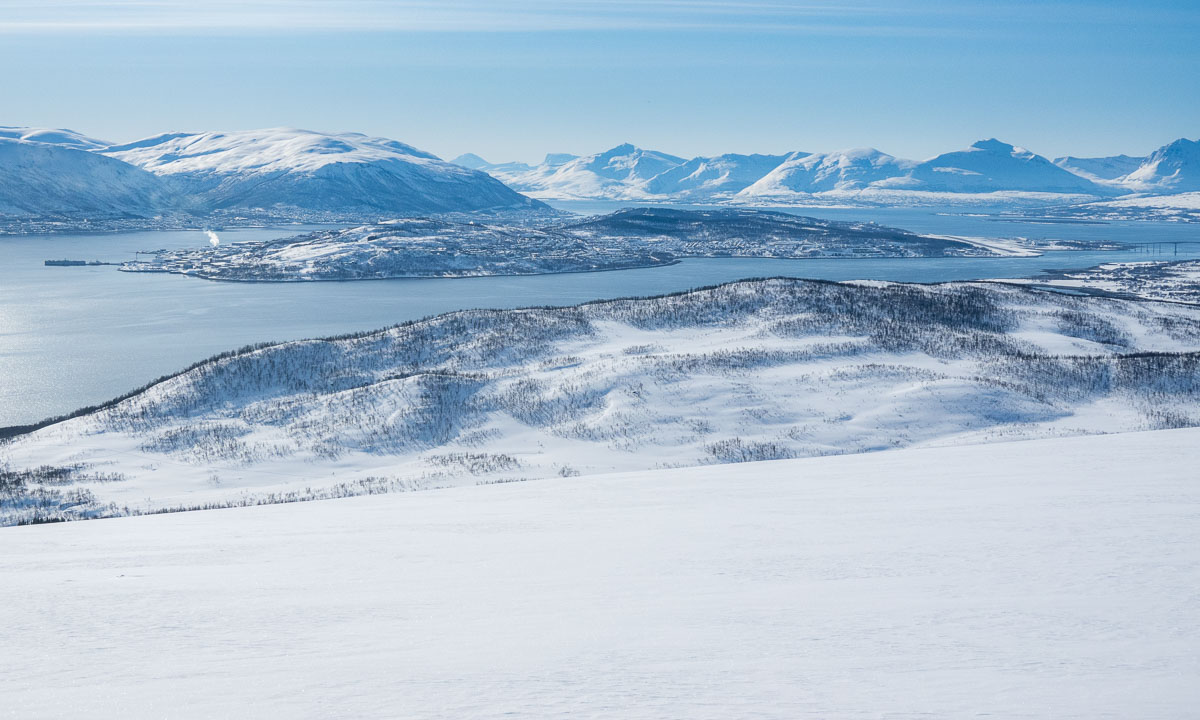
When I look back I can see the whole island Tromsøya. Somewhere over there in the south, hidden by the wooded hills is my small rented apartment.

I didn’t plan a route for today. I just wanted to be out enjoying the winter. But when a heap of stones marks a top and it’s easy to reach I have to ski there. Mountain summit 1: Kraknesaksla (ca.335 m). With a nice view into the sound Grøtsundet.

According to the map there are some lakes a bit down. The lakes are invisible. There is only snow. What I can see are the buildings. One small cabin and a wee, tiny shed with a wind turbine. The cabin is closed and I cannot see any sign. Probably it’s private.

I continue my ski trip. I have reached a vidda – a plateau.

Now I start to see other people. A single skier, a group of three going uphills, a skier with a dog in the distance. Most locals love to be outdoors but perhaps not as early as I.

I decide to ski to a mountain top I found on my map app Norgeskart. It’s called Jerremaš (467 m) and is a kilometre away. On the way there I see that the group of three heads into the same direction while two others are already returning. Seems to be a popular place.

And it is. I’m not alone. Several other skiers are sitting there, enjoying the sun, talking Norwegian. Almost all of them are 65+.

I look at the 360 degree panorama. There are snowy mountain chains everywhere, the sound Kvalsundet, the island Ringvassøya and somewhere in the northwest the Norwegian Sea.

How shall I continue the tour? Skiing downhills and letting the others watch how I fall face first into the snow? As I mentioned before, I’m not a downhill skier. The others are probably all former Olympic athletes. I decide to take a small detour …

I start to ski down. To my surprise the hills are gentle and the snow is soft and uniform. I manage to ski downhill the broad, snowy slopes and I’m enjoying it. Sometimes I even think, it is too slow.

Much faster than expected I leave the vidda behind. I pass the first trees and see more and more tracks – and skiers. Many of them are skiing on the prepared ski trail that cuts through the valley like a German Autobahn. Others just sit on a mat in the snow taking a break.

A hole in the snow triggers my curiosity. I ski there and look down. A shallow mountain stream flows down there. Open water. It’s comforting that the snow layer is more than a metre thick.

Now it’s only some more kilometres to ski back to the parking lot where I started my ski tour this morning. Although I’m avoiding the prepared ski trail it is obvious, that more and more skiers have been here the weekend. Ski tracks everywhere.

After round about 17 kilometres I’m back at the car. Pretty exhausted and thirsty but very satisfied.

Here’s a map from today’s ski tour. I went counterclockwise. Red is faster than green but still not fast. I’m not a downhill skier.
 

12 more photos of Longyearbyen

This article is part of the series “2023-03: Svalbard”.

3 March

It is the first evening of Annika’s and my stay in Longyearbyen, Spitsbergen, Svalbard. We already strolled through the settlement after arrival. Now it is dark but the full moon illuminates the end of the road of Nybyen, one of Longyearbyen’s districts. What a special feeling to be in one of the world northernmost settlements on Earth. And a slightly tense one. It’s the edge of town, are there any polar bears around?

8 March

When you are in Svalbard you have to keep distance to animals to protect them. The animals do not follow this rule. This is a Svalbard reindeer, an own species of reindeer living here. It is looking for food in the middle of the city.

9 March

I didn’t expect to see ptarmigans on Svalbard but on our guided minibus tour we get to see a whole flock, again in Longyearbyen. Magnus is so kind to stop so that I could take a photo from the road.

10 March

This day is quite warm for Longyearbyen: Only -8 °C. When I took this photo however it was windy. Average wind wind 16 m/s, gusts 21 m/s and snow is blowing in the streets.

12 March

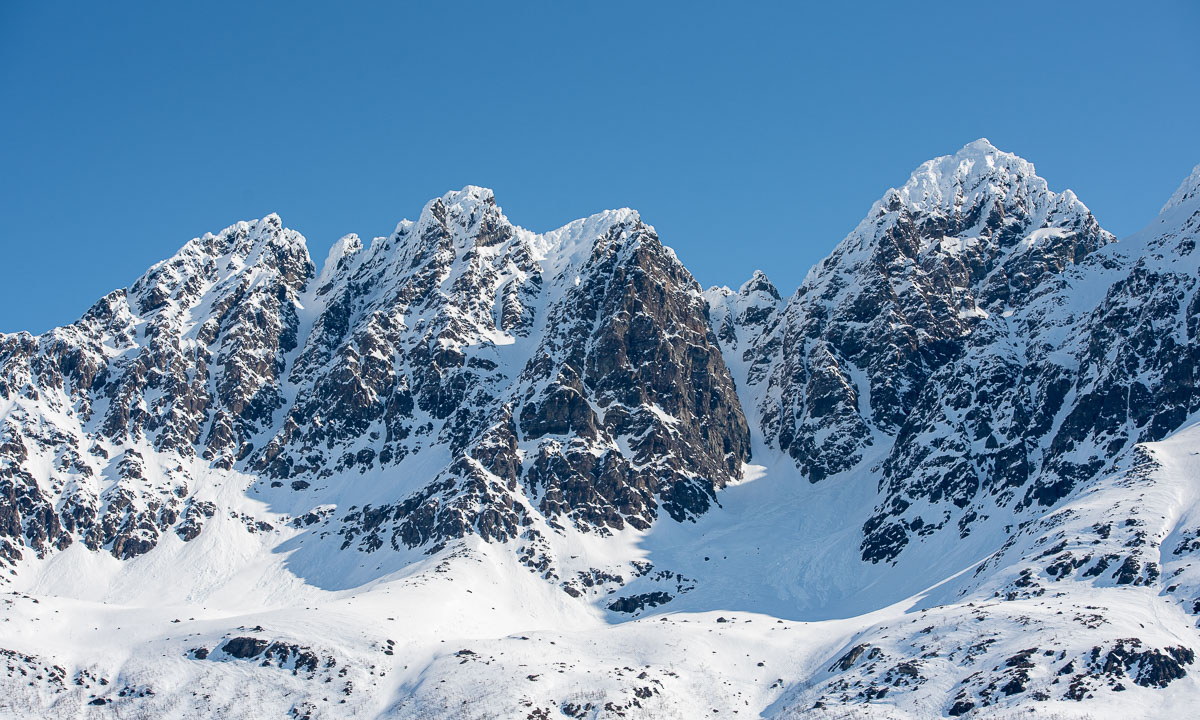
Annika is on her way home, I’ll stay for another week and today I enjoy the beautiful weather by the coast. The mountains on the other side of the fjord Isfjorden look quite near today – especially through the big telephoto lens.

15 March

I take an after work stroll along the coast and through town. It is cold and even with the modest wind of 6 m/s windchill is below -30 °C. It looks arctic, it smells arctic (the nose hairs freeze together immediately) and it feels arctic. No wonder – I am in the Arctic. Even the petrol prices show, that you are not in mainland Norway any longer. Petrol is cheap because Svalbard has reduced taxes.

18 March

Another walk in town. Up the hill to Taubanesentrale (the central of coal mining cableway), down to the center and up again to the elevated way in the east, part of the avalanche protection.

19 March

Sunday. Tomorrow I’ll fly back to Tromsø, today I’m quite lazy but finally I walk to the coast again because of the wonderful weather. Even with my hood on I can hear something above me. I look up and see the first two seagulls since I have arrived here. It is two glaucous gulls that draw large circles above the coastal line.

I try even to take pictures of the incredibly coloured mountains on the other side of the Isfjorden but the turbulences in the air make clear pictures impossible. I’ll keep it in my memory as I’ll do with my whole stay in Longyearbyen.


Farewell, Longyearbyen

This article is part of the series “2023-03: Svalbard”.

I am sitting in the waiting hall of Longyear Airport, waiting for my plane to Tromsø.

More than two weeks I’ve been here, first on vacation with Annika, then working for the Norwegian Polar Institute at UNIS, the University Centre in Svalbard.

I worked with Luke, data manager for the Nansen Legacy and had a guest office on the other side of his office in the biology section.

While my office may look totally normal, the view definitely wasn’t.

Some days at 9 o’clock I went to other side of the building to the Longyearbyen section of the Norwegian Polar Institute to have coffee break with my colleagues there.

In Longyearbyen you put out your outdoor shoes before you enter a building (with some exceptions as the local COOP grocery shop). And so it is at UNIS. You can clearly see by the shelfs whether people are at home or at UNIS.

Soon I will travel back to Tromsø and I’m looking forward being back. It was a fantastic experience to spend much time in Longyearbyen. Anyhow as a visitor you also realise the limitations as for example not being able to leave the town without valid rifle permit because of the polar bears.

Continental Europe – here I come.

Colder days in Longyearbyen

This article is part of the series “2023-03: Svalbard”.

Two days ago on 14 March 2023 it started getting colder in Longyearbyen. Yesterday temperatures were around -19 °C, today around -21 °C.

Yesterday I took a walk after work and took some photos with my tiny Sony camera that worked surprisingly good in the cold when being kept warm.

While light was beautiful yesterday, today it was magic. After work I went to my apartment. Round about 15 minutes later I left it with all my camera gear and went to the shore. Due to the interface between the open water and the cold air ice fog covered large parts of the Adventfjorden. While I looked for good places to take photos the setting sun and the altering fog changed the mood every minute. Extraordinary beautiful!

Like the days before the sunset colours on the snow covered mountains became warmer and warmer until they reached a delicate but intense purple shade while the sunlit parts rose higher and higher until only the tops stayed in the sun.

Remember, these photos were not taken in the wilderness, I’m in the settlement Longyearbyen and my apartment lies just 500 metre from the nearest photo spot.

As already mentioned today’s temperatures were round -21 °C. With a moderate breeze of 6 m/s that felt like -32 °C. Pretty cold and the ice fog didn’t make it warmer.


After work snowmobile tour

This article is part of the series “2023-03: Svalbard”.

This week I’m working at UNIS, the university centre in Svalbard together with friend and colleague Luke Mardsen. He is data manager for The Nansen Legacy. This week we collaborate on some of the software he wrote for this research project. Interesting stuff, but maybe not for this blog.

Today Luke invited me to an after work snowmobile trip up the glacier Longyearbreen. I borrowed a helmet, ski goggles and warm mittens from the Norwegian Polar Institute whose colleagues I had coffee break with today. Then I dressed like being in the high Arctic, but hey, I am in the high Arctic. Luke picked me up from the UNIS Guesthouse and then we started the tour. Luke was driving the snowmobile, I was sitting behind him. First through town, under the water pipes – duck! – and past Huset, where Annika and I had food ten days ago. Then we ascended the valley and then the glacier. Today we have had the finest whether thinkable: crisp, clear, blue sky and so we got to see the beauty of the sunset colours on the snowy mountains around as well as on the other side of the Adventdalen.

But beside of marvelling the beauty of nature there were other attractions waiting. Another ice cave, probably larger than that Annika and I visited a week ago and a bit more need of climbing. We got a tip of a colleague of Luke to visit a side room and it was astonishing. A large and high, beautiful room with a roof covered with large feather-like ice plates. I never saw something like this before. Without torches it was pitch black in the cave and so photographing took more time and efforts. I managed to take some snapshots anyhow.

After some exploring we returned and climbed up the ladders to the cave entrance. Now the blue hour had started and the light was less colourful but equally beautiful.

Back we went on Luke’s snowmobile. He in the front, I in the back. It was only two hours later when we arrived at the guesthouse again, but I had completely fallen out of time, especially in the ice cave.

I lack the words to thank you for this wonderful after work trip, Luke. See you tomorrow in the office.