Day 4 – a day on the ferry

This article is part of the series “2019-07: Southern Sweden”.

11 July, Turku—Stockholm—Jogersö

After our side trip to Finland we are sitting in the car and waiting to be allowed to drive on the car ferry Amorella, that connects Turku with Stockholm. Soon we enter the car deck.

We go up the stairs until we reach the upper deck. The journey takes eleven hours. While we wait for the departure another large ferry leaves Turku.

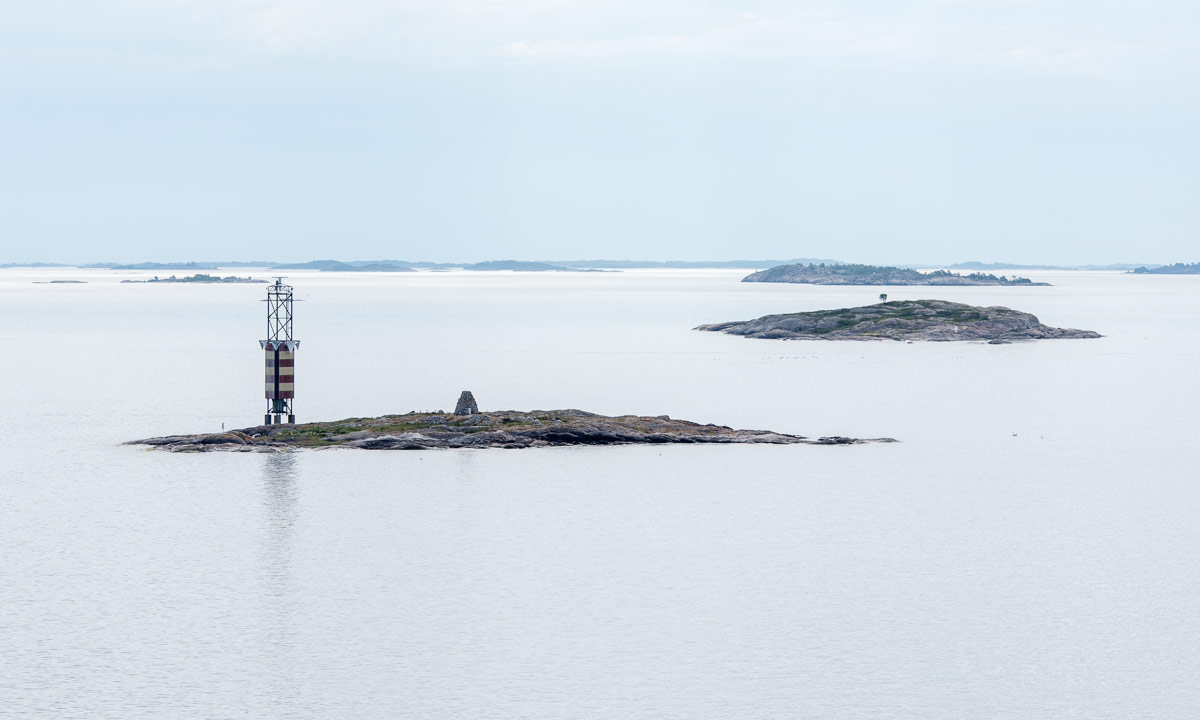
At 8:43 the ferry leaves. We drive through the Turku Archipelago that consists of more than 20000 islands and skerries. The large islands are wooded. Impressive wooden villas are hiding between the trees and small huts that look like carved are by the sea.

After a while we reach more open water. The islands nearby are smaller skerries, some wooded, some rocky.

While the islands pass by there’s a lot of entertainment inside. Bingo – minigolf – dance band – face painting for kids and much more.

At lunch time we enjoy the extensive buffet on board. Here is an expert of the menu. Although it’s Finnish some of the words like paprikaa or palsternakkaa are understandable.

The ferry makes a stopover in Mariehamn, capital of Åland. Here several ferries meet. They connect Åland with Sweden, Finland and Estonia.

Åland is an autonomous territory. Although it lies under Finnish sovereignty it is Swedish-speaking. At the terminal nine flags are fluttering in the wind. From left to right it’s:

Sweden, Norway, Greenland, EU, Iceland, Faroe Islands, Denmark, Finland and Åland.

After the stopover we continue our journey to Sweden. Sometimes it’s cloudy, sometimes it’s sunny and we can sit or lie on the top deck. There’s a small wooden platform right in front of the huge chimney that is perfect for sunbathing. We say goodbye to the islands of Åland and an open water passage lies before us.

After a while we see the first rocky skerry, the first trees, the first houses. We have reached the Stockholm Archipelago, that consists of ca. 24000 islands. We are back in Sweden and slowly we are approaching Stockholm.

Before we dock in Södermalm, we have to leave the top deck to enter our car. It’s Annika who is going to drive. I’m too scared to drive in Stockholm.

Our plan is to leave the greater Stockholm area as fast as possible and look for a campsite. Annika masters the chaos on the road behind the ferry terminal, where’s a big pushing and shoving. Priority rules? Who cares …! She masters the huge four-lane motorway, too.

South of Södertälje the traffic decreases. Now it’s only one hour left to Oxelösund where we want to look for a place to stay. We drive to the island Jogersö and arrive six minutes after the reception of the campsite has closed. Luckily the receptionist is still there and we are allowed to come in. All small cabins are occupied but there’s always place for a tent. So we put up our tent, eat bread and cheese and finally I have to take a bath in the sea before going to sleep.

When we lie in our sleeping bags ready to fall asleep it starts to rain. Just gemütlich!


A kayak trip shorter than expected

About neoprene suits, the post-glacial rebound and changed lunch plans.

Today I wanted to paddle to Själagrundet, an island 1.6 km from mainland. The air may be warm but the water is still cold and that’s the element you should be prepared for in case of capsizing. Today I decided against the bulky drysuit and chose a thin neoprene suit for the first time.

The suit is very tight (especially if you each too much chocolate …) and hard to put on. After I managed to squeeze myself into the suit and to close the back zipper it felt quite comfortable. Until I started paddling. It was much harder to move the paddle than usual because of the tight neoprene sleeves. Every paddle stroke felt like training with a rubber band. I got used to it after a while, but neoprene will probably not become my favourite choice of kayak clothing.

I passed the island Storgrundet and headed northeast. The waves came exactly from the side which is the worst direction regarding stability. So I zigzagged a bit to avoid the waves rocking the kayak too much. Nevertheless the island came closer and closer and soon I got out of the kayak and dragged it ashore. The seagulls didn’t like my arrival. Screeching loudly they rose in the air, sailed in the wind and didn’t dare to land as long as I occupied their private property.

There are many islands whose name ends with -grundet. From Skelleftehamn for example you can paddle to Storgrundet, Norrskärsgrundet or Nygrundet. The Swedish word grund means (among others) shallow, so the translations of the islands mentioned above are: the Large-Shallow, the North-Skerry-Shallow, the New-Shallow.

Who is to blame? The post-glacial rebound! After the last glacial period the glaciers started to melt. Slowly the land, that had been compressed by the huge weight of the ice sheet started to expand. It is still expanding and rising – round 8–9 mm a year. Therefore some islands are quite new. Själagrundet for example is hardly older than 100 years. They got their names from the old times when they weren’t islands yet but shallow underwater-banks that the fishermen had to take care of.

Today Själagrundet still is mainly a large gravel bank. Only on the higher eastern side plants had started to grow. Mostly it’s flowers, but two small bushes and a small willow tree have settled there as well.

I walked around and had a look at the 260 meter long island until I got hungry and wanted to eat my lunch – salad and a chocolate bar. When I looked at the dark grey clouds that seemed to approach the island I changed my plans. Did I hear the rumble of thunder? When I would be hit by a thunderstorm on this flat island without any shelter I could get into serious trouble. I checked the speed of the clouds and decided that the best option was to paddle back to mainland, now and quickly.

I had a fast start and paddled quicker than usual until half of the distance lay behind me. It was quite exhausting –remember the neoprene suit? When I realised that there was no immediate danger of thunderstorm and lightning I slowed down. I took my dinner on the island Storgrundet. A save place with summer houses and hardly 100 metres from mainland. Then I paddled back to the small beach at the mainland, took off the neoprene suit and had a refreshing bath in the Baltic Sea in the sun.


White nights

Since the summer solstice on 21 June the nights are slowly getting longer again. Last night sunset was 23:21 and today’s sunrise 01:56. At this time I usually sleep.

I was extremely lazy photographing the last weeks, so I decided to ignore my tiredness and drive to the coast. This time I chose a new place I’ve never been before. I left my car at the side of the small gravel road that I had followed for some kilometres. I took my camera bag with the tripod and crossed the hilly forest until I reached the coast.

While photographing I decided to publish at least two photos in this blog, whether I like them or not. I have to admit that I’m not so content with the result, but anyway, here are two shots of last night. Both pictures are taken in the last minutes before sunset, the first 22:59, the second 23:12.


Fog in Skelleftehamn

Yesterday fog patches pulled up from the sea. At the coast was quite dense and hid anything further than 20 meters away.

But fog does not only hide things farther away, it also reveals other things nearby. For example the many spider nets in a small bog nearby.


Colours above the Luleälven

Yesterday evening. We are at Storbacken near Vuollerim in Norrbotten, where we visit friends. They live in a house by the large river Luleälven. It’s a bit chilly outside but we still sit there, enjoy the fresh air and try to ignore the first mosquitoes.

I haven’t planned to take pictures but the warm evening light on the forest on the other side of the river becomes more and more intense. Two whooper swans paddle along the river. And finally, half an hour later there appears a rainbow and hovers above the Luleälven like a huge airy bridge. Beautiful!

This morning. I sit in the living room while the fire in the fireplace warms up the room. Outside it’s 3.5 °C and it has been raining the whole night and the whole morning. That’s two of the many sides of Sápmi, the region of the Sámi people.

Two ways of paddling

Between these two photos lie 4 weeks and 620 km. I made the first one on a kayak tour in Skelleftehamn late April. The second one I took in Stockholm last week. (And no, I didn’t paddle the whole way.)

It’s no coincidence that I have called my blog way-up-north. I’m more often in Kirkenes than in Stockholm. There was however an important reason for travelling south to the capital of Sweden. I need a new passport and the only possibility to apply for it is in the Embassy of Germany in Stockholm. I was a bit nervous that I would have forgotten one of the needed documents as e.g. my birth certificate, but the documents were complete and anything went well. In a few weeks I will receive a letter with my new passport.

After the passport application I had some spare hours before taking the train back to Umeå and then the car to Skelleftehamn. It was warm and sunny and I decided to hire a kayak. I booked it for just an hour but it was fun to be on the water and see Stockholm from this perspective. On the tour before I used a dry suit for protection, this time I paddled barefoot and in a t-shirt. Nice!

I like Stockholm – it is a beautiful town – but I don’t want to live there. Beside of the ridiculously high prices for housing it’s too big for me. And of course way too south!

From Haparanda to Tromsø through the bus window

Four pairs of looking-through-the-window photos and a bonus proof photo

I’m sitting on my bed of room 223 in the Clarion Hotel “The Edge” in Tromsø. I’m here to join the Barents Press International Media Conference that will take place tomorrow and the day after. We from Skellefteå took a car to Haparanda at the Swedish-Finnish border already yesterday. Today we took the bus to Tromsø.

I took photos through the bus window, all with my Nikon D750 and an old 70-210mm/ƒ4.0 lens.

Pair 1 – along the river Torneälven

The Torneälven is the border river between Sweden and Finland. We drive on the Finnish side of the river. Almost all snow has melted and the river is ice free now. Sometimes large walls of ice floes lie along the riverbank.

Pair 2 – moorlands

We already have crossed the Arctic Circle. The coniferous forests are behind us and large moorland frame the road. It’s windy and temperatures are hardly above zero. From time to time it snows.

Pair 3 – winterland

The more up north we travel the snowier and more wintry the landscape becomes. We pass Kilpisjärvi and are in Norway now.

Pair 4 – fjords and mountains

Fjords and mountains – both are typical for Norway. And both can be seen from the bus. A lot of other participants have never been here before and the Oh-s and Ah-s do not stop. And they are right, the landscape is both beautiful and impressive. (… and quite unphotographable from a driving bus.)

Bonus photo

At 7 o’clock we departed in Haparanda, at 17 o’clock we arrive in Tromsø. Later I make some pictures from the roof terrace of our hotel. A Hurtigruten ship with the ishavskatedralen in the background. Take it as a proof, that I’m really in Tromsø.

Opening the kayak season 2019

Two days ago a personal weather record was beaten. It was almost 20 °C in Skelleftehamn. in April! In town 22.1 °C was measured, the warmest April day for at least 15 years. And that’s what my garden looks like: beside of a stubborn patch of snow in the shadow of my neighbour’s garage my garden is completely free of snow.

While the air was warm, the seawater was still very cold and I would not dare to paddle without a drysuit. I didn’t want to be boiled in the drysuit and so I postponed the kayak opening to today, when it was colder again.

When I leave the house at 8:45, it is 4 °C. My favourite starting point is still icebound, so I walk to the peninsula Näsgrundet with the kayak in tow. I use a belt and a rope to drag the kayak behind. When the kayak is balanced on the cart I have the hands free and can walk normally. 25 minutes later I reach the shore where I put on drysuit and life jacket. Soon I sit in the kayak and realise, that even though I miss winter there are fun things to do when it’s warm as well.

It’s colder on the sea and I put on my neoprene gloves and waterproof hood. As I expect some of the paddle routes are still blocked by ice. There is still ice between the island Bredskär and mainland so I cannot circle the island. I have to return. I pass a large ice floe – time to enter the floe for some minutes. It doesn’t move, probably it sits on a large rock.

I kayak along the islands Bredskär, Klubben and Flottgrundet, always along the open outsides. Then I head for the island Nygrundet, where I made a very special snowshow tour a month and a day ago. The ice heaps have vanished, only a long strip of ice follows the coastal line. Time to take a break and to have an early lunch. Crisp bread, cheese, fresh grapes and a bar of chocolate. I feel a bit cold and put on my lightweight down jacket, but I would have preferred my winter anorak. I even make a small fire on the ice but more for having it gemütlich than for additional warmth.

After the break I’m full and warm again. I pack my stuff and continue my kayak tour. I paddle along the outside of the islands Nygrundet and Gråsidan, where I make a short photo stop.

Then I continue to Bredskär, where some quite high ice walls are reminiscent of the winter.

I try to paddle between Flottgrundet and Bredskär but soon come to a large area of old and soft ice. I measure the thickness with the paddle – round 30 cm. I decide to walk over the ice and drag the kayak behind. First it works well …

… but then the ice gets softer and softer. Just some steps next to the island I break through. It is not a sudden movement, the ice just slowly gives way. Paired with the buoyancy of drysuit and life jacket that’s probably the reason why I only break in up to my chest. The hole is small and it’s a matter of seconds to get on the ice again. Carefully I take the last steps until I reach land.

Sea ice and lake ice have a strange way of melting in spring. The solid ice transforms to an array of long vertical ice needles. There is hardly any connection between one needle and the next and it’s not possible to lift larger pieces of ice from the water without breaking them. When you get out a smaller piece and drop it, it will splinter into many parts. The structure shown on the photos below is round 10 cm thick.

I continue walking, partly on ice, partly in shallow water. Then I can paddle again. But not for long. Soon I reach another ice field, this one looking very unstable. So I cross the ice by staying in my kayak and pushing myself forward with the hands. Ouch – the vertical ice needles hurt, even through the neoprene gloves. Alas it’s only 15 meters to cross, then I’m in open water again.

The rest of the tour? Slowly paddling back to the starting point – taking off the dry suit – putting on soft shell and down jacket because I feel cold – put the kayak onto the cart and attach it to the belt – walking home. The tour took 5 hours, 40 minutes. 5 km of walking, round 10 km of paddling. Here’s a sketch:

Legend:  on foot | kayak

Spring sprint

The warm weather of the last ten days has made the snow melt quickly. Many birds have arrived, among others swans, geese, cranes and northern lapwings. The first spring flowers are blooming and butterflies flutter around.

Some days before I still had up to 40 cm of snow in my backyard, now there are only some snowy patches left that probably will thaw away soon.

Even at Storgrundet – my favourite beach and one of the places where the sea ice uses to remain longest – the first large patches of open water can be seen.

Since most of the sea ice has been vanished I want to open the kayak season this week. I need however another starting point than Storgrundet. Even though the ice has holes, most of it is still thick enough to walk onto. I met a couple that crossed the ice to visit their cabin. The man told me, that he crossed the ice a week ago, too – by car!


Boats between ice and water

Normally I try to make a winter kayak tour as soon as parts of the sea are free of ice. Not this year. Either it was too windy or the sea was ice covered again or I was travelling.

While my kayak is still sleeping in the garage two other boats have already been taken out. I saw them in the afternoon but made the photos in the evening.

It may look like the sea is frozen again, but the transparent ice is floating freely. Look closely and you’ll realise that the second boat has moved while I took the photo and therefore is a bit blurred.

Although the boats are a clear spring sign the ice makes the photos look still wintry. Today’s day temperature however was round 10 °C and for the first time I jogged in a t-shirt.