Frost


Voilà, bon appétit!


(Finding the items of the third row was really easy. It’s almost the same I paddled along through the ice half a day ago.)
Today I was out and did some canoeing. There was a special reason for that: Johan from Sweet Earth wanted to make a short film about kayaking in wintry conditions for Skellefteå kommun, the municipality of Skellefteå. He asked me whether I wanted to be the canoeist and I accepted gladly. Since the weather forecast looked good for today we planned to make the film today.
And the weather was good – it was fantastic! When I woke up at 6 o’clock, the sky was still dark but starry and completely free of clouds. The thermometer showed -13.8 °C – the coldest temperature in Skelleftehamn this season. I was curious about Storgrundet, where it happened to be open water the day before. How would it look like today?
Some minutes later I stood on Storgrundet’s boat bridge and lit my strong flashlight. As almost excepted the water has completely frozen over last night and the rim of the new ice was about 3 cm thick. Too thick to break through with my kayak. Anyway, it could be less thick a bit farther away, I considered.
At 7 o’clock Johan arrived and we discussed the possibilities:
We decided for Plan A. I fetched the kayak from the garage and pulled it through the deep snow to the street where I put it onto the trolley. I pulled the kayak to the beach while Johan followed by car filming. Soon I arrived at Storgrundet’s parking place, but not Johan. Some minutes later my phone rang: Johan’s car got bogged down in the snow and he had to shovel it free. I returned to give him a push. Luckily his car was free soon again and we arrived at Storgrundet for sunrise.


I took off my winter anorak and slipped into my waterproof immersion suit – ugly but vital. I removed the kayak from the trolley and pulled it to the end of the boat bridge. Near the shore and round that boat bridge the ice was white, it was older and thicker. Some metres away it was transparent and you could see the sea bottom. That ice was less than 12 hours old. I positioned the kayak at the rim of the white ice that bore my weight and entered slowly the fresh ice. It took just some steps and – Splat! – the ice broke and I stood in chest deep water. Well, that came not unexpected. That’s why I had the waterproof suit on and my isdubbar round my neck.
“Isdubbar” or ice claws are sharp spikes with handles. These are attached to a cord to be worn round your neck. If you fall through the ice you can use the spikes of the ice claws to pull yourself out of the ice hole back to safety. A must have when going onto the ice in early winter or unknown terrain!
I managed to crawl onto the ice even without the ice claws, because the immersion suit has so much buoyancy. I put the kayak onto the little ice hole and climbed in. Unfortunately the kayak wasn’t heavy enough to break the ice. I tried and pushed, wiggled and jiggled until I managed to forge ahead perhaps ten meters. Anyway I only succeeded into bending down the fresh and soft ice, instead of breaking it. Since the paddle had zero grip on the wet ice I couldn’t steer at all and turning was completely impossible. Finally I gave up and pushed myself backwards with the glove protected hands.
When I came to the older and slightly higher ice I was kind of trapped. I couldn’t push myself backwards hard and fast enough to come up onto the safe ice surface. I tried several times and at last I just left the kayak – Splat! – went through the ice again, crawled onto the safe ice and dragged the kayak back to the boat bridge.
The result: Paddling on ice: round 25 m. Paddling in water: 0 m. Baths taken: 2. Photos taken: zero. I hope, that Johan filmed my abortive efforts. It will make me laugh watching it.
But as I said, there was Plan B2:
500 meters to the northwest the Baltic Sea is not in the lee of the island Storgrundet anymore. Here at the bay Flunderviken it usually takes much longer for the water to freeze over. While Johan had to take the save way on land I could go straight ahead by crossing the ice with my kayak in tow. First I had to plunge through soft ice and water again but then the ice was of the older and stronger kind and it was easy to get ahead. I knew, that Johan would be slower and I would had time to make some pictures.


Anyway even Plan B2 was in danger: Flunderviken was iced, too. At least I could see open water 100 or 150 meters ahead. Perhaps the ice would be weaker and I could go through the ice howsoever and reach open water. But first I had to wait for Johan who had to stomp through more than knee-deep snow to arrive. Time for another photo, time for going through the ice again, this time only knee-deep. Even here the ice was 3 cm thick – too thick to paddle.


Soon Johan arrived and I made my reservations. I didn’t believe in “ice-paddling” that far. Johan got an idea: Wouldn’t it possible to use the ice claws to push oneself forward? Well, I could try. The idea appeared to be brilliant. It was quite easy to push oneself forward, even it was hard work for my non-existing arm muscles. It went great until the ice got weaker and the kayak started to break it. Here it was hard to reach ice solid enough to pull oneself forward with the spikes. It took a long time and I had to take breath several times until I reached the last meters of the ice cover where ice was so thin that I could use the paddle again and finally I was free. Hip, hip, hooray!
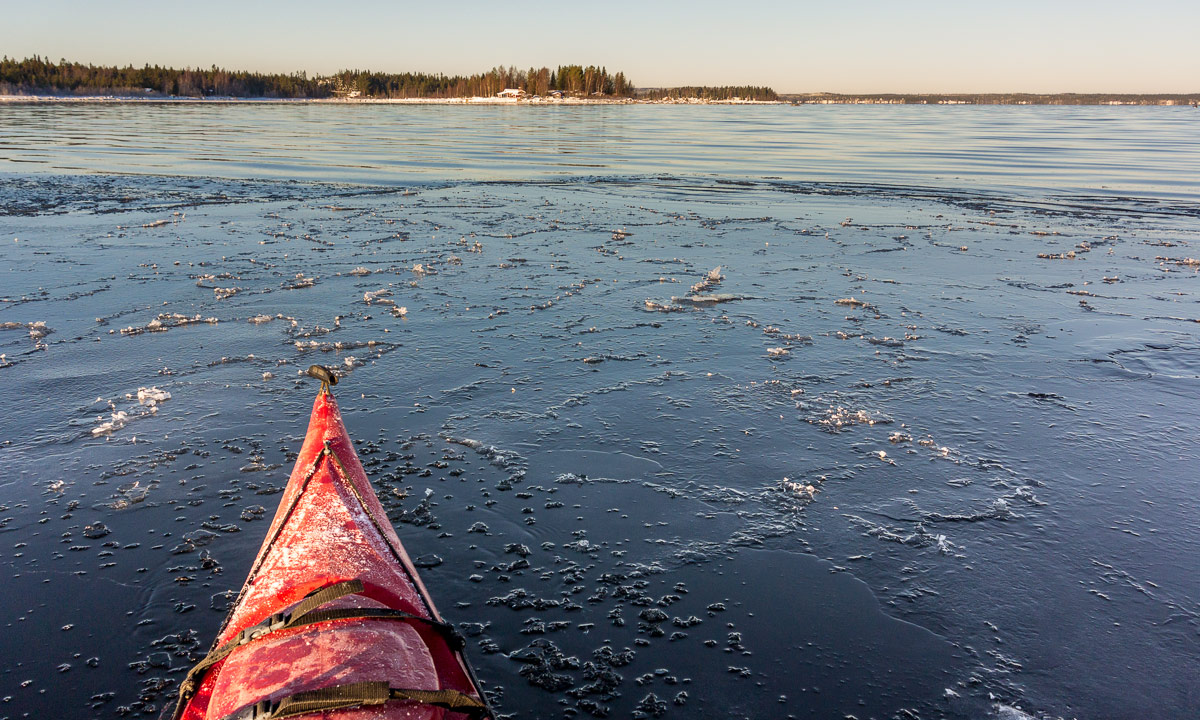


Now I was able to paddle freely as on a warm summer day. Beside of the floating ice needles. Beside of wearing my heavy immersion suit. Beside of the snow that covered all shores. Beside of the ice crust on my kayak …
And beside of my exhaustion because of the struggles traversing the ice. Anyway I wasn’t here for a long tour but for being filmed. I didn’t want to get too far away from Johan who was landbound. Therefore I took just a short round and made some more photos before I started back.


I followed my old route where the ice already was cut and it was much easier to get ahead. Soon I reached the thicker ice – first still cracking under the weight of me and my kayak, then thick enough to bear us without any complaints – and then the shore where I had to plunge in into knee-deep water for the last time before I went ashore.
It was great fun testing out the limits of winter paddling in Skelleftehamn today. It won’t be the last time that I do such. However this is only possible with proper equipment. Without immersion suit or dry suit, isdubbar and such this tour wouldn’t have been possible at all.
So, folks: Be crazy and be safe!
And – as promised – the link to the video.
Tomorrow I want to canoe. So I checked the potential starting points today. Where could I set in my kayak?
That’s where Skelleftehamn’s pilot station is. As expected the Baltic Sea is completely open. Here it would be possible to start the tour, but I had to go 2.5 km.
The nearest place, only 600 metres away, but this small bay has been already ice-covered for some days.
We’ll, this should rather be frozen over, too, but to my surprise there was a broad band of open water left. I guess that the water level, that changed several times the last days prevented parts of the water surface to freeze over. The distance to Storgrundet is 1.6 km and I think I’ll try out this place tomorrow.

Anyway I’m not completely sure, if there will be open water tomorrow in the morning, too. Today has been the first day, where the temperature dropped below -10 °C and maybe there will be ice on today’s open water tomorrow. Either a bit that cracks when you traverse it by kayak or a bit more making it impossible to squeeze through.

Seasons are a bit in between. The open sea is completely free of ice beside of some sheltered bays having a thin, but solid ice cover. When such an ice cover breaks in the waves, pancake ice is formed. Pancake ice are ice floes that move, twist and turn, scrubbing each other until they are round, like pancakes. I found some of them when I drove to the peninsula Rönnskär to have a look at the sundown. They floated in the sheltered boat harbour near the shore.

This article is part of the series “2016-11: #snowember16”.
Last night it snowed another 15 cm, increasing the snow depth in my backyard to 76 cm and finally the fence in my backgard was gone, hidden by the snow.

You see, that the picture looks a bit hazy? That’s because it snowed still a lot, when I made this picture this morning at 6 o’clock. You see that blending light to the right of the house? It’s a tractor that already had started to plough away the snow.
Some hours later Annika and I took the car to Bureå – another “snow pocket” nearby. As a matter of fact I was curious, if there was even more snow as here in Skelleftehamn.
Finally I could take a picture of the beautiful pavilion Åbacka paviljong which lies near Bureå on the other side of the E4. A huge pile of snow left by a tractor came in handy to get a higher perspective.

And we saw buried cars. And half buried tractors, and really buried cars, and a quite snowed in bicycle.


I heard from some people living in Bureå, that at least one meter of snow has fallen, but I couldn’t find such places in town. I seemed to be as much snow as home, perhaps a bit more.
When we took a detour, left Bureå and headed to Burvik over the hill Bureberget (altitude: 99 meters!) the snow walls at the sides of the road increased. I stopped the car on the side of the street and just took some steps into the forest. Here the snow was really much deeper, I should say round 110 cm! Here seems to be Bureå’s “snow center”.
I left Annika at the bus station and took the E4 to Skellefteå where I had a meeting at one o’clock. Well, I tried to take the E4, but from the next exit on it was closed due to an accident. I left the E4 and took a secondary route. There were many trucks and other cars taking the same detour and since the road was quite snowy and it still snowed the drive was at quite a low pace. Following a truck is no fun since you hardly see anything beside of the white snow whirling through the air. That is called snörök – “snow smoke”. Sometimes it was not easy to follow the street because all meadows and fields are just as white as the road and the red sticks marking the road hardly help in the snörök.
I took it easy, stopped the car in one of the rare snow-free parking bays and made a photo from the collapsed barn buried in the deep snow.

When I came home the snow fall had stopped and the streets where ploughed. On each corner you could see piles of snow up to four meters high. And finally even my elder bush seemed to realise that summer is over and has started to cast of its leaves.


Tomorrow I’ll take a day off and enjoy the early winter. Skis or snowshoes? I haven’t decided yet.
Some other snow depth:
This article is part of the series “2016-11: #snowember16”.
And the snow fall continues. Today it didn’t stop snowing at all. 40 cm of snow covered the backyard of my house in the morning, now it’s already 65 cm and probably the fence will be buried by the snow soon.
Most people are only out to clear the snow, by shovel, snow blower or – more efficient – by tractor. The big municipal snowplough has just come through for the first time today, leaving a “plogkant” (plough rim) – a wall of snow, round 60 cm high, on the side of the street. That means, before I even think off taking the car, that stands on the driveway of my property, I have to go out and shovel all that snow away. And that snow of the plogkant is always quite compact and therefore heavy.
The neighbours have started to look at me almost a bit angry. They know, that I’m snow-addicted and just love that kind of weather while they just see the work. Perhaps I would think the same, if I had lived here the whole of my life.
But anyway – it is so beautiful with all that snow. Have a look by yourself.


Today it’s even cold the first day with day temperatures round -6 °C. In combination with all that snow, it’s hardly believable that it’s just the beginning of November.
The forecast says, it will permanent frost temperature the next 10 days. I – sorry, my neighbours – would approve it.
This article is part of the series “2016-11: #snowember16”.
Often the first snow in Skelleftehamn already comes in late October and melts away the other day. Larger snowfalls can occur in November – in 2010 for example the snowfall lasted several days and covered the ground with 70 centimetres of snow.
This years first snow fall was already on Monday but rain melted it away the very same day.
On Wednesday however it started to snow and since then quite a lot of snow has fallen in Skelleftehamn. I have round 35 centimetres in my backyard and more is forecasted for the next days. This is a bit unusual for the beginning of November where mostly it’s just dark and wet.
You could call me snow-addicted, I just love snow – the more, the better! And so I’ve been in great mood since yesterday that the rainy tristesse was replaced by the grandeur of snow.
Six photos from today:


This article is part of the series “2016-11: #snowember16”.
Hooray! Winter is here! I want 4 meters of snow and -45 °C already in November. (Well, a bit less is ok, too.)
I saw the first snow of the season two days before on my way back home from Umeå. The forecast predicted more snow to come today – even a class 1 snowfall warning had been issued – but not in Skelleftehamn where rain was forecasted.
Skelleftehamn showed only some patches of slush-like snow this morning as a result of last nights precipitations. Skellefteå got two centimeters of snow and experienced some wet snow showers today. On the way back to Skelleftehamn more snow lay on the ground. Between town and home it’s mostly a bit colder with neither city nor the Baltic Sea directly nearby. In Skelleftehamn itself however the snow has been almost rained away and the thermometer showed +2 °C.


Today I had a rehearsal with a new jazz trio in Kroksjön, which means hook lake and is just eight kilometres south from Skellefteå. It was just slightly colder there and the snow less wet. Round ten centimetres had fallen down – still wet but white and beautiful to look at. I took some photos after the rehearsal (I always have a tripod in the car).


When I made these photos it didn’t snow anymore, temperatures where below zero and I could see some stars. When I was on the 364 to Skellefteå it started snowing again, but not much, so I took the E4, the fastest way to Skelleftehamn. Well, normally. Today it took much more time. The snow fall intensified more and more and the visibility was really poor. Instead of 110 km/h I hardly dared to drive 70.
Another car tailgated me, eager to overtake. Finally the E4 became two-lane and the car driver overtook me. I really had to smile, because now – without my backlights in front – the other driver was forced to slow down as well, driving exactly the same tempo I had been using all the time.
It wasn’t easy but I found the exit to Skelleftehamn. The snow fall intensified even more and I slowed down further. Using the full beams the approaching snow looked like a tunnel of stars when a space ship goes into some kind of faster-than-light hyperdrive. That’s what it looks like (imagine that in fast motion):

Funnily enough the heavy snow fall decreased when I approached Skelleftehamn and stopped when I arrived home.
Now at 23:30 we have ca. 5 cm of snow and it started snowing a bit again. If the forecast is right we will get permanent frost on Friday and 30 cm of snow from Friday until Monday morning.
Yesterday I took the car and drove to Umeå. The sky was blue and the sun was shining. Sounds nice, right? Well, it was nice but hard to drive. The sun melted the frost on the asphalt and the wet street reflected the low hanging sunlight. Sometimes it was really hard to see anything other than just a glaring white nothing.
Today the sky was blue and the sun was shining again. Sounds nice, right? Today it was nice since Annika and I took a longer stroll through the forests near Strömback south from Umeå.
The temperatures were above zero, but parts of the ground were still frost covered. We followed a path between Tjuvvarpet – a lake – and Matsund – part of the Baltic Sea. Anyway you could see neither lake or sea from the path since the forest was too dense and hid the waters which were just 100 meters away.


On the way back we made a short rest at a place on the lake near the hill Tjuvvarpberget. Most of the lake was still free of ice but near the rocky shore you could see the first covering of ice. It almost looked a bit wintry.

Apropos winter: If the weather forecast is right we will get at least 30 cm of snow in Skelleftehamn within the next eight days. Nevertheless I’m quite sceptical. Just two centigrade warmer and it will all pour down as rain.
