A lake named after Anders

This article is part of the series “2019-02: Northern Norway”.

Ascending and descending hills and mountains and three selfies at three different places

The forecast was right, today it was sunny. Morning temperatures were round -9 °C – good conditions for another snowshoe tour.

Chris gave me some tour tips and I decided to go south to a nameless hilltop. I crossed the road and followed the snowmobile trail that cross the river Katojoki. To be honest, without having looked on the map before I hadn’t realised that it was a river. Now I put on my snowshoes and left the trail.

It was quite exhausting to walk through the snow because even with snowshoes I sank 20 – 40 cm into the snow with each step. Snow was falling on top of the snowshoes giving them additional weight. The terrain was rising and I had to make several short breaks to catch my breath. When I came near the hill, it got steeper but since the hill is only 151 meters above see level I was soon on the summit, a snowy platform with a 360 degree view. Here I took a break.

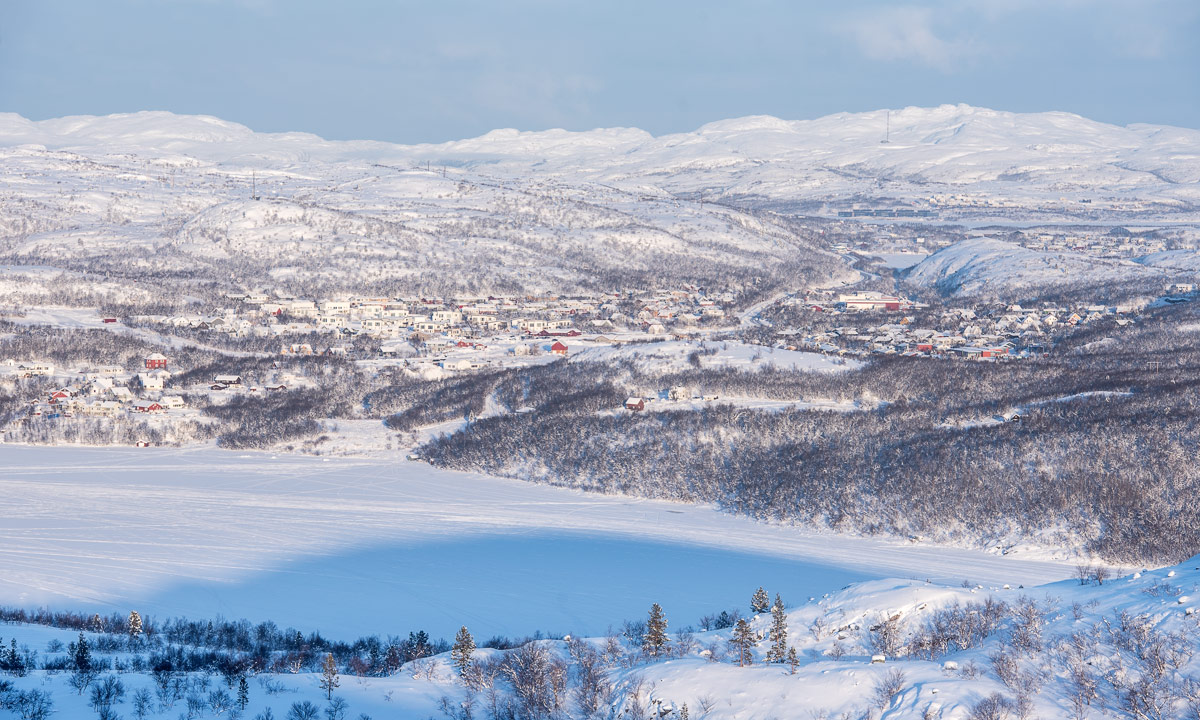
To the north I could see the small town Bjørnevatn and snowy mountains at the horizon. To the east I could see the Fjord Uhcavuotna or Langfjorden. On the snow covered frozen fjord I watched the snowmobile groups and the dogsleds. It’s high season for tourists. Looking to the south I saw the fjord disappearing in the fog. In the colours of the still low sun the scenery looked quite unreal.

It was half past ten. Definitely too early to return. In the southwest I spotted a higher mountain range, which I already knew from the map. Between the mountain range and my resting place on the hilltop there was a valley. I wasn’t sure if I would manage to climb the mountain range but I could try. I zigzagged down the hill to avoid the steeper parts, crossed the valley – phew, deep snow again – and went up a small snowy hill.

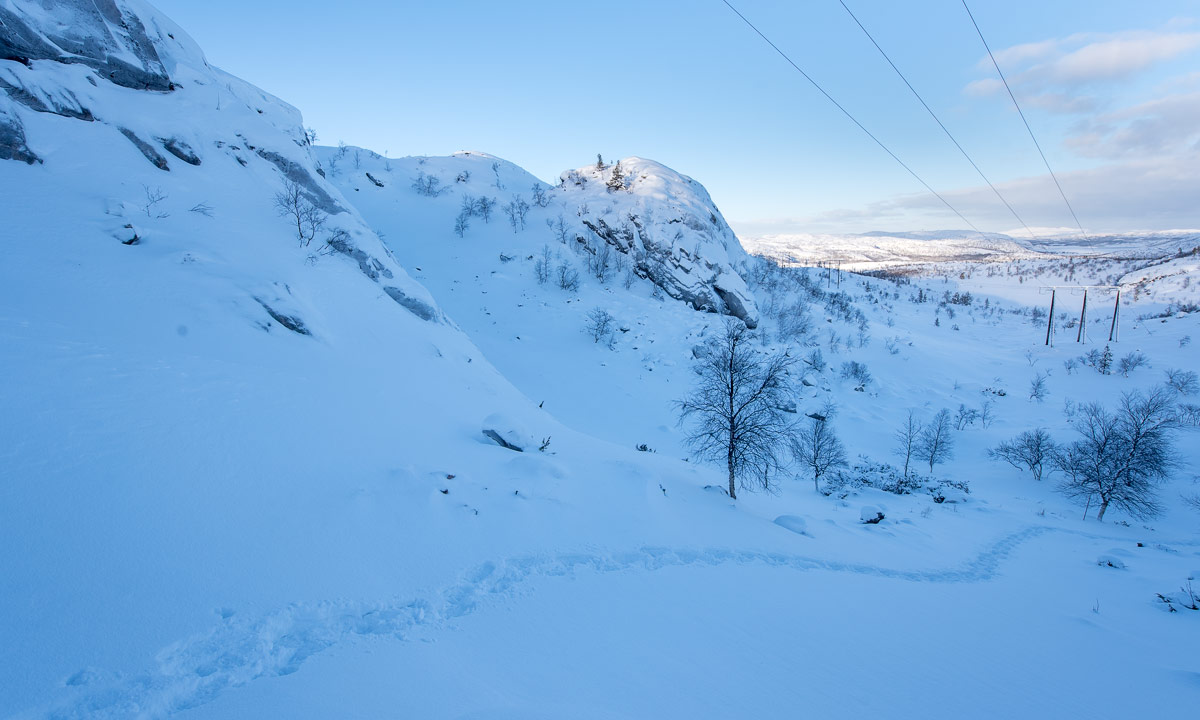
You see the picture above? There are two possible ways up the mountains. A steeper and higher one to the right and a shorter and less steep one to the left. The right one could be too steep for me and my snowshoes and I was afraid of avalanches. Therefore I chose the left one. It worked! After ascending the snowy slope I stood on a small plateau.

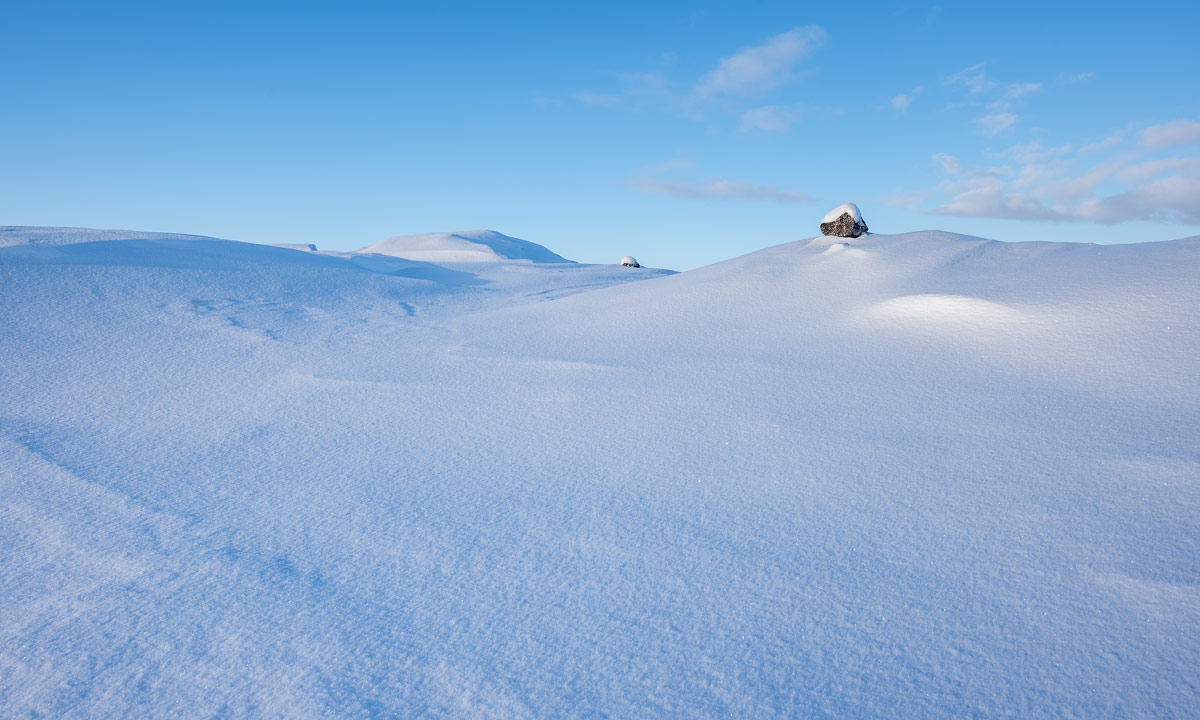
I had to climb another slope, shorter but steeper, then I reached the sunny vidda. Vidde is Norwegian for expanse and for plateau or tableland. You may know the word from Hardangarvidda, a large plateau between Bergen and Oslo.

That’s the landscapes I love – less is more!

After walking around and going up another small top I reached a flat snowy plane. If it’s completely flat it’s probably not a bog but a lake and so it was. It was the lake Andersvatnet (136 m above sea level).

On the other side another hilltop, according to the digital map 183 m above sea level. Strange that all these summits and tops do not have any names, at least not in the official maps. I decided to climb this top, too. The borrowed snowshoes are not very good for steeper passages so I had to look for a good way up and more than once I slid back or had to use my hands to pull me up. But finally I “conquered this hostile mountain”!

The first photo above shows Andersvatnet. If you look at the enlarged picture you can see my snowshoe tracks.

I didn’t make a long break because I wasn’t sure about the continuation of my tour. I would love to stay up for a while and then descend at another place, but according to the map it could be quite steep. I went northwest and went along the edge of the mountain range.

I looked for a possibility to descend the plateau but finally I had to realise that all slopes were much too steep to descend. Therefore I continued by circular route until I could see the same power pole again that I passed on my way up. I ascended another small top, again with a gorgeous view. Time for another break.

I felt cold. Probably it was because I was exhausted and a bit sweaty. While I didn’t close the down parka at all at my first break I closed it completely this time and even put on the woollen mittens. Wrapped up like this I could enjoy the sun and the views in all directions. But then it was time to continue the tour and to leave the bare mountains. I found my old snowshoe tracks, followed them and went down, mostly in my own tracks.

After I left these mountains behind I went back straight ahead. Again deep snow, but less exhausting than climbing all hilltops. I was back to civilisation. I could hear the roaring of the snowmobiles and the barking of the huskies. Later I saw them both. A group of white dressed snowmobilers – probably hunters – and the huskies pulling the dogsleds. Still I was 100 meters above sea level – high enough to have wide views. Do you see the dogsled on the next photo?

I reached a large trail prepared for the dogs. It was solid enough that I could go there without snowshoes. What a blessing! Snowshoes are great for mountain tours like today but I always feel clumsy wearing them. I passed some dog teams – guides sorting the dogs and tourists wrapped in winter coveralls sitting in the sleds or taking pictures.

The inner of my nose started to tickle, normally a sign that it’s -15 °C or below because then the nose hairs start freezing. Even my eyelids started to freeze together. When I arrived home the thermometer showed -16 °C. So it has become colder over the day.

Now it’s 22:15 and outdoor temperature has dropped to -22 °C. Probably the last cold night for a long time, since much warmer weather is on its way.


Travelling to Bjørnevatn

This article is part of the series “2019-02: Northern Norway”.

After visiting me home in Skelleftehamn Chris and I continued to Jokkmokk on Thursday. We visited the winter market and then drove to Solberget, where we stayed overnight.

The next day we started a long drive with her car. Chris lives in Bjørnevatn near Kirkenes and we planned to arrive there the very same day. At 7:10 we started our journey that would lead us through Sweden, Finland and Norway.

First the sky was cloudy but the visibility was good. Then it started to get a bit foggy.

Normally that’s no problem. This icy fog however started to cover the windscreen more and more and we had to stop often to scrape of the ice.

In Gällivare we stopped at the gas station and had some breakfast. We also bought a bottle with de-icer for the windscreen and continued our trip.

The de-icer didn’t help, we had to stop many times to scrape away the ice from the freezing fog. We were not the only ones. The headlights and the number plate were covered with several millimetres of ice, too. I never had experiences something like this before.

Only the bottom 15 cm of the windscreen were free of ice. While Chris crouched into the seat to be able to see I gave up taking pictures from the road and photographed sideways.

We approached the Swedish town Karesuando. This small town is located directly on the Muonio älv, which also forms a natural border with Finland. On the other side the town is named Karesuvanto where we took another break.

Strangely the ice problems stopped right after the Finnish border. We continued to Palojoensuu without any problems. There we turned left onto the road 93. An hour later we were at the Norwegian border.

After being stopped by the customs and assuring them that we have neither alcohol nor cigarettes with us, we continued driving through the snowy plains. Next stop: Kautokeino, where most inhabitants are Sámi. Here we ate a hamburger with chips, a typical meal if you travel through Northern Norway.

Until now, Chris had driven a car. Now it was my turn to drive to give her at least a short rest. The first time I drove a diesel.

Round two hours later we arrived in Karasjok. What I already had suspected, confirmed here: It was cold outside: -30 °C.  Time for another break.

Back in the car, Chris was driving again. It was dark, it was cold, we were tired and still more than four hours to go.

I started to get bored and played around with my camera.

A pale green stripe appeared above the street. A northern light. The next hour we got quite nice northern lights, mostly directly in front of us. Though being tired we got at least entertainment. The photos are awful, northern lights are not made for being photographed free-handed from a car on a bumpy road.

Finally we came to Tana, where we crossed the river of the same name. A quarter hour later we arrived in the small town Varangerbotn, were we took the last stop of our long trip.

Now we drove along the fjord Varangerfjorden. Anyway, beside of some street lights and the weakened aurora it was pitch black and I couldn’t see the fjord. Beside of that I just longed for a bed.

But finally we arrived at Chris’ home in Berg near Bjørnevatn. Arrival time 23:40, 16½ hours after we started in Solberget.

Here I’ll spend the next days.

Link to the route on Google Maps


Light pillars and northern lights in Bjørnevatn

This article is part of the series “2019-02: Northern Norway”.

I have seen light pillars in my life and I have seen the aurora many times. Today I got the perfect combination of these two light effects. And never ever saw I light pillars as clear as today.

To see light pillars you need cold weather. When I was out, it was between -22 °C and -24 °C, probably colder on the frozen fjord. Light pillars are caused by hexagonal ice plates that tend to hover horizontally and therefore reflecting the light vertically. The light source can by natural, as e.g. sun and moon or artificial.

I was very lucky that it was cold and clear today so that I could observe them and make some pictures.


Snowy night, snowy day

When I returned from Avan two days ago the Swedish weather institute SMHI had issued a snow warning: 20-30 cm snowfall and at the coast fresh winds from northeast. Yesterday the wind increased and in the afternoon it started to snow. Soon the snowfall increased, too and the wind made the snow whirl round the houses and through the streets. More and more snow came falling down and soon the street was snowed over completely.

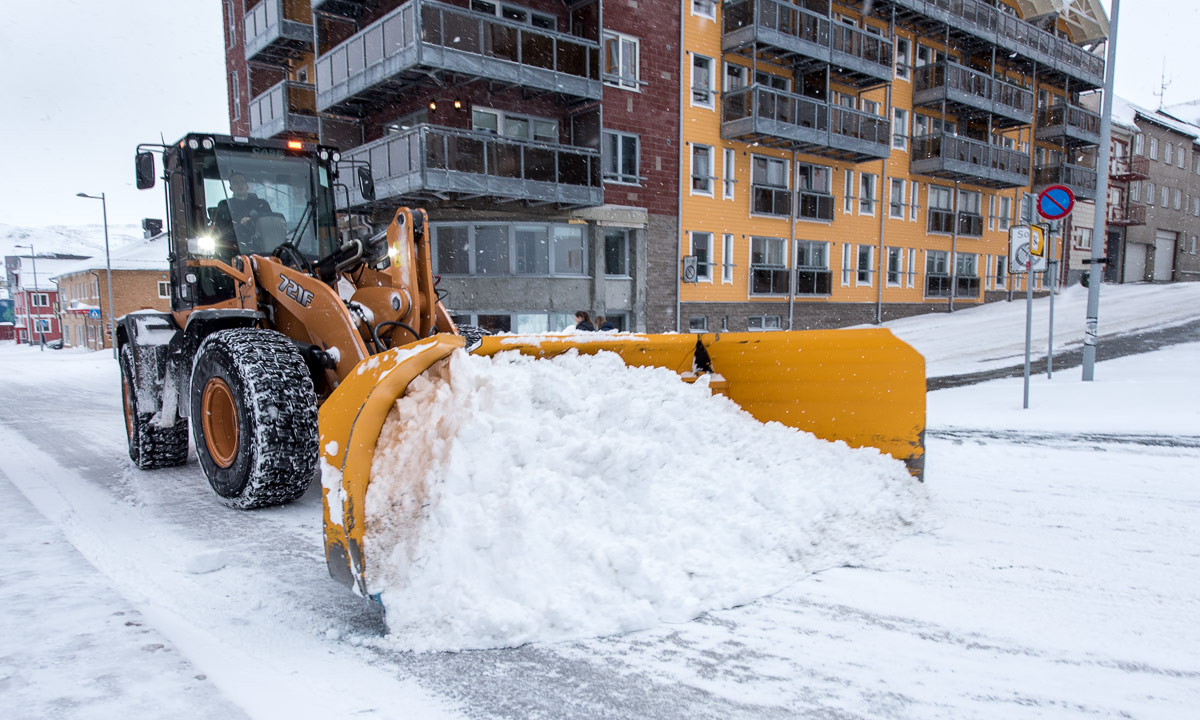
“Beep! Beeep! Krrrr. BEEEP! KRRRRR!” – these sounds woke me up this morning at 5 o’clock. The sound of snowploughs and shovel loaders clearing the roads. They beep when they go backwards and the shovels make loud scraping noises.

While the shovel loaders take the snow and move it to other places the snowploughs just push the deep snow aside. Both are important but the latter create work for the locals. They create a so-called plogkant – compact walls of snow – along the street and so right in front of your driveway.

This plogkanten was 60 cm high and the loose snow behind was of almost the same height. Before I could use the car I had to shovel snow. A lot of snow, at least 2½ m³. Fortunately the temperatures where round -10 °C and the snow was loose and fluffy. A good workout anyway. Finally I could get camera and tripod and took the car to two places by the sea.

The garage at the pilot station was surrounded by meter-high snowdrifts. The snowdrifts in the lee of the house were even higher. The gaps in the fence created a nice stripe pattern on the snowdrift outside. It was still quite dark and there was not much to see otherwise.

At the “beach” of Storgrundet the stormy gusts of wind blew the snow horizontally from left and right and in the dawn the scenery looked very harsh.

Great weather for a ski tour on the sea ice, isn’t it?

Two and a half hours later: Chris – a friend of mine from Kirkenes who arrived yesterday – and I had just come to the very same place to start a ski tour. We mounted the skies, put our hoods on and slipped into the gloves. It still was snowing and quite windy.

And when it’s windy at the mainland you can bet that it’s much more windy on the sea ice which is completely exposed to the elements. And so it was. The island Storgrundet was in the back and we could see the pale schemes of some other islands in the northwest. The northeast however looked like the Arctic Zone.

Chris was following my ski tracks. She looked like an arctic explorer with the white void in the background.

Here’s one of of the rare photos of me, that is no selfie. If you look closer you see that my ski tracks go zig-zag. That’s because even on the sea ice of the Baltic Sea there were many snowdrifts with sharp edges and I could hardly see whether it went up or down. Skiing was not exhausting but we were slow due to the wind and the bad sight. (… and taking pictures.)

We skied to a headland which had been in sight for a while.

As soon as we reached the lee of the headland it was almost windless. What a huge difference to the exposed parts of the sea where weather was quite rough. In the shelter of the headland we took a break. (We forget the tea in my kitchen but at least we had a bit of chocolate.) On the headland were summer cottages, now snowbound in meter-high snowdrifts.

The way back was easier. The gusty wind had started calm down a bit and the snowfall lessened. The view to the west however was still extremely arctic.

We were however no arctic explorers but had the luxury of a parked car and a heated house just some minutes away. The ski tour was short in distance but rich in experience and that’s what counts!

Takk for turen, Chris!

It continued snowing until dark. The fence in my backyard had been buried in snow almost completely. The fence is 85 cm high.

Later in the afternoon I continued clearing snow. Not with a front loader but with a wide snow shovel. Chris has parked her car on the street and both the snowfall and the snowplough had buried it up to the top of the wheels. I pushed all snow into the front yard where the snow pile got higher and higher.

I’m a quite curious person when it comes to snow depths. I made a step on the top of the snow pile and as I guessed the snow was quite loose:

If the forecast is right we get calm, sunny and colder winter weather tomorrow. We consider to start the very same ski tour again just to see the difference.


Backsjön

A short tour with “turskidor” (touring skis) on the lake Bäcksjön near Umeå. After some days with slightly warmer temperatures and fluffy snowfall we got another sunny day with no wind and temperatures round -20 °C today.

Now I’m home again in Skelleftehamn. This night could be the coldest yet. Already now at 22:30 it’s -25 °C, that’s quite cold for the coast. From tomorrow on it shall become warmer with temperatures mainly round -10 °C.


Welcome to my icy world

This morning I walked to the same spot on the island Storgrundet as four days ago. This time I arrived there already at 8 o’clock, one hour before sunrise. It was the coldest winter day yet with temperatures round -22 °C. This means two pairs of gloves: full-fingered stretch fleece gloves for handling the camera and warm woollen mittens for keeping the hands warm.

Four days ago the pancake ice had been still floating on the water. The ice floes had been bobbing up and down in the approaching tiny waves that had come from the open sea nearby.

Today the Baltic Sea was completely frozen as far as I could look. No movement, no sound, just a solid layer of ice to the horizon. The shore was coated with a thick layer of ice, too. The ice looked blueish because of the ambient light. No wonder that this time of the day is called “blue hour”.

I went along the shore. There were mainly two types of ice covering the Baltic Sea:

First there was pancake ice frozen together. The floes built a solid layer of ice but you could still see the patterns of the raised edges.

Then there was fresh ice. The ice itself was flat, clear and featureless, but it was completely covered with featherlike ice and therefore as white as the pancake ice.

While I was walking along the shore the colours had started to change. Opposite the sun the sky became lilac, purple, violet, pink.

Finally the sun rose and started to illuminate the ice.

The ice in the sun looked orange – the complementary colour of blue. The „golden hour“ had started.

Did you notice the round horizon of the last photo? Today’s the first time I tried out my new fish eye lens. Fish eyes make very special pictures due to their extreme distortion. The last photo shows the effect even more clearly. I call it „My icy world“.

Kayak season is over

Two days ago I considered to go kayaking a last time before the sea freezes over. Large parts of the inshore Baltic Sea were still open but it was hard to reach the open water without bearing the heavy kayak over the icy, rocky shore or walking on unstable ice. So I decided against paddling.

When I arrived at the seashore this morning it was clear that the kayak season would be over for a while.

Temperatures between -15°C and -20 °C have made the Baltic Sea freeze. It almost looks like one could walk to the island Gåsören, but that wouldn’t work. That, what looks like a solid surface of ice is actually a pattern of floating ice floes. It’s not visible to the naked eye, but comparing photos shows, that there are still tiny waves under the ice floes that make them go up and down.

Two winter activities

The morning

Finally there’s enough snow in Skelleftehamn for cross-country skiing. The great people from Frilufts­främjandet Skelleftehamn had prepared the ski track last night and I was one the first people that skied there this morning. The weather was sunny with temperatures round -16 °C. The sun however was still low and had hardly a chance to illuminate the forests round the ski track. There were some sunny spots where I made the photos below.

After 7 km I was covered with frost but I wasn’t cold at all.

The early afternoon

After lunch I decided to check out the shore at Kågnäsudden. I parked my car and trudged through the snow until I arrived at the coast. The Baltic Sea was mostly open but partly covered with pancake ice. I walked on the banks by the sea and enjoyed the bright sunlight and the crisp air.And I made some photos, too.

When I drove back the car thermometer showed temperatures between -19 °C and -23 °C. The next seven days temperatures between -10 °C and -20 °C are forecasted. I guess it will not take long until the shore areas of the Baltic Sea will finally freeze over.

Snow in Skelleftehamn

After a snowy car ride from Umeå I arrived in Skelleftehamn. Partly the E4, the main road was completely white and the visibility was quite poor, especially when a huge truck passed by. In this case a lot of snörök – snow smoke – whirled to the air and reduced the sight almost to zero for some seconds. Driving through snow and darkness is exhausting and I’m glad I’m home.

At home there are no huge amounts of fresh snow, “only” 15 – 20 cm. This is however the largest amount of fresh snow I experienced this winter. Nice and a good start! And since I was to lazy to shovel snow at 21:00 I just drove my car onto the driveway. I guess, tomorrow I’ll get some outdoor exercising.

Where is the snow? – part II

While parts of Bavaria and Austria have been buried in snow masses – partly there’s more than 250 cm of snow in the valleys and 350 cm in the mountains – we got plus degrees and storm squalls yesterday evening.

Yesterday the bay Kallholmsfjärden was still covered with a solid layer of ice. Today the wind and high water broke this sheet of ice and blew it away. At lunchtime the bay was covered with drifting ice floes. Some hours later the ice was gone, probably drifting to Finland …

I want this (left image) but I got that (right image):

I have to admit that I’m frustrated. I moved to Northern Sweden for real winter experiences, not for this kind of roller coaster weather, that makes the snow dirty and the streets slippery. The photo motives are ugly, I cannot ski, I cannot even walk onto the ice anymore. I just want to snip my fingers and be in Filzmoos or Reit im Winkl or somewhere else where it’s really snowy.

There’s only one realistic way to solve this: I need a teleporter. Or a time machine. For this I need a crazy scientist, that will build one for me. To pay him/her and all that crazy scientist equipment I need money.  There is a way to get a lot of money without work: a Trisslott, the most famous scratchcard in Sweden. The same amount three times and you win it. OK, let’s see …

Well, that didn’t work. Four amounts only twice. As usual. I guess, I have to deal without a teleport.