Snowy night, snowy day

When I returned from Avan two days ago the Swedish weather institute SMHI had issued a snow warning: 20-30 cm snowfall and at the coast fresh winds from northeast. Yesterday the wind increased and in the afternoon it started to snow. Soon the snowfall increased, too and the wind made the snow whirl round the houses and through the streets. More and more snow came falling down and soon the street was snowed over completely.

“Beep! Beeep! Krrrr. BEEEP! KRRRRR!” – these sounds woke me up this morning at 5 o’clock. The sound of snowploughs and shovel loaders clearing the roads. They beep when they go backwards and the shovels make loud scraping noises.

While the shovel loaders take the snow and move it to other places the snowploughs just push the deep snow aside. Both are important but the latter create work for the locals. They create a so-called plogkant – compact walls of snow – along the street and so right in front of your driveway.

This plogkanten was 60 cm high and the loose snow behind was of almost the same height. Before I could use the car I had to shovel snow. A lot of snow, at least 2½ m³. Fortunately the temperatures where round -10 °C and the snow was loose and fluffy. A good workout anyway. Finally I could get camera and tripod and took the car to two places by the sea.

The garage at the pilot station was surrounded by meter-high snowdrifts. The snowdrifts in the lee of the house were even higher. The gaps in the fence created a nice stripe pattern on the snowdrift outside. It was still quite dark and there was not much to see otherwise.

At the “beach” of Storgrundet the stormy gusts of wind blew the snow horizontally from left and right and in the dawn the scenery looked very harsh.

Great weather for a ski tour on the sea ice, isn’t it?

Two and a half hours later: Chris – a friend of mine from Kirkenes who arrived yesterday – and I had just come to the very same place to start a ski tour. We mounted the skies, put our hoods on and slipped into the gloves. It still was snowing and quite windy.

And when it’s windy at the mainland you can bet that it’s much more windy on the sea ice which is completely exposed to the elements. And so it was. The island Storgrundet was in the back and we could see the pale schemes of some other islands in the northwest. The northeast however looked like the Arctic Zone.

Chris was following my ski tracks. She looked like an arctic explorer with the white void in the background.

Here’s one of of the rare photos of me, that is no selfie. If you look closer you see that my ski tracks go zig-zag. That’s because even on the sea ice of the Baltic Sea there were many snowdrifts with sharp edges and I could hardly see whether it went up or down. Skiing was not exhausting but we were slow due to the wind and the bad sight. (… and taking pictures.)

We skied to a headland which had been in sight for a while.

As soon as we reached the lee of the headland it was almost windless. What a huge difference to the exposed parts of the sea where weather was quite rough. In the shelter of the headland we took a break. (We forget the tea in my kitchen but at least we had a bit of chocolate.) On the headland were summer cottages, now snowbound in meter-high snowdrifts.

The way back was easier. The gusty wind had started calm down a bit and the snowfall lessened. The view to the west however was still extremely arctic.
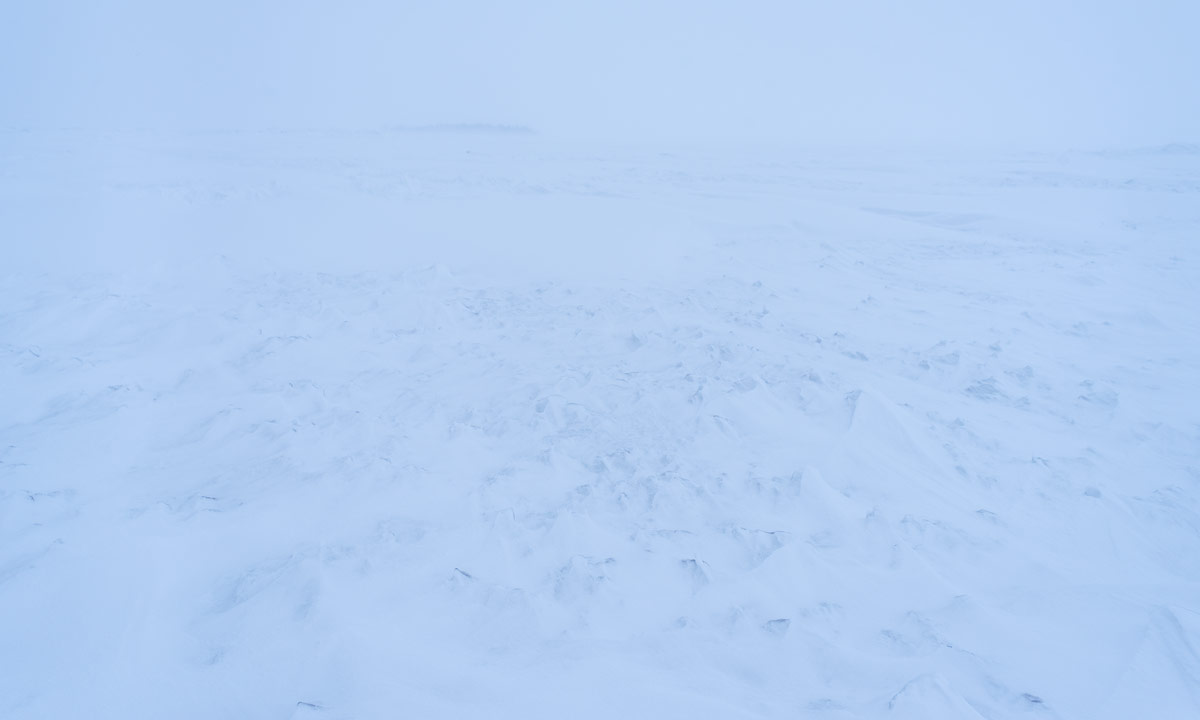
We were however no arctic explorers but had the luxury of a parked car and a heated house just some minutes away. The ski tour was short in distance but rich in experience and that’s what counts!

Takk for turen, Chris!

It continued snowing until dark. The fence in my backyard had been buried in snow almost completely. The fence is 85 cm high.

Later in the afternoon I continued clearing snow. Not with a front loader but with a wide snow shovel. Chris has parked her car on the street and both the snowfall and the snowplough had buried it up to the top of the wheels. I pushed all snow into the front yard where the snow pile got higher and higher.

I’m a quite curious person when it comes to snow depths. I made a step on the top of the snow pile and as I guessed the snow was quite loose:

If the forecast is right we get calm, sunny and colder winter weather tomorrow. We consider to start the very same ski tour again just to see the difference.


Backsjön

A short tour with “turskidor” (touring skis) on the lake Bäcksjön near Umeå. After some days with slightly warmer temperatures and fluffy snowfall we got another sunny day with no wind and temperatures round -20 °C today.

Now I’m home again in Skelleftehamn. This night could be the coldest yet. Already now at 22:30 it’s -25 °C, that’s quite cold for the coast. From tomorrow on it shall become warmer with temperatures mainly round -10 °C.


Welcome to my icy world

This morning I walked to the same spot on the island Storgrundet as four days ago. This time I arrived there already at 8 o’clock, one hour before sunrise. It was the coldest winter day yet with temperatures round -22 °C. This means two pairs of gloves: full-fingered stretch fleece gloves for handling the camera and warm woollen mittens for keeping the hands warm.

Four days ago the pancake ice had been still floating on the water. The ice floes had been bobbing up and down in the approaching tiny waves that had come from the open sea nearby.

Today the Baltic Sea was completely frozen as far as I could look. No movement, no sound, just a solid layer of ice to the horizon. The shore was coated with a thick layer of ice, too. The ice looked blueish because of the ambient light. No wonder that this time of the day is called “blue hour”.

I went along the shore. There were mainly two types of ice covering the Baltic Sea:

First there was pancake ice frozen together. The floes built a solid layer of ice but you could still see the patterns of the raised edges.

Then there was fresh ice. The ice itself was flat, clear and featureless, but it was completely covered with featherlike ice and therefore as white as the pancake ice.

While I was walking along the shore the colours had started to change. Opposite the sun the sky became lilac, purple, violet, pink.

Finally the sun rose and started to illuminate the ice.

The ice in the sun looked orange – the complementary colour of blue. The „golden hour“ had started.

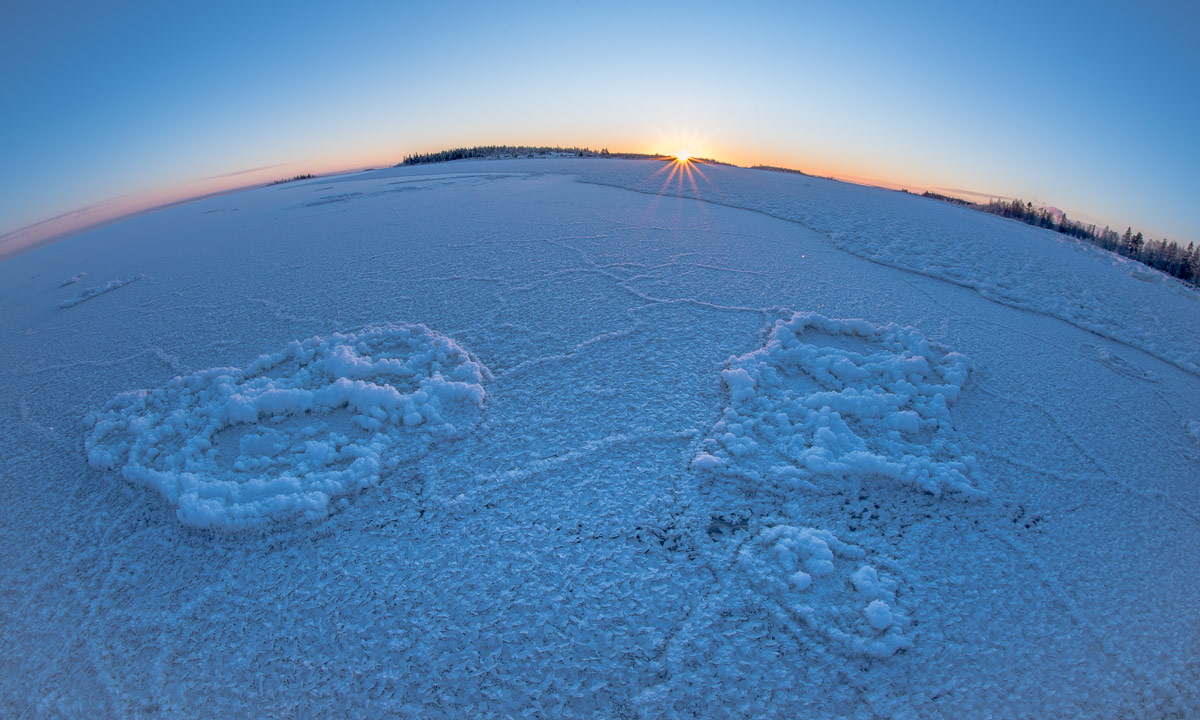
Did you notice the round horizon of the last photo? Today’s the first time I tried out my new fish eye lens. Fish eyes make very special pictures due to their extreme distortion. The last photo shows the effect even more clearly. I call it „My icy world“.

Kayak season is over

Two days ago I considered to go kayaking a last time before the sea freezes over. Large parts of the inshore Baltic Sea were still open but it was hard to reach the open water without bearing the heavy kayak over the icy, rocky shore or walking on unstable ice. So I decided against paddling.

When I arrived at the seashore this morning it was clear that the kayak season would be over for a while.

Temperatures between -15°C and -20 °C have made the Baltic Sea freeze. It almost looks like one could walk to the island Gåsören, but that wouldn’t work. That, what looks like a solid surface of ice is actually a pattern of floating ice floes. It’s not visible to the naked eye, but comparing photos shows, that there are still tiny waves under the ice floes that make them go up and down.

Two winter activities

The morning

Finally there’s enough snow in Skelleftehamn for cross-country skiing. The great people from Frilufts­främjandet Skelleftehamn had prepared the ski track last night and I was one the first people that skied there this morning. The weather was sunny with temperatures round -16 °C. The sun however was still low and had hardly a chance to illuminate the forests round the ski track. There were some sunny spots where I made the photos below.

After 7 km I was covered with frost but I wasn’t cold at all.

The early afternoon

After lunch I decided to check out the shore at Kågnäsudden. I parked my car and trudged through the snow until I arrived at the coast. The Baltic Sea was mostly open but partly covered with pancake ice. I walked on the banks by the sea and enjoyed the bright sunlight and the crisp air.And I made some photos, too.

When I drove back the car thermometer showed temperatures between -19 °C and -23 °C. The next seven days temperatures between -10 °C and -20 °C are forecasted. I guess it will not take long until the shore areas of the Baltic Sea will finally freeze over.

Snow in Skelleftehamn

After a snowy car ride from Umeå I arrived in Skelleftehamn. Partly the E4, the main road was completely white and the visibility was quite poor, especially when a huge truck passed by. In this case a lot of snörök – snow smoke – whirled to the air and reduced the sight almost to zero for some seconds. Driving through snow and darkness is exhausting and I’m glad I’m home.

At home there are no huge amounts of fresh snow, “only” 15 – 20 cm. This is however the largest amount of fresh snow I experienced this winter. Nice and a good start! And since I was to lazy to shovel snow at 21:00 I just drove my car onto the driveway. I guess, tomorrow I’ll get some outdoor exercising.

Where is the snow? – part II

While parts of Bavaria and Austria have been buried in snow masses – partly there’s more than 250 cm of snow in the valleys and 350 cm in the mountains – we got plus degrees and storm squalls yesterday evening.

Yesterday the bay Kallholmsfjärden was still covered with a solid layer of ice. Today the wind and high water broke this sheet of ice and blew it away. At lunchtime the bay was covered with drifting ice floes. Some hours later the ice was gone, probably drifting to Finland …

I want this (left image) but I got that (right image):

I have to admit that I’m frustrated. I moved to Northern Sweden for real winter experiences, not for this kind of roller coaster weather, that makes the snow dirty and the streets slippery. The photo motives are ugly, I cannot ski, I cannot even walk onto the ice anymore. I just want to snip my fingers and be in Filzmoos or Reit im Winkl or somewhere else where it’s really snowy.

There’s only one realistic way to solve this: I need a teleporter. Or a time machine. For this I need a crazy scientist, that will build one for me. To pay him/her and all that crazy scientist equipment I need money.  There is a way to get a lot of money without work: a Trisslott, the most famous scratchcard in Sweden. The same amount three times and you win it. OK, let’s see …

Well, that didn’t work. Four amounts only twice. As usual. I guess, I have to deal without a teleport.

Where is the snow?

Where is the snow? That’s of course a rhetorical question. It’s in Bavaria, in Austria (masses of snow in the Northern Alps). It’s in Italy and in Romania. It is in Greece, in Russia, in Portugal and in Poland. It’s in Turkey and even in Libya.

But not in Skelleftehamn. It is still white from last year’s snow, but when it snows a centimetre it gets warm and it melts again. And no precipitation is sight.

Due to the stormy wind some days ago the Baltic Sea is still open and a lot of ice floes – up to 20 cm thick – lie at the shore. Despite of yesterdays rain there is still a bit of snowy powder left on some of the stranded ice blocks. Yes, I am longing for snow, but that’s beautiful, too.


Mirages, vintervägg and sea smoke

After the warm but chilly weather on Holmön it’s nice to have colder weather at home. The sky has been clear all night and day and the morning temperatur was -14 °C.

The whole open sea was smoking. A common view when the sea is free of ice but the air is cold.

At the horizon I could see the vintervägg, a local meteorological phenomenon that is typical for this season. Vintervägg means “vinter wall” and names a cloud layer on sea. Sometimes it’s quite near, sometimes it’s far away. Today it was far away and a third meteorological effect came into view: A mirage, also called Fata Morgana. It has the same origin as the sea smoke: abrupt temperature differences. This is why these mirages mostly are found in deserts and polar regions.

Skelleftehamn is not really part of the polar region but shares at least some of the meteorological phenomenons.

Early winter Holmön IV

This article is part of the series “2018-12: Holmön”.

It is Monday. It has rained the whole night and it still rains. Most of the snow is history and everything is wet. After breakfast we decide to give the road to the southern tip of Ängesön another try. Indeed, it is almost free of snow and soon we are at the southern tip of the island where we walk along the coast. The clouds are grey and so is the sea. Some water areas are still covered with wet, brownish ice but the sea itself is open.

There are some marked hiking paths on Ängesön that we want to give a try. The guide book recommended “tåliga skor” – that means tough, durable shoes – due to the wet ground. The first path to the east has many deep water puddles and flooded parts. Partly the path is supported by wooden planks, but mostly not. The path leads through a quite old forest as we can see by the many lichens that cover the pine, spruce and birch trees. Snowless and wet as it is, it looks more like mid-October than December.

We try the other trail that leads to a shelter at the western coast of Ängesön. This trail is less wet and easier to follow than the other one. It is however not too easy to reach the rocky coast because of the marshland between forest and coast. It still drizzles and rains and everything is damp.

The hiking paths are nice but I would strongly recommend high rubber boots if you want to keep your feet dry.

After our “three course hiking” we return to our accommodation at Berguddens fyr. We’re still the only people, the place – as beautiful it is – seems less popular in winter time as the guest book tells us. While Annika prepares a warm lunch it starts to get dark outside. Grey clouds still cover the sky and it continues drizzling. The lighthouse starts sending its light beams over the Västra Kvarken, part of the Baltic Sea between Holmön and mainland.

Today day we leave Berguddens fyr. We were lucky to be change the booking for the ferry from 19 o’clock to 9 o’clock to avoid another rainy day – partly in darkness. At 8:20 we sit in the small waiting room, because it’s very windy outside. Waves break at the quay wall and after some the small ferry arrives and wobbles into the small harbour.

I have to admit that I get a bit nervous when I learned I have to back the car onto the ferry. The man however that pilots me onto the ship is fantastic and guides me much better than every rear camera. I am relieved, but get nervous again when I watch the man securing the car with belts. Is it so stormy? Will the belts hold?

First the boat trip is quiet but soon the ferry starts to roll and pitch more and more. I stay in the inside of the boat where I feel safer. While Annika and I are hoping the best for the car, the other two passengers do not pay any attention to the rough weather. Probably they live on the island Holmön and they are used to something like that.

45 Minutes later we arrive in Norrfjärden. My car has survived this unsteady trip without any problems.The ferry needs several attempts to dock, but finally I can leave the ferry with the car. Annika, who already went ashore gets into the car and we drive to her home in Umeå. This drive takes only 30 minutes – less than the ferry passage.

It’s fantastic to have such an interesting and special place nearby. We’ll come again, hopefully with better weather.