A ski tour in the Kvikkjokk mountains – day 2 and 3

This article is part of the series “2018-02: Ski tour near Kvikkjokk”.

Day 8 and 9 of my winter journey 2018

After the first night in the tent (it was a cold one!) we were eager to continue the tour. The tent was packed and so were the pulkas. We started by skiing through powder snow – a slow movement. I guess I hardly reached 2 km/h in average and I definitely was much slower when I had to go uphills. We looked for a good place to access the river again since it was much easier to follow the stable snow on the snowmobile tracks. After a while we found a good place to enter the river bed. Mostly the winter trail followed the river, only twice it continued on land where the river is narrow and had open water.

After some kilometres the river bent southwards and our trail left the river to continue more westwards. We continued the snowmobile tracks that led through forests and over smaller bogs.

We started to think about reaching the mountain hut Njunjes but weren’t at all sure if we would reach it before darkness. Anyhow, we didn’t had any pressure, since we had anything with us which we need for tenting:

  • a tent (of course)
  • down filled camping mats
  • very warm sleeping bags and vapour barrier lines
  • warm clothes from head to foot
  • a lot of food
  • a paraffin oil driven cooker
  • … and much more …

The way was easy but the pulkas were heavy loaded and after hours of walking I started to get tired and exhausted. That’s one of the reasons why I hardly made any photos. Another reason was that both my cameras refused to work in the morning with temperatures round -30 °C. It became warmer, but it was still round -25 °C, although it had become cloudy and overcast that day quite early.

Beside of a longer and a shorter rest we continued skiing, now with the defined goal to reach the hut. It started to get dark but we knew that we only had to go another hour or a bit more to make it.

After a while it went so dark that we skied with headlights. The buildings of Njunjes had come into view but they were on the other side of the river. When we were on a level with Njunjes we realised that the river became a quite deep ravine, probably with open water and quite impossible to cross …

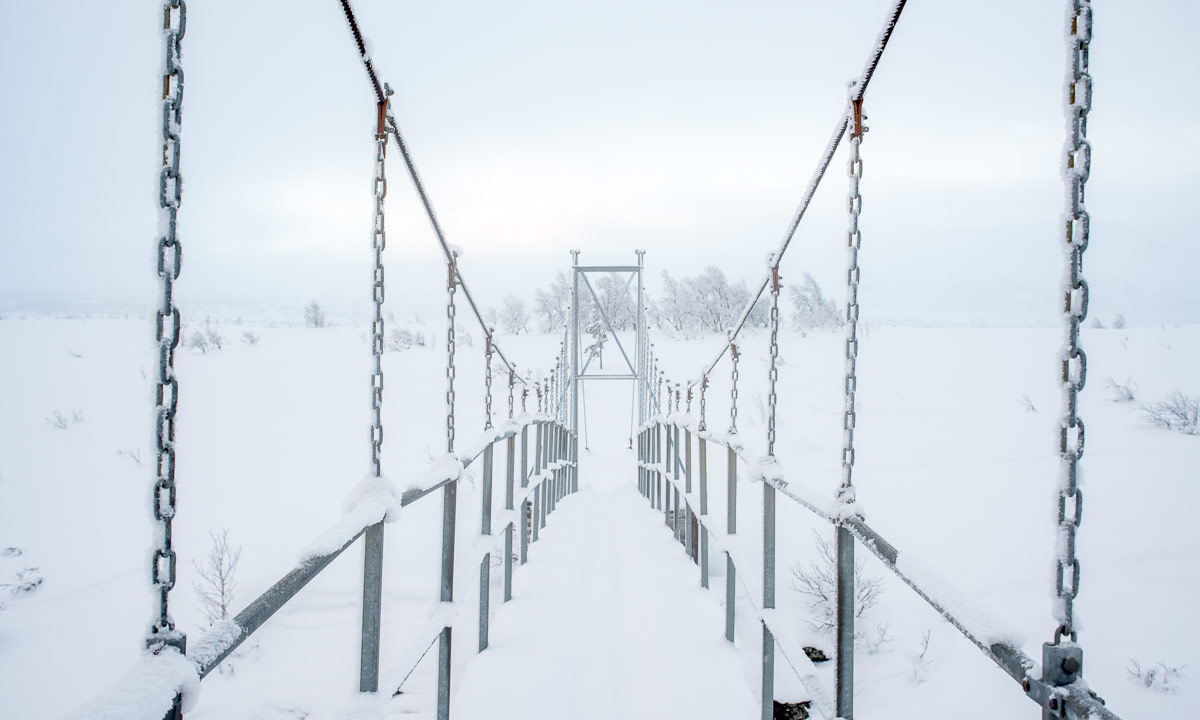
… but we were really lucky: there was a metal chain bridge that led over that very ravine. It was quite a fight to climb up the slope after crossing the bridge, but with a lot of pulling (and without our skis) we managed it.

Soon Jonas found the open winter room with was made for people like us who like to travel off-season. A stove, wood, a bunk bed for two people, hooks for drying clothes, a table and two stools – anything to stay here for a night or two.

Day three was a day off. It was warmer than the day before and mostly dim and cloudy. I took pictures of the chain bridge, the mountain hut and the landscape (as far as it was visible)
 

After breakfast we attached new climbing skins to my skis and took a ski tour. First cross the river again and right to the sun. Then up some minor hills through sparse birch forests and eastwards to meet the branch to the hut that we had missed the day before. The skins worked well but it was almost a pity to have them attached to my skis since they slowed me down when skiing downhills through the loose powder snow. The sun was hardly visible through the clouds and the landscape almost looked sepia – like an old black and white photo.

First it only snowed a bit but when we finished our tour and arrived at “our” mountain hut snowfall increased. While Jonas was busy sawing and chopping wood I took a small nap.

In the evening we planned to continue to Tarrekaisestugan the next day – the next mountain hut in the west – and probably to continue and tent again in the wintry forests.

Photo #2 in this blog article is made by Jonas Balbasus.

A ski tour in the Kvikkjokk mountains – day 1

This article is part of the series “2018-02: Ski tour near Kvikkjokk”.

Day 7 of the winter journey 2018

I’m really glad, that my friend Jonas and I managed to realise a ski tour this year. It’s our 3rd ski tour together, but the last one was five years ago. A long time. Actually we had planned for eleven days, but due to severe snow falls between Gävle and Sundsvall two weeks ago the whole train traffic was cancelled and Jonas arrived more than two days later than planned.

On Wednesday, 7 February we left Solberget and took my car to Jokkmokk, where we bought food for nine days. Anything from muesli (with powdered milk), tea and chocolate to pasta with pesto, salami, potato mash and much more. Have a look:

After taking a lunch we continued to Kvikkjokk. The weather was sunny and the temperatures sank below -20 °C. In Kvikkjokk we packed our pulkas, transport sledges you carry behind, locked the car, put on the skies and started our tour. First along a road, then on a snow mobile track. We didn’t come long when we met a local with a snow shovel who asked for our plans. He looked at our heavy loaded pulkas and mentioned that we would have a hard time in pathless terrain. He said, that it was 100 cm of snow in Kvikkjokk and 150 in the mountains.

I reparked my car – another tip of the local – and we started our tour again. With his permission we used his private snowmobile track that led us to the river where it joined a larger snowmobile track. It already had been starting to get dark and our plan was to find a place for our tent quite soon. We weren’t alone on the river – two moose (mother and calf) stood on the river some hundred metres away. We waited until they left and continued. The river slopes were quite steep and after we had decided to leave the river we had to put off our skis and drag the heavy pulkas up through hip deep snow. Exhausting! At least we found a nice little clearing in the forest for our first night in the tent.

As usual we started to tramp down the snow with our skis to make it stable enough to bear the weight of tent and ourselves after some time. This snow however was so loose that it seemed impossible to us to erect the tent on top of it. Therefore we digged down half a meter (making round 6 cubic meters of snow to dig) and erected the tent in the hole. The temperature had continued to fall, now down to -25 °C. Finally the tent was “ready for occupation” and we were eager to eat something warm.

After Chinese noodles with some asian ready-made sauce we left the tent and watched the amazing clear starry night. The milky way gleamed over half the sky and Sirius had just started to rise on the eastern horizon. What a wonderful first night!

… and a cold one. When we started to sleep the temperature had fallen to -30 °C. Jonas and I have huge down sleeping bags and we had it warm and cozy anyway. I just had problems to sleep because I don’t like sleeping on my back and always have trouble to fall into sleep the first two, three nights when tenting.

Next morning: Clear blue sky, some feathery clouds that just started to colour purple. Jonas’ thermometer at the pulka showed -34 °C. It was completely calm and we decided to cook outside. Cooking in the morning mainly means boiling water for tea and for making milk for the muesli. I was glad about my warm mukluk boots, down pants and my puffy down parka. And finally the sun rose over horizon and trees.

Today we would continue westward to the mountain lodge Njunjes and probably sleep there.

Photo #1 and #6 in this blog article are made by Jonas Balbasus.

Changes in the winter weather

This morning it was more than 20 °C warmer than yesterday morning: only -2 °C. And it had been snowing the whole night and half the day. Not huge amounts – just another 10 cm – but enough to bury my garden fence even more. I measured 70 cm of snow in the center of my backyard, round the fence it’s probably more like 80 cm.

As the photo from five days ago I made this photo through the window of my living room.

3× winter coast

Yesterday, 13:30

After having lunch, Annika and I drove to Näsgrundet, where the Baltic Sea had been mostly clear of ice three days before. Still most of the sea was ice-free, only at the coast some meters of new thin ice had formed.

It had started clearing up and the temperatures dropped to -15 °C already in daytime. The cold air over the open water created sea smoke, that gleamed in the colours of the low sun.

Yesterday, 23:00

It continued getting colder and soon the temperature dropped below -20 °C. Before sleeping I was out again, this time to check for an optical effect, that can appear when it’s as cold as then: light pillars. Even though it was round -23 °C I wasn’t lucky, but I took some photos of the Rönnskär industry anyhow.

Today, 8:00 – 9:00

This morning was the coldest yet this winter with temperatures round -24 °C. That’s when I start wearing two pairs of gloves for taking pictures. The inner fleece glove for handling the camera and a thick woollen mitten for staying warm when I just wait or look for motives.

The first motive may look quite boring but I love motives like these: just different cloud layers and ice up to the horizon plus the first gentle sunrise colours.

Remember, this part of the Baltic Sea had been clear of ice the day before. Due to the cold weather it has frozen within a range of several kilometres within less than twenty hours. It still amazes me how fast this process can be.

After I had made the former photo I detected that purple-red spot beside of the island Gåsören. The sun started to rise. I changed the lens and made a telephoto shot. (It’s quite blurred due to the atmospheric conditions)

Then I waited for the sun to rise. And really – after some minutes the sun succeeded to rise above the lower cloud layer. But only seconds later the upper cloud layer, that approached from the southwest covered the red orb again and the sun disappeared for the rest of the day.

Though it was still below -20 °C it started to snow.

Checking the winter …

This winter has been quite lagom yet. It hadn’t been too warm for a longer period, nor it was it really cold. We got snow several times, but we didn’t get any lake effect snow neither as e.g. five years ago where it snowed more than 80 cm within 24 hours.

Yesterday and today it snowed round 20 cm. Since we already had round half a meter of snow, the fence of my garden is about to disappear in the snow.

I took the photo above through the window of my living room. It shows my (and the neighbours) backyard. The fence is round 80 cm high.

Today I took the car to the Näsgrundet, one of my favourite places in Skelleftehamn. When I had been at the same place 12 days ago, the Baltic Sea was covered with ice as far as the eye could see. When I arrived today I was really surprised to see the Baltic Sea clear of ice again.


The photo above shows a small bay beside of Näsgrundet. The ice had been broken by wind and the floodwater two days ago. The wind was pushing the ice floes slowly offwards and some of them already had started to drift seawards.

That was the view to the northeast. The view to the southwest is completely different: there is the peninsula Rönnskär with the copper smelter of the same name. It snowed but the low sun managed to peek through the airy cloud layer. Temperature was -9 °C and the chimneys smoked.

In front of the industrial plant is the “cape” of Näsgrundet, which is a peninsula as well. I took a short discovery tour and found another motive. When I was standing up, Rönnskär and some trees were visible but when I knelt down I was able to hide the background and to make a completely different photo:

I intensified both contrast and colours to give this photo a more irreal appeal. The motive itself however is unchanged.

What type of winter comes next? I could take a look at the weather forecast of SMHI, but I have difficulties to take it seriously. Beside of the overall temperature and wind direction trends the web forecasts for Skelleftehamn are quite bad. The 20 cm of snow for example weren’t forecasted at all.

But in the back of my mind I know that lake effect snow could be possible again as long as the Baltic Sea is open and wind comes from eastern directions …


Winter is just some miles away …

Let’s face it: The weather in Skellefteå and Umeå has been nasty the last days – temperatures above zero and a lot of rain making the minor roads icy and incredibly slippery. Most of the snow of the days before has been thawing away. So just now there’s much more winter in Germany towns than here beside the coast of the Baltic Sea.

The good thing: winter is not far away. I was in Umeå today and Annika and I drove westwards to catch a glimpse of winter. First it continued raining a good while, the road was dark and wet and the snow was slushy and ugly. But suddenly – just within a few kilometres the weather changed and rain turned into snow. Snow fall increased and anything was snow covered and white: the roads, the trees, the traffic signs, the bogs and the parking place where we stopped to visit the Hägring (english: mirage).

Hägring is an artwork between Bjurholm and Vännäs. It is a church-shaped object built of mirror fragments and stands in the midst of a bog. We’ve been there in May and knew that the bog is wet but safe to walk on. It was funny anyway to walk through knee-deep snow and feeling the bog bouncing underneath our feet with each step.

We continued westwards, Annika was driving and I was navigating and taking some pictures through the windscreen. Right after Bjurholm we took a minor road to Örträsk, a village by the lake Örträsksjön. Everything was snow covered. We stopped at the small grocery to buy something to drink but it was closed due to the “snow storm”. Well, we knew of the level one weather warning but it didn’t seem so severe.

Since days in December are short (and we didn’t find a place to eat in Örträsk) we decided to return to Umeå but on another route taking some minor roads eastwards. Snow fall intensified but still only some centimetres covered the roads.

While we followed the small ways the snow on the road got deeper and deeper until Annika’s Golf ploughed through 10 cm of snow. Where there was a house, people were outside to clear the snow with any available tool – from shovels to quite huge shovel loaders. But we didn’t get stuck.

Finally we reached the European route E12 which runs between Mo I Rana (Norway) and Helsinki (Finland). Even this road was covered with snow but much better to drive than the smaller forest roads before. 66 km to Umeå and it was snowing almost the whole way back. The last part however we came into the more maritim and warmer climate of Greater Umeå area and snow turned back into rain. We however got our winter impressions. Within just in half a day! One of the big advantages of living here!

On a final note, a “making-of” photo of Annika: Me walking to the Hägring:


Dreaming of snow …

It’s the first of December and luckily Skelleftehamn has been looking wintry for some days with temperatures below zero. The backyard is covered with round 30 cm of snow. Many of you however probably know that I’m a winter and especially a snow fan. So I’m longing for much more snow to come.

My personal record in Skelleftehamn is 108 cm in December 2011 which is a lot but far away from extreme.

Tromsø in Northern Norway uses to get at least one meter of snow each season. The record is 240 cm. Would we have that much snow in Skelleftehamn I still could look out of my kitchen window but snow probably would be on eye level.

The Swedish record is 327 cm of snow, which covered the small village Kopparåsen in February 1926. That’s really a lot of snow and most of my house would be buried in the snow. At least I would find it and could dig a tunnel to the door to enter and leave my “cave”.

Norway however has areas with much more snow. Just two and a half years ago, round 15 meters of snow covered the glacier of Folgefonna in Jotunheimen. In June!  (Here’s a Swedish article on the website Åka skidor. You can see, that the snow almost buried a whole cable car). In this case I would have to temporarily look for another place to live and probably my house would have been smashed into pieces by the pressure of the snow masses. In this case the dreaming of snow would turn into a nightmare.

(As always: click on the image to enlarge it.)

So, I’d like to have much more snow than now but not without limit. One or two meters would turn out just fine …


Stormy farewell

Today I sold my Saab 9-5 – the first car I ever had in my life. I bought it in March 2011 when I realised that a life without car is quite limiting in Northern Sweden.

Since then I have travelled to many places as e.g.: Abisko · Alta · Arvidsjaur · Bodø · Gällivare · Hammerfest · Höga Kusten · Jokkmokk · Kirkenes · Kiruna · Kusfors · Lofoten · Loma Vietonen · Luleå · Mosvik · Narvik · Nordkapp · Pajala · Senja · Solberget · Tromsø · Umeå · Vesterålen · Äkäslompolo · Örnsköldsvik

Do you know, how many places in the list are in the south of Skellefteå? Exactly three and Höga Kusten is the southernmost place I have gone by car because normally I head northwest or north.

Today however I sold my car to H., a friend, who lives in the county of Kalmar, more than 1000 km in the south. Funnily enough it’s the very same friend who visited me in 2011 and test-drove the car before I bought it. Back then he said “Well, if you do not buy this car, I’ll take it”. Well – now you got it H., with only six and a half years delay.

Since the Saab is a great winter car – it started without any problems in -35 °C – the elements bade it a stormy farewell with heavy wind gusts and squalls plus round 20 cm of new snow.

My new car is a Subaru Outback, which I bought half a year ago. Less comfortable than my Saab and a bit shorter but equipped with All Wheel Drive. Today I could test it and can confirm that the Subaru had no problems with driving through 20 cm of snow and crossing snowdrifts twice as high. I took some photos but soon drove home again since it was so stormy that it was almost impossible to take photos in the snowstorm. In addition to that I considered the weather potentially dangerous, at least near trees or power lines.

Some winter tours are already planned: A trip to the winter market in Jokkmokk and a longer trip to Kirkenes and the Varanger Peninsula, the northeasternmost part of Norway. And there’s probably much more to come …

Some hours later. It still was snowing. 40 to 50 cm of snow cover my back yard. The snow flakes melt on the lens and create funny plankton-like reflections. In Umeå it already had started to rain and here the temperatures were raising as well. A pity!


The first cold and sunny days

It became colder the last days. Yesterday temperatures were between -10 °C and -6 °C. Today it was warmer but still below zero the whole day. Especially the night before last was cold: coldest in Nattavaara with -23.8 °C but even in Åliden, just 33 km west, temperatures lay round -17 °C the whole night.

This morning I took the car to the bridge Sundgrundsbron that leads over the river Skellefteälven and pleasured in the wonderful sunrise colours. The sky in the east was coloured of warm shades of bright orange, while the sky in the west was more blue and purple, looking much colder.

Due to the stream parts of the Skellefteälven were still open but many parts were already covered with ice. Noises of cracking and clicking echoed through the air, clearly indicating that the ice was still fresh and quite thin.

A family of mute swans paddled over the river. Did they decide to stay or will they fly south? I hope they’ll cope the cold weather in case of staying.

If you look closer at the first photo you see a layer of clouds hovering above the horizon. The locals call this phenomenon “vinterväggen”, meaning “the winter wall”. It’s quite typical for this season and sometimes the whole eastern horizon is covered by a thick layer of clouds. According to a neighbour it’s this type kind of clouds that brings snow.

But according to the weather forecast tomorrow’s precipitation will come more as rain than snow.

Kayakvideo – my thing – winter kayaking in Skellefteå

Last summer I was asked by filmmaker Johan Granstrand if I would be interested in making a small film about my winter paddling. I felt honoured to be asked and gladly accepted.

Despite to this year we got a lot of snow already in the beginning of November last year. Since weather was nice (and cold) we decided to make the film on November 12, exactly one year ago.

I already blogged about this day in my post “Kayak – is it a boat or a sledge?”. Some weeks ago I got the permission to share the link to the video and that’s what I do today.

“Min Grej – Kayaking i Skellefteå på vintern” on Vimeo.

(I really like this film but I don’t like listening to me talking. My Swedish sounds awfully!)