Strange skies

Three days ago Aurora Alerts by Soft Serve News showed a forecast for very strong polar lights, first for last night, than for tonight.

That’s why I took camera and tripod with me when I drove to the rehearsal with the Chamber Choir. When we had finished and I left the building it was cloudy – as expected – but you could see the green light of a quite strong aurora shining through the spots were clouds were less dense.

I hoped for the sky to clear up and drove to Långhällan – a favourite place at the seaside. Unfortunately however the sky hardly cleared up and finally the clouds became even denser. Suddenly I could spot a bright red light at the horizon. Is it a strong spotlight of a ship? But why is it so red? It took a minute until I realised that it’s really the moon rising above the horizon. I cannot remember seeing the moon in such an extreme red colour – even redder than at the total lunar eclipse five weeks ago.

The next photo is a bit special. It is much more edited than I use to edit photos to show the colder green colours of the Northern lights behind the clouds and the warm, now bright orange colour of the moon. I lit the foreground with a flashlight to make it visible. Not very easy to light it evenly without overexposing it. Even here I had to edit some spots that were too bright or too dark.

There may be less clouds at 4 or 5 o’clock. Ant perhaps still polar lights. But I guess I’ll be sound asleep … .

Two sides of an autumnal morning

A cold side and a warm side. The difference? 19 Minutes and 500 meters.

It’s really fascinating that even larger water areas than mud puddles start to freeze over after just three mornings with temperatures below freezing; today round about -5 °C.

From Singi to Sälka and Nallo

This article is part of the series “2015-08: Kungsleden hike”.

August 26 – 29: Day four to seven of the summer hike through the mountains of Swedish Lapland

Singi – Sälka

After three very warm and sunny days clouds came in over night and the sky was quite overcast that morning. Only at the northern sky a larger patch of blue was visible. That fits, we’re going north! The first two kilometres were very well known to us, we went them there and back the day before. The day’s walk was short – just 12 kilometres.

Soon the huts of Sälka came into view. It was funny to see the ads for the shop and the bastu – the sauna – amidst the extend mountain landscape. Only 300 meters left and we entered the reception to check in.

It’s a nice look from Sälka but we had another interest that afternoon: Overall on the ground the ptarmigans were running and there were even sitting on the huge pile of birch wood, so that me, the photographer and them, the models, were on eye level. They let me advance quite near – in fact so near that the tele lens couldn’t focus anymore. The first two images are younger ptarmigans, the last is a grown up – look at these fantastic white feathered feet.

Sälka – Nallo

The next morning there were so many ptarmigans around that you really had to watch yourself not stepping on one of them. I never saw so many and never saw them so near. Our plan was not to continue the King’s Trail but to go northeast to Nallo, a smaller cabin a bit higher up in the mountains. After the common breakfast (muesli with some milkish liquid made from dry milk – yuck!) we started our tour. Even shorter than yesterday: only 9 km but perhaps a bit more demanding since there’re streams to ford, while the whole King’s trail is equipped with Bridges.

We had to look for planks to cross the small rivers behind the cabins but soon we were on our trail.

One hour later we were on the moon …

… well, not exactly, but it was such a sharp contrast to the sweet and lovely landscape of the last days. We could hardly see any vegetation. Only moss, grass and some scattered flowers were left. And some reindeers on some of the tabular slopes. There were many small streams and brooks to cross and it was the first day where I was glad, that I walked in rubber boots.

After a while the lake Reaiddájávri that lies on 1056 meter came into view and we went along it. More and more clouds came towards us and swirled around as if they wanted to surround us.

We had to cross the stream that enters the lake at the northern shore. Annika had to switch to sandals and ford the stream, for the water was to high for her hiking boots. It started to drizzle, than to rain and it got windy. Navigation was less easy now since it started to get foggy, there were less marks and some streams and snow patches to cross. Mostly I navigated with the compass, but twice I took the GPS to ensure my navigation. Since wind and rain increased more and more and I was busy with the navigation I packed the camera into the waterproof bag and didn’t make any photo on the last two kilometres. In the end the small Nallostuga came into view and even the huge mountain Nállu in the back lingered through the floating clouds. We got a warm welcome of the stugvärd – the warden of the Nallostuga. And warm was the wood fired oven, too. A good opportunity to dry our wet clothes.

I only went out later that day to take a photo of the wooden signpost and the hut itself. The rest of the day was just gemütlich – the pouring rain outside and we ourselves warm and cozy inside.

Two days of at Nallo

One

We planned to stay a day in Nallo already two days ago. It looked like a good idea since the rain just poured down the whole day and it was very windy. All people out there looked very wet, whether they just crossed the stream – now twice as large and probably twice as deep – or if they just fetched a bucket full of water.

Time to make some photos within the house. Two typical views in Swedish mountain huts: Many of them have two rooms, each has a kitchen and two flanking bedrooms, only separated by a curtain. That make 20 beds in total. Plus one for the stugvärd who has his own little room. The Primus 2388 is a gas cooker, easy to handle and is found in almost each Swedish mountain hut.

Two solo hikers planned to continue their tour that day but after a while they decided to stay. Perhaps not the worst idea when you looked at the young hikers, that came in. They were completely soaked. They poured the water out of their hiking shoes and hang up the dripping-wet sleeping bags for drying. All was just soaking wet! We we’re quite glad to be inside. But finally I took my camera and went out for some photos. Brr, it was really cold (7 °C) and so windy that the spray of the brooks was blown upwards again. Some photos:

I was glad, when I came into the inside of our cozy hut again. Only Simba, the warden’s dog endured the weather stoically.

Later that day: The sleeping bag already has dried, but other clothes were still hanging on the clothes line.

Two

Next day we wanted to continue our trip but I changed plans. Unintentionally. I got ill. I got fever that night and problems with my stomach and intestines, that I definitely don’t want to describe in detail. Otherwise there’s nothing much to report. I didn’t make a single photo (a certain proof that I was really ill) and slept almost the whole day.

Later in the evening, when I felt a bit better I was able to communicate again. I heard about others that went Singi–Sälka, the very same way we went three days before. The trail has been so flooded that the water poured over the wooden planks of the minor bridges making them very slippery and it was so windy that the hikers were really frightened to be blown from the bridge right into one of the swollen rivers. Illness never fits, bit I guess I chose a quite good day for being sick.

I slept the night before, I slept almost the whole day and I slept the next night. That sums up to round about 30 hours of sleep without any larger interruption. That probably was the best medicine and the next day I felt sound and healthy again. The plan for the coming day: Hiking to Vistas.

From Nikkaluokta to Kebnekaise Fjällstation

This article is part of the series “2015-08: Kungsleden hike”.

August 23: Day one of the summer hike through the mountains of Swedish Lapland

It’s hardly imaginable that it was only two weeks ago, that Annika and me started our tour through the mountains of Swedish Lapland.

On Saturday, August 22 I shouldered my packed backpack and travelled from Skelleftehamn to Nikkaluokta, this time not by car but by bus and train: The bus to Skellefteå, the bus to Luleå, the train to Kiruna, the bus to Nikkaluokta. The journey took the whole day – hardly surprising, it’s more than 550 kilometres and travelling in Northern Sweden takes time.

The most popular way through the Swedish mountains is the kungsleden, the “King’s trail”. It’s not only possible to sleep in cabins, you even can buy food in some of them to keep your package small. We however preferred another route on the Norwegian side. There’re cabins, too, but you cannot buy food. That’s why we started with quite heavy backpacks that included food for more than a week. (It included my camera, three lenses and a tripod as well, but that’s another story …)

Sunday morning was a sunny morning and already very warm. Our destination today: The Kebnekaise Fjällstation, 19 km away. We started our trip right behind the cabins of Nikkaluokta and soon we left “civilisation” and were out in the beautiful Lappish nature.

But we were not alone. Some other hikers were on their way but most of all there were a lot of helicopters flying there and back. Soon we gave up counting them, they were too many. We were glad that the aerial traffic calmed down after a while.

Our first stop was the beginning of the lake Láddjujávri, quite popular for two reasons: Here you can take a boat over the lake to shorten your trip to the Kebnekaise Fjällstation and you can eat a reindeer burger at “Lap Dånalds”. We neither took the boat (too lazy) or a burger (too early), but we ate waffles with cloudberry jam. Tasty!

The day was really warm: 24 °C. You even may call it hot when you carry 20 kilos on your back. Beads of sweat ran down and before we ordered our waffles, I took a bath in the fresh and cool water of the lake.

After a quite long and relaxed rest we continued our tour. The path is extremely well marked and changes between rocky and wet parts. Almost all wet and muddy passages are bridged with spångar – wooden walkways – but there are exceptions …

After 6 km walk we came to the other pier. Time for a rest, some water and food and another bath. This part of the lake was much colder and the bath was merely a dip into the icy water.

What a nice resting place: Warm, quite and not too many mosquitoes. It was hard to get up and to continue, both because of the great weather and our heavy backpacks that felt quite uncomfortable on the very first day of our hiking trip. But finally we managed to pick ourselves up and continued.

After a while the first chain bridge came into view: The bridge over the Darfáljohka. That meant, it was less than two kilometres to the Kebnekaise Fjällstation where we would stay over night. But before that I saw the first patch of snow. As a snow lover I just had to take a picture of it even though I knew it wouldn’t be the last snow on our journey.

Finally we arrived at the mountain lodge which is quite huge. The Kebnekaise is the highest Swedish mountain and so the lodge is used by many people: Hikers, climbers, mountaineers, and fly-in tourists – remember the helicopters?

Annika invited me to dinner – thank you, Annika! – but sadly it was a bit disappointing. The restaurant changed the menu without letting us know in advance and the cod was so soaked in butter that it hardly had any own taste left. Anyway the starters were great!

But anyway – a really nice first day of our tour.

Three weeks ago: Beautiful light on the lake Göksjön

Three weeks ago, when I visited friends in Bygdeträsk, A. und I made a boat tour on the lake Göksjön. We started in sunshine but soon dark clouds arrived and we shortened the boat tour in case of some incoming thunderstorms. But, as I hoped, it stayed calm and dry and the light on the way back was just incredible. When we landed the small boat, sky became blue again.

An overnight stay on the island Gåsören

Saturday

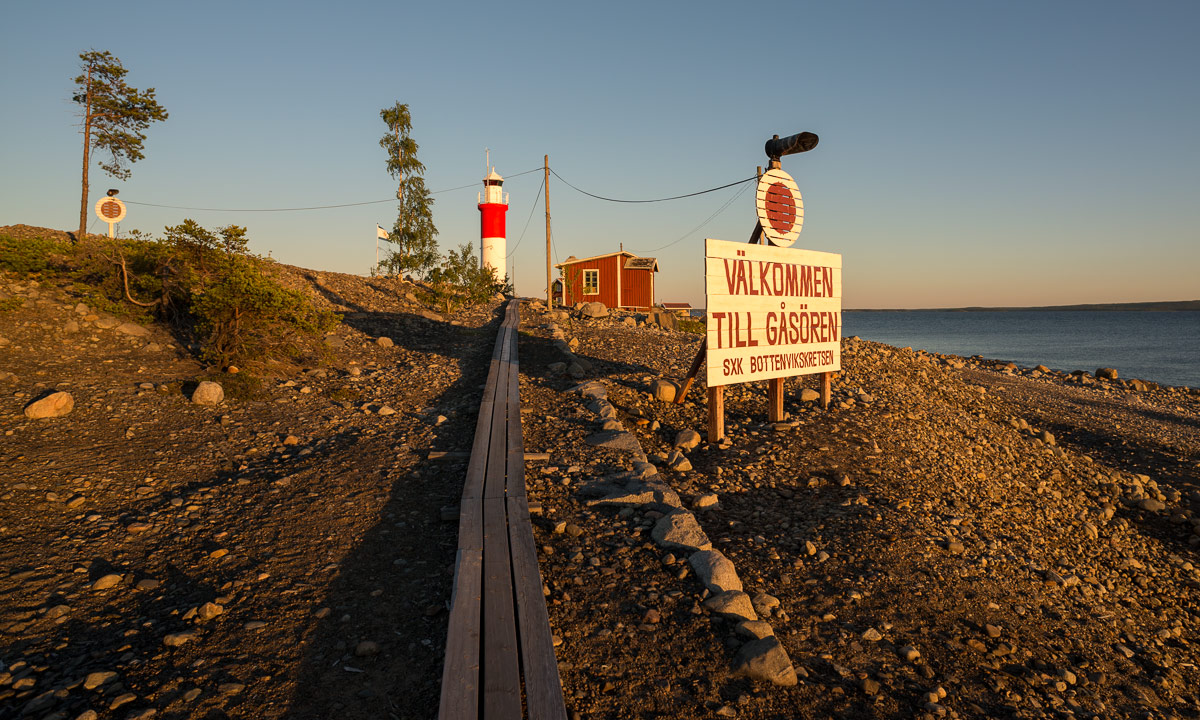
The advantage of short kayak trips with overnight stay: you can start quite late. It was 7 p.m. when I started pulling my loaded kayak from home to shore. A quarter later I sat in the kayak and started paddling. It’s only four, five kilometres to the island Gåsören that shone in the warm light of the evening sun.

The first thing to do: Put up the tent before sundown. The second thing to do: Taking a picture of the lighthouse before sundown. The stomach reminded me of thing number three: Preparing food and eating. Todays dinner: Graved salmon on fire roasted bread à la plein air.

I was quite curious if I would catch the first polar light. The short term forecast of Soft Serve News wasn’t too bad. But even if the sun already went down round 9 o’clock – two and a half hours earlier than eight weeks ago – I still had to wait for the sky getting darker. After a while however I could see the first faint greenish garlands. My first Northern Lights of the season 2015/16! Great!

But then I saw something in the sky that I thought was much more fascinating: Right above the red coloured northern sky I could see a layer of lucent clouds. They looked really strange because there weren’t red or purple – they were pale white! I never saw something like that before. They looked extremely far away, almost extraterrestrial. I wondered if this perhaps could be noctilucent clouds – clouds that are found in extremely high altitudes of round about 80 kilometres. I stayed awake for a long time, I just couldn’t tear my eyes away from this wonderful phenomenon. Two pictures of the clouds:

Of course I checked my hypothesis directly, when I went home. Yes – I guessed right. My first noctilucent clouds ever. I was really lucky and I’m happy that I could see them just from my tent.

But let’s leave the Mesosphere and go back to earth again. If you tent on the island Gåsören, you can see other lights, too. Lights of civilisation: The peninsula Rönnskär is quite nearby. On Rönnskär there is Boliden Rönnskär, one of the most efficient copper smelters. You think industry is unsightly and ugly? Well, not Rönnskär by night in my opinion:

Sunday

I woke up in broad daylight although it was only half past five. I took one halfhearted picture out of my tent and then I started reading.

I started the book “Norwegen der Länge nach” written by Simon Michalowicz that was published just some weeks ago. Simon hiked from the Southern tip of Norway to the North Cape – round about 3000 kilometres.

I read in the tent – I read sitting in front of the island’s sauna — I read sitting or lying on a floating boat bridge, only interrupted by a short bath in the Baltic Sea. I followed Simon’s tour and just couldn’t stop reading. It was noon when I finally finished the book. If can warmly recommend it to all German readers that love Scandinavia or are interested in hiking. There’s a website as well: www.simonpatur.de.

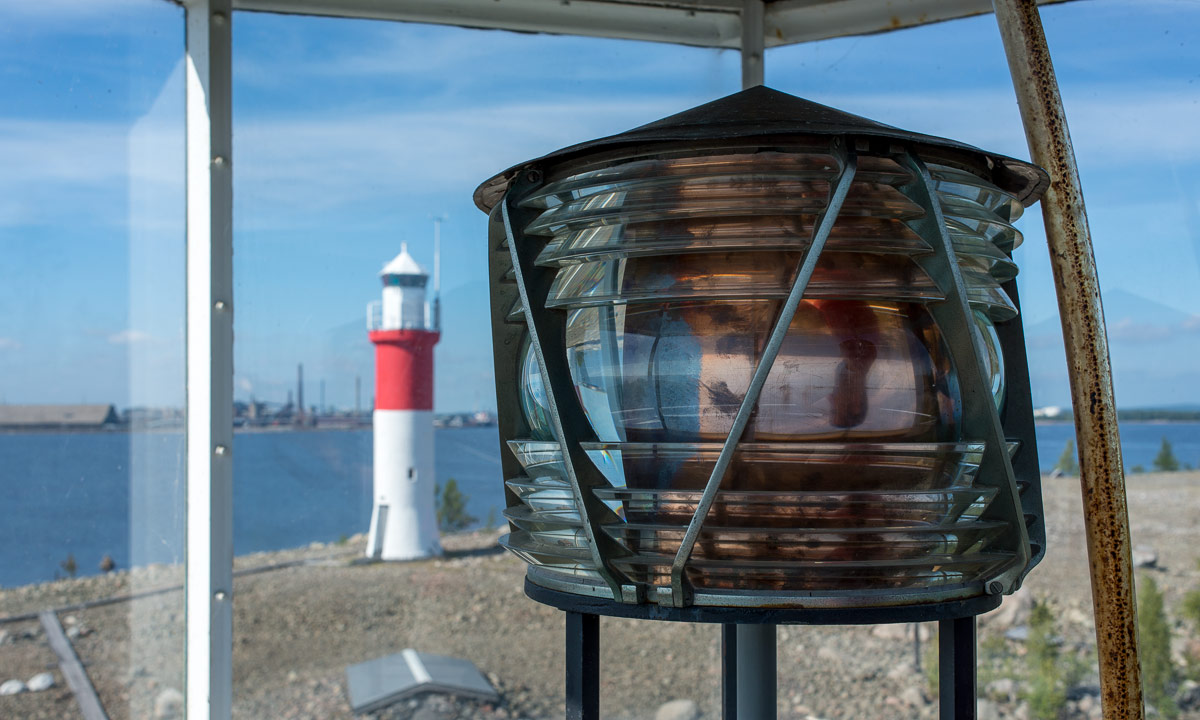
I wasn’t alone on the island. Some people hired the old lotshus – the pilot’s house for an overnight stay. The first motor boats came in for a day visit. And both summer cottages – there’re only two on Gåsören – were used, too. From T. who owns one of the cottages I learned that it was international lighthouse day today. So before I packed all my stuff together and paddled home I went up the two stairs in the old lighthouse and made a last photo.

I was home again half past two. Many experiences and a good book in less than twenty hours – that’s a fine weekend.

Translation:

EnglishGermanSwedish
Noctilucent cloudsLeuchtende NachtwolkenNattlysande moln

On the way to Å

This article is part of the series “2015-07: Lofoten and Vesterålen”.

Day one

Å is not only the last letter of the Norwegian alphabet, it’s the name of some places, too. The probably most known  is Å i Lofoten, the southmost village of the Lofoten islands.

Delle, a German friend of mine and I started the tour last Saturday. The only plan was to take the car, drive to Bodø and take a ferry to the Lofoten islands, the same day or the other day.

The weather in Skelleftehamn was fine but in Arjeplog, where we made a lunch break it started to rain. We continued our trip to Bodø over the mountains. They were wrapped in clouds and were still partly covered with snow.

17:30 we arrived in Bodø, just in time to get the ferry to Moskenes on the Lofoten. Normally I love to be outside all the time when I’m on a ship but this time the sky was so grey that you hardly could see anything. The Lofoten with its more than 1200 meter high mountains came in sight just some minutes before we arrived.

We left the ferry with Delle’s car and drove the 5 km to Å, where it rained so much, that we decided not to put up our tent but to sleep in the car. I put on my rain cloth and made a short evening walk but soon returned to the car. The only pictures I made that evening were the fish heads on the wooden racks drying in the salty wind.

Umiak I

It started like many kayak trips: I put out to sea at the tiny beach Storgrundet without any plans at all. Unlike yesterdays weather forecast it was a nice and sunny day, although not very warm. Since the sea was calm I paddeled along the seaward sides of the islands Storgrundet and Brottören, crossed the Bredskärsviken to the islands Norrskär and Bredskär, continued at the east side of Flottgrundet and headed to Gåsören, probably my favourite island nearby. Some photos:

But much more fascinating than nature, birds and islands was the moment when I looked at the horizon and saw the faint but large silhouette of a big ship. The blurred outline looked more like a fata morgana than a real object. But I wasn’t the only one watching the ship. Two tugboats came from the port to bring the ship into port.

T., whom I met on the Island Gåsören knew the ship. It’s Umiak I, an ice breaker, that can break 1.5 meter ice and still going 6 knots (ca. 11 km/h). Impressing! I do like summer, but I really adore winter and started dreaming of travelling with the Umiak I in winter and cutting through solid ice.

Later today I made a better image of the ship in port.

It’s at least so famous, that it has its own Wikipedia page! I looked at Shorelink as well, to get some more information:

  • Cargo: 9257 tons copper concentrate
  • Coming from: Edwards Cove via Brunsbuttel

Of course I had to look up Edwards Cove, too. Never heard the name before. If the internet is right, Edwards Cove is a harbour west-northwest from Nain in Labrador, Arctic Canada. If the ship would go back the same way, I guess I would ask for a lift.

Links: