Some summer days in Sweden

I was home in Sweden for only three weeks but the time feels long and rich. Annika and I had guests most of the time but some days in between just the two of us.

A short kayak trip in the sun

On 1 July I used my lunch break to paddle to the beach. I took a bath and lunch there and then paddled back to work. Ah, I love this type of lunch breaks!

A day trip to Norrbyskär

On 3 July Annika and I took the car to Norrbyn and from there the ferry to the island Norrbyskär. Always worth visiting, especially when the warm weather invites to a bath.

A wavy kayak trip

On 4 July Annika and I made a kayak trip to and round the island Tarv. Normally this would be a quite relaxing tour of 10–11 km. But due to the windy weather the sea was pretty choppy and we had to focus a lot on the waves and the rocks.

No one of us took any photos there, but in the more sheltered waters beside and behind the island it was possible to take some photos again. And another bath.

Finally rain

On 7 July it finally rained in Obbola. The rain came too late for the dried up lawn but probably saved a lot of flowers and bushes in our garden.

Hiking twice

On 8 July Annika and hiked twice. First round Grössjön together with guests from Germany, then just we two at the Kronören naturreservat. Grössjön is mostly forest and bogs (and a lot of mosquitoes) while Kronören is also open landscape by the sea.

Back to Tromsø

Ten days ago an 10 July I travelled back to Tromsø. Train Departure in Umeå 2:15 in the night, bus arrival in Tromsø was 17:30.

I felt cold and made a Covid test the next day. Bang – positive! Therefore I couldn’t take advantage of the beautiful summer weather in Tromsø but stayed home in bed the week.

I made some short hikes on the weekend but the weather was dull, foggy and rainy.


Hiking up the Nordtinden

After I failed reaching the summit of the Nordtinden (640 m) last November I gave it a second try today. It’s so much easier to navigate when there is no snow covering the path and the sparse way marks.

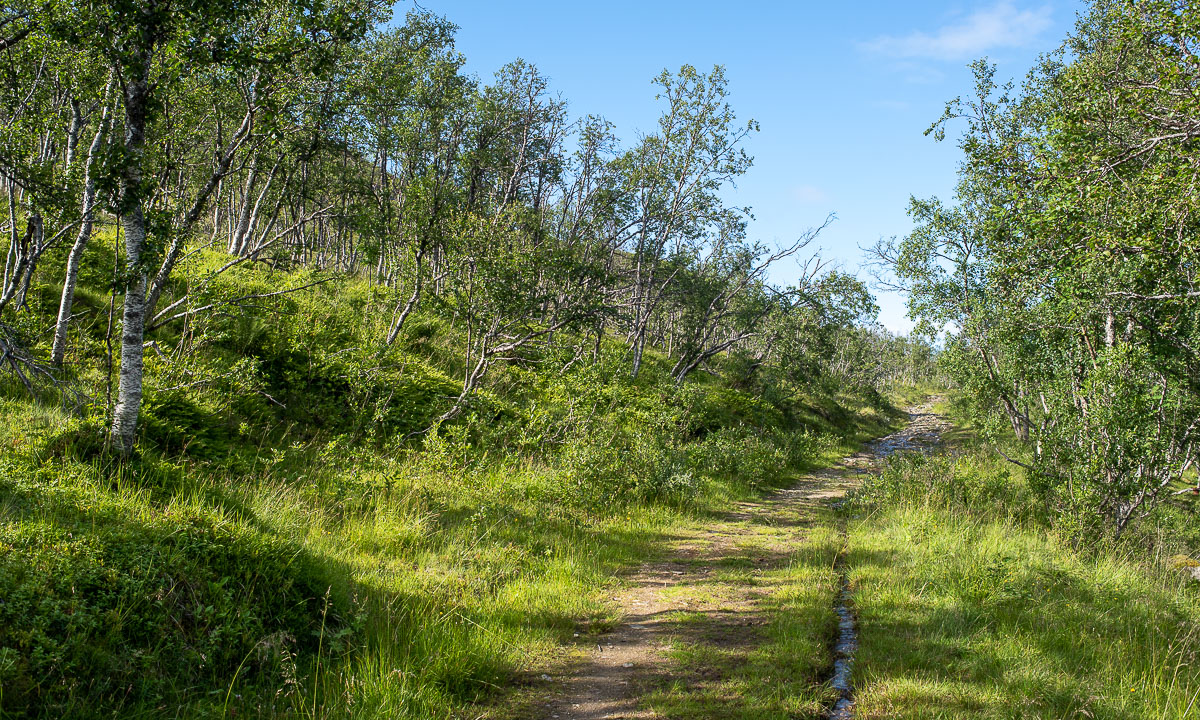
I start to follow the gravel road, which I leave after 2.7 km.

The small trail leads up steadily. It’s not so steep, that I have to climb but steep enough to raise my pulse to hummingbird level. I could blame it on my Covid infection two weeks ago but I guess it’s just a lack of fitness.

A movement to the left wakes me up. It’s a flock of ptarmigan fledglings with an adult. Some flutter away, some stay. I use the confusion to take some photos with my telephoto lens. The photos are heavily cropped, I want to keep distance.

I am above the tree line now and the views are impressive.

Most impressive is a chasm at the side of the trail. The gradient down? Perhaps 400%. Enough to keep safety distance while photographing.

The last part is rocky and pathless but the huge cairns marking the tops of Nordtinden (there seem to be two) are in view so I can navigate just by eye. I take it easy on the boulder fields. I reach summit number one and add myself to the summit register that lies sheltered in an aluminium box.

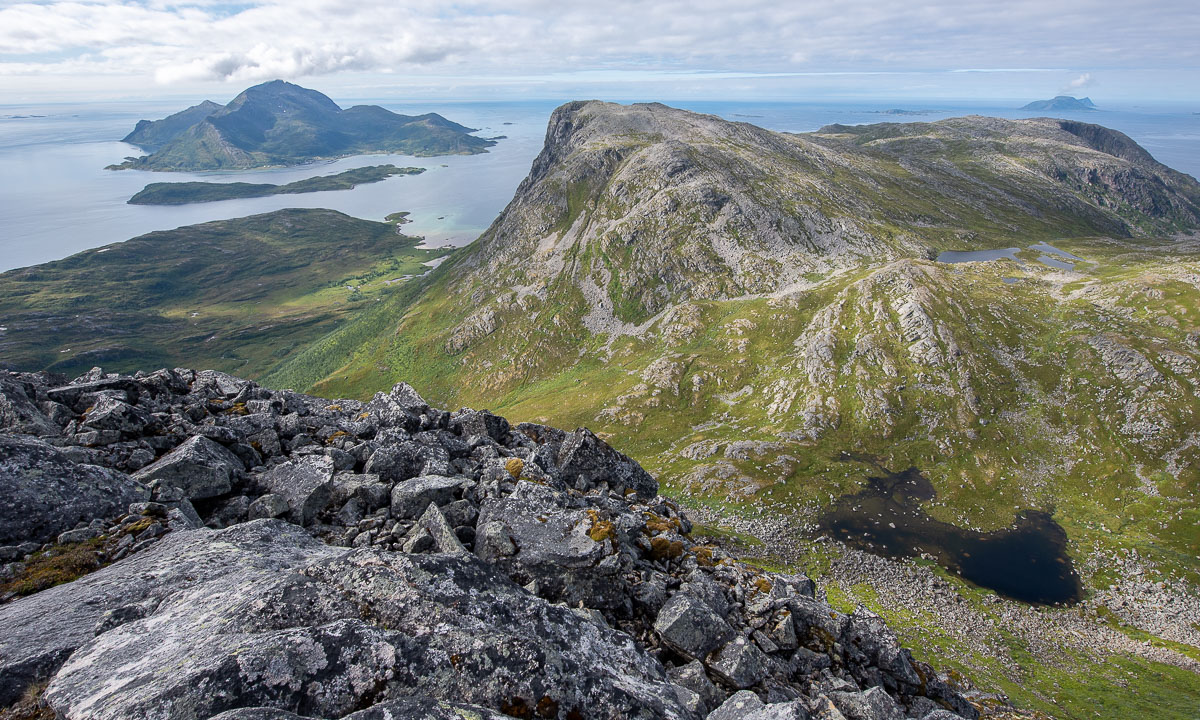
I continue a bit more west to get a better view to the sea. And there it is – the island Vengsøya with the smaller island Vågøya in the front.

I walk around to take some more pictures. I watch the ferry leaving Vengsøya and climb a bit down the slope to have a closer look to the nameless lake below the mountain Laukviktinden.

Then I walk back in a small circle, pass the other summit cairn and start to descend.

It’s always interesting how not only the view changes but the terrain as well. Round the summits it’s mostly rocks and boulder fields, then more and more grass is present and the path consists also of gravel and then earth, too. On the way back the lake Skulsfjordvatnet lies in the sun.

As most day trips the way back is the same as the way there. So I pass the sign to Nordtinden a second time and am on the gravel road again.

The change from forest to farmland shows that my car is not far away. After four hours and about 12 km I’m back from a lovely mountain hike.

Two more photos showing small things. The first one a beetle from the genus Carabus. The first one a berry from the genus Rubus. I was glad about both discoveries. The difference: The beetle stayed unharmed, the berry was eaten right after taking the picture.


An intangible longing

This blog article is a bit special. It’s not about the places I visit but about a special place of longing. The article is more personal than the others and probably I write it mostly for myself. I decided to publish it anyhow. You are welcome to read it and share your thoughts in the comment section. That would be nice!

I’m feeling sad and wistful. This map shows the reason for my melancholy and the place of my longing:

The image above is a clip of the map North Circumpolar Region. A large version of the map hangs in my work room home in Sweden. In the middle of the cropped image there it is: The North Pole! Unreachable. But …

Let’s first go back in history. 20 years ago. I lived in Essen, Germany and I just had stopped working as a professional jazz musician and made my first work experiences in web programming. Everything was new. And I started to develop a new passion: The Scandinavian winter.

That winter I had been in Lapland for the first time and I loved it! With the exception of the following year I have been north of the Arctic Circle every single year since then. In 2004 I first moved to the opposite direction – Munich – but in 2010 I moved to Sweden. 2020 was a very special year. Annika and I bought a house and moved in together in May. And in August we have married ! At the same time I got a job at the Norwegian Polar Institute in Tromsø. As a matter of fact that is too far away from home but this job is just a once-in-a-lifetime opportunity. That’s why I have had two places to live since then. Right now I’m in Tromsø.

Since I not only like maps but also graphics, I photoshopped a bit today. A graph about “way-up-north” the last 20 years. The x-axis shows the time and y-axis shows the latitude. The bars show were I lived and the dots my northernmost latitude per year.

You see the green dot this year? 82 °N – that’s quite out of my normal Northern Scandinavian boundary box. How I came there? As part of my job I got the opportunity to join a polar expedition with the ice breaker Kronprins Haakon. The three week journey took us to the Polar Ocean north of Svalbard. I was really touched and overwhelmed by the beauty of the sea ice and I fell in love with the high Arctic.

Last week Kronprins Haakon started another polar expedition for five weeks. Oh, I was longing for being in the high Arctic again and I wished to join that cruise so much!

It doesn’t make it easier that I know 9 of the 27 participants. And it doesn’t make it easier either, that the ship is probably not fully booked. There might have been a place (although no budget)! But today it became even harder when I read that yesterday Kronprins Haakon has reached the North Pole for the first time. The North Pole! Imagine – the NORTH POLE! Being there is one of my two strongest dreams in life! The other I’ll keep secret ;-). But of course it is not my main field of work travelling around. Unfortunately.

So that’s why I have been feeling sad and wistful the last two weeks.

But there are things that help.

Annika is coming to Tromsø next Friday and then we have three weeks of holiday together! Since we do not see each other regularly, each day together is something special. I’m so looking forward to see her!

Other thing that help? Hiking in the mountains (last Sunday and tomorrow), paddling kayak (yesterday), taking a bath in the sea (this afternoon).

But still visiting the North Pole will be one of my big dreams!

Just a hike up the Rødtinden

Today I joined a group of (much) younger people on a mountain hike up the Rødtinden (470 m). It was special in two ways: First of all it was nice to talk to a bunch of people from the USA, the Netherlands, Austria, Poland and Spain. An then – the weather! It was a real summer day with a cloudless sky and a lot of gorgeous views.

I didn’t take many pictures but some from a small pre-summit that we hiked to after reaching the main summit.

A new camera

Next week Annika, my sister, brother in law a nephew and I will start a hiking tour in Sweden and Norway. We will not use a tent but hike from cabin to cabin. Last time I had 6 kilo of camera equipment with me. This year I decided to scale down weight and so I bought a point-and-shoot camera this week: the Sony RX100 VII. It has some disadvantages, but a huuuge advantage: It’s small and weights hardly more than 300 grams. That’s why I even can take a smaller backpack (also bought this week) and save another 1300 grams of weight.

Today I tested the camera, first on my way to work and then on random places, from the center to Telegrafbukta. I know, that the camera has its limitations (being not weatherproof for example) but I’m quite glad that I finally bought it. And here come some test shots from today. All photos are edited in Lightroom.


Two mountain peaks at the weekend

My wife Annika has arrived in Tromsø on Friday. The weather forecast looked quite well for Saturday (and only for Saturday), so we took the car to the island Hillesøya – the westernmost part of Kvaløya – and went up the mountain Nordkollen (214 m). To our surprise the ascent was mostly secured with a thick rope because it was rocky and pretty steep. We hiked a round trip via the subsidiary summits Sørkollen and Storbergan and back by the sea. We got less sun than expected but at least hardly any rain.

Yesterday we hiked again, this time with a colleague of mine and his family. And this tour was very rainy and we got quite wet. While the others started going back, my colleague and I reached the top of the Blåkollen (461 m) and had even some minutes without rain.


Back from a hiking tour

This article is part of the series “2022-08: Jämtland and Trøndelag”.

Hello, my dear blog readers. Three weeks of holiday have come to an end today. Mostly I was aborad. The main attraction: an eleven day hiking tour with my wife, my sister, my brother-in-law and my younger nephew.

We mostly hiked in the Swedish Jämtland but visited two Norwegian cabins as well. Our route: StorlienBlåhammarenStorerikvollen (Norway) – Nedalshytta (Norway) – SylarnaGåsenHelagsFältjägarenRamundberget. That’s a total of about 135 km.

Today I scrolled through the photos I made on the tour – it’s more than 1500. So it will take some time to go though, edit them and write some blog articles.

Anyhow, here is a sneak preview. 9 photos of the tour.

Jämtland tour 22 – the cabins, part 1

This article is part of the series “2022-08: Jämtland and Trøndelag”.

On our hiking tour in the Swedish Jämtland and a bit of Norway we hiked from cabin to cabin. These cabins are quite different, both in concept and in standard.

Ok, the photo above does not show a mountain cabin, it shows the Ringve Musikkmuseum in Trondheim that we visited the day before. Sorry folks, I couldn’t resist.

½ – the first emergency hut

Since the weather in the Swedish mountains can be quite rough, there are emergency huts on the trail. The first one lies between Storvollen and Blåhammaren, our first destination. You may rest inside the hut, but do not touch the fire wood or the emergency box – they are meant to save life.

1 – Blåhammaren

With an altitude of 1086 metres it is the highest STF mountain cabin. Famous for its fire beacon and its three-course dinner. We however use the self-catering kitchen to cook pasta with tomato sauce. A great first stay on our tour.

1½ – Endalen raststuga

Another emergency hut. The sun comes out and invites us to take a break. From here it’s only a kilometre to the Norwegian border.

2 – Storerikvollen

Two signs, that we are not in Sweden anymore: All roofs are grass-covered and the inside is full of carpets, wall pictures and other things to make the cabin individual and hyggelig – cozy.

A thing that makes Storerikvollen special: free-roaming sheep and Icelandic horses.

3 – Nedalshytta

After the longest distance of ca. 23 km we gladly arrive at Nedalshytta. As in Storerikvollen this cabin does not provide a self-catering kitchen in the season. We have pre-booked half board and now order dinner. What we do not know yet: the cook is very gifted and the dinners are awesome! A good place for a rest day.

This is by the way the only cabin with road access on our tour.

3½ – Ekkordörren

We are back in Sweden again. Time to take a short rest in the hut Ekkordörren before we follow the trail over the pass.

4 – Sylarna

Without loosing too many words: this is the worst cabin I know! A tiny shop with ridiculous prices, a dysfunctional self-catering kitchen with five soup plates in total, insufficient drying space and so on, and so on. The personal is friendly and pretty uninterested.

We will meet other people on our trip – cabin hosts as well as guests. No one likes Sylarna. But it’s only a single night and now it gets better. Much better!

Stay tuned for part 2 of the cabin article. Coming soon …


Thursday paddling – 1 september

It was five weeks ago that I joined the Thursday paddling of my kayak club in Tromsø last time. That time we were only three paddlers, today we were 19. Could be the weather ;-)

One group of eight returned after a while, we others continued to the beach at Telegrafbukta where we took a longer break. While we had the wind in our backs on the way there, the wind already started to die down on our way back. Good luck! It was beginning to get dark, but many paddlers were prepared and had lights on their kayaks and themselves to be seen.

Some photos from today:

Takk for turen!

Jämtland tour 22 – the cabins, part 2

This article is part of the series “2022-08: Jämtland and Trøndelag”.

Let’s continue with part 2 of the cabins on our Jämtland hiking tour. You can read the first part here.

4½ – Gamla Sylen

Another emergency hut on our way. We do not rest here, because it is just 2 km behind Sylarna.

5 – Gåsen

In Gåsen we choose the older cabin. It is a “Fjällstuga 65”, also known as Abrahamssonstugan after Tore Abrahamsson, who planned this cabin type in 1965. A room to the left, a room to the right. A large kitchen and two curtain-separated alcoves with five beds each. Propane gas stove, wood stove, no running water, no electricity. It is simple, genuine and it just works! Especially if you have a whole room for yourself as we did.

The other guests prefer the newer cabin, build in the eighties which is great, too – an even larger kitchen and eight four-bed rooms.

Here we take a day off. Time for idling, reading or taking small tours.

And taking an outdoor shower. The water is cold, but not icy. I leave the bath untouched, it is only knee deep.

Gåsen is one of my favourite cabins and places. I’ve been here several times – once in 2013, twice in 2020, but always in winter. It’s always windy but I just love it, even though you have to shovel a lot of snow and going to the toilet can be an effort.

Some photos from winter 2020. The first photo shows the newer cabin. Do you recognise it?

6 – Helags

Two days later we approach Helags fjällstation. Fjällstation means, that there is a restaurant. There are several cabins with self-catering kitchens and sleeping rooms, a house with reception, shop and restaurant, there is a large sauna building and there is Gamla Östan – the oldest cabin, built in 1916.

And that’s where we sleep: The right room in Gamla Östan. It is tiny, has a table, a wood fired stove, a double and a triple bunk bed. To enter the uppermost bed some mountaineering skills are required. The room is really cosy but does not have any kitchen. So we use the one in the cabin called Nordan.

The second evening I made a fire because the cabin was a bit chilly the night before. It takes some time, because the wood stove had its own ideas about getting oxygen or not. But finally it is burning.

It’s a nice combination of living in a museum, having a sauna and hot showers and be able to chose to cook or to go to the restaurant. (We take one breakfast and one dinner. Tasty!) And that all in a gorgeous place amidst the mountains. Me like!

7 – Fältjägaren

The first and only cabin I’ve never been before, neither in summer or in winter. It lies on the top of a hill, has a Fjällstuga 65, a toilet and a tiny cabin for the stugvärd. A really nice place, especially when it’s warm and you can bath in this fantastic mountain lake just some minutes down the hill.

And that was all the cabins we slept over on our hiking tour. Plus some of the resting places.

What I like most is the diversity of the cabins – from Norwegian hygge (cosiness) to Swedish funkis (functional design). From 1916 to 20-something. Variety rules!

A cloudy hike up the Stor-Kjølen

The weather forecast promised sun for most of the day today. Nice conditions for hiking up the Stor-Kjølen. I’ve been there once almost exactly one year ago, today I chose the other route coming from the Northeast.

I was there, my camera was there, however the sun wasn’t. Thick and low clouds hung over the whole mountainscape.

1 – The trail

5-5½ km long, leading up 560 metres in altitude. It is well marked and a visible trail most of the time. One boulder field has to be crossed and the last part is mainly pathless, but not steep.

2 – The reindeer

Much less shy than the Jämtland reindeer. They let me get quite close and one of them came within 3 metres. It seemed to be very curious and I expected it to touch me with its soft nose asking for goodies, but it went away. Another reindeer with huge antlers was much more careful and stayed with its small herd.

3 – The summit

Visible from a lot of places in and round Tromsø because of its prominent, mushroom shaped flight radar station at the top. Beneath the station – a small hut. It’s the varmebua, a heated hut driven by Troms Turlag. Very welcoming today, when it was foggy and round 4 °C.

4 – The weather

According to yr.no 4 °C and sunny. While the temperature might have been correct the rest wasn’t. It was cloudy and foggy and partially also drizzly. But then the sea started to shine and glare. While the sun itself was still hidden by clouds the reflection of the water surface sent sunlight upwards to the Stor-Kjølen. Amazing light, nearly unphotographable.

I waited in the hut for the weather to change, but in vain. On my way back to the car the cloud layer lifted and I could see a bit more of the fantastic surrounding scenery. But if took some more hours until the sun came out today and then I was long home.

A nice tour anyway. Or as the Norwegians say: ut på tur aldri sur – Out on a trip, never sour.

Jämtland tour 22 – hiking up the Gåsen

This article is part of the series “2022-08: Jämtland and Trøndelag”.

In Gåsen, one of my favourite cabins in the Swedish mountains we took a day off from our hiking tour. My brother-in-law and I took this as an opportunity to hike up to the summit of the mountain Gåsen, name giver of the cabin.

Gåsen is 1427 metres high. That’s however not a huge ascent, because the cabins lie on 1100 metres.

As everywhere in on our hiking trip there were reindeer around. What do they do on the snow fields? Eating snow? Fleeing the mosquitoes, while there were no around? I don’t know.

We approached the mountain from the south where it is less steep, although Gåsen is quite flat everywhere. While we went up my brother-in-law discovered a snow hare (a.k.a. mountain hare) that ducked to the ground but then sprang away when it realised that we spotted it.

Looking back: the cabins of Gåsen. Looking ahead: the way to the top. And more reindeer.

And there it is – the summit of Gåsen. While the top of the mountain is just a large gravel plateau the 360° panoramic view is quite impressive. It’s not only the mountainscapes that surround Gåsen but the large valleys that made this landscape so huge and seemingly endless.

After a rest – being thankfully for our jackets because it was quite windy – we ascended again, this time more direct to the cabins we stayed over. This time our hike led us over two snow fields. We were not alone, the reindeer seemed to liked the snow fields, too.

At the end we had to go a bit zigzag because the ground was quite wet but after 2½ hours we were back at our cozy cabin. That was fun!

Bonus photo: A cloud. For me it looks like a singing turtle floating effortless though the sky. And you?


Jämtland tour 22 – the trail

This article is part of the series “2022-08: Jämtland and Trøndelag”.

On the photo above you can see the trail from Blåhammaren to Storulvån. It is in fact two trails together: the winter trail that is marked with red crosses and the summer trail that mostly is marked with stones with a large dot of red paint on it. We didn’t follow this trail I only took the photo because of the beautiful evening colours.

Many parts of the trail are just like this. They lead through heather, grass, crowberries, and dwarf birches. Other parts of the trail lead over hills, across rock fields, through forests and sometimes over a reindeer fence.

This is when the trail is dry. But often it isn’t. The trail can just be very wet of last nights rain as we had it on our third day.

The trail can be boardwalks that lead over swampy area or bogs. Some of them may be under the water which makes them rather slippery.

And then there are rivers, streams and brooks. Some of them are crossed by a bridge. Some bridges are big, some are – well – small, simple, and pragmatic.

And then there are rivers that you have to ford. I ’m used to hiking in rubber boots and so I could splash through while my fellow hikers had to switch to sandals and wade through the ice cold water. Already Douglas Adams said: You have to know where your towel is.

And then there is mud. It can be slippery and sometimes quite deep, especially right before or after a plank. When you have a plank.

Especially the first day trail section StorvallenBlåhammaren was in an extremely poor shape. The others went around all these muddy patches while I – hey, I have rubber boots! – just continued straight ahead. But then at one point it happened. I made a step ahead and my right leg sank thigh deep into the mud. On the trail! Luckily Blåhammaren had a dry room.

But don’t be afraid, that’s not typical. Many sections of the trail look more like this:

How long the trail was? I don’t have the exact numbers but I think we hiked round about 135 km on 8 days, so round 17 km a day.

Takk for turen – Thursday paddling – 8 september

Oh, what a wonderful kayak tour! And oh, what wonderful weather!

We were 31 kayakers from the Tromsø Sea Kayakers Club today and split into two groups. 19 paddled to Telegrafbukta, where I’ve been last week, 12 paddled to Grindøya, where I’ve been in June. I joined the Grindøya group and was very glad that I got some training this year. Not because of the waves that we had on the way there but because the group was experienced and quite fast. But I managed to follow and could take some snapshots on the tour.

Now it starts getting dark quite soon and we must have lighting at our life vests and the stern of the kayak. I had only some make-shift light and have to buy some equipment for next Thursday.

But now it’s getting late, so no more words, just some photos. To all today’s fellow paddlers: takk for turen – thanks for the tour.

Jämtland tour 22 – the glacier of Helagsfjället

This article is part of the series “2022-08: Jämtland and Trøndelag”.

It is 23 August, day 9 of our hiking tour through the mountains of Jämtland. Today we take another day off and I decide to try to reach the glacier of the mountain Helagsfjället. I don’t know how near I can get but I’ll see.

This glacier is the Sweden’s southernmost and parts of it are visible from the Helags fjällstation. You can even see the mark of the top (1797 m) which is round 750 metres higher than the cabins.

On my way up I meet three men heading for the top. I hear that it is easy to climb, even for children. Other hikers will confirm that later. Well, perhaps I’ll do that another time but today I want to touch the glacier.

I walk first up on across county, reach the main trail and follow it for a while. Then I turn right to follow a smaller path heading to the glacier. I reach a field with large rocks and boulders. Carefully I follow the cairns that mark a path until I stand in front of the first glacier tongue.

Time for a selfie!

I spot another glacier tongue. For coming there I have to climb over a rock outcrop. Mountaineers will laugh that I call it climbing but I’m more a hiker than a climber and as soon as I have to use both hands I call it climbing. The effort was rewarded. What an impressive view on the glacier!

I stand still for a while. First of all it is beautiful weather and then it is fascinating just to see the colours of the glacier changing while shady clouds pass by. And then I move again to take more pictures. And I drink some water and eat a bit of chocolate.

How long I stand there? I cannot say. I start my way back. My first view is on the radio station on the mountain Jalkedsåajja. This is where my sister and brother-in-law are today. But it is too far to spot if they are there right now.

While walking back I come to the small glacial lake that I already passed on my way up. Some people had written their names using stones. Wait – some people!? Only now I do realise that the whole area is covered with messages arranged by stones. An ancient social media stream – though without cat videos.

The whole tour took only three hours, with a lot of photographing and taking rests. If you plan to visit Helags you definitely should consider to give the glacier a visit. I keep my fingers crossed that you get nice weather, too.

Jämtland tour 22 – signposts and waymarks

This article is part of the series “2022-08: Jämtland and Trøndelag”.

If you want to hike you need either a good map and a compass, or a GPS, or you have an area with designated hiking trails. Then you in most cases have only two issues: find the right trail and follow it.

Easy, isn’t it? Yes, but wait – what’s that?:

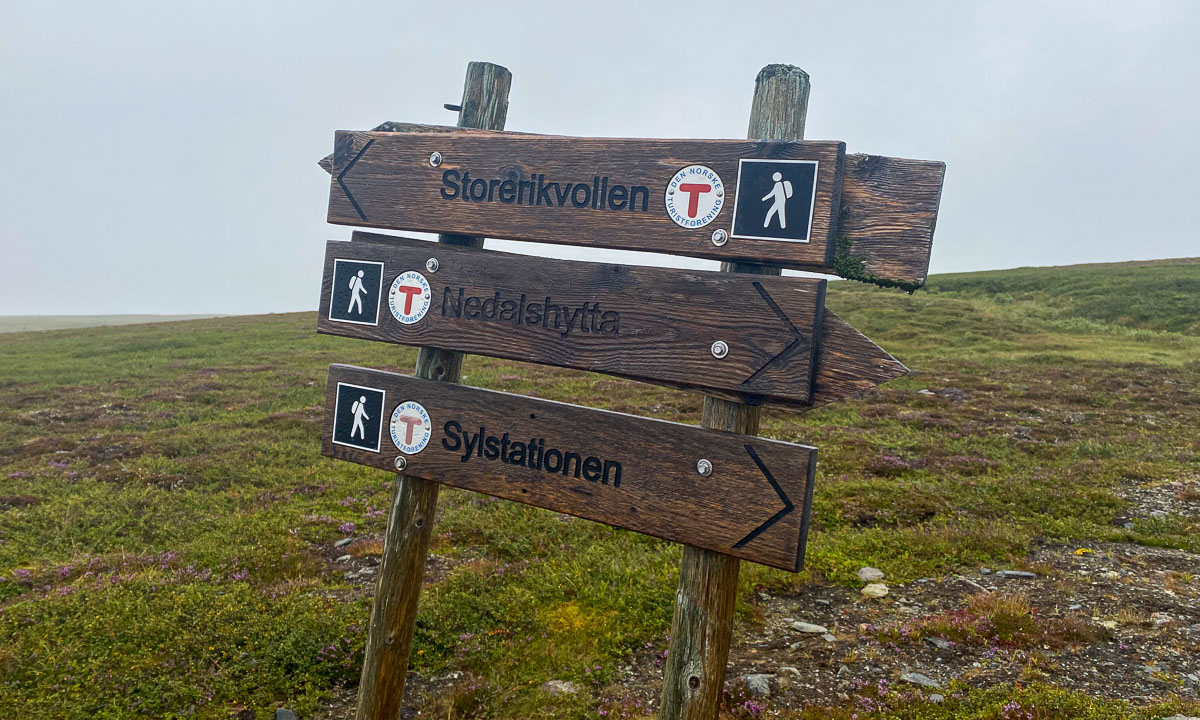
Why are there two trails to Storerikvollen? Check the symbols. One shows a skier, the other a hiker. That’s the first think you have to know: There are summer and winter trails in the Swedish mountains. The latter ones are often a bit less hilly but can lead over bogs and lakes. So choose the right track. Quite often they go together for a while and then split up again. That’s where you have either to check a map (take an up-to-date one) or follow the right waymarks.

The waymarks for summer trails use stones and red paint. In Norway it is a red T, in Sweden it is mostly a red dot. Mostly they are painted on large stones, rocks or on cairns – heaps of stones. The advantage of cairns: they are easier to spot when it is foggy.

In wintertime most summer waymarks are hidden under a deep snow cover. Then it is the time of the winter waymarks: Red diagonal crosses.

The poles can be several metres long because of the snow, the depth of which can vary greatly. When you have snowstorm conditions in winter you sometimes just can spot the next cross. When you’re lucky. I took the following photo on 20 February 2020 on a ski tour. Two hours later we experienced average wind speeds of 25 m/s. Then you start to love the waymarks that guide you through the storm.

Back to our August Jämtland tour this week. We could watch some people replacing the old winter waymarks by new ones. An important job, probably done on a voluntary base. Voluntary work is so important in Norway that it has its own word: dugnad.

I guess the best sign posts we found in Nedalshytta in Norway. One “summer signpost”, one “winter signpost” and even ratings for the trails from green to black.

It’s always nice to meet some signposts on your way, but not all of them show the distances. I like the last one. The letters are holes in the metal sign, so it won’t snow over so easily in winter time.

But not all signs are about following the trail. They can show you the Swedish-Norwegian border. Or the way to the toilet. Or the toilet – often a “privy” – itself. Or where to park your dog in case you have any.

And some of the signs or marks are quite creative. I almost missed this “in-tree” waymark in Norway. Perhaps more funny than helpful.

But the clearest sign we directly spotted on our first hiking day in Storlien:

The words say henan, dittan and hittn which are apparently words in Jamska, a group of Jämtland dialects. They mean something like here, →there and →here. I cannot express it better. Anyhow this is an article about signposts and waymarks, not about linguistics.

Stappen in the autumn

Reader, meet Stappen. Stappen, meet reader.

Hiking up Stappen is tour 54 in my book “På tur i Tromsø” – On tour in Tromsø – and it is marked blue, which somehow means that it is moderately easy. I tried to hike up Stappen in winter last year but gave up because of the steep terrain paired with snow. Today I gave it another try.

Autumn has been in full swing the last days and most of birch leaves are yellow, while other plants as groundcovers are anything between green, yellow and bright red. Sky today was grey but the colours shone brightly.

After crossing a bog I had started hiking up the mountain from the left side. Or should I say, climb? There was no recognisable path and it was quite steep. Since all rocks were overgrown, terrain was not so easy and I took it slowly and cautiously. I didn’t want to slip or find some hole between the rocks.

As usual the views were gorgeous. The island Tussøya with the pale sea behind, the mountain massif round Skamtinden that rose above the valley while gaining height. or the autumnal coloured marshes with their embedded lakes and small meandering streams.

You can see it on the first photo. The way up stays steep – up to 85% or 40° – until the very top. But finally I crossed the 550 metres level curve and was almost up, because Stappen is only 565.2 metres high. But up does not mean that it was a plateau, it was more a constant up and down and I used my hands a lot when it got steep. Fortunately the ridge was always some metres broad. I’m a bit afraid of heights. And then – after crossing most of the ridge – I reached the top.

Impressive is not the word that you would use to describe this knee-high heap of stones. It was quite obvious, that this mountain is not very popular. It is pretty steep to the sides, so that I could look straight down to the lake Botnvatnet (“the bottom water”). Later I would go round this lake on my way back.

But I was still on the top of the mountain and continued following the ridge that slowly descended. Here you can see two parts of the ridge:

On my way I found a small clearing surrounded by rocks. With the rough mountains around it looked like a secret valley, where dinosaurs still live. Well, they have to be tiny, the clearing was only round ten square metres in size.

This part of Stappen was much less steep, but when I looked back again it looked quite impressive anyhow.

After a while I reached the bogs – still at an altitude of round 330 metres and started to walk back onto the wet and bouncy ground.

Stappen was a nice tour but steeper than expected. At home I read the tour description in the book again. You had to read between the lines: While it was not mentioned, that the ascent is steep, alternative routes were mentioned with the words: “Her er det litt mindre bratt”.

Google translate’s translation: “Here it is a little less steep”.

Olaf’s translation: “Here it is little less steep which is still pretty steep. But other paths – those that you will choose – are much steeper! Anyhow, we marked the tour as blue so you might survive.”

At the end just three pairs of photos of this tour and my tour on 4 December:


Kayaking into the dark

It seems, that summer is over. It’s less a matter of temperature but light. Next night will be autumnal equinox and today’s sunset was already at 18:47. Tromsø has almost the same longitude as Budapest.

Anyhow the Thursday paddling of Tromsø Havpadelklubb – the Tromsø sea kayak association – still hold place today. Next week will be the last time for this season. Today we had perfect conditions: No waves, no wind and 10 °C. We had many a summer day worse than that here in Tromsø

May I present, that is D5. It’s one of the many rental kayaks of the association and my standard choice. My own kayak is in Sweden.

Today we were 15 people heading to the island Grindøya on the other side of the sound between Tromsøya and Kvaløya. OK, let’s start …

First we paddled along the coast, then we started crossing the sound. From the boat houses to Grindøya it is round about 4 km.

This time we did not paddle round the island like in June or two weeks ago. Instead we headed for a beach at the northern tip and made a break there. I had a piece of soft chocolate cake with cashew nuts, a welcome leftover of the three day data management workshop that I joined this week. And while we stood or sat there it started getting dark.

Some of my fellow paddlers already had switched on their lights on the way to Grindøya, now we all illuminated our kayaks and ourself. It’s less about seeing but about being seen. There is commercial shipping on the sound. We prepared our kayaks and departed.

While we paddled back it got darker and darker. It’s really a special experience to paddle through the dark in a group. You hear the drone of the city, occasionally interrupted by an airplane or a motorcycle. But that’s far away. Our own sounds are near: soft conversation and the little noises of the paddle entering and leaving the surface of the sea. And since you see less and less, hearing becomes more and more present. And anyhow I tried to paddle as silent as possible not to disturb the quietness.

When we arrived at the boat houses of Tromsø Havpadelklubb it had become dark. The tour lasted only an hour and a half plus a half hour break. But the peaceful sound of kayaking calmly through the darkness lingers still in my ears.