More winter
Round 20 cm of new snow, still snowing / temperatures round -17 °C, still dropping – that’s a good start for a nordic winter in my opinion.
Two photos from today:


Round 20 cm of new snow, still snowing / temperatures round -17 °C, still dropping – that’s a good start for a nordic winter in my opinion.
Two photos from today:
A single photo from Annika’s and my Christmas promenade today. In Umeå we got more rain than snow yesterday and the trail Tavelsjöleden which we walked some kilometres today was completely covered with ice. However we both had spikes under our boots and so it was easy to walk. When we left the town behind the ground started to be covered with snow – just as much for a touch of winter.

Anyway it’s definitely much too warm for winter and we need colder weather and snow. Much snow! Loads of snow!!!
I have stopped counting the times I was in Solberget, the beautiful wilderness retreat in Swedish Lapland. This time I was asked if I want to join a three day first aid course in Solberget. Since my last one was long ago I accepted gladly.
The course, arranged by the German Outdoorschule Süd, was both intense and fantastic and I’m glad that I was able to participate. I stayed another day after the course to make a ski tour. It has snowed quite a lot in Lapland in November and round about 60 cm of snow covered the forest soil. I started the tour at 8:30 – an hour before sun rise. The air was crisp and cold with temperatures round -15 °C. I borrowed a pair of wooden Tegsnäs skis. They are long and broad and fit to every boot which makes them ideal for the powdery snow in the Northern forests. I crossed the street and entered the narrow forest path that leads to the hill which bears the same name as the wilderness retreat: Solberget – the Sunmountain. I crossed the Solbergsvägen, which was covered with a half metre of snow and soon went slightly uphill through the old forest with its mighty spruce and pine trees.


Even though I didn’t take the smoothest way up it didn’t take long until I arrived at the top of the Solberget, which is 459 meters above sea level. I ignored the cozy mountain hut and went straight to the old fire lookout tower which provides a unique 360 degree view over the landscape.

As fastly as I arrived at the tower as slowly I climbed it, since the handrails and the steps of the three ladders were covered with a thick layer of hard and crusty snow. Finally I was on the top of the tower, just in time to see the sun rising above the hilly horizon.

I stayed on the tower for more than an hour, happy to see the snow covered trees in the warm and ever-changing light of the low hanging winter sun. First the sun got free of the clouds and started to illuminate more and more of the scenery. The colours changed from a pale pink to shades of orange and many other colours I don’t have any name for. After a while a cloud layer approached from the north changing the mood of the landscape again. At the end almost the whole landscape was shadowy beside of the fog that still hung above the swampy areas in the southwest.


Finally the sun vanished behind the cloud layer. I climbed down the three ladders of the tower and continued my ski tour. First I headed southeast, then I turned more and more to the right while I descended the hill. After a while (and a bit of squeezing through the pathless thickets) I reached the Solbergsvägen again, however more in the south. This part of the path was completely untouched beside of a track of a hare that you still could guess under the fresh snow of the last day.

After a while I came to the turn-off to the swamp Solmyran which I followed a bit. The sun was low again and illuminated the snow in bright orange colours, while the snow in the shadows looked more blueish. There are many colours in winter, you just have to go out to spot them.


I can highly recommend both a stay at Solberget and the first aid courses of the Outdoorschule Süd. In February you can combine the two, if you can speak and understand German.
This article is part of the series “2016-11: #snowember16”.
As yesterday I took the car to the hill Bureberget, this time with skis and snowshoes. I had thought that the biggest challenge would be to park the car – not easy if there are only snow walls on the left and the right off the road, but I was lucky, a side road was cleared and I could park the car there in front of an old, wooden house buried in the snow.

I decided for the skis, changed shoes, put on gaiters, strapped the backpack on and put on my skis. After following the main road to Burvik a bit I bent left into the road to the top of Bureberget. The snow has settled a bit and was less high than yesterday. Soon I found a nice way downhills – my first “ski-run” this season, perhaps 20 seconds long. Of course I had to climb up again. That was partly not so easy between trees, rocks and quite soft snow where I sank down to my knees quite often even with the skis on. I found a steep but nice passage up that led me to some kind of bridge or ladder crossing a small ravine. This part I took without my skis …
After I had succeeded the “winter climbing challenge” I stood on a huge rock, almost up on the level of the top again. I took a detour to the forest and was soon back again.
This ski tour was quite short. One of the reasons was, that I didn’t find nice motive for photos today. It was very windy and all treetops were bare of snow. Many pine needles and pieces of bark lay on the snow which made the snow looking old and dirty, even if it was just one day old.


But anyway, it’s always great to be out and so it was today! And even better, when the sun comes out.

2. The coast of Storgrundet
When I was back in Skelleftehamn I didn’t drive home directly but to the coast of Storgrundet. I was curious how much ice would cover the part of the Baltic Sea between island and mainland. There’re still patches of open water, but most of the water is covered with ice. I guess that I have to look for other starting points, when I want to paddle kayak in the weekend.


It was only some degrees below zero but the strong winds made me shiver and I was very glad to had a warm down jacket with me and put the hood on tight. Brrr, autumn is definitely over.
This article is part of the series “2016-11: #snowember16”.
And the snow fall continues. Today it didn’t stop snowing at all. 40 cm of snow covered the backyard of my house in the morning, now it’s already 65 cm and probably the fence will be buried by the snow soon.
Most people are only out to clear the snow, by shovel, snow blower or – more efficient – by tractor. The big municipal snowplough has just come through for the first time today, leaving a “plogkant” (plough rim) – a wall of snow, round 60 cm high, on the side of the street. That means, before I even think off taking the car, that stands on the driveway of my property, I have to go out and shovel all that snow away. And that snow of the plogkant is always quite compact and therefore heavy.
The neighbours have started to look at me almost a bit angry. They know, that I’m snow-addicted and just love that kind of weather while they just see the work. Perhaps I would think the same, if I had lived here the whole of my life.
But anyway – it is so beautiful with all that snow. Have a look by yourself.


Today it’s even cold the first day with day temperatures round -6 °C. In combination with all that snow, it’s hardly believable that it’s just the beginning of November.
The forecast says, it will permanent frost temperature the next 10 days. I – sorry, my neighbours – would approve it.
Yesterday I took the car and drove to Umeå. The sky was blue and the sun was shining. Sounds nice, right? Well, it was nice but hard to drive. The sun melted the frost on the asphalt and the wet street reflected the low hanging sunlight. Sometimes it was really hard to see anything other than just a glaring white nothing.
Today the sky was blue and the sun was shining again. Sounds nice, right? Today it was nice since Annika and I took a longer stroll through the forests near Strömback south from Umeå.
The temperatures were above zero, but parts of the ground were still frost covered. We followed a path between Tjuvvarpet – a lake – and Matsund – part of the Baltic Sea. Anyway you could see neither lake or sea from the path since the forest was too dense and hid the waters which were just 100 meters away.


On the way back we made a short rest at a place on the lake near the hill Tjuvvarpberget. Most of the lake was still free of ice but near the rocky shore you could see the first covering of ice. It almost looked a bit wintry.

Apropos winter: If the weather forecast is right we will get at least 30 cm of snow in Skelleftehamn within the next eight days. Nevertheless I’m quite sceptical. Just two centigrade warmer and it will all pour down as rain.

This article is part of the series “2016-09: Jämtland and Norway”.
The day after our walk to and through the Torghatten we took a breakfast in our fantastic cottage Feriehus ved Lille Torgvatnet we hired for two days. After that we tidied a bit, packed our baggage into the car and continued the tour.

We took the 17 to the north to Horn, where we took the ferry to Andalsvågen. We drove 17 km to Forvik, where we took another Ferry to Tjøtta including some intermediate stations.


Have a look at the 2nd photo above: „Tricky stopover in Stokka“. You see the car with the trailer? Look closer. Did you realise, that the taillights are on? The car isn’t leaving the ferry, it’s entering it. Backwards! All cars in Stokka had to embark the ferry backwards – whether that car with the trailer or the camping van. I never expected that you have to enter a ferry like this. The next port we experienced an even bigger oddity: The car with the trailer even left the ferry backwards. Really strange!
We continued on the 17 – now without any ferries – but left the road near Leira to continue to Mo I Rana. From that town it’s just another 40 km to the Swedish border.
Annika and I enjoyed the incredible autumnal colours of the trees on our way back and I looked for a place to make some last photos of the tour. 2.8 km behind the border I found it:
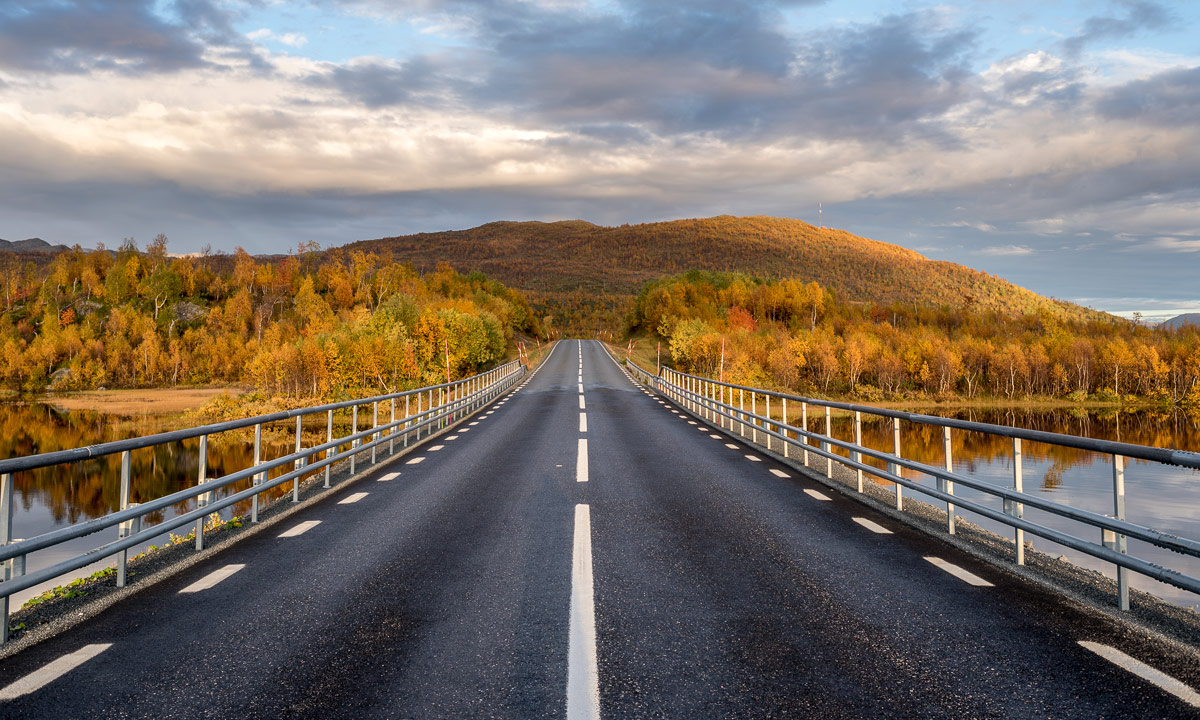

After looking at these stunning and extreme colours we continued to Tärnaby, where we stayed over night. The next day we drove back to Umeå, where we arrived in the afternoon.
This article is part of the series “2016-09: Jämtland and Norway”.
After two days in Norway we headed back to the Swedish mountains.
We started our day with a breakfast.
The Norwegian lodge Nedalshytta is really beautiful, but doesn’t have a kitchen and sells only some snacks, when it comes to food. Luckily we had both own things to eat and a mug with us, so would could enjoy our own breakfast: oat flakes with frothy milk! How to get frothy milk on a mountain tour? Mix milk powder and water in an empty coke bottle, shake it vigorously and voilà: schiuma di latte à la Annika.


After packing our backpacks we started our hike to the Sylarna Fjällstation. It was the first cloudy day since we started our tour three days before and anything was moist and wet. Sometimes we had to take a break to pluck some blueberries, that still tasted fresh and sweet.


We went along the Templet, which is Swedens highest peak of the Sylarna mountain range (1728 m). (Storsylen with its 1762 meter altitude is higher, but on the Norwegian side, just 100 meters from the Swedish border.) Due to the weather we first couldn’t see that much but after a while it started to clear up and the clouds released the view on the huge and barren slopes of the Templet massif. We were so lucky, that we hadn’t to go this part of the trail in fog and clouds.

Soon we arrived at a place called Ekorrdörren – the squirrel door.


We started our tour at 780 m above sea level. Now we were on 1100 meter and would have to go up another 260 meters to reach the Ekorrpasset – the squirrel pass – which is 1360 m above sea level and so the highest point of our tour so long. We started climbing up the slope but had to look back over and over again. The undulating valley of the river Åeruvedurrienjohke with it’s many hills and ponds looked like from another planet.

Our trail got more and more rocky. After a while there was hardly any way left, we just went over angular rocks with gorgeous views of the Templet, including a small glacier and the Slottet, another peak of the Sylarna.


I really love the changes of the landscape you can have within just some hours: From autumnal birch forest with blueberries over to grass covered plateaus and finally up to an asteroid-like landscape that looks like a pile of stones.
Especially the squirrel pass looks both harsh and impressive. Anyway, when you go up a pass you’ll probably go it down as well and even 200 meters altitude make a difference. The Sylarna Fjällstation lies near the river Sylälven that flows through a wide grass covered U-shaped valley and when we came nearer we could see three reindeers standing in front of the cabins. Back to civilisation.


We had hiked four days in a row and were quite eager to take a day off. Sylarna fjällstation would be an ideal place, since it lies beautifully and you can leave that place in six different directions. Alas, there weren’t only reindeers, but people, too. Many people. The place was crowded! There were many hikers and mountain joggers. In the big dining room sat a large group of bankers that got their three-course dinner including candlelight and fresh salad, brought by helicopter. We were unsure, if this should be a good place to rest for a day.
The information we got in the evening shocked us a bit: There were already 100 – 125 booked sleeping-places for that night (in addition to all people that would come without booking). That means, that this place would be even more crowded. Even Helags, which is more in the South had just some single sleeping-places left.
That was the moment, where we decided to escape.
We would stay overnight of course, but the next day we would abandon the tour and hike back to Storulvån, were I parked my car.
I was awake quite early, took my camera and tripod and walked out to wait for the sunrise. The valley Endalen was covered with fog. I looked at the glacier Storsylglaciären,that covers the eastern slope of the Storsylen and a lavvu – a traditional sami dwelling. The sun however showed up quite late, there were too many clouds.


I looked at the less beautiful parts of that place too: An excavator on a flat building site, a welcome sign surrounded by building material and waste.


We started the tour being content to leave Sylarna behind but a bit melancholy, too, because we didn’t plan to leave the mountains already after five days. Annika started to count the approaching hikers, there were quite many …
After half the way we approached something quite funny:

It’s neither a sculpture nor a church, it’s a WiFi-station including a recharging unit for smartphones! It is even marked in the hiking map: “WiFi och laddstn.”. There were many hikers and even some mountain bikers resting, but no one started the WiFi. The cellular network is quite good in that part of the mountains and I guess there’s hardly a young Swede without a mobile internet flat rate.
We continued our tour and slowly hiked down the valley Endalen. After a while we were below the tree line and the landscape got even more colourful.


And just shortly before we reached our starting point, were we had left four and a half days before I spotted a lonely birch tree – almost leafless. A symbol, that winter will come even this year. Fifteen minutes later we reached Storulvåns fjällstation, then the parking place, then my car. Annika has counted almost 150 people hiking, jogging and cycling to Sylarna, just from one direction! That confirmed our decision to leave Sylarna behind.

It has been a fantastic and varying tour with many different experiences in a short time. Tack för turen – Annika!
The End.
“Wait, wait …”
– “… wait, what?”
“How can it be the end? You had two weeks holidays, not only five days!”
– “well, ok, we did continue our journey.”
After changing cloth, using the bath room and drinking a coke we got in the car and I drove the way back to Enafors, that lies at the E14 which connects Trondheim in Norway with Sundsvall in Sweden. We considered some options but didn’t decide yet what to do next. Shortly before we approached the E14 I asked Annika: “Back to Umeå or Norway?” The answer was: “Norway”. So we travelled to Norway …
Stay tuned for the next article telling more about our trip in Norway …
This article is part of the series “2016-09: Jämtland and Norway”.
Annika and I are in the mountains in Jämtland and have just reached our first destination: Blåhammaren, where we slept in a 14-bed room.
Sleeping in a 14-bed room can be quite demanding, especially if you have this kind of snorers in your room, that could awake a frozen mammoth. However Annika and I were really lucky, no snorers at all! After our breakfast we had to decide where to continue our tour. From Blåhammaren you can hike back to civilisation or continue to two other destinations. Most of the hikers continue to Sylarna which is very central and part of the Jämtland Triangle, a very popular three-day-tour, that connects Storulvån, Blåhammaren and just Sylarna. We were keener to cross the border and hike to the Norwegian lodge Storerikvollen and so we did.
With an altitude of 1086 m Blåhammaren is the highest tourist station of the STF – the Swedish Tourist Association – so first the trail ran over the treeless mountain plateau, over rocks and moss, crossing some swamps and brooks. After a while we descended and the first yellow coloured birch trees came into view again.
Swedish summer trails are marked with red coloured dots on rock or tree, while winter trails are marked with poles bearing red crosses. You really shouldn’t follow the winter trails in summer unless you want to stand in front of a lake or find yourself deep in a bog – both are easy to cross only in wintertime. But quite often there’s a year round trail which makes navigation extremely easy even on less walked routes.


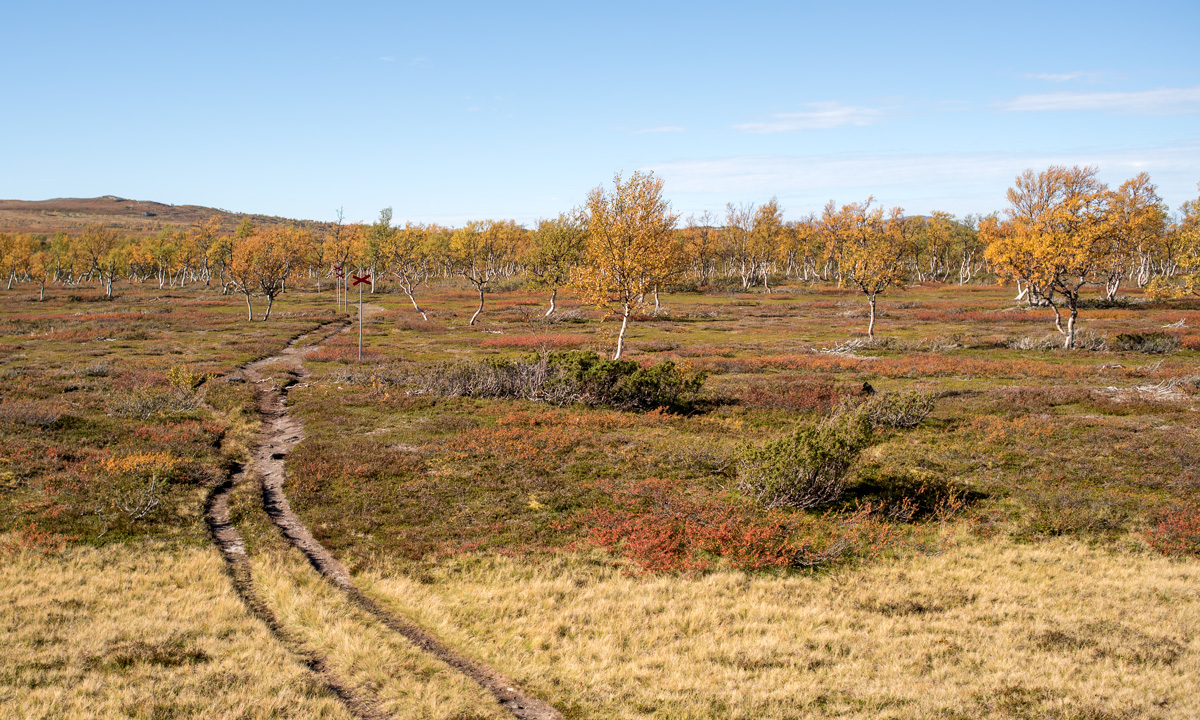


One kilometre behind Endalen, an emergency shelter, where we rested for a short while, the Sweden-Norwegian border came into view. It’s hard to mark a border less spectacularly than this one: A sign amidst of a pile of yellow painted stones, that’s it. The large bridge that crosses the river Enan (Sami: Äjnänjohke) directly after the border offers far more spectacularity.
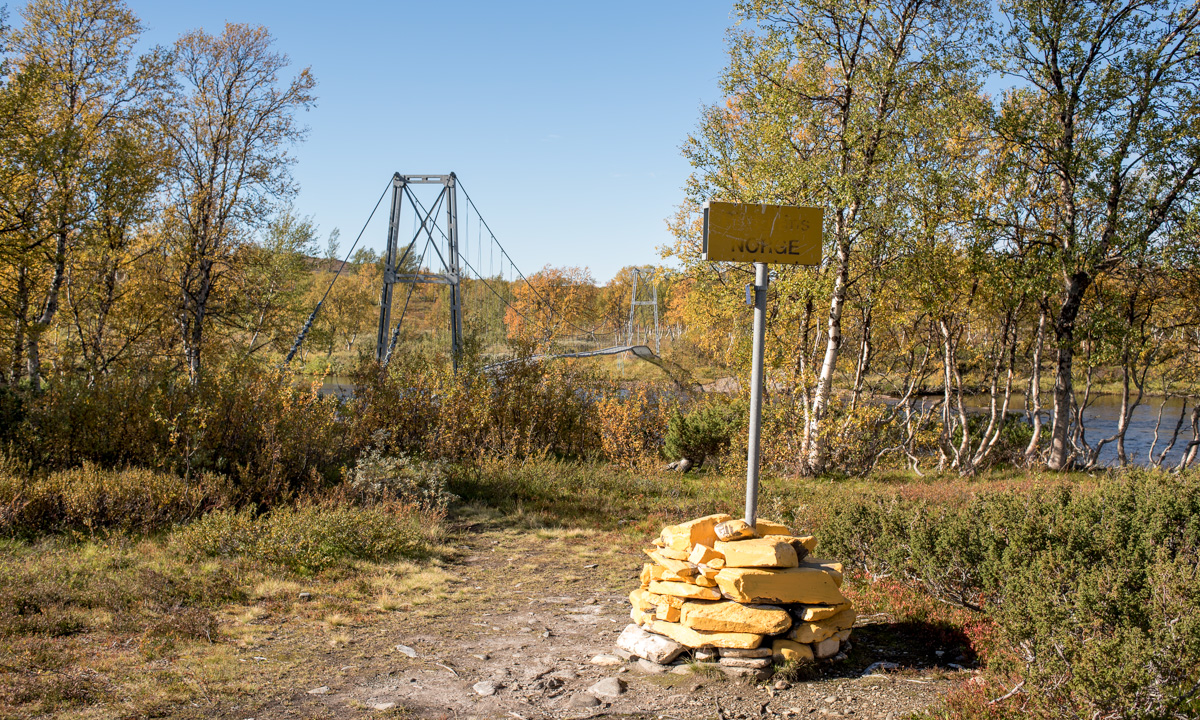

We detected a real nice resting place on the other side of the river, where we planned to enjoy the warm summerly weather, but two other hikers – by the way the first ones we met that day – coming from the other side chose exactly the same slab of rock to rest. Luckily we found another place, at least as nice as the first one. We unmounted our backpacks, took of our boots and dangled our feet into the ice-cold water.
(I like the photo with the drifting yellow birch leave and the dead mosquito. It illustrates, why I prefer the autumn to summer: Beautiful colours and no biting insects left!)


In Norway the summer trail marks change, now the trail was marked with big bright red T-s. The red T is also the logo of the DNT, the Norwegian Trekking Association.

Do you see the dark piece of something on the top of the stone? It’s animal droppings, but I’m not sure of which species. I asked for help on Facebook and the favourite answers are reindeer and (arctic) fox.
We continued our tour until we came to another swing bridge, this time crossing the river Djupholma. On the other side of that river lies a nice sandy beach where I took a refreshing bath (the only one of the whole tour). It was only two other kilometres to walk to our destination, the cabin Storerikvollen, where we arrived round six o’clock.


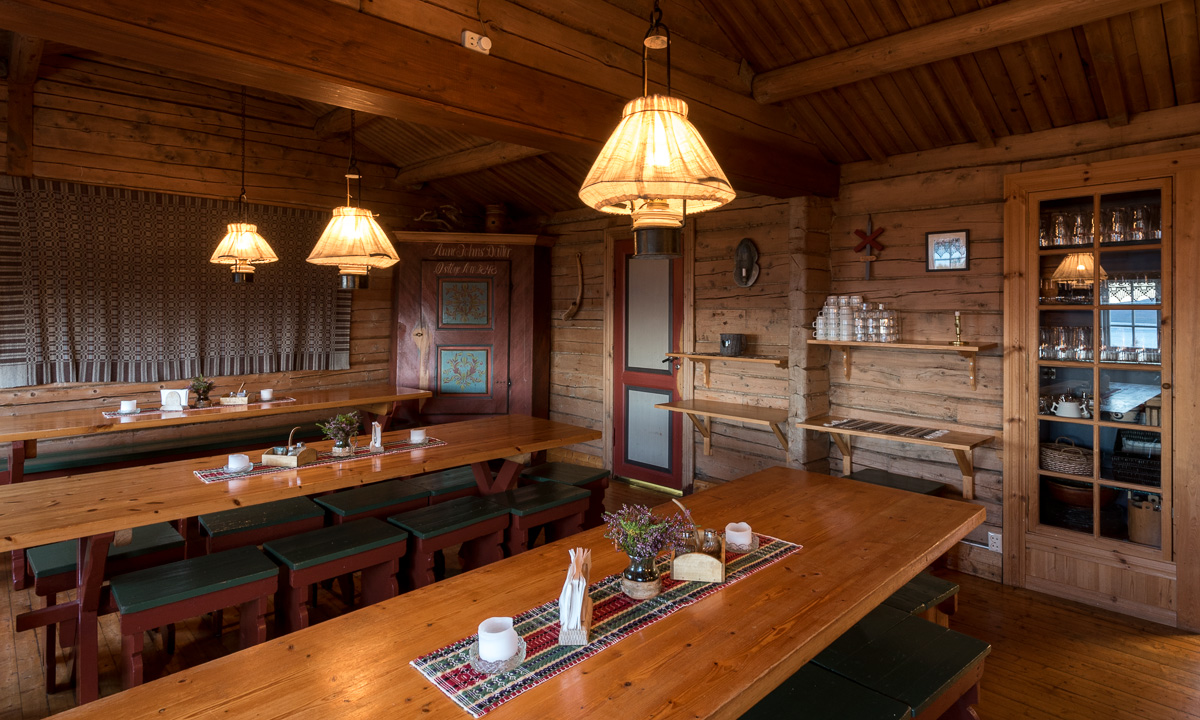

Oh, so nice these Norwegian lodges are. They seem less “funkis” (the Swedish functional style) and more “hyggelig” (the Norwegian word for cozy, snug, or homelike). Just gemütlich! And we got a two-bed-room for a good price. The only thing you should know, when you visit the Norwegian side: These cabins hardly sell any food and there is no public kitchen as in the Swedish cabins. So you have three options: (1) take a camp stove with you and cook outside. (2) cold dishes! Hopefully you have all with you. (3) eat the dinner and breakfast provided by the lodges (and pay the Norwegian price).
We chose (2) and had a nice dinner with salami, crisp bread and fresh water outside in the evening sun, enjoying both our simple meal, the warm air and the beautiful view. Later the almost full moon rose above the reddish mountain chain – what a beautiful evening!


The next day would lead us to the Nedalshytta, which is between 20 and 24 km away, depending on which map or sign post you rely on. So we got up quite early.


We had to go back yesterdays route 2 or 3 km where the trail divided. Now we turned south and had to ascent. Soon again we were above the treeline. When we looked back, we could see parts of the big lake Essandsjøen and even spotted – beside of some reindeers – the now tiny Storerikvollen, that we left some ours ago.


After a while we came to the river Fiskåa, where we had to ford. My rubber boots were high enough and I just splashed through the water, whereas Annika changed boots with trekking sandals and waded through the river.

Since rivers use to flow through valleys we had to ascend again and walked up along a reindeer fence. The weather was still warm and sunny, but you could see a cloud layer approaching afar. Would it rain in the evening as the forecast told us?


Only the map showed us the progress of our longest tour so far. We went a bit up, a bit down, a bit to the left, a bit to the right, down a small valley and up again. But finally trees came into view once more and soon we stood on an exposed plateau not far away from the yet invisible Nedalshytta.
Come on, just less than a kilometre to go … . Final spurt! A short while later we arrived at the beautiful lodge. Again we got a nice two-bed room, this time right below the grass roof. And we got: pizza! Perhaps not the best I ate in my life, but walk 20 – 24 kilometres with a backpack by yourself and you’ll know, how delicious a warm pizza slice can be!


