Finally it’s sunny again home in Sweden!

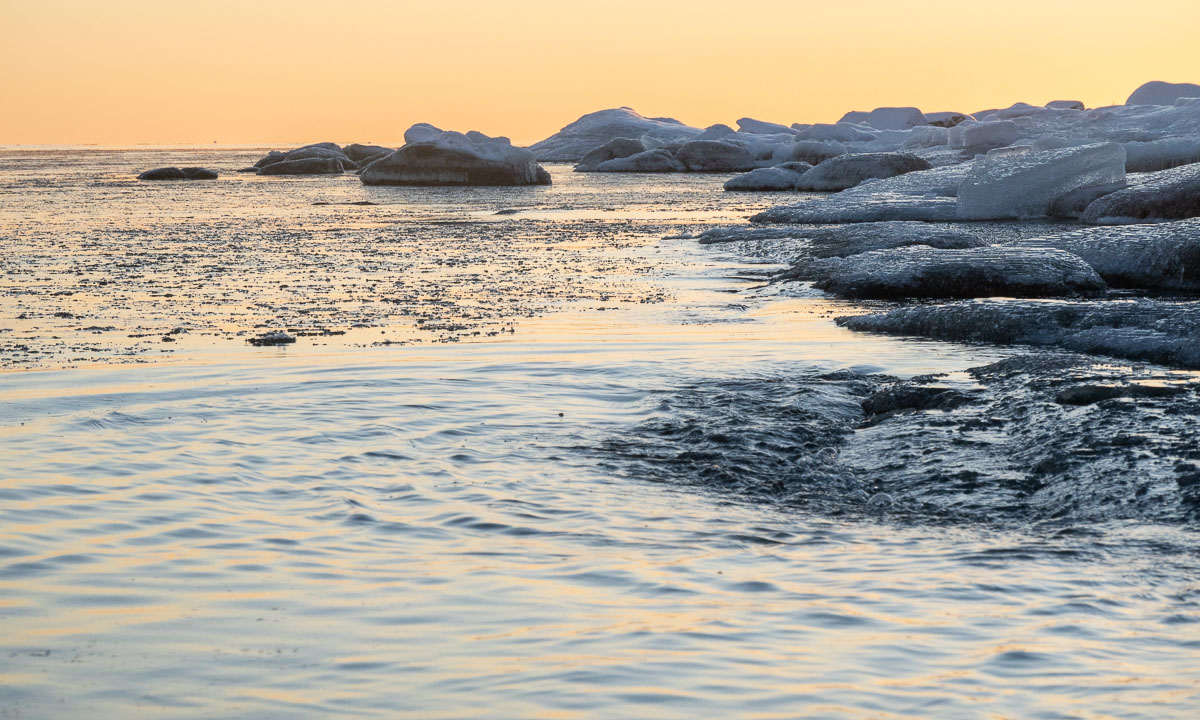
After a period of dull and cloudy weather that felt like ages the sun finally came out yesterday. Since I was flexible with working hours in the  morning I could make a small kayak tour.

The first part was easy. Since our house in Obbola is on the coast I only had to change my clothes and drag the kayak from the house to the bay. The bay was covered with ice. As usual I just sat in my kayak and started pushing myself ahead using ice claws. This works surprisingly well until you have a lot of water on the ice as I had yesterday. Although I wore neoprene gloves I got cold fingers. As usual this took some time but finally I reached open water.

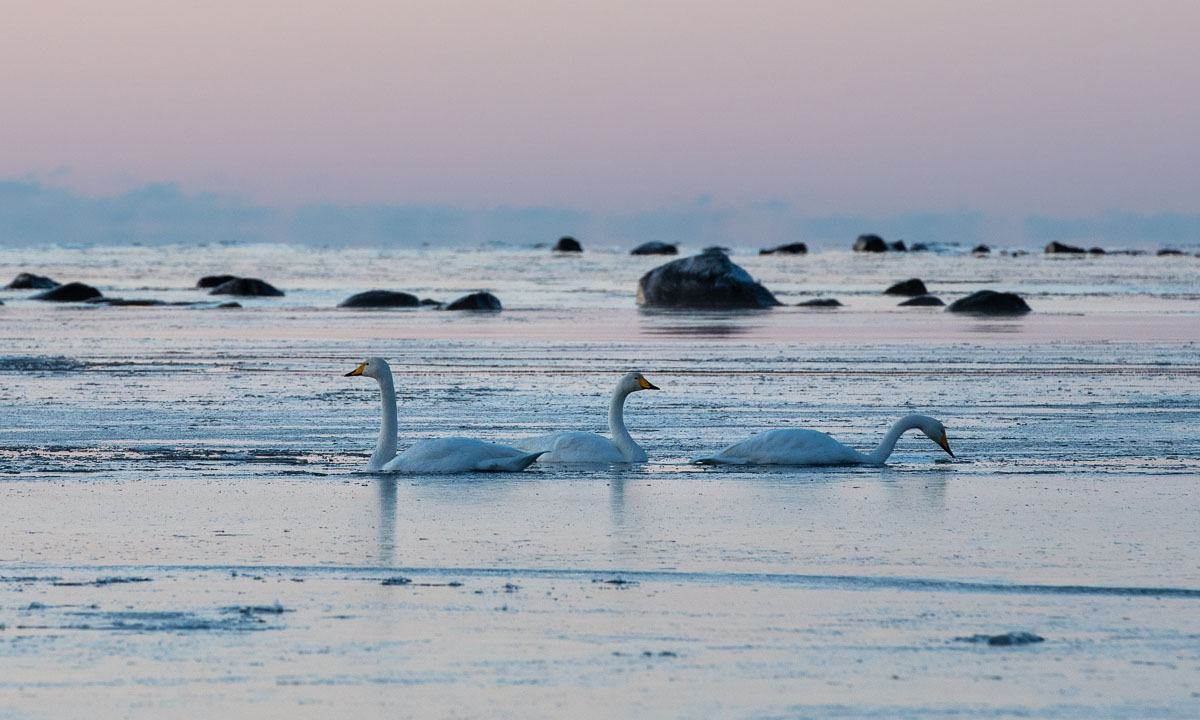
It was then that I realised that I had forgot my paddle. Fortunately the bay is shallow and I could leave the kayak, step on the ice and carefully walk back to land to fetch the paddle. Some minutes later I sat in my kayak again ready to circle the island Bredskär. I watched the hooting whooper swans and even four flying goldeneyes, a species of ducks. At the northwestern tip of the island there was a small, slushy ice field, the rest was open water. The big freezing hadn’t started yet. When I reached the eastern side of the island I could watch the sunrise some minutes after 9 o’clock.

The last part of the otherwise calm tour was surprisingly wavy. When one breaking wave came out of nothing and of course directly from the side I was afraid that I could capsize but the wave just lifted me gently up half a metre and down again. I was lucky. Sometimes it’s nice to own a less agile but super stable boat.

Even it was only some degrees minus the kayak was covered with a layer of frost that glittered in the warm light of the sun. I just had to take another photo when I was back on land.

And then? After taking a hot shower I made it to the 10 o’clock meeting. In time!

From Tromsø to Obbola

Friday, 18 November – walking back from work

It’s weekend. Today I stopped working already at 14:15. Sunset was 40 minutes ago and the light is beautiful while I’m walking home.

In Tromsø there’s hardly any snow, but a lot of rime. In the evening there’s polar light, but I only take a smartphone snapshot – tomorrow is a long day.

Saturday, 19 November – taking the bus to Narvik

Today is travel day. Round 16–17 hours it will take me from home to home.

Yes, I have two homes. One “work home” in Tromsø where I work and one “Home home” in Obbola where my wife Annika and I have a house by the Baltic Sea.

The weather is gorgeous and I take many photos through the window of the bus. Therefore some of the motives are blurred. The last one – the large bridge Hålogalandsbron is jittery because it has become dusky.

Saturday, 19 November – taking the train to Umeå

It’s a long ride from Narvik to Umeå. Departure 15:10, arrival 1:40 in the night. But it is a though train. I don’t have anything more to do but being awake on the arrival in Umeå. While I eat my take-away sushi outside of the train station it gets dark and so there is not much to see from the landscape in the train unless it stops.

In the frosty inland where it is quite cold I witness a special phenomenon. The whole forest we are passing is lit in green light. Another aurora? No, it’s cloudy. There are passages where the power lines for the train are coated with rime ice. The layer is so thick, that the current collector of the train looses contact and the electricity jumps over emitting bright green light that illuminates the dark forest.

The train arrives in Umeå in time and Annika already waits at the station. Another half an hour and I’m home home. Bed is waiting!

Sunday, 20 November – winter feelings

Oh, what a blessing it is to be home home. Normally we are supposed to work at the offices of the Norwegian Polar Institute but my boss knows about our long-distance relationship (or is it called long-distance marriage?) and allowed me to do home office until Christmas. Tusen takk! And it is even wintry and a bit sunny and a bit snowy.

From now on I can enjoy the view from my home office.

Monday, 21 November – the first home office day

Enjoying the view from my home office is a pleasure but when all of the sudden the morning sun peeks through the clouds I just have to go outside and make some photos!

And what do I do at lunchtime? This:


The first frost – hiking tour on the Laukviktinden

Today was the second day, where my car was covered with ice in the morning. I had to scrape ice after breakfast because I wanted to drive to Kvaløyvågen on the island Kvaløya to hike up the Laukviktinden (587 m) today. The weather was calm and the sky was blue and I enjoyed the views on sea and mountains from the car.

When I passed the shallow bay Finnvika I just had to stop and go there. Large areas were covered with a thin layer of ice that sparkled in the sun. Autumn in Tromsø is a fast season. Last weekend the trees were colourful, now many of them are bare.

20 km later: I just parked my car by the sea and read the tour description. I should follow the road for 80 metres, take the gravel road to the left and leave it when it turns left. The rest of the tour would be pathless but according to the book easy to find.

When I left the gravel road the terrain was a bit tricky. It was more or less overgrown boulders with hidden holes. The trees had shed their leaves and almost looked dead. I was glad when I had reached the mountain ridge where it was much easier to walk. The wet moss was covered with frost and so were the water puddles. Laukviktinden came into view, but I knew that there would be an acsent before. It looked pretty steep. Hopefully it’s just the perspective.

And indeed it was less steep than expected. A bit tricky however because some parts were wet and slippery. And that one of the countless moss pads hid a knee deep water puddle was not nice ;-) ! It is always a satisfying experience when you gain altitude, are above the tree line and can see more and more – both fjords and mountains.

Just straight ahead I spotted the lake Laukvikvatna and its neighbours. They lie 50 metres below. So I first had to climb down before hiking up again. Most of the lakes were covered with a thin layer of ice.

From the lake it is only 200 more metres in altitude to the top – according to the tour book. That meant that most of the the ascent lied behind me. It was easy to go up, only the very last part was a steep boulder field. Probably not the best routeI chose, but that was hard to see from below.

The terrain flattened out and then – all of the sudden – I could see the summit marker: A huge pile of stones with a metal box containing the summit book. And behind that: The open sea with the island Vengsøya.

What do you do on mountain summits beside of adding your name to the summit book? Yes – you take a selfie! After that I went a bit further to a place where the terrain drops off steeply. Here the view was really impressive because I could not only see the open sea and its islands but the bay Laukvika and even the boggy marshland that looked like it was directly under my feet. Here I took my iPhone as camera because it has a wide angle lens.

I took a break, ate some cookies and drank water. I even met another hiker that probably hiked up twice as fast as me. Then I started my way back. I found a better way because it is so much easier to find a good path when you look from above. Later my optimism was dampened when I landed in quite steep terrain and had to traverse it a bit until I was on my old trail.

Round 9½ km later I reached the gravel road again. In the shadow the ground was still frozen, but the car that waited in the sun was warm.

Jämtland tour 22 – the glacier of Helagsfjället

This article is part of the series “2022-08: Jämtland and Trøndelag”.

It is 23 August, day 9 of our hiking tour through the mountains of Jämtland. Today we take another day off and I decide to try to reach the glacier of the mountain Helagsfjället. I don’t know how near I can get but I’ll see.

This glacier is the Sweden’s southernmost and parts of it are visible from the Helags fjällstation. You can even see the mark of the top (1797 m) which is round 750 metres higher than the cabins.

On my way up I meet three men heading for the top. I hear that it is easy to climb, even for children. Other hikers will confirm that later. Well, perhaps I’ll do that another time but today I want to touch the glacier.

I walk first up on across county, reach the main trail and follow it for a while. Then I turn right to follow a smaller path heading to the glacier. I reach a field with large rocks and boulders. Carefully I follow the cairns that mark a path until I stand in front of the first glacier tongue.

Time for a selfie!

I spot another glacier tongue. For coming there I have to climb over a rock outcrop. Mountaineers will laugh that I call it climbing but I’m more a hiker than a climber and as soon as I have to use both hands I call it climbing. The effort was rewarded. What an impressive view on the glacier!

I stand still for a while. First of all it is beautiful weather and then it is fascinating just to see the colours of the glacier changing while shady clouds pass by. And then I move again to take more pictures. And I drink some water and eat a bit of chocolate.

How long I stand there? I cannot say. I start my way back. My first view is on the radio station on the mountain Jalkedsåajja. This is where my sister and brother-in-law are today. But it is too far to spot if they are there right now.

While walking back I come to the small glacial lake that I already passed on my way up. Some people had written their names using stones. Wait – some people!? Only now I do realise that the whole area is covered with messages arranged by stones. An ancient social media stream – though without cat videos.

The whole tour took only three hours, with a lot of photographing and taking rests. If you plan to visit Helags you definitely should consider to give the glacier a visit. I keep my fingers crossed that you get nice weather, too.

Back from a hiking tour

This article is part of the series “2022-08: Jämtland and Trøndelag”.

Hello, my dear blog readers. Three weeks of holiday have come to an end today. Mostly I was aborad. The main attraction: an eleven day hiking tour with my wife, my sister, my brother-in-law and my younger nephew.

We mostly hiked in the Swedish Jämtland but visited two Norwegian cabins as well. Our route: StorlienBlåhammarenStorerikvollen (Norway) – Nedalshytta (Norway) – SylarnaGåsenHelagsFältjägarenRamundberget. That’s a total of about 135 km.

Today I scrolled through the photos I made on the tour – it’s more than 1500. So it will take some time to go though, edit them and write some blog articles.

Anyhow, here is a sneak preview. 9 photos of the tour.

Two small winter paddling tours

Two small morning kayak tours I did this week. One two days ago, one today. Weather was just too great to sit inside the whole day: sunny with temperatures between -10 and -6 °C and a calm wind.

Here is a photo of each tour start:

As you can see it had snowed a bit between these two tours.

The day before yesterday I just wanted to circumnavigate the small islet Lillskär, but there was too much ice to cross and crossing ice with a kayak takes time. And since I work full time, time is limited. So I just paddled around a bit and then back.

Due to the frosty temperatures the ice was thicker today though hardly more extended. I started at the same place but then continued to the island Bredskär. From there I wanted to circumnavigate the island Bredskärssten, but the same story as two days before: At the northern shore of the island there was an ice field. Crossing it would have taken too much time so I changed my plans and made a smaller tour. Nice to be outdoors anyhow!

How do you cross ice with a kayak? If the ice is safe, just walk. You wear a drysuit and have your safety equipment with you, don’t you!? If the ice is very thin, just paddle through (use your cheapest paddle). But if the ice is between 1–2 cm, the ice may not bear you and you cannot use the blades of the paddle neither.

Then you can use isdubbar – part of the ice safety equipment. With these ice claws it is possible to pull yourself forward while sitting in the kayak.

If you are lucky the ice is thick enough to let the kayak glide over it quite fast. If you are less lucky the kayak will constantly break though and then it can be pretty exhausting, especially when the ice claws break the ice as well. Then it is sometimes simpler to pull yourself forward by grabbing the ice with your hands. Waterproof gloves or mittens strongly recommended!

White swans in Obbola

After two weeks in Tromsø i travelled home to Obbola last weekend, where I will work from home for two weeks.

When Annika and I looked out of the window yesterday we could see 3 swans swimming in the water between the small islet Lillskär and us. Oh, another 3 nearby, that’s 6 swans. And another one, and two more.

After some snowfall it had cleared up yesterday and it got colder in the night. This morning the temperature was below -12 °C. When I walked to the coast the water before Lillskär was covered with ice. The swans lay on the ice sleeping. They discovered and watched me but since I was slow and did not come too near they soon tucked their beaks under their feathers again and continued dozing.


Polar expedition AeN JC3 – day 21: Longyearbyen · time to say farewell

This article is part of the series “2022-02: Winter cruise KPH”.

Day 21 · 11 March 2022

It’s the night before 11 March, the last day of the polar expedition JC3 in the program Arven etter Nansen that I have been allowed to take part the last three weeks.

As often before I stand on the helicopter deck of the icebreaking research vessel Kronprins Haakon. It’s dark but I can see pale mountain schemes on both sides of Isfjorden. Mountains and fjords, that feels almost unreal after two and a half weeks with hardly any land in sight.

The first lights, the first other ships, the first mobile connection for weeks – we are definitely approaching civilisation. The airport is already in sight and soon the illuminated settlement Longyearbyen, the largest inhabited area of Svalbard is visible.

At 1:30 in the night we arrive at the harbour of Longyearbyen and the ship is moored. Time to catch some sleep.

After some hours of sleep the alarm clock wakes me up – time for breakfast. We have to leave our cabins at 8:00, the first farewell. Goodbye cabin 385 at the port side of the ship’s bow. After breakfast I stand again on the helicopter deck to welcome the sun and the blue sky.

Some of us leave the ship to visit town. Is it possible to go there without the threat of polar bears? Apparently, although we are at the coast and polar bears can swim. For two hours I stroll through the town, first with others than alone. Many of the others have lived here for a while – a normal place for people who are involved in polar research.

I head to the University Centre in Svalbard (UNIS). It’s not only the university that is located there, my employer the Norwegian Polar Institute has offices there as well. Hopefully I may work here for some weeks someday. I want to spend more time in Longyearbyen.

Together with J. who works there we had back to the ship. Here we will meet the taxis to the airport but before that we get lunch – the last meal on board.

Some hours later. Seven of our team sit in the waiting hall of the airport. Others already left with the earlier flight. And then we enter the airplane. It’s surprisingly cold in row 3 near to the open front door and after some minutes I put on my down parka. It may look ridiculous but soon I’m getting warm again. And then the plane starts.

The plane is rapidly gaining altitude and more and more the whole wintry beauty of the island Spitsbergen is revealed. I’m so touched by the view of mountain chains, glaciers and ice covered fjords.

And then we leave Spitsbergen’s southern tip behind and a layer of clouds slide between airplane and sea. A journey far beyond the ordinary comes to its end. Time to say farewell.

On the arctic sea iceFarewell

I stand on the Arctic sea ice
far in the north. The sun hangs low
over the horizon and there lies
an ice ridge lit by the morning glow.

The silence feels as infinite
as the extent of the frozen sea
and with every subsequent minute
my heart grows with boundless glee.

I stood on the Arctic Ocean
It’s past now and I should say good bye.
But an overwhelming sad emotion
shades my soul. And I cry, and I cry.


Olaf Schneider – 24 March 2022

My heartfelt thanks to all people that made this journey possible.


Polar expedition AeN JC3 – day 17 and 18: An incredibly beautiful day on the ice

This article is part of the series “2022-02: Winter cruise KPH”.

Day 17 and a bit of 18 · 7 and 8 March 2022

7 March

We have arrived at a place somewhere between Svalbard’s second largest island Nordaustlandet (14.443 km²) and the easternmost island Kvitøya (682 km²). No one lives permanently on these islands.

The ice experts have found an ice flow and examined it. The ice near the ship has some holes so the dress code is survival suits for the first time. In opposite to the formerly used Regatta suits they have attached boots and neoprene arm and neck cuffs. They shall keep you warm and dry in case you fall into cold water – or in our case break through the ice.

I am very interested to join and observe ice coring, a missing link on this expedition. I wasamhowever quite doubtful whether I will be allowed to enter the unreliable ice on this station. But I am lucky again, I may follow M. and L. onto the ice.

Earlier I was told that I may join the scientists taking ice cores but won’t get the opportunity to take ice cores by myself. That’s understandable. To my huge surprise – and delight! – plans were changed: L. shows me how to do it once and then it’s up to me to take five more ice cores. Give me snow or ice and something to play with and I’m happy ;-).

No, I’m no experiences ice corer after five cores. But at least I get an idea and a bit of a routine. In measuring snow depths, ice depths, the freeboard and writing down the values with a pencil. In mounting the large ice core attachment onto the electric drill and removing it after coring. In putting the ice core onto the gutter-shaped cutting board without flooding the electric drill or touching the snow (happened once – sorry!). While M. is cutting the core into slices and putting them into wide-necked plastic bottles I continue with my work. And I have to continue, because I’m still slow and M. shall not wait too long. I think, I could do that for weeks. Standing on the ice and drill cores out of the sea ice.

I have asked Pernille to take some photos from me while coring. These are probably the only photos that prove that I actually did something on the expedition beside of taking photos.

Photo credit: Pernille Amdahl, Nansen Legacy –tusen takk!

And the afternoon? I am allowed just to go onto the ice once more as long as I find some team lead to join. I find one and so get my 7th opportunity on this cruise. Two and a half more hours on the ice. I overhear a radio message. No polar bear warning but the information that our ice flow drifts with more than 2 km/h and the water depth is decreasing. This could damage instruments when they are too deep in the water.

Just some more photos:

And later, when we are on the ship again another polar bear approaches. This time it is a curious one that is very interested in the scientist’s equipment. And since it could harm the bear when it eats cables or plastic it is shooed away with a flare gun. **BANG**. It gallops some metres and then walks away. No polar bears were harmed and as far as I know no cables.

By the way – it was a good decision to use the survival suits. One of the scientists went through the ice today. All of a sudden and quite near the ship. It did not take long to pull the scientist out of the water but without the survival suit this would have been a very wet, cold and unpleasant experience.

8 March

The next day some additional measurements are done on the ice and then we leave last ice station of Arven etter Nansen JC3.

Ha det bra, Arctic sea ice. Farewell! It was a great pleasure to meet you and I definitely will miss you!

Polar expedition AeN JC3 – day 14 – 17: Travelling south

This article is part of the series “2022-02: Winter cruise KPH”.

Day 14 – 17 · 4 – 7 March 2022

4 March: after our second polar bear encounter we leave the ice station P7 at the 82th degree of latitude behind and slowly head south.

This journey will take more than two days although its only 250 km to sail. That’s because many scientific activities go on. Not from the ice but from the ship. Just an excerpt from the activity log:

  • CTD with water sample (19×)
  • Box core (4×)
  • Håv-trekk stasjon (2×)
  • Multinet (2×)

I help the benthos people in the lab and learn a lot, I discuss data matters with scientists, I edit photos. At the same time the character of this polar expedition has started to become a bit more leisure-like. A “no-talent show” is organised as well as a table tennis tournament. A quiz evening takes place and J. shows some of his favourite movies. And from time to time I stand on the helicopter deck and take new photos.

7 March: In the morning we arrive at a place between Svalbard’s second largest island Nordaustlandet and the island Kvitøya, that we already passed a week ago. Here we will have a last 24-hour ice station with the adhoc name SIce Kvitøyrenna.