Finally it’s sunny again home in Sweden!

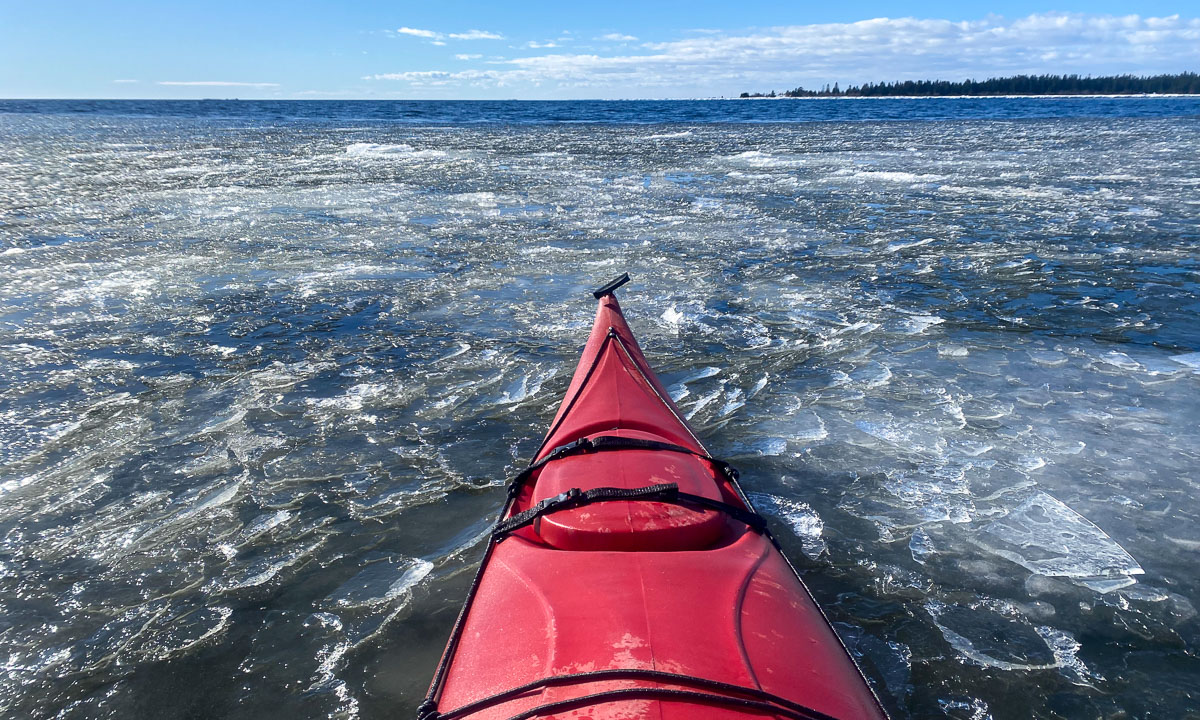
After a period of dull and cloudy weather that felt like ages the sun finally came out yesterday. Since I was flexible with working hours in the  morning I could make a small kayak tour.

The first part was easy. Since our house in Obbola is on the coast I only had to change my clothes and drag the kayak from the house to the bay. The bay was covered with ice. As usual I just sat in my kayak and started pushing myself ahead using ice claws. This works surprisingly well until you have a lot of water on the ice as I had yesterday. Although I wore neoprene gloves I got cold fingers. As usual this took some time but finally I reached open water.

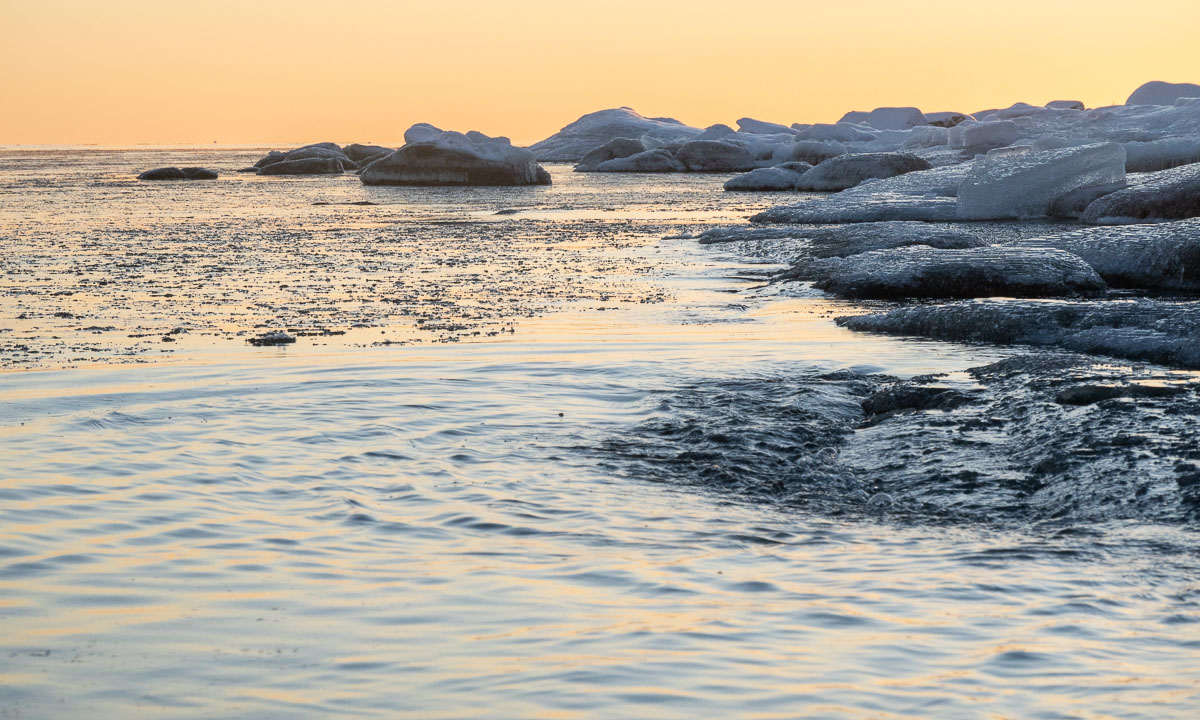
It was then that I realised that I had forgot my paddle. Fortunately the bay is shallow and I could leave the kayak, step on the ice and carefully walk back to land to fetch the paddle. Some minutes later I sat in my kayak again ready to circle the island Bredskär. I watched the hooting whooper swans and even four flying goldeneyes, a species of ducks. At the northwestern tip of the island there was a small, slushy ice field, the rest was open water. The big freezing hadn’t started yet. When I reached the eastern side of the island I could watch the sunrise some minutes after 9 o’clock.

The last part of the otherwise calm tour was surprisingly wavy. When one breaking wave came out of nothing and of course directly from the side I was afraid that I could capsize but the wave just lifted me gently up half a metre and down again. I was lucky. Sometimes it’s nice to own a less agile but super stable boat.

Even it was only some degrees minus the kayak was covered with a layer of frost that glittered in the warm light of the sun. I just had to take another photo when I was back on land.

And then? After taking a hot shower I made it to the 10 o’clock meeting. In time!

Jämtland tour 22 – the landscapes

This article is part of the series “2022-08: Jämtland and Trøndelag”.

I’m sitting in the train to Umeå. We have a longer stop in Kiruna where the train changes direction. The other trains standing here are cargo trains that transport iron ore from the mines around. Temperature is -10 °C or lower and there are some centimetres of snow covering the ground. Winter finally has arrived in the Swedish fjäll.

I’m so glad to arrive home in Obbola tonight. I haven’t been there since July. Now I’ll stay until Christmas working from home for the Norwegian Polar Institute.

I’ve been however in Sweden in August, too. Not home but for a hiking tour with my sister and family together with my wife Annika.

This reminds me that I almost forgot to publish the last blog article about our hiking trip in the Jämtland. It will take more than seven more hours until I arrive in Umeå, so there’s plenty of time to start blogging now, as long as the mobile net allows. Earlier I’ve written about the cabins, some day trips, the trail and way marks. Today I want to show some photos of the landscape. Let’s go back three months in time. It is late summer in Sweden.

What I love about the Swedish mountains – the fjäll – is its variety. Not only in weather but also in landscapes. In the lowlands there are forests – mostly birch forests – but all Swedish cabins we visited lie above the tree line and here you have a wide view of the mountains, small and large lakes, rivers and streams, bogs and stone deserts. Let’s have a look.

15 August, our first day. The landscape is rising and we have left the forest behind. The trail between Storlien and Blåhammaren leads over many swamps and bogs and is wet and muddy.

16 August. We leave Jämtland and cross the border to Norway. The cabin Storerikvollen lies quite low and we descend through forests of crooked birches.

18 August. Still in Norway we take a resting day at Nedalshytta. I talk a walk along the lake Nesjøen. The water level is extremely low and so I can cross some mud fields that normally are under water. This landscape looks a bit hostile and is not typical for this region.

19 August. Again the terrain is wet and has many small lakes and water puddles. The mountains are hidden behind low hanging clouds.

We start hiking up the Ekorrpasset. Looking back we witness one of the most unphotographable landscapes I know. In reality it is an impressive view of a hilly terrain with uncountable lakes, ponds, streams and puddles. The photos however always look pale, blurred and boring.

Let’s not look back but ahead. The peak of the pass is more than 1300 metres high. That may not be much in the alps, but in these latitudes only few plant can survive these altitudes and so we walk through a desert of stones and rocks. Hidden in between some moss and the flower Ranunculus glacialis.

And let’s look aside. We pass the mighty Sylarna massif (1574 m) with its glaciers and rugged rocks. Impressive.

The Sylarna cabins lie lower. Grass and heather cover the ground presenting the landscape much more mellow, especially in the soft colours of dusk.

20 August. We leave Sylarna and continue to Gåsen. For that we have to hike through the valley of the river Handölan. Here we meet birch forests again. And some quite impressive rapids.

22 August. After a resting day in Gåsen we continue to Helags. The landscape is wide and broad. And where it is not too wet there are surely some reindeer around.

24 August. We are on our way to Fältjägaren, the last cabin of our tour. The weather is sunny and we are accompanied by the mountain Predikstolen (the pulpit) which shows itself from some of its many beautiful sides.

In the evening we stand outside watching the sunset and the incoming night. Soon the lakes are the only part of the landscapes visible. The rest is almost black.

25 August. Our last hiking day. On the other side of the valley we can see the gaps in the forests covering the mountain slopes. These are the ski slopes of Ramundberget where we’ll take the bus to Östersund. Back to civilisation.

And back to the present. I’m still sitting in the train. Where am I? Ah – half an hour left to Gällivare. Now I’m longing for a cold and snowy winter. But then I want to change ski boots with rubber boots and go for a hike again.

The first winter promenade

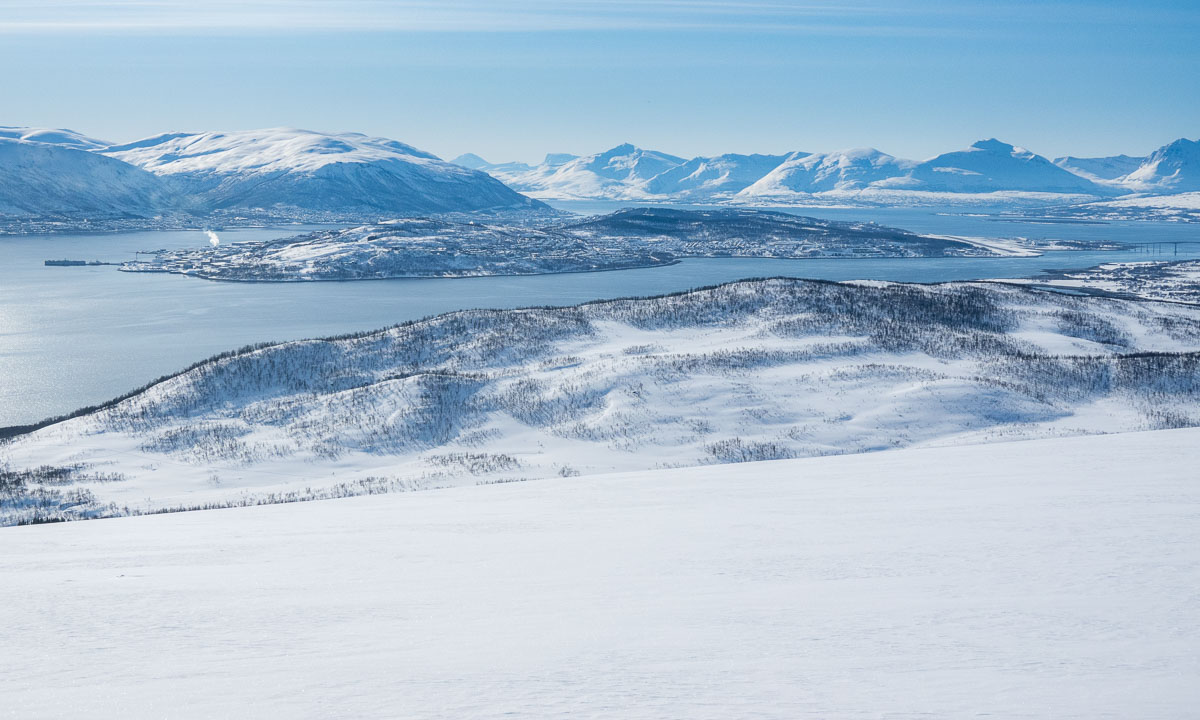
Down there, that’s the southern part of Tromsø. That’s where I live when working for the Norwegian Polar Institute.

There are reasons why I see Tromsø from above today instead of working in the office. First of all my wife Annika is here this week. Then it is wonderful weather today. I was able to take a day off today and so Annika and I could fetch the first cable car up to Stor­stei­nen, 421 m above sea level. From there you have a fantastic view on the islands Tromsøya and Kvaløya, the strait Tromsøysundet and many, many mountains.

While Tromsøya itself is free of snow all mountains look wintry on this sunny day. Our hiking tour starts in the shadow and it takes some time until we reach the pre-summit of Fløya where the sun shines on our faces the first time.

From there it is not far to the summit of Fløya (671 m).

It has become windy and grains of snow are drifting over the snow. In the low sun they look like grains of gold.

Although it is chilly we stay on the top for a while, because the wintry landscape is so beautiful. The season’s first snow hike is always something special and I’m glad that I can share it with Annika this year.

Slowly we walk back. On the top it was easy to go, later the path gets steeper and the snow makes the path slippery. The sun stands lower now and the drifting snow is even more colourful.

We find a sunny though windy spot to drink warm juice and eat some cookies, then we head back to the mountain station of the cable car. While sunset is near, the almost full moon that has accompanied us the whole day starts rising again above the wintry mountain chains.

Scotland: wetness

This article is part of the series “2022-10: Autumn in Scotland”.

You cannot deny, that Scotland can be a pretty wet land. There are however different kinds of wetnesses.

Bathing in the sea

This kind of wetness I love: bathing in the sea. Finally Annika and I managed to find a sandy beach that looked very promising for taking a bath. And it was perfect. No stones, no currents, no sharp-edged shells, no waves as high as a house. The water was warmer than expected and it hardly rained.

Rain and muddy trails

We continued our road trip through the region of Assynt and parked our car by the Stoer Lighthouse. From there we took a circular hike to the Old Man of Stoer, a 60 metre high sea stack. It rained and the trail was soaking wet and partially quite muddy. I managed to keep my rubber boots dry but Annika’s hiking boots were soaking wet after our hike. Her dancing experience helped her to change to dry shoes.

Adventurous roads

As the days before it was Annika that drove the rental cars. You don’t want to fall asleep while driving in Scotland. Beside the single file tracks with its many meeting points sometimes the roads are blocked by sheep. The road sign warning of a 25% steep hill however looked much more dramatic than the road was.

Ardvreck Castle

We have passed Ardvreck Castle several times the last days. Now it was time to stop and have a look.

The lake Loch Assynt was flooded and so was the path to the castle. I like hiking in rubber boots which is a bit overdressed sometimes. In Scotland however I think it’s perfect footwear. Here they helped me to wade to the castle to take some more photos, while Annika waited ashore.

Sea monsters

I almost forgot to tell: At the beach of Clashnessie I observed sea monsters! Carefully I sneaked up to one of them and I managed to take a photo as a proof. There are sea monsters in Scotland!

10 cm high sea monsters.

10 cm high sea monsters buried in the sand.

10 cm high sea monsters buried in the sand looking suspiciously like seaweed.

Scotland: the west coast of Isle of Lewis

This article is part of the series “2022-10: Autumn in Scotland”.

It is 10 October.

Yesterday evening we arrived on the Isle of Lewis, took the reserved rental car (Annika driving) and stayed in the Ravenspoint Community Hostel. Today we want to go by car to explore the west coast of the island.

We do not meet a single person while taking breakfast. We succeed in not raising fire alarm while frying eggs, we pack our backpacks, revert our personal rearrangement of the beds in our twin room and get in our small car – a Kia Picanto. While Annika has been in Scotland much more often than me it is our joint premiere in exploring this country by car.

After taking a detour to a small beach at Tobson we continue to Callanish Stones, one of several arrangements of menhirs. Although yesterdays gale has subsided it is still very windy with some showers of rain. My challenge as a photographer is not only to keep my small Sony dry (first photo is an iPhone photo) but also to take pictures while a large family uses the standing stones for playing hide and seek.

We make a stopover at Doune Braes Hotel for lunch. There we spot the standing stones again – as a colourful leaded window, animals included.

Next stop: the Gearrannan Blackhouses, a village of thatched cottages that was inhabited until 1974. Now it is not only a museum but one of the cottage is a hostel, where we check in and reserve a bunk bed. We have a look at the museum, where a local shows his expert knowledge regarding weaving looms. The view of the coast from the village is quite impressive. The waves are high and smash surf and spray against the rocky cliff.

Now we continue the road north to the headland with the catchy name Butt of Lewis. When we arrive there I’m really flabbergasted. Neither Annika nor I have ever seen waves breaking so high as here at the northern tip of the Isle of Lewis. Extremely impressive, a bit daunting and also a bit wet because sea spray seems to be everywhere. Keep in mind, that the rocks in the next photos are round 10 metres high. Thanks, Google Earth for your elevation data.

It takes some time until I can tear myself away. Next we head for Port of Ness, a harbour village nearby. The sandy beach is broad and shallow. Huge waves roll ashore. While they are breaking the wind gusts blow the spray away – a fascinating view. I decide that today is just not the day to take a relaxing bath in the Atlantic ocean.

We return to our parked car and drive back to our hostel – part of the Gearrannan Blackhouses. The museum is closed and it looks like we are completely alone in our cottage, that can host 13 guests. While we boil water to cook pasta we still can hear the waves splashing ashore at the rocky coast round 100 metres away. After dinner we fall fast asleep . Stormy weather is exhausting, and so is left-hand driving. So, thank you, Annika, my luv, for driving us.


The first frost – hiking tour on the Laukviktinden

Today was the second day, where my car was covered with ice in the morning. I had to scrape ice after breakfast because I wanted to drive to Kvaløyvågen on the island Kvaløya to hike up the Laukviktinden (587 m) today. The weather was calm and the sky was blue and I enjoyed the views on sea and mountains from the car.

When I passed the shallow bay Finnvika I just had to stop and go there. Large areas were covered with a thin layer of ice that sparkled in the sun. Autumn in Tromsø is a fast season. Last weekend the trees were colourful, now many of them are bare.

20 km later: I just parked my car by the sea and read the tour description. I should follow the road for 80 metres, take the gravel road to the left and leave it when it turns left. The rest of the tour would be pathless but according to the book easy to find.

When I left the gravel road the terrain was a bit tricky. It was more or less overgrown boulders with hidden holes. The trees had shed their leaves and almost looked dead. I was glad when I had reached the mountain ridge where it was much easier to walk. The wet moss was covered with frost and so were the water puddles. Laukviktinden came into view, but I knew that there would be an acsent before. It looked pretty steep. Hopefully it’s just the perspective.

And indeed it was less steep than expected. A bit tricky however because some parts were wet and slippery. And that one of the countless moss pads hid a knee deep water puddle was not nice ;-) ! It is always a satisfying experience when you gain altitude, are above the tree line and can see more and more – both fjords and mountains.

Just straight ahead I spotted the lake Laukvikvatna and its neighbours. They lie 50 metres below. So I first had to climb down before hiking up again. Most of the lakes were covered with a thin layer of ice.

From the lake it is only 200 more metres in altitude to the top – according to the tour book. That meant that most of the the ascent lied behind me. It was easy to go up, only the very last part was a steep boulder field. Probably not the best routeI chose, but that was hard to see from below.

The terrain flattened out and then – all of the sudden – I could see the summit marker: A huge pile of stones with a metal box containing the summit book. And behind that: The open sea with the island Vengsøya.

What do you do on mountain summits beside of adding your name to the summit book? Yes – you take a selfie! After that I went a bit further to a place where the terrain drops off steeply. Here the view was really impressive because I could not only see the open sea and its islands but the bay Laukvika and even the boggy marshland that looked like it was directly under my feet. Here I took my iPhone as camera because it has a wide angle lens.

I took a break, ate some cookies and drank water. I even met another hiker that probably hiked up twice as fast as me. Then I started my way back. I found a better way because it is so much easier to find a good path when you look from above. Later my optimism was dampened when I landed in quite steep terrain and had to traverse it a bit until I was on my old trail.

Round 9½ km later I reached the gravel road again. In the shadow the ground was still frozen, but the car that waited in the sun was warm.

Thursday paddling – from dusk to darkness

It is 29 September and it is Thursday. Time for torsdagspaddlingen – Thursday paddling – with the Tromsø Sea Kayakers Club.

As usual we meet between 5 and 6 o’clock pm to prepare the kayaks, put on our drysuits and life vests and listen to the tour leaders about the plans for today. For several weeks there has been another thing to think of: attach lights to the kayaks and the life vests to be seen. September equinox has been one week ago and it starts getting dark quite soon. Today we are lucky: It is high tide and we don’t have to carry the kayaks more than a few metres.

We are 23 people. 7 will follow the shore to the beach of Telegrafbukta, the others including me want to paddle to Lilje Grindøya that lies behind Grindøya. I’ve never been there. Round 18:00 we sit in our kayaks. As soon as all are on the water we start our tour.

Before we reach the island Grindøya one of the tour leaders lifts the paddle vertically in to the air. That’s the sign for gathering.

Plans are changed. Lilje Grindøya is quite far away and the waves on the sound we crossed were a bit higher than expected. So we head for Grindøya instead.

It it warm and calm. 16 kayaks lie by the beach. We sit our stand around. One paddler passes around homemade cake, another one lights a cosy fire on the sandy beach. Hyggelig!

While we are eating, chatting or taking pictures it is getting darker and darker. The kayaks are hardly visible anymore and in the distance there are the lights of Tromsøya and Kvaløya.

After half an hour it is time to set off and paddle back to shore.

While crossing the sea again I didn’t take photos for three reasons. All of them were related to the darkness.

First:  we want to stick together to be seen and to know we are all there. There may be ships crossing and then you do not want to have a stray paddler around. So I cannot just let the others go to take photos.

Then: my waterproof camera is – well – waterproof but it hardly can take photos in the dark. Even with a better camera it is difficult. Did you ever try to make long exposure photos while sitting in a kayak?

Finally: the waves! The kayak I use is stable as a truck and on our way to Grindøya I didn’t care about the waves a lot. Now it is quite different. I can see the waves because of the reflections of the city lights. But I cannot see how broad, how steep or how high they are. So I have to react by instinct which I don’t yet have. It’s a first time experience and a slightly weird one.

While we are approaching main land the other paddlers come into view. Or better said, their lights. Two of the other kayaks are not illuminated and completely invisible. We take a long turn to the left and follow them. Some of us almost collide with one of the jetties. Everything that isn’t illuminated comes into view at the last moment.

I’m a bit sad because this is the last Thursday paddling this year. Probably we won’t start with it again before end of April. Hopefully there will more kayak opportunities in daytime over the winter.

At 20:15 I  come ashore. Again I want to say to all fellow paddlers: takk for turen! Thanks for the tour!

Kayaking into the dark

It seems, that summer is over. It’s less a matter of temperature but light. Next night will be autumnal equinox and today’s sunset was already at 18:47. Tromsø has almost the same longitude as Budapest.

Anyhow the Thursday paddling of Tromsø Havpadelklubb – the Tromsø sea kayak association – still hold place today. Next week will be the last time for this season. Today we had perfect conditions: No waves, no wind and 10 °C. We had many a summer day worse than that here in Tromsø

May I present, that is D5. It’s one of the many rental kayaks of the association and my standard choice. My own kayak is in Sweden.

Today we were 15 people heading to the island Grindøya on the other side of the sound between Tromsøya and Kvaløya. OK, let’s start …

First we paddled along the coast, then we started crossing the sound. From the boat houses to Grindøya it is round about 4 km.

This time we did not paddle round the island like in June or two weeks ago. Instead we headed for a beach at the northern tip and made a break there. I had a piece of soft chocolate cake with cashew nuts, a welcome leftover of the three day data management workshop that I joined this week. And while we stood or sat there it started getting dark.

Some of my fellow paddlers already had switched on their lights on the way to Grindøya, now we all illuminated our kayaks and ourself. It’s less about seeing but about being seen. There is commercial shipping on the sound. We prepared our kayaks and departed.

While we paddled back it got darker and darker. It’s really a special experience to paddle through the dark in a group. You hear the drone of the city, occasionally interrupted by an airplane or a motorcycle. But that’s far away. Our own sounds are near: soft conversation and the little noises of the paddle entering and leaving the surface of the sea. And since you see less and less, hearing becomes more and more present. And anyhow I tried to paddle as silent as possible not to disturb the quietness.

When we arrived at the boat houses of Tromsø Havpadelklubb it had become dark. The tour lasted only an hour and a half plus a half hour break. But the peaceful sound of kayaking calmly through the darkness lingers still in my ears.


Stappen in the autumn

Reader, meet Stappen. Stappen, meet reader.

Hiking up Stappen is tour 54 in my book “På tur i Tromsø” – On tour in Tromsø – and it is marked blue, which somehow means that it is moderately easy. I tried to hike up Stappen in winter last year but gave up because of the steep terrain paired with snow. Today I gave it another try.

Autumn has been in full swing the last days and most of birch leaves are yellow, while other plants as groundcovers are anything between green, yellow and bright red. Sky today was grey but the colours shone brightly.

After crossing a bog I had started hiking up the mountain from the left side. Or should I say, climb? There was no recognisable path and it was quite steep. Since all rocks were overgrown, terrain was not so easy and I took it slowly and cautiously. I didn’t want to slip or find some hole between the rocks.

As usual the views were gorgeous. The island Tussøya with the pale sea behind, the mountain massif round Skamtinden that rose above the valley while gaining height. or the autumnal coloured marshes with their embedded lakes and small meandering streams.

You can see it on the first photo. The way up stays steep – up to 85% or 40° – until the very top. But finally I crossed the 550 metres level curve and was almost up, because Stappen is only 565.2 metres high. But up does not mean that it was a plateau, it was more a constant up and down and I used my hands a lot when it got steep. Fortunately the ridge was always some metres broad. I’m a bit afraid of heights. And then – after crossing most of the ridge – I reached the top.

Impressive is not the word that you would use to describe this knee-high heap of stones. It was quite obvious, that this mountain is not very popular. It is pretty steep to the sides, so that I could look straight down to the lake Botnvatnet (“the bottom water”). Later I would go round this lake on my way back.

But I was still on the top of the mountain and continued following the ridge that slowly descended. Here you can see two parts of the ridge:

On my way I found a small clearing surrounded by rocks. With the rough mountains around it looked like a secret valley, where dinosaurs still live. Well, they have to be tiny, the clearing was only round ten square metres in size.

This part of Stappen was much less steep, but when I looked back again it looked quite impressive anyhow.

After a while I reached the bogs – still at an altitude of round 330 metres and started to walk back onto the wet and bouncy ground.

Stappen was a nice tour but steeper than expected. At home I read the tour description in the book again. You had to read between the lines: While it was not mentioned, that the ascent is steep, alternative routes were mentioned with the words: “Her er det litt mindre bratt”.

Google translate’s translation: “Here it is a little less steep”.

Olaf’s translation: “Here it is little less steep which is still pretty steep. But other paths – those that you will choose – are much steeper! Anyhow, we marked the tour as blue so you might survive.”

At the end just three pairs of photos of this tour and my tour on 4 December:


Takk for turen – Thursday paddling – 8 september

Oh, what a wonderful kayak tour! And oh, what wonderful weather!

We were 31 kayakers from the Tromsø Sea Kayakers Club today and split into two groups. 19 paddled to Telegrafbukta, where I’ve been last week, 12 paddled to Grindøya, where I’ve been in June. I joined the Grindøya group and was very glad that I got some training this year. Not because of the waves that we had on the way there but because the group was experienced and quite fast. But I managed to follow and could take some snapshots on the tour.

Now it starts getting dark quite soon and we must have lighting at our life vests and the stern of the kayak. I had only some make-shift light and have to buy some equipment for next Thursday.

But now it’s getting late, so no more words, just some photos. To all today’s fellow paddlers: takk for turen – thanks for the tour.