Hiking up the Slåka and Guratinden

Slåka (314 m) and Guratinden (424 m) are two mountains on the island Kvaløya. I know them from my book “På tur i Tromsø” where they are described in tour 7. This tour is marked as green, which is the easiest category in this book. I chose it because on the higher mountains there still might be some amount of snow and I wanted to avoid that.

I took the car to the parking place in Skulsfjorden yesterday. The parking place I already knew from another tour. Then I tried to find the hiking trail while the cows starred at me curiously and the bravest of them came to sniff at my hand.

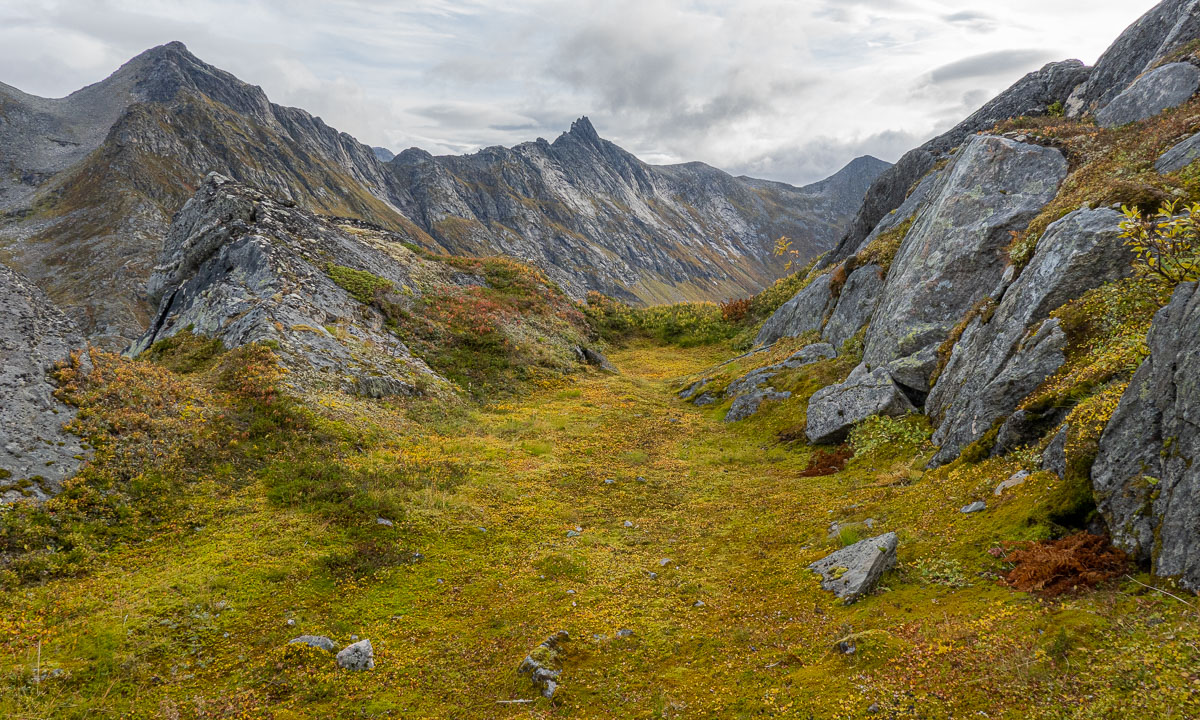
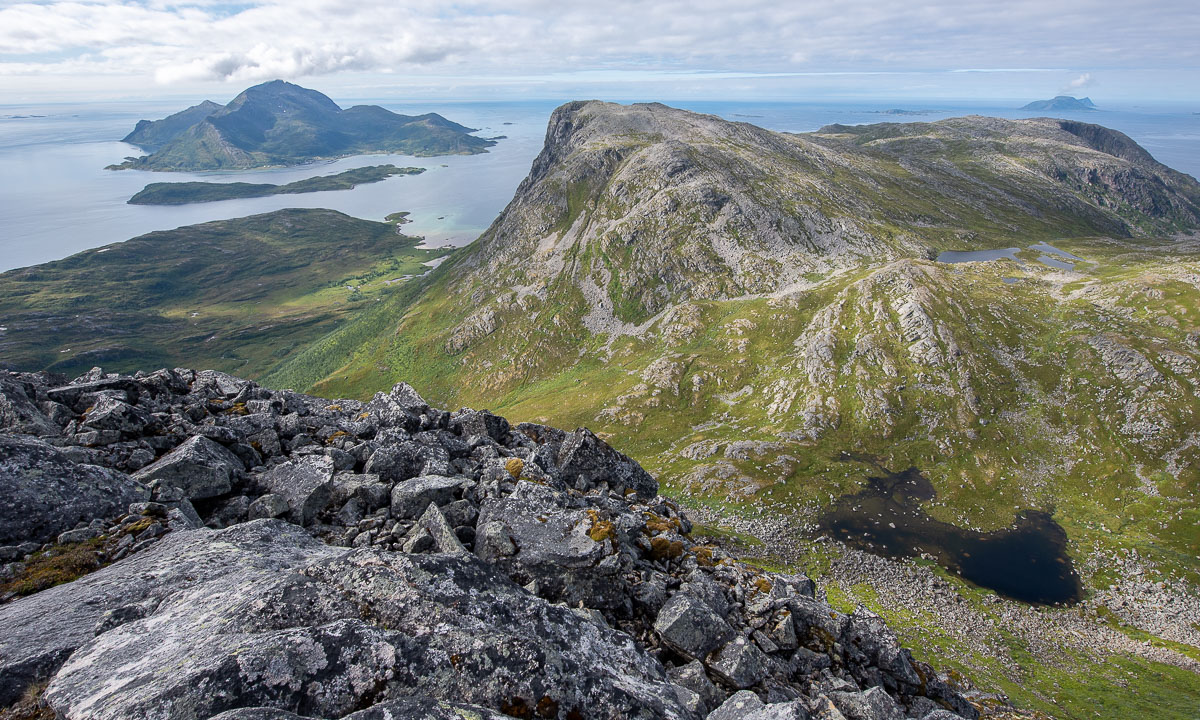
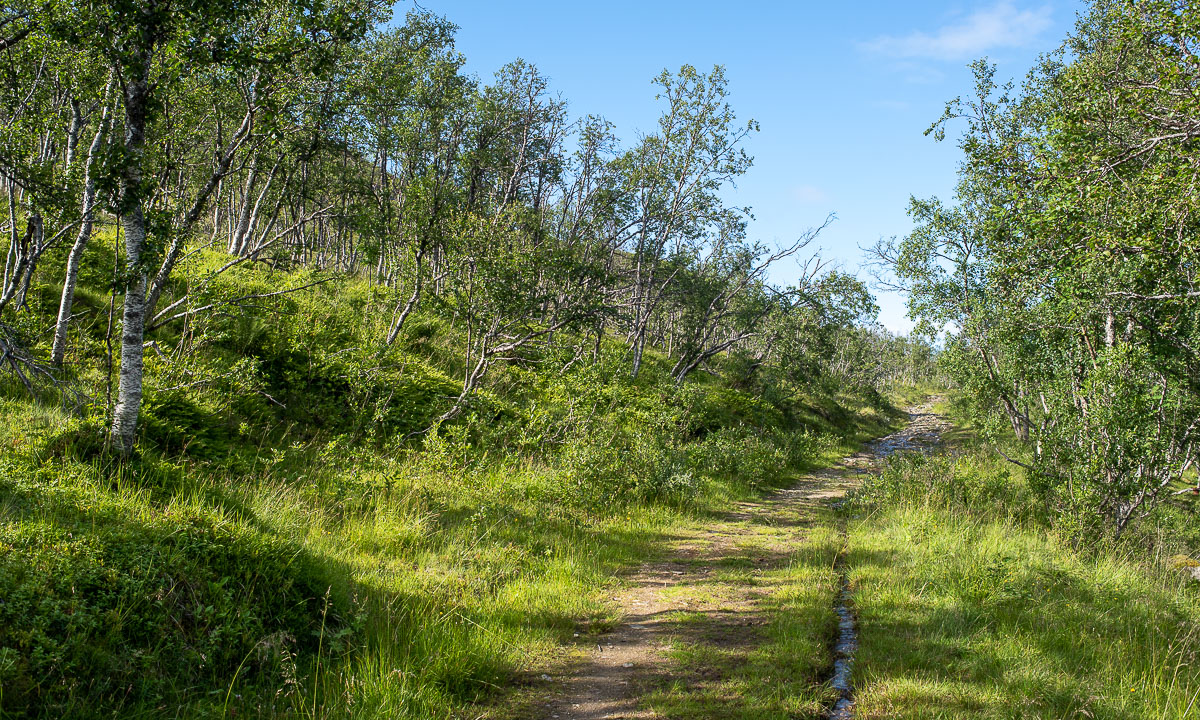
It took a while until I found the way which was not were the map showed it. It forked quite soon and maybe I followed the wrong direction because somewhere over the tree line it faded away somewhere in the heather. Way marks and sign posts you will hardly find when you hike like this in Norway. It is assumed that you can orientate in pathless terrain even on beginner tours. Anyhow a way to the top of the Slåka was easy to find without paths. Here I had a fantastic 360° view. In the north the mountain Nuortagáisi (or Nordtinden), in the south the fjord Kaldfjorden, in the west the island Vengsøya and behind that the open sea. And where there was no sea there were mountains, mountains, mountains, all higher ones still covered in snow.

Without any break I continued to the Guratinden. Again I could not find a reliable hiking trail but more a patchwork of paths, some of them probably animal tracks. Anyhow it’s not far to the Guratinden, where I took a rest to enjoy the view and something to drink.

Although it was the beginning of June it was very chilly on the summit, mostly because of the strong wind. I guess it was 7 °C and at least 15 m/s. Already on my way up I wore gloves and a woollen cap, now I was really glad about my down hoodie. Without I wouldn’t have taken any rest.

On the way back I followed other trails and tracks or I just cut cross country. Sometimes I walked on rocks, sometimes on boggy ground but mostly on heather.

Round three hours later I was at my car after 9 km hiking and round about 650 metres in altitude. And here you can see how it looks on the map when you hardly follow any trails ;-)


Thursday paddling round Grindøya

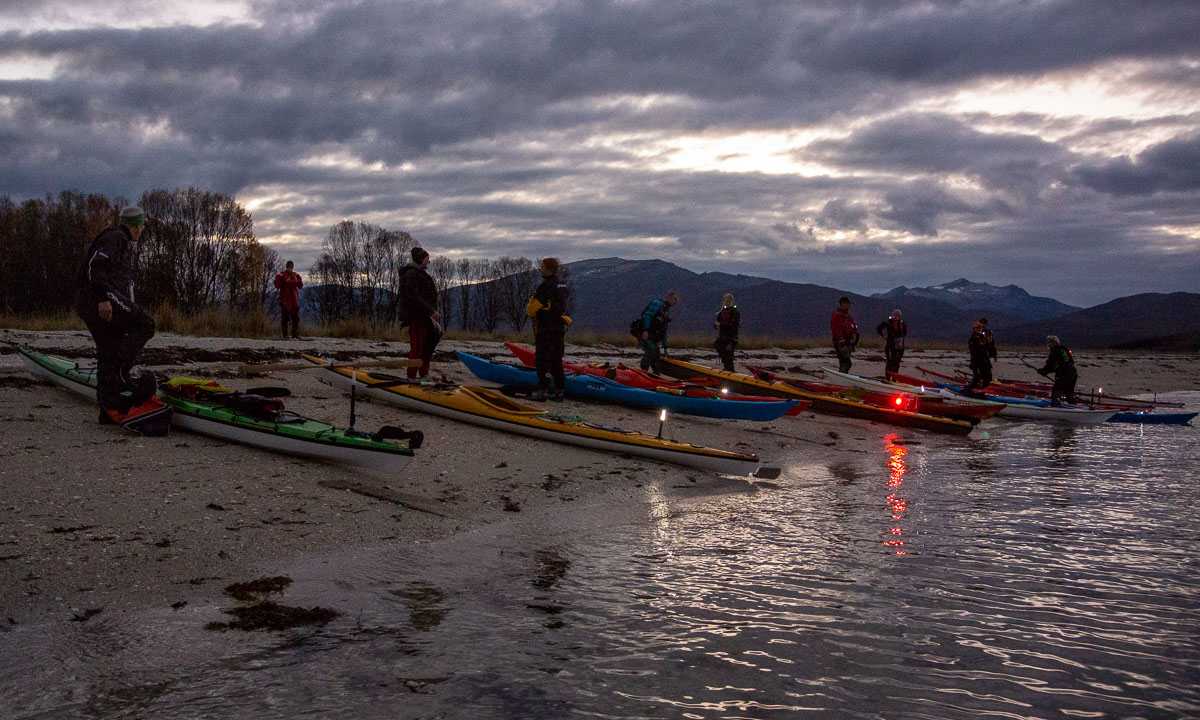
Yesterday I was in the mountains – today at 18:00 I joined the torsdagspadling (Thursday paddling) of the Tromsø Sea Kayakers Club. Together with 16 others paddlers and a dachshund we crossed the Grindøyskarven and rounded the island Grindøy.

The conditions were excellent: Hardly any wind, a calm sea, blue sky and temperatures almost 20 °C. Perfect not only for paddling but also for taking a break in the sun – of course at the northern tip where we didn’t disturb the common eiders that nest along the beaches of Grindøya. Then we paddled back – with a small sprint to avoid two ships crossing. No danger however because the guides have a VHF to talk to the ships but they already had spotted us and had slowed down. Three hours later we were back from our round 12 km long paddle tour.

Takk for turen, thanks for the tour! And thanks to all organisers of the torsdagspadling. Great initiative!

“Kayak daytrip to Skarsfjord with beach clean up”

… this was the Facebook event I was invited to some weeks ago. It was an event organised by people from TSI Trulle, the other kayak association, but it was open for non-members, too. The idea was to start a kayak tour in Skarsfjord on the island Ringvassøya, paddle to a beach, clean it, cross the fjord to another beach, clean it, too, relax and paddle back. We were eight people joining the tour from five different countries.

Our tour does not start on the water. It starts with carrying kayaks to a trailer, use lashing straps to fix them there, packing all equipment into two cars  and some driving.

After 50 km – one hour drive – we arrive at the parking place by the sea, where we unstrap the kayaks and get everything ready including testing the sprayskirts and the footboards. Things you can do on land as well as you see.

It always takes some time to put on the drysuit, check that everything is packed and working but then we all sit in our kayaks and are ready to paddle to our first destination: The islet Teistholmen.

We leave the kayaks there, take a huge rubbish bag each and start combing the shore of the island. Most of the rubbish is on the northwest side of the island that is most exposed to the elements. Mostly it is plastic from fishing. Parts of old green nets, buoys from small to football size and then of course all the civilisation garbage as empty (or half-full) bottles, styrofoam and some nasty stuff. But it’s not extremely much.

After collecting I take a stroll over the green island. Hard to imagine, that I did a ski tour the day before.

After a while and some lunch we continue our triangular tour, now crossing the fjord Skarsfjorden to another beach. You can see the rubbish bags on our kayaks. We were very lucky that there is no mentionable wind, because with side winds the huge bags would act as sails and turn the kayaks into the wind. But without any wind and waves it was easy to cross the fjord.

When we reach the beautiful sandy beach it turns out that this is not the beach to be cleaned. The location that the organiser has in mind is a bit further away. So we continue a bit to arrive at a rocky shore that looked much less inviting than the sandy beach and a bit more difficult to land.

But it looks like that we would collect a lot of more trash here, and so we do. There is a lot of plastic trash, scrap metal (that we left alone) and driftwood for making fires for months. Some of us are collecting large amounts of plastic. It is obviously too much to be transported on our kayaks. But we are lucky and get help by two locals living on an island nearby. They load their whole boat full with our filled rubbish bags to take care of it. You can hear the motor of their boat for a while after they departed. Tusen takk – thousand thanks!

While others have collected more rubbing some of us have started a fire. Time to tell stories, eat a second lunch or just relax.

Anyhow, it is a day trip and so we leave this place, some of us with extra rubbish bags that didn’t make it on the motor boat. We pass the ship wreck, that we already spotted on the way there. It was washed ashore this winter while the captain was asleep because the anchor did not hold. He was not harmed but the ship was totally destroyed.

We are so lucky with the weather! Not much sun, but hardly any wind, no rain and much warmer than the weeks before. We paddle back to the parking place, the cars are visible as a small grey and a small white dot. The water is extremely clear and of a turquoise colour that makes the sea look Caribbean – until you put your hands into the water and realise how cold it is. This is, why drysuits are a must on such tours even under perfect conditions. Safety first!

And then we are back. Some of us train rescue manoeuvres, some of us relax, some collect trash (oh my, here you could collect for days :-( ). Then we put all kayaks back on the trailer, drive back to the boat house where we put all kayaks back in the boat houses. Then we are ready to leave.

Thank you guys for inviting me, letting joining me and having a great day together. Hopefully I meet some of you again. Would be a pleasure!


April snow in Tromsø

On Monday evening, the 25 April it started to snow.

Tuesday, 26 April 2022

On Tuesday it was snowing and temperatures were below zero.

Still some flowers peeked through the snow.

Wednesday, 27 April 2022

On Wednesday it was snowing and temperatures were below zero.

Some heavy snow squalls covered everything with snow.

In the evening I took a winter bath at the beach of Telegrafbukta and then took a photo of the snow figure by the stairs.

Thursday, 28 April 2022

Yesterday on Thursday it was snowing and temperatures were below zero.

It was fun to kayak through the snow after work.

Friday, 29 April 2022

Today on Friday it has been snowing and temperatures have been (mostly) below zero.

The snowflakes have become thicker.

This afternoon snow depth was 25–30 cm. The snow figure was snowed in to the neck and the stairs have disappeared in the snow.

Thursday, 19 Mai 2022 …

In 20 days there will be the first polar day. Then the sun does not set for more than seven weeks. Midnight sun!

Summer is near but incredibly well hidden.


Two small winter paddling tours

Two small morning kayak tours I did this week. One two days ago, one today. Weather was just too great to sit inside the whole day: sunny with temperatures between -10 and -6 °C and a calm wind.

Here is a photo of each tour start:

As you can see it had snowed a bit between these two tours.

The day before yesterday I just wanted to circumnavigate the small islet Lillskär, but there was too much ice to cross and crossing ice with a kayak takes time. And since I work full time, time is limited. So I just paddled around a bit and then back.

Due to the frosty temperatures the ice was thicker today though hardly more extended. I started at the same place but then continued to the island Bredskär. From there I wanted to circumnavigate the island Bredskärssten, but the same story as two days before: At the northern shore of the island there was an ice field. Crossing it would have taken too much time so I changed my plans and made a smaller tour. Nice to be outdoors anyhow!

How do you cross ice with a kayak? If the ice is safe, just walk. You wear a drysuit and have your safety equipment with you, don’t you!? If the ice is very thin, just paddle through (use your cheapest paddle). But if the ice is between 1–2 cm, the ice may not bear you and you cannot use the blades of the paddle neither.

Then you can use isdubbar – part of the ice safety equipment. With these ice claws it is possible to pull yourself forward while sitting in the kayak.

If you are lucky the ice is thick enough to let the kayak glide over it quite fast. If you are less lucky the kayak will constantly break though and then it can be pretty exhausting, especially when the ice claws break the ice as well. Then it is sometimes simpler to pull yourself forward by grabbing the ice with your hands. Waterproof gloves or mittens strongly recommended!

White swans in Obbola

After two weeks in Tromsø i travelled home to Obbola last weekend, where I will work from home for two weeks.

When Annika and I looked out of the window yesterday we could see 3 swans swimming in the water between the small islet Lillskär and us. Oh, another 3 nearby, that’s 6 swans. And another one, and two more.

After some snowfall it had cleared up yesterday and it got colder in the night. This morning the temperature was below -12 °C. When I walked to the coast the water before Lillskär was covered with ice. The swans lay on the ice sleeping. They discovered and watched me but since I was slow and did not come too near they soon tucked their beaks under their feathers again and continued dozing.


Polar expedition AeN JC3 – day 7 and 8: a stormy intermezzo

This article is part of the series “2022-02: Winter cruise KPH”.

Day 7 and 8 · 25 – 26 February 2022

25. Feb 07:00 – testing clothing concepts for extreme cold weather

Another Arctic morning. It has become slightly warmer with temperatures round -24 °C but at the same time a lot of windier. The average wind speeds of 20 m/s and above. So windchill is still -45 °C and I wonder how to dress just in case I will be on the sea ice the first time this night. No, I do not count on being allowed to enter it under such conditions but you never know. Be prepared and wait …

For safety reasons we always have to wear a special suit on the ice in case of someone breaks through. That’s either the Regatta suit, a floatation suit. This acts as a full body life vest giving you buoyancy in the water. However you will get wet instantly. No big issue because we will always be quite near the ship and conditions are ok. If the circumstances are more extreme or the ice is not trusted a survival suit with attached rubber boots is used. It will keep you completely dry as long as the arm and neck cuffs are tight. It is said however that it is uncomfortable to wear and you easily get very cold feet.

So, let’s get dressed. For the first time I put on the Regatta suit. It is as breathable as a rubber dinghy so you should not sweat too much. Over that, more for the fur hood than the warmth the Canada Goose parka. Yes, I can still move ;-)

Dressed like never before I open the thick door to the helicopter deck and stagger outside. Whoa! That’s some rough weather. I instantly feel every single square millimetre of skin that is still exposed to the wind and even that the zipper of the down pants are not completely closed at the bottom although I wear high rubber boots. In my opinion the hood of the Snow Mantra is ingenious but the gusty storm just pushes it aside in all directions and I can hardly see anything. So I do not check if the selfies taken with the Nikon and three pairs of gloves and mittens are in focus. They are not.

Being in again I understand the first time, why the parka hood is not only fur-trimmed but have this thick fleece rim inside. It keeps away the ice dust that the storm blows in.

The combination of Regatta suit is too warm and too bulky. I test another combination with the shell jacket of the Norwegian Polar Institute and ski goggles. Insight 1: if the hood does not fit perfectly it is completely useless in the storm. Insight 2: my old ski goggles freeze over so fast that within a minute I am functionally blind. I have to remove them to find back to the helicopter hangar. While checking this the storm pushes me around on the deck slippery deck. I really doubt if anyone wants to work on the ice in these extreme conditions. On the other side I do not know anything about polar research. Neither about polar researchers. It’s me who is the newbie.

25. Feb 11:00 +2h – planning for the storm

Aside: The day before we changed the ship’s time to take better advantage of the daylight. When I write +2h it means our privately shifted time. Otherwise it means „normal“ CET time zone.  If you don’t care, just ignore it.

We have a meeting before lunch. A storm approaches. We will seek shelter between Nordaustlandet, Svalbard’s second-largest island and the island Kvitøya. Conditions are too rough for an ice station. Although all four ship engines are running we hardly make progress. There is no time schedule anymore. We just have to sit it out.

25. Feb 16:20 – the swell wracks the ice

At 15:20 I take a long afternoon nap while Kronprins Haakon struggles through the ice. I have on of the frontmost cabins on deck 3 –the noisiest ones. The icebreaker is rumbling, rattling, grinding, squeaking and doing many more noises that I do not have words for. I lie in my bed and feel the mattress vibrating, shaking, bouncing. And I love it. For me it is like an Arctic lullaby and as mostly I fall fast asleep.

z – z – z – z – z

After an hour I wake up all of a sudden. Something has changed. The ship is slowly and strongly pitching. At the same time noises and vibrations are absent. Are we in open water? What happened!?

I have to compensate the ship’s movements while I walk to the dayroom. I peek through the ice crusted windows. Yes, we are in open water. J. sitting there tells me that 10 minutes ago swell waves. They broke up the ice within minutes and now the ice has disappeared. Impressive and a bit frightening, too.

Now we are amidst the storm with an hourly average of 24.2 m/s, that’s round 87 km/h. The highest wind speed measured in this hour is 32.7 m/s, that’s the exactly beginning of Hurricane force or level 12 on the Beaufort scale.

Although the ship is stabilised it is pitching, rolling, yawing, heaving and a lot of people have started to get seasick. I feel quite ok, but a bit stressed and tired. After a while I decide to lie down for a quarter. Good idea! I feel better again after that.

I’m in the day room again, watching the dark waves through the ice encrusted windows . Sometimes the spray splashes up many metres. No, I won’t enter any outside deck today any longer!

25. Feb 19:24 – crossing the 80th degree of latitude

I wanted to see on the digital nautical chart how we cross the 80th degree of latitude but I miss it by some minutes in time. Soon I go to bed quite curious how the next day may look like.

26. Feb morning – Kvitøya

06:10 – The wind has calmed down and I stand on the helicopter deck (on level 6) again. Open water, a bit of ice and in the distance a pale scheme. The island Kvitøya. It looks like the spray has reached the deck because everything is coated in ice and the ice on the floor is slippery and feels like soap powder.

After the breakfast I try to catch Kvitøya on the Nikon sensor.

The last photos are crap from a technical view (taken at 600 mm ƒ/6.3 in twilight on a moving ship and a travel tripod). Anyhow they show the glacial coast of this Arctic island which I think is very impressive. A pity that the weather was so cloudy.

26. Feb morning – we reach ice again

While I take these photos another thing happens: we reach ice again. First fields of beautifully rounded pancake ice floes, then a few hours later we are in ¹⁰/₁₀ of thick ice again. There Kronprins Haakon can show again that it is an icebreaker.

We have another meeting at 09:00 +2h. We learn that it is more than unsure whether station P4 will have any reliable sea ice to work on. The cruise leader asks: shall we try P5 instead? Yes, all scientists agree. So today we will head to P5 at 80.5 °N 34 °E. That’s only an estimated position. First of all a suitable ice floe has to be found and then this floe will drift on the sea and so change position while ice work is ongoing.

26. Feb 16:00 – checking the ice

Eight hours later. Together with the cruise leader and the captain the ice experts had looked for a suitable ice floe. When they were satisfied the ship stopped and a derrick lowered the ice gangway. Now four people are on the ice. All equipped with survival suits. Two of them carry rifles. We are in the home of the polar bears.

Will I be allowed to enter the sea ice? Perhaps already tomorrow? I doubt it but I’m really longing. I don’t know where this strong relation for the Arctic comes from but it’s definitely there and it grew the last days. And I want to be part of it as much as possible.

Four winter days in and round Obbola

OK guys, it’s Sunday afternoon and I’m too lazy to write long texts. I just show some photos of the last days where our German friend Medi joined Annika and me on various excursions with some notes.

Thursday, 6 January – skiing in Västermarks naturreservat

+++ Västermarks naturreservat, 50 km north from Umeå +++ a non-commercial forest made us climb over and under fallen trees that lay across the marked loop trail +++ by the trail a wooden cabin +++ time was too short to fire the oven but lighting candles is cozy, too +++

Friday, 7. January – lunch break skiing

+++ right next to our postbox (500 metres from our house) starts Spåret, a 3600 metre long forest trail +++ we use back-country skis to ski Spåret in my prolonged lunch break +++ we, that’s Dirk – guest for two nights – Medi and I +++ -12 °C, but my Anorak is too warm +++ I tie it round my hip +++ on the photo it looks like a skirt +++

Photo: Dirk Thomas

Me sking “Spåret” – Photo: Dirk Thomas

Saturday, 8 January — cross-country skiing on Olle’s Spår

+++ grey weather, -14 °C +++ the trees are covered with snow +++ black-and-white imagery +++ after some days of back-country skiing it’s nice to use cross-country skis on a real trail +++

Sunday, 9 January – Northern lights and sunrise

+++ 1 o’clock in the night +++ I check for Northern lights +++ we are lucky +++ Medi and Annika watch the aurora beside of the garage +++ I take some photos from our garden +++
+++ 8:20 in the morning +++ the Baltic Sea freezes over more and more +++ sunrise colours by the sea  +++ and then in our garden +++ watching sunrise while taking breakfast +++

Still Sunday, 9 January – Strömbäck-Kont

+++ just a short walk at one of Annika’s and my favourite places: Strömbäck-Kont +++ looking at the ice ridge by the sea +++

Still Sunday, 9 January – halo effects

+++ after lunch we are taking Medi to the airport +++ strong and colourful parhelion or sun dogs halos +++ the photo is taken at the airport +++ I am questioned by the security and show the taken photos to prove I’m not a spy +++

Whale watching – second try

Yesterday Same meeting point, same tour, same boat as 6 days before. But completely different weather! No stormy wind from the north and clouds everywhere, but a clear and starry sky.

And off we went.

It was just incredible how much brighter everything was although it was less daylight than last Sunday. After two hours the island Nordfugløya came into view. A cloud parked itself over the island.

Slowly the colours of the sky intensified and remained colourful the whole short day, because now it was the first day of polar night¹.

It took us round 3½ hours to reach our destination, the sea round Skjervøy. So we had only limited time before we headed back. Already at one, half past one o’clock it started getting darker again.

Eight hours after our departure we had returned to Tromsø.

I have been outside for round seven hours. I didn’t freeze because I was wearing my warmest winter parka. I was inside once to eat a bowl of soup and once when I stood at the ship’s bow and the sea spray soaked the whole foredeck (including me). So I was eager to take a shower not because of being cold but I wanted to get rid of the salt hands and face were covered with.

Resumé: It was a great boat tour and I enjoyed the air, the colours, the light.

And the whales? Oh yes, the whales! Almost forgot them ;-) Well, we saw some of them, mostly orcas and the first fin whale of the season. There were not many whales around and they were quite in a distance, so for photographing whales this tour was not ideal. Too little time and too high the boat decks above the water. I would love to paddle kayak there but I’m pretty sure that I never ever will dare to do that.

____

¹ Where I live in Tromsø we technically had 14 minutes of daylight yesterday but already 1.3 km north it was the first day of polar night.