Polar expedition AeN JC3 – day 7 and 8: a stormy intermezzo

This article is part of the series “2022-02: Winter cruise KPH”.

Day 7 and 8 · 25 – 26 February 2022

25. Feb 07:00 – testing clothing concepts for extreme cold weather

Another Arctic morning. It has become slightly warmer with temperatures round -24 °C but at the same time a lot of windier. The average wind speeds of 20 m/s and above. So windchill is still -45 °C and I wonder how to dress just in case I will be on the sea ice the first time this night. No, I do not count on being allowed to enter it under such conditions but you never know. Be prepared and wait …

For safety reasons we always have to wear a special suit on the ice in case of someone breaks through. That’s either the Regatta suit, a floatation suit. This acts as a full body life vest giving you buoyancy in the water. However you will get wet instantly. No big issue because we will always be quite near the ship and conditions are ok. If the circumstances are more extreme or the ice is not trusted a survival suit with attached rubber boots is used. It will keep you completely dry as long as the arm and neck cuffs are tight. It is said however that it is uncomfortable to wear and you easily get very cold feet.

So, let’s get dressed. For the first time I put on the Regatta suit. It is as breathable as a rubber dinghy so you should not sweat too much. Over that, more for the fur hood than the warmth the Canada Goose parka. Yes, I can still move ;-)

Dressed like never before I open the thick door to the helicopter deck and stagger outside. Whoa! That’s some rough weather. I instantly feel every single square millimetre of skin that is still exposed to the wind and even that the zipper of the down pants are not completely closed at the bottom although I wear high rubber boots. In my opinion the hood of the Snow Mantra is ingenious but the gusty storm just pushes it aside in all directions and I can hardly see anything. So I do not check if the selfies taken with the Nikon and three pairs of gloves and mittens are in focus. They are not.

Being in again I understand the first time, why the parka hood is not only fur-trimmed but have this thick fleece rim inside. It keeps away the ice dust that the storm blows in.

The combination of Regatta suit is too warm and too bulky. I test another combination with the shell jacket of the Norwegian Polar Institute and ski goggles. Insight 1: if the hood does not fit perfectly it is completely useless in the storm. Insight 2: my old ski goggles freeze over so fast that within a minute I am functionally blind. I have to remove them to find back to the helicopter hangar. While checking this the storm pushes me around on the deck slippery deck. I really doubt if anyone wants to work on the ice in these extreme conditions. On the other side I do not know anything about polar research. Neither about polar researchers. It’s me who is the newbie.

25. Feb 11:00 +2h – planning for the storm

Aside: The day before we changed the ship’s time to take better advantage of the daylight. When I write +2h it means our privately shifted time. Otherwise it means „normal“ CET time zone.  If you don’t care, just ignore it.

We have a meeting before lunch. A storm approaches. We will seek shelter between Nordaustlandet, Svalbard’s second-largest island and the island Kvitøya. Conditions are too rough for an ice station. Although all four ship engines are running we hardly make progress. There is no time schedule anymore. We just have to sit it out.

25. Feb 16:20 – the swell wracks the ice

At 15:20 I take a long afternoon nap while Kronprins Haakon struggles through the ice. I have on of the frontmost cabins on deck 3 –the noisiest ones. The icebreaker is rumbling, rattling, grinding, squeaking and doing many more noises that I do not have words for. I lie in my bed and feel the mattress vibrating, shaking, bouncing. And I love it. For me it is like an Arctic lullaby and as mostly I fall fast asleep.

z – z – z – z – z

After an hour I wake up all of a sudden. Something has changed. The ship is slowly and strongly pitching. At the same time noises and vibrations are absent. Are we in open water? What happened!?

I have to compensate the ship’s movements while I walk to the dayroom. I peek through the ice crusted windows. Yes, we are in open water. J. sitting there tells me that 10 minutes ago swell waves. They broke up the ice within minutes and now the ice has disappeared. Impressive and a bit frightening, too.

Now we are amidst the storm with an hourly average of 24.2 m/s, that’s round 87 km/h. The highest wind speed measured in this hour is 32.7 m/s, that’s the exactly beginning of Hurricane force or level 12 on the Beaufort scale.

Although the ship is stabilised it is pitching, rolling, yawing, heaving and a lot of people have started to get seasick. I feel quite ok, but a bit stressed and tired. After a while I decide to lie down for a quarter. Good idea! I feel better again after that.

I’m in the day room again, watching the dark waves through the ice encrusted windows . Sometimes the spray splashes up many metres. No, I won’t enter any outside deck today any longer!

25. Feb 19:24 – crossing the 80th degree of latitude

I wanted to see on the digital nautical chart how we cross the 80th degree of latitude but I miss it by some minutes in time. Soon I go to bed quite curious how the next day may look like.

26. Feb morning – Kvitøya

06:10 – The wind has calmed down and I stand on the helicopter deck (on level 6) again. Open water, a bit of ice and in the distance a pale scheme. The island Kvitøya. It looks like the spray has reached the deck because everything is coated in ice and the ice on the floor is slippery and feels like soap powder.

After the breakfast I try to catch Kvitøya on the Nikon sensor.

The last photos are crap from a technical view (taken at 600 mm ƒ/6.3 in twilight on a moving ship and a travel tripod). Anyhow they show the glacial coast of this Arctic island which I think is very impressive. A pity that the weather was so cloudy.

26. Feb morning – we reach ice again

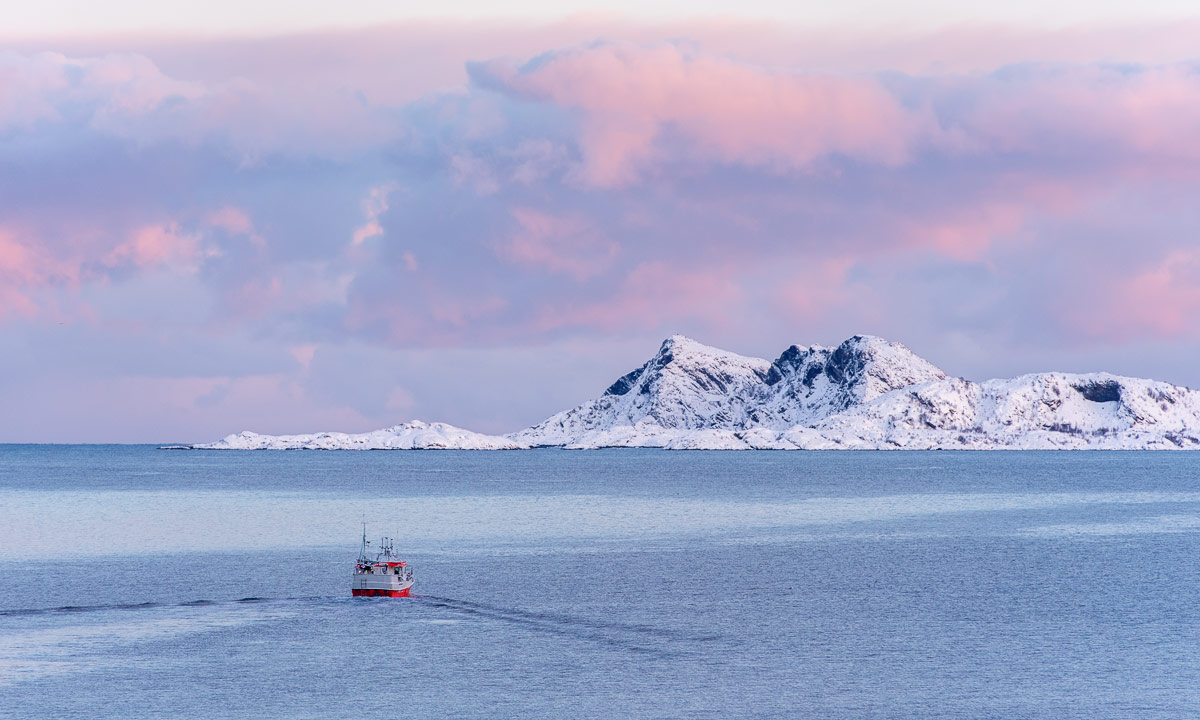
While I take these photos another thing happens: we reach ice again. First fields of beautifully rounded pancake ice floes, then a few hours later we are in ¹⁰/₁₀ of thick ice again. There Kronprins Haakon can show again that it is an icebreaker.

We have another meeting at 09:00 +2h. We learn that it is more than unsure whether station P4 will have any reliable sea ice to work on. The cruise leader asks: shall we try P5 instead? Yes, all scientists agree. So today we will head to P5 at 80.5 °N 34 °E. That’s only an estimated position. First of all a suitable ice floe has to be found and then this floe will drift on the sea and so change position while ice work is ongoing.

26. Feb 16:00 – checking the ice

Eight hours later. Together with the cruise leader and the captain the ice experts had looked for a suitable ice floe. When they were satisfied the ship stopped and a derrick lowered the ice gangway. Now four people are on the ice. All equipped with survival suits. Two of them carry rifles. We are in the home of the polar bears.

Will I be allowed to enter the sea ice? Perhaps already tomorrow? I doubt it but I’m really longing. I don’t know where this strong relation for the Arctic comes from but it’s definitely there and it grew the last days. And I want to be part of it as much as possible.

Four winter days in and round Obbola

OK guys, it’s Sunday afternoon and I’m too lazy to write long texts. I just show some photos of the last days where our German friend Medi joined Annika and me on various excursions with some notes.

Thursday, 6 January – skiing in Västermarks naturreservat

+++ Västermarks naturreservat, 50 km north from Umeå +++ a non-commercial forest made us climb over and under fallen trees that lay across the marked loop trail +++ by the trail a wooden cabin +++ time was too short to fire the oven but lighting candles is cozy, too +++

Friday, 7. January – lunch break skiing

+++ right next to our postbox (500 metres from our house) starts Spåret, a 3600 metre long forest trail +++ we use back-country skis to ski Spåret in my prolonged lunch break +++ we, that’s Dirk – guest for two nights – Medi and I +++ -12 °C, but my Anorak is too warm +++ I tie it round my hip +++ on the photo it looks like a skirt +++

Photo: Dirk Thomas

Me sking “Spåret” – Photo: Dirk Thomas

Saturday, 8 January — cross-country skiing on Olle’s Spår

+++ grey weather, -14 °C +++ the trees are covered with snow +++ black-and-white imagery +++ after some days of back-country skiing it’s nice to use cross-country skis on a real trail +++

Sunday, 9 January – Northern lights and sunrise

+++ 1 o’clock in the night +++ I check for Northern lights +++ we are lucky +++ Medi and Annika watch the aurora beside of the garage +++ I take some photos from our garden +++
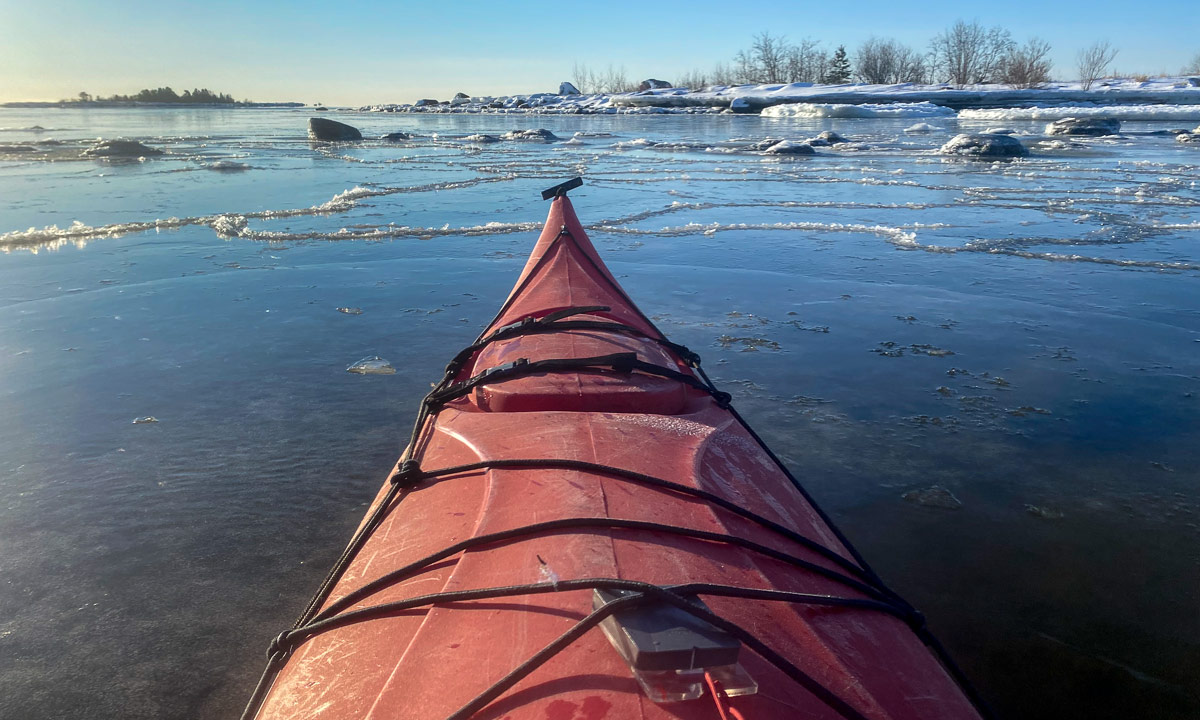
+++ 8:20 in the morning +++ the Baltic Sea freezes over more and more +++ sunrise colours by the sea  +++ and then in our garden +++ watching sunrise while taking breakfast +++

Still Sunday, 9 January – Strömbäck-Kont

+++ just a short walk at one of Annika’s and my favourite places: Strömbäck-Kont +++ looking at the ice ridge by the sea +++

Still Sunday, 9 January – halo effects

+++ after lunch we are taking Medi to the airport +++ strong and colourful parhelion or sun dogs halos +++ the photo is taken at the airport +++ I am questioned by the security and show the taken photos to prove I’m not a spy +++

Whale watching – second try

Yesterday Same meeting point, same tour, same boat as 6 days before. But completely different weather! No stormy wind from the north and clouds everywhere, but a clear and starry sky.

And off we went.

It was just incredible how much brighter everything was although it was less daylight than last Sunday. After two hours the island Nordfugløya came into view. A cloud parked itself over the island.

Slowly the colours of the sky intensified and remained colourful the whole short day, because now it was the first day of polar night¹.

It took us round 3½ hours to reach our destination, the sea round Skjervøy. So we had only limited time before we headed back. Already at one, half past one o’clock it started getting darker again.

Eight hours after our departure we had returned to Tromsø.

I have been outside for round seven hours. I didn’t freeze because I was wearing my warmest winter parka. I was inside once to eat a bowl of soup and once when I stood at the ship’s bow and the sea spray soaked the whole foredeck (including me). So I was eager to take a shower not because of being cold but I wanted to get rid of the salt hands and face were covered with.

Resumé: It was a great boat tour and I enjoyed the air, the colours, the light.

And the whales? Oh yes, the whales! Almost forgot them ;-) Well, we saw some of them, mostly orcas and the first fin whale of the season. There were not many whales around and they were quite in a distance, so for photographing whales this tour was not ideal. Too little time and too high the boat decks above the water. I would love to paddle kayak there but I’m pretty sure that I never ever will dare to do that.

____

¹ Where I live in Tromsø we technically had 14 minutes of daylight yesterday but already 1.3 km north it was the first day of polar night.


No whales today

To the left the Brim Explorer, a boat located in Tromsø for amongst other whale watching. To the right the tourists waiting to be boarded. The boat is fully booked, I am not alone.

Before leaving an announcement: The crew will try its best but it’s not granted that we reach the waters where the whales are. Anyone is free to leave and given a full refund. Most people stay and so do I. First of all I’m not surprised, as another tour operator already cancelled today’s tour. And then I just want to be a day on the water. Whales of course would be a nice extra.

To the left Tromsøbrua, the bridge that connects Tromsø with the mainland. To the right the safety on board drill, that everyone had to join.

And then we’re off.

To make it short: What we didn’t get today was whale sightings. What we got today was rough weather in the open parts. The boat was rolling and pitching like a cork in the waves. More than one passenger got sea sick. The unpredictable movements of the boat and the dim light under the grey sky made photographing a bit adventurous. Several times I was forced in and one passage even the doors were locked. The rest I was outside, partly taking photos, partly just looking around and letting the wind blow around my nose.

Conclusion: an awesome tour even without whales. If you want to participate as well: take your warmest clothes with you. And those of you that just want to stay home and look at some whale photos may read my article about Whale watching in Andenes. Enjoy.

Note to myself: TromsøyaRingvassøya/ReinøyaVannøyaNordfugløyaArnøya/LaukøyaSkervøya/KågenLyngenReinøyaTromsøya

Saskarö in the fog

From Monday and Thursday Annika and I made a trip that I had in mind for a longer while. Travelling round the Bothnian Bay which is the northernmost part of the Baltic Sea. The first days we travelled by car along the sea. The last hours we travelled by ship from Vaasa in Finland to Holmsund in Sweden. From there it’s only a 12½ additional km to our house in Obbola where we live.

On our way to Haparanda we made a detour to Seskarö, an island that is connected to the mainland by several bridges. As the whole day (and half our journey) it was quite foggy.

Especially by the shores there was not much to see. A near island, a bit of ice, some rocks and and a white sea merging seamlessly into the white sky.

Tromtinden

This article is part of the series “2021-07: Back in Tromsø”.

It wasn’t planned, that I woke up already before 6 o’clock. Anyhow I took the opportunity to get an early start for my 2nd mountain tour of #onceaweek. Todays destination is the Tromtinden in the northwest of the island Kvaløya. The starting point is 50 km away so I had to take the car. It won’t be the last time.

The car ride however is incredible. Now many trees bear autumnal colouring. It is already impressive in the shadow, but then I suddenly drive into the sun and was almost blinded by these colours, to bright and intense they were.

I have to take another photo, that shows the road to Tromvik. It lies in the shadow while the sun illuminates the bald mountain peaks.

Already at 7:20 I start the tour. It’s 2 °C. It seems that most Norwegians prefer to start their hiking tours much later and so I am completely alone. The first part crosses boggy ground. There are some planks leading over wet parts but they are quite slippery because of ground frost.

The way leads up through a sparse birch forest. Now the path is less muddy and starts being dominated by rocks. No wonder – it’s going to be a mountain tour.

On a small plateau I find some cloudberries. There are overripe and have a bland taste, but the frozen one in the shadow is really tasty. Cloudberry sorbet!

On a saddle between the Mellomtinden and Tromtinden the view opens to the northwest and a mountain lake as well as the sea appears.

I follow the ascending path until I stand on a larger plateau. From here I can see the steep northwest face of the Tromtinden and the marking of the summit.

After traversing the plateau the path gets steeper, leads mostly over rocks and I have to stop several times to look where it continues. Do you see the mark on the next image?

After crossing some rock fields and a bit of level I “climbing” I arrive at the summit plateau with its impressive cairn and an even more impressive 360° view.

9:15 – finally time for breakfast. Three cloudberries didn’t fill me up.

I almost spend one hour on the Tromtinden and enjoy being outdoors completely undisturbed.

Finally I start walking down. Slowly and carefully I take my steps on the rock fields but then the path gets easier and easier. When I am halfway down I meet the first other hiker – a woman with a dog. From now on I meet twelve other people (plus three dogs) until I arrive at the car. The sky is blue and it has become so warm, that I only wear a t-shirt.

I arrive at the car at round 11 o’clock. I’m surprised that the car thermometer shows only 7 °C, but the sun has still quite a lot power. Now I’ll head home, only with a detour to the grocery to buy a huge bowl of salad for lunch.

For the stats: 8.3 km, summit altitude 636 m.

A hike to the Stor-Kjølen

This article is part of the series “2021-07: Back in Tromsø”.

Let’s be honest and face it. I’ve been really lazy this year and my outdoor fitness is near non-existent. I don’t like that. There is a simple solution for that: Be more outdoors!

Today I started the project #onceaweek. I want to make an outdoor tour with at least 10 km every week. (Thanks M. for your inspiration.)

I will try to blog about these tours and I want to give each tour some photographical focus. Today’s theme: vegetation zones.

From forest to fjell

The gravel road is quite steep in the beginning. First it leads through birch forests that have started to colorise autumnal. Then the landscape opens and is not dominated by trees anymore.

Gaining height

At the lake I leave the gravel road and the character of the hike starts to get alpine. It’s however still a hiking tour, no climbing needed on the whole tour.

From earth to moon

The vegetation is becoming more and more sparse. Some tufts of grass, a fern, moss, map lichens. And then I pass the first snow field. I look up the mountain I wish to climb. It is just an enormous pile of stones. Fortunately there’s a way round this slope.

The mountain top of the is a plateau of rocks with even less live. It’s almost like being on another planet or moon. And there it is: the space station.

“Oh, the space station looks so cozy inside!” – „Well, that’s not the space station, it’s the varmebua, a small wooden cabin to give shelter to hikers.“

“Um, hikers? On an alien moon?” – “Well, we are on earth and the ‘space station’ is a radar station used for controlling the air traffic of a larger part of Northern Norway.“

I had been almost alone on my way up but on the summit there were many other hikers. Some passed, others took a rest like me.

Looking around

The plateau provided a 360° panoramic view. I could see many mountain chains, the higher tops all snow covered. Anyhow, it’s Tromsø and so fjords and open sea are present as well.

This could be a favourite place of mine in Tromsø’s gorgeous nature. But it is way too early to know this. Remember, it is my first tour of #onceaweek. There will be other places to discover.

For the stats: 16 km, summit altitude: 788 m.

A short and rainy Hurtigruten trip

This article is part of the series “2021-08: Northern Norway”.

After 2700 km by car we had arrived in Bjørnevatn near Kirkenes. From there it would be another 900 km back to Tromsø, my temporary home. So Annika and I had decided to go by ship and use the Hurtigruten for our journey west. Last Friday we went on board of the MS Vesterålen, the smallest and oldest ship of the current Hurtigruten fleet. I left it to be parked while Annika used the regular gangway. The ship departed round 12:30, round 35 hours later we arrived in Tromsø.

The weather was rainy, chilly, windy and although parts of the upper deck are well protected against wind and rain we often sat there alone. While it was quite rainy there were a lot of small holes in the clouds that let the sun peek through. Especially the light on the first day was very wonderful.

I just show some of the photos I made from the upper deck. All of them are made with a telephoto lens and focal lengths between 150 and 600 mm. To avoid blurred images because of the ship vibrations I hardly used a tripod but used ISO 800–1600. But now to the photos:

Norwegian summer journey I

This article is part of the series “2021-08: Northern Norway”.

Annika and I have two weeks holiday and are travelling through Northern Norway. Our southernmost point: Lofoten, right now we are in Hammerfest.

Ten images looking back:

10 – We are on the high plateau Sennalandet. There are hardly any trees and the road E6 crosses the plateau in a straight line. I can imagine how rough and lonely this place may be in winter.

9 + 8 – The Øksfjordjøkelen is definitely worth the 16 km detour. The parking place and the small path leading through the sparse birch forest grant impressive views on this glacier. When the weather is clear.

7 – It’s grey on our passage from Andenes, Vesterålen to Gryllefjord, Senja. I stand on the top deck of the ferry and wonder how many tourists may have rung this bell and what had happened then.

6 – We just left Andenes by ferry. The razor sharp mountain line of Bleik will soon transform into a whitish grey scheme slowly vanishing in the drizzle.

5 + 4 – It is grey on our short ferry passage from Fiskebøl, Lofoten to Melbu, Vesterålen, too.

3 – One of the typical features of the Norwegian landscapes is the presence of high summits and fjords. Sometimes the mountains are reflected in the water surface of the sea.

2 – Hauklandstranda is one of these incredible beaches on the Lofoten islands with white sand and turquoise water. The sun is shining – time for a bath. Air temperature 11 °C, water 12 °C. Not as cold as expected.

1 – We pass Sildpollnes kapell on the Lofoten twice. Once on our way south and once when heading back again. There’s a parking place by the road where stairs and ways lead up to some hills that present a view over the landscapes around.

0 – On Saturday I leave Tromsø to fetch Annika from Riksgränsen train station in Sweden. It’s still not possible to travel further to Narvik by train. Our destination today: a room in Tjeldsundbrua.