Serenity

After a really warm day (+12 °C!) we got a colourful sunset. Unfortunately I was too late to catch the most colourful period.

The ice on the Baltic Sea is still thick, but the snow melted and left many ice water puddles between the snowmobile tracks.
Where are we – Annika and I? In the Arctic on our way to the North Pole? Looking for polar bears?

Well, not really! We’re on the frozen Baltic Sea on our way to the island Gåsören, enjoying the blue sky and the warm sun.

But we didn’t only enjoy the warmth of the sun, but the warmth of the sauna, too – even if we didn’t fire it as hot as it should be for a real sauna experience.


We were not the only ones on the ice of the Baltic Sea yesterday.
There were ski tracks and skiers.
There were snowmobile tracks and snowmobile drivers.
There were moose tracks …
… and there were moose on the ice, too. Far, far away, but clearly visible.


“vårvinter” means “spring winter” and describes this season, where the land is still covered with snow and ice, but the temperatures aren’t longer as cold as in January or February.
As you can see in the blog posts before, we had really nice winter weather with a lot of sun the last weeks. Even last night was clear. When I stood up at 7 o’clock we had -15 °C outside, but it was cloudy. Three hours later the temperature has climbed to -5 °C and it started to snow.
Annika and I went outside to go for a walk. It became a bit longer and chillier than planned: We went to the shore and rounded the island Norrskär on the thick ice layer that covers the Baltic Sea. When we returned to the mainland, wind and snowfall had intensified. It’s still snowing, but not very much, just some centimetres, I guess.
This photo shows a nameless stony island between Norrskär and the mainland. What a contrast to the photos of the sunrise some days ago.
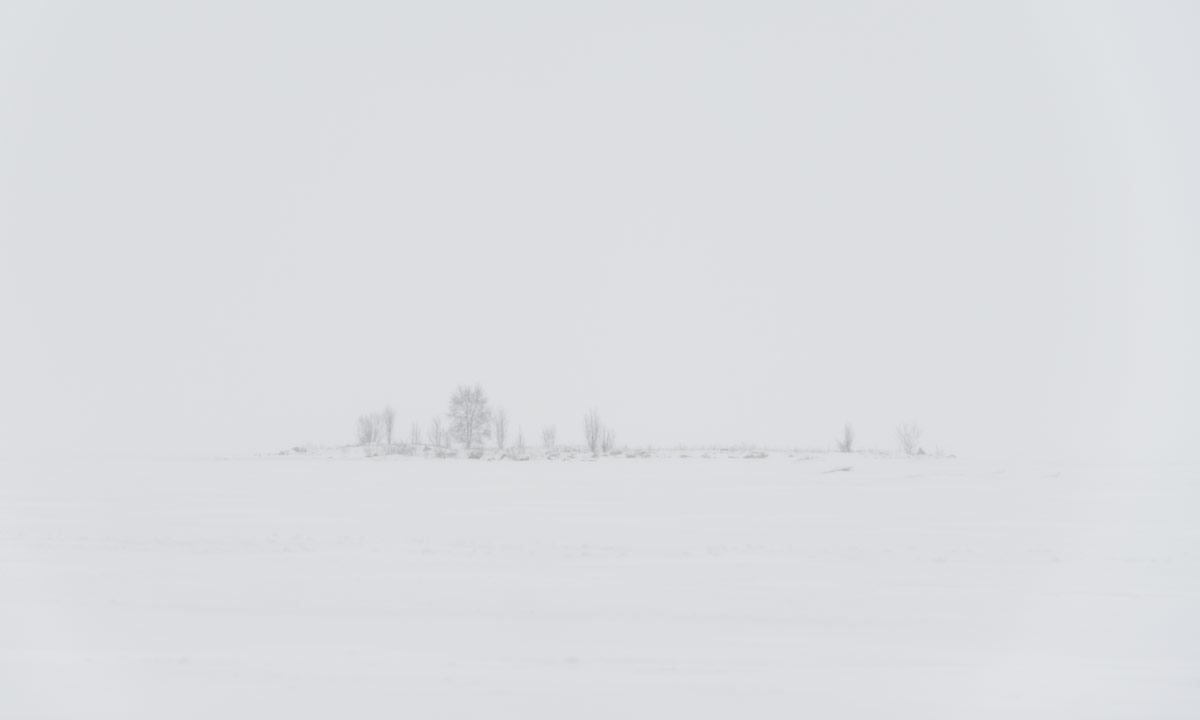
It’s not the photo, it’s the whole landscape that looks monochrome and the island Gåsören – 2 kilometres away – was even completely hidden behind the falling snow.
When I took the car to Umeå three days before, temperatures where between -20 °C and -31 °C. Today it was much warmer in Umeå, just round -4 °C.
Annika and I took the car to Holmsund, a place 20 km south from Umeå. This coastal locality has round about 5500 inhabitants and is special, because here starts the only ferry connection from Sweden to Finland beside those from Stockholm. When we arrived, the ferry from Vaasa in Finland just had anchored.

Neither of us has been in Vaasa before, so we thought about making a trip to Finland, perhaps already in two weeks, if the weather isn’t too bad.
Right beneath the ferry dock there’s a pair of piers reaching 700 meters into the sea. If you look east, you see that the Baltic Sea is ice covered beside of the waterway. But in contrast to the Baltic Sea outside of Skelleftehamn, which is thick, solid ice, you can see the big ice floes lift and lower with the underlying waves. If you look west, you see the mouth of the river Umeälven, where the water is mostly open and small ice floes float and drift southwards.
I don’t know, when it has been so windy, that the waves rolled over these piers, but you could still see the result: Many of the dried up flower stalks and the lower branches of bushes and trees were covered with a thick layer of ice. It must be both impressive and frightened to witness such a stormy weather in winter.


Yesterday I went to Umeå by car, but I took a detour. In Övre Bäck, where I made the photo from the “Winter tree” I left the E4 to drive to Bjuröklubb, a salient that reaches wide into the Baltic Sea.
In summer, you can walk up from the parking place, eat in the Café Fyren or follow the wooden walkway up to the light house. In winter time this place is abandoned. I took my snow shoes and went first along the shore and then up to the light house.
Temperatures were between -25 °C and -30°C and the sky was totally clear. Another wonderful winter day.


No survival suit, no down coverall, not crossing sea ice, not being frostbitten – just a normal little ski trip, that’s what I did today. Most time I followed tiny paths through the forest, partly I skied on the ice along the coast. Just being out two hours, hardly 6 km, that’s nice, too. And it was even a bit warmer: -20 °C.

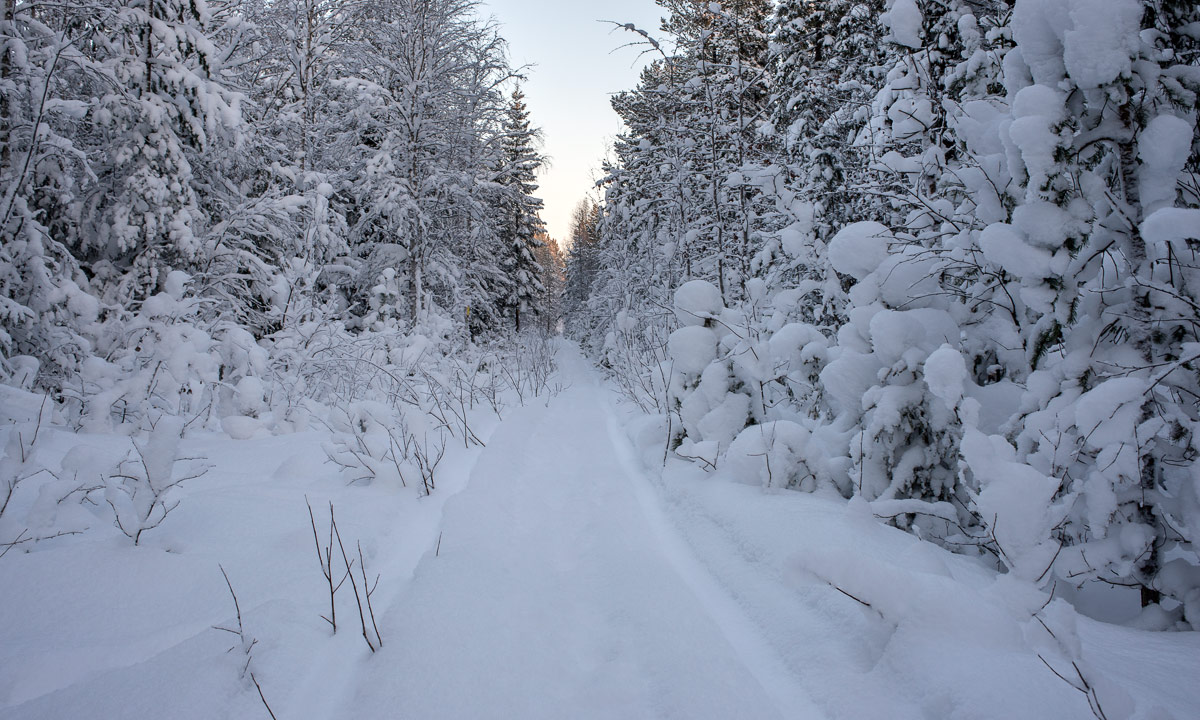


Disclaimer: Don’t try this at home. Unknown sea ice can be dangerous just as very cold temperatures.
Today I had the plan to cross the ice and go to the island Gåsören which is one of my favourite places nearby. The challenge: Parts of the Baltic Sea were open five days ago due to the low water. How thick would the ice be and would I be able to go to the island?
I started at the little boat harbour Tjuvkistan and planned to go to the island Bredskär where I’ve been with Annika two days ago. This time I chose snow shoes and pulka to transport all clothes and equipment. I changed plans and didn’t head to Bredskär, but followed the ski tracks to the island Klubben instead – a better direction. In the dim light of the daybreak I could see Gåsören ahead.
It was quite cold, round -27 °C and I was glad about my fur rimmed hood, that protects the face against wind and cold air.

I continued to the next island Flottgrundet, which is hardly 300 meters away. A tiny ice rim encircled the island and I took a small break. Normally I take breaks mainly for taking pictures, but this time I had another reason, too:
Beside of the tracks of a lonely hare I couldn’t see any track or trail to Gåsören. Is the ice safe and will it bear me? Since I already expected such, I brought along my survival suit, which is completely waterproof and has attached socks, gloves and hood, so that only the face would be exposed to the ice cold water in case of breaking through the ice. All other equipment such as camera, extra clothes and food was in waterproof bags.


I looked like a Teletubbie, (and probably moved like one too) but I felt safe. Round my head I had my camera bag and so-called isdubbar, that’s ice picks, that would help me to pull myself on land, if I had broken though. I put the snow shoes into the pulka and started crossing the ice.


Round 700 meters later I reached Gåsören. I went ashore and was quite glad that the ice bore me without any problem. I unmounted the pulka but continued wearing the survival suit. I wanted to discover the ice rim on the eastern side of Gåsören and didn’t dare to do that without it. First of all I climbed onto the two meter high ice to get an overview. The risen sun started to light parts of the landscape in warm colours, while the snow in the shadows still looked cold and bluish.


The next two hours I strolled around east from the island to take pictures from the amazing ice formations round the island. Some of them were up to three meters high. It’s interesting to see, how many different colours ice can have, both the ice itself and the sun light as the day progresses. While I walked round I could see the light houses of Gåsören, the new one (the red tower to the left) and the new one (the house to the right).


Meanwhile I protected even my nose that started to get cold. The danger is that you won’t realise, when the nose gets too cold and you really have to be careful to avoid frostbite. The neoprene survival suit is surprisingly warm, but not comfortable at all. Since it’s not breathable I started to sweat and become wet. I longed for warm tea and other clothes. I went back to the pulka, undressed the suit and slipped into the cold boots. Then I took tea, crackers, camera and a huge bin bag that wrapped my down coverall. I went to the other side of the island, this time on land and put on the coverall over the other jacket. Now I really looked like a polar explorer, but was just 5 kilometres away from home. It took a while, until I got warm again and another while to realise, that this suit is almost to warm for temperatures between -26 and -28 °C. But at least I got my hot tea, some cookies and I didn’t freeze at all.


Of course I continued making photos on land. I went round, took images of the big welcome-sign, the red-white light tower and even more ice. But after a while clouds came in and started to cover the sun.


So I undressed my down coverall, went back to the pulka, packed all stuff into it and started my walk back to main land. I chose almost the same way to be sure, that the ice is stable. The sun vanished behind a layer of clouds, only a bright orange light pillar was left.
When I looked left I got reminded, that this fantastic tour was not in the arctic wilderness, but near home. The smelting works on the peninsula Rönnskär was within sight. The chimneys gave off clouds of smoke that racked southwards below the inversion boundary, but northwards above. When I was almost back on the main land I could see the red solar disk setting behind Rönnskär.


When I entered the car, it was still -26 °C below – one of the coldest days that I experienced in Skelleftehamn until now.
Conclusion: a great tour with a touch of expedition due to the coldness and the unsafe ice. Should be repeated when ice is safer and weather is warmer.
This tour was more dangerous than I suspected. Not because of the weak ice but because the rubber gloves of the survival suit didn’t isolate good enough. Today – two days after – I got small blisters on all fingers but the thumbs, a clear sign for a second degree frostbite. My nose is a bit reddish and itches, probably a first degree frostbite.
I have full tactile sense in all parts of the fingers and the nose, but it probably will take some time until the skin heals completely.
The danger was, that I didn’t feel any pain in the fingers while being out. I just felt the cold when I removed the wool mittens. I never will make such an extended photo tour in the survival suit when it’s so cold.
Take care, photographers. Don’t risk your health for just some nice photos. It’s not worth it.
More and more it’s not the snow and ice that fascinates me by winter, or the coldness that tickles in my nose. It’s the light, the amazing light! It’s incredibly beautiful, but – at least for me – hardly photographable. Too delicate and subtle are the colours and shades.
I tried it anyway, when Annika’s and I made our ski tour to the island Bredskär today.


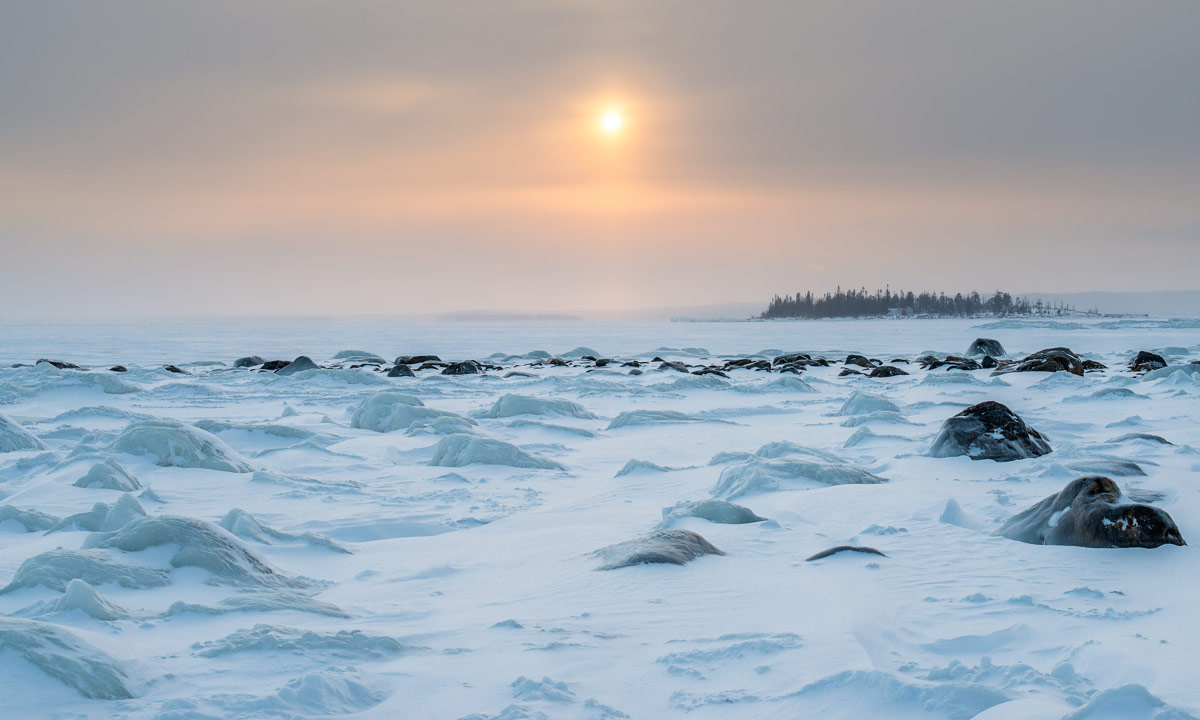
After a snow fall of 12 cm last night the sea ice was partly covered with snow and skiing was nice and easy. However, we changed our plan to go round the whole island Bredskär, since the ice on the outer side was much too soft and weak. I don’t want to get wet feet or legs, when it’s -17 °C. However a wonderful little ski tour because of the light, the amazing light!
