Kungsleden ski tour: Singi – from blizzard to clear sky

This article is part of the series “2016-02: Ski tour on the Kungsleden”.

Singi day #1 – 21. February

That’s me on the picture above. It’s 3:45 in the night. I can hear the storm shaking the cabin and howling in all chimneys. When I look out through another window (this one is completely covered with a layer of snow), I can see that it’s still snowing a lot. But it doesn’t help, I have to go to the loo. And since the toilet is a utedass – an earth closet round 50 meters away, I have to dress for it: The headlamp to find my way through the blizzard, the parka to stay warm and the ski goggles for more comfort when I go back against the snow storm.

Some hours later: The blizzard lasts the whole day. Sometimes you cannot see the other cabins standing 50 meters away – just whiteout. Most of the day I stay inside, either in “my” cabin, which I have completely for myself or I visit J., the stugvärd, in his cabin. But I got out to make some pictures (all made with a 35mm lens):

Singi day #2 – 22. February

Still the wind howled, still snowfall from the sky the next day, but I could see some stars shimmering through the clouds above. And after a short while the snowfall stopped and the overcast sky started to clear up. It’s really nice if you’re able to see something again:

I left the cabins for a short ski tour to the near sami village Goržževuoli. Still some snow crystals fell from the clouds above, still snow was drifting over the white ground, but when I looked back, I could see the sun illuminating this landscape with golden and almost magical colours.

After a while sky cleared up and the weather went “normal”. I took some pictures in the village, which is abandoned, at least in winter time. The buildings are a mixture of wooden houses and traditional sami buildings called kåta.

After I while I headed back over white and untouched snow. I love making the first tracks on fresh snow!

When I came back to Singi, wind increased again. The stugvärd told me, that Singi is quite exposed to wind. I crouched behind a two meter high snow drift to make a photo of the drifting snow. After that I had to dry my lens since the snow dust was everywhere.

The blizzard of the last day created snowdrifts up to three meter high and up to 60 meters long behind the lee side of the cabins.

If you are in a mountain hut, you’ll experience big contrasts: Storm or bright sky – inside or outside – day or night. The following two pictures show the same day:

I was quite busy with keeping the hut warm. It has wooden stoves, one for the kitchen, one for each sleeping room. It takes a lot of wood to keep such a cabin warm, especially when strong winds cool it down (and even accelerate the burning). In the morning I had temperatures round 0 °C and was glad about my warm down filled sleeping bag. The wood on the King’s trail comes in long logs. The stugvärd will cut it up to one meter long logs, the rest is up the the guests. The guests? That’s me! I guess I sawed and hacked wood four or five times to keep the fire running and – even more important – to leave enough wood for those that will come after me.

Later in the evening the full moon rose behind the snow covered mountain chain, surrounded by a halo. I just love standing out in the wintry mountains when the moon lights the scenery. Just beautiful.

The next article: Sälka >>

Kungsleden ski tour: From Nikkaluokta to Singi

This article is part of the series “2016-02: Ski tour on the Kungsleden”.

It was 2005 when I was asked by C. from Switzerland, if I wanted to join him on a ski tour on the Kungsleden – the King’s trail. That’s how I came to my first ski tour in the mountains of Swedish Lapland. More tours followed, but sometimes it was hard to find a tour mate. Same thing this year; that’s why I decided to do my first ski tour on my own.

Kungsleden would be ideal for that, since there’s infrastructure as mountain huts and I won’t be alone. Good to know, since even twisting an ankle could be a serious problem in winter if no one’s around. I wanted to start 19 February, the day, when the huts open.

After a long trip I reached Nikkaluokta (many thanks to A. for the lift from Kiruna!) on the evening of the 17th I had one spare day in one of the cosy cabins of family Sarri. This place can be very cold and I had a look at the digital thermometer in the cabin: -44.8 °C minimum since the last reset – brr, that had been a cold day!

I climbed the small church hill and looked west. That’s were I’ll go the next day.

From Nikkaluokta to Kebnekaise Fjällstation

19 February · 19 km · Link to map

Time: 7:40, temperature -17 °C, weather: cloudy. Time to start the tour. I mount my skis, put the belt of the pulka (a sled for transportation) round my hips and after some gliding steps I see the first mark of the winter way to Kebnekaise.

It’s the only mark for a long time, the winter way to the Kebnekaise Fjällstation is not marked, neither on the map nor in real. But it’s easy to find the way, since many snowmobiles take this way and you only have to follow their tracks. Soon I’m at the place where the trail crosses the stream Čievrragorsa. In summer I used the chain bridge, In winter the snowmobile goes right over the frozen and snow covered stream. I can hear the sound of water running underneath the ice – a strange feeling.

After some kilometers I come to the lake Láddjujávri. Here you can eat waffles with cloudberries or burgers at “Lap Dånalds” and even take the boat over the lake to shorten your trip a bit. Well – in summer …

Hardly imaginable that I took a bath here six month ago on a hot summer day, when I was here with Annika. Not it’s winter, all is closed down, the boats lie on land and are covered with snow and I’m completely alone. Anyway it’s not too cold and I take a first rest on my tour. Without waffles, without a refreshing bath, but with the same beautiful view as in summer, since the sky starts to clear up and one mountain top after the other starts to get free from clouds, fogs and haze.

When I continue my tour over the ice of the frozen lake I soon can see the same mountain range as I did in summer. And it’s as beautiful as in summer, too.

After some kilometres the trail leaves the lake and continues through scattered birch forests and over frozen swamps, some of them covered with ice. The weather is fine and sky is of a clear blue with some clouds.

Another rest, this time on top of a rock, with hot tea, chocolate, and a bit of salami. What a beautiful day! I could sit here for hours, but I shouldn’t. I have to reach the huts of the Kebnekaise Fjällstation. I do reach them, but before that I have to work. The trail ascends and I have to make wide V-steps with my skis to be able to pull the pulka uphills. Finally I arrive. This mountain resort is quite huge, since Kebnekaise is the highest mountain in Sweden and very popular among hikers, skiers, and climbers. Anyway it is not opened yet beside of the cabin Jägarn (“the hunter”). Here I’ll stay overnight before I’ll continue to the Singistugorna the next day. Twice I climb on the small hill with the radio mast, first after sundown, then at half past six – where I see the first polar light of the tour.

From Kebnekaise Fjällstation to the Singistugorna

20 February · 14 km · Link to map

When I wake up sky is blue again and -17 °C. I take a short breakfast with muesli and prepare for leaving. That means: packing all things – doing the dishes – cleaning the kitchen and my bed room – checking that I have everything with me – putting on skis and pulka belt. Meanwhile the sky is overcast and it has started snowing. Weather can change quickly in the mountains.

After I have walked some kilometres it clears up a bit, just so much, that you can see some mountain tops shining through the hazy fog.

When I enter the narrow passage of the valley the mountain tops hide again, which is a pity. The mountains here are so beautiful.

There is not much snow in the mountains this winter. Parts of the marked winter way lead over stony passages with no snow at all. I have to go round these passages to avoid ruining my skis and pulka. Mostly I follow the snowmobile tracks, hoping that the locals know the best way.

This way leads over the frozen river, but sometimes it’s hard to see, since the snow under the overcast whitish-grey sky don’t show any contours. Wind increases, snow falls as well and the snow starts to drift in the increasing wind. In the narrow valley between the mountains Siŋŋičohhka and Liddubákti more snow lies on the ground which makes it easier to ski but worse to see.

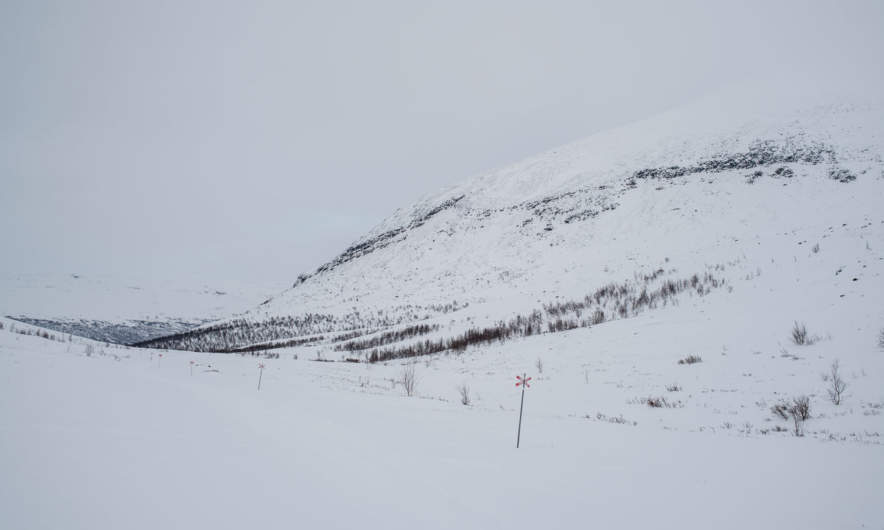
That’s when you are really glad about the winter way marks: Red crosses set on long poles. Sadly plastic crosses are used nowadays. They are ugly, in my opinion harder to see and many of them are broken. But I’m glad to have them anyway. They do not only show you the way, they help you even in guessing whether it’s going up or down, which you cannot see, if visibility and sight are poor.

I always have compass and a good map with me on such tours. Anyway, if you cannot see any landmark these tools are of limited help if you do not count steps or know how fast you are on your skis. That’s when a GPS can be very handy. When I make another rest, longing for the mountain huts Singistugorna, the GPS revealed, that it’s only 970 meter to go. Easy!

Well, not really. The valley opens, wind increases and there are many rocks and snow-free parts on my way. I decide to circumnavigate a steeper passage and ski a bit to the right. To my big amazement I don’t go down but keep on level. Suddenly I feel part of the ground collapsing a bit and realise that I stand on the rim of a soft snow drift, about two meter high. It was absolutely impossible to see it. I’m lucky, that I didn’t fell down! I go back and circumnavigate my circumnavigation until I’m on the marked trail again. There I can see the cabins shining through the drifting and blowing snow. It takes some time to find a good way down to Singi but finally I arrive. Here the wind seems to be even stronger and the snow falls even more intense.

Stugvärd J. shows me my room, light fires in the ovens of the kitchen and my bed room and allows me to take my pulka inside since I’m the only guest. After doing some work he leaves and heads to his own cabin against hard wind and snow.

According to the forecast wind will increase even more and snow fall round 20 cm are expected. I’m glad, that I have time and plan to stay at least one other day in the Singistugorna, perhaps two.

The next article: Singi – from blizzard to clear sky >>

Just a photo through the window

Today it was just a fine winter day. Last week was warm and cloudy, with wet snow showers and drizzle. Parts of the little amount of snow, that we got this year melted away. But last weekend it snowed. As a matter of fact it snowed so much, that some of the planes to Skellefteå were cancelled and round 30 of the participants of the Winter Swimming Championship couldn’t join.

On the other side it’s always nice with fresh, white snow, at least in my opinion. From Friday to Sunday we got round 25 – 30 cm and it needs only 20 other centimetres to hide the fence in my backyard.

But I won’t witness it, if more snow came the next week. Tomorrow (more precise: in tome hours, it gotta be a short night!) I will take the bus to Skellefteå, another bus to Luleå, the train to Kiruna and probably a lift to Nikkaluokta, where I’ll start a ski tour on the Kungsleden:

NikkaluoktaKebnekaiseSingiSälkaTjäktjaAlesjaureAbiskojaureAbisko

I’ll be offline for some weeks. Now I just hope for good weather, because I want to make many photos. Wish me luck!


The snow returns

I dislike thaw. When it’s winter I want to see white snow, not brownish slush and drizzle falling from low-hanging clouds.

The latter was the weather that we got for four days. The snow slid from the roofs and melted away and under many water puddles sheer ice covered the roads. But alas, yesterday the weather changed and it started to snow. Today it has been quite windy and it has been constantly snowing. The strong winds glue the wet snow to the houses, the cars, and the windows.

I guess, we got round 20 cm of snow the last 24 hours and it continues snowing. The thick brown half-frozen chunks of wet snow, that framed all streets start to get a fresh white snow blanket and small snow drifts cover the roadways.

Yes snow – that’s more my cup of tea. I hope however, that the wind gusts will stop soon, since tomorrow the Winter Swimming World Cup and Scandinavian
Championship 2016 will take place in Skellefteå and I guess it won’t be much fun for the swimmers standing in some kind of “snow storm” dressed only with a swimsuit and a warm cap. And neither for me, who is going to take pictures of this event.

No sun today

As you can see in the blog posts before, we had really nice winter weather with a lot of sun the last weeks. Even last night was clear. When I stood up at 7 o’clock we had -15 °C outside, but it was cloudy. Three hours later the temperature has climbed to -5 °C and it started to snow.

Annika and I went outside to go for a walk. It became a bit longer and chillier than planned: We went to the shore and rounded the island Norrskär on the thick ice layer that covers the Baltic Sea. When we returned to the mainland, wind and snowfall had intensified. It’s still snowing, but not very much, just some centimetres, I guess.

This photo shows a nameless stony island between Norrskär and the mainland. What a contrast to the photos of the sunrise some days ago.

It’s not the photo, it’s the whole landscape that looks monochrome and the island Gåsören – 2 kilometres away – was even completely hidden behind the falling snow.

Short trip to Bjuröklubb

Yesterday I went to Umeå by car, but I took a detour. In Övre Bäck, where I made the photo from the “Winter tree” I left the E4 to drive to Bjuröklubb, a salient that reaches wide into the Baltic Sea.

In summer, you can walk up from the parking place, eat in the Café Fyren or follow the wooden walkway up to the light house. In winter time this place is abandoned. I took my snow shoes and went first along the shore and then up to the light house.

Temperatures were between -25 °C and -30°C and the sky was totally clear. Another wonderful winter day.

A little expedition to the island Gåsören

Disclaimer: Don’t try this at home. Unknown sea ice can be dangerous just as very cold temperatures.

Today I had the plan to cross the ice and go to the island Gåsören which is one of my favourite places nearby. The challenge: Parts of the Baltic Sea were open five days ago due to the low water. How thick would the ice be and would I be able to go to the island?

I started at the little boat harbour Tjuvkistan and planned to go to the island Bredskär where I’ve been with Annika two days ago. This time I chose snow shoes and pulka to transport all clothes and equipment. I changed plans and didn’t head to Bredskär, but followed the ski tracks to the island Klubben instead – a better direction. In the dim light of the daybreak I could see Gåsören ahead.

It was quite cold, round -27 °C and I was glad about my fur rimmed hood, that protects the face against wind and cold air.

I continued to the next island Flottgrundet, which is hardly 300 meters away. A tiny ice rim encircled the island and I took a small break. Normally I take breaks mainly for taking pictures, but this time I had another reason, too:

Beside of the tracks of a lonely hare I couldn’t see any track or trail to Gåsören. Is the ice safe and will it bear me? Since I already expected such, I brought along my survival suit, which is completely waterproof and has attached socks, gloves and hood, so that only the face would be exposed to the ice cold water in case of breaking through the ice. All other equipment such as camera, extra clothes and food was in waterproof bags.

I looked like a Teletubbie, (and probably moved like one too) but I felt safe. Round my head I had my camera bag and so-called isdubbar, that’s ice picks, that would help me to pull myself on land, if I had broken though. I put the snow shoes into the pulka and started crossing the ice.

Round 700 meters later I reached Gåsören. I went ashore and was quite glad that the ice bore me without any problem. I unmounted the pulka but continued wearing the survival suit. I wanted to discover the ice rim on the eastern side of Gåsören and didn’t dare to do that without it. First of all I climbed onto the two meter high ice to get an overview. The risen sun started to light parts of the landscape in warm colours, while the snow in the shadows still looked cold and bluish.

The next two hours I strolled around east from the island to take pictures from the amazing ice formations round the island. Some of them were up to three meters high. It’s interesting to see, how many different colours ice can have, both the ice itself and the sun light as the day progresses. While I walked round I could see the light houses of Gåsören, the new one (the red tower to the left) and the new one (the house to the right).

Meanwhile I protected even my nose that started to get cold. The danger is that you won’t realise, when the nose gets too cold and you really have to be careful to avoid frostbite. The neoprene survival suit is surprisingly warm, but not comfortable at all. Since it’s not breathable I started to sweat and become wet. I longed for warm tea and other clothes. I went back to the pulka, undressed the suit and slipped into the cold boots. Then I took tea, crackers, camera and a huge bin bag that wrapped my down coverall. I went to the other side of the island, this time on land and put on the coverall over the other jacket. Now I really looked like a polar explorer, but was just 5 kilometres away from home. It took a while, until I got warm again and another while to realise, that this suit is almost to warm for temperatures between -26 and -28 °C. But at least I got my hot tea, some cookies and I didn’t freeze at all.

Of course I continued making photos on land. I went round, took images of the big welcome-sign, the red-white light tower and even more ice. But after a while clouds came in and started to cover the sun.

So I undressed my down coverall, went back to the pulka, packed all stuff into it and started my walk back to main land. I chose almost the same way to be sure, that the ice is stable. The sun vanished behind a layer of clouds, only a bright orange light pillar was left.

When I looked left I got reminded, that this fantastic tour was not in the arctic wilderness, but near home. The smelting works on the peninsula Rönnskär was within sight. The chimneys gave off clouds of smoke that racked southwards below the inversion boundary, but northwards above. When I was almost back on the main land I could see the red solar disk setting behind Rönnskär.

When I entered the car, it was still -26 °C below – one of the coldest days that I experienced in Skelleftehamn until now.

Conclusion: a great tour with a touch of expedition due to the coldness and the unsafe ice. Should be repeated when ice is safer and weather is warmer.

Addendum (2016-01-20)

This tour was more dangerous than I suspected. Not because of the weak ice but because the rubber gloves of the survival suit didn’t isolate good enough. Today – two days after – I got small blisters on all fingers but the thumbs, a clear sign for a second degree frostbite. My nose is a bit reddish and itches, probably a first degree frostbite.

I have full tactile sense in all parts of the fingers and the nose, but it probably will take some time until the skin heals completely.

The danger was, that I didn’t feel any pain in the fingers while being out. I just felt the cold when I removed the wool mittens. I never will make such an extended photo tour in the survival suit when it’s so cold.

Take care, photographers. Don’t risk your health for just some nice photos. It’s not worth it.