A cruise from Skelleftehamn to Bjuröklubb

It doesn’t happen often, that you can make boat trips from Skelleftehamn, were I use to live. Only one week once a year the Laponia Rederi from Luleå comes down to Skelleftehamn for some cruises. Last Saturday Annika and I took the opportunity to attend a five hour cruise to Bjuröklubb, where I’ve been quite a lot, but never by ship. When we arrived in good time before 11 o’clock people already started entering the small ship.

We boarded, too and thereby lowered the average age some years. I sniffed around the boat and got the permission to enter the bridge for some photos.

Five minutes before schedule the ship put out to sea, cruising along the industrial peninsula Rönnskär.

While Annika and I were standing on the top deck looking at the sea, the islands, the sky and the waves, all other people stayed inside and started focussing on the main topic: the lunch buffet. Anyway I have to admit, that especially the salmon was extremely delicious, and the bread as well.

I once thought about making a kayak trip to Bjuröklubb, an exposed peninsula and the easternmost point of the county Västerbotten. It would take me some days, since for one thing I’m slow and for another thing I would follow the coastline and never dare to take the much shorter direct route long away from the mainland. The ship, however was fast and took the “directissima”. Therefore it took only 90 minutes to cruise there.

At the small harbour we all went ashore and the ship continued to a larger harbour nearby where it waited for us. We got a guided tour and went up to the lighthouse where we left the croud for a good reason: Just that day was the International Lighthouse and Lightship Weekend, the only day where the lighthouse – which is still in use – is open for visitors. I went up, waiting for the other visitors – max 4 at the same time – to leave and made some photos. Not only the cut glass mirror construction was incredible but the colourful reflections of the sunlight, too.

Since we already left the group we took a hike to the other harbour, where we entered the ship again. Why it took us more than half an hour to walk for just some hundred meters? Well, there were blueberries, there were raspberries … and we picked and ate a lot of them.

The crew untied all the ropes connecting the ship to the land. I’m sure they are nautical terms for those ropes, you are free to post their proper names in the comments. Then the ship started, fetched the other passengers at the other small harbour and headed back to Skelleftehamn. Annika and I sat on the upper deck and enjoyed sun, clouds, wind, and waves as well as the view on the islands Skötgrönnan and Gåsören.

Ninety minutes later we arrived again in Skelleftehamn, where we came off the ship, while one of the crew played farewell music on the accordion.

Conclusion: A relaxed cruise and the opportunity to play tourist in my adopted homeland for one day.

Noctilucent clouds

19 days ago it was dark enough to see the first star. Since then it got a bit darker each night and tonight – which is a clear night – you can see the first constellations as for example Cassiopeia.

It would be dark enough for the first polar lights of the season but there aren’t any this night. Anyway I spotted something even better in my opinion since it is not often that you can see it so lucid as tonight: Noctilucent clouds, which are clouds so high up in the sky that they are illuminated by the sun the whole night through. Cirrus clouds, the highest “normal” clouds exist in altitudes of round 4 – 12 km, noctilucent clouds however occur in altitudes round 50 km! And I think there are really beautiful.

Translation:

EnglishGermanSwedish
Noctilucent cloudsLeuchtende NachtwolkenNattlysande moln

Norrbyskär – Sweden in a nutshell

Prologue

It’s a bit funny. Although the internet weather forecast rarely correspondents with reality, I check it anyway. Then I at least try to ignore it.

Last sunday, when Annika and I considered what to do, the forecast promised sun for two or three hours, but rain showers for the rest of the day. We decided to take the car to Norrbyn 40 km south from Umeå and the 11:30-ferry to the island Norrbyskär. If it really rained, I could at least try out my brand new rain jacket.

Sweden in a nutshell

11:20 we were on board of the ferry Norrbyskär and soon the little ship put out to sea. The trip didn’t take long, it’s only 2 km to the island. I just love boat trips, it always feels like holidays when you stand on the ship’s bow, feel the airflow and look at the blue sea.

Norrbyskär consists of several islands connected with dams and as we experienced later even another possibility to cross the water. We went ashore with the other guests and headed left on the island Stuguskär. The way is framed by quite large brick houses. Most houses in Northern Sweden are made of wood and for us the brick houses looked more like a small coastal town in Germany, not a North Swedish island. The broad way ended soon, but a path continued through the forest and led us to a tiny bay. The single summer house standing on stilts brought us back to Sweden: it was wooden and painted red.

We continued to a place called Calmarn, another part of the island. The soil along the bay was brown and very bouncy. I had to look twice until I realised that the soil was neither sand nor mud. As many other places Norrbyskär had a huge sawmill in former times and this bay was completely covered with a thick layer of sawdust that gave you the feeling of crossing a huge trampoline when you walked on it.

We continued the path and entered the forest again. Soon we stood on the rocky north point of Calmarn, where we took the first rest. We sat down on a big rock, looked at the sea and enjoyed the blue sky and the warm sun. No rain in sight yet.

Now we went back the whole way until we almost were at the shipping pier again but continued the main road that connects the islands Stuguskär and Långgrundet. The street ends at a place surrounded by two white wooden houses and a bell tower. The entrance of the main building was labelled sommarkyrka – “summer church”. The ferries that connect the island with the mainland are going only between late april and early october – hardly more than 5 months, so probably this church is only active these months.

We went around the church where we found the Tannskärsstigen, a forest road on the peninsulas Tannskär and Truthållan. Sometimes the path was near the shore and you could see water lingering through the trees. Sometimes the path looked like leading through a huge and dense forest, even if Tannskär is hardly 500 meters in diameter.

It got warmer and warmer and we longed for a bath. The first beach was not actually crowded, but the nice places were occupied and so we continued our walk. The second bathing place wasn’t completely deserted neither, but big enough for us to find a place. A pair sitting on a wooden bench, some boats, some people on the pier, some kids in huge orange life jackets. We drank some water, ate some sweets and decided to take a bath.

Brr – the water was still really cold but so refreshing. So delightful! After the bath we laid down on the wooden pier and the sun dried us in a short time.

We continued the circular track and soon approached the summer church again. We went a bit back and crossed another dam to reach the island Stengrundet. Here’s a huge campground of the YMCA (in Swedish: KFUM). We had a look at the climbing crag where people with climbing harnesses and helmets climbed ladders and balanced on ropes, but soon we went to another shore were we had a look at the blue sea with its small and tiny islands.

We went back to the campsite, found another path through the forest and followed it, this time in direction north. The north peak of this island is extended by a quite long breakwater made of big rocks. Again a nice place to rest. In the east we could see the tiny island Burgrundet. It looked spooky. Some leafless dead trees and black birds. Crows? Dead man’s island? No, it weren’t crows, but cormorants sitting on the bare branches of the dead trees.

In the south we could see some wooden wrecks in the shallow water between Stengrundet and Långgrundet. On the satellite photos it looked like shipwrecks – almost like a ship graveyard. We went back – first along the shore then through the forest. It took a while but finally we found the path to the shore where we could see the wrecks of some twenty meter long wooden shipwrecks – an amazing view!

I already started to check the time because we wanted to reach the 18:15-ferry. The museum, which is not far away from ferry dock, was already in view and hardly hundred meters away, but on the other island. To reach the museum by foot we would have to go two kilometers to use the dam between the islands. But there happened to be an alternative:

When we looked at the shipwrecks we found a big wooden raft, tied to some cords that were fixed to the shore of both islands. Apparently it was possible to enter the raft and just pull oneself cross the water. After some considerations whether it would be (a) possible and (b) permitted we entered the raft, took the soaking wet cords and pulled ourselves over the water. It didn’t take long and we were able to hop on shore. We went into the museum, bought lemonade, strolled back to the ferry dock, sat in the warm sun (still no rain cloud in view) and waited for the ferry. A short boat trip to the mainland ended a wonderful day on the island(s) Norrbyskär.

Conclusion

This felt like an ideal day trip and – even though Annika and I both live in Sweden – a bit like Sweden in a nutshell: ferry trips and tiny islands, sailing boats and motor boats, a museum, a restaurant and a kiosk, stony and sandy beaches, huge rocks and forest paths, not to mention many flowers, ice cream and the first blueberries (still very sour!).

Conclusion: fully recommendable!

Official Site: visitnorrbyskar.se

Second kayak tour 2016

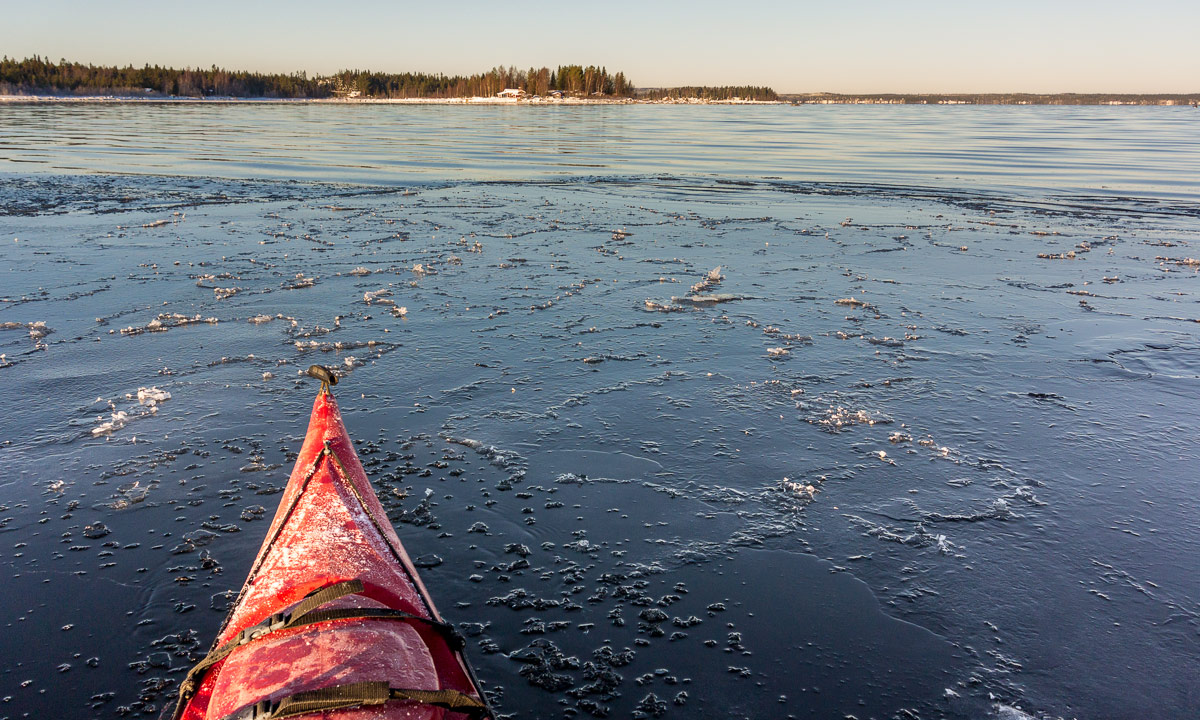
What a contrast to the first kayak tour six weeks ago: Last time dry suit, today t-shirt. Last time between ice floes, today birches with fresh leaves. Last time Baltic Sea, today the river Skellefteälven.

I put my kayak onto the new two-wheeled dolly (the old one broke down) and dragged it to the small bay Killingörviken, where I started my today’s tour. First I paddled along the harbour, then I turned right into the channel Kejsar Ludvigs Kanal. It always reminds me a bit of the “Ruhrgebiet” in Western Germany, where I lived for eleven years. After the last tunnel waited the Sörfjärden.

There I left harbour and industry behind and considered, where to go. The tour into the Nördfjärden wan, since it was windier than expected and I didn’t want to cross the Sörfjärden. So I paddeled upstream.

After a while the peninsula Örviken to my left ended. That’s where the Nördfjärden starts. I knew the first part and paddled to one of the rotten wooden piers. Luckily I realised that there were also under water parts – there were almost everywhere. I slowed down to avoid a collision with one of the big rusty underwater-nails. Finally I came to one of the four old platforms that probably formed an old pier, too – many, many years ago.

Now it was not far to the small island Gustavsgrönnan, where I made a short break. The whole shore is wet and covered with reeds, that lay flat on the ground.

I continued my tour by surrounding the island and paddled to the islands Stensgrönnan and Björnsholmen. To these islands you can drive by car and I was curious, if there would be a bridge or a tunnel to allow me continuing my trip.

First try Stensgrönnan: No chance! A solid dam connects the island to the main land.

Second try Björnsholmen: A small chance … . This island is connected to Stensgrönnan by bridge, but it looked really low. I didn’t believe I could manage to squeeze me underneath it until the end, but it worked. I had to bend my upper body onto the kayak and drag myself forward slowly by hand.

(Reminder to myself: This tour works only when water level is ±0. 20 cm more water and I wouldn’t fit under the bridge. 20 cm less and paddling could be hard due to the shallow water round the islands.)

Now I paddled downstream, which was not as much help as expected since the wind increased and came right from the front. But soon the bridge of the Sundgrundsleden was in view, the tiny cabins ashore and the dry dock with the read ship that I already saw on the way there.

I was a bit exhausted when I turned left to enter the bay Kurjoviken on the other side of Kallholmen. Now I was almost home, I just have to take the tiny tunnel “Lappstrupen” and I’m …

… well, that didn’t work. Due to roadworks this tunnel was completely blocked. Can I traverse the tunnel anyway? No. Do I want to walk and get the jetty? Neither. So I returned to the open water again and had another two kilometres against the wind until I entered the Kejsar Ludvigs Kanal again.

Now I headed back to my starting point. Another kilometer to go and I was onshore again. Phew – the last part was exhausting!

Today’s tour: Round 19 km total. (3.2 km extra because of the blocked tunnel Lappstrupen.)

Cold, clear and crisp

It’s mid-April and the civil twilight already starts round 4 o’clock. A quite stupid time to wake up, but it happened to me today. Normally I would roll over in my bed and continue sleeping, but the sky was so incredibly clear, that I just had to stand up and take the car to the coast.

As clear the sky was, as cold was the air: -8 °C. Time for gloves and down parka again. East from the peninsula Näsgrundet the Baltic Sea was still open – just as on Monday, when I opened the kayak season.

West from Näsgrundet however, the frost has frozen together the drifting ice floes and put a thin layer of fresh sea ice on the bay Kallholmsfjärden.

Now I have to get some more sleep, it’s still quite early.

Blue sky, blue sea – opening the kayak season

Finally the Baltic Sea round the peninsula Näsgrundet has been open and free of ice. Time to open the kayak season!

To Näsgrundet it’s just a 2.8 km walk from home. The kayak is tied onto a small two-wheeled dolly. I wear the same waistbelt, that I use for my pulka. Hereby I can walk and drag the kayak behind me without using my arms.

Soon I reached the peninsula and dragged the kayak onto the surrounding ice shield. After putting on my dry suit, lifejacket, neoprene boots, gloves and balaclava I was dressed for the first paddling. Perhaps I looked a bit overdressed, but despite of the springlike air temperatures it’s still winter paddling – the water is as cold as it can be.

I paddled along the ice shelf, that still connects the islands BredskärKlubben and Flottgrundet with the main land. The ice is soft and starts to get transparent, but it’s still quite thick.

Soon I reached Klubben and paddled along the icy coast.

From Klubben it’s just 200 metres to Flottgrundet and from that it’s only 500 or 600 meters to Gåsören

… at least, if you take the direct way. I preferred a detour to paddle between the ice floes. It’s a great experience. Some ice floes are quite big and welcome resting spots for ducks, geese and seagulls. Others are so tiny, that they are hardly visible, especially if they are completely transparent and clear. They sparkle and glitter like huge diamonds.

After some detours I headed to Gåsören, circuited it to look for a good anchorage and went on land (or better said, on ice) to make a small rest.

After I stilled my hunger and thirst I entered my kayak again and returned to the Näsgrundet, this time on the direct way, which is round about two kilometres. When I got out from my kayak and stepped onto the ice that surrounds the peninsula, I heard a noise: A snow mobile crossed the same ice shield I paddled along some hours ago – in same distance to the open water. Spring, meet winter!

After taking of the lifejacket and dry suit I went home, dragging the kayak behind again and enjoying the springlike temperatures. No warm jacket anymore, no woollen cap – no gloves and no warm boots. Round 40 °C warmer than 12 weeks ago – glorious!

Torneträsk and Port of Narvik

On thursday – three days ago – Annika and I drove to Abisko to enjoy some winter days in the Swedish mountains. Skelleftehamn is in Northern Sweden, Abisko is in Northern Sweden, but it’s still 570 km to go by car.

Yesterday I stood up quite early, because the sun was shining and I wanted to go onto the lake Torneträsk (one of Sweden’s biggest lakes – 70 km long) to make some photos. The whole lake is covered by a thick layer of ice and a thin layer of snow.

In the front you can see stacked up ice that builds along the fissures in the sheet of ice, in the background you can see Lapporten – the landmark of the region.

After a while fog came down and when you looked against the sun you only could see vague shades and pale colours. It looked more like standing in a sandy desert, not on the icy surface of the Torneträsk.

Some hours later: Annika and I had planned to do a ski tour near the Swedish-Norwegian border. We packed the car with our skis, cameras and hot tea and set off. It’s 38 km to the border. Behind that border – on the Norwegian side – there’re a lot of cottages and since it’s Easter and probably every single Norwegian is in his cottage there were a lot of parked cars, too.

We looked for a parking place as well. The most parking places were stuffed with cars and were furthermore only for private use. I continued driving and we looked for a public parking place. Well, we found one but the surrounded mountains were too steep for skiing. We stopped anyway to check our position on the map. After that we helped some Norwegians to dig out their car that was completely stuck in the packed snow – on the very same parking place! There’s a reason, that most of the locals have all-terrain vehicles or at least cars with all-wheel drive.

My Saab doesn’t have such and from now on I was even more cautious in choosing a potential place to park. To make a long story short: We didn’t found a single parking place that was (a) available, (b) public, and (c) not too snowy. That’s why we changed plans and continued to Narvik, which is 46 km behind the border.

There’re (at least) three signs for leaving the mountain plateau and approaching Narvik:

  • The road is narrower
  • The road has much more curves and bends
  • It gets much warmer. (down to -9 °C in Sweden, +5 °C near Narvik)

Soon we saw the first fjord, the Rombaken:

We continued to Narvik that seemed to be completely closed due to the Easter Saturday. Therefore we headed to the Port of Narvik and looked around there. Most ports I know are locked and fenced off. Not in Narvik. Here it’s possible to walk around, enter the piers and have a closer look to the ships. And we were completely alone.

Narvik is a huge contrast compared to Abisko! Even if I prefer landscape and nature to towns, I like this place.

But anyway we drove back to the wintry mountains of Swedish Lapland quite soon and round an hour later we arrived again at our fine and cozy room at Abisko Cabin.

Wintry Scandinavia in a nutshell (without the skiing).

Kungsleden ski tour: From Nikkaluokta to Singi

This article is part of the series “2016-02: Ski tour on the Kungsleden”.

It was 2005 when I was asked by C. from Switzerland, if I wanted to join him on a ski tour on the Kungsleden – the King’s trail. That’s how I came to my first ski tour in the mountains of Swedish Lapland. More tours followed, but sometimes it was hard to find a tour mate. Same thing this year; that’s why I decided to do my first ski tour on my own.

Kungsleden would be ideal for that, since there’s infrastructure as mountain huts and I won’t be alone. Good to know, since even twisting an ankle could be a serious problem in winter if no one’s around. I wanted to start 19 February, the day, when the huts open.

After a long trip I reached Nikkaluokta (many thanks to A. for the lift from Kiruna!) on the evening of the 17th I had one spare day in one of the cosy cabins of family Sarri. This place can be very cold and I had a look at the digital thermometer in the cabin: -44.8 °C minimum since the last reset – brr, that had been a cold day!

I climbed the small church hill and looked west. That’s were I’ll go the next day.

From Nikkaluokta to Kebnekaise Fjällstation

19 February · 19 km · Link to map

Time: 7:40, temperature -17 °C, weather: cloudy. Time to start the tour. I mount my skis, put the belt of the pulka (a sled for transportation) round my hips and after some gliding steps I see the first mark of the winter way to Kebnekaise.

It’s the only mark for a long time, the winter way to the Kebnekaise Fjällstation is not marked, neither on the map nor in real. But it’s easy to find the way, since many snowmobiles take this way and you only have to follow their tracks. Soon I’m at the place where the trail crosses the stream Čievrragorsa. In summer I used the chain bridge, In winter the snowmobile goes right over the frozen and snow covered stream. I can hear the sound of water running underneath the ice – a strange feeling.

After some kilometers I come to the lake Láddjujávri. Here you can eat waffles with cloudberries or burgers at “Lap Dånalds” and even take the boat over the lake to shorten your trip a bit. Well – in summer …

Hardly imaginable that I took a bath here six month ago on a hot summer day, when I was here with Annika. Not it’s winter, all is closed down, the boats lie on land and are covered with snow and I’m completely alone. Anyway it’s not too cold and I take a first rest on my tour. Without waffles, without a refreshing bath, but with the same beautiful view as in summer, since the sky starts to clear up and one mountain top after the other starts to get free from clouds, fogs and haze.

When I continue my tour over the ice of the frozen lake I soon can see the same mountain range as I did in summer. And it’s as beautiful as in summer, too.

After some kilometres the trail leaves the lake and continues through scattered birch forests and over frozen swamps, some of them covered with ice. The weather is fine and sky is of a clear blue with some clouds.

Another rest, this time on top of a rock, with hot tea, chocolate, and a bit of salami. What a beautiful day! I could sit here for hours, but I shouldn’t. I have to reach the huts of the Kebnekaise Fjällstation. I do reach them, but before that I have to work. The trail ascends and I have to make wide V-steps with my skis to be able to pull the pulka uphills. Finally I arrive. This mountain resort is quite huge, since Kebnekaise is the highest mountain in Sweden and very popular among hikers, skiers, and climbers. Anyway it is not opened yet beside of the cabin Jägarn (“the hunter”). Here I’ll stay overnight before I’ll continue to the Singistugorna the next day. Twice I climb on the small hill with the radio mast, first after sundown, then at half past six – where I see the first polar light of the tour.

From Kebnekaise Fjällstation to the Singistugorna

20 February · 14 km · Link to map

When I wake up sky is blue again and -17 °C. I take a short breakfast with muesli and prepare for leaving. That means: packing all things – doing the dishes – cleaning the kitchen and my bed room – checking that I have everything with me – putting on skis and pulka belt. Meanwhile the sky is overcast and it has started snowing. Weather can change quickly in the mountains.

After I have walked some kilometres it clears up a bit, just so much, that you can see some mountain tops shining through the hazy fog.

When I enter the narrow passage of the valley the mountain tops hide again, which is a pity. The mountains here are so beautiful.

There is not much snow in the mountains this winter. Parts of the marked winter way lead over stony passages with no snow at all. I have to go round these passages to avoid ruining my skis and pulka. Mostly I follow the snowmobile tracks, hoping that the locals know the best way.

This way leads over the frozen river, but sometimes it’s hard to see, since the snow under the overcast whitish-grey sky don’t show any contours. Wind increases, snow falls as well and the snow starts to drift in the increasing wind. In the narrow valley between the mountains Siŋŋičohhka and Liddubákti more snow lies on the ground which makes it easier to ski but worse to see.

That’s when you are really glad about the winter way marks: Red crosses set on long poles. Sadly plastic crosses are used nowadays. They are ugly, in my opinion harder to see and many of them are broken. But I’m glad to have them anyway. They do not only show you the way, they help you even in guessing whether it’s going up or down, which you cannot see, if visibility and sight are poor.

I always have compass and a good map with me on such tours. Anyway, if you cannot see any landmark these tools are of limited help if you do not count steps or know how fast you are on your skis. That’s when a GPS can be very handy. When I make another rest, longing for the mountain huts Singistugorna, the GPS revealed, that it’s only 970 meter to go. Easy!

Well, not really. The valley opens, wind increases and there are many rocks and snow-free parts on my way. I decide to circumnavigate a steeper passage and ski a bit to the right. To my big amazement I don’t go down but keep on level. Suddenly I feel part of the ground collapsing a bit and realise that I stand on the rim of a soft snow drift, about two meter high. It was absolutely impossible to see it. I’m lucky, that I didn’t fell down! I go back and circumnavigate my circumnavigation until I’m on the marked trail again. There I can see the cabins shining through the drifting and blowing snow. It takes some time to find a good way down to Singi but finally I arrive. Here the wind seems to be even stronger and the snow falls even more intense.

Stugvärd J. shows me my room, light fires in the ovens of the kitchen and my bed room and allows me to take my pulka inside since I’m the only guest. After doing some work he leaves and heads to his own cabin against hard wind and snow.

According to the forecast wind will increase even more and snow fall round 20 cm are expected. I’m glad, that I have time and plan to stay at least one other day in the Singistugorna, perhaps two.

The next article: Singi – from blizzard to clear sky >>