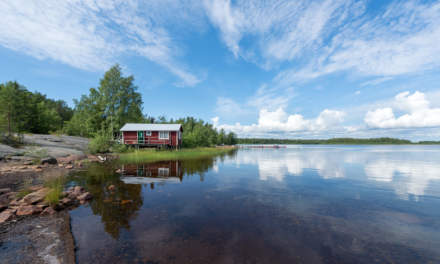
Another ship, this time the Crystal Skye in Skelleftehamn. A good opportunity to test my new wide-angle lens.
Crystal Skye
Icicle tree – a short trip to Holmsund
When I took the car to Umeå three days before, temperatures where between -20 °C and -31 °C. Today it was much warmer in Umeå, just round -4 °C.
Annika and I took the car to Holmsund, a place 20 km south from Umeå. This coastal locality has round about 5500 inhabitants and is special, because here starts the only ferry connection from Sweden to Finland beside those from Stockholm. When we arrived, the ferry from Vaasa in Finland just had anchored.
Neither of us has been in Vaasa before, so we thought about making a trip to Finland, perhaps already in two weeks, if the weather isn’t too bad.
Right beneath the ferry dock there’s a pair of piers reaching 700 meters into the sea. If you look east, you see that the Baltic Sea is ice covered beside of the waterway. But in contrast to the Baltic Sea outside of Skelleftehamn, which is thick, solid ice, you can see the big ice floes lift and lower with the underlying waves. If you look west, you see the mouth of the river Umeälven, where the water is mostly open and small ice floes float and drift southwards.
I don’t know, when it has been so windy, that the waves rolled over these piers, but you could still see the result: Many of the dried up flower stalks and the lower branches of bushes and trees were covered with a thick layer of ice. It must be both impressive and frightened to witness such a stormy weather in winter.
The last kayak tour?
The evening I came home from my trip to Pajala I didn’t drive home directly but made a small detour to the pilot station. As expected the ice floes that I saw two days before already froze together and built a solid layer of ice. I took my flashlight and checked a more exposed place. To my surprise I could see open water and tiny waves rolling ashore. The whole water surface was steaming of sea smoke. I was quite keen to make a last kayak tour before even this part of the sea freezes over.
The next day: I was really tired and scrapped the plan of an early morning kayak tour. But at least I wanted to have a look. I took the car to the same place, got out, went to the shore and looked amazed and flabbergasted. Where was the water? That’s what it looked like:
The whole sea was ice covered. Not only near the shore but almost the whole way to the island Gåsören! Did I dream the evening before or is it possible, that such a large area freezes over in a single night? It was still -26 °C so who knows?
I told my story to the sjöfartsverket on Facebook and asked, if such could happen. They answered that it’s possible that larger areas freeze over in a single night. I guess it will take some time until I’ll canoe again on the Baltic Sea.
Spying the land
Tomorrow I thought about paddling through the freshly snowy winter landscape. Is it realistic? Let’s check:
A: the snow warning
smhi (Swedish Meteorological and Hydrological Institute) released a class 1 warning for tonight: 10 – 15 cm snow should fall at the coastal areas of Västerbotten. But actually it’s too warm, most of the precipitation has come as sleet and rain. Probably we will have a centimeter of wet snow tomorrow, not much more.
B: the sea ice cover
smhi has another warning, this time for the sea: “higher than 80 cm above mean sea level.” – I took the car to Storgrundet and smhi was right: Parts of the beach are submarine now. But unfortunately the high water didn’t break the sea ice. The ice near the shore is quite soft, I could paddle through. But the rest? Will I manage to break through or do I have to give up?
C: the forecast
At 7:00 it will be clear sky and -6 °C. Nice weather, but at this time it’ll be pitch dark; sun rise is round 9:15. According to the forecast it will be cloudy at 9:00 and start to rain at 13:00. Not enough with that, smhi had another warning for tomorrow: wind will be round 30 knots, that’s round 60 km/h – too much for my kayaking abilities.
Let’s summarise: Hardly any snow, the ice maybe to thick to break, windy + cloudy + some rain later on. I guess, my kayak will stay in the garage tomorrow.
Freezing over – day two
Another chilly morning, with -7 °C it was the coldest in Skelleftehamn this season. Again I woke up quite early and took a tour to Storgrundet. There lay more ice on the sea than yesterday and you could see that it was partly ice floes that froze together the night before. However, the beautiful ice rim that I photographed yesterday was gone.
I made a short stop at the lake Snesviken, that is round about one kilometer long. Since we had only two frosty nights after a longer warm period with day temperatures above 10 °C, I was sure that the lake was completely open with perhaps a bit of ice at the shore.
I couldn’t believe my eyes when I realised that almost the whole lake was covered with ice – after only two frosty nights. Incredible how fast it goes!
This evening I had a meeting in Ursviken at the Kanotudden – the canoe bay, where the canoe club has its location. This bay is part of the Skellefte River and it starts to freeze over, too. I really like the clubhouse. It’s a pity that it’s hardly used in winter time – it would be the perfect location for a public winter bath site!
Continuing to the Vesterålen
This article is part of the series “2015-07: Lofoten and Vesterålen”.
Our third day started with a lot of rain. We put the wet tent into the car and continued our tour to Kabelvåg where we visited a friend of mine. We took a small mountain hike but it was cloudy and wet. Only far away in the east you could see some sunny patches on the top of the snowy mountains.
After the hike Delle and I looked for a camp ground. But first I had to take a picture of the beautiful rainbow near Sildpollen.
This time we tented on a bigger campsite in Sandsletta. When I woke up quite early the next day I could see another rainbow over the Vatnfjorden, but later it started to rain and pour down again. And again we put the soaked tent into the car. We continued on the road 888 to Fiskebøl. The clouds were hanging low and you could hardly see any mountain, just some white and light grey schemes.
Soon we arrived in Fiskebøl where we waited for the ferry. Again we were lucky – we waited hardly half an hour until we entered the ferry for the short crossing to Melbu, the southernmost city of the Vesterålen. We visited friends of mine, this time in Haukenes were we tented near the friend’s house. The cocks tried to wake me up ridiculously early, but in vain. I continued sleeping until 8 o’clock.
Alas it was the first morning without rain (and the only one, too) and we could dry the tent. After a long and lazy breakfast with my friends we said farewell and continued our car trip. We got a tip to visit Stø at the northern end of the Vesterålen island Langøya. What a good tip and what a beautiful landscape – especially after the weather was nice and sunny. We made a short photo stop between Strengelvåg and Klo before we continued to Stø.
In Stø we parked our car and took a short hike over the mountains to a beautiful white sanded beach were we made a rest and I took a short bath. There’s a 15 km hiking trail as well; next time I’ll definitely will go it.
After our rest we slowly walked back and continued by car. First we had to head south to Sortland were we crossed the Sortlandsundet and headed north on the other side. The sky became more and more cloudy and we looked for a nice campground. Finally we found one in Bleik, quite near Andenes, a town at the northern end of the Vesterålen. We put up the tent and – guess what – it started to rain.
It had been raining the whole night and it continued raining. Again a soaking wet bunch of a tent lay in the back of the car. After a while of driving through the greyness we decided to head back to Skelleftehamn. It’s more than 900 kilometres and it took the whole day. Rain became less near Abisko and after we passed Jokkmokk the sky cleared up and we could see the full moon slowly rising. The next photo, which is the last of our car trip through the Lofoten and Vesterålen is taken near Storforsen, one of Europe’s biggest rapids. At 23:50 we were in Skelleftehamn again – and I was home.
- 2296 kilometres in six days
- a lot of clouds and rain, but two nice and sunny days, too
- one night in the car, four in the tent (three of them on campgrounds)
- two bathes and at least four rainbows
- – a nice trip!
On the way to Å
This article is part of the series “2015-07: Lofoten and Vesterålen”.
Day one
Å is not only the last letter of the Norwegian alphabet, it’s the name of some places, too. The probably most known is Å i Lofoten, the southmost village of the Lofoten islands.
Delle, a German friend of mine and I started the tour last Saturday. The only plan was to take the car, drive to Bodø and take a ferry to the Lofoten islands, the same day or the other day.
The weather in Skelleftehamn was fine but in Arjeplog, where we made a lunch break it started to rain. We continued our trip to Bodø over the mountains. They were wrapped in clouds and were still partly covered with snow.
17:30 we arrived in Bodø, just in time to get the ferry to Moskenes on the Lofoten. Normally I love to be outside all the time when I’m on a ship but this time the sky was so grey that you hardly could see anything. The Lofoten with its more than 1200 meter high mountains came in sight just some minutes before we arrived.
We left the ferry with Delle’s car and drove the 5 km to Å, where it rained so much, that we decided not to put up our tent but to sleep in the car. I put on my rain cloth and made a short evening walk but soon returned to the car. The only pictures I made that evening were the fish heads on the wooden racks drying in the salty wind.
Umiak I
It started like many kayak trips: I put out to sea at the tiny beach Storgrundet without any plans at all. Unlike yesterdays weather forecast it was a nice and sunny day, although not very warm. Since the sea was calm I paddeled along the seaward sides of the islands Storgrundet and Brottören, crossed the Bredskärsviken to the islands Norrskär and Bredskär, continued at the east side of Flottgrundet and headed to Gåsören, probably my favourite island nearby. Some photos:
But much more fascinating than nature, birds and islands was the moment when I looked at the horizon and saw the faint but large silhouette of a big ship. The blurred outline looked more like a fata morgana than a real object. But I wasn’t the only one watching the ship. Two tugboats came from the port to bring the ship into port.
T., whom I met on the Island Gåsören knew the ship. It’s Umiak I, an ice breaker, that can break 1.5 meter ice and still going 6 knots (ca. 11 km/h). Impressing! I do like summer, but I really adore winter and started dreaming of travelling with the Umiak I in winter and cutting through solid ice.
Later today I made a better image of the ship in port.
It’s at least so famous, that it has its own Wikipedia page! I looked at Shorelink as well, to get some more information:
- Cargo: 9257 tons copper concentrate
- Coming from: Edwards Cove via Brunsbuttel
Of course I had to look up Edwards Cove, too. Never heard the name before. If the internet is right, Edwards Cove is a harbour west-northwest from Nain in Labrador, Arctic Canada. If the ship would go back the same way, I guess I would ask for a lift.
Links:
Paddling round Storgrundet
Two weeks ago the sea between the island Storgrundet and the mainland was still partly ice covered. Today I paddled round Storgrundet and couldn’t discover any ice left. The view of the blue sea almost looked like spring, but it didn’t felt like spring at all, it was very windy and chilly. When I left the protected bay I tried to make some photos but soon gave up since I was blown back ashore faster than I could take my camera out of its pocket. I only made a selfie on which it’s quite visible that – measured by temperature – spring hasn’t come far yet.
At the outside of the island I didn’t had a chance to release the paddle for a photo, too high were the waves. I regretted soon that I paddled without spray deck, because some of the bigger waves made it into my kayak. The next photo I made in a sheltered bay, where the water finally was calm enough and I could empty my kayak with a sponge (it wasn’t so much water, that came in).
Some hours later …
I had a look at “kanotudden” (literally: the canoe bay), a bay of the river Skellefteälven, where the ice is finally gone, too. Almost. There is some leftover ice, mostly crushed to small bits that were jingling and clanging with each arriving wave. But even the small bits were still solid enough to bear a wandering wagtail looking for food.
The canoe club, which is located at kanotudden still seems to be in hibernation, I’ll have to check later …