Eight times Ytre Kiberg and around

This article is part of the series “2018-03: Varanger peninsula”.

Day 31 and 32 of my winter journey 2018

1. Yesterday, Ytre Kiberg – the morning

Two days ago two other guests arrived at Cape East Arctic Adventure, our cozy stay in Ytre Kiberg. They came from Utrecht in the Netherlands and were on a three week car trip from Utrecht to the North Cape and back – 8500 kilometres in total!

Trond, our fantastic host made a special breakfast for them: King crabs, locally caught in the Barents Sea. Annika and I got our share, too. King crabs are probably my favourite seafood but it was the first time I got such for breakfast.

After breakfast Trond had some work to do: clearing the snow with his rotary snow plough. Last days had been very windy with some short but intense snow showers. The snowploughs had to work a lot to keep the roads clear of snow and Trond had to clear the snow on his property several times a day. This morning the snow drifts were especially high and Trond had to work hard to get through with his snowblower.

2. Yesterday, Vardø – a private guide tour by Trond

After the driveway was cleared, Trond invited the Dutch guests and us to a short private guided tour in Vardø. We entered his all-wheel drive car and he drove us the short way to Vardø – a town with 2100 inhabitants located on an island – where he showed us some of his favourite places. There is a lot of street art in Vardø and next time I have to take a closer look to all the graffiti and more conceptual artworks. But you cannot do all in a single journey.

There’s a mountain pass between Vardø and Ytre Kiberg called Domen. It’s quite exposed to the elements and when we crossed it waves of driving slow covered the road.

3. Yesterday, Skallelv – a short visit

Soon after we arrived in Kiberg, the Dutch guests left and Annika and I made a car ride to Skallelv, 30 km south of Ytre Kiberg. The weather was really nice: sunny and hardly any wind. We went round a bit and I made some photos. I had however problems with some lenses, they got moisture inside that tends to freeze when being outside. Hopefully they will dry within the next days.

4. Yesterday, Vardø – the Vardøhus Fortress

After a rest we took a tour to Vardø again, this time we wanted to focus on two local attractions: The fortress and the witch memorial.

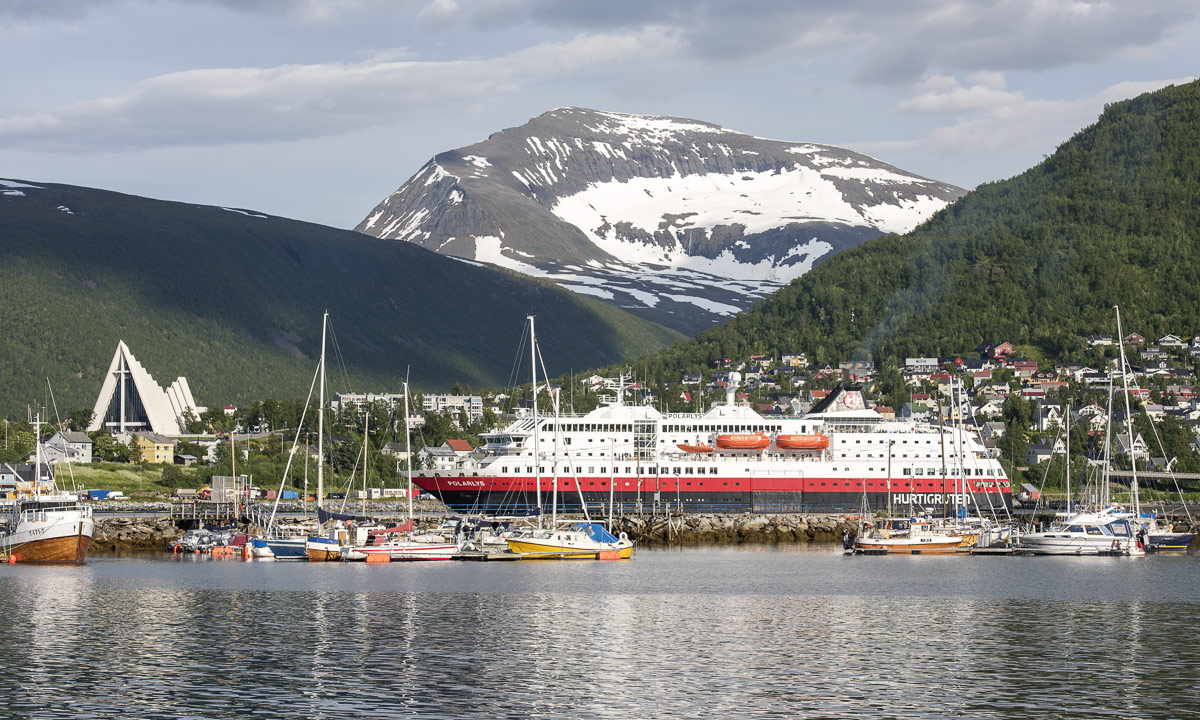
The Vardøhus Fortress (Vardøhus festning) was built round 1300 and is the northernmost fortress of the world. Beside of being a museum it is used today as a school for the Norwegian marine. Shortly after we arrived there, the Trollfjord, a Hurtigruten ship landed in Vardø and shortly after many tourist rushed through the fortress. In contrary to us they only had litte time.

5. Yesterday, Vardø – Steilneset Memorial

After visiting the fortress we went on to visit the witch memorial. It’s not easy to reach. First of all you have to know that it is called Steilneset Memorial (or find it visually), then you have to plunge through deep snow, because there are no cleared ways to the memorial.

In 1621 91 people, mostly women and Sami people had been executed for witchcraft. This memorial, created in 2011, shows the history of all 91 people and lists the confessions made. It is a shocking and touching place about the cruelty of mankind and worth to visit, if you are in Vardø and have the time.

After this long and eventful day we were quite exhausted and decided to take it a bit more easy the next day.

6. Today, Ytre Kiberg – a promenade in Ytre Kiberg

Today morning it was quite warm (-4 °C) and almost windless. 10 cm of new snow had been fallen over night. After breakfast we took a medium short promenade along the beach and into the village and back. The weather was changeable as it uses to be here. It could change from sun to snow within less than a minute.

Snow fall intensified and it became a bit windier, too.

7. Today, Ytre Kiberg – a private tour though the partisan museum

At 15:30 we had an appointment: we were invited to visit the Partisanmuseet – the partisan museum in Ytre Kiberg. We would get a personal guided tour from Steinar Borch Jensen – expert for the history of Kiberg and around – who would open the museum for us.

Trond took a huge spade, we entered the car, drove the short way to the museum, plunged through the snow to the entrance, where Steinar already had started to clear the outer stairs. Trond joined him shovelling.

The museum is not the biggest and the showpieces maybe not the most special, it’s the stories behind the showpieces that matter. Steinar had a lot to tell about the partisans in Northern Norway that fought on the Soviets side against the National Socialists in World War II. Beside of Steinar’s huge knowledge about that time there was another facet, that made our visit in the museum very special. Both Trond and Steinar have personal relations to the partisans. They know their relatives and they know the places where they lived. For many Norwegians the history of WWII is not just an academic interest but personal history. Soon the last witnesses of the past will be gone.

I felt very touched by the visit and was glad that we got the opportunity to get involved into the local history, but it made me thoughtful, too and reinforced my personal pacifistic worldview.

8 .Today, Ytre Kiberg – the first Varanger polar lights

Actually I planned only seven stories in this long blog article, but well …

I was out after a great two course dinner: reindeer (provided by Trond), pancakes (provided by Annika) and me doing the dishes. I wanted to make a photo of Cape East Arctic Adventure, Trond’s house, where Annika and I had such a good time. Then I spotted faint polar lights. I wore only a t-shirt and got in to fetch my Canada Goose parka. I was outside quite a while since the polar lights gradually became stronger. They constantly changed place making it hard to take any good pictures. It was -10 °C, quite windy and more and more I closed the zipper of the parka to prevent freezing. After a while the aurora weakened and I went in to look at the photos. I’m not content with the image above, but it’s a nice remembrance of our fantastic stay at Cape East Arctic Adventure in Ytre Kiberg.

Tomorrow we will leave and stay in Ekkerøy for some days.

Tusen takk, Trond, for your kindness and your great hospitality!

A trip to Murmansk – day one

This article is part of the series “2018-02: A trip to Murmansk”.

Day 22 of my winter journey 2018

tl;dr Alyosha monument · old concrete buildings · Church of the Savior on Waters · view over Murmansk · restaurant Tundra · nocturnal Murmansk

Alyosha (Алёша)When we arrived in Murmansk the day before it was already dark and we were tired. Today after breakfast we were eager to explore. We ordered a taxi to our first tourist attraction: The Alyosha Monument.

“Defenders of the Soviet Arctic during the Great Patriotic War” (Защитникам Советского Заполярья в годы Великой Отечественной войны), commonly called Alyosha (Алёша) is a monument to Soviet soldiers, sailors, and airmen of WW2.

It was build in 1974 and it’s the second-tallest statue in Russia. The 70th aesthetics and the communistic concrete appeal didn’t help to make me like this statue, but I always have difficulties with war memorials. I’m a pacifist.

I enjoyed however the view over Murmansk. It was visible, that it’s a large town (it has 300,000 inhabitants) with a large port and many concrete high-rise buildings.

After we visited Alyosha we started to walk back into the center of Murmansk, where our hotel Azimut was located. We turned right into the street Ulitsa Aleksandrova. To the left there were old concrete buildings. They were extremely rundown and I was shocked to see these building and imagine people living here. Maybe the inside would look nicer, but the outside was horrifying.

In many directions you could see these high-rise estates with rectangular concrete buildings. But we could see something else: a Ferris wheel. We went on and came to a permanent amusement park, located beside the lake Semyonovskoye (Семеновское озеро). Of course the lake is covered with ice and snow in wintertime and some locals used the ski tracks going round the lake.

From that place the next destination was quite near: the Church of the Savior on Waters (Спас на Водах), a small Russian orthodox church, built 2002.

When we came to the church I could see some people leaving, going backwards and making the sign of the cross again and again. It is allowed to enter the small church but not to take pictures. I’ve never been in an orthodox church before and I was stunned. The walls were covered with icons of saints and incense was burned. Some elderly women were lighting candles and immersed into deep prayers and almost seeking physical contact to the icons and other objects. I felt deeply touched by this lived religiosity although I’m not religious by myself. On a table some food was placed. Bread and fruit, among others a bag with three lemons. Sacrifices or donations to the priests?

I have to admit that I felt like an intruder and completely at the wrong place. I have to read more about this religion and a bit about how to behave.

We continued our promenade back and passed the Memorial Complex to the Soldiers and Seamen Who Died in Peaceful Time.

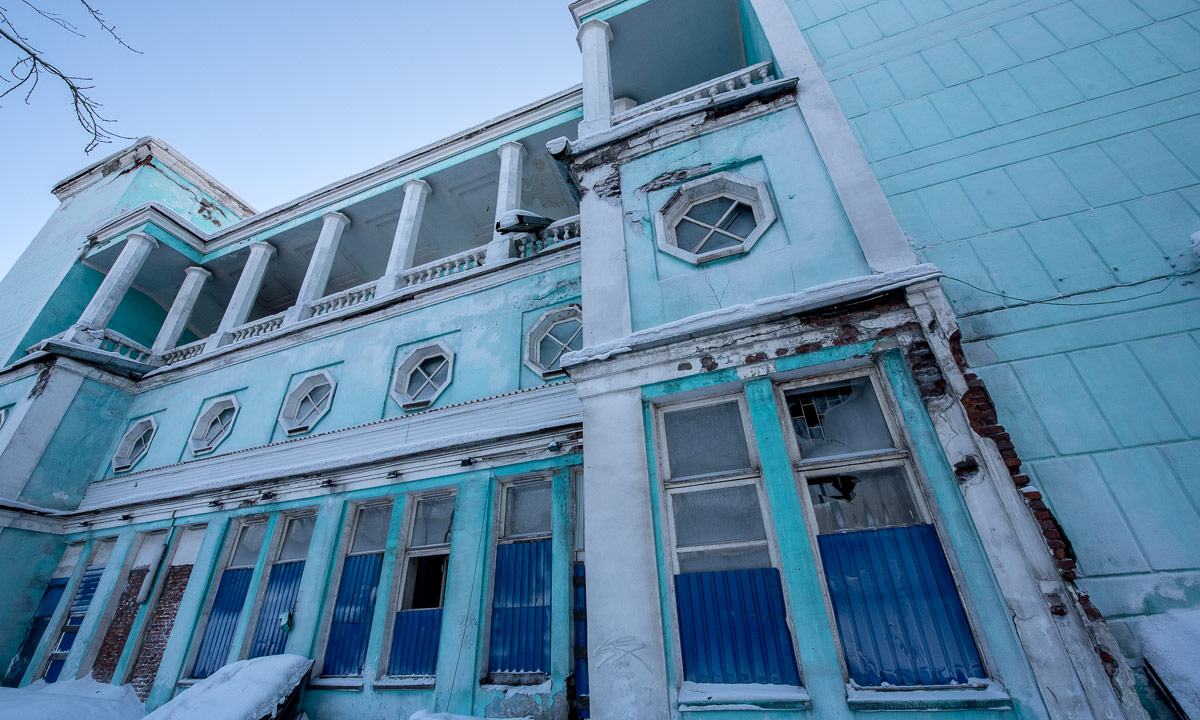
We left the memorial behind and entered the streets of the center. We walked back to our hotel and took a short rest. We passed an old theatre, painted in bright indigo but more a ruin than a building. A pity, I think it must have been beautiful in former times.

Then the hotel. I had twisted my ankle one week ago and was glad to rest the foot a bit. Time for shooting some photos from the 16th floor.

Some hours later. We decided to eat dinner and Annika and I found the restaurant Tundra (Тундра) that got excellent reviews in the internet. And excellent it was. The restaurant was fully booked but we were allowed to sit in the bar. In Russia the food is quite cheap compared to Scandinavia even in really good restaurants. The dishes are not as huge as in many places in Europe. I like that because it gave me the opportunity to taste different things: borscht and caviar with seaweed. Both very tasty!

After a nice evening at this great location with fantastic food we went back to the hotel. Murmansk is definitely not the most beautiful town in daylight but it wins a lot when it gets dark because many places, streets, parks and buildings are illuminated with lights of all colours.

We have seen a lot that day, both the beautiful and less beautiful facets of this arctic Russian town and I was as exhausted as I use to be when strolling through a big town for a whole day.

We were glad however to have another day to explore a bit more.

Some other random pictures of the day:

Crossing three borders

Day 19 of my winter journey 2018

Whilst I still haven’t finished the blog articles about my ski tour with Jonas, life (and holidays) went on. Jonas and I had arrived at Solberget on Thursday evening and Jonas went home yesterday (on Sunday). This morning I packed the last things, stuffed them into the car and went to Nattavaara Station, where Annika arrived with the 7:38 train. With this reunion another stage of my six and a half week winter journey had begun. Destination: Kirkenes and Varanger, the easternmost parts of Norway.

Today we started with a travel day by car. We travelled 600 kilometres and crossed three borders.

Stage one: (Solberget) – Nattavaara – Gällivare – Svappavaara – Vittangi – Övre Soppero – Karesuando.
And the first border: Sweden – Finland.

Stage two: Karesvanto (Finland) – Palojoensuu (Finland) – road 93 …
Second border: Finland – Norway.

Stage 3: … road 93 – Kautokeino (Norway) – Karasjok (Norway) – Karigasniemi (Finland).
The third border Norway – Finland. And since it was dark and I was tired we directly continued to our destination for an overnight stay: Giellajohka (Finland).

The temperatures had been between -20 °C and -28 °C for the last hours and the weather was bright and clear. The new fingernail moon shone above the eastern horizon and the first stars came out. Good conditions for polar lights. And we had polar lights actually here in Giellajohka but unfortunately a thin layer of clouds approached and therefore the aurora was less impressive. A photo anyway:

Tomorrow we will continue to Kirkenes to visit friends. It’s a smaller distance to travel than today, just 209 kilometres.

Impressions of the Jokkmokk Winter Market

Day 1 and 2 of the winter journey 2018

The first time I’ve been on the Jokkmokksmarknad – the Jokkmokk Winter Market – was 2005. As many other tourists I strolled over the market looking at the many products, everything between fox furs, Sami handicraft and plastic tools for the everyday life.

Since then I’ve been on the market several times, last time in 2015. And I still enjoy the market. Some random impressions:

But my focus has started to change. More and more I want to talk to all the people on the market. With the old guy from Finland trading with fur products, with the American artist building objects from weaving looms, with the Sami women selling grammar books about “lulesamiska”, with the people selling double-walled sauna tents. So many interesting people, all with their own story.

Another way of storytelling I witnessed at 4 o’clock. Sofia Jannok, a famous Sami singer and songwriter presented her current program, which is very political from a Sami perspective. As a musician however I had a strong focus on the music, which I enjoyed very much even though it wasn’t the music I use to listen to. I asked Sofia after the concert if I may publish a photo and I may:

I could tell more but the laptop battery is almost empty and dinner is served in 15 minutes. Two strong arguments for closing the article. We’ll hear soon …


Jokkmokk Church

Day 1 of the winter journey 2018

This is the (new) Jokkmokk church. It is a wooden church but it looks more like it was made of ice, or meringue, especially on a winter afternoon, when it’s already dark and the church is illuminated.

Winter is just some miles away …

Let’s face it: The weather in Skellefteå and Umeå has been nasty the last days – temperatures above zero and a lot of rain making the minor roads icy and incredibly slippery. Most of the snow of the days before has been thawing away. So just now there’s much more winter in Germany towns than here beside the coast of the Baltic Sea.

The good thing: winter is not far away. I was in Umeå today and Annika and I drove westwards to catch a glimpse of winter. First it continued raining a good while, the road was dark and wet and the snow was slushy and ugly. But suddenly – just within a few kilometres the weather changed and rain turned into snow. Snow fall increased and anything was snow covered and white: the roads, the trees, the traffic signs, the bogs and the parking place where we stopped to visit the Hägring (english: mirage).

Hägring is an artwork between Bjurholm and Vännäs. It is a church-shaped object built of mirror fragments and stands in the midst of a bog. We’ve been there in May and knew that the bog is wet but safe to walk on. It was funny anyway to walk through knee-deep snow and feeling the bog bouncing underneath our feet with each step.

We continued westwards, Annika was driving and I was navigating and taking some pictures through the windscreen. Right after Bjurholm we took a minor road to Örträsk, a village by the lake Örträsksjön. Everything was snow covered. We stopped at the small grocery to buy something to drink but it was closed due to the “snow storm”. Well, we knew of the level one weather warning but it didn’t seem so severe.

Since days in December are short (and we didn’t find a place to eat in Örträsk) we decided to return to Umeå but on another route taking some minor roads eastwards. Snow fall intensified but still only some centimetres covered the roads.

While we followed the small ways the snow on the road got deeper and deeper until Annika’s Golf ploughed through 10 cm of snow. Where there was a house, people were outside to clear the snow with any available tool – from shovels to quite huge shovel loaders. But we didn’t get stuck.

Finally we reached the European route E12 which runs between Mo I Rana (Norway) and Helsinki (Finland). Even this road was covered with snow but much better to drive than the smaller forest roads before. 66 km to Umeå and it was snowing almost the whole way back. The last part however we came into the more maritim and warmer climate of Greater Umeå area and snow turned back into rain. We however got our winter impressions. Within just in half a day! One of the big advantages of living here!

On a final note, a “making-of” photo of Annika: Me walking to the Hägring:


Travelling to Tromsø

This article is part of the series “2017-07: Tromsø”.

Sometimes I’m just too lazy to blog and so was I the last weeks. Today however I finally want to write about a great trip to Tromsø, that Annika and I started on 7 July, almost three weeks ago.

Tromsø is in located in the North. Very far north. It lies 344 km north of the polar circle and is the northernmost town of the world with more than 50,000 inhabitants. It has the northernmost university, both the northernmost cathedral and mosque, the northernmost brewery and probably some more northernmost things of the world.

The shortest route by car from Skelleftehamn to Tromsø leads over Luleå, Pajala, Kilpisjärvi (Finland) and Nordkjosbotn (Norway) and that’s the route Annika and I took.  We had a lot of time and planned to stay overnight twice, but didn’t plan where.

The first part of the route, the E4 leading north, is kind of boring. At least you’re allowed to drive 110 km/h – the maximum allowed speed of the whole journey. In Töre we left the E4, took a break and ate in the Restaurang Roady – the first KRAV-certified sidewalk restaurant.

After lunch we continued northwards. After 50 km we reached Holgers Traktor Museum in Svartbyn, which is always worth a visit. Since it was late – we started our trip in the afternoon – we just made a short stop to take a picture and then continued our trip.

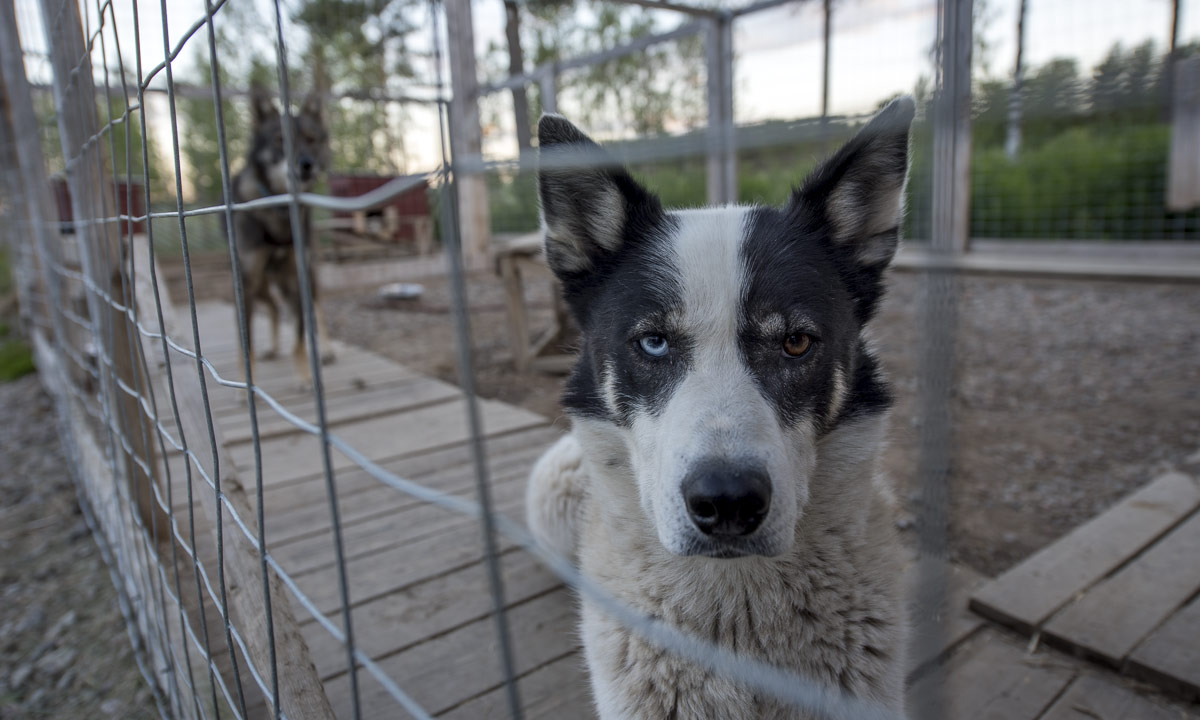
Where to stay? Perhaps we could stay with Katharina whom I met last winter. She lives in Miekojärvi between Överkalix and Övertorneå. We tried to ring her, but she didn’t answer the call. Anyway it’s just a detour of 30 kilometres so we just gave it a try. Katharina has round 20 huskies and someone has to feed them. When we arrived at her house, a man left the shed, looked at us and we were quite surprised to meet Sascha whom we met before in Solberget several times. What a lucky coincidence! So we found not only our first overnight stay but great company, too! Thank you, Katharina (abroad) and Sascha for your hospitality!

The next day we continued our tour after a nice and rich breakfast. We crossed the arctic circle and watched the reindeers.

First stop: Pajala, where a big market took place. Here you could buy a lot of things between tradition and modern age.

After two hours we left the hurly-burly and entered the car again. We crossed the Swedish–Finnish border and followed the E8 which was more construction site than main road. We passed Karesuvanto, where I was sure to meet a food store. All stores however are on the Swedish side, in Karesuando. Not a problem, if you have bread with you and then are given butter, cheese and salami as a present on the super-nice camping ground Lätäsenon Majat near Enontekiö, where we stayed overnight.

Next day we passed Kilpisjärvi near the border triangle, where Sweden, Finland, and Norway meet and soon we were in Norway. Norway is my favourite country in summer because the landscape is so varying and beautiful that even I make photos from within the car:

In Skibotn we saw the first fjord – the Lnygen – and made a break. Annika used it for jogging and I for looking around and taking pictures. I love to stand at the shore, the feet in the water, the view either on the shells or on the fjord and the still snow covered mountains. But the seagulls didn’t like me standing there and they flew some feint attacks, luckily in vain. They don’t dare to come really close.

In Nordkjosbotn we ate hamburgers for lunch. It’s not easy to get anything other than burgers and pizza in Northern Norway outside the cities, but sometimes I like fast food, especially when travelling. From Nordkjosbotn it’s only another hour to Tromsø, where we arrived in the afternoon.

Here we would stay for four whole days with … but that’s another story for another blog article. Stay tuned!


Two days on the Hurtigruten

This article is part of the series “2017-02: Northern Norway”.

On Wednesday we left Kirkenes and started our journey to the next destination: Stokmarknes on the Vesterålen where we planned to visit good friends of mine.

Kirkenes—Stokmarknes would be 1000 km by car and take at least 14 hours, if you take the faster way through Finland and Sweden. Anyway there’s an alternative: The Hurtigruten express route, which connects many coastal towns, among others Kirkenes and Stokmarknes. That’s why we took the Hurtigruten ship instead of driving for at least two days. In Vardø we entered the vessel Trollfjord and 16:45 we started our two day long tour.

The first night we went to bed quite early and I only took some pictures in Berlevåg. Since the ship already was moving again I decided to make a longer exposure with the camera on a tripod. That’s Berlevåg by night seen from the Hurtigruten:

We missed Mehamn, Kjøllefjord, Honningsvåg. The first place with a landing stage I saw was Havøysund, were we anchored from 7:45 to 8:00. Shortly after we met the Lofoten, the oldest and smallest ship of the Hurtigruten fleet today. It was tiny compared to the much bigger Trollfjord (which is tiny compared to modern cruise ships).

I tried to be as much outside as possible. It was cold and quite windy, not only because of the airflow, but the gusty wind, too. First I thought, that I would be extremely overdressed in my Canada Goose expedition parka, but soon I found it quite comfortable to wear it in the chilly weather.

In Hammerfest we left the Hurtigruten, looked round in town and bought food. In Øksfjord it started to get dark and the black-white mountain ranges became blue.

… and blurred if you wanted to …

… and it got darker …

Then it started to snow. Sometimes the snowfall was quite heavy especially with the wind and I was even more glad about my warm parka.

In Tromsø we arrived at 23:35 and I made some night shots of this favourite town of me.

We could have left the ship for a visit of Tromsø but we preferred sleeping. We’ll probably visit Tromsø this summer.

The next morning came and the last day aboard began. Good for me, because even if I was glad to slip the car ride it’s not my world to be on a large ship looking at the landscape rolling by. Last night snow fall has brought much snow on the top deck. I never waded through snow drifts on a ship before.

At the same time the Trollfjord anchored in Harstad, a town on the island Hinnøya.

On our way to the next destination Risøyhamn it got extremely windy, the stabilised ship started to roll and to pitch and heavy snow showers appeared, reducing the view to some hundred metres.

Suddenly the wind calmed down, the snow showers were left behind and for the first time of the whole cruise patches of blue sky and finally the sun came out. We approached Sortland, the last stop before our destination Stokmarknes where I gazed at the beautiful mountains of the Lofoten archipelago in the south.

I generally dislike the last 30 minutes of transportation, if it’s by train or by plane. I just want to arrive, and so it was on the Hurtigruten. Impatiently I waited in the inside of the Trollfjorden for its arrival in Stokmarknes, then another fifteen minutes for the allowance to enter the car deck and another ten until I was allowed to drive the car onto the very same car elevator which I used to enter the ship almost 46 hours ago.

I could write a lot more about the Hurtigruten and its passengers, but that’s another story. Short résumé: I love those ships for transportation, but cruising is not my cup of tea. (Anyway, the outside jacuzzi on the top deck is really great!)

The Varanger Peninsula

This article is part of the series “2017-02: Northern Norway”.

Never have I been so far northeast before, travelling from Kirkenes to Vardø, where Annika and I would enter the Hurtigruten vessel Trollfjord. After the visit of the Sjøsamisk Museum we were glad to be in the warm car again as it was quite stormy outside with temperatures round -12 °C.

We left the E6 in Varangerbotn and continued eastwards on the E75. While there were many trees along the E6, the landscape became more and more arctic now. Between Varangerbotn and Vadsø there were still small and scattered birch trees and thickets, but there’s hardly any visible vegetation left between Vadsø and Vardø in wintertime. On the left side of the street lay snow covered mountains, hills and tundra plains, on the right side the rough Barents Sea. Hardly believable that people live here, but they do, mostly on places quite exposed to the sea and of course near to the E75, the only street.

We had to catch the Trollfjord the same day, a pity, since there was so much to look, to explore, to photograph. Next time I would plan an additional overnight stay to have more time.

Far away at the horizon of the Barents Sea we could see something rectangular. A container ship or our Trollfjord? Coming further and the ship coming nearer we could see that it indeed was the Trollfjord that left Kirkenes some hours after us.

We didn’t have much time to visit Vardø, just a very brief run through the witchcraft trials memorial, then we had to enter the big ship by car. I was the only car boarding; most passengers are cruisers, either taking the whole tour Bergen—Kirkenes—Bergen, or the much shorter Tromsø—Kirkenes—Tromsø.

We got our room (small, but sufficient), I bought internet for two days (quite poor, since it blocks a lot of urls and ports, among others my mail traffic) and then we left Vardø by Hurtigruten.

Since then Annika and I have been on the Trollfjord. In three hours we’ll be in Tromsø, tomorrow afternoon we’ll leave the ship in Stokmarknes and will stay on the Vesterålen for some days.

757.5 – from Mosvik to Skelleftehamn by car

Last week I’ve been in Mosvik (Norway) to visit friends. Yesterday I drove back home, not directly but with a detour via Nordli and Røyrvik (Norway) and Stekenjokk, (Sweden).

According to google maps the direct way is 671 km, taking 8 h 38 min. With the detour it is only 67 km, but 1 h 46 min longer. That says a lot about the small and steep gravel roads near the Swedish–Norwegian border …

For me the journey didn’t take 10.5 hours, but more than 15. For one thing I don’t drive fast, especially in Norway and for another thing I took many smaller rests for taking pictures as well as a lunch and a dinner break. I left at 9 o’clock; at quarter past midnight I finally was home again. Total distance by car: 757.5 km.

See my travelogue of the journey by clicking the first image and navigating through the images. Swipe on touch devices and click or use arrow keys on other computers.

By the way: After nineteen articles without any photo with snow, this is the first article showing at least some patches of snow again.