∞ Infinite rain ∞

Ok, guys, let’s face it: It always has been raining, it’s raining right now and it will never stop raining again until the end of the world!

Never ever I have expected such a rainy autumn! Since I’ve been back from the hiking tour on the Kungsleden it rained most of the days and in the spare moments without precipitation it was cloudy anyway.

Sometimes it was windstill, sometimes it was stormy, but it rained. Either as a steady rain or more like a curtain of a dense fog or sometimes as a series of cloudbursts. So my daily outfit has been almost the same for weeks: A sturdy rain parka and rubber boots.

Of course the sun came out little here and there but mostly just for a short time. I can count the days with much sun with the fingers of one hand. And I don’t need all fingers!

Today I looked at one of the many puddles of water. It was some centimetres deep. Some yellow leaves – probably victims of last night’s squalls – floated have under the water surface, which was rippled by the ongoing rain. And then I saw it:

The Sign Of Infinity!

I looked at the sign and all at once I got the dreadful message: It always has been raining, it’s raining right now and it will never stop raining again until the end of the world!

Addendum (11 October)

If I understand the weather statistics of the school Balderskolan in Skellefteå correctly, we got 63mm of rain yesterday. That’s more rain than the average precipitation  in Skellefteå all October! No wonder, that some of the puddles in Bonnstan were more than 15 cm deep. Since these puddles were covered with yellow birch leaves it looked really beautiful. What a pity, that I only had my iPhone to shoot this image:


Sjøsamisk Museum

This article is part of the series “2017-02: Northern Norway”.

Today Annika and I left Kirkenes and headed north to the Varanger Peninsula and the towns Vadsø and Vardø. Well, heading north it would be without the fjords. We took the E6 and followed it in almost all directions to drive round Neidenfjorden, Munkefjorden, Bugøyfjorden and the large Varangerfjorden.

Ørjan had advised us to visit the Sjøsamisk Museum – the museum of the sea sami. It is located in Byluft 30 km before Varangerbotn when you come from Kirkenes. We rang at the door bell of the private looking house and Helmer Losoa, the creator and owner opened the museum for us. We entered the large wooden building and looked stunned. We didn’t expect such a huge collection related to the history of the sea sami and the region. Almost uncountable items hung on the walls, the ceiling, stood on large tables or in cupboards. From old sami costumes to wooden fishing boats, buoys made of glass and ancient radios – I guess there’s hardly a thing you cannot find in this collection. And Helmer, who has both built the museum and has been collecting all these items for 27 years, know them all and can tell stories about them.

So that’s my tipp for today: If you ever should be near Kirkenes or Vadsø – visit this collection. If you come in wintertime, keep in mind that the rooms are not heated. Inside temperature = outside temperature minus the stormy wind.


4×4 winter impressions of Kirkenes

This article is part of the series “2017-02: Northern Norway”.

Kirkenes – the harbour

While Annika and our friends in Kirkenes enjoyed their breakfast in the Hotel Thon I took a short promenade along the Johan Knudtzens gata to take some pictures. Already the view from the hotel terrace over the fjord is quite impressive and shows the beauties of the arctic nature while the harbour shows the more practical sides of living here: fishing, both commercially and just for fun.

A hike onto the top of the Lyngberget

After the breakfast we took the car to Jakobsnes and a bit further to take a promenade up the mountain Lyngberget, which lies on the other side of the Bøkfjorden. Here you can have a wide view over the whole town of Kirkenes – at least as long it doesn’t snow, as it did on our way back. I just love these wintry landscapes where you have views over fjell and fjord, but the wind was quite chilly and soon we looked like the participants of an arctic expedition.

The Huskies of the Kirkenes Snowhotel

Today we played tourists and visited the Kirkenes Snowhotel, which is just some hundred metres away. The Snowhotel has 180 Huskies including the seniors plus 30 puppies. The huskies are like we humans – some are working, some are resting, some are curious and some are shy. But they are all very kind and friendly.

Inside the Kirkenes Snowhotel

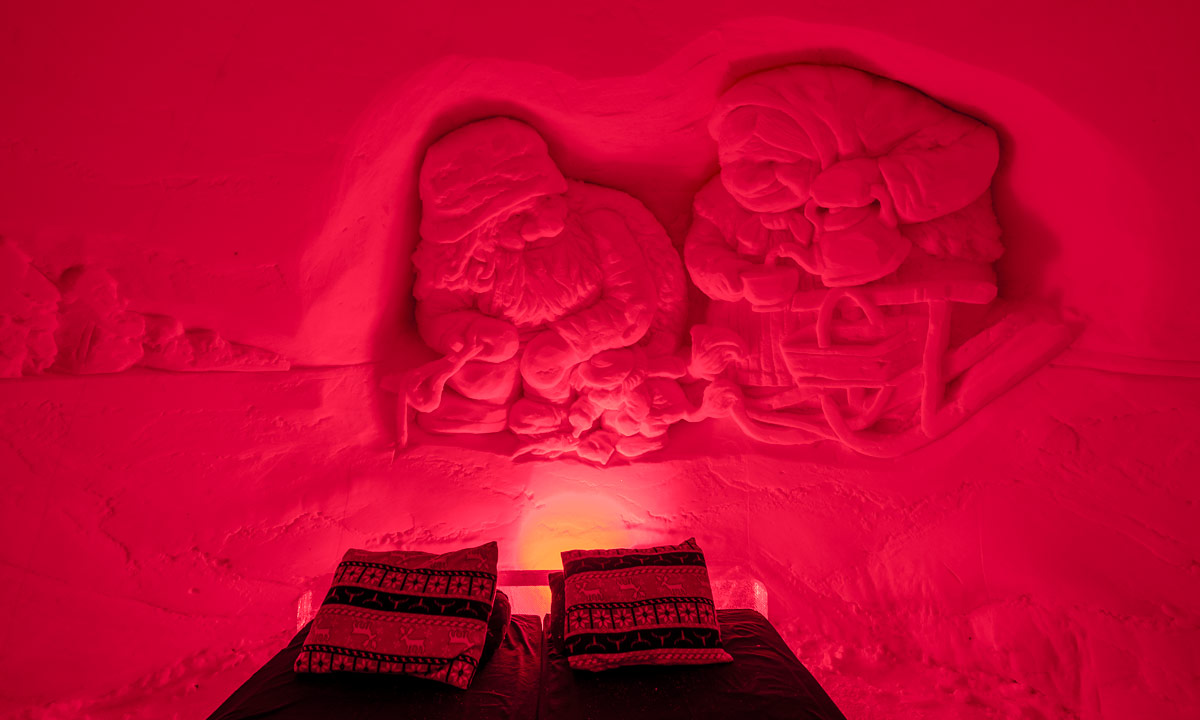
I slept in tents, in igloos and outside in wintertime. I even slept in the Kirkenes Snowhotel two years ago. This time Annika and I enjoy sleeping in the inside of our friends house (Thank you for your great hospitality, Christine and Ørjan) but gave the Snowhotel a visit. And it was worth it – especially the lounge with it carved ice blocks is very impressive.

Tomorrow we’ll leave this fine place, take the car to Vardø in the North (yes, that’s still possible!) and take the Hurtigruten from there to our next destination.

The Baltic Sea freezes over

Yesterday the Baltic Sea was open and a lonely goosander paddled through the cold, gusty wind. Meanwhile the air got colder and colder.

This morning the temperature has dropped to -25 °C and I wondered whether the Baltic Sea froze over last night. And so it did.

Since it was not only cold, but also windy I was glad about my warm parka. The highest temperature I measured here in Skelleftehamn today was -22.5 °C, but in Örviken, hardly 7 km away the car thermometer showed -30 °C.

In Kautokeino (Norway) it was much colder: -42.4 °C was measured already yesterday evening. The coldest day of this winter season in Northern Scandinavia.

If the Swedish weather forecast is right, we’ll expect -23 °C this night and -3 °C the following night. That’s 20 °C warmer within 24 hours; almost springlike. Good news for the goosander. I hope, he’s well.

Blue sky, blue sea – opening the kayak season

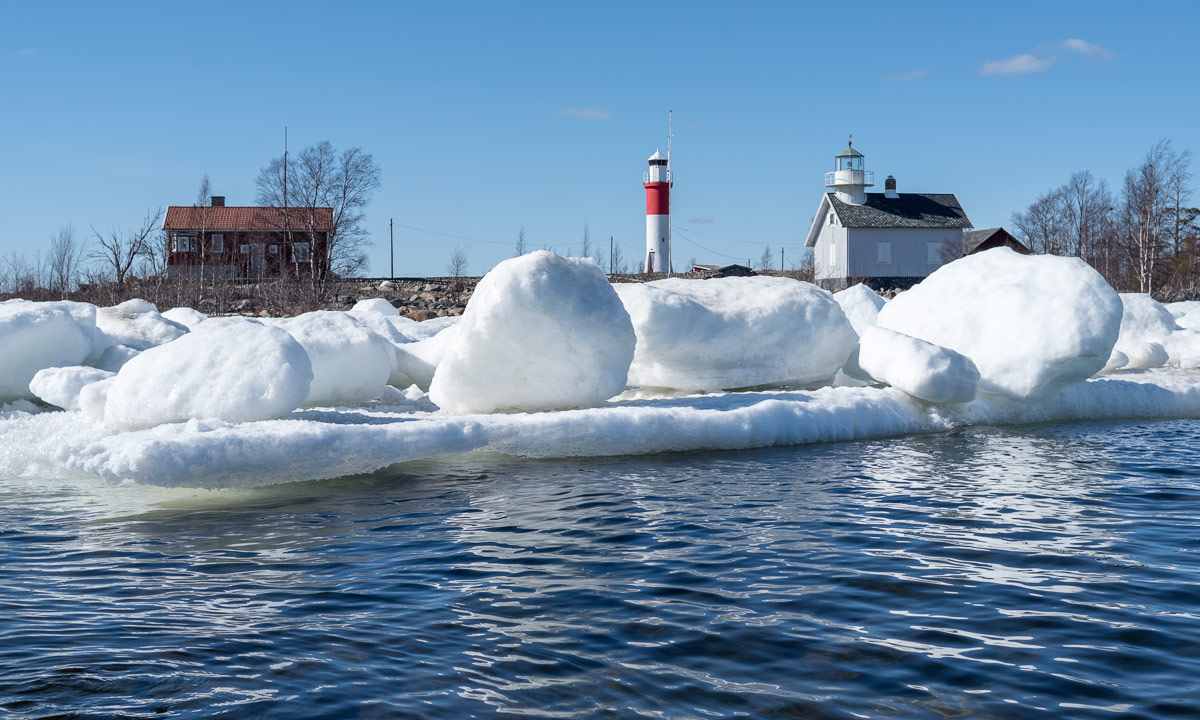
Finally the Baltic Sea round the peninsula Näsgrundet has been open and free of ice. Time to open the kayak season!

To Näsgrundet it’s just a 2.8 km walk from home. The kayak is tied onto a small two-wheeled dolly. I wear the same waistbelt, that I use for my pulka. Hereby I can walk and drag the kayak behind me without using my arms.

Soon I reached the peninsula and dragged the kayak onto the surrounding ice shield. After putting on my dry suit, lifejacket, neoprene boots, gloves and balaclava I was dressed for the first paddling. Perhaps I looked a bit overdressed, but despite of the springlike air temperatures it’s still winter paddling – the water is as cold as it can be.

I paddled along the ice shelf, that still connects the islands BredskärKlubben and Flottgrundet with the main land. The ice is soft and starts to get transparent, but it’s still quite thick.

Soon I reached Klubben and paddled along the icy coast.

From Klubben it’s just 200 metres to Flottgrundet and from that it’s only 500 or 600 meters to Gåsören

… at least, if you take the direct way. I preferred a detour to paddle between the ice floes. It’s a great experience. Some ice floes are quite big and welcome resting spots for ducks, geese and seagulls. Others are so tiny, that they are hardly visible, especially if they are completely transparent and clear. They sparkle and glitter like huge diamonds.

After some detours I headed to Gåsören, circuited it to look for a good anchorage and went on land (or better said, on ice) to make a small rest.

After I stilled my hunger and thirst I entered my kayak again and returned to the Näsgrundet, this time on the direct way, which is round about two kilometres. When I got out from my kayak and stepped onto the ice that surrounds the peninsula, I heard a noise: A snow mobile crossed the same ice shield I paddled along some hours ago – in same distance to the open water. Spring, meet winter!

After taking of the lifejacket and dry suit I went home, dragging the kayak behind again and enjoying the springlike temperatures. No warm jacket anymore, no woollen cap – no gloves and no warm boots. Round 40 °C warmer than 12 weeks ago – glorious!

Kungsleden: returning to civilisation

This article is part of the series “2016-02: Ski tour on the Kungsleden”.

From the Tjäktjastuagn to Alesjaurestugorna

27 February · 13 km · Link to map

This day I continued to the Alesjaurestugorna, the last mountain hut in the kalfjäll –  the treeless mountain landscape in Lapland. Perhaps that’s why I was a bit sad, because I love the bare mountains and I felt that I had to say farewell to this outstanding landscape soon. I said farewell to quietness a bit, too, since I knew, that Alesjaure would be quite crowded:

But first of all I had a nice trip of thirteen kilometres to go. Weather was good and the way was short and easy, even if there were some patches with hardly any snow that I had to bypass. So I arrived in Alesjaure already at a quarter past one, being the first guest.

Other guests came, from Austria, from Germany, from France and from Denmark – many interesting people. And in between five scooters arrived – all with a trailer loaded with figures dressed in huge black down parkas and ski goggles – the Englishwomen. Their plan was to go back to Abisko on skis in two days with some detours to make it a full marathon distance.

The rest of the day was relaxed and easy-going. First I sat the sauna, then I made dinner (an outdoor meal called “Rice with basil” – quite boring). After that I sat together with all those kind and interesting people. At half past nine one of the Danes started to make pancakes – and I was invited! The Danes told me, that each of them has a surprise for the others on their tour and the pancakes were the first surprise. What a great idea (especially, since I benefitted from this surprise). I went to bed at half past ten – much later than the last days.

From Alesjaure to Abiskojaure

28 February · 20 km · Link to map

The next day I wanted to continue to Abiskojaure, that’s the longest part of my journey. The last tour days had quite short distances between 12 and 14 km and I was rather slow. As a photographer I have a good excuse: It’s making photos, that takes time, not my slow speed! Anyway, today I planned to start very early and decided to go a bit faster to avoid arriving in darkness. But first I had to get water, there was hardly any left.

If you tent in the winter, you’ll have to melt snow in most cases – this takes a lot of time and doesn’t taste well. The mountain huts on Kungsleden have ice holes to get fresh water, either in lakes or rivers. The ice hole of Alesjaure lies exactly below the summer bridge. It is covered with a wooden look to reduce freezing over, but I had to break the fresh ice anyway. It’s almost impossible to fill a 25 litre container with water (lowering the bucket into the small hole – pull it up again – pour water through the funnel – de-ice the funnel – pour water through it again) without getting wet hands. Oh, what I longed for waterproof gloves. My fleece gloves were completely soaked and my fingers got so cold that they itched when I “defrosted” them above the gas oven.

That’s why I started a bit later than planned and at the same time as the marathon skiers. They followed the official winter way, I took the short cut over the frozen lake Alisjávri. Although I took pictures I was faster than the skiers – some of them probably stood on skis the first time – and when I left the lake to join the winter way they already lagged behind.

I tried to go a bit faster, but stopped for some photos:

After I went more than half the way I took a break. It’s quite warm: -5 °C and even the cloud-covered sun warms a bit. For me it was a bit like saying good-bye. Good-bye to the treeless kalfjäll. Soon I will enter the narrow valley Gárddenvággi where terrain declines. And soon after I finished my break and continued the tour I saw the first small birch woods. The sun has disappeared behind a cloud layer and the landscape got monochrome. Dark birches, white snow, only interrupted by some red waymarks.
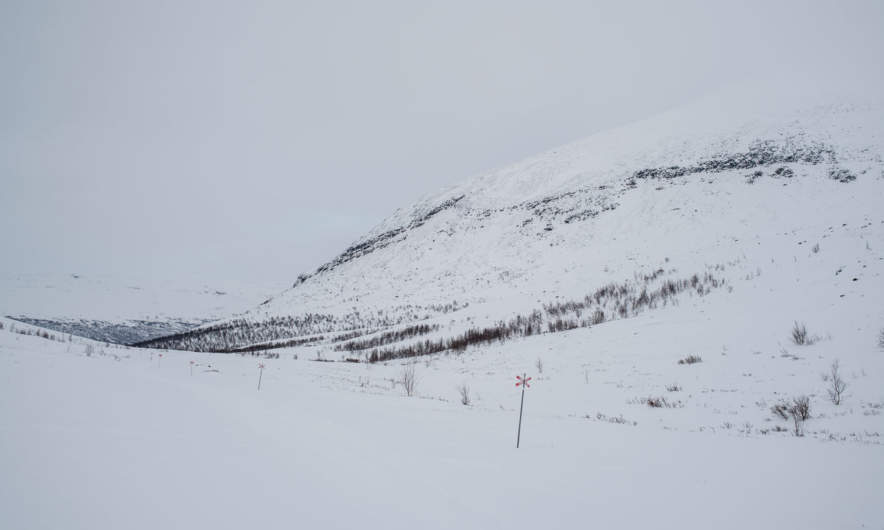
The last descend to the woodlands is quite steep. I decided to unmount my skis and go on foot. Even so the pulka tried to push me down towards the valley and I had to lean back to avoid being knocked over. After some minutes I was almost level with the Abiskojaurestugorna and went the rest of the tour through denser birch forests on skis again. I have to admit that I found this part a bit boring – we have snow and trees in Skelleftehamn, too, but soon I arrived at the mountain huts, where I spent the rest of the day.

In the evening I met C. who wanted to go to Abisko the next day and we planned to do this last part together.

From Abiskojaure to Abisko Östra and home

29 February · 15 km · Link to map

Let’s make it short: This day was travel day. C. and I woke up at 6 o’clock. Not by our own will but because we had the loudest snorer ever in our room. Jet engine level! We took a short breakfast, packed our pulkas and started our tour. Not to Abisko Turiststation, the classical start and end of the Kungsleden, but to Abisko Östra, the station of the village Abisko. I went on skis, C. just with normal boots, since the snow on the snow mobile tracks was packed and easy to walk on. C. was much faster than I use to be, but we headed for the 12-o’clock-train and I was keen to get it, too. We took two breaks: One for elevenses (or some kind of pre-lunch), one for the reindeer posing in front of the kåta.

We mad it, we even had an hour time until the train arrived. 14 km in 3 hours, 8 minutes (including the two breaks) – that was the fastest part of my tour. Thank you, C. for helping me leaving my comfort zone a bit.

The rest of the tour: Train from Abisko Östra to Luleå. Bus from Luleå to Skellefteå. Bus from Skellefteå to Skelleftehamn. I was home at 21:30 – 13½ hours after starting on skis in Abiskojaure.

Now it’s midnight. I’m sitting in the living room of my house in Skelleftehamn. I really like this place, but I’m already longing to the Swedish Mountains again. Perhaps another ski tour later in April?

Well, we’ll see …

Hunting the cold – day #2

This article is part of the series “2016-01: Hunting the cold”.

Yesterday I travelled to Pajala to search the cold. With a minimum of -39.6 °C i missed the -40 °C.

Day #2 I stood up quite early, took a short breakfast and drove again to Käymäjärvi, where I measured the coldest temperature yesterday. It seemed to be colder than last night and directly after I turned left into the small road to Käymäjärvi, the thermometer showed -40.3 °C. First time below -40 °C – yay! At 08:37, nine minutes later it showed -40.7 °C , which turned out to be the coldest temperature I measured this day.

I continued the road to the end. Here a couple of lonely wooden building stand beside the road, obviously uninhabited, at least in the winter.

But now it was time to pack the pulka – a transportation sledge – and mount the skis. I wanted to make a ski tour, at least a short one. I parked the car at the place where I saw the aurora the day before.

I filled the pulka with warm clothes, hot tea, a bit of food, the camera equipment and such. Then I dressed for skiing. Here it was -37 °C and I dressed carefully to stay warm and avoid frostbite.

One of the telescope tracking poles was not possible to fix. I tried a workaround with the result, that it broke after 5 meters. I’ll have to buy new ones.

First skiing was easy, even with only one ski pole. The snow on the frozen swamp was hard and it was easy to pull the pulka behind.

But then I entered the forest. Of course pulkas are not made for woodland and this forest was like a thicket of birches which sometimes bend down and build low hanging arcs.

I tried to turn left to find more open land (I was quite unprepared and hadn’t any map with me) and had to cross several small brooks. One of them was a bit larger, a bit deeper and I could here water floating under the ice. I had to unmount me skis and was quite nervous crossing the brook that I probably would jump over easily in summer but all went well.

I continued and wanted to make another photo, but not the camera. It didn’t work any longer. The D-800 just showed an ERR on the display, that was all. Now I was a bit of fed up: Only one ski pole in the midst of a thicket of birch trees and the camera not working. I turned and went back. This probably was one of the shortest ski tours ever.

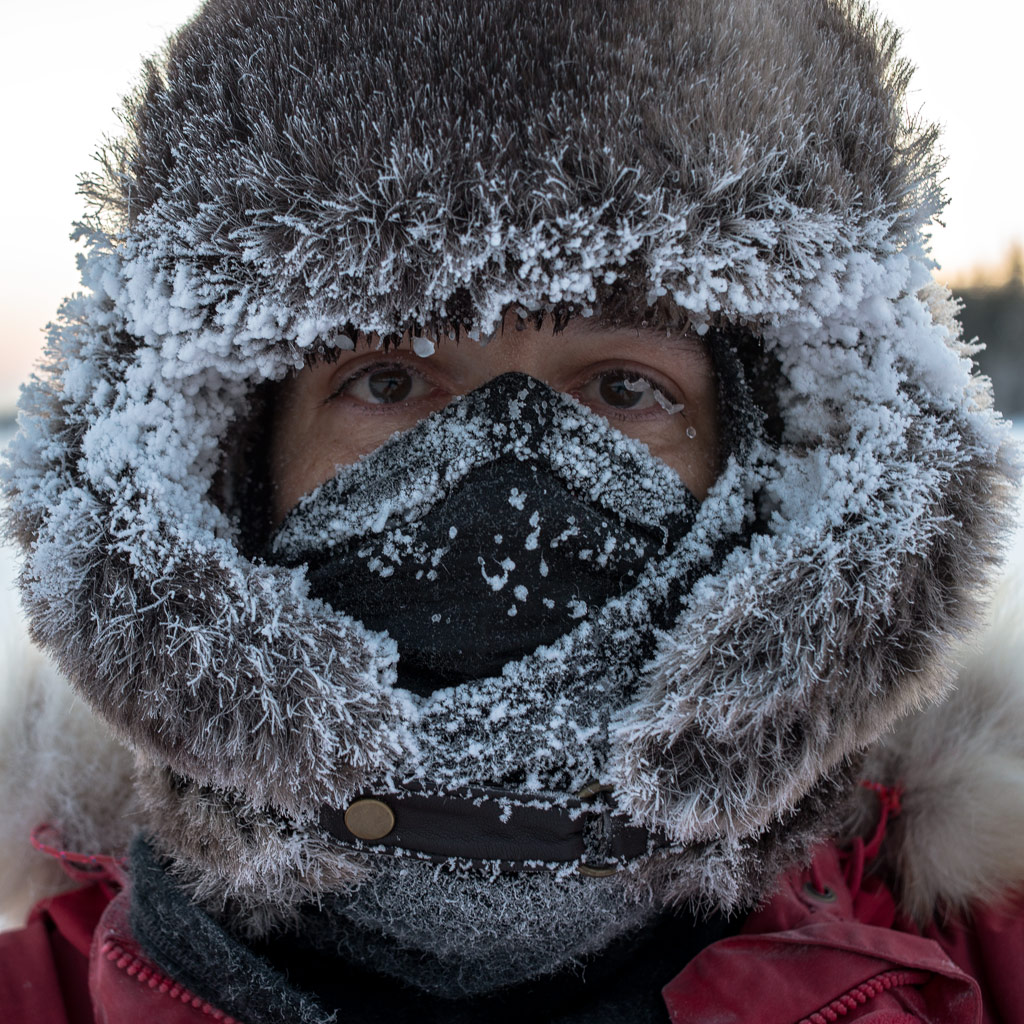
That’s what I looked like. The first photo is taken 10 minutes after beginning, the second right after the end of the tour. That was not easy: The Nikon D-800 was out of order, the iPhone is not made for cold temperatures and the batteries of my auxiliary camera were left in the car and didn’t work neither. But at last I found a battery that worked for the moment.

You see the fur cap? Some equipment that I have is really expensive, for example by Canada Goose down parka (not on the photos above). The fur cap however is from H&M and costed only 10 Euros. You can hardly call this professional equipment but it worked extremely well.

When you exhale in this cold the air flickers as it does over open fire. No surprise, the temperature difference is round 75 °C. When you inhale you should wear a buff or a scarf to protect your lungs. Remember the temperature difference?

I was so glad that the car copes with the cold. It was -36.9 °C outside and -35.1 °C inside when I started the car after the tour. It took only two seconds and the motor was running. Only changing gears is heavy as long the system is so cold.

On the way back temperatures dropped again below -40 °C. Time to many another selfie – a ridiculous one: The camera inside, holden by a long arm, me outside in front of the car. To my big relief the Nikon camera worked again. The motive: The temperature at the left, me outside with my parka at the right. It didn’t work as excepted. Where’s my face?!

Back in Pajala I admired the fragile birch trees covered with frost beside of the river Torneälven. In the background the clear sky with colours from pink to azure. It seemed to be even colder on the bridge that led over the river back into the city. I could feel the wind through my gloves and mittens and even the nose started to freeze together with the camera when taking photos! I closed my hood completely which looks a bit ridiculous, but I stayed warm.

I took my anemometer (A birthday present to myself) and measured the wind: 20 km/h. The temperature: -36 °C. That makes a wind chill of -51 °C! That’s what I call coldness!

I took a lunch and headed home since weather in this region should worsen, while the forecast for Skelleftehamn looked quite good. It was hardly warmer than -25 °C on the whole journey back home.

At 7 o’clock I arrived home. -28 °C outside – time for a hot bath!

Hunting the cold – day #1

This article is part of the series “2016-01: Hunting the cold”.

Two days ago it looked like that it could by quite cold in Northern Sweden yesterday and today. I checked several places and their weather forecasts and Pajala with a forecasted temperature of -40.4 °C won. That’s good news, since Pajala is only 350 km away. Nikkaluokta for example is one of the coldest places in Sweden, is 537 km away and it will take more than 6 hours to travel to (when conditions are good).

Yesterday – 6 Jan, 2016 – I packed kamera, very warm clothes and all you need for ski tours into my Saab and started the trip. In Skelleftehamn it was -17 °C, but already 20 km away the temperature dropped to -20 °C.

I made a stop in Jävre. I’ve passed this place several times and every time I planned a future stop. Well, future was yesterday. Jävre -23.3 °C.

I continued the trip and the temperature continued dropping. Round half past ten I could see the sun – it was bright red (the camera couldn’t catch this) and because of the higher latitude it was even lower above the horizon. -27 °C.

Now I continued driving to avoid arriving too late. Right after Svartbyn (E10) the thermometer dropped below -30 °C the first time. Round 40 km later I turned right. Here temperatures dropped below -33 °C. Near Pentäsjärvi – 25 km before Pajala – it got even colder: -36.9 °C. I probably experienced colder temperatures, but never saw such low numbers on a thermometer.

I found a quite low-priced room in the Hotell Smedjan but I continued driving around looking for nice (and cold!) places.

One of the most fascinating things in my opinion is the light in wintertime. Twilight may last hours or even the whole short morning, day, and evening and there are always soft pink colours in the sky. Just beautiful, but cold to take pictures of if you don’t have warm clothes. But when I have one thing, it’s cold weather equipment.

I looked for the airport, which is a bit out of town and quite tiny. It was closed. It’s the first airport I saw with an own parking place for reindeers. Good to know!

On my way back to Pajala I found a side road that headed to a small national park. I parked the car and walked the 700 meters to the cabin and the grill place in darkness. Of course it wasn’t pitch black, the snow and some thin clouds reflected the light of the city, giving enough light to see and walk. (The selfie is made with the iPhone which can take two photos until it will shut down because of the cold.

On the way back it was even colder: -38.8 °C. Now I got really hungry, drove back to the hotel and walked to the pizza restaurant. (Pizza and burger bars rule the Scandinavian north). Pajala by night:

Then I went home. I was glad that I have all I need for such a trip: A camera, food and a warm winter parka.

After a while I considered if I could catch the -40 °C now. It was warmer than expected, but let’s give it a try.

This time I took the road to Käymäjärvi (the name proofs, that Finland is not far away). Yes, here it was quite cold – below -39 °C. Between a swamp and the lake I stopped, since these low lands can be cold traps. I didn’t get lower temperatures but a view on the village and northern light (quite strong until I was ready to take pictures …)

On the way back to the main road I got my new personal cold record: -39.6 °C (sorry, no -40 °C)! When it’s really cold in Northern Sweden people take pictures of thermometers and show them in the internet. I will join this tradition. Voilà:

>>> read about day 2 of the journey >>>

A hike and three tests

Do you remember Nokia? Cell phones and rubber boots? Today I tested a quite similar combination: Rubber boots and a Nikon lens. Plus a hiking trail.

A few weeks ago I discovered a big information board at a forest edge in Skelleftehamn. It describes the “kraftleden”The force trail or The energy trail. Perhaps the trail is named after Skellefteå Kraft, one of the sponsors I thought when I read the information.

Today I decided to try to hike the 18km long trail. I had two new things with me: My new rubber boots Tretorn Sarek which are made for hiking and my new lens Nikon 100mm f/2.8 (Series E), that I bought secondhand some days ago.

After a one kilometer walk I was at the starting point.

At the first junction I was lost, since I couldn’t see a sign. But after checking my photos of the information board I learned that the way marks where orange coloured blazes round the trees. That’s easy. The trail itself however wasn’t easy at all. It looked more like an area where you cut down trees and bushes. Like a stork I stalked through the cut down branches and twigs that lay criss-cross on this so-called trail hoping for a better path.

And the trail got better. But I still was slow. This time not because of the trail but of my new lens. It’s my first lens ever without an autofocus. This means that I have to focus manually at the lens itself. It took some time until I got used to it, but I still had to control every single shot on the display and I had to make some photos five times until I was satisfied.

I continued the trail – now a nice stony path until I came to the Örberget – altitude 40 meters, 30 meters higher than the starting point. It doesn’t take much to be called a mountain here. I made a photo of a “gravröse”, a tomb from the Bronze Age. Probably it was build at the shore some thousand years ago but the land has been rising round a centimeter a year since then.

I continued the walk. The ground became wet and muddy and after a while I stood in front of a bog. In the middle of the bog I saw a wooden post with an orange blaze. OK, let’s go …

… now I knew, that the new rubber boots were not only comfortable but really waterproof. I didn’t get soaked, but it was quite close.

I always had to look down carefully to avoid the deep water and mud puddles, and I had to look forward to find my way. When I looked up I started to suspect why the trail was called kraftleden. Almost the whole trail followed the transmission lines and the Swedish word for transmission lines is kraftledning. That’s a really pragmatic approach to make a trail since some kind of path was made already to mount the power poles. But it’s not very inspiring just following the lines and not beautiful neither.

After round 11 kilometers I made a rest on a high seat normally used for hunting moose.

I continued the tour but I started to lose interest a bit. Parts of the way were hard to walk, harder than many mountain trails but without the reward of a beautiful landscape or great views. In addition of that I started the tour round half past two and I didn’t want to come to town too late. So I left the kraftleden and walked southwards through the forest. At the beginning I found some nice flowers and I changed the lens to a macro. First two additional test images of the new 100mm lens, then two flowers – a dactylorhiza maculata and a linnaea borealis:

OK, I have to admit: I tested four different things, not only three. Number four was a mosquito protection jacket, that came in quiet handy when I shot the macros of the flowers. Flocks of mosquitos darted for my blood, but they didn’t had a chance beside of biting into my unprotected hands.

After taking the flower images I had to walk some other kilometers until I came to the main road and another one to come to the bus station where I had to wait half an hour for the next bus. Happily I slipped of my rubber boots to try my socks, sat down and waited. Finally the bus came and half an hour later I was home. The GPS displayed:

19.0 kilometers · average when moving: 4.3 km/h · total average: 3.3 km/h

And here come todays test candidates:

Rubber boots Tretorn Sarek: Really nice and comfortable boots, perhaps a nuance too tight for me. They are made of natural rubber and it’s easy to turn the upper upside down. They could be a bit higher.

For me: 8 points out of 10.

Nikon 100mm f/2.8 (Series E): A small, lightweight lens with manual focus. I have to practise focussing. I prefer my huge Nikon 70-200mm VR II, but there’s a reason why I bought the former one: At the end of August I’ll start a two week hiking tour in the Scandinavian mountains and I want to save weight. The 70-200 weights more than 1500 gram, the new 100mm only 215 gram. Got the point? And it was cheap, too – only 53 Euros.

For me: 7 points out of 10.

The trail kraftleden: The only advantage of the trail is that you avoid navigation. Beside of that it’s an awkward combination of a trail a bit too hard to be nice and a bit too boring to be beautiful. I wouldn’t recommend it. If you want to give it a try, take high rubber boots and plenty of time with you. Take care and follow the way marks if you don’t want to end in almost knee deep mud as it happened to me today.

For me: 3 points out of 10.

The nameless mosquito jacket: Perhaps it’s not fun to walk within some kind of mosquito net but it was great, when I took the macro photos of the flowers. The hood is too big. Since it’s very light – only 214 gram – I will take it with me on all summer photo tours and perhaps even on the planned mountain hike. And with costing only 18 Euros it was a bargain, too.

For me: 6 points out of 10.

Translations:

EnglishGermanSwedish
Dactylorhiza maculata / heath spotted-orchid / moorland spotted orchidGeflecktes KnabenkrautFläcknycklar
linnaea borealisMoosglöckchenLinnea
upperSchaft (am Schuh)skaft

Yes, we can waves

Strange weather we had today. Sky was blue and the warm sun warmed up the air, but it was really stormy. Even if the wind came from west, we had a lot of waves on the Baltic Sea, that sprayed sea foam high up into the air, where storm gusts blew it ashore.

selfie-at-the-shoreThe last photo was shot against the sun, which was against the wind as well, so that a lot of foam landed on the lens of my camera. Not so ideal for photos, because each drop of water blurs parts of the image. I have to think about a method how I can avoid this. The camera itself is waterproof and so were my clothes and boots, that I used today, when I sat in the midst of the waves.

Why I called the article “Yes, we can waves”? Well, many people – sometimes including me – smile at the Baltic Sea and say, that it’s more like a big lake and no real sea at all. That it is shallow and never has big waves. Partly they may be right, because the Baltic sea is hardly affected by tides and the northern part – the Bothnian Bay – where I live, has a very low salinity. But at least we got some waves and sea foam today.