3rd Ice Swimming World Championship in Murmansk – preparations

This article is part of the series “2019-03: Redex Murmansk”.

I was in Murmansk with Barents Press with a project called Redex 2019. The project goal is to establish contacts between sports journalists and exchange experiences.

Thursday, 14 March

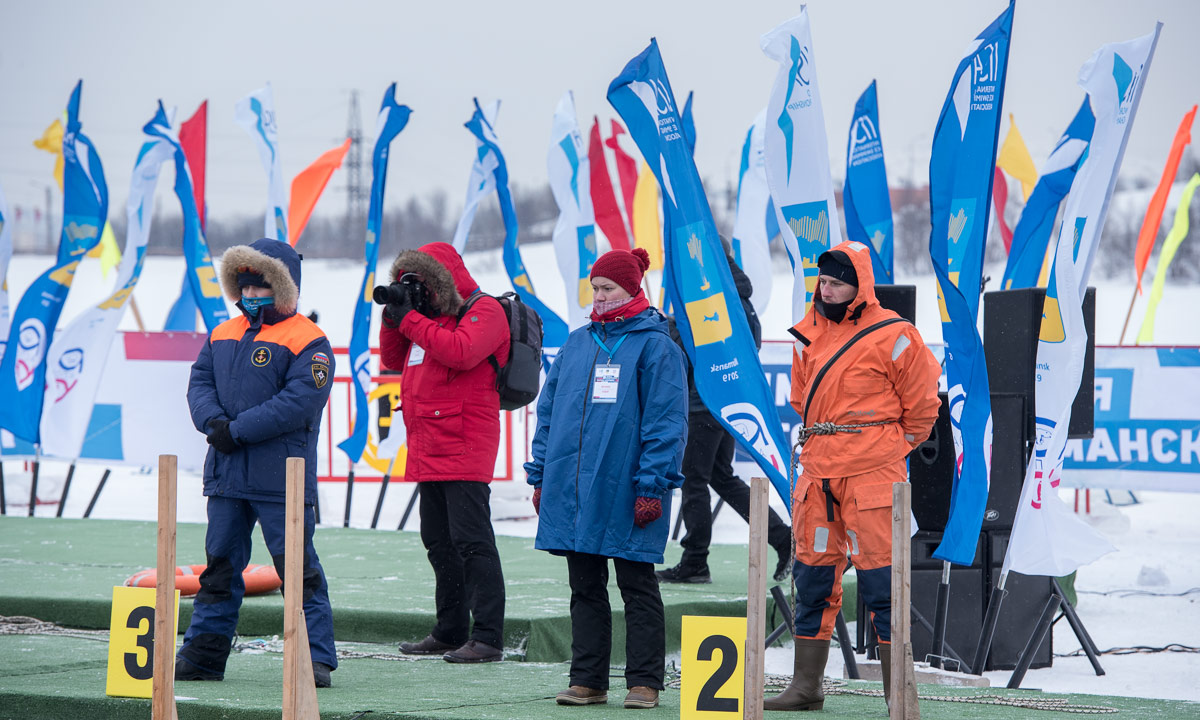
Tomorrow, 15 Mars 2019 the 3rd Ice Swimming World Championship will start. 400 swimmers from 33 countries will participate in this competition and will swim distances up to 1000 metres. The event is organised by the IISA and the town of Murmansk.

The first contact to this event we got yesterday, 13 March in the swimming bath. We met Davaadorj Shagdarsuren, a professional swimmer from Mongolia and only participator of his country. His traditional clothes were really eye-catching and according to himself much too warm for Murmansk. He’s more used to winter temperatures between -35 °C and -50 °C.

Later we had an appointment with Irina Andreeva, leader of the municipal Sport Committee and member of the organising committee. She gave us interesting details about the ice swimming championship and the organisation.

When we went back we passed the Five Corners Square we heard loud music. There a rehearsal for the closing ceremony was in full swing. Heroic music sounded from the PA system and young people were marching to it with huge flags. Half of them in some kind of winter uniforms and flags with the logos of the IISA, the city of Murmansk and Аспол, the association of polar explorers. The others with the national flags of all participants. A nice gesture to all countries. I have however to admit that such kind of parade looks quite odd from my German-Swedish perspective. I’m not used to marching and parading.

Today at 1 o’clock was the press conference for the championship. It hold place in the hotel Azimut. 13 officials talked a bit about the event and invited the journalists to ask questions. Since there came hardly any question they started to ask each other instead. Quite funny situation.

After that we got our press accreditations. Now I have a press badge and I’m quite curious how freely I’m allowed to move the next two days to take pictures of this event.

Links

Redex 2019 – side dishes

This article is part of the series “2019-03: Redex Murmansk”.

I was in Murmansk with Barents Press with a project called Redex 2019. The project goal is to establish contacts between sports journalists and exchange experiences.

Thursday, 14 March

The first two days of Redex 2019 and therefore half the time in Murmansk is already over. Yesterday was very intense, today was more relaxed.

Yesterday we met trainer Erika of Fizkult, a gym for people with special needs such as medical rehabilitation. We met trainer and director of the bandy team Murman. We were shown the hockey stadium, the most northern ice rink in the world and the bandy arena. We met Irina Andreeva, leader of the municipal Sport Committee in her office. By good luck we met Davaadorj, ice swimmer from Mongolia while visiting the sport swimming pool. We watched a rehearsal of a flag parade, part of the closing ceremony of the 3rd Ice Swimming World Championship and we had dinner in the Sumakh restaurant in the Volna shopping mall.

To come to all these places we walked sometimes but mostly we took the trolleybus. There’s always a ticket collector in the bus and you have to pay cash. A trip costs 32 Rubel, that’s round 0.45 Euro.

Here I won’t tell all the stories about all the interesting people we met. I’ll just show some images that I made yesterday. That’s why I called the article “side dishes”.

Today we took a trolleybus to the sport complex Долина Уюта/Dolina Uyuta where there was a huge cross country skiing competition of school kids. It was interesting to see all the kids and teens warming up and the communication with their trainers. Looks like a great place to ski, even though I cannot skate but only ski classical style (on a very low level).

After that we went to the press conference of the 3rd Ice Swimming World Championship, the main event in Murmansk that will start tomorrow. 400 swimmers from 33 countries will compete in ice swimming with distances up to 1000 metres. But that’s another story.

Just two other snapshots photos from today:

Skiing from Syter Fjällstuga to Umasjö

This article is part of the series “2019-03: Ski tour Vindelfjällen”.

Wednesday, 6 March

Today we will have the longest distance of our ski tour: round 22 km from the Syter Mountain Cabin to Umasjö. We get up at 5:45 and start our tour at 7:30 to have enough time before sunset.

G., the stugvärd recommended to go on the small river Voehpejoeke or Svärfarbäcken, it would be easier to ski. We however do not dare and follow the marked winter trail. That turns out to be a quite bad idea. The trail seems to connect all existing hilltops around. The hilltops are exposed to the wind so that they are free of snow. There is vegetation, rocks and a lot of bare ice where neither the skis nor the poles get any hold. We barely make any progress and our frustration grows. After a while we decide to follow G.’s advice and ski down to the winding river.

You have to know, that there is ice and water under your feet for all we can see is snow, a bit of vegetation and some rocks. We feel safe and we are at least three times faster than before. After some time we come to a wide plain where I make the first tour photo of the day.

The morning had been cold again with temperatures below -20 °C, but it quickly became warmer and clouds have approached, covering the mountain peaks. Despite to the forecasts it is windy and the drifting snow makes the view hazy.

After 5 km we pass a Sámi dwelling, marked in the map as a black triangle.

Then we approach a narrow passage and the frontal wind increases. First I think it is snowing but it’s just the snow driven by the wind. We avoid making smaller breaks because there is no shelter in the valley and we would have to put on down jackets to avoid hypothermia.

The way is long but navigation is easy. We just have to follow the red crosses. Visibility is not the best but still we can see at least the next three or four crosses. After the valley we have to ascent a pass but the ascent is so slow that we hardly realise, that it’s already the pass. I check our position with the GPS but take the wrong number. I know that it has to be wrong but we continue anyway. What shall happen: we are on the trail and it feels like we are in time. It was only the first stage that slowed us down.

Even though the way is long it is a great tour. Snowmobiles are prohibited and we ski through the untouched snow landscape, completely alone. I do not take many pictures because I don’t want to loose too much time.

It’s still windy. When Annika goes ahead parts of her ski tracks are snow covered after already half a minute. At least it’s not cold, probably between -5 °C and -10 °C.

I check the GPS again, this time more properly. We have come further than expected and are faster than thought. Sometimes we stop to drink a bit and eat chocolate (mostly me) but we try to minimise the breaks.

We are on a plateau now, where the wind is calmer and it’s easy to ski. But we know that we have to descend 300 – 400 metres. And soon we have to ski downhills which is not our most outstanding skill. At least the slopes are wide and there are no trees around.

The trees appear a bit later but still it’s easy to ski. And then we finally meet the first snowmobile trail. It is descending through the forest but it’s so wide that it’s easy to ski down, either directly on the tracks or on the sides through untouched snow. Then we come to the “snowmobile main road”. The signpost says, that 17 km lie behind us and 5 other km to go.

This part is both boring and tiring. The track goes up and down which doesn’t matter for snowmobile drivers but for us. We curse every hill we have to ski up.

But finally we reach our final destination of today’s ski tour. The road E12 in Umasjö.

Our four-day ski tour is over but neither the journey nor the day.

Annika’s colleague F. is staying on her mountain cottage in Umasjö. It is she who comes shortly after our arrival and gives us a lift to Hemavan, where I parked my car three days ago. We buy some food and drink (rich in calories!) and drive back to Umasjö where we meet F. again in her cottage together with her family. We sit in the living room and report from our ski tour. After that we continue our journey to Norway, where we visit friends of Annika in Mo I Rana. The road conditions are not the best and I’m tired but luckily it’s only a one-hour drive from Umasjö.

That has been a long day and an exhausting one as well, but – more important – a great one. Now I’m looking forward to the next ski tour together with Annika.

Skiing from Viterskalet Fjällstuga to Syter Fjällstuga

This article is part of the series “2019-03: Ski tour Vindelfjällen”.

Monday, 4 March

I wake up early in our four-bed room. Annika and I are in the Viterskalet Mountain Cabin in the Vindelfjällen, part of the Swedish mountains. I get up, take tripod and camera and go out. The temperature in the kitchen has dropped to 7 °C, but that’s almost 30 °C warmer than outside, where it’s -22 °C according to the outdoor thermometers at the windows.

I love it when the rising sun colours the snowy mountains in purple, pink, orange and yellow until it stands so high, that the snow looks white.

At ten o’click we start our tour: 12 or 13 km to Syter Fjällstuga, the next mountain cabin. We follow the winter trail that slowly bends eastwards into the valley Syterskalet.

Here we walk in the shadow of the mountains. First it’s a nameless top (1603 m), then the Södra Sytertoppen (1685 m) that blocks the sun. Round a kilometre before the emergency cots– also named Syterskalet – we leave the shadow and walk into bright sunlight. We take a break at Syterskalet, both for eating and drinking and for attaching the climbing skins to our skis.

After the rest we have to climb a bit, round 100 metres in altitude. That’s why we mounted the climbing skins. With them the ascend is easier than expected.

When we reach the peak I remove the skins. Although I’m a lousy downhill skier I want to try anyway. The terrain is difficult for me, because parts of it are icy and others are hardly covered with snow. With large bends and a bit of luck I manage to ski downhill the slope. Annika skis downhill with climbing skins that slow down her skis. Because of that she can use the snowmobile tracks that are to steep for me. We meet at the chain bridge over the stream or Svärfarbäcken. The Syter Mountain Cabin is on the other side. We don’t have to use the bridge to cross the stream, it is completely frozen. There’s only a marked hole in the ice for fetching drinking water.

We arrive at the cabin and the stugvärd – the host – welcomes us with hot juice; a nice tradition on the mountain cabins. We realise that we met before in Nallo, a small cozy cabin in August 2017, when we took a day off.

We get a cozy room with a bunk bed and take it easy the rest of the day.

Of course I have to go to the toilet again in the night and the sky is as starry as the night before. I made some photos and due to the long exposure you even can see polar lights on the photos. These polar lights however were hardly visible to the naked eye.

Tuesday, 5 March

Today we are going to take a day off and stay at the Syter Fjällstuga. I’m an early bird and get up before sunrise. Again it’s -22 °C and the temperature will not rise above -15 °C for the whole day.

After a breakfast (we have crisp bread, butter and cheese plus hot cocoa) we start a small day trip on skis. We want to go up the slopes north from Syter. It is fun to go without pulka. Flocks of ptarmigans (snow grouses) are overall. First you hear them, then you can see them as white spots. If you come closer they fly away and you realise that you hardly spotted half of them.

Today we do not follow any marks, we make our own tracks. The tour is shorter than expected. Annika still has climbing skins under the skis and does not have any problem with the many icy patches on the slope, but I have. Instead of descending any further we turn right and make our way to the Kungsleden that continues to the northeast. Here we ski back to the cabin.

The rest of the day we stay in and round the cabin. It’s awesome to ski through the incredible beautiful winter landscapes but it’s just as great to meet interesting people.

  • Stugvärd G. with whom we talk a lot. She travelled a lot in the whole world.
  • Myra de Rooy, who is going to go the 440 km to Abisko, the first week with a friend. She writes books, mostly about her adventures in Tibet and Nepal.
  • the man who temporary helps with the cabin. He seems to know every path and every rock of the Vindelfjällen, where we are.

Annika realised that today is fettisdagen, the day in the year where the Swedes eat en semla, a barm filled with marzipan and cream. And right – the man mentioned above prepares semlor for him and his family. We are invited to take one and gladly accept. The rest of the day is a lot of talking, resting, eating and Annika making pancakes. But we even start to pack our things. Tomorrow we are going to Umasjö and that’s 22 km to go. We want to get up at 6 o’clock to start the tour as early as possible.

The last photo shows a typical situation in the Swedish mountains in wintertime: Sitting on the loo. It is dark, so you need a headlight to go there. It is cold (-23 °C), so you need a warm jacket, too. You think, that’s uncomfortable? Then you never tented in wintertime where you long for such a utedass (the Swedish word for this type of outdoor toilet).

Travelling with the MS Lofoten: Øksfjord – Stamsund

This article is part of the series “2019-02: Northern Norway”.

Disclaimer: Many, many photos, some of them pretty mediocre but all part of the journey.

Still Saturday, 16 February

After we left Øksfjord we continued our journey through the darkness. The people on board were idle, they chatted, read a book, look through the window and of course most of them used their computers, tablets or smartphones.

Three hours later we were in Skervøy, stop #9 of my Hurtigruten journey.

After a short stay we continued to Tromsø, Norway’s largest town north of Trondheim. I took a night image of the passing Hurtigruten ship MS Trollfjord then I went to sleep.

Our stays in Tromsø and Finnsnes I overslept completely.

Sunday, 17 February

At 7 o’clock I woke up, half an hour later I stood outside and took the first pictures in the blue hour. The weather was much better than the other days and the temperatures had dropped below zero in the night. We were on our way to Harstad, with 25000 inhabitants the third largest town in Northern Norway. Stop #12.

While we were stopped in Harstad the sun was rising and was bathing the landscape in purplish light. Harstad started to glitter. It was the many windows reflecting the warm sunlight.

The sun rose higher and after a while the sky was blue. I stood outside with my large telephoto lens and tried to catch the impressive snowy mountain ranges by the fjords and sea.

Risøyrennan, a deepened part of Risøysundet came into view.

After a short stay in Risøyhamn, part of the Vesterålen and stop #13 of my journey we continued south. The sheltered  was covered with a closed layer of thin pancake ice. You could hear it crack when it met the bow wave of the ship.

Some more images taken between Risøyhamn and Sortland:

I left the MS Lofoten in Sortland, stop #14, but only for a short time. In Norway all shops are closed on Sundays and then the towns may be a bit boring. Partly the ways still covered with a bit of frozen snow, but mostly it was slippery ice and some deep water puddles. Home in Skelleftehamn it had been very warm the last days and I expect the same road conditions when I’ll come home in a couple of days.

After 30 minutes the MS Lofoten continued its tour. At the horizon the steep mountains of the Lofoten islands came into view.

The backlit Lofoten mountain ranges looked amazing as if they were from another world. I’ll show you two photos but I’m not at all happy with them. In reality the landscape looked more aerial or as if made of light.

These mountains were in the far. The nearer mountains to the left or right looked more normal when it comes to light but still unreal because they were so steep and snowy.

The large island Hinnøya on the port side, the island Langøya on starboard side of the ship I stood at the starboard and peeked through my telephoto lens. I have friends near Stokmarknes on the Vesterålen and was I looking for their house. I found it ;-). Unfortunately R. was ill but J. visited be on the ship with the children. They went on board while the ship lay at the port of Stokmarknes, stop #15. Shortly before departure my friends left the ship. Thank you very much for your visit!

Oh, I forgot the photo of the islet (or holm) Gjæva. I already knew it from earlier stays with my friends.

Now we headed for the impressive sound Raftsundet where we would even take a small detour to the entrance of the Trollfjorden. Due to the narrowness of the fjord and the risk of avalanches it’s not possible to drive into it in wintertime.

We left the blue sky behind us, the weather worsened.

First the weather still was quite fair but then it started to snow. The snowfall was so strong and the cloud layer was so thick and low that it was decided not to visit the Trollfjorden. You hardly would have seen anything.

The camera was wet, I was wet, too and it was so dark that it was near to impossible to take any pictures. It was twenty to five and I went into my cabin and took a nap.

Just some photos “for the archives” of the next stays: Svolvær and Stamsund, stops #16 and #17, both on the Lofoten.

Travelling with the MS Lofoten: Kirkenes – Øksfjord

This article is part of the series “2019-02: Northern Norway”.

Friday, 15 February

While I moved into my cabin the Hurtigruten ship MS Lofoten still anchored in the port of Kirkenes. I had a windowless 2-bed-cabin for myself and was able to spread out my belongings. But before that I took a photo with my fisheye lens. With the fisheye-like distortion the cabin look huge!

I used the Hurtigruten twice before, in 2017 from Vardø to Stokmarknes and last year from Båtsfjord to Ørnes. So the section KirkenesVardø was new to me. And it’s the first time without my car on board.

We were in the harbour till half past twelve.

Then we left Kirkenes and my 3rd and longest Hurtigruten journey had started. I stood at the stern of the ship and looked back.

Soon I changed place from stern to bow – at the MS Lofoten you can stand next to the bridge – and looked ahead. Far away, a bit to the port side I could spot a white plain – part of the Varanger peninsula.

[Live interruption: We have reached the open Lopphavet between Øksfjord and Skervøy. The ship has started to rock again. I am interrupted by the sound of a plate falling down from the table. Thanks to the soft carpet it survived]

Annika and I travelled a lot on the Varanger peninsula last winter. I stood on the port side of the ship and tried to spot all places we have been: There’s Vadsø, the largest town – there, far away is Ekkerøy with it’s beautiful beaches. And there is Kiberg, where we had a good time with Trond, our host of Cape East Arctic Adventure. And there’s his house! I found it! Let’s see, what about Kibergsneset, the easternmost point of mainland Norway where Annika and I had been last year? It was farther away from the village than I remembered, but finally I found it, too. Both photos are taken with 600 mm from a rocking ship with a vibrating motor, so the quality is bad, but it was nice to take these pictures.

Half an hour we arrived in Vardø, stop #1. (Vadsø is left out on the southbound direction.) We arrived late and I decided to stay aboard. I’ve been in Vardø before.

When we left Vardø behind, it was too dark to see the scenery. I have breakfast included but not the other meals, because I think they are quite expensive. I have my own food with me. This day however I didn’t have a proper breakfast so I bought a large bread with salmon and scrambled eggs.

The MS Lofoten went along the northern coast of Varanger. It was windy and the sea was a bit rough. The MS Lofoten was exposed to the elements. It is not only the smallest operating Hurtigruten ship but also the only one without stabilisers. It was rocking in every direction and the swell got stronger and stronger. Sometimes the bow of the ship was hovering in midair and then scended into the next trough. I’ve never been seasick before but I started to sweat and to feel quite uncomfortable. I tried to ignore it for a while, then I interrupted my photo edit session, went down to my cabin and went straight into bed. Whether it was my lying position or the fact, that the cabin was nearer to the center of the ship’s mass I don’t know, but I felt much better and fell soon asleep.

I woke up shortly before Båtsfjord, stop #2. Near the harbour the strong swell had subsided. Soon the ship lay calmly at the jetty. It had started snowing intensely. We were in Båtsfjord quite a long time due to a lot of freight being unloaded and loaded.

I went into my cabin and continued sleeping. I overslept Berlevåg, Mehamn and Kjøllefjord but was awake in …

Saturday, 16 February

Honningsvåg, stop #6. I was so sure that I would oversleep this stop as well, but we were an hour late. I was still dark, but I could take some photos with my tripod.

[Live interruption: We have left the Lopphavet, the sea was much calmer than expected]

We left Honningsvåg with an hour delay. I tried to make pictures but the sight was poor, mostly because of the snow showers and the low hanging clouds. At least I could take a picture of the MS Nordnorge.

An announcement came through the speakers: Due to the delay we would skip Havøysund, usually stop #7. This would spare us half an hour.

It got warmer. Temperatures were hardly below zero, much too warm for the season. It snowed more and more and all you could see was the ship and a circular patch of waves and snow.

Anyway the snow showers didn’t last for hours and after another snow shower Melkøya came into view.

Melkøya is just a few kilometres away from Hammerfest, second largest town of the Finnmark. It’s the endpoint of an undersea pipeline for natural gas. Here it is converted to liquefied natural gas that is exported to the world.

Right after Melkøya Hammerfest, stop #7 on this journey came into view.

Here we had a longer stopover. A young woman took ropes, rolled them up and threw them up onto the much higher foredeck of the MS Lofoten. She succeeded every time. Later I asked here if I might use the photo (I may) and she told me that she wasn’t sure if she would make it today because of the strong winds.

I left the MS Lofoten for looking around, taking pictures and buying a coke in the local supermarket. Some photos:

After an hour I went aboard again, placed myself into the salon and started editing images. The weather was too dull to take great pictures, a good reason to be lazy.

I even took a short nap in my cabin. Anyhow I was up again when we arrived in Øksfjord, stop #8. With a fisheye photo of the port Loppa Havn I will finish this blog article.

[Back to now: Soon we’ll arrive in Skjervøy, stop #9. If we make it we’ll even reach Tromsø today but perhaps I’ll sleep. I’ve been in Tromsø several times before and even twice last year.]


Going by snowcat

This article is part of the series “2019-02: Northern Norway”.

It’s dark outside. I’m in the cozy house, where Chris and Ørjan live and reading. But what’s that blinking orange light outside? I peek through the door and what I see is a snowcat.

Ørjan is about to start a tour to prepare trails, both for his employer, the Snowhotel Kirkenes and for the local skiers. Preparing trails for the latter is a dugnad, that means voluntary work. Dugnad is very popular in Norway.

I ask Ørjan if I could join him on the tour and I am allowed to. Time to take some handheld pictures.

It’s fun to go by snowcat through the dark. I looks quite easy to operate and I would like to have my own snowcat. But neither do I need one nor could I pay it.

Takk for turen, Ørjan!

Snowy night, snowy day

When I returned from Avan two days ago the Swedish weather institute SMHI had issued a snow warning: 20-30 cm snowfall and at the coast fresh winds from northeast. Yesterday the wind increased and in the afternoon it started to snow. Soon the snowfall increased, too and the wind made the snow whirl round the houses and through the streets. More and more snow came falling down and soon the street was snowed over completely.

“Beep! Beeep! Krrrr. BEEEP! KRRRRR!” – these sounds woke me up this morning at 5 o’clock. The sound of snowploughs and shovel loaders clearing the roads. They beep when they go backwards and the shovels make loud scraping noises.

While the shovel loaders take the snow and move it to other places the snowploughs just push the deep snow aside. Both are important but the latter create work for the locals. They create a so-called plogkant – compact walls of snow – along the street and so right in front of your driveway.

This plogkanten was 60 cm high and the loose snow behind was of almost the same height. Before I could use the car I had to shovel snow. A lot of snow, at least 2½ m³. Fortunately the temperatures where round -10 °C and the snow was loose and fluffy. A good workout anyway. Finally I could get camera and tripod and took the car to two places by the sea.

The garage at the pilot station was surrounded by meter-high snowdrifts. The snowdrifts in the lee of the house were even higher. The gaps in the fence created a nice stripe pattern on the snowdrift outside. It was still quite dark and there was not much to see otherwise.

At the “beach” of Storgrundet the stormy gusts of wind blew the snow horizontally from left and right and in the dawn the scenery looked very harsh.

Great weather for a ski tour on the sea ice, isn’t it?

Two and a half hours later: Chris – a friend of mine from Kirkenes who arrived yesterday – and I had just come to the very same place to start a ski tour. We mounted the skies, put our hoods on and slipped into the gloves. It still was snowing and quite windy.

And when it’s windy at the mainland you can bet that it’s much more windy on the sea ice which is completely exposed to the elements. And so it was. The island Storgrundet was in the back and we could see the pale schemes of some other islands in the northwest. The northeast however looked like the Arctic Zone.

Chris was following my ski tracks. She looked like an arctic explorer with the white void in the background.

Here’s one of of the rare photos of me, that is no selfie. If you look closer you see that my ski tracks go zig-zag. That’s because even on the sea ice of the Baltic Sea there were many snowdrifts with sharp edges and I could hardly see whether it went up or down. Skiing was not exhausting but we were slow due to the wind and the bad sight. (… and taking pictures.)

We skied to a headland which had been in sight for a while.

As soon as we reached the lee of the headland it was almost windless. What a huge difference to the exposed parts of the sea where weather was quite rough. In the shelter of the headland we took a break. (We forget the tea in my kitchen but at least we had a bit of chocolate.) On the headland were summer cottages, now snowbound in meter-high snowdrifts.

The way back was easier. The gusty wind had started calm down a bit and the snowfall lessened. The view to the west however was still extremely arctic.

We were however no arctic explorers but had the luxury of a parked car and a heated house just some minutes away. The ski tour was short in distance but rich in experience and that’s what counts!

Takk for turen, Chris!

It continued snowing until dark. The fence in my backyard had been buried in snow almost completely. The fence is 85 cm high.

Later in the afternoon I continued clearing snow. Not with a front loader but with a wide snow shovel. Chris has parked her car on the street and both the snowfall and the snowplough had buried it up to the top of the wheels. I pushed all snow into the front yard where the snow pile got higher and higher.

I’m a quite curious person when it comes to snow depths. I made a step on the top of the snow pile and as I guessed the snow was quite loose:

If the forecast is right we get calm, sunny and colder winter weather tomorrow. We consider to start the very same ski tour again just to see the difference.


Lunar Eclipse

Just for the records. Today’s lunar eclipse at 6 o’clock in the morning.

The photos themselves are a bit boring. They could have been taken everywhere. The experience itself however was great: Crossing the sea ice to the near island Storgrundet in the darkness – following older footprints through the island’s forest with a flashlight – sitting on the ice wall at the island’s northern tip and watching the moon turning red – thinking of warmer boots even though it was just -20 °C.

The next lunar eclipse that is visible in Northern Sweden will be in 2025 if I looked right.

Two sides of photography

B. lives by the sea. He has his own boat bridge and he loves fishing in all seasons. And – most important for me – he is an local expert for the sea ice. Today he said that the ice between mainland and the island Storgrundet was 30 cm thick. That’s more than enough for crossing the ice safely.

So today was the first time I crossed a bit of ice this season. I went to the Storgrundet and crossed it. On the outer side wind and waves had created ice walls and a mosaic of Pancake ice floated on the sea. This looked quite arctic. I’m glad that there are no polar bears in Sweden!

Even though the Baltic Sea is still mostly open it feels like “real” winter finally has arrived. A winter with a certain amount of snow and coldness. That’s much more my element than the rollercoaster weather we got the last weeks.

You see these metal thingies under my boots? That’s my Snowline spikes – great for walking on ice. You see the red thingies round my neck? That’s my ice claws – used for dragging yourself back onto the ice in the case of falling through it. Hopefully I’ll never need them.

And now to something completely different.

I have taken countless photos since I moved to Sweden. However, I never ever have printed my photos (beside of some private photo books). This afternoon I got a SMS from DHL  announcing the arrival of a parcel at the petrol station.

I was eager to fetch it, because it contained some of my photos printed in formats up to 70 cm × 50 cm. These prints are tests for my photo website photo.olafschneider.net where I want to sell printed images in the near future. I’m really content with the quality. Anyway, It will take some more weeks until it is possible to order prints on the web page.