Day 19 – +30 °C

This article is part of the series “2019-07: Southern Sweden”.

July 26 – Crea Diem Bokcafé in Od Kyrkby and Solviken bathing place

It’s really hot weather in Europe and so in Sweden (though not as extreme as e.g. in Germany). Time to focus on drinking lemonade in the shadow in the book café, not moving too much, trying to avoid the wasps, eating ice cream and of course taking long baths in the lake Ärtingen together with our friends and hosts Annika and Jonas.

And with this recipe the day becomes another nice one on Annika’s and my summer holiday.

Later that day – after an abundant dinner – we played music together. Clarinet, viola, double bass and piano. Sorry, no recordings and no photos neither.

Day 10 – leaving Skåne

This article is part of the series “2019-07: Southern Sweden”.

17 July – Mälarhusen—Figaholm

Today we leave Skåne and continue to the historical province Småland, home of Astrid Lindgren and many of her characters. But before we start our tour we have breakfast and before breakfast we take a morning bath in the Baltic Sea. 12 °C water temperature – a bit chilly. We lock the tiny, cozy house where we stayed the night and start our car trip north.

We make many small stopovers and bath three other times this day, enjoying the fresh water and the warm sun.

Some photos:

Day 5 – Götaland

This article is part of the series “2019-07: Southern Sweden”.

12 July, Jogersö—Gränna—Bjärnum

It always seems to be the third night in a tent, when I got used to the camping mat and sleep very well. Nevertheless I’m looking forward to a real bed. Annika and I dry the sleeping bags and the tent in the sun and have breakfast. Half past nine we start our journey farther south. We have to drive 413 km, mostly on the E4, the very same European route, that connects UmeåSkellefteå, Piteå and Luleå.

Here it connects Nyköping, Norrköping, Linköping and Jönköping. While å stands for river, köping means market town.

We stop in Gränna, a town by the lake Vättern which is Sweden’s second largest lake. Here’s a large campsite, a lovingly designed minigolf course, a ferry to the island Visingsö and – most important for us now: several restaurants and ice cream shops. Children are wading in the water, grown up are sunbathing on the public benches, the place is touristic but not crowded.

There are nice bathing places along the coast of the Vättern, so we bath twice, first in Röttle, then near Sjöbergen. Since the Vättern is so large you can think that you bath in the North Sea or Baltic Sea – until you taste the water. It’s fresh, not brackish or salty.

Röttle has another attraction besides its bathing place: there were severals water mills. Here we stroll around for a while.

After our long break we continue our car trip southwards. We cross the border to Skåne, the southernmost part of Sweden. In the evening we arrive in Bjärnum.

You see the light behind the front window of the house? That’s our place for the next days.

A word to the title of the article: Sweden is divided into three parts: Norrland in the north, Svealand in the middle and Götaland in the south. The population density in Götaland and Svealand is more than ten times as high as in Norrland.

Day 4 – a day on the ferry

This article is part of the series “2019-07: Southern Sweden”.

11 July, Turku—Stockholm—Jogersö

After our side trip to Finland we are sitting in the car and waiting to be allowed to drive on the car ferry Amorella, that connects Turku with Stockholm. Soon we enter the car deck.

We go up the stairs until we reach the upper deck. The journey takes eleven hours. While we wait for the departure another large ferry leaves Turku.

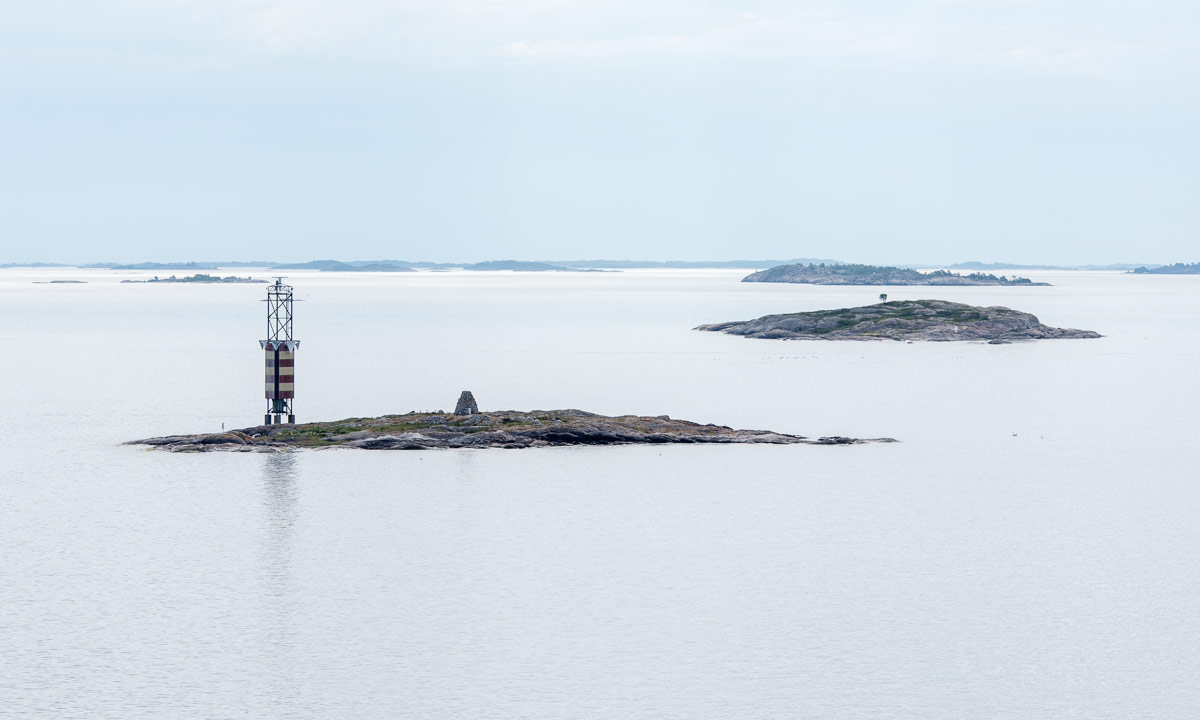
At 8:43 the ferry leaves. We drive through the Turku Archipelago that consists of more than 20000 islands and skerries. The large islands are wooded. Impressive wooden villas are hiding between the trees and small huts that look like carved are by the sea.

After a while we reach more open water. The islands nearby are smaller skerries, some wooded, some rocky.

While the islands pass by there’s a lot of entertainment inside. Bingo – minigolf – dance band – face painting for kids and much more.

At lunch time we enjoy the extensive buffet on board. Here is an expert of the menu. Although it’s Finnish some of the words like paprikaa or palsternakkaa are understandable.

The ferry makes a stopover in Mariehamn, capital of Åland. Here several ferries meet. They connect Åland with Sweden, Finland and Estonia.

Åland is an autonomous territory. Although it lies under Finnish sovereignty it is Swedish-speaking. At the terminal nine flags are fluttering in the wind. From left to right it’s:

Sweden, Norway, Greenland, EU, Iceland, Faroe Islands, Denmark, Finland and Åland.

After the stopover we continue our journey to Sweden. Sometimes it’s cloudy, sometimes it’s sunny and we can sit or lie on the top deck. There’s a small wooden platform right in front of the huge chimney that is perfect for sunbathing. We say goodbye to the islands of Åland and an open water passage lies before us.

After a while we see the first rocky skerry, the first trees, the first houses. We have reached the Stockholm Archipelago, that consists of ca. 24000 islands. We are back in Sweden and slowly we are approaching Stockholm.

Before we dock in Södermalm, we have to leave the top deck to enter our car. It’s Annika who is going to drive. I’m too scared to drive in Stockholm.

Our plan is to leave the greater Stockholm area as fast as possible and look for a campsite. Annika masters the chaos on the road behind the ferry terminal, where’s a big pushing and shoving. Priority rules? Who cares …! She masters the huge four-lane motorway, too.

South of Södertälje the traffic decreases. Now it’s only one hour left to Oxelösund where we want to look for a place to stay. We drive to the island Jogersö and arrive six minutes after the reception of the campsite has closed. Luckily the receptionist is still there and we are allowed to come in. All small cabins are occupied but there’s always place for a tent. So we put up our tent, eat bread and cheese and finally I have to take a bath in the sea before going to sleep.

When we lie in our sleeping bags ready to fall asleep it starts to rain. Just gemütlich!


Winterly Tromsø in May

I’m sitting in the bus somewhere in Northern Finland. We just passed the sign “Tornio 410 km”. Are we there, it’s only some more minutes to Haparanda from where a car ride of another 270 km awaits us. Then I’m home.

Home from the incredible interesting and inspiring but also exhausting Barents Press International Media Conference that took place in Tromsø for two days. Great speakers, great talks! Here are some of the topics:

  • EU and the struggle against fake news
  • How to make your climate change story into a click-blockbuster
  • #Barents #Beingyounghere: Official book release
  • Norwegian spy scandal in Russia: A close friend’s story

At the same time winter had come back to Northern Scandinavia and so to Tromsø. I used the mornings and evenings to walk round or just visit the roof terrace of our hotel to make some pictures of Tromsø.

Thursday 2 May – the weather is quite nice. I’m glad to walk around after the long bus trip there.

Friday 3 May – the morning is windy. First it’s dry but then snow showers rack over Tromsø for the rest of the day. Some of them are quite intense.

Saturday 4 May – Tromsø is covered with fresh snow. The air is cold but the ground is warm and so the snow is partly melting again. In the evening some very intense snow showers cover Tromsø with more snow.

Sunday 5 May – partly cloudy, partly blue sky that reflects in the sea water. And so do the ships.

Although I enjoyed the conference it was a bit of a pity that I didn’t have more time to take pictures and explore the city. On the other side I’ve been in Tromsø several time and probably will be there again.

I would love to work there for some months but the tax rules of the non-EU-member Norway would make that quite complicated because then I had to declare taxes both in Sweden and in Norway.


All articles about Tromsø >

Opening the kayak season 2019

Two days ago a personal weather record was beaten. It was almost 20 °C in Skelleftehamn. in April! In town 22.1 °C was measured, the warmest April day for at least 15 years. And that’s what my garden looks like: beside of a stubborn patch of snow in the shadow of my neighbour’s garage my garden is completely free of snow.

While the air was warm, the seawater was still very cold and I would not dare to paddle without a drysuit. I didn’t want to be boiled in the drysuit and so I postponed the kayak opening to today, when it was colder again.

When I leave the house at 8:45, it is 4 °C. My favourite starting point is still icebound, so I walk to the peninsula Näsgrundet with the kayak in tow. I use a belt and a rope to drag the kayak behind. When the kayak is balanced on the cart I have the hands free and can walk normally. 25 minutes later I reach the shore where I put on drysuit and life jacket. Soon I sit in the kayak and realise, that even though I miss winter there are fun things to do when it’s warm as well.

It’s colder on the sea and I put on my neoprene gloves and waterproof hood. As I expect some of the paddle routes are still blocked by ice. There is still ice between the island Bredskär and mainland so I cannot circle the island. I have to return. I pass a large ice floe – time to enter the floe for some minutes. It doesn’t move, probably it sits on a large rock.

I kayak along the islands Bredskär, Klubben and Flottgrundet, always along the open outsides. Then I head for the island Nygrundet, where I made a very special snowshow tour a month and a day ago. The ice heaps have vanished, only a long strip of ice follows the coastal line. Time to take a break and to have an early lunch. Crisp bread, cheese, fresh grapes and a bar of chocolate. I feel a bit cold and put on my lightweight down jacket, but I would have preferred my winter anorak. I even make a small fire on the ice but more for having it gemütlich than for additional warmth.

After the break I’m full and warm again. I pack my stuff and continue my kayak tour. I paddle along the outside of the islands Nygrundet and Gråsidan, where I make a short photo stop.

Then I continue to Bredskär, where some quite high ice walls are reminiscent of the winter.

I try to paddle between Flottgrundet and Bredskär but soon come to a large area of old and soft ice. I measure the thickness with the paddle – round 30 cm. I decide to walk over the ice and drag the kayak behind. First it works well …

… but then the ice gets softer and softer. Just some steps next to the island I break through. It is not a sudden movement, the ice just slowly gives way. Paired with the buoyancy of drysuit and life jacket that’s probably the reason why I only break in up to my chest. The hole is small and it’s a matter of seconds to get on the ice again. Carefully I take the last steps until I reach land.

Sea ice and lake ice have a strange way of melting in spring. The solid ice transforms to an array of long vertical ice needles. There is hardly any connection between one needle and the next and it’s not possible to lift larger pieces of ice from the water without breaking them. When you get out a smaller piece and drop it, it will splinter into many parts. The structure shown on the photos below is round 10 cm thick.

I continue walking, partly on ice, partly in shallow water. Then I can paddle again. But not for long. Soon I reach another ice field, this one looking very unstable. So I cross the ice by staying in my kayak and pushing myself forward with the hands. Ouch – the vertical ice needles hurt, even through the neoprene gloves. Alas it’s only 15 meters to cross, then I’m in open water again.

The rest of the tour? Slowly paddling back to the starting point – taking off the dry suit – putting on soft shell and down jacket because I feel cold – put the kayak onto the cart and attach it to the belt – walking home. The tour took 5 hours, 40 minutes. 5 km of walking, round 10 km of paddling. Here’s a sketch:

Legend:  on foot | kayak

#escapism – an overnight stay on an icebound raft

Thanks to Facebook I saw yesterday afternoon, that my mate Hans planned to have a sauna in the evening. I took the opportunity to invite myself. Hans answered I should take a sleeping bag with me when I wanted to stay over.

Half an hour I had packed sleeping bag, warm clothes, camera and food and took the car to Bureå. Here in the bay of the marina Hans has parked his rafts. Two rafts are equipped with a cosy cabin with two beds each, the third raft has a toilet and the sauna. In summer the rafts are floating freely and you need a boat to get there. Now it’s possible to cross the ice. When I arrived Hans already had fired the sauna. But first we took an ice bath.

We warmed bread and grilled sausages directly on the sauna oven, the only source of heat. After our third ice bath we warmed up in the sauna and then went in the left cabin. Soon we wrapped up ourselves in our sleeping bags because it was quite chilly. Outside -5 °C, inside only slightly warmer.

I slept well although I woke up several times because the ice cracked loudly. Either it was the frost expanding the ice or the rising water level. Already at 5 o’clock it was so light that I went out to take some photos. Brrr, -10 °C! I could hear the ice crack and the hooting of the whooper swans. Far away some of them swam in the water of one of the few ice-free places.

When I came back it was still early morning and Hans was sleeping. I thought that looked like a good idea, went into my sleeping bag and slept another hour.

When we stood up I was curious about my food for breakfast. The water in my large plastic bottle was partly frozen but still drinkable. To my surprise my yoghurt hadn’t turned into ice over night. Cheese and bread neither. Since it was almost warmer outside than inside we had an outdoor breakfast under the blue morning sky.

After breakfast we called it a day, crossed the ice to our parked cars, said hejdå and left this nice place. Tack så mycket, Hans – thank you, Hans for a relaxed evening and a wonderful spontaneous experience.

Closing ceremony of the Ice Swimming World Championship in Murmansk

This article is part of the series “2019-03: Redex Murmansk”.

I was in Murmansk with Barents Press with a project called Redex 2019. The project goal is to establish contacts between sports journalists and exchange experiences.

Saturday, 16 March

This evening we gather on the Площадь Пять Углов, the Five Corners Square in Murmansk. We want to join the closing ceremony of the 3rd Ice Swimming World Championship. The event has started already and we are not alone.

And it’s a big, long show with loud music. And I mean really, really loud! Never ever will I travel to Russia again without ear protection. Right after some children dances the flag parade that was rehearsed some days ago starts. Loud playback music: A male voice sings a very patriotic sounding song. The only words I understand: “Murmansk! Murmansk!”. To this song flag bearers are marching on the elevated walkway and onto the stage. One group in some kind of winter uniform bears the flag of the event, others clad in black uniforms carry the flags of the participating nations. “Murmansk! Murmansk!” The final country is Russia and of course it gets the biggest applause.


Now the Russian regions whose swimmers participated were presented, and these are a lot. Russia is divided into 55 oblasts and krais, 22 republics and 8 other regions. Not all of them were involved in this World Championship, but many were.

Alexandr Brylin, the guy who swam with the flags yesterday comes for example from the Amur Oblast which is north of China. Альметьевск/Almetyevsk – the town presented in the photo below – is much nearer, just 2500 km by car. Russia is huge!

Everything is accompanied by music, fireworks and flames. An enormous and perfectly staged spectacle.

After that a singer enters the scene accompanied by girls in metallic dresses. The singer is dancing, acting, jumping and gesticulating all the time and finishes his number with a big jump from the winner’s podium.

Finally the award ceremony starts and with that the swimmers enter the scene. They are welcomed by a speaker that stands near the mixer unit in the darkness of the night. TO be able to read the names he wears a headlight. Many people stand around the fenced area, others stand a bit back in the snow that covers the flowerbeds. One child however seems to be longing for a quieter place. It rests a while on some kind of box before it has loaded its batteries and jumps back to its family.

The rest of the evening? A delicious dinner in the restaurant Terrasa with the other participants of Redex 2019 including translator Anna and journalist Dmitry.

We return to the hotel quite early, because tomorrow we will travel back to Luleå in Sweden and already leave at 6:30 local time, that’s 4:30 Swedish time! The journey back will turn out to be relaxed and without any problems. 15 hours later I’ll be home in Skelleftehamn again.

The lake Semyonovskoye in Murmansk

This article is part of the series “2019-03: Redex Murmansk”.

I was in Murmansk with Barents Press with a project called Redex 2019. The project goal is to establish contacts between sports journalists and exchange experiences.

Saturday, 16 March

While swimmers still compete in 1000 m of ice swimming as part of the 3rd Ice Swimming World Championship in Murmansk I leave the spot and start to go back to our Hotel Park Inn. That’s round 5 km to go.

In Summer I would have to go round the lake Семёновское озеро/Lake Semyonovskoye. Now it’s winter and I can simply go across. The ice is at least 50–60 cm thick as the huge ice cuboids along the way show. In the heap of these ice blocks kids were playing. One of them probably will become next generation’s polar explorer.

On the other side of the lake I can spot grey concrete buildings – as cuboid as the ice blocks – and the Russian orthodox church Спас на водах/Saviour on Waters. They have been the background scenery of the championship, too.

And I see people everywhere. The lake is not crowded, but used of many people for different activities. Some of them are sitting on folding stools and doing ice fishing. Others are going for a walk or doing cross country skiing. The nice thing: some of the skiers are quite athletic and fast, others are do not have any technique and are quite slow. But they ski anyway. And all of them seem to enjoy being outside.

These funny “motor-bananas” probably only exist during the ice swimming: The vehicles consist of three parts. In the middle there’s the “chauffeur” standing in a sledge-like plastic tub. At the rear a banana-shaped inflatable rubber thingy is attached on which people can ride. The whole thing is driven by a small caterpillar attached to the front of the plastic tub and operated by the man in the middle.

I start to cross the lake. I pass a snowman and admire his artful face. He looks however too serious to be my namesake Olaf from the film Frozen.

The lake is not so big and soon I reach the other side. Here’s the winter bathing place I already heard of before. I’m angry with myself that I didn’t take swimming trunks and towel with me because the cold water looks inviting. But no swimwear, no bath.

Here I have to leave the Lake Semyonovskoye and I start following the main road Улица Челюскинцев/Ulitsa Chelyuskintsev back to the hotel. Temperature is above zero and the snow is soft, brown and greasy, but it’s easier to walk on that than on blank ice. At the branch Улица Туристов (“Tourists Street”) a woman comes my way. She bears skis with an old-fashioned binding system. I’m sure she wants to go to the place I just left: the Lake Semyonovskoye.

The 3rd Ice Swimming World Championship in Murmansk

This article is part of the series “2019-03: Redex Murmansk”.

I was in Murmansk with Barents Press with a project called Redex 2019. The project goal is to establish contacts between sports journalists and exchange experiences.

The main reason for us to visit Murmansk just this week was the 3rd Ice Swimming World Championship and the 1st Ice Swimming Arctic Cup 2019. There were 7 individual distances/styles and 2 relay distances/styles, all from 50 m butterfly to 1000 m (!) freestyle. The event is organised by the IISA and the town of Murmansk. 400 swimmers from 33 countries will participate.

Friday, 15 March

After breakfast we meet Dmitry, a local journalist at the hotel lobby and then take the trolley bus to the ice swimming pool, which is located in the freshwater lake Семёновское озеро/Lake Semyonovskoye, 5 km from the centre. We arrive there to see the opening ceremony at 11:30 but due to the many starts the competitions already have begun in the morning. As usual we have to show our press badge to be able to enter the arena.

I’ve been on several winter swimming championships before: in Joensuu and Rovaniemi in Finland and of course several times in Skellefteå.

The first thing I notice are the many people wearing robust drysuits. There were two for each lane, all secured with ropes, plus additional divers. They belong to EMERCOM,  the Ministry of Emergency Situations.

The next thing are the restrictions for the press. We have got a plan with the marked areas where we are allowed to stand, but even there we sometimes are shooed away because we block the audience’s view. We are not allowed to go too near to the ice. Security first! The area behind the pool was open for a short time and then closed for the rest of the competitions.

When we arrive the 500 m freestyle competition is in full swing. A total of 47 swimmers compete in this distance. Some people are so exhausted after the swimming that they have to be helped out of the water. Some of them are even lad to the hot tub where they are able to warm up, but most people can walk by theirselves.

The opening ceremony starts with a flag parade in groups of three, one for each country: a boy presenting a sign with the name of the country, a cadet holding the country’s flag and a swimmer of that country. Here we meet again Mongolian swimmer Davaadorj Shagdarsuren.

Then a line of women walk along the green walkway. They are clad in white and blue dresses and hold traditional Russian welcome gifts in their hands: bread and salt. They walk around the pool and present these gifts to the guests from all countries that stand there in one line.

Finally the championship is opened by the outstanding Russian ice swimmer Alexandr Brylin who swims 25 meter holding two flags in his hands.

The next hours I take various pictures: Of the two mascots dancing around, of the swimming itself, or of the Chinese people having fun with the Russian women.

I have a lot to watch and I reflect on similarities and differences of this ice swimming event compared to others. While Skellefteå is partly a fun event with short distances and a funny cap competition, this competition is a 100% serious sport competition. On the other side the opening and closing ceremonies (we got a sneak preview two days before) in Murmansk are colossally enormous. Nevertheless the championships in Skellefteå have a larger public, partly because it’s in the middle of the city, partly because in Skellefteå you can compete in 25 m, too and many locals do this.

The scenery has its contrasts, too: snow – cold ice – open water – people with warm clothes – women wearing fur – swimmers in bathing suits – colourful flags everywhere – grey concrete buildings in the distance.

I take the freedom to loosely quote Tim, who helped organising Redex 2019: Russia will always surprise you!

Saturday, 16 March

Today it’s the day of the 1000 m freestyle competitions. To be allowed to participate you have to proof that you are able to cope being in the ice water for at least 25 minutes. Nothing for the average leisure swimmer. We arrive to heat number 2, where among others Ren Feng Wang from China participates. Just before swimming all participants get a medical exam and another after the swim.

The start commando: all others swim crawling while Ren Feng Wang breaststrokes. At the end of the competition he will be slowest of all with a time of 24:05:04. For me this would be worth an extra medal for being able to cope the icy water such a long time.

Winner of heat 4, men is the German Martin Kuchenmeister, a professional ice swimmer with a time of 16:56:94.

In the same heat a swimmer has to give up. He is helped out at the other side of the pool by the people of EMERCOM.

Some more photos:

Again, it’s the contrasts that fascinate me. The competition, the concrete buildings and the white Russian orthodox church Savior on Waters.

When you watch the championship you hardly realise that there is a lot of life on the Lake Semyonovskoye outside of the fenced area. People are walking, skiing or ice fishing and some of them stand outside the fence and watch the championship as well. After a while I leave the temporary arena and walk across the lake to make some non-swimming photos.

At the end of the day there are two winners of the 1000 m run:

For the men: Petar Stoychev from Bulgaria with 12:10:81. For the women: Alisa Fatum from Germany with 13:02:39. Chapeau!

Links