Taking orthophotos on Kvaløya

That’s me, nine days ago, near a parking place by the lake Finnvikvatnet on the island Kvaløya.

I just got a drone from the Norwegian Polar Institute, a DJI Mavic Pro 2. Since it is forbidden to fly a drone in Tromsø (too near to the airport) I chose a place on Kvaløya to check out the drone and practise a bit.

What you may expect from drone flying is photos like this:

What I actually did that day was taking a bunch of photos like these:

Back at home let the computer do some heavy work. That’s the result:

What I wanted to achieve is creating a so-called orthophoto. That is a stitched image that also contains geographical information. You need quite a lot of photos to get good results. In the map above it is only 9 photos and 11 photos in two distinct groups.

I used two softwares: First OpenDroneMap to create the orthophoto and then QGIS, an open source Geographic Information System, to present the orthophoto in a geographical context.

This afternoon I took a trip to Kvaløya again, this time to the way to Sommarøya and stopped by the lake Kattfjordvatnet. Here I pulled up the drone to an altitude of 80 metres and tried to navigate a rectangular zig-zag pattern with a lot of overlapping between the images. Beside of the fact, that the images are underexposed (and I was too lazy to correct them) I’m quite content with the result. The first image is an oblique shot, the second image is an orthophoto calculated from about 80 images and then placed into QGIS.

Plan for the next two weeks: getting more practise!

My first Thursday paddling 2023

Today I was joining the “Thursday paddling” of the Tromsø Sea Kayakers Club. They started the season two weeks ago, I joined today for the first time this year.

At 18:00 a group of 13 kayakers left the shore by the boat houses and headed to Telegrafbukta, the small bay near my apartment. In the dull weather the kayaks and the paddlers in their drysuits always look quite colourful.

Although I’ve already been paddling in Sweden several times this winter it took me some time to find a rhythm. When I’m alone, I use to paddle slower.

At Telegrafbukta we decided to continue to Sydspissen, the southern tip of the island Tromsøya. There we turned back, paddling through snow showers.

We already saw it on the way there – there was very low water at Telegrafbukta, or just “Bukta” as the locals say. We took a break there but only a short one. The weather was too chilly to be comfortable.

We talked about the weather and came to the conclusion, that summer probably already was on first of May and now summer season is over. I’m not completely sure, if this theory will prove true, but on the way back spring or summer seemed to be far away.

It reminded me at last years first Thursday paddling. It was on 28 April and the weather was as snowy as today. Let’s see how the weather is next week.

Like ice in the springtime …

In the rare cases where the temperature rises above 0 °C something special happens: Ice and snow melt and become a liquid known as „water“. One of these rare occasions is called „spring“ and this is what has started happening right now. In these days many things happen that are related to ice, snow, and water.

8 April: Vattenplasket in Malå

Last Friday Annika and I visited our friends Lasse and Martine in Kusfors and stayed over. Lasse is a journalist and had a job in Malå the next day. There was a very special ski competition named “Vattenplasket” – the water splash. A ski hill and instead of a finish line a large basin with knee deep water. Is it possible to downhill on ski or snowboard and have enough momentum to cross the water? Let’s see:

Most of the competitors failed, two actually managed it. True sportsmanship showed a small boy that did not get enough momentum with his sled and just walked into the water. Kudos!

9 April: almost a kayak tour

On Sunday Annika and I tried to do another kayak tour. Five days ago the ice was stable, this day it had got holes and was not reliable anymore. While Annika stood on safe ice I tried to cross the old ice to the island but **splash!** broke through several times. No biggie, the water is quite shallow and we have drysuits but it is exhausting. When Annika started breaking through as well, we decided to return. Another time …

10 April: winter bath

Finally. Annika and I. Twice. And then: sitting on the rocks in the wet bathing clothes without freezing because the sun is so warm. Springtime!

12 April: ice work

This is a piece of ice seen from the side. You can see the different horizontal layers that accumulated over time.

This is however no glacier ice nor Arctic sea ice. It is a piece of ice from our way to our house. Annika and I have been chopping the ice bit by bit for many days and today was the day: the way to the car and the road is free of ice and snow.

12 April: another “almost” kayak tour

There are other parts that are free of ice: Most of the weak ice between land and the island Lillskär is gone. After work I tried to paddle around the islet. We had low water (-30 cm) and some of the stable ice was grounded while large parts of the sea were open.

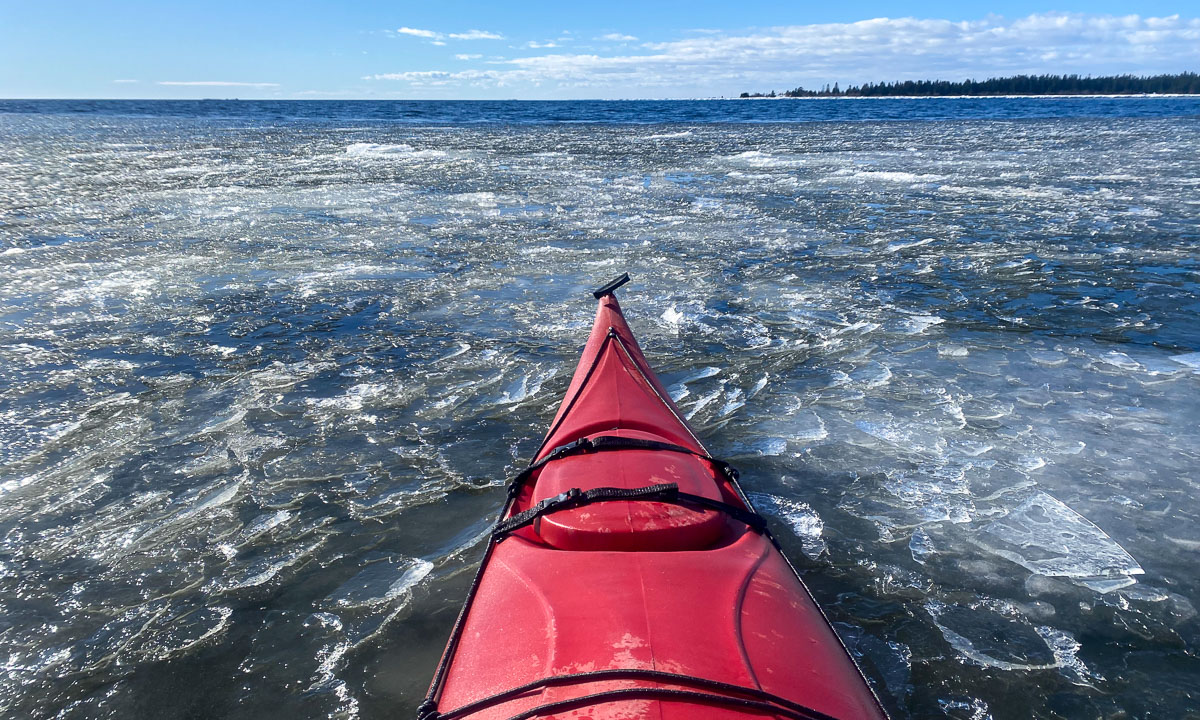
The first part was easy but when I almost rounded the island I came into an ice field. I already had seen it before starting the tour and thought I could paddle through. In theory this was possible, but the wind and the layers of ice made it near to impossible to steer the kayak.

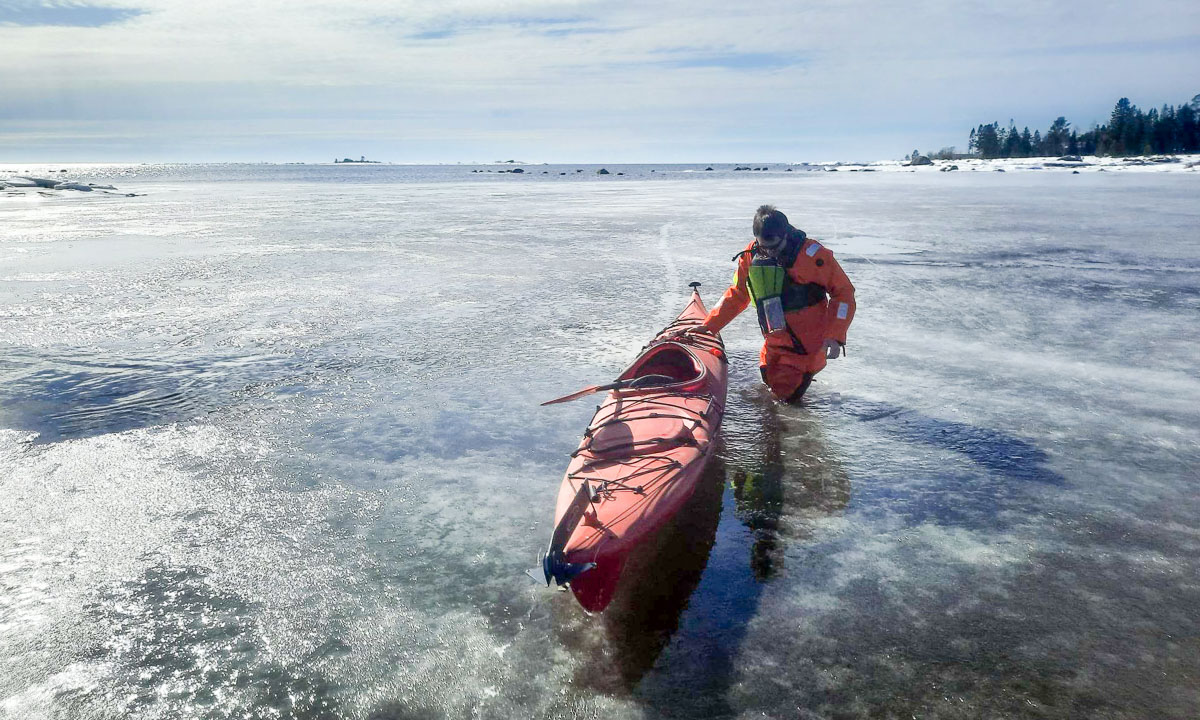
So I got off the boat, jumped into the 60 cm deep water and while standing turned the kayak back to course. Now I could continue my island circumnavigation. Anyhow I consider exiting the kayak on the tour cheating, that’s why I say: I almost circumnavigated Lillskär today.

Even though the ice floes may have been 7–8 cm thick you couldn’t stand on the ice any longer. The ice was “rotten”. Many tiny vertical channels had weakened the ice and made it sensible to vertical stress. You can see it on the next photo. The piece on ice is standing, the bottom part of the ice floe is on the left.

What a wonderful vårvinter kayak tour!

Yesterday the weather was calm and sunny. A perfect day for kayaking! Perhaps to Vitskärsudden, our favourite beach?

Chapter one – Bredskär

Kayaking needs a bit of preparation, especially in winter. After we have fixed a problem with Annika’s rudder, dressed ourself and went over the ice to the northern tip of the islet Lillskär we are ready to start our tour.

Annika goes first, I follow. We turn left and paddle along the edge of the ice.

Sometimes we cross fields with crushed ice. Many of the ice slices are thin and in the waves they sound like tuned bells.

We paddle along the island Bredskär. The waves are shallow and there is hardly and wind. I have to make a short stop to take a picture of the “ice monster”, then I follow Annika to the sandy bay in the northeast of the island.

We continue following the coastal line until we come to Bredskärssund, the sound between Bredskär and Obbola. As expected the sound is covered with ice and we have to return.

Time for …

Chapter two – Vitskärsudden

Slowly we paddle back enjoying the exceptionally beautiful weather and the ease of movement. Leaving Bredskär behind we cross the water heading for the rock that marks the entry to Vitskärsudden.

Arriving there more ice fields wait for us. Here are many layers of thin ice and it is not easy to find gaps to put the paddle in. Often it just glides and slides away.

It is not possible to paddle into the bay. It is covered with ice floes, many of them thick and large. But we do not want return home – too beautiful the day – and decide to paddle to the islands Obbolstenarna where we shortly have been two days ago.

Chapter three – Obbolstenarna

The way there is easy. No mentionable wind, just open water. In front of the islands there is another ice field, but it is small and easy to cross.

The next ice field is thicker. We try to break through but decide to go round. We just follow the coastal line.

In the south we go round an ice cap. According to the nautical map there is no island, just a shallow with some rocks.

Again I take a small detour to take a photo. This time to a large ice block.

Then we paddle north. First along the islands …

… then …

Chapter four – Home

we are leaving Obbolstenarna behind and head home. We enjoy the effortlessness of our today’s kayaking but we got a bit hungry. 10–15 minutes later we stand on the ice near our house.

We take a tour selfie then we drag our kayaks back home. First over the ice, then through the snow.

Thanks for the fabulously beautiful tour, Annika!

Annika tracked the tour with her smart watch. Here’s a small map. I added some names.

Back in Obbola – 20 hours

Sunday 10:30

After a breakfast in the sun heated winter garden Annika and I dress for a kayak tour. Special challenge today is not the frozen bay but the deep snow in our garden. I plunge through the snow, Annika is taking snowshoes while dragging the kayak behind. We are walking over the ice to the small skerry island Lillskär and then turn left until we approach open water. There we start the tour. I give Annika a push, then be both are sitting in our kayaks hopping forward until we reach open water.

We paddle to the islands Obbolstenarna. The way there is fast, a clear sign that we have tailwind. And true, the way back takes much longer. Yes, we are cold, but the winter garden is very warm and soon are we.

Sunday 17:00

A friend from Stockholm is visiting us today. Time to dig out our barbecue place. The two benches are covered with 20-30 of snow and it takes a bit of digging, until they are usable again. On the photo you still can see last day’s ski track crossing the bench.

Sunday 19:00

It gets cold and we have moved to the winter garden again. Blue sky, blue sea, blue snow, blue hour.

Sunday 20:23

A bright greenish light crosses the night, much faster than a plane. What was that? Many other sightings in Sweden confirm my thoughts: it was a bolide, an extremely bright meteor. I never saw anything like this. Since it was a matter of seconds, I couldn’t even think of taking a photo.

Monday 5:45

I wake up. Unnecessarily early for having vacation. Anyhow I peek out of the window. A beautiful morning, and with -13 °C a cold one for beginning of April. I pull ski pants and a down jacket over my pyjamas, slip into my boots and go out to take photos and wait for the sun. The icy edge at the horizon is already sunlit and I can see a weak light pillar above the island Bredskär. Fifteen minutes later the sun rises over the forestal island and I enjoy the sun for a short while.

Monday 6:30

When I’m back in the house it is still early. Time to take off the warm overclothes and continue sleeping …


12 more photos of Longyearbyen

This article is part of the series “2023-03: Svalbard”.

3 March

It is the first evening of Annika’s and my stay in Longyearbyen, Spitsbergen, Svalbard. We already strolled through the settlement after arrival. Now it is dark but the full moon illuminates the end of the road of Nybyen, one of Longyearbyen’s districts. What a special feeling to be in one of the world northernmost settlements on Earth. And a slightly tense one. It’s the edge of town, are there any polar bears around?

8 March

When you are in Svalbard you have to keep distance to animals to protect them. The animals do not follow this rule. This is a Svalbard reindeer, an own species of reindeer living here. It is looking for food in the middle of the city.

9 March

I didn’t expect to see ptarmigans on Svalbard but on our guided minibus tour we get to see a whole flock, again in Longyearbyen. Magnus is so kind to stop so that I could take a photo from the road.

10 March

This day is quite warm for Longyearbyen: Only -8 °C. When I took this photo however it was windy. Average wind wind 16 m/s, gusts 21 m/s and snow is blowing in the streets.

12 March

Annika is on her way home, I’ll stay for another week and today I enjoy the beautiful weather by the coast. The mountains on the other side of the fjord Isfjorden look quite near today – especially through the big telephoto lens.

15 March

I take an after work stroll along the coast and through town. It is cold and even with the modest wind of 6 m/s windchill is below -30 °C. It looks arctic, it smells arctic (the nose hairs freeze together immediately) and it feels arctic. No wonder – I am in the Arctic. Even the petrol prices show, that you are not in mainland Norway any longer. Petrol is cheap because Svalbard has reduced taxes.

18 March

Another walk in town. Up the hill to Taubanesentrale (the central of coal mining cableway), down to the center and up again to the elevated way in the east, part of the avalanche protection.

19 March

Sunday. Tomorrow I’ll fly back to Tromsø, today I’m quite lazy but finally I walk to the coast again because of the wonderful weather. Even with my hood on I can hear something above me. I look up and see the first two seagulls since I have arrived here. It is two glaucous gulls that draw large circles above the coastal line.

I try even to take pictures of the incredibly coloured mountains on the other side of the Isfjorden but the turbulences in the air make clear pictures impossible. I’ll keep it in my memory as I’ll do with my whole stay in Longyearbyen.


Colder days in Longyearbyen

This article is part of the series “2023-03: Svalbard”.

Two days ago on 14 March 2023 it started getting colder in Longyearbyen. Yesterday temperatures were around -19 °C, today around -21 °C.

Yesterday I took a walk after work and took some photos with my tiny Sony camera that worked surprisingly good in the cold when being kept warm.

While light was beautiful yesterday, today it was magic. After work I went to my apartment. Round about 15 minutes later I left it with all my camera gear and went to the shore. Due to the interface between the open water and the cold air ice fog covered large parts of the Adventfjorden. While I looked for good places to take photos the setting sun and the altering fog changed the mood every minute. Extraordinary beautiful!

Like the days before the sunset colours on the snow covered mountains became warmer and warmer until they reached a delicate but intense purple shade while the sunlit parts rose higher and higher until only the tops stayed in the sun.

Remember, these photos were not taken in the wilderness, I’m in the settlement Longyearbyen and my apartment lies just 500 metre from the nearest photo spot.

As already mentioned today’s temperatures were round -21 °C. With a moderate breeze of 6 m/s that felt like -32 °C. Pretty cold and the ice fog didn’t make it warmer.


Ta sjansen

This article is part of the series “2023-03: Svalbard”.

Funny clad people and strange vehicles on the town’s ski slope in Longyearbyen, what happens?

Today it’s the last day of the sun festival week and one of the items on the agenda is “Ta sjansen” (take the chance) an annual race down the ski hill with self-made vehicles where creativity is as as important than speed.

1 – 2 – 3 – here we go!

And – what do you think? Who won the race?

Sol, sol, kom igjen, sola er min beste venn!

This article is part of the series “2023-03: Svalbard”.

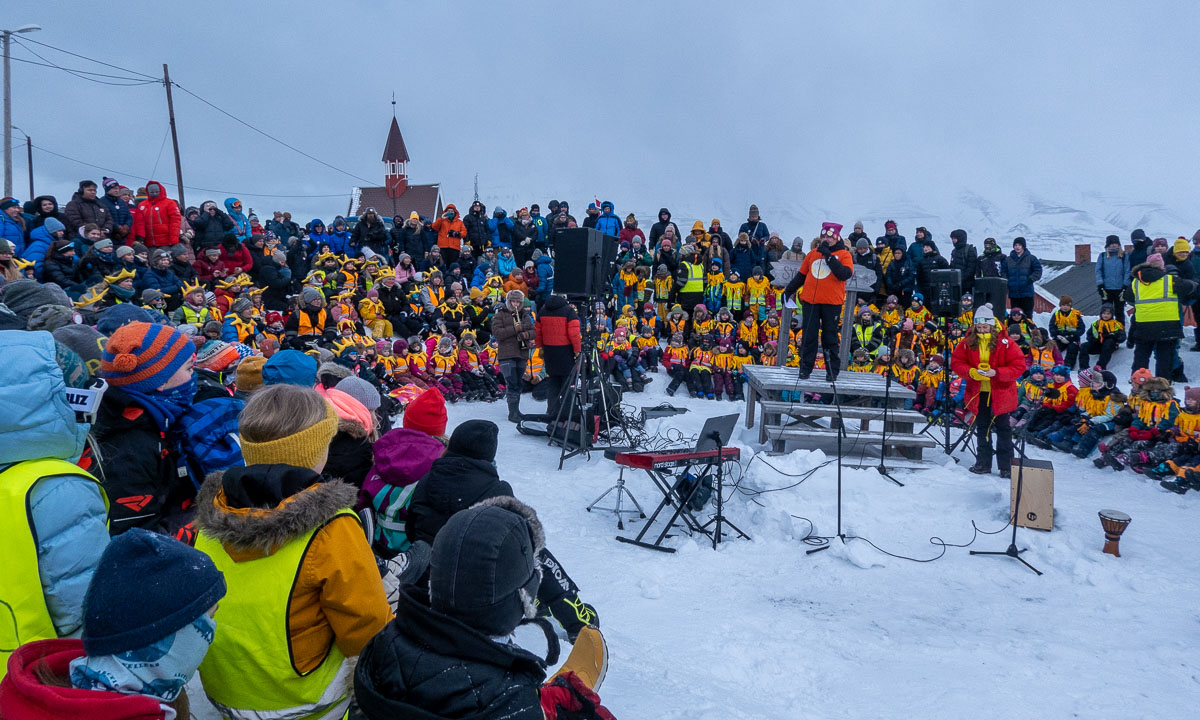
It is 8 March 2023, a special day in Longyearbyen. While polar night ended already three weeks ago today is the first opportunity to see the sun in Longyearbyen above the mountains in the south. A special day after the sun disappeared in October last year. And as you can see it is a big celebration!

After some singing the moment has come. All people are shouting: “Sol, sol, kom igjen, sola er min beste venn!” – Sun, sun, come back, the sun is my best friend!

But the chanting was in vain: the sun didn’t appear. Some children are in doubt – was it the clouds or didn’t they shout loud enough.

But now it’s only a matter of waiting. Already in six weeks the time of polar day and midnight sun will begin.

Kudos for the musicians. Must be hard to play guitar or piano when windchill is round -23 °C. Brrr!

Two-day dogsledding tour in Svalbard – day 2

This article is part of the series “2023-03: Svalbard”.

Last night I dreamt that a heavy polar bear was lying on top of me. It had sneaked into our sleeping room. In reality a polar bear could never have approached the cabin unnoticed. We have seventeen polar bear guards outside: the sled dogs.

It is half past seven. I just started a fire because the inside temperature of the cabin in Tverrdalen has dropped to 5.7 °C, while it is -20 °C outside. It is the second day of Annika’s and my dogsledding tour in Svalbard and despite some stormy gusts of wind the weather looks quite promising.

Snow is blown around the dog sleds. Most dogs are still sleeping, some of them half snowed in. Snow will keep them warm, it is a good isolator. Not all dogs have slept outside, some have slept in wooden boxes to be protected against the wind.

I hurry to go in again, the glove livers were much too cold in the cold wind and my fingertips hurt. The next hours we are busy with taking breakfast, packing things, tidying the cabin, putting our clothes on and taking care of the dogs. While we are outside the wind is calming down and the sun shines on the snowy mountains round Tverrdalen.

We say goodbye to this wonderful place and start our journey back to the dog kennel in wonderful winter weather. Annika and I have put the bulky isolated anoraks into the sledge, they were too warm the day before and use our own windproof jackets. The fur-rimmed hoods are a good protection against wind and coldness.

We take a lunch break at the Scott Turner glacier, but before that we visit an impressive ice cave. I’ll write an own blog article about that later.

After a warm lunch break – Real Turmat outdoor food only needs hot water – we walk the dogs to the sledge and start our last stage of our dogsledding adventure.

It is not only the great weather, the beauty of the valley Bolterdalen and the mountains around, it’s the dogsledding itself that is great fun. After only a day Annika and I know how to work together, help the dogs, shift weight, brake and release the brakes again. Now we hardly have to help the dogs by pedalling or pushing the sledge. It goes downhills and the dogs know that they are on their way home where they will be rewarded with treats. So we glide effortlessly through the snowy landscape enjoying this extraordinary experience. And then we are back at the dog yard, were our sled dogs are eager to get loose and run around a bit, greet friends and wait for their goodies.

Annika and I get to know Foxi as well, the famous dog that led Tommy’s sledge on the Iditarod race and has also been at the North Pole. While Tommy and Adelheid are taking care of both dogs and other tourists Annika and I are sitting in the living room of the dog yard’s cabin and are chilling. Adelheid’s jeep needs a jump start – it does not like the cold – then she brings us back to town.

@ my colleague Y.: Thanks for the tip. Great tour. We enjoyed every minute!
@ Janne and Tommy: Thanks for the organisation of this extra tour!
@ Adelheid: Thanks for the guiding and cooking! It was a pleasure meeting you!
@ the dogs: Thanks for your hard work and your relaxed attitude 🐾!