Jämtland hike part III: back to Sweden and finishing the tour

This article is part of the series “2016-09: Jämtland and Norway”.

After two days in Norway we headed back to the Swedish mountains.

Thursday, 15. September

We started our day with a breakfast.

The Norwegian lodge Nedalshytta is really beautiful, but doesn’t have a kitchen and sells only some snacks, when it comes to food. Luckily we had both own things to eat and a mug with us, so would could enjoy our own breakfast: oat flakes with frothy milk! How to get frothy milk on a mountain tour? Mix milk powder and water in an empty coke bottle, shake it vigorously and voilà: schiuma di latte à la Annika.

After packing our backpacks we started our hike to the Sylarna Fjällstation. It was the first cloudy day since we started our tour three days before and anything was moist and wet. Sometimes we had to take a break to pluck some blueberries, that still tasted fresh and sweet.

We went along the Templet, which is Swedens highest peak of the Sylarna mountain range (1728 m). (Storsylen with its 1762 meter altitude is higher, but on the Norwegian side, just 100 meters from the Swedish border.) Due to the weather we first couldn’t see that much but after a while it started to clear up and the clouds released the view on the huge and barren slopes of the Templet massif. We were so lucky, that we hadn’t to go this part of the trail in fog and clouds.

Soon we arrived at a place called Ekorrdörren – the squirrel door.

We started our tour at 780 m above sea level. Now we were on 1100 meter and would have to go up another 260 meters to reach the Ekorrpasset – the squirrel pass – which is 1360 m above sea level and so the highest point of our tour so long. We started climbing up the slope but had to look back over and over again. The undulating valley of the river Åeruvedurrienjohke with it’s many hills and ponds looked like from another planet.

Our trail got more and more rocky. After a while there was hardly any way left, we just went over angular rocks with gorgeous views of the Templet, including a small glacier and the Slottet, another peak of the Sylarna.

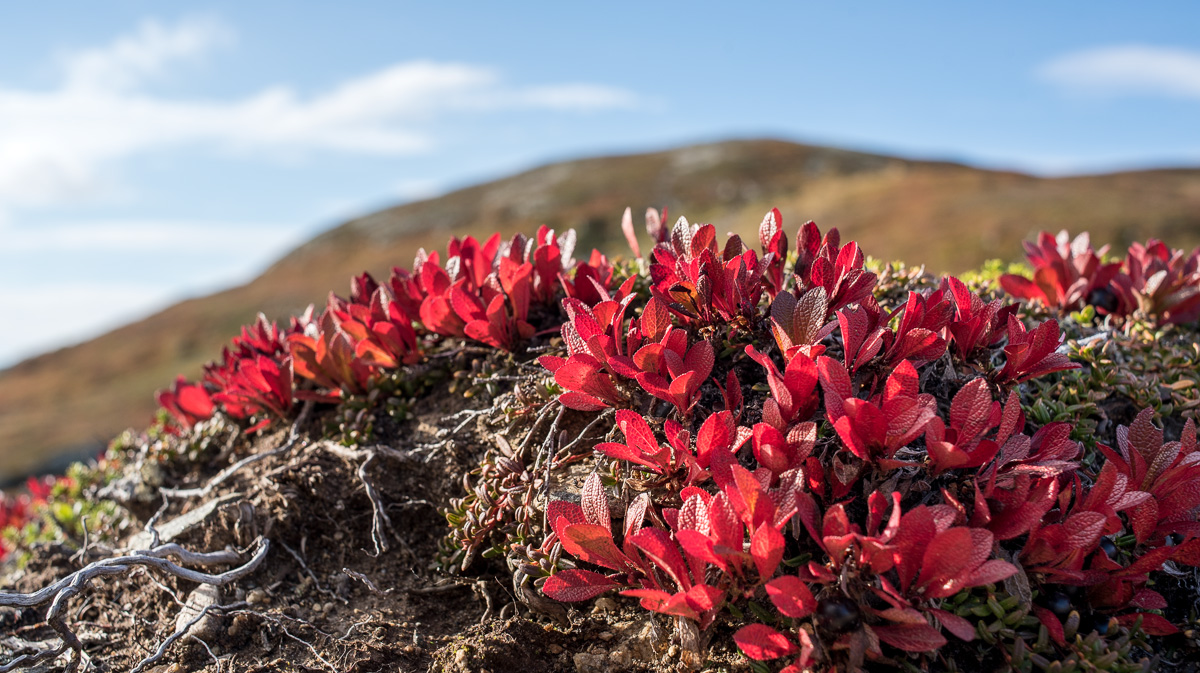
I really love the changes of the landscape you can have within just some hours: From autumnal birch forest with blueberries over to grass covered plateaus and finally up to an asteroid-like landscape that looks like a pile of stones.

Especially the squirrel pass looks both harsh and impressive. Anyway, when you go up a pass you’ll probably go it down as well and even 200 meters altitude make a difference. The Sylarna Fjällstation lies near the river Sylälven that flows through a wide grass covered U-shaped valley and when we came nearer we could see three reindeers standing in front of the cabins. Back to civilisation.

We had hiked four days in a row and were quite eager to take a day off. Sylarna fjällstation would be an ideal place, since it lies beautifully and you can leave that place in six different directions. Alas, there weren’t only reindeers, but people, too. Many people. The place was crowded! There were many hikers and mountain joggers. In the big dining room sat a large group of bankers that got their three-course dinner including candlelight and fresh salad, brought by helicopter. We were unsure, if this should be a good place to rest for a day.

The information we got in the evening shocked us a bit: There were already 100 – 125 booked sleeping-places for that night (in addition to all people that would come without booking). That means, that this place would be even more crowded. Even Helags, which is more in the South had just some single sleeping-places left.

That was the moment, where we decided to escape.

We would stay overnight of course, but the next day we would abandon the tour and hike back to Storulvån, were I parked my car.

Friday, 16. September

I was awake quite early, took my camera and tripod and walked out to wait for the sunrise. The valley Endalen was covered with fog. I looked at the glacier Storsylglaciären,that covers the eastern slope of the Storsylen and a lavvu – a traditional sami dwelling. The sun however showed up quite late, there were too many clouds.

I looked at the less beautiful parts of that place too: An excavator on a flat building site, a welcome sign surrounded by building material and waste.

We started the tour being content to leave Sylarna behind but a bit melancholy, too, because we didn’t plan to leave the mountains already after five days. Annika started to count the approaching hikers, there were quite many …

After half the way we approached something quite funny:

It’s neither a sculpture nor a church, it’s a WiFi-station including a recharging unit for smartphones! It is even marked in the hiking map: “WiFi och laddstn.”. There were many hikers and even some mountain bikers resting, but no one started the WiFi. The cellular network is quite good in that part of the mountains and I guess there’s hardly a young Swede without a mobile internet flat rate.

We continued our tour and slowly hiked down the valley Endalen. After a while we were below the tree line and the landscape got even more colourful.

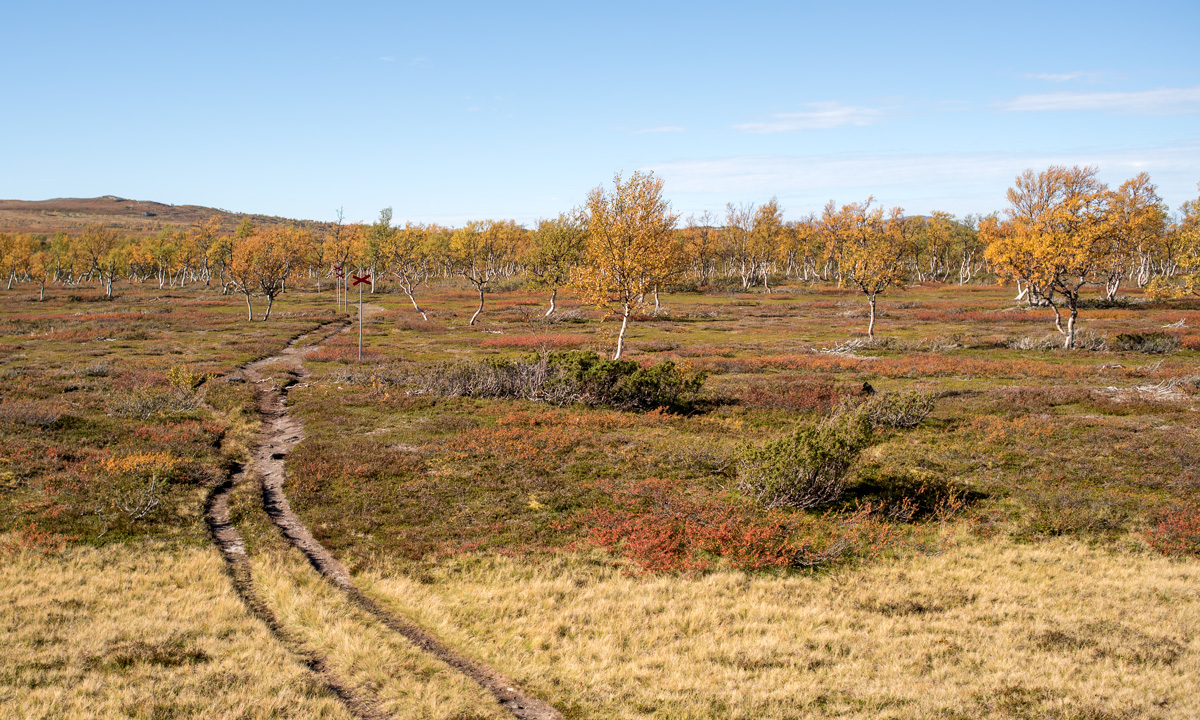
And just shortly before we reached our starting point, were we had left four and a half days before I spotted a lonely birch tree – almost leafless. A symbol, that winter will come even this year. Fifteen minutes later we reached Storulvåns fjällstation, then the parking place, then my car. Annika has counted almost 150 people hiking, jogging and cycling to Sylarna, just from one direction! That confirmed our decision to leave Sylarna behind.

It has been a fantastic and varying tour with many different experiences in a short time. Tack för turen – Annika!

The End.

“Wait, wait …”
– “… wait, what?”

“How can it be the end? You had two weeks holidays, not only five days!”
– “well, ok, we did continue our journey.”

After changing cloth, using the bath room and drinking a coke we got in the car and I drove the way back to Enafors, that lies at the E14 which connects Trondheim in Norway with Sundsvall in Sweden. We considered some options but didn’t decide yet what to do next. Shortly before we approached the E14 I asked Annika: “Back to Umeå or Norway?” The answer was: “Norway”. So we travelled to Norway …

Stay tuned for the next article telling more about our trip in Norway …

Jämtland hike part II: hejdå Sweden, hei Norge!

This article is part of the series “2016-09: Jämtland and Norway”.

Annika and I are in the mountains in Jämtland and have just reached our first destination: Blåhammaren, where we slept in a 14-bed room.

Tuesday, 13. September

Sleeping in a 14-bed room can be quite demanding, especially if you have this kind of snorers in your room, that could awake a frozen mammoth. However Annika and I were really lucky, no snorers at all! After our breakfast we had to decide where to continue our tour. From Blåhammaren you can hike back to civilisation or continue to two other destinations. Most of the hikers continue to Sylarna which is very central and part of the Jämtland Triangle, a very popular three-day-tour, that connects Storulvån, Blåhammaren and just Sylarna. We were keener to cross the border and hike to the Norwegian lodge Storerikvollen and so we did.

With an altitude of 1086 m Blåhammaren is the highest tourist station of the STF – the Swedish Tourist Association – so first the trail ran over the treeless mountain plateau, over rocks and moss, crossing some swamps and brooks. After a while we descended and the first yellow coloured birch trees came into view again.

Swedish summer trails are marked with red coloured dots on rock or tree, while winter trails are marked with poles bearing red crosses. You really shouldn’t follow the winter trails in summer unless you want to stand in front of a lake or find yourself deep in a bog – both are easy to cross only in wintertime. But quite often there’s a year round trail which makes navigation extremely easy even on less walked routes.

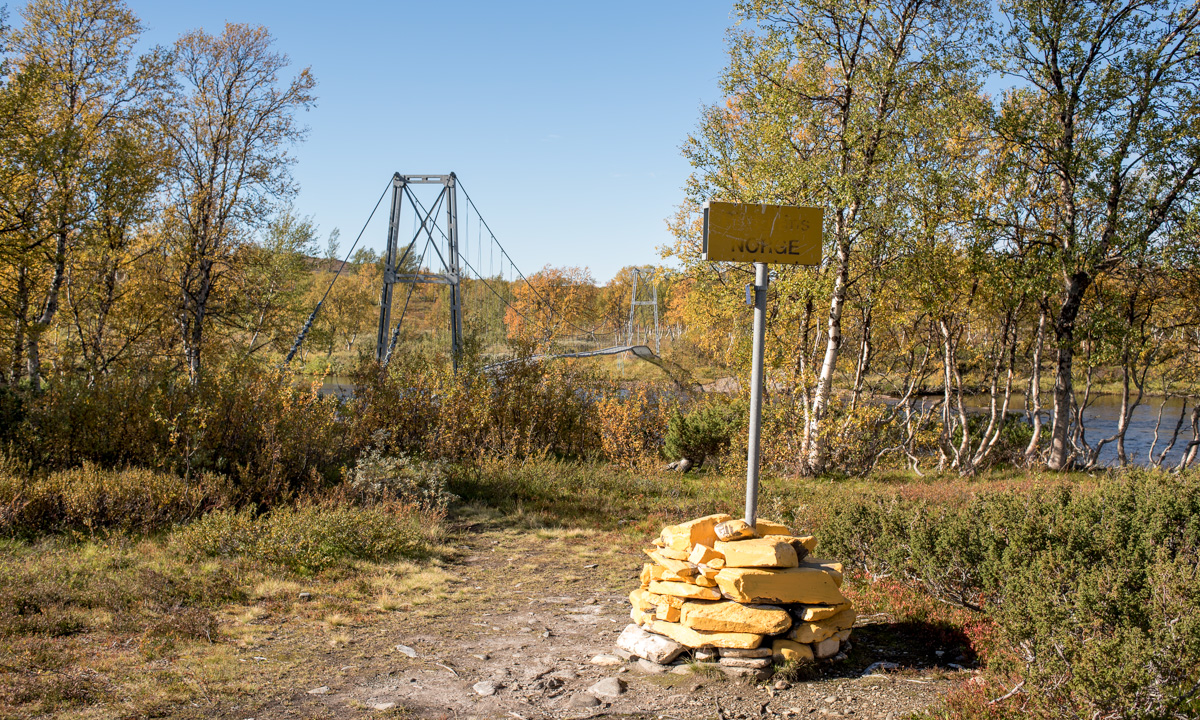
One kilometre behind Endalen, an emergency shelter, where we rested for a short while, the Sweden-Norwegian border came into view. It’s hard to mark a border less spectacularly than this one: A sign amidst of a pile of yellow painted stones, that’s it. The large bridge that crosses the river Enan (Sami: Äjnänjohke) directly after the border offers far more spectacularity.

We detected a real nice resting place on the other side of the river, where we planned to enjoy the warm summerly weather, but two other hikers – by the way the first ones we met that day – coming from the other side chose exactly the same slab of rock to rest. Luckily we found another place, at least as nice as the first one. We unmounted our backpacks, took of our boots and dangled our feet into the ice-cold water.

(I like the photo with the drifting yellow birch leave and the dead mosquito. It illustrates, why I prefer the autumn to summer: Beautiful colours and no biting insects left!)

In Norway the summer trail marks change, now the trail was marked with big bright red T-s. The red T is also the logo of the DNT, the Norwegian Trekking Association.

Do you see the dark piece of something on the top of the stone? It’s animal droppings, but I’m not sure of which species. I asked for help on Facebook and the favourite answers are reindeer and (arctic) fox.

We continued our tour until we came to another swing bridge, this time crossing the river Djupholma. On the other side of that river lies a nice sandy beach where I took a refreshing bath (the only one of the whole tour). It was only two other kilometres to walk to our destination, the cabin Storerikvollen, where we arrived round six o’clock.

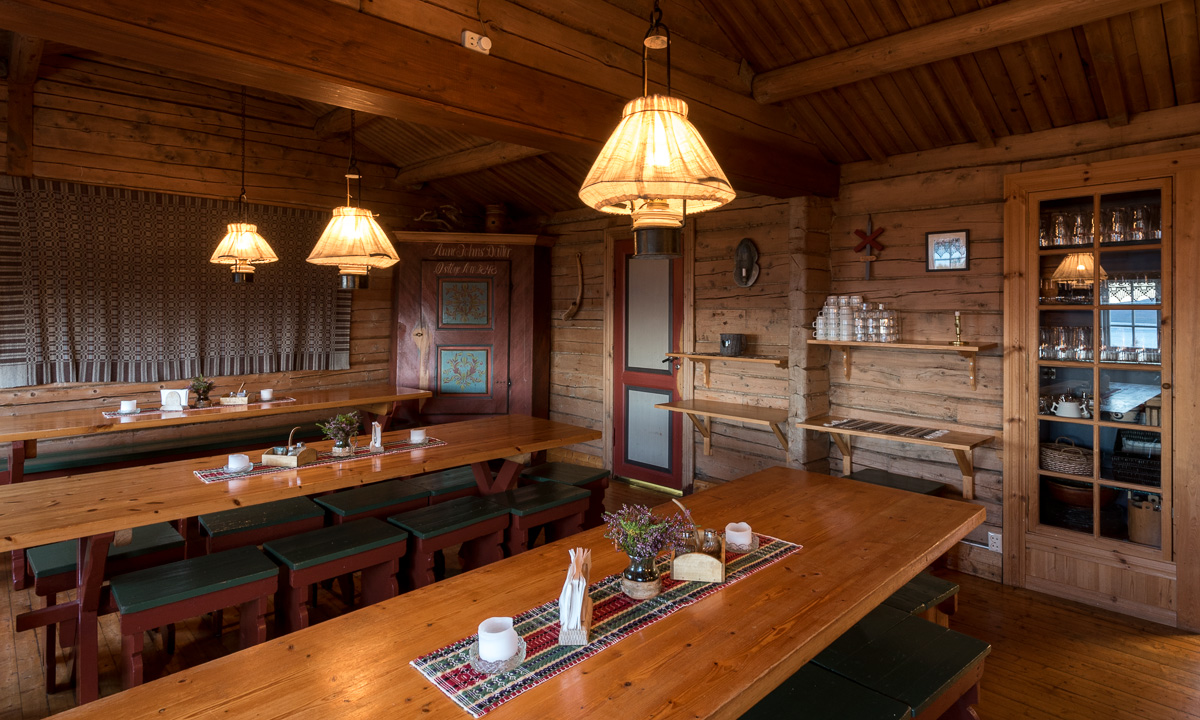
Oh, so nice these Norwegian lodges are. They seem less “funkis” (the Swedish functional style) and more “hyggelig” (the Norwegian word for cozy, snug, or homelike). Just gemütlich! And we got a two-bed-room for a good price. The only thing you should know, when you visit the Norwegian side: These cabins hardly sell any food and there is no public kitchen as in the Swedish cabins. So you have three options: (1) take a camp stove with you and cook outside. (2) cold dishes! Hopefully you have all with you. (3) eat the dinner and breakfast provided by the lodges (and pay the Norwegian price).

We chose (2) and had a nice dinner with salami, crisp bread and fresh water outside in the evening sun, enjoying both our simple meal, the warm air and the beautiful view. Later the almost full moon rose above the reddish mountain chain – what a beautiful evening!

Wednesday, 14. September

The next day would lead us to the Nedalshytta, which is between 20 and 24 km away, depending on which map or sign post you rely on. So we got up quite early.

We had to go back yesterdays route 2 or 3 km where the trail divided. Now we turned south and had to ascent. Soon again we were above the treeline. When we looked back, we could see parts of the big lake Essandsjøen and even spotted – beside of some reindeers – the now tiny Storerikvollen, that we left some ours ago.

After a while we came to the river Fiskåa, where we had to ford. My rubber boots were high enough and I just splashed through the water, whereas Annika changed boots with trekking sandals and waded through the river.

Since rivers use to flow through valleys we had to ascend again and walked up along a reindeer fence. The weather was still warm and sunny, but you could see a cloud layer approaching afar. Would it rain in the evening as the forecast told us?

Only the map showed us the progress of our longest tour so far. We went a bit up, a bit down, a bit to the left, a bit to the right, down a small valley and up again. But finally trees came into view once more and soon we stood on an exposed plateau not far away from the yet invisible Nedalshytta.

Come on, just less than a kilometre to go … . Final spurt! A short while later we arrived at the beautiful lodge. Again we got a nice two-bed room, this time right below the grass roof. And we got: pizza! Perhaps not the best I ate in my life, but walk 20 – 24 kilometres with a backpack by yourself and you’ll know, how delicious a warm pizza slice can be!

The tour so far:

Continue with part three …

Jämtland hike part I: Storulvån—Blåhammaren

This article is part of the series “2016-09: Jämtland and Norway”.

After three weeks of travelling I’m back in Skelleftehamn. The first week I was in Germany, then I travelled back to Umeå, where Annika lives. Let’s start there:

Sunday after breakfast Annika and I started our tour through the autumnal Jämtland. However the first day’s focus was on getting there by car. It takes round six and a half hours to get from Umeå to Storulvån. We made a stopover in Åsele to look in on some friends and so it took a bit longer until we reached the STF Storulvån Fjällstation where we parked our car. But anyway, we have semester – holiday – and plenty of time. It was even still daylight left, when we crossed the creek Stor-Ulvån (sami: Stoere Vïerejällanjohke) to get to our cabin.

Monday, 12. September

I awoke quite early the next morning and went out to make some photos of the beautiful morning mood and the autumnal colours of nature.

After our breakfast we shouldered our backpacks and started the tour. My backpack could have been quite lightweight if I hadn’t taken my camera, four lenses and a tripod with me. Nevertheless the weight was less than 15 kilos since we were able to buy food in almost all cabins and mountain lodges.

First it was a bit cloudy but soon the sky cleared up more and more and we got a warm autumn day with temperatures up to 20 °C, which is quite warm for the season. The summer trail led us first through autumnal birch forests but after some kilometres we were already on the kalfjäll – the bare mountains above the tree line.

In the middle of the trail between Storulvån and Blåhammaren lies the cot Ulvåtjärn, one of the “emergency cots”. You’re welcome to have a break here, but not to stay overnight beside of emergency situations. Right before this cot you have to cross the Stor-Ulvån again, this time by fording it. When Annika crossed the river three years ago, the water was knee deep, now the water level was much lower and I could just cross it in my rubber boots, while Annika went barefooted.

After a break we continued our tour to Blåhammaren. There were many reindeers on the fjäll. No big herds, but many small groups here and there. They are quite shy and cautious, but on the kalfäll it’s quite obvious, that they are the real residents of the mountains, not we human beings.

We continued our tour on the treeless mountain terrain until the Blåhammaren fjällstation came into view. Here we got two beds in a 14-bed-room and entered the sauna, that has a gorgeous view. After that Annika invited my to a three-course dinner (Blåhammaren is famous for its cuisine) where I got the most delicious reindeer meat I ate in my whole live. Thanks for the invitation, Annika!

While we enjoyed our dinner it started to get dark outside and after a while the beacon in front of the main house was lighted and the first stars came out. Later in the night we got a fantastic crystal clear starry sky, but no Northern lights. I considered about taking some pictures of the milky way, but I was too lazy and too tired.

The tour so far:

Continue with part two …

757.5 – from Mosvik to Skelleftehamn by car

Last week I’ve been in Mosvik (Norway) to visit friends. Yesterday I drove back home, not directly but with a detour via Nordli and Røyrvik (Norway) and Stekenjokk, (Sweden).

According to google maps the direct way is 671 km, taking 8 h 38 min. With the detour it is only 67 km, but 1 h 46 min longer. That says a lot about the small and steep gravel roads near the Swedish–Norwegian border …

For me the journey didn’t take 10.5 hours, but more than 15. For one thing I don’t drive fast, especially in Norway and for another thing I took many smaller rests for taking pictures as well as a lunch and a dinner break. I left at 9 o’clock; at quarter past midnight I finally was home again. Total distance by car: 757.5 km.

See my travelogue of the journey by clicking the first image and navigating through the images. Swipe on touch devices and click or use arrow keys on other computers.

By the way: After nineteen articles without any photo with snow, this is the first article showing at least some patches of snow again.

Kungsleden: returning to civilisation

This article is part of the series “2016-02: Ski tour on the Kungsleden”.

From the Tjäktjastuagn to Alesjaurestugorna

27 February · 13 km · Link to map

This day I continued to the Alesjaurestugorna, the last mountain hut in the kalfjäll –  the treeless mountain landscape in Lapland. Perhaps that’s why I was a bit sad, because I love the bare mountains and I felt that I had to say farewell to this outstanding landscape soon. I said farewell to quietness a bit, too, since I knew, that Alesjaure would be quite crowded:

But first of all I had a nice trip of thirteen kilometres to go. Weather was good and the way was short and easy, even if there were some patches with hardly any snow that I had to bypass. So I arrived in Alesjaure already at a quarter past one, being the first guest.

Other guests came, from Austria, from Germany, from France and from Denmark – many interesting people. And in between five scooters arrived – all with a trailer loaded with figures dressed in huge black down parkas and ski goggles – the Englishwomen. Their plan was to go back to Abisko on skis in two days with some detours to make it a full marathon distance.

The rest of the day was relaxed and easy-going. First I sat the sauna, then I made dinner (an outdoor meal called “Rice with basil” – quite boring). After that I sat together with all those kind and interesting people. At half past nine one of the Danes started to make pancakes – and I was invited! The Danes told me, that each of them has a surprise for the others on their tour and the pancakes were the first surprise. What a great idea (especially, since I benefitted from this surprise). I went to bed at half past ten – much later than the last days.
From Alesjaure to Abiskojaure

28 February · 20 km · Link to map

The next day I wanted to continue to Abiskojaure, that’s the longest part of my journey. The last tour days had quite short distances between 12 and 14 km and I was rather slow. As a photographer I have a good excuse: It’s making photos, that takes time, not my slow speed! Anyway, today I planned to start very early and decided to go a bit faster to avoid arriving in darkness. But first I had to get water, there was hardly any left.

If you tent in the winter, you’ll have to melt snow in most cases – this takes a lot of time and doesn’t taste well. The mountain huts on Kungsleden have ice holes to get fresh water, either in lakes or rivers. The ice hole of Alesjaure lies exactly below the summer bridge. It is covered with a wooden look to reduce freezing over, but I had to break the fresh ice anyway. It’s almost impossible to fill a 25 litre container with water (lowering the bucket into the small hole – pull it up again – pour water through the funnel – de-ice the funnel – pour water through it again) without getting wet hands. Oh, what I longed for waterproof gloves. My fleece gloves were completely soaked and my fingers got so cold that they itched when I “defrosted” them above the gas oven.

That’s why I started a bit later than planned and at the same time as the marathon skiers. They followed the official winter way, I took the short cut over the frozen lake Alisjávri. Although I took pictures I was faster than the skiers – some of them probably stood on skis the first time – and when I left the lake to join the winter way they already lagged behind.

I tried to go a bit faster, but stopped for some photos:

After I went more than half the way I took a break. It’s quite warm: -5 °C and even the cloud-covered sun warms a bit. For me it was a bit like saying good-bye. Good-bye to the treeless kalfjäll. Soon I will enter the narrow valley Gárddenvággi where terrain declines. And soon after I finished my break and continued the tour I saw the first small birch woods. The sun has disappeared behind a cloud layer and the landscape got monochrome. Dark birches, white snow, only interrupted by some red waymarks.

The last descend to the woodlands is quite steep. I decided to unmount my skis and go on foot. Even so the pulka tried to push me down towards the valley and I had to lean back to avoid being knocked over. After some minutes I was almost level with the Abiskojaurestugorna and went the rest of the tour through denser birch forests on skis again. I have to admit that I found this part a bit boring – we have snow and trees in Skelleftehamn, too, but soon I arrived at the mountain huts, where I spent the rest of the day.

In the evening I met C. who wanted to go to Abisko the next day and we planned to do this last part together.

From Abiskojaure to Abisko Östra and home

29 February · 15 km · Link to map

Let’s make it short: This day was travel day. C. and I woke up at 6 o’clock. Not by our own will but because we had the loudest snorer ever in our room. Jet engine level! We took a short breakfast, packed our pulkas and started our tour. Not to Abisko Turiststation, the classical start and end of the Kungsleden, but to Abisko Östra, the station of the village Abisko. I went on skis, C. just with normal boots, since the snow on the snow mobile tracks was packed and easy to walk on. C. was much faster than I use to be, but we headed for the 12-o’clock-train and I was keen to get it, too. We took two breaks: One for elevenses (or some kind of pre-lunch), one for the reindeer posing in front of the kåta.

We mad it, we even had an hour time until the train arrived. 14 km in 3 hours, 8 minutes (including the two breaks) – that was the fastest part of my tour. Thank you, C. for helping me leaving my comfort zone a bit.

The rest of the tour: Train from Abisko Östra to Luleå. Bus from Luleå to Skellefteå. Bus from Skellefteå to Skelleftehamn. I was home at 21:30 – 13½ hours after starting on skis in Abiskojaure.

Now it’s midnight. I’m sitting in the living room of my house in Skelleftehamn. I really like this place, but I’m already longing to the Swedish Mountains again. Perhaps another ski tour later in April?

Well, we’ll see …

Hunting the cold – day #1

This article is part of the series “2016-01: Hunting the cold”.

Two days ago it looked like that it could by quite cold in Northern Sweden yesterday and today. I checked several places and their weather forecasts and Pajala with a forecasted temperature of -40.4 °C won. That’s good news, since Pajala is only 350 km away. Nikkaluokta for example is one of the coldest places in Sweden, is 537 km away and it will take more than 6 hours to travel to (when conditions are good).

Yesterday – 6 Jan, 2016 – I packed kamera, very warm clothes and all you need for ski tours into my Saab and started the trip. In Skelleftehamn it was -17 °C, but already 20 km away the temperature dropped to -20 °C.

I made a stop in Jävre. I’ve passed this place several times and every time I planned a future stop. Well, future was yesterday. Jävre -23.3 °C.

I continued the trip and the temperature continued dropping. Round half past ten I could see the sun – it was bright red (the camera couldn’t catch this) and because of the higher latitude it was even lower above the horizon. -27 °C.

Now I continued driving to avoid arriving too late. Right after Svartbyn (E10) the thermometer dropped below -30 °C the first time. Round 40 km later I turned right. Here temperatures dropped below -33 °C. Near Pentäsjärvi – 25 km before Pajala – it got even colder: -36.9 °C. I probably experienced colder temperatures, but never saw such low numbers on a thermometer.

I found a quite low-priced room in the Hotell Smedjan but I continued driving around looking for nice (and cold!) places.

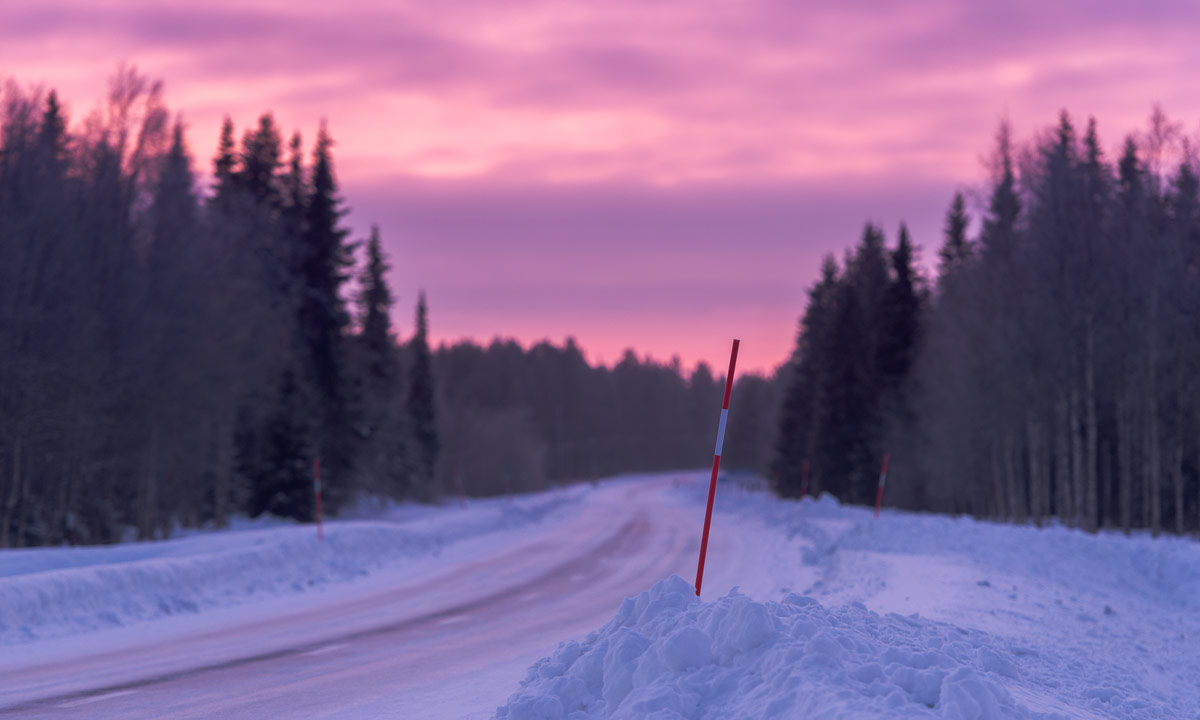
One of the most fascinating things in my opinion is the light in wintertime. Twilight may last hours or even the whole short morning, day, and evening and there are always soft pink colours in the sky. Just beautiful, but cold to take pictures of if you don’t have warm clothes. But when I have one thing, it’s cold weather equipment.

I looked for the airport, which is a bit out of town and quite tiny. It was closed. It’s the first airport I saw with an own parking place for reindeers. Good to know!

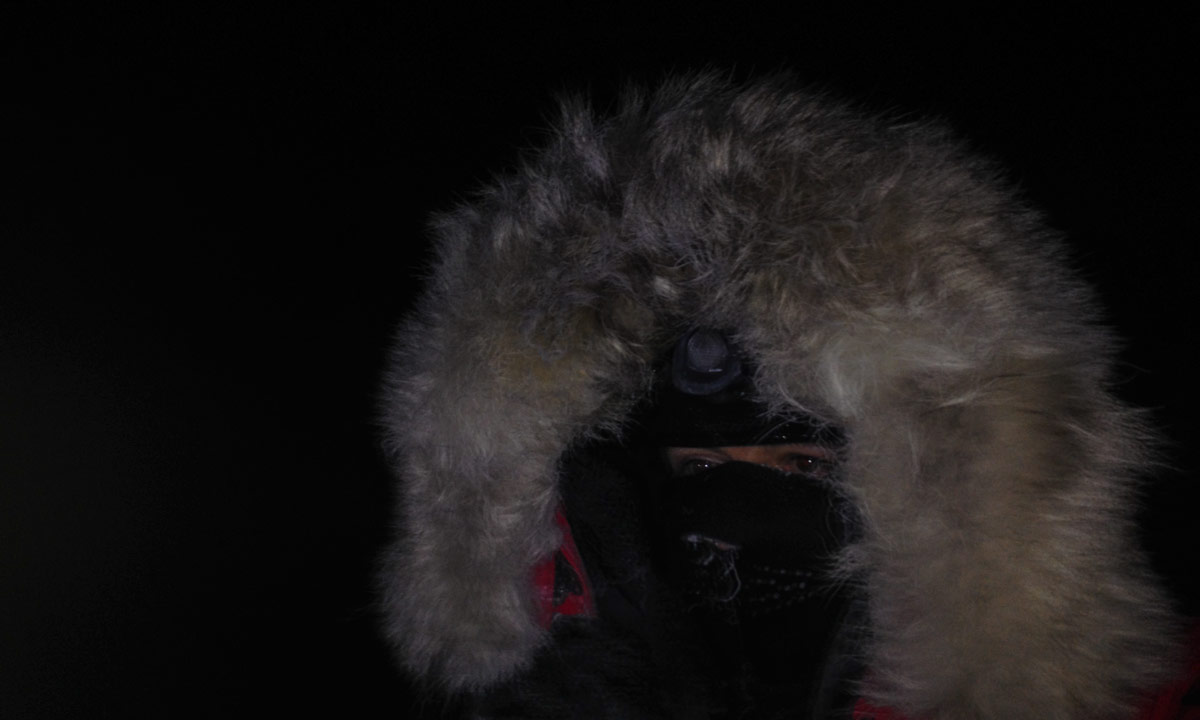
On my way back to Pajala I found a side road that headed to a small national park. I parked the car and walked the 700 meters to the cabin and the grill place in darkness. Of course it wasn’t pitch black, the snow and some thin clouds reflected the light of the city, giving enough light to see and walk. (The selfie is made with the iPhone which can take two photos until it will shut down because of the cold.

On the way back it was even colder: -38.8 °C. Now I got really hungry, drove back to the hotel and walked to the pizza restaurant. (Pizza and burger bars rule the Scandinavian north). Pajala by night:

Then I went home. I was glad that I have all I need for such a trip: A camera, food and a warm winter parka.

After a while I considered if I could catch the -40 °C now. It was warmer than expected, but let’s give it a try.

This time I took the road to Käymäjärvi (the name proofs, that Finland is not far away). Yes, here it was quite cold – below -39 °C. Between a swamp and the lake I stopped, since these low lands can be cold traps. I didn’t get lower temperatures but a view on the village and northern light (quite strong until I was ready to take pictures …)

On the way back to the main road I got my new personal cold record: -39.6 °C (sorry, no -40 °C)! When it’s really cold in Northern Sweden people take pictures of thermometers and show them in the internet. I will join this tradition. Voilà:

>>> read about day 2 of the journey >>>

Winter journey in a nutshell

It snowed in Skelleftehamn tonight. It’s hardly a secret, that I love winter, snow and coldness. In Skelleftehamn however it would be too warm, because the Baltic Sea is near.

Therefore I decided yesterday to take a day off today, take camera and car and travel towards winter. In the inland the climate is colder and hopefully there would be more snow. I started at 6:45 in darkness. The first part was no fun to drive. Road salt is used on the big road to Skellefteå and the road further west. With temperatures slightly below zero you always have a film of muddy saltwater on your windscreen while the wipers still are partly frozen and will not work properly. That in combination with approaching cars with bright lights makes it hard to see and much concentration is needed.

That instantly got better when I left the big road 95 (that would bring me to Bodø in Norway) right after Jörn. The smaller roads are covered with ice and hard snow – much easier to drive and the windscreen stays clear. And it looks much more like winter than a wet road. And while in Skelleftehamn even the duck pond is open, here the lakes and some small streams are ice and snow covered.

I continued the road and drove to Storklinten, a small ski hill. Well, it wasn’t so interesting yet with only round about 10 cm snow, but the lake nearby – Lill-Klintträsket – was really nice. It started snowing and the tree covered hills farther away seemed to vanish into a white nothing.

The way to Storklinten is a dead-end road and I had to return. I continued the larger road to Myrheden looking for motives. And I found one. The small river Ålsån:
I was glad I had my chest waders with me, so I could come quite near to the motive. And there were a lot of motives this day. For example reindeers. The first small flock was extremely shy and cautious. It didn’t dare to pass my car and left the road starring at me suspiciously from behind the small trees. You can see that they digged for food in the snow, the noses are snow covered and one of the reindeers even had a twig hanging in its antlers.

Further on the road: Town signs with funny looking names (there was even a village called Hej, which is Swedish for hello), more snow covered roads and trees and two extremely well educated reindeers going beside the road in single file.

I’m looking for motive especially, where there are crash barriers beside of the road – there the street will probably cross a river or a creek. Some of them are open, many broader ones with less current are already covered with ice. And on one of them – far away – I could see a reddish animal and some dark spots. A fox? Birds? I looked for the next parking opportunity – sometimes a real challenge – and walked back.

I was right: There was a fox. And some kind of skeleton, perhaps a roe deer or a reindeer. And some crows. And an eagle! It doesn’t happen often, that I see eagles nearby where I live. I made some photos with my tele lens. Zooming in I could even see some magpies hopping around hoping for a snack. The scene was much too far away to get good pictures, but anyway, I want to show you this one:

After a while I started to get hungry. My car too; the red R-lamp has been glowing for a while. Anyway, the town Arvidsjaur, todays destination, was not so far away anymore. As people in former days first fed their horses before eating themselves I first tanked my car with E95, then myself with beef, mashed potato, mushroom sauce and salad. Then I looked around in the city which I think is really nice. Especially in winter with snow – round 20 cm today.

Even if the “real winter” is not here yet the days are already quite short: Sunset in Arvidsjaur was a quarter past two! At three o’clock I started to use the car’s full beam, half an hour later it was quite dark. Time to head home. I couldn’t see any motives any longer and I navigated to the main road. Now driving became exhausting again for a while since it started to snow quite heavily. And if you use full beam while snowing you just see a tunnel of snow flakes swooshing towards you. It’s a big like old televisions science fiction series, when the spaceships activated their warp-drives. And as in space there is no up or down. The second photo may give you a faint idea.

Luckily the snow shower ended soon and the rest of the trip was just about coming home.

400 km and 500 meters – 11 hours 30 minutes – a straining but great one day trip winterwards.

Back again in Skelleftehamn: Snow is gone, it’s pitch black and it’s raining cats and dogs.

From Singi to Sälka and Nallo

This article is part of the series “2015-08: Kungsleden hike”.

August 26 – 29: Day four to seven of the summer hike through the mountains of Swedish Lapland

Singi – Sälka

After three very warm and sunny days clouds came in over night and the sky was quite overcast that morning. Only at the northern sky a larger patch of blue was visible. That fits, we’re going north! The first two kilometres were very well known to us, we went them there and back the day before. The day’s walk was short – just 12 kilometres.

Soon the huts of Sälka came into view. It was funny to see the ads for the shop and the bastu – the sauna – amidst the extend mountain landscape. Only 300 meters left and we entered the reception to check in.

It’s a nice look from Sälka but we had another interest that afternoon: Overall on the ground the ptarmigans were running and there were even sitting on the huge pile of birch wood, so that me, the photographer and them, the models, were on eye level. They let me advance quite near – in fact so near that the tele lens couldn’t focus anymore. The first two images are younger ptarmigans, the last is a grown up – look at these fantastic white feathered feet.

Sälka – Nallo

The next morning there were so many ptarmigans around that you really had to watch yourself not stepping on one of them. I never saw so many and never saw them so near. Our plan was not to continue the King’s Trail but to go northeast to Nallo, a smaller cabin a bit higher up in the mountains. After the common breakfast (muesli with some milkish liquid made from dry milk – yuck!) we started our tour. Even shorter than yesterday: only 9 km but perhaps a bit more demanding since there’re streams to ford, while the whole King’s trail is equipped with Bridges.

We had to look for planks to cross the small rivers behind the cabins but soon we were on our trail.

One hour later we were on the moon …

… well, not exactly, but it was such a sharp contrast to the sweet and lovely landscape of the last days. We could hardly see any vegetation. Only moss, grass and some scattered flowers were left. And some reindeers on some of the tabular slopes. There were many small streams and brooks to cross and it was the first day where I was glad, that I walked in rubber boots.

After a while the lake Reaiddájávri that lies on 1056 meter came into view and we went along it. More and more clouds came towards us and swirled around as if they wanted to surround us.

We had to cross the stream that enters the lake at the northern shore. Annika had to switch to sandals and ford the stream, for the water was to high for her hiking boots. It started to drizzle, than to rain and it got windy. Navigation was less easy now since it started to get foggy, there were less marks and some streams and snow patches to cross. Mostly I navigated with the compass, but twice I took the GPS to ensure my navigation. Since wind and rain increased more and more and I was busy with the navigation I packed the camera into the waterproof bag and didn’t make any photo on the last two kilometres. In the end the small Nallostuga came into view and even the huge mountain Nállu in the back lingered through the floating clouds. We got a warm welcome of the stugvärd – the warden of the Nallostuga. And warm was the wood fired oven, too. A good opportunity to dry our wet clothes.

I only went out later that day to take a photo of the wooden signpost and the hut itself. The rest of the day was just gemütlich – the pouring rain outside and we ourselves warm and cozy inside.

Two days of at Nallo

One

We planned to stay a day in Nallo already two days ago. It looked like a good idea since the rain just poured down the whole day and it was very windy. All people out there looked very wet, whether they just crossed the stream – now twice as large and probably twice as deep – or if they just fetched a bucket full of water.

Time to make some photos within the house. Two typical views in Swedish mountain huts: Many of them have two rooms, each has a kitchen and two flanking bedrooms, only separated by a curtain. That make 20 beds in total. Plus one for the stugvärd who has his own little room. The Primus 2388 is a gas cooker, easy to handle and is found in almost each Swedish mountain hut.

Two solo hikers planned to continue their tour that day but after a while they decided to stay. Perhaps not the worst idea when you looked at the young hikers, that came in. They were completely soaked. They poured the water out of their hiking shoes and hang up the dripping-wet sleeping bags for drying. All was just soaking wet! We we’re quite glad to be inside. But finally I took my camera and went out for some photos. Brr, it was really cold (7 °C) and so windy that the spray of the brooks was blown upwards again. Some photos:

I was glad, when I came into the inside of our cozy hut again. Only Simba, the warden’s dog endured the weather stoically.

Later that day: The sleeping bag already has dried, but other clothes were still hanging on the clothes line.

Two

Next day we wanted to continue our trip but I changed plans. Unintentionally. I got ill. I got fever that night and problems with my stomach and intestines, that I definitely don’t want to describe in detail. Otherwise there’s nothing much to report. I didn’t make a single photo (a certain proof that I was really ill) and slept almost the whole day.

Later in the evening, when I felt a bit better I was able to communicate again. I heard about others that went Singi–Sälka, the very same way we went three days before. The trail has been so flooded that the water poured over the wooden planks of the minor bridges making them very slippery and it was so windy that the hikers were really frightened to be blown from the bridge right into one of the swollen rivers. Illness never fits, bit I guess I chose a quite good day for being sick.

I slept the night before, I slept almost the whole day and I slept the next night. That sums up to round about 30 hours of sleep without any larger interruption. That probably was the best medicine and the next day I felt sound and healthy again. The plan for the coming day: Hiking to Vistas.

Cross-country skiing in Äkäslompolo – part two

Last Friday I travelled to Kittilä in Finland, to make a one week holiday with Annika and and Medi, a friend of hers. I wrote already about the first days in “Cross-country skiing in Äkäslompolo – part one”.

Wednesday. We took the ski bus to Äkäsmylly and we were not the only ones. Some busses arrived at the parking place and spit out round hundred cross-country skiers, most of them dressed in skin-tight racing suits. And if the children were too small to stand on their own skis, they were pulled behind in a pulka sledge. That looked really snugly.

We didn’t like to start within a crowd and so we waited, until the most skiers had started. But we didn’t go very far. The Äkäsmylly Café is just round the corner and it’s really extremely cozy. An old man played traditional Finnish songs on his accordion and yes – they all were in moll. We peeked into the text books to sing along, but even if we knew the melody the Finnish language with its long and unfamiliar words gave us a hard time. But it was fun anyway!

Finally we broke away from the warm Café and started the tour. As the days before it snowed most of the day. I made less and less photos each day but today I had to make a break and leave the ski trail for this lonely tree in the snow fall. It took some time, because the snow didn’t bear the thin cross-country skis and I was up to my knees in snow.

I didn’t have to leave the comfortable ski trail for the next photo, a bridge over a completely snowed in brook.

We made our last stop in the Karilan Navettagalleria, the beautiful café and gallery that I already visited the day before.

Thursday. With 25 km our longest tour from Totovaara via Tammitupa, Karhunkota Hanguskurun and again Karilan Navettagalleria back to Äkäslompolo, and by the way my birthday tour.

I think, this is the first day where we neither used the private sauna in our lodge nor lit the fireplace after the ski tour. Instead we went to a bar nearby and listened again to the karaoke. It was just wonderful, listening to the singers – some men had really nice voices. People browsed the set lists to see what they could sing next and at least one pair was dancing to the karaoke songs all the time. Unfortunately some of the people got extremely drunk quite quickly. One of them was so intrusive and pushy that we left the bar soon. I guess that’s also part of the Finnish culture, just as karaoke.

Friday. A short but more demanding tour in the south-west with some nasty descents. I was glad that the trails were in good shape and hardly icy, although it was so warm. I didn’t make a single photo, because I started to get bored of the cloudy sky and the forest, that looked more or less alike everywhere. I enjoyed the week, but since I’m more in nature for the landscape than for the sports, a week was long enough for me and I started to long home a bit. And again I had back luck with the weather; the two weeks before were cold and sunny.

Saturday. Phew, that was early! We stood up at 4:45 local time (that’s 3:45 Central European Summer Time) and 5:35 I said good-bye to Annika and Medi that took the early bus to the airport. Then I drove home. After 425 km and six hours (some ways were in quite bad shape) I was home in Skelleftehamn again.

Addendum:

I hardly saw any animals when I was on the ski trails. That changed on my way back to Skelleftehamn: I saw a fox, a mountain hare, two reindeers, two squirrels and some black grouses, all from my car. I guess, animals are seen best when driving ;-)

Cross-country skiing in Äkäslompolo – part one

Since Saturday I’ve been in Äkäslompolo with Annika and Medi, a friend of hers. Äkäslompolo is famous for cross-country skiing and has a total of  330 km of cross-country ski tracks. And that’s what we are here for: Cross-country skiing. My first almost real sport holiday for a zillion years.

On Saturday we used the skis only for a shopping trip to the other side of the lake. I gave my old cross-country skis a quite suspicious look, they are so much thinner than my tour skis (not to mention the broad wooden Tegsnäs skis). Will I be able to ski on these sticks or will I fell right onto my nose after five steps? But the shopping trip (no ascents or descents at all) went well. And in the evening even the grey sky cleared up, patches of fog appeared over the snowy terrain and temperature dropped to -10 °C. We took an evening walk and watched the starry night in hope for Northern Lights, but unfortunately they didn’t come out.

Sunday. Our first ski tour to the cabin Kotamaja. It gave me a quite sportive feeling when I mounted the skis right before our lodge, crossed the road and entered the ski trail. The sportive feeling disappeared quite soon, because almost all other skiers were extremely skilled, extremely athletic and extremely fast, even the much older ones. I had the feeling of accidentally having got into an olympic training race, but it was fun anyway. Earlier than expected we reached Kotamaja and took a break. And we were not alone …

We continued and headed for Hangaskuru where we planned to take our lunch. And we were well equipped: We didn’t only have sandwiches, but sausages and extendable barbecue forks as well. Yummy!

When we headed home more and more skiers were on the ski tracks, it was really crowded and it got worse and worse. “That’s no fun anymore”, I thought but rather like driving on a German autobahn. Hopefully it would be less crowded under the week.

Monday. We took the airport bus that left us at Ylläs-Lainion. The track was in inferior condition, since it had started snowed a bit, but we were almost alone and that’s more the way I like being outdoors. With relaxed but steady movements we slid through the wintry Finnish landscape. However we did not hesitate to take short or longer breaks in the cozy little huts. After round about 20 km we were home again.

Tuesday. It hadn’t stop snowing the whole night and it should continue snowing the whole day. That was the view through our window this morning:

We decided not to make a longer tour, because cross-country skiing on tracks is less fun when the tracks are covered with snow.

I took a walk to the supermarket – partly with Annika, partly alone and tried to continue a snowshoe trail, but the trail was only prepared partly and the snow mobile track, that I followed instead a while, headed to the wrong direction. So I had to return the same way. Äkäslompolo is made for cross-country skiers.

In the afternoon I took a short circular ski tour. Since yesterday fell 10-12 cm new snow accumulating to at least 100 cm snow on the ground.

On the short tour I’ve been in Karilan Navettagalleria,  a nice café, that Medi discovered in the morning, but I took only two pictures and continued my tour. We already have planned another tour for tomorrow and included the café in our plans.

Now I’m sitting in a cozy couch in a typical Finnish bar. And what’s typical Finnish? Right – Karaoke! The Finns love it and I love listing to all these melancholy melodies. Next time I have to learn some melodies and join the singers, too. They probably will laugh their heads off when I try to sing in Finnish.