Tussilago 2017 – one day later


It almost became a tradition: take photos of the first local spring flower and share them in my blog. And as every year the winner is tussilago. These samples I photographed yesterday in Skelleftehamn.


What spring flowers blossom at your place?
It’s July and the beach peas (aka sea peas) are blooming. They love sand or gravel beaches, where they seem to crouch over the ground. Crouching I did, too, to get a photo from the pale purple blossoms.


These flowers grew near Grundskatan south of Bjuröklubb.
| English | German | Swedish | Latin |
|---|---|---|---|
| Beach pea / Sea pea | Strand-Platterbse | Strandvial | Lathyrus japonicus |
You didn’t like the water insects and tadpoles? Well, I found flowers, too, today. Finally the marsh-marigold has started to bloom. It is one of my favourite flowers and I love these warm yellow hues of the blossoms.

In contrast to the weather forecast yesterdays morning was sunny and sky was blue. I’ve been in Umeå the weekend and after the breakfast Annika and I decided to make just a small trip before weather would get worse.
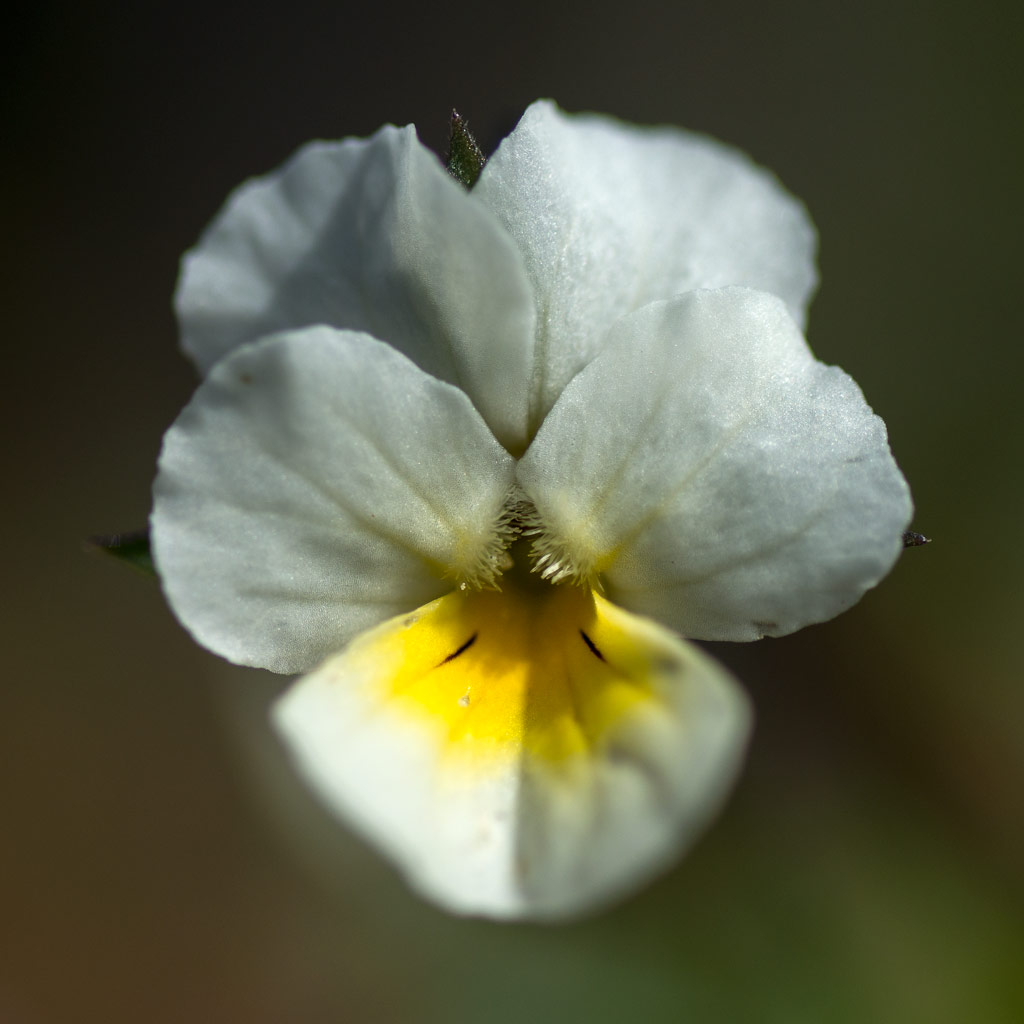
We drove to Baggböle, 8 km west from Umeå. Here’s the “Arboretum Norr”, a tree collection (or arboretum) along the river Umeälven. We enjoyed the springlike temperatures and the many small flowers that started to blossom everywhere.




It was a bit too early for an extensive visit, since many trees just started to get their leaves, but we had another destination anyway.
In an abandoned turbine sump you can find an orange figure sitting cross-legged just as a statue of a meditating monk. The figure is reflected in the shallow water. This artwork is part of the Konstvägen sju älvar, a 350 km long tourist and sculpture route in Västerbotten. Sju älvar (seven rivers) sounds almost like sju elva (seven eleven), that’s how this artwork got its name: 8 11. Outside it was warm and sunny, inside it was dark and chilly. The ground was still frozen.

Probably the weather missed the forecast, because outside it continued being warm and sunny. So we continued our car trip, first toVännäs to visit another artwork: Eldsoffa (fire sofa) – a brick sofa that you can heat by fire (no picture).
After that we took a detour via Pengsjö and headed to another artwork between Vännäs and Bjurholm: Hägring (mirage).
A model of a church built of pieces of mirror glass seems to hover above a bog. It reflects it’s surroundings and if you go there over the wet boggy ground it reflects you yourself.

If you want to go to that artwork: Take rubber boots with you or you’ll get wet feet, at least in May.
After going round that artwork we continued our tour, had a brief look to Bjurholm and after that we started to return to Umeå again. We took the 353 southwards and would have been in Umeå one hour later if not my curiosity made me turn right into the road to Ågnasbacken, a local ski area. I love standing on hill and mountain tops and enjoy the views, but we discovered something better: The klangvägen (the sound path), a 1.5 km long path on two of the ski slopes with sound objects. Especially Sofie Weibull’s Klockspel – a wind driven installation of metal pieces sounding like bells – fascinated us very much. I did not make any photos because in my opinion it was sound that mattered, not the optical appearance of the installations themselves.
Anyway, I made a photo from one of the ski slopes and the view. And some leftover snow …

We came back to Annika’s flat eight our nine hours after start. Sometimes a short trip can get out of hand a bit …


Yesterday I found the first blooming flower in Umeå – a tussilago, one of the heralds of spring in Sweden. On the other side I did something, that is quite typical for the winter season: I took a winter bath (and swam twenty meters).


Is it spring or winter? The Swedes have an own word for it: vårvinter – “spring-winter”. It’s the season round March and April, when snow still covers the ground – at least in Northern Sweden, but it’s less cold as in January or February.
When I took the car to Umeå three days before, temperatures where between -20 °C and -31 °C. Today it was much warmer in Umeå, just round -4 °C.
Annika and I took the car to Holmsund, a place 20 km south from Umeå. This coastal locality has round about 5500 inhabitants and is special, because here starts the only ferry connection from Sweden to Finland beside those from Stockholm. When we arrived, the ferry from Vaasa in Finland just had anchored.

Neither of us has been in Vaasa before, so we thought about making a trip to Finland, perhaps already in two weeks, if the weather isn’t too bad.
Right beneath the ferry dock there’s a pair of piers reaching 700 meters into the sea. If you look east, you see that the Baltic Sea is ice covered beside of the waterway. But in contrast to the Baltic Sea outside of Skelleftehamn, which is thick, solid ice, you can see the big ice floes lift and lower with the underlying waves. If you look west, you see the mouth of the river Umeälven, where the water is mostly open and small ice floes float and drift southwards.
I don’t know, when it has been so windy, that the waves rolled over these piers, but you could still see the result: Many of the dried up flower stalks and the lower branches of bushes and trees were covered with a thick layer of ice. It must be both impressive and frightened to witness such a stormy weather in winter.


This article is part of the series “2015-08: Kungsleden hike”.
August 26 – 29: Day four to seven of the summer hike through the mountains of Swedish Lapland
After three very warm and sunny days clouds came in over night and the sky was quite overcast that morning. Only at the northern sky a larger patch of blue was visible. That fits, we’re going north! The first two kilometres were very well known to us, we went them there and back the day before. The day’s walk was short – just 12 kilometres.


Soon the huts of Sälka came into view. It was funny to see the ads for the shop and the bastu – the sauna – amidst the extend mountain landscape. Only 300 meters left and we entered the reception to check in.


It’s a nice look from Sälka but we had another interest that afternoon: Overall on the ground the ptarmigans were running and there were even sitting on the huge pile of birch wood, so that me, the photographer and them, the models, were on eye level. They let me advance quite near – in fact so near that the tele lens couldn’t focus anymore. The first two images are younger ptarmigans, the last is a grown up – look at these fantastic white feathered feet.


The next morning there were so many ptarmigans around that you really had to watch yourself not stepping on one of them. I never saw so many and never saw them so near. Our plan was not to continue the King’s Trail but to go northeast to Nallo, a smaller cabin a bit higher up in the mountains. After the common breakfast (muesli with some milkish liquid made from dry milk – yuck!) we started our tour. Even shorter than yesterday: only 9 km but perhaps a bit more demanding since there’re streams to ford, while the whole King’s trail is equipped with Bridges.
We had to look for planks to cross the small rivers behind the cabins but soon we were on our trail.


One hour later we were on the moon …

… well, not exactly, but it was such a sharp contrast to the sweet and lovely landscape of the last days. We could hardly see any vegetation. Only moss, grass and some scattered flowers were left. And some reindeers on some of the tabular slopes. There were many small streams and brooks to cross and it was the first day where I was glad, that I walked in rubber boots.


After a while the lake Reaiddájávri that lies on 1056 meter came into view and we went along it. More and more clouds came towards us and swirled around as if they wanted to surround us.


We had to cross the stream that enters the lake at the northern shore. Annika had to switch to sandals and ford the stream, for the water was to high for her hiking boots. It started to drizzle, than to rain and it got windy. Navigation was less easy now since it started to get foggy, there were less marks and some streams and snow patches to cross. Mostly I navigated with the compass, but twice I took the GPS to ensure my navigation. Since wind and rain increased more and more and I was busy with the navigation I packed the camera into the waterproof bag and didn’t make any photo on the last two kilometres. In the end the small Nallostuga came into view and even the huge mountain Nállu in the back lingered through the floating clouds. We got a warm welcome of the stugvärd – the warden of the Nallostuga. And warm was the wood fired oven, too. A good opportunity to dry our wet clothes.
I only went out later that day to take a photo of the wooden signpost and the hut itself. The rest of the day was just gemütlich – the pouring rain outside and we ourselves warm and cozy inside.


We planned to stay a day in Nallo already two days ago. It looked like a good idea since the rain just poured down the whole day and it was very windy. All people out there looked very wet, whether they just crossed the stream – now twice as large and probably twice as deep – or if they just fetched a bucket full of water.


Time to make some photos within the house. Two typical views in Swedish mountain huts: Many of them have two rooms, each has a kitchen and two flanking bedrooms, only separated by a curtain. That make 20 beds in total. Plus one for the stugvärd who has his own little room. The Primus 2388 is a gas cooker, easy to handle and is found in almost each Swedish mountain hut.


Two solo hikers planned to continue their tour that day but after a while they decided to stay. Perhaps not the worst idea when you looked at the young hikers, that came in. They were completely soaked. They poured the water out of their hiking shoes and hang up the dripping-wet sleeping bags for drying. All was just soaking wet! We we’re quite glad to be inside. But finally I took my camera and went out for some photos. Brr, it was really cold (7 °C) and so windy that the spray of the brooks was blown upwards again. Some photos:


I was glad, when I came into the inside of our cozy hut again. Only Simba, the warden’s dog endured the weather stoically.

Later that day: The sleeping bag already has dried, but other clothes were still hanging on the clothes line.

Next day we wanted to continue our trip but I changed plans. Unintentionally. I got ill. I got fever that night and problems with my stomach and intestines, that I definitely don’t want to describe in detail. Otherwise there’s nothing much to report. I didn’t make a single photo (a certain proof that I was really ill) and slept almost the whole day.
Later in the evening, when I felt a bit better I was able to communicate again. I heard about others that went Singi–Sälka, the very same way we went three days before. The trail has been so flooded that the water poured over the wooden planks of the minor bridges making them very slippery and it was so windy that the hikers were really frightened to be blown from the bridge right into one of the swollen rivers. Illness never fits, bit I guess I chose a quite good day for being sick.
I slept the night before, I slept almost the whole day and I slept the next night. That sums up to round about 30 hours of sleep without any larger interruption. That probably was the best medicine and the next day I felt sound and healthy again. The plan for the coming day: Hiking to Vistas.
Do you remember Nokia? Cell phones and rubber boots? Today I tested a quite similar combination: Rubber boots and a Nikon lens. Plus a hiking trail.
A few weeks ago I discovered a big information board at a forest edge in Skelleftehamn. It describes the “kraftleden” – The force trail or The energy trail. Perhaps the trail is named after Skellefteå Kraft, one of the sponsors I thought when I read the information.
Today I decided to try to hike the 18km long trail. I had two new things with me: My new rubber boots Tretorn Sarek which are made for hiking and my new lens Nikon 100mm f/2.8 (Series E), that I bought secondhand some days ago.
After a one kilometer walk I was at the starting point.

At the first junction I was lost, since I couldn’t see a sign. But after checking my photos of the information board I learned that the way marks where orange coloured blazes round the trees. That’s easy. The trail itself however wasn’t easy at all. It looked more like an area where you cut down trees and bushes. Like a stork I stalked through the cut down branches and twigs that lay criss-cross on this so-called trail hoping for a better path.

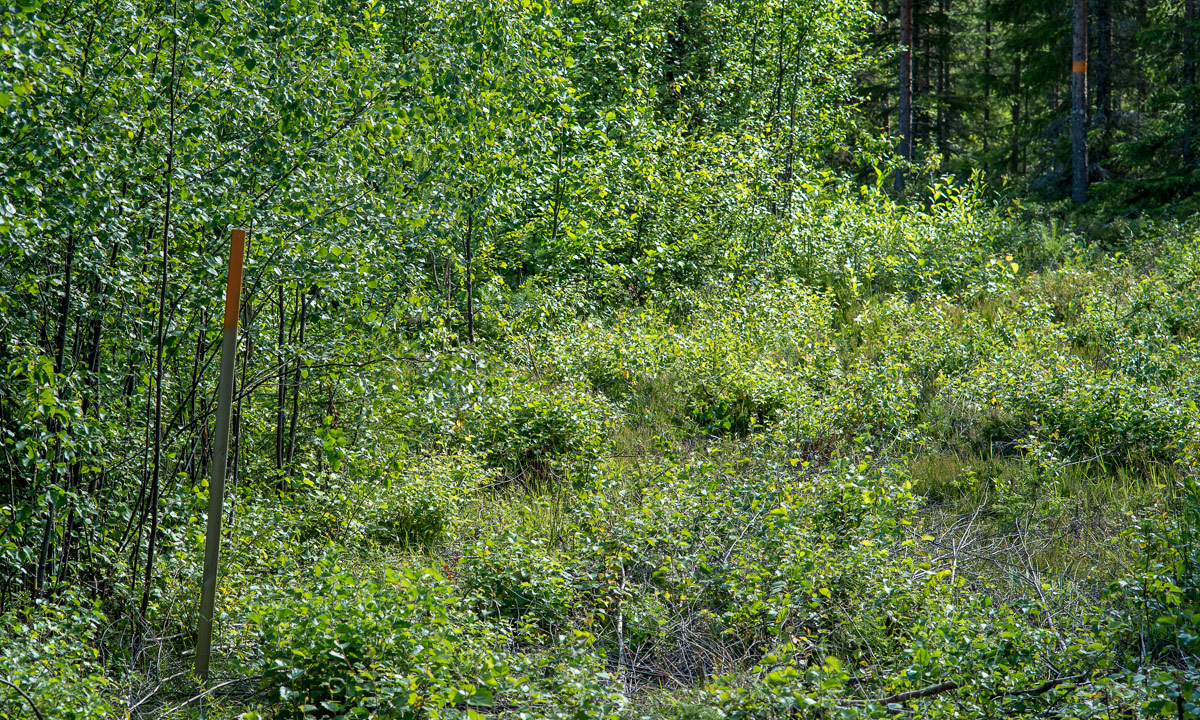
And the trail got better. But I still was slow. This time not because of the trail but of my new lens. It’s my first lens ever without an autofocus. This means that I have to focus manually at the lens itself. It took some time until I got used to it, but I still had to control every single shot on the display and I had to make some photos five times until I was satisfied.
I continued the trail – now a nice stony path until I came to the Örberget – altitude 40 meters, 30 meters higher than the starting point. It doesn’t take much to be called a mountain here. I made a photo of a “gravröse”, a tomb from the Bronze Age. Probably it was build at the shore some thousand years ago but the land has been rising round a centimeter a year since then.

I continued the walk. The ground became wet and muddy and after a while I stood in front of a bog. In the middle of the bog I saw a wooden post with an orange blaze. OK, let’s go …

… now I knew, that the new rubber boots were not only comfortable but really waterproof. I didn’t get soaked, but it was quite close.
I always had to look down carefully to avoid the deep water and mud puddles, and I had to look forward to find my way. When I looked up I started to suspect why the trail was called kraftleden. Almost the whole trail followed the transmission lines and the Swedish word for transmission lines is kraftledning. That’s a really pragmatic approach to make a trail since some kind of path was made already to mount the power poles. But it’s not very inspiring just following the lines and not beautiful neither.
After round 11 kilometers I made a rest on a high seat normally used for hunting moose.


I continued the tour but I started to lose interest a bit. Parts of the way were hard to walk, harder than many mountain trails but without the reward of a beautiful landscape or great views. In addition of that I started the tour round half past two and I didn’t want to come to town too late. So I left the kraftleden and walked southwards through the forest. At the beginning I found some nice flowers and I changed the lens to a macro. First two additional test images of the new 100mm lens, then two flowers – a dactylorhiza maculata and a linnaea borealis:


OK, I have to admit: I tested four different things, not only three. Number four was a mosquito protection jacket, that came in quiet handy when I shot the macros of the flowers. Flocks of mosquitos darted for my blood, but they didn’t had a chance beside of biting into my unprotected hands.
After taking the flower images I had to walk some other kilometers until I came to the main road and another one to come to the bus station where I had to wait half an hour for the next bus. Happily I slipped of my rubber boots to try my socks, sat down and waited. Finally the bus came and half an hour later I was home. The GPS displayed:
19.0 kilometers · average when moving: 4.3 km/h · total average: 3.3 km/h
And here come todays test candidates:


Rubber boots Tretorn Sarek: Really nice and comfortable boots, perhaps a nuance too tight for me. They are made of natural rubber and it’s easy to turn the upper upside down. They could be a bit higher.
For me: 8 points out of 10.
Nikon 100mm f/2.8 (Series E): A small, lightweight lens with manual focus. I have to practise focussing. I prefer my huge Nikon 70-200mm VR II, but there’s a reason why I bought the former one: At the end of August I’ll start a two week hiking tour in the Scandinavian mountains and I want to save weight. The 70-200 weights more than 1500 gram, the new 100mm only 215 gram. Got the point? And it was cheap, too – only 53 Euros.
For me: 7 points out of 10.
The trail kraftleden: The only advantage of the trail is that you avoid navigation. Beside of that it’s an awkward combination of a trail a bit too hard to be nice and a bit too boring to be beautiful. I wouldn’t recommend it. If you want to give it a try, take high rubber boots and plenty of time with you. Take care and follow the way marks if you don’t want to end in almost knee deep mud as it happened to me today.
For me: 3 points out of 10.
The nameless mosquito jacket: Perhaps it’s not fun to walk within some kind of mosquito net but it was great, when I took the macro photos of the flowers. The hood is too big. Since it’s very light – only 214 gram – I will take it with me on all summer photo tours and perhaps even on the planned mountain hike. And with costing only 18 Euros it was a bargain, too.
For me: 6 points out of 10.
| English | German | Swedish |
|---|---|---|
| Dactylorhiza maculata / heath spotted-orchid / moorland spotted orchid | Geflecktes Knabenkraut | Fläcknycklar |
| linnaea borealis | Moosglöckchen | Linnea |
| upper | Schaft (am Schuh) | skaft |