Sun, blue sky, +2 °C, but very windy: 15–18 m/s in average.
Just nine days after the last snow warning that brought up to a metre snow in Västernorrland another snow warning was issued for today. And it has been snowing (and still is) and blowing since early morning. Time for a ski tour through the forest between two meetings …
Why I have time for a ski tour when working? Because as an employee of the Norwegian Polar Institute you have the right to two paid hours of training/sport/outdoor activities each week. One of the advantages of being employed there!
I went Spåret – “the track”, a circular route just 500 metres from here. It’s 3½ km long and leads through forests, over rock and along some swamps. Now with half a metre of snow you only see the the forest. Anything else is covered by white snow. And so is the small boggy pond: You should know where the planks cross it because under the snow there is still liquid mud.
This time the plank bridge was easy to find, because I could see the ski tracks that Annika and I left last weekend, when we skied Spåret the first time. I continued through the forest. I have jogged and promenaded this track many times, otherwise I hardly would have found the way.
Skiing was quite exhausting because my skis sank down at least 20 cm with each step, sometimes even knee deep. Will I come back in time to participate the next meeting? I guess I have to ski faster and take less photos. The last one I took was when I crossed Södra Obbolavägen, our only road to “civilisation”.
To make it short: I arrived in time.
Some hours later I had a special after work activity: clearing a roof of snow. Most roofs had been blown free but there was one large snowdrift on the roof of our main house that I shovelled away while standing on the old metal ladder.
The ladder stands still there. Probably I’ll have to do some more shovelling tomorrow again. While I write this blog entry a huge snowdrifts starts to cover the bottom part of my home office window. What a pity, that it probably will rain on Saturday. One of the few disadvantages when living directly by the coast where it uses to be warmer than in the inland.
This article is part of the series “2020-10: New in Tromsø”.
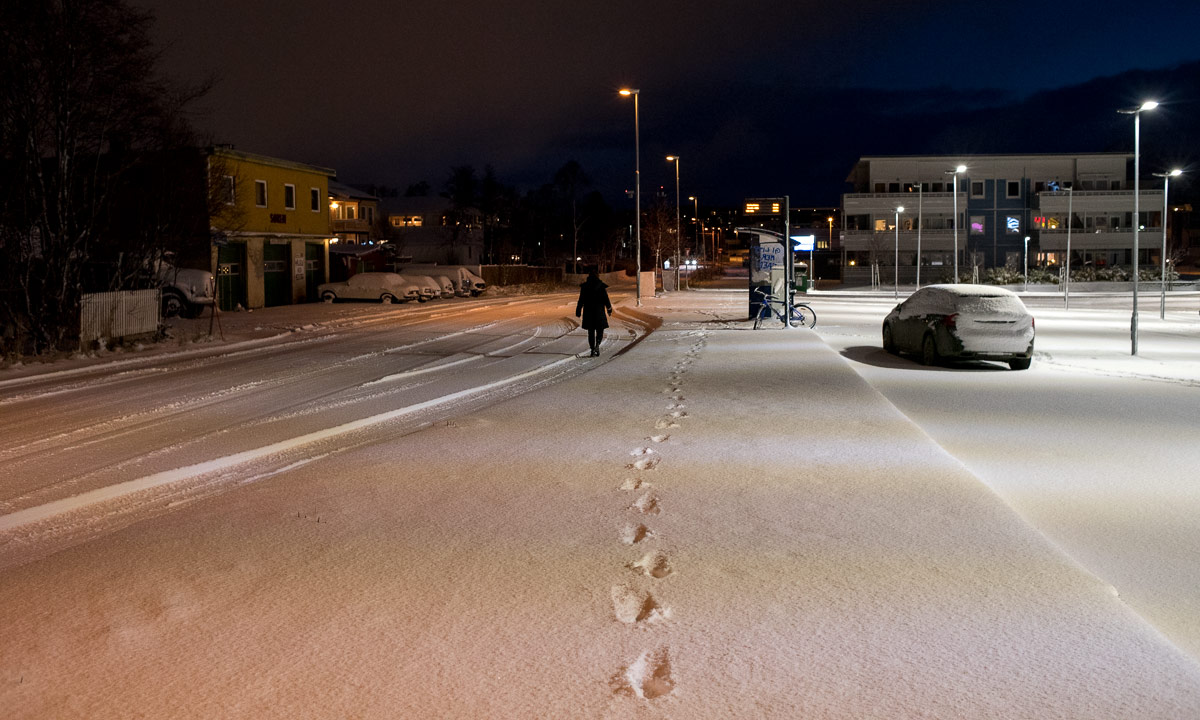
Yesterday evening it started to snow and this morning it still has been snowing. 10 cm of snow cover the streets, cars, houses, trees – it’s the first noteworthy snowfall in Tromsø, since I’ve been here.
The beauty of the snow won’t last long because already on Saturday it will be warmer again and it will thaw away. But hey, it’s only late October. Winter hasn’t even started yet.
And now I’ll take a short breakfast and walk to work.
Annika googled it, then we visited it shortly last Saturday, yesterday I took the opportunity to visit this bog with more time: The Torsmyran Nature Reserve.
The parking place is right next to the E4, 45 km southwest from Umeå. You open a gate (and close it behind you to keep the moose away from the road). Then you walk to a small forest strip and follow a round 100 metres long wooden ramp leading into the bog. The platform at the end of the ramp is raised so you have a nice view over the 8.3 km² large bog.
That’s it.
As long as you don’t dare to enter the bog by foot. At first the bog looks flat, but if you take a closer look you see that there are slightly higher parts, mostly covered with heather. Even pine trees grow here and the ground is safe to walk. Beside of these parts there are large areas covered with peat moss, a sure sign that you will get wet walking onto. Even with rubber boots! And there are depressions. Some are covered with water, others with brown mud.
Is the mud deep? Well, have a look at the next photo:
You see the bit of a stick sticking in the mud? That’s my walking stick that I use when hiking through bogs. It’s two metres long. Without any effort I could stick it into the mud like that. Anyhow it was possible to avoid such treacherous places in this labyrinth of humps and pools, even though I came quite near to take same pictures.
After a while I come to a line of wooden planks. Old wooden planks. Old, half rotten planks with rusty nails looking out. I decide to follow the path. First it is quite easy, but then the planks go submarine. Since both my camera and I myself are packed waterproof I continue. Although the planks were slippery I succeed without taking a bath.
There is a signpost in the middle of the bog, leading to cities and places in the area. Who needs a signpost at such a remote place? Well, winter is coming and the bog will be frozen and covered with snow. Then the whole area is easily accessible by snowmobile. And that’s what the signpost is for: Helping the snowmobile drivers.
I leave the signpost behind and continue the path. Partly the planks lie directly on the mud. *Crack!*. One of the planks breaks under my right foot but still supports my weight. When I come to another watercourse to cross and see the the planks deeply sunken into the water I decide to turn back. This passage looks quite challenging and for a round trip I would have to cross the watercourse again at another place.
Slowly I walk back to the platform at the end of the ramp. I have to zigzag a lot to avoid open water or muddy patches but I arrive. I’m quite wet and muddy from taking some photos. I however already suspected that and have spare clothes in the car and a canister with water for cleaning. And something even more important: Chocolate and something to drink!
Disclaimer: It’s not the first time that I hiked on boggy ground. It needs some experience to avoid the soft patches and knowing how to free yourself when sinking in mud. That’s why I have a long and stable walking stick with me that could support my weight in case of sinking. Take care!
Fjell/fjäll is the word for mountain or mountains. Fjell is Norwegian, fjäll is Swedish. As similar the words are as different the fjell/fjäll can be.
When Annika and I started our way back home from Tromsø yesterday we could experience the inaccessible steep mountains in Norway with the dark grey summits hanging in the evenly dark clouds as well as the colourful autumnal mountain plateaus between Abisko and Kiruna.