Abisko: A first small ski tour

Day 17

Finally – my first time on skis! I didn’t dare to use them in the Tromsø mountains, they are too steep for my mediocre skiing abilities. The mountains – the fjäll – in Abisko however is not so hard.

EquipmentWhat do I need for a (short) day trip? Let’s see …

  • windproof clothes
  • a down jacket for resting
  • warm woolen mittens
  • hot tea
  • goodies
  • a compass
  • a good map
  • my GPS with spare batteries
  • first aid kit
  • headlamp
  • camera equipment
  • bivy bag
  • some money (just in case)

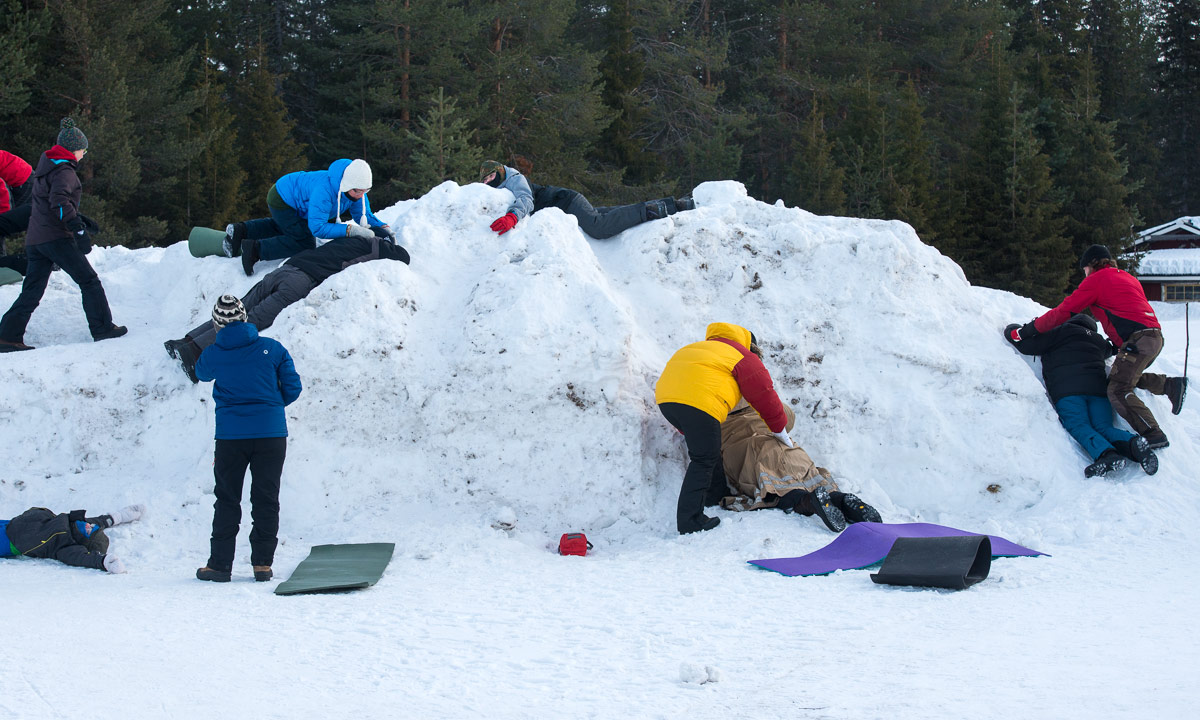
I love it when I can start a ski tour just from the doorstep. Weather was fine, partly blue sky, partly clouds, -15 °C and no wind at all. The first time in this winter I put on my ski shoes, attached the skis, unattached them again to get the other mitten that still was in the house, attached the skis again, took the backpack and ski poles and started the tour. First the tunnel under the railway (Stockholm–Narvik) then up the street and into the open woodland. First I followed the snowmobile tracks. That’s easy because the snow is solid and it’s easy to go. But it’s a bit boring, too. So I left the trail after a while and went cross-country. The snow is new – it snowed 30-40 cm the last days and quite soft. Soon the skis were more under than on the snow, mostly calf deep, later sometimes more than knee deep.

In average the snow was 70 cm deep – that’s not so much for the fjäll, but I was quite glad that I could continue cross-country even if it was a bit exhausting. Again and again the snow around me slumped down under my weight sometimes snapping like a whip, sometimes growling like thunder. This is what avalanches are build of. It was clear that I had to avoid all steeper terrain today.

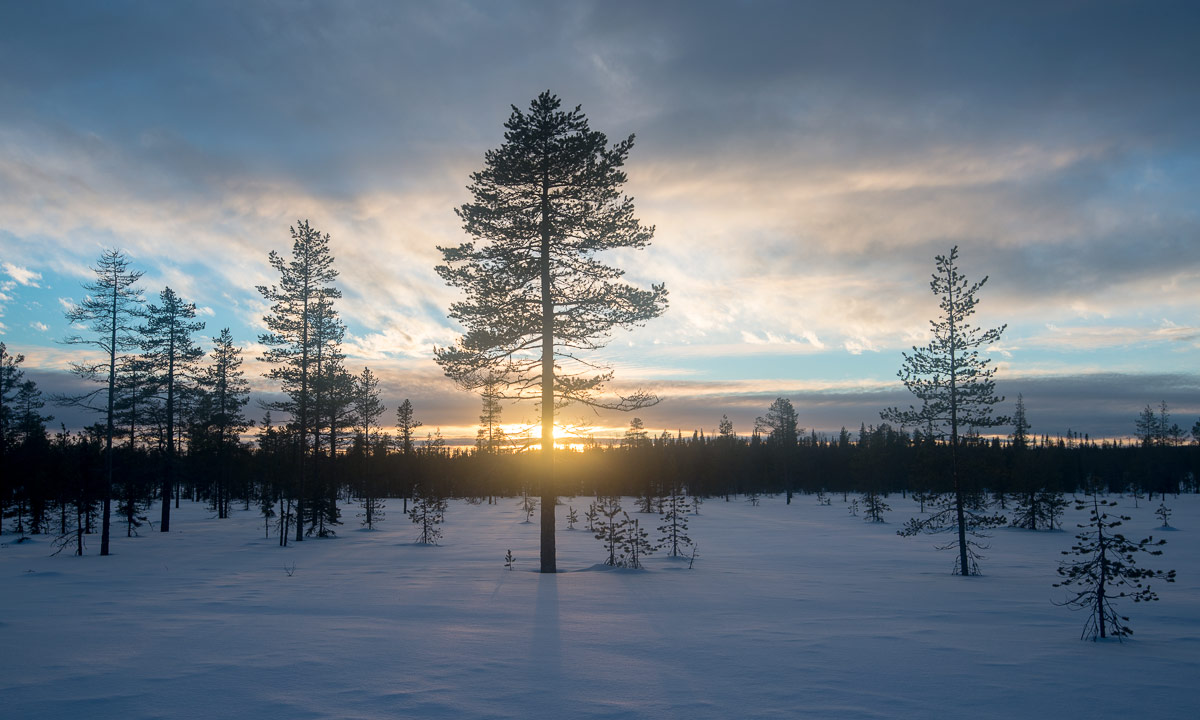
Soon the valley Lapporten, that you can see from Abisko as well, came into view again.

I hit another snowmobile tracks and followed them. An a slope ahead a snowmobile approached and I stepped aside to make place – sinking into snow almost knee deep again. The snowmobile was followed by eleven tourists that booked a dog sledding tour. I laid down into the snow to make pictures and since the dogs came to a stop I could make a photo of the husky with its snow-covered nose.

The dogs continued and so did I. But now I had a minor challenge. The track on the slope was quite steep and so narrow, that I couldn’t make V-steps big enough to go up on skis without sliding back. So I left the track and tried to go up zigzag beside the track. But after ten steps I was bogged down into the snow more then knee deep. I tried to go up, but impossible, at least for me. I returned to the hard snowmobile track, unmounted the skis and went up afoot.

Up on a bleak plateau I left the snowmobile trail and continued cross-country again in direction Lapporten. On the treeless plateaus it has been much windier and the snow was pressed and beared my weight. I continued a bit further and enjoyed the beautiful views and impressions.

But soon I headed back and skied down again through the untouched terrain. Downhill skiing was a bit thrilling: Some patches where hard and the skis ran fast but soon a patch filled with deep soft snow waited for you. It was pure luck that I didn’t fell. Four hours later I was in front of the house – right before the doorstep. A nice tour.

Winter intensifies

Did I write about the “just normal” winter two days before? Well that changed a bit. Right after I wrote the last article the snowfall intensified and brought 10 cm new snow within 16 hours. It got both windier and colder and still snowed a lot.

Today¹ I took a walk round the small lake Rudtjärnen. Snow fell in thick, heavy flakes and made it impossible to look farther than 100 meters. The squalls whirled up the snow morphing the view into a grey-white nothing. And it was even windier on the slope by the lake. The trees on the 2nd photo were hardly 50 metres away!

That was a nice and not so long walk (which was intended since I don’t want to overstrain myself right after the infection), but it wasn’t enough. I wanted to go out again. And so I did. This time with food and drink, (of course) my camera, my new flashlight and my new down clothes for some testing. I already guessed that I couldn’t drive to the small boat harbour because the way wasn’t ploughed and snow was too deep for my car. So I decided to continue to the peninsula Näsgrundet. What a piece of luck!

I dressed up for cold weather, lit my new strong flashlight and went to the rocky beach. Normally the shore descends to the open sea but not tonight where – I couldn’t believe my eyes – the shore was an ice shelf rising up at least one meter before dropping into a black nothing. I could hear the sea behind but I couldn’t see it. Where am I? What happened? Then I heard a rolling wave and – SPLAT! – I could see water and foam rising high up behind the brink and clashing onto the ice shelf! It took a moment or two until I realised what happened: The brisk northern wind presses the waves ashore where they rocket up into the air several meters. I guess that the water and foam first landed on the rocks where it probably froze almost instantly – remember, it’s -15 °C  out there. The rocks became more and more ice covered until they vanished under a growing layer of ice. When I came to this place this evening some parts of the ice were already two meters above sea level! And still some of the waves managed to toss a lot of water onto the ice where it froze and enlarged the ice shelf. What a fantastic experience!

I was both happy to be out there and a bit disappointed that I couldn’t share this moment. If I at least could take a photo, but how to take pictures of waves when it’s so dark. Wait a moment – dark? – My new flashlight was described as extremely bright – Let’s test. I switched the flashlight to the brightest mode, laid it onto my backpack and adjusted the beam to the waves. Then I took tripod and camera and started to experiment. And that’s the result:

I’m impressed. The new Flashlight is really bright. So bright that I can take such pictures at night time. (For the photo freaks: 1/20 sec at f / 4.5, ISO 1600. 35mm)

OK. The flashlight succeeded the test. But what’s with the rest? I was curious how warm the new bought down parka and down pant would be. I just wore a single layer of woollen underwear and my thin but windproof Norrøna-jacket, mostly to test the fur under the down clothes, that was all. (Not mentioning boots and gloves, of course). I’ve been out more than an hour, first taking pictures, then measuring wind and temperature, than taking my frugal evening meal. And yes – the Marmot down combination is as warm, snugly and cozy as it looks like. Almost too warm when sitting although we had an average wind speed of 10 m/s resulting in a wind chill of  -27 C. That’s good to know.

Now I’m longing to sunrise. I want to visit the spot again and take some daylight pictures. That’s perhaps evan a reason to postpone my journey another day. I’m not in a hurry. But tomorrow, when I’ll visit the place again I’ll wear something less water-sensitive than down, because tonight I always expected a huge monster wave would flood half the shelf and soak me completely.

Finally just two selfies from today, one when I walked round the lake, the other when I sat outside after the evening meal.

Foot note:

¹ As a matter of fact: Yesterday. It will already be Monday when I publish this article.

Some vocabularies for my German readers:

squall – Windböe
down – (hier) Daune
foam – (hier) Gischt
flashlight – Taschenlampe
fur – Pelz

For equipment nerds:

Flashlight: Nitecore EA41 Pioneer
Down clothes: Marmot 8000M Parka, Marmot 8000M Pant. Older (or simpler) models.

Just for the archives:

Friday 2015-01-09 21:45 ca. 30 cm -4.6 °C
Saturday 2015-01-10 13:40 ca. 40 cm -7.1 °C
Sunday 2015-01-09 09:15 ca. 45 cm -8.6 °C
Sunday 2015-01-09 16:55 ca. 52 cm (47 cm backyard, 57 cm front yard) -15.0 °C

At high watermark

Today we had a really high watermark in the Baltic Sea: Up to one meter above sea level. You may laugh if you live nearby the Northern Sea or the Atlantic Ocean, but that’s a lot for the Bottenviken, the northern part of the Baltic Sea and hasn’t happened for several years. Despite of my cold I took the car and drove to several places to make pictures of the flooded shores. But I realised, that most motives were extremely boring. What differs a shore with high water of a shore with sea level? Almost nothing!

But the beach at Storgrundet was a bit different. The ice was covered with 60 cm water and slush and the whole sand beach was flooded and many of the small pines that grow beside the beach where partly or completely under water. What a pity, that I didn’t have my waterproof camera with me.


Ice pears and frozen splashes

A starry night was followed by a cloudy and frosty day.

First stop: The bay Kallholmsfjärden. The sea was open but the stems of the reeds were ice coated. The attached ice looked a bit like ice pears.

Next stop: Storgrundet. This sheltered part of the sea started to freeze over again with soft and thin new ice.  Because of the sinking sea level some of the older ice pieces stood erect. One of them looked like a frozen splash!

Last stop before it got dark: The lake Snesviken. Despite the last week with temperatures slightly above zero the lake is not only frozen, but you could see the first tracks of ice skating.

Some of the locals are quite experienced and they know exactly whether the ice will bear their weight or not. I’m not experienced at all. Therefore I’m nervous even if I have 20 cm ice under my feet which means that the ice would easily bear a car. Today I only crawled two meters onto the icy surface of the lake to take the last photo, well knowing that the water isn’t deep near the shore.

November: sun and ice

I love the combination of sun and snow, or sun and ice. Today I got the latter. I woke up 5:45 and after a short breakfast I drove to Långhällan, where I’ve been four weeks ago. First I tested my new lens, but quickly changed to my old wide angel lens, since I don’t have a 52mm filter adapter for the new one. It was quite cold for the first of November: between -8 °C and -9 °C. The sun slowly went up but was hidden behind a wall of clouds. Långhällan is just a big rugged rock but I could take photos again and again, always trying to find new and better motives. Today I tried to catch both the cold ice covered puddles and the sky with its warm daybreak colours.

After a while I turned the car and drove back a bit, but stopped at another shallow beach. In contrast to Långhällan which is quite exposed, this small bay starts to freeze over. The ice is still very thin and even small waves can break it into large, irregular pieces.

All grass and reeds where covered with hoarfrost which gave the landscape a quite wintry mood, even if it’s only first of November. First I was annoyed with myself because I left home the macro lens. But the new wide angle is surprisingly good for near shots, too.

Now it got cloudy and warmer, +1 °C. So I guess I can have a lie-in tomorrow.

Bog colors

The illusion of winter is past. The snow that fell two nights ago melted the next day and made place for warmer weather with a grey-white, cloudy sky and some rain.

For me the colours of early autumn are the yellow and red leaves, but the colours of late autumn, that’s all these shades of brown found in bogs and swamps. Today I made a short tour in a bog nearby to catch these colours. Large parts of the bog were frozen and you could walk quite easily, other parts were wet and muddy. Therefore I left by big camera home and took my waterproof Nikon AW1 instead. A good choice, even if the quality of the photos is a bit poorer.

The last image shows the forest way I took, which was partly covered with soft ice. I was a bit nervous when driving, because I still have summer tyres on my car, but it was much easier to drive than I thought. When I was home I washed my muddy clothes and – luxury! – took a hot bath after this chilly and wet bog walk.


The first ice on the Baltic sea

After a clear and starry night temperatures dropped to -6 °C. I was quite curious if there would be ice on the Baltic Sea already and drove to the beach of Storgrundet. Of course the sea is still open in the midst of October, but in some protected bays the first thin sea ice starts covering the water. While I looked around the sun rose and instantly changed the colours of the scenery showing a nice contrast between the bluish ice in the shadowy and the warm colours in the sunlit parts.

Even if it’s cold, some bluebells are still blooming. I guess there’re quite tough. They really look nice with the tiny hoar frost crystals on their blue petals. (I guessed I looked quite funny while taking this picture from below with my head lower than my feet …)

The sun rose higher while it was still quite cold. A small outboard motorboat with two people in bright red thermal suits and fur caps went by. I took another photo of the first motif, just ten seconds before the tiny bow waves of the boat reached the thin ice and crushed it into pieces. That was the time when I realised that it’s friday, no weekend yet and I definitely should start working. So I drove home and took the bus at 9:30. Still -5 °C – the first day where a down jacket came quite handy.

Now its a quarter to eight, -5 °C again and I want to go paddling tomorrow morning. But I’m still unsure how to dress. I’m not too experienced in cold weather paddling.

Some vocabularies for my German readers:

starry – sternenklar
Baltic Sea – Ostsee
bluebell – Glockenblume
hoar frost – Raureif
petal – Blütenblatt
outboard – Außenborder
bow wave – Bugwelle

Autumnal kayak tour

Today morning weather was calm with a grey sky, but later it brightened up a bit and I decided to take a kayak trip. Summer kayaking with just a life vest over your t-shirt are definitely past for this year, since both air and water where chilly. It always takes a bit of time before I finally sit in the kayak: Emptying the kayak from this weeks rain fall, dressing, fixing map and compass as well as the camera and finally dragging the boat into the water.

Minutes later I paddled round the northwest point of the island Storgrundet which lies off the coast of Skelleftehamn. The birches on the island where almost completely leafless, only the rowan trees still wear their many-coloured leaves and bright red berries.

On the outer side of Storgrundet the sea was a bit wavy and I tried to make pictures of the waves flooding the bow of my kayak. But I wasn’t lucky because when bigger waves came I felt safer with the paddle in both hands.  I landed on the small island Brottören, hardly more than a flat pile of stones, some birches, rowan trees and a shallow pond. On one of the bigger rocks I found a twig with rowan berries and I wondered if a human or a bird laid it onto this stone.

I continued in calmer sea between Brottören and Storgrundet where I had a nice view on the Island Norrskär with many coloured trees. Alas the sun hid behind clouds again.

Since weather was a bit dull I didn’t continue to other island but returned to the tiny sandy beach where my kayak has been laying since summer. The sharp tracks of the keel where the only tracks I left today.

Protected against wind and waterTo protected against wind and weather and – much more important – I use a dry suit. I bought it second hand, it is too big and not at all breathable. This could be a problem on longer tours since you start sweeting and getting means getting cold. The head was protected by a balaclava – there may be prettier things – because on the open sea it’s always a bit windy and chilly. And even if I love cold and even rough weather, I don’t like to freeze.

On my wish list: A neoprene balaclava – much better when it gets wet, and a better dry suit for kayaking, but those are extremely expensive and cost up to 1000 Euros.

Autumn colours round the corner

Sunset in Skelleftehamn is 17:55 today. Therefore I didn’t have much time to shoot an after-job autumn photo today. But just some hundred meters away there’s a small boat harbour and I managed to capture the last sun beams on the coloured trees before the sun disappeared behind the opposite line of trees.

Probably not the best motive, but I love the autumn colours. As every autumn I have the impression that I soak up those bright colours like a sponge. Soon the trees will shed their leaves and even the first snow may fall in October or early November.