The first Thursday paddling in Tromsø

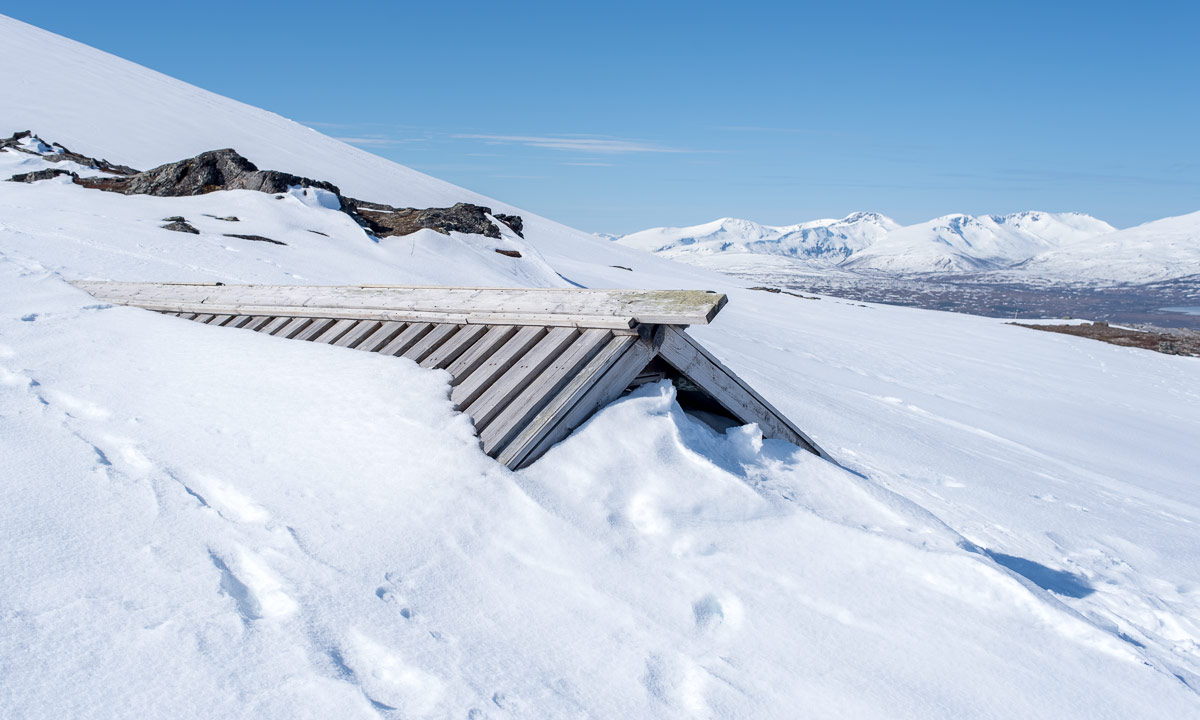
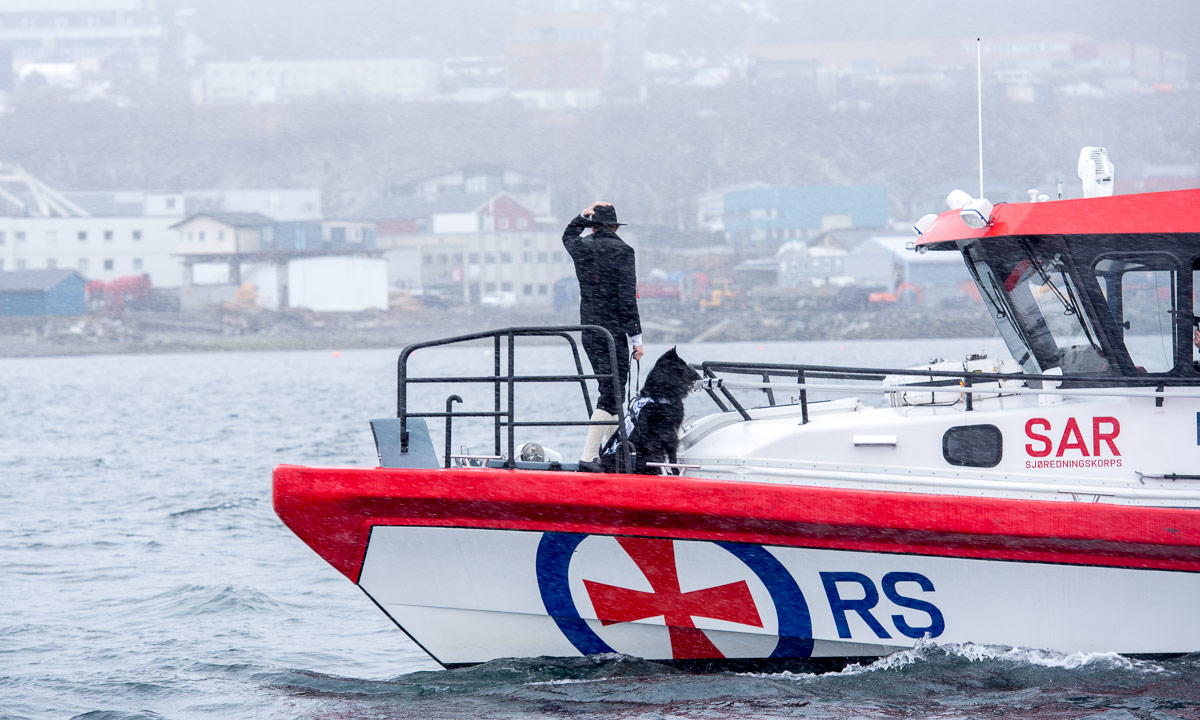
Today was the first torsdagspadling (Thursday paddling) of the Tromsø havpadleklubb, one of the two large kayak associations in Tromsø. Now we have enough light in the evening that you can take tours after work and it’s not so cold anymore. Well, kind of …

While it is not my first kayak tour this year – I paddled for example four weeks ago in Sweden– it is my first one in Tromsø and most of all the first one with others. We were nine paddlers today, eight experienced kayakers and me, the beginner. Fortunately the tempo was low and wind and waves were not demanding. So I could follow without any problems.

First everything went wrong. I could not book a kayak in the internet. Then I could reserve it but not pay it. Then one zipper of my neoprene boots was jammed. Then I could not close my drysuit zipper. Then I lost a part of my waterproof iPhone bag. Then I could not find my woollen cap. And so on. And so on. But with a lot of help of my fellow paddlers I finally was on the water. And luckily someone remembered me to attach the spray deck. (In Sweden I hardly use it.)

Oh – so nice to paddle again!

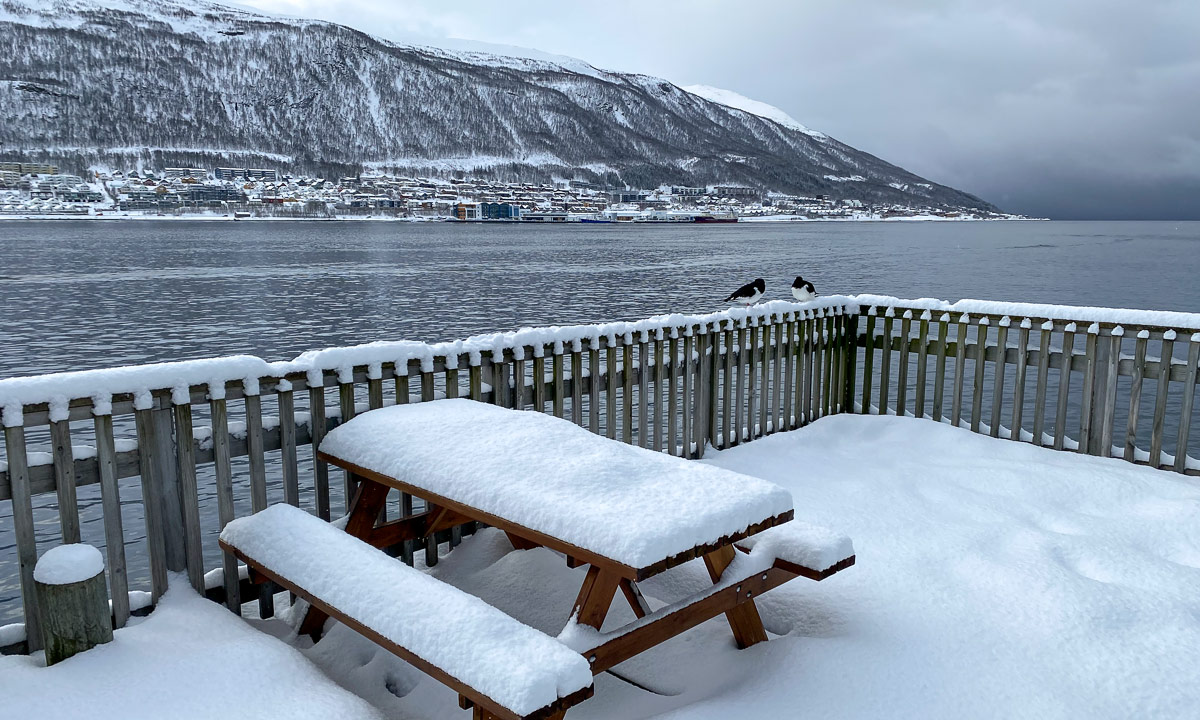
It took perhaps 15 minutes until we were right in the first snow shower. Not unexpected, since it had been snowing in Tromsø for three days now and we have subzero temperatures and at least 20 cm of snow on the ground. It was so beautiful with the sun peeking through holes in the clouds while the snow was falling.

But between the showers the sun came out.

Until the next shower. Now we were quite near the bay Telegrafbukta which is in the direct neighbourhood of my apartment. There I had taken a winter bath yesterday (water: 3.5 °C), now we approached it by kayak. We slowed down a bit – time for discussing paddle technique or to go ashore and re-adjust the footrests.

We did not go on land because the weather was not too inviting. So we paddled back against the sun and through a new snow shower. This time the wind increased a bit and we got even some waves on our way back.

Round two hours and eight or nine kilometres later we arrived at the club houses of the Tromsø havpadleklubb. Time to dry the kayaks, put them back and change to more civil clothes.

Takk for turen – thanks for the tour – I’ll be there next Thursday!

A hike to the Sørtinden between the seasons

After a springlike Easter week in southern Sweden I travelled back to my “work town” Tromsø on Easter Monday. Yesterday I was outdoors in the fjell. –the first time since the end of January.

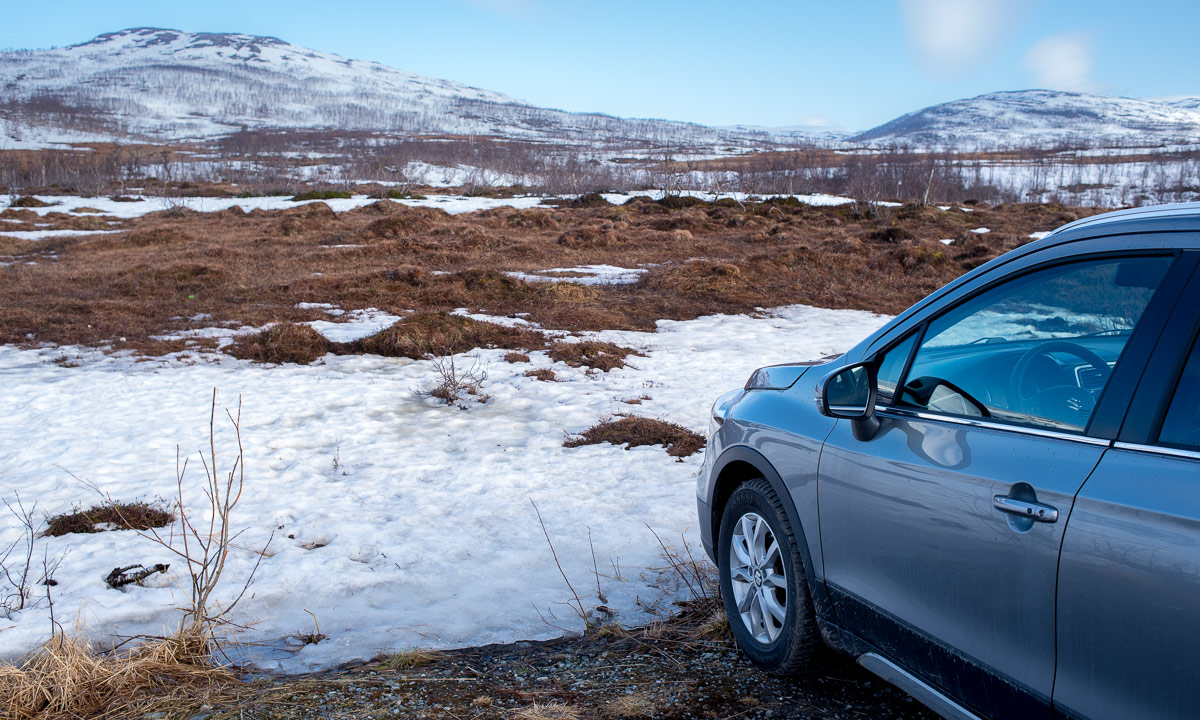
What kind of tour will I go for? Is it skis or rubber boots? Let’s pack both, take the car to the parking place by the road 863 on the island Kvaløya and have a look.

OK. Let’s take boots! I lock the car and start crossing the bogs. Some parts are still frozen, others bounce like a wet sponge when being crossed. The terrain rises and soon my boots trudge through snow. Snow is still deep but so compact that I hardly sink more than 5–20 cm.

I slowly ascent the mountain landscape and leave the trees behind. Soon I reach the top of the hill Skavlikollen.

I continue north. I put off my jacket because I am sweating in the warm sun. I realise that I forgot a sun blocker and take my buff for protection. (It worked – no sunburn the next day!) While the higher mountains are still covered with snow I walk also on rocks and heather. The hilly and mountainous landscape looks beautiful in the sunny weather.

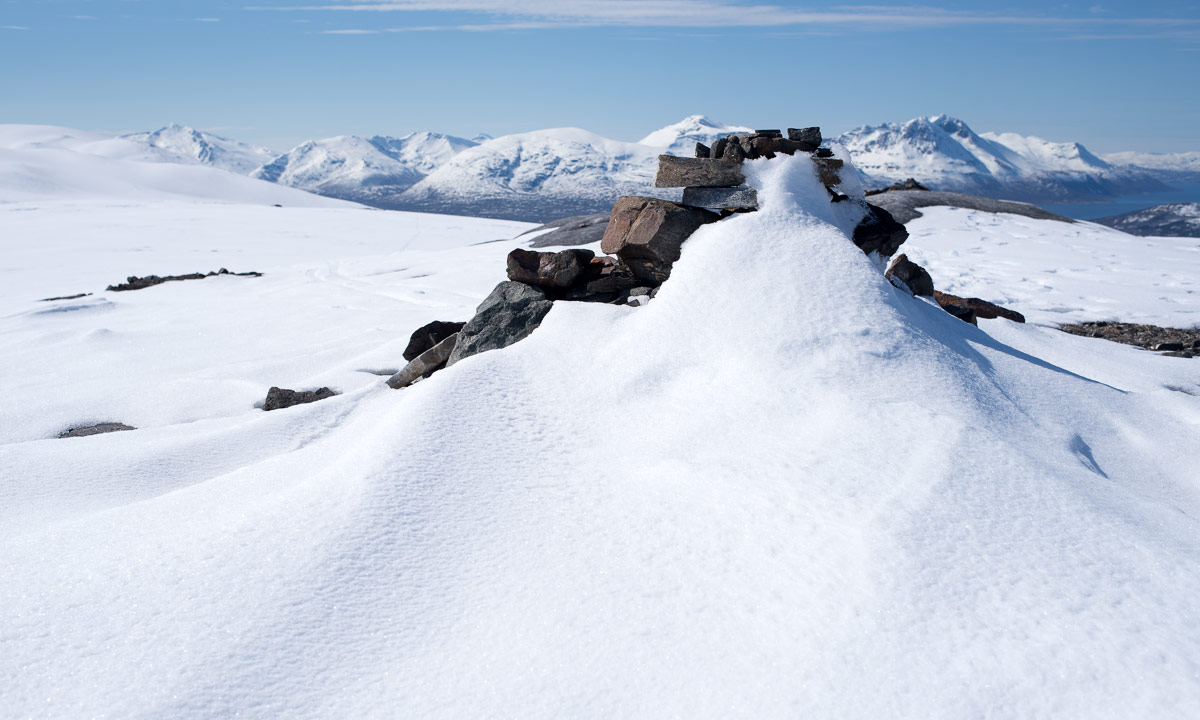
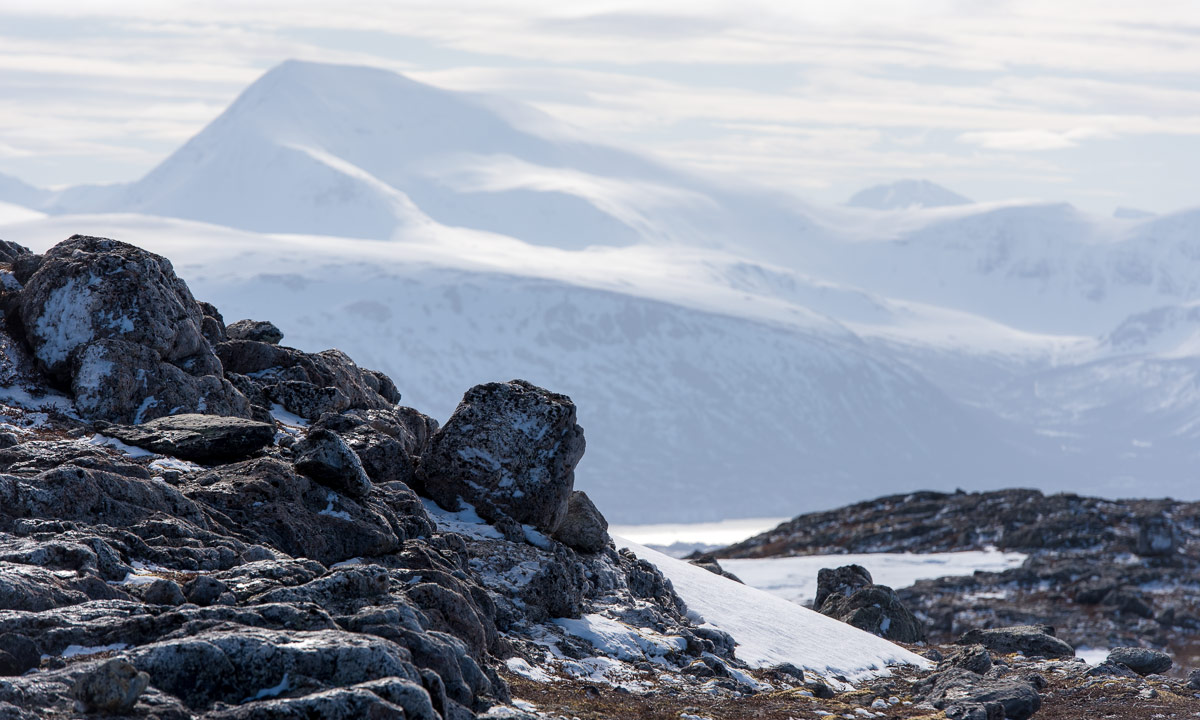
After round about 6 km I reach the top of Sørtinden (471 m). I’ve been there twice (1), (2), but only in autumn.

Here I take a rest and enjoy the view of mountains and fjords. I start to freeze and I’m glad about my down hoodie that fits into the camera backpack. The sun provides warmth but the air temperature is hardly above zero.

I choose another way back but get a bit “photo-lazy”. For the birch at the slope however I’ll take my camera out of the backpack.

Partly it is easy to walk down the snowy hills because you can glide, but parts of the snow has softened by the sun and more than once I break into knee deep snow. After 11.5 km of walking and snow trudging I arrive at the car. From there it’s only 20 minutes by car home.

That’s a good start for #onceaweek– my plan to make a new tour every week. Let’s see what I’ll do next weekend. When I look at next week’s weather forecast it might be a ski tour.

Polar expedition AeN JC3 – day 21: Longyearbyen · time to say farewell

This article is part of the series “2022-02: Winter cruise KPH”.

Day 21 · 11 March 2022

It’s the night before 11 March, the last day of the polar expedition JC3 in the program Arven etter Nansen that I have been allowed to take part the last three weeks.

As often before I stand on the helicopter deck of the icebreaking research vessel Kronprins Haakon. It’s dark but I can see pale mountain schemes on both sides of Isfjorden. Mountains and fjords, that feels almost unreal after two and a half weeks with hardly any land in sight.

The first lights, the first other ships, the first mobile connection for weeks – we are definitely approaching civilisation. The airport is already in sight and soon the illuminated settlement Longyearbyen, the largest inhabited area of Svalbard is visible.

At 1:30 in the night we arrive at the harbour of Longyearbyen and the ship is moored. Time to catch some sleep.

After some hours of sleep the alarm clock wakes me up – time for breakfast. We have to leave our cabins at 8:00, the first farewell. Goodbye cabin 385 at the port side of the ship’s bow. After breakfast I stand again on the helicopter deck to welcome the sun and the blue sky.

Some of us leave the ship to visit town. Is it possible to go there without the threat of polar bears? Apparently, although we are at the coast and polar bears can swim. For two hours I stroll through the town, first with others than alone. Many of the others have lived here for a while – a normal place for people who are involved in polar research.

I head to the University Centre in Svalbard (UNIS). It’s not only the university that is located there, my employer the Norwegian Polar Institute has offices there as well. Hopefully I may work here for some weeks someday. I want to spend more time in Longyearbyen.

Together with J. who works there we had back to the ship. Here we will meet the taxis to the airport but before that we get lunch – the last meal on board.

Some hours later. Seven of our team sit in the waiting hall of the airport. Others already left with the earlier flight. And then we enter the airplane. It’s surprisingly cold in row 3 near to the open front door and after some minutes I put on my down parka. It may look ridiculous but soon I’m getting warm again. And then the plane starts.

The plane is rapidly gaining altitude and more and more the whole wintry beauty of the island Spitsbergen is revealed. I’m so touched by the view of mountain chains, glaciers and ice covered fjords.

And then we leave Spitsbergen’s southern tip behind and a layer of clouds slide between airplane and sea. A journey far beyond the ordinary comes to its end. Time to say farewell.

On the arctic sea iceFarewell

I stand on the Arctic sea ice
far in the north. The sun hangs low
over the horizon and there lies
an ice ridge lit by the morning glow.

The silence feels as infinite
as the extent of the frozen sea
and with every subsequent minute
my heart grows with boundless glee.

I stood on the Arctic Ocean
It’s past now and I should say good bye.
But an overwhelming sad emotion
shades my soul. And I cry, and I cry.


Olaf Schneider – 24 March 2022

My heartfelt thanks to all people that made this journey possible.


Polar expedition AeN JC3 – day 17 and 18: An incredibly beautiful day on the ice

This article is part of the series “2022-02: Winter cruise KPH”.

Day 17 and a bit of 18 · 7 and 8 March 2022

7 March

We have arrived at a place somewhere between Svalbard’s second largest island Nordaustlandet (14.443 km²) and the easternmost island Kvitøya (682 km²). No one lives permanently on these islands.

The ice experts have found an ice flow and examined it. The ice near the ship has some holes so the dress code is survival suits for the first time. In opposite to the formerly used Regatta suits they have attached boots and neoprene arm and neck cuffs. They shall keep you warm and dry in case you fall into cold water – or in our case break through the ice.

I am very interested to join and observe ice coring, a missing link on this expedition. I wasamhowever quite doubtful whether I will be allowed to enter the unreliable ice on this station. But I am lucky again, I may follow M. and L. onto the ice.

Earlier I was told that I may join the scientists taking ice cores but won’t get the opportunity to take ice cores by myself. That’s understandable. To my huge surprise – and delight! – plans were changed: L. shows me how to do it once and then it’s up to me to take five more ice cores. Give me snow or ice and something to play with and I’m happy ;-).

No, I’m no experiences ice corer after five cores. But at least I get an idea and a bit of a routine. In measuring snow depths, ice depths, the freeboard and writing down the values with a pencil. In mounting the large ice core attachment onto the electric drill and removing it after coring. In putting the ice core onto the gutter-shaped cutting board without flooding the electric drill or touching the snow (happened once – sorry!). While M. is cutting the core into slices and putting them into wide-necked plastic bottles I continue with my work. And I have to continue, because I’m still slow and M. shall not wait too long. I think, I could do that for weeks. Standing on the ice and drill cores out of the sea ice.

I have asked Pernille to take some photos from me while coring. These are probably the only photos that prove that I actually did something on the expedition beside of taking photos.

Photo credit: Pernille Amdahl, Nansen Legacy –tusen takk!

And the afternoon? I am allowed just to go onto the ice once more as long as I find some team lead to join. I find one and so get my 7th opportunity on this cruise. Two and a half more hours on the ice. I overhear a radio message. No polar bear warning but the information that our ice flow drifts with more than 2 km/h and the water depth is decreasing. This could damage instruments when they are too deep in the water.

Just some more photos:

And later, when we are on the ship again another polar bear approaches. This time it is a curious one that is very interested in the scientist’s equipment. And since it could harm the bear when it eats cables or plastic it is shooed away with a flare gun. **BANG**. It gallops some metres and then walks away. No polar bears were harmed and as far as I know no cables.

By the way – it was a good decision to use the survival suits. One of the scientists went through the ice today. All of a sudden and quite near the ship. It did not take long to pull the scientist out of the water but without the survival suit this would have been a very wet, cold and unpleasant experience.

8 March

The next day some additional measurements are done on the ice and then we leave last ice station of Arven etter Nansen JC3.

Ha det bra, Arctic sea ice. Farewell! It was a great pleasure to meet you and I definitely will miss you!

Meanwhile in Tromsø

While I am writing a lot of blog articles about my time in the Arctic live in Tromsø goes on.

When I arrived Friday a week ago Tromsø was as un-wintry as possible. It was several degrees plus and it rained.

But to be honest, it didn’t affect me a lot. Mentally I was still in the Arctic.

Despite to the torrential downpours that Yr forecasted for this weekend the weather was ok yesterday and nice today. But as the whole week it was really warm: +7 °C. Time for a morning walk. _(Sunny, but much windier than expected.)_

In the afternoon I wondered if it was possible to take a small promenade on Kvaløya. I headed to the parking place from which I started a ski tour seven weeks ago. A lot of other cars were there and snow and ski tracks. I did not have any skis with me today. I tried to walk on the snow just with boots but the snow was at least knee deep. And then I came to the bridge that crossed a rapid meltwater flow. Maybe nice for experienced skiers but I didn’t have any interest in falling into the water. Time for me to return to the parking place.

The good thing: the parking place is just 200 metres away from the coast. So I took a short afternoon promenade there enjoying the colours, the sun, the fresh air and the wind. Yes it was windy – the display at the bridge to Kvaløya showed 20 m/s.

Back again at my car skiers arrived. My skis where home but then I remembered, that I always have snowshoes in my car. I attached them to my rubber boots and so I could make at least a tiny promenade to the next hill some hundred metres away.

Back in my car. Next stop: Sandnessund Cemetery. Never been there before. Even there a lot of snow.

Next stop was unplanned. I just had to take a photo of the vessel and the mountains of Kvitøya. Luckily the parking place of the Tromsø Havpadleklubb was near.

The Arctic has its own extraordinary beauty and I feel a special connection to it. Tromsø and surroundings however are beautiful too, even when weather has been much too warm for mid-March.

For the records: The first „hestehov“ or Tussilago I (17 March on my way to work).

Polar expedition AeN JC3 – day 7 and 8: a stormy intermezzo

This article is part of the series “2022-02: Winter cruise KPH”.

Day 7 and 8 · 25 – 26 February 2022

25. Feb 07:00 – testing clothing concepts for extreme cold weather

Another Arctic morning. It has become slightly warmer with temperatures round -24 °C but at the same time a lot of windier. The average wind speeds of 20 m/s and above. So windchill is still -45 °C and I wonder how to dress just in case I will be on the sea ice the first time this night. No, I do not count on being allowed to enter it under such conditions but you never know. Be prepared and wait …

For safety reasons we always have to wear a special suit on the ice in case of someone breaks through. That’s either the Regatta suit, a floatation suit. This acts as a full body life vest giving you buoyancy in the water. However you will get wet instantly. No big issue because we will always be quite near the ship and conditions are ok. If the circumstances are more extreme or the ice is not trusted a survival suit with attached rubber boots is used. It will keep you completely dry as long as the arm and neck cuffs are tight. It is said however that it is uncomfortable to wear and you easily get very cold feet.

So, let’s get dressed. For the first time I put on the Regatta suit. It is as breathable as a rubber dinghy so you should not sweat too much. Over that, more for the fur hood than the warmth the Canada Goose parka. Yes, I can still move ;-)

Dressed like never before I open the thick door to the helicopter deck and stagger outside. Whoa! That’s some rough weather. I instantly feel every single square millimetre of skin that is still exposed to the wind and even that the zipper of the down pants are not completely closed at the bottom although I wear high rubber boots. In my opinion the hood of the Snow Mantra is ingenious but the gusty storm just pushes it aside in all directions and I can hardly see anything. So I do not check if the selfies taken with the Nikon and three pairs of gloves and mittens are in focus. They are not.

Being in again I understand the first time, why the parka hood is not only fur-trimmed but have this thick fleece rim inside. It keeps away the ice dust that the storm blows in.

The combination of Regatta suit is too warm and too bulky. I test another combination with the shell jacket of the Norwegian Polar Institute and ski goggles. Insight 1: if the hood does not fit perfectly it is completely useless in the storm. Insight 2: my old ski goggles freeze over so fast that within a minute I am functionally blind. I have to remove them to find back to the helicopter hangar. While checking this the storm pushes me around on the deck slippery deck. I really doubt if anyone wants to work on the ice in these extreme conditions. On the other side I do not know anything about polar research. Neither about polar researchers. It’s me who is the newbie.

25. Feb 11:00 +2h – planning for the storm

Aside: The day before we changed the ship’s time to take better advantage of the daylight. When I write +2h it means our privately shifted time. Otherwise it means „normal“ CET time zone.  If you don’t care, just ignore it.

We have a meeting before lunch. A storm approaches. We will seek shelter between Nordaustlandet, Svalbard’s second-largest island and the island Kvitøya. Conditions are too rough for an ice station. Although all four ship engines are running we hardly make progress. There is no time schedule anymore. We just have to sit it out.

25. Feb 16:20 – the swell wracks the ice

At 15:20 I take a long afternoon nap while Kronprins Haakon struggles through the ice. I have on of the frontmost cabins on deck 3 –the noisiest ones. The icebreaker is rumbling, rattling, grinding, squeaking and doing many more noises that I do not have words for. I lie in my bed and feel the mattress vibrating, shaking, bouncing. And I love it. For me it is like an Arctic lullaby and as mostly I fall fast asleep.

z – z – z – z – z

After an hour I wake up all of a sudden. Something has changed. The ship is slowly and strongly pitching. At the same time noises and vibrations are absent. Are we in open water? What happened!?

I have to compensate the ship’s movements while I walk to the dayroom. I peek through the ice crusted windows. Yes, we are in open water. J. sitting there tells me that 10 minutes ago swell waves. They broke up the ice within minutes and now the ice has disappeared. Impressive and a bit frightening, too.

Now we are amidst the storm with an hourly average of 24.2 m/s, that’s round 87 km/h. The highest wind speed measured in this hour is 32.7 m/s, that’s the exactly beginning of Hurricane force or level 12 on the Beaufort scale.

Although the ship is stabilised it is pitching, rolling, yawing, heaving and a lot of people have started to get seasick. I feel quite ok, but a bit stressed and tired. After a while I decide to lie down for a quarter. Good idea! I feel better again after that.

I’m in the day room again, watching the dark waves through the ice encrusted windows . Sometimes the spray splashes up many metres. No, I won’t enter any outside deck today any longer!

25. Feb 19:24 – crossing the 80th degree of latitude

I wanted to see on the digital nautical chart how we cross the 80th degree of latitude but I miss it by some minutes in time. Soon I go to bed quite curious how the next day may look like.

26. Feb morning – Kvitøya

06:10 – The wind has calmed down and I stand on the helicopter deck (on level 6) again. Open water, a bit of ice and in the distance a pale scheme. The island Kvitøya. It looks like the spray has reached the deck because everything is coated in ice and the ice on the floor is slippery and feels like soap powder.

After the breakfast I try to catch Kvitøya on the Nikon sensor.

The last photos are crap from a technical view (taken at 600 mm ƒ/6.3 in twilight on a moving ship and a travel tripod). Anyhow they show the glacial coast of this Arctic island which I think is very impressive. A pity that the weather was so cloudy.

26. Feb morning – we reach ice again

While I take these photos another thing happens: we reach ice again. First fields of beautifully rounded pancake ice floes, then a few hours later we are in ¹⁰/₁₀ of thick ice again. There Kronprins Haakon can show again that it is an icebreaker.

We have another meeting at 09:00 +2h. We learn that it is more than unsure whether station P4 will have any reliable sea ice to work on. The cruise leader asks: shall we try P5 instead? Yes, all scientists agree. So today we will head to P5 at 80.5 °N 34 °E. That’s only an estimated position. First of all a suitable ice floe has to be found and then this floe will drift on the sea and so change position while ice work is ongoing.

26. Feb 16:00 – checking the ice

Eight hours later. Together with the cruise leader and the captain the ice experts had looked for a suitable ice floe. When they were satisfied the ship stopped and a derrick lowered the ice gangway. Now four people are on the ice. All equipped with survival suits. Two of them carry rifles. We are in the home of the polar bears.

Will I be allowed to enter the sea ice? Perhaps already tomorrow? I doubt it but I’m really longing. I don’t know where this strong relation for the Arctic comes from but it’s definitely there and it grew the last days. And I want to be part of it as much as possible.

Polar expedition AeN JC3 – day 3 and 4: transit to P1

This article is part of the series “2022-02: Winter cruise KPH”.

Day 3 and 4 · 21 – 22 February 2022

Monday, 21 February

Yesterday afternoon we left Tromsø behind for the transit to P1. The program Arven etter Nansen has seven so called process study stations called P1 to P7. P1 is the southernmost station with the approx. coordinates 76° N 31°13′ E. That’s almost five degree more north then I’ve ever been in my live. And it is planned to reach P7 at 82° N later on this cruise. Will we make it?

ETA (estimated time of arrival) is set to tomorrow 8:00. So today is travel day.

After I woke up I take a short lookout on the helicopter deck before breakfast. This starts to be a personal tradition on this cruise. With -11 °C it is colder than the days before but wind is calm and the temperature feels still very moderate.

I expected that we had left the mainland far behind and would cruise through open sea. To my surprise I can see mountains and lights. Where are we!?

Internet reveals that we are just passing the island Melkøya near Hammerfest. Melkøya is illuminated by the lights of the processing plant Hammerfest LNG. Interesting!

After a rich breakfast I stand on the same deck again. Today I feel more like a cruise tourist then a data manager on a work trip. Even the photos look like beautiful but quite random pictures taken from a Hurtigruten ship.

And indeed the icebreaker Kronprins Haakon follows the very same route as the Hurtigruten ships. Aside from that we do not call any ports. (Spoiler: next port is Longyearbyen on Svalbard 18 days from now.)

What do you do on a transit day on sea? Participating the mandatory sea ice training for example. It’s from 9:00 to 14:00 with a lunch break and we are told a lot about the different risks we might be confronted with on this cruise.

What I know is cold weather. Hypothermia, frost bite. I tented at -35 °C, I skied in blizzard-like conditions. I guess I have a bit of experience.

What I hardly know is arctic sea ice. I’ve been on the ice of the northern Baltic Sea countless times, but that water has only the tenth of the salinity compared to the water of the Barents Sea. The sea ice is softer and the conditions are quite different.

I  definitely know nothing about polar bears and a lot of the training is learning the procedures to avoid contacts.  I’ll talk more about this in another blog article.

At 13:30 we meet at the quarterdeck and train the handling of throw bags. Inside the bag there is a rope attached to a hip belt. When someone breaks through the ice the rescuer can throw this bag. The person to be rescued catches the rope and can be pulled back to safety. By having a long rope it is possible to keep distance. This minimises the risk that the rescuer breaks through as well. I know this from kayak courses but I’m glad to give it some tries again. Yes, it’s me on the next photo.

Photo: Adam Steer, Norwegian Polar Institute

At 16:00 I go on deck 3 again. It has got dark and started snowing.

Later that day the arrival time for P1 has been postponed to 19:00, eleven hours later than the ETA before. So much to the letter E in ETA ;-) It is almost impossible to plan with conditions as unsure as in the Arctic.

Tuesday, 22 February

My sis has birthday today. Hooray! Will we still have internet that I can wish her a Happy Birthday? Don’t ask me why, but we have internet in this remote place and I can send her a message.

Again I am on the helicopter deck before breakfast. Three differences to the day before: The deck is covered with snow, it is slightly warmer and no land is in sight. Finally we have left mainland Norway behind. And more and more I’m able to realise that I am really on a scientific polar expedition!

Still it will take another 11½ hours until we reach P1. I use the time to finally start working. My goal on this cruise is to understand the flow of scientific data. Where do the unique IDs come from? Where location and time? How are physical samples tied to the digital data? And can I improve these processes? I ask many stupid question to scientists to get a basic understanding.

And since I cannot ask questions for 11½ hours – I don’t want to be thrown overboard by my “victims” – I use more time to stand outside and take pictures.

Dinner 17:30. I forgot what I ate but it was delicious! For sure, because every single meal has been delicious on Kronprins Haakon.

But after dinner it is time to recover a glider. This is the first scientific activity on this cruise. Finally!


Polar expedition AeN JC3 – day 1 and 2: Tromsø

This article is part of the series “2022-02: Winter cruise KPH”.

Day 1 and 2 · 19 – 20 February 2022

Oh, well – where to start? I’m still completely overwhelmed from the polar winter expedition Arven etter Nansen (The Nansen Legacy) with the icebreaking polar research vessel Kronprins Haakon that just ended three days ago.

Ok, perhaps it’s best to start with the beginning.

The beginning

It’s Saturday, 19 February 2022 early in the morning. I look at my baggage in my one-room flat. A huge suitcase, an even huger bag, my photo backpack and my bulky Canada Goose down parka plus winter boots.

Do I really have everything? Warm clothes? The helseerklæring – a medical certificate that proves me “seaworthy”? All camera equipment? All gloves and mittens? LAN-cable with adapter for Mac? My reading glasses? Passport? Woollen underpants? Balaclava?

I made a complete packing list, I packed twice(!) but still I’m a bit nervous. When I’m on the ship, it’s probably too late to organise left-behind things.

The taxi arrives at 8:15. It drives north to the harbour, opens the gate to the restricted area and continues directly to pier 25. I’m not alone. Other people that came by taxi or brought by private car and a lot of luggage are there, too. And there it is: Kronprins Haakon, my home for the next three weeks.

My cabin

I ascent the gangway – I have to go twice with all my luggage – and there is a reception. I tell my name and get my key card. I’m in cabin 385. I get a short description of where to find it. It is quite low on deck 3 and right in the front. These cabins are told to be the loudest when the ship starts breaking ice.

The cabin has a huge window. Wow! Behind the window: two bull eyes. As closed and locked as possible. So I won’t see anything from my cabin, but that’s ok. It’s pretty roomy with a desk, a small table, a small sofa and space to store your stuff. And a bathroom. I’ll share this cabin with P., a scientist.

Waiting

Next event: passport control through the police. Then: the first meeting. Here we learn, that departure is delayed, because a crane has to be fixed. Estimated time of departure: tomorrow after bunkering fuel.

While I can take it easy the scientists are busy. They don’t wear lab coats, they wear safety boots and helmets and use pallet jacks to put their equipment to the right places. And there is a lot equipment! Several containers full of it!

11:30 – lunch. Wow, the food is rich in variety and it tastes wonderful. I heard that many people gain weight on these cruises. Now I understand.

12:30 – group photo. That’s my job because I have all my camera equipment with me. Click. Click. Click.

13:00 – safety briefing. How to put on the survival suit in case of evacuation. I’m the guinea pig. And I hear a thing that photographers dream of: Almost every place on the ship is freely accessible. The quarterdeck at the ship’s stern, the helicopter deck at the ship’s bow, the bridge on level 8, the observation deck on level 9. Great! I use the spare time to stroll around a bit.

15:00 – safety training. We „muster“ which means we gather all in the mess – the same room where we eat – split into two groups and enter the life boats. These boats are equipped with everything you need to survive for some days but when you go to the toilet everyone can see it. Made for survival, not for comfort or privacy.

17:00 – dinner. 18:30 – a second meeting. 20:00 – the equipment of the polar institute is accessible: I fetch two pairs of boots and a floating overall size XL. A helmet I already have.

22:45 – bed time. First night on the ship. My bunk bed looks small but is comfortable and very cozy. Good night!

Day 2 – More waiting

I wake up. Do we move? I’m not sure. The internet reveals: we have moved and are now south of Tromsøya. Let’s go out onto the heli deck. Oh, what a beautiful morning!

The ships moves to the bunker station. There it will lie for many hours. Bunkering fuel takes time.

A lot of time. I help a bit here and there, but I cannot do so much. The scientists are extremely organised and mostly it’s faster for them when I do not try to help. At least I can carry some stuff around.

The departure is estimated for 16:00 but when we have dinner at 17:30 we still lay at the same place. I overhear that this delay is larger than usual. When will we start? Will this affect the planning? As most things on board I just don’t know. I’m the newbie.

The journey begins

17:54 – while I am eating my chilli con carne I feel a change in the ship. I look out of the window and almost shout out: „We are moving!“. Finally we are on our way!

After dinner I stand on the heli deck for a long time. I’m on the phone with Annika – maybe the last time for some weeks. I watch the ship going under the bridge Sandnessundbrua that connects Tromsøya and Kvaløya. I watch the Northern Lights. And I’m very happy. The journey begins!

Arrival in Longyearbyen

This article is part of the series “2022-02: Winter cruise KPH”.

It is half past two in the night between Thursday and Friday. For almost two hours I had stood on the helicopter deck of the icebreaker Kronprins Haakon to witness our arrival in Longyearbyen on Svalbard.

When I went outside two hours ago clouds had just started to gather and the moon was hidden. I could see dark and pale schemes on both sides of the ship and straight ahead another shade of a mountain, decorated with lights.

Slowly the lights came nearer. And since it was the first time I had mobile Internet for many days I could follow our route on the map of the iPhone. Only occasionally because a cold wind on the bow made the quite mild temperatures of -5 °C feel much colder.

There – the airport! And then, after we started to turn into the Adventfjorden, the city LongyearbyenSvalbard’s largest settlement.

The ship slowed down at the harbour and slowly and carefully started to move sideways. Do we still move? I peek down to the pier. There, the first thick rope connects the vessel with land – the first land after we bunkered fuel round 19 days ago!

We have arrived in Longyearbyen. Almost three weeks I worked, learned, photographed, relaxed, ate and slept on Kronprins Haakon. Tomorrow I’ll disembark and in the early afternoon take an airplane back to Tromsø. Yes, I am sad that this incredible journey has now come to its end. But I am also happy and content and full of stories, experiences and memories.

Do I smile on the photo or am I sad? Most of all I am tired and then a bit tense because it is hard to hold the iPhone as still as possible for some seconds with an outstretched arm.

The scientific winter cruise Arven etter Nansen JC3 took almost three weeks. Three very extraordinary weeks. And it will take at least three other weeks to tell some of the stories and show some of the photos here in the blog. So, please be patient – more to come, but step by step.

We are on our way

This article is part of the series “2022-02: Winter cruise KPH”.

After a lot of delays the departure of the icebreaker Kronprins Haakon was estimated for today, 16:00. But even when going to dinner at 17:30 we were moored at the bunker station. Some minutes before six I felt some change in the vessel’s vibration, looked out and could see lights passing by. I almost shouted out – “we are moving!” So finally we are on our way to P1, the first station 500 km east of Svalbard. We will travel there for 40–48 hours.

Today I stood on the helicopter deck, watched Tromsø passing by and the polar lights in the southeast.

Tomorrow I hopefully will wake up in the open Barents Sea continuing north for the whole day. There’ll be open water for some days and then more and more sea ice.