An almost outdoor barbecue on Kvaløya

Some days ago I got a message from Elisabeth. She already had organised several events with friends and acquaintances – always outdoors – and in this message she asked me:

Lyst å bli med på grilling på fredag etter jobb?

(Would you) like to join (us) for a barbecue on Friday after work?”  That sounded like fun and I gladly accepted the invitation.

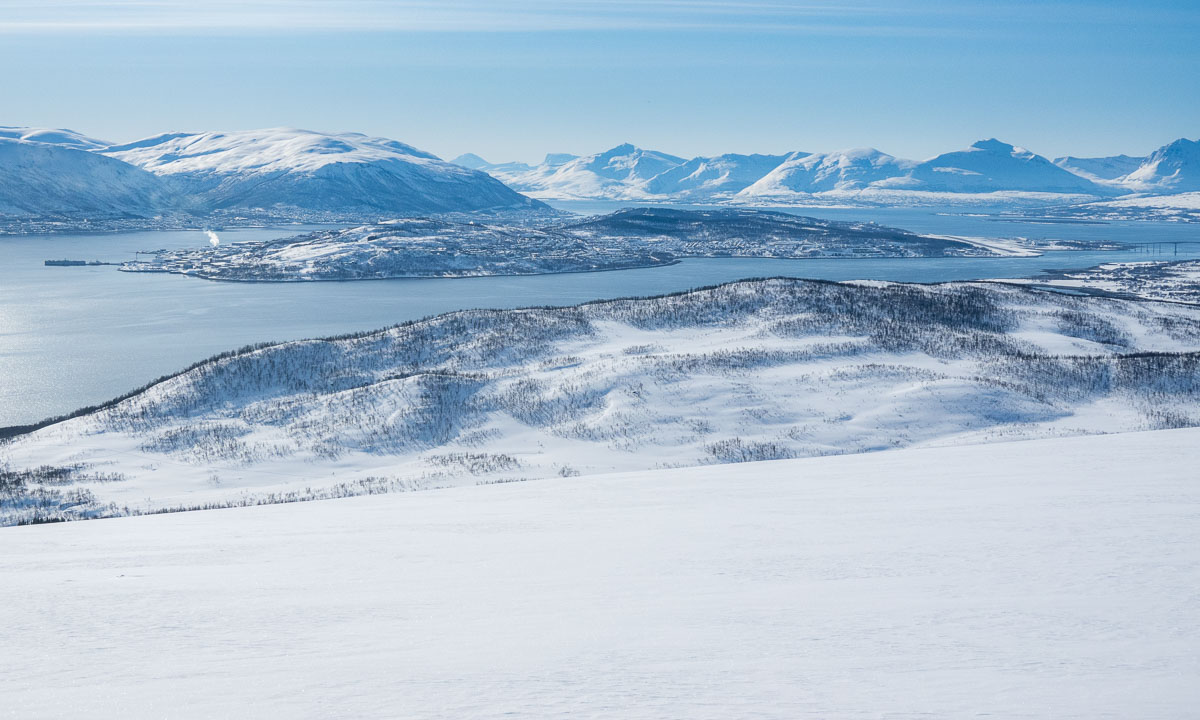
Friday evening was calm and clear and with -12 °C pretty cold for Tromsø – the coldest day this season. So I put some food and a lot of warm clothes with me. I met Elisabeth and two of her friends at the parking place and we went down to the barbecue hut by the sea. It looked like just a normal wooden house. Only without door, without window panes and without any floor. Instead of this a huge fire place in the middle.

More people dropped by until we were eleven people in total. Some of them had reindeer skins with them but they were hardly used. You know these parties where all people gather in the kitchen? It was a bit alike, all of us stood round the fireplace in the middle of the hut. Some to make stick bread or sausages, some to grill marshmallows or prepare waffles and some just to stay warm.

It’s always great to meet interesting, nice people. It gets however a bit harder when most of them are native speakers, because my Norwegian is still not so well. But it gets better and better. While I couldn’t take photos from the conversations I could take photos from the beautiful surroundings, even from within the hut. Remember, no window panes.

After three hours people started to leave. I was the last one left, just to take some more photos, then I took the car home as well.

Thank you Elisabeth for the organisation and for inviting me. Or more Norwegian: takk for i går – thanks for yesterday!


SE—DE—NO

Sweden—Germany—Norway, that’s the short version of my travel route the last two weeks.

Obbola – Sweden

Christmas was less than two weeks ago but it feels much longer. The kayak defrosting in the winter garden on Christmas Eve to prepare for a last paddle tour in 2022 with Annika. The drag marks of her kayak in the snow the day after. Last year. Long ago and far away.
On 25 December we travelled to Germany – a 24-hour train journey from Umeå to Bremen to celebrate the 90th birthday of my mother.

Bremen, Oldenburg, Münster, Heidelberg, Düsseldorf – Germany

After two days of celebration we visited friends in Oldenburg and Münster and then continued to Heidelberg by train to meet my old and loved friends I got to know in Munich many years ago. I love the north but I miss my friends in Germany. Some of them I haven’t met for many years. But that’s another story.

On 30 December we travelled to Heidelberg by train, our southernmost destination in Germany. From Tromsø, Heidelberg is further away than the North Pole though much easier to travel to ;-).

While the weather in Bremen was partially rainy, New Year’s Eve in Heidelberg was warm and sunny. The temperature of  18 °C was much warmer than usual for the season and felt like a warm spring day in Obbola (or like a great summer day in Tromsø).

In the air

On 2 January we took the train to Düsseldorf Airport, from where we flew home the next day. I travelled to Tromsø in Norway with an early direct flight, Annika to Umeå in Sweden some hours later. I could see the sun for many hours while flying on 11000 feet altitude but it didn’t reach the earth. Norway lay in the shadow. In Southern Norway it was too early, in Tromsø the sun won’t rise before 16 January.

Tromsø – Norway

Today has been my 2nd work day in Tromsø this year. With temperatures round -10 °C it’s almost 30 degrees colder than in Heidelberg 5 days ago. I enjoy spring but I embrace winter. I feel home in the North. And when I can watch polar lights from my doorstep with just a parka and warm boots over my pyjamas I realise how privileged I am that I may live here – both in Obbola and Tromsø.

The last two kayak tours 2022

It’s Friday and the day before Christmas Eve. It’s actually my last working day but I worked only short, thanks to flextime. At 11:10 I stopped developing software for this year and went out kayaking.

Two days before the sea was open between our small ice covered bay and the islet Lillskär. Today it is covered with a layer of new ice. I drag the kayak to the end of the bay and start the tour.

Just crossing the 100 metres of ice seems to take ages. The ice is too thick to paddle through, too thin to walk on and too soft to push oneself forward with arms and ice claws. So it’s a lot of back and forth to get a bit of momentum to crash another metre with brute force. The stiff neoprene of my survival suit does not make it easier and I’m so exhausted when I leave the ice behind. I change plans. I won’t visit Obbolstenarna today (farther away) but the island Bredskär again. I turn the kayak and paddle north. Partially to open water, partially through fields of thin feathery ice. Let’s see, how far I’ll come.

I reach Bredskär and start to circle it. Looking at the right I see snow covered islands in the distance and ice fields. It feels and looks quite arctic.

This impression changes directly when I look left and see the forest of Bredskär passing by. Looking straight ahead gives another view: The port of Holmsund with the ferry to Finland. Between that and me: many ice fields.

I pass the small bay with the sandy beach and slowly follow the shore line. When I want to turn left again to enter the sound that leads back I am stopped by another ice field, this one thicker than the others. I remember the first 100 metres today and decide not to break through but to turn. It will make the tour a bit longer but I have holidays and I’m not cold. The outer side of the island is beautiful anyhow in the light of the lowering sun.

Yes, the sun is lowering. The tour took longer than expected. I decide to watch the sunset from the kayak and slow down a bit. My fingers are getting a bit cold, but it’s worth it.

A good two hours later I arrive at the first ice field again. The ice channel that I had created by breaking through has frozen over again but breaks under the weight of my kayak. Shortly before 14 o’clock I stand on the bay ice again. The tour was a bit demanding, but impressive and beautiful. A great start into the Christmas holidays!

I’m however quite sceptical about Annika’s and my idea for tomorrow: Christmas eve paddling together. With temperatures round -10 °C the ice will probably be too thick the next day. A pity!

One day later – Christmas eve. Annika and I peek through the spotting scope to check the ice situation. Looks like the ice has gone. I walk to the ice edge and see our observations confirmed: Yesterday’s ice has gone and beside of some new and thin ice fields the water is open. So let’s take a kayak tour together!

This paddling tour was magic. The sea surface was smooth as silk, the sun felt warm and the new ice was easy to paddle through. The air was so clear that we could spot islands far away and there was almost no wind. Beside of the high frequency noises when crushing the ice with our kayaks and a dog at land barking at us it was completely silent.

It was Annika’s first winter paddling tour and I’m glad and lucky that it was such an exceptionally great one. May many other tours follow in the future! In spring, summer, autumn and winter.


Break at work IV – skiing through the forest

It’s Friday, the last day before weekend and the last opportunity this week to take a break at work.

In the morning I participated a workshop via video conference from my home office in Obbola. I just love the view through the window, where I can see the sun rising over the Baltic Sea and the snow covered backyard.

The workshop ended at 12:20. Right after that I took my old backcountry skis and dressed for a ski tour through the forests. Sunny, calm, -12°C. I wanted to go “Spåret”, a local forest trail. I followed the gravel road, crossed a ditch and followed the trail. Some hundred metres I was lost. When the snow is fresh everything looks quite alike. So I just made my own path. The fluffy snow was as deep as on the trail.

Later I found Spåret again and followed it. I walked through the shadows because the sun didn’t rise more than 3.3° above the horizon today. But at the part north of the treeless swamp the sun had a chance to peek into the forest edge.

At the road I decided to walk straight ahead instead of turning right to avoid the asphaltwith my skis. This was when I lost Spåret for good. Mostly I followed animal tracks because optical orientation is hard when it looks like this:

But it was fun because there was always something to see, even in a forest covered with 40 cm of snow. A frozen puddle at the rim of a swamp – a small pine covered with rime – thick animal tracks – the temporary (and abandoned) snow cave of a black grouse.

Sometimes I could see a roof of the house or hear a car. It’s Obbola, no wilderness. And so I came to the road that we use to take to town. I didn’t follow it but took a side road today. Less asphalt, more snow!

I arrived home at 13:55, some minutes after sunset. Again the horizon was coloured orange – and again I had a video meeting.

Break at work III – running to Vitskärsudden

It’s sunny again and significantly warmer than yesterday, but still -12 °C. I do not have time to take a longer break, so today’s plan is just running to Vitskärsudden. I’m a bit faster on the streets that have been cleared of snow and much slower on the snowy parts. I took a short photo break at the beach of Vitskärsudden, but no winter bath. Would have been a challenge between the ice floes. This break took round 30 minutes, including the photo break.

Break at work II – ice paddling

Today has been another clear and calm day. It was colder than the day before with temperatures round -19 °C. Today’s plan was paddling, at least round Lillskär, the small skerry nearby.

Step 1 – fetching the kayak

I knew exactly where our kayaks are. They lay in the garden – hidden under a layer of powder snow. So the first part of my paddle tour was digging out my kayak.

Step 2 – dressing and get equipment

Survival suit · thick mittens · ice claws · smartphone · camera · waterproof bag for the camera · paddle. Just the basics, I won’t go far.

Step 3 – crossing the ice

After some frosty days the ice on the shallow bay seemed to be thick enough to support my weight. I walked over the ice dragging the kayak behind. At the edge of the bay there was an ice range that I had to cross. I entered the kayak and mostly I used my ice claws to drag myself forward. Sometimes the ice supported the weight of me in the kayak, sometimes we broke through. Although the ice range to cross was only 100 metres wide I had to take several breaks. Some to take photos, some to catch my breath.

Step 3 – paddling

Then I reached open water. Almost. The water was covered with a thin layer of transparent ice needles that made the water look crystallised. It slowed down the waves and I could hear the high-pitched clinking while I was paddling through. Very fascinating!

In addition to that the sea was smoking. When it is as cold as today, the surface water evaporates and quickly resublimes to tiny ice grains that build this moving fog that colours the sea in a pale white.

Step 4 – visiting an ice exhibition

When I passed Lillskär I bent right to the mainland. There were some ice-coated rocks and thicker ice floes there – an extremely beautiful view in the low sunlight. I just went straight ahead. The first ice floes were split by my kayak, on the thicker once I had to use my ice claws again to move forward.

Step 5 – back to land

I realised, that my tour has taken much longer than planned, although the distance was tiny. I was clad in my survival suit, the kayak was on the ice and in 20 minutes my video meeting would begin. I had to hurry up!

The ice near the mainland was too thick to paddle through, but too thin to walk on. So, ice claws again. Not easy, when you lack trained arm and abdominal muscles. When I approached another shallow, I just left the kayak, splashed a bit trough soft ice and knee deep water until I reached the bay again.

From there I could walk on the ice and drag my kayak behind until I reached our property. I went to the house and transformed from paddle guy to IT guy as fast as possible. I informed my boss and colleagues that I would by 5 minutes late. That gave my the chance to take a hot shower, because I was freezing.

Did I miss anything of the meeting? No, the others had to fix audio and that took longer than my shower.

After the meeting, round 12:15 I walked out again to make a photo of the cloud bank and the sea smoke in the low winter sun.

Tomorrow shall be another cold and sunny day. Let’s see how I’ll spend my work break …

Break at work I – island hopping

The Baltic Sea at Obbola has hardly a tidal range. When we get high water or low water it’s mostly due to the wind. Today we had gusty wind from north that let the air temperature of -12 °C feel much colder and to a sea water level of 70 cm below normal, that’s really rare.

Today I took a break at work to enjoy my beloved winter weather. Today’s plan: island hopping to Lillskär, a skerry less than 250 metres away.

Along the small bay I walked to the sea. A lot of rocks that normally are underwater were visible now, some of them wore rings of ice.

The skerry was even nearer than usual when I took this photo because I already stood on the ice. You see parts of the skerry in the right.

I had a decision to make: Shall I try to cross the ice or just wade through the icy water? I decided to wade, because you can get bruises when you go through the ice, even in my thick neoprene survival overall.

So I waded through the water which was less than hip deep. On the islet I had to wade through some thigh deep snow drifts, then I arrived at the outer shore of the islet.

Oh, I love winter when it’s a bit rough and I enjoyed being out. But not for long. Soon I went more or less the same way back …

… and home. After I had changed clothes I had five more minutes until the 10 o’clock meeting. Good timing.


And suddenly it’s winter

Last Tuesday it got sunny and I paddled kayak.  On Wednesday it got cold and the small sound between island Lillskär and mainland was covered with ice.

Although it’s mid-December and despite temperatures between -10 °C and -14 °C there were still whooper swans around. Don’t they migrate south? In the morning they managed to paddle through last night’s fresh and thin sea ice. In the afternoon the swans had left. Perhaps they finally decided to fly south.

On Thursday it snowed. In the afternoon 10 cm of fresh snow had fallen and everything was white and bright, even in the night.

On Friday Annika and I had a day off and visited friends in for a long weekend. They live in Kusfors in the inland, round 180 km north. On the way there and there we found more winter. It was not very cold but it snowed quite a lot. I took some images from the car while Annika was driving.

Yesterday on Sunday we came back to our house in Obbola round 20:00. Our property was covered with 45 of fresh snow. Since it had been sub-zero all the days the snow was pretty fluffy. We had to do quite a bit of snow shovelling – but after taking a photo.

Today it’s Monday and a new working week has begun. I had a lot of meetings today and therefore no time to paddle kayak. Oh yes, the kayaks … where are they? I know they lie beside the wooden terrace. Here they are, well hidden under a thick blanket of snow, right beside the window of the winter garden.

But there are other things to do as well. For example opening the afterwork ski season in Olles Spår near Umeå together with Annika. The snow is still soft and the cross-country skiing trail still slow but the first time of skiing is always special and we are happy and grateful that we live in a place where winter is around us.

Now it’s half past nine in the evening and I’m blogging. Snow is falling and the thermometer shows -9.5 °C, the same temperature as the last hours.

And you? What kind of winter do you like? Or do you prefer other seasons?

Finally it’s sunny again home in Sweden!

After a period of dull and cloudy weather that felt like ages the sun finally came out yesterday. Since I was flexible with working hours in the  morning I could make a small kayak tour.

The first part was easy. Since our house in Obbola is on the coast I only had to change my clothes and drag the kayak from the house to the bay. The bay was covered with ice. As usual I just sat in my kayak and started pushing myself ahead using ice claws. This works surprisingly well until you have a lot of water on the ice as I had yesterday. Although I wore neoprene gloves I got cold fingers. As usual this took some time but finally I reached open water.

It was then that I realised that I had forgot my paddle. Fortunately the bay is shallow and I could leave the kayak, step on the ice and carefully walk back to land to fetch the paddle. Some minutes later I sat in my kayak again ready to circle the island Bredskär. I watched the hooting whooper swans and even four flying goldeneyes, a species of ducks. At the northwestern tip of the island there was a small, slushy ice field, the rest was open water. The big freezing hadn’t started yet. When I reached the eastern side of the island I could watch the sunrise some minutes after 9 o’clock.

The last part of the otherwise calm tour was surprisingly wavy. When one breaking wave came out of nothing and of course directly from the side I was afraid that I could capsize but the wave just lifted me gently up half a metre and down again. I was lucky. Sometimes it’s nice to own a less agile but super stable boat.

Even it was only some degrees minus the kayak was covered with a layer of frost that glittered in the warm light of the sun. I just had to take another photo when I was back on land.

And then? After taking a hot shower I made it to the 10 o’clock meeting. In time!

Jämtland tour 22 – the landscapes

This article is part of the series “2022-08: Jämtland and Trøndelag”.

I’m sitting in the train to Umeå. We have a longer stop in Kiruna where the train changes direction. The other trains standing here are cargo trains that transport iron ore from the mines around. Temperature is -10 °C or lower and there are some centimetres of snow covering the ground. Winter finally has arrived in the Swedish fjäll.

I’m so glad to arrive home in Obbola tonight. I haven’t been there since July. Now I’ll stay until Christmas working from home for the Norwegian Polar Institute.

I’ve been however in Sweden in August, too. Not home but for a hiking tour with my sister and family together with my wife Annika.

This reminds me that I almost forgot to publish the last blog article about our hiking trip in the Jämtland. It will take more than seven more hours until I arrive in Umeå, so there’s plenty of time to start blogging now, as long as the mobile net allows. Earlier I’ve written about the cabins, some day trips, the trail and way marks. Today I want to show some photos of the landscape. Let’s go back three months in time. It is late summer in Sweden.

What I love about the Swedish mountains – the fjäll – is its variety. Not only in weather but also in landscapes. In the lowlands there are forests – mostly birch forests – but all Swedish cabins we visited lie above the tree line and here you have a wide view of the mountains, small and large lakes, rivers and streams, bogs and stone deserts. Let’s have a look.

15 August, our first day. The landscape is rising and we have left the forest behind. The trail between Storlien and Blåhammaren leads over many swamps and bogs and is wet and muddy.

16 August. We leave Jämtland and cross the border to Norway. The cabin Storerikvollen lies quite low and we descend through forests of crooked birches.

18 August. Still in Norway we take a resting day at Nedalshytta. I talk a walk along the lake Nesjøen. The water level is extremely low and so I can cross some mud fields that normally are under water. This landscape looks a bit hostile and is not typical for this region.

19 August. Again the terrain is wet and has many small lakes and water puddles. The mountains are hidden behind low hanging clouds.

We start hiking up the Ekorrpasset. Looking back we witness one of the most unphotographable landscapes I know. In reality it is an impressive view of a hilly terrain with uncountable lakes, ponds, streams and puddles. The photos however always look pale, blurred and boring.

Let’s not look back but ahead. The peak of the pass is more than 1300 metres high. That may not be much in the alps, but in these latitudes only few plant can survive these altitudes and so we walk through a desert of stones and rocks. Hidden in between some moss and the flower Ranunculus glacialis.

And let’s look aside. We pass the mighty Sylarna massif (1574 m) with its glaciers and rugged rocks. Impressive.

The Sylarna cabins lie lower. Grass and heather cover the ground presenting the landscape much more mellow, especially in the soft colours of dusk.

20 August. We leave Sylarna and continue to Gåsen. For that we have to hike through the valley of the river Handölan. Here we meet birch forests again. And some quite impressive rapids.

22 August. After a resting day in Gåsen we continue to Helags. The landscape is wide and broad. And where it is not too wet there are surely some reindeer around.

24 August. We are on our way to Fältjägaren, the last cabin of our tour. The weather is sunny and we are accompanied by the mountain Predikstolen (the pulpit) which shows itself from some of its many beautiful sides.

In the evening we stand outside watching the sunset and the incoming night. Soon the lakes are the only part of the landscapes visible. The rest is almost black.

25 August. Our last hiking day. On the other side of the valley we can see the gaps in the forests covering the mountain slopes. These are the ski slopes of Ramundberget where we’ll take the bus to Östersund. Back to civilisation.

And back to the present. I’m still sitting in the train. Where am I? Ah – half an hour left to Gällivare. Now I’m longing for a cold and snowy winter. But then I want to change ski boots with rubber boots and go for a hike again.