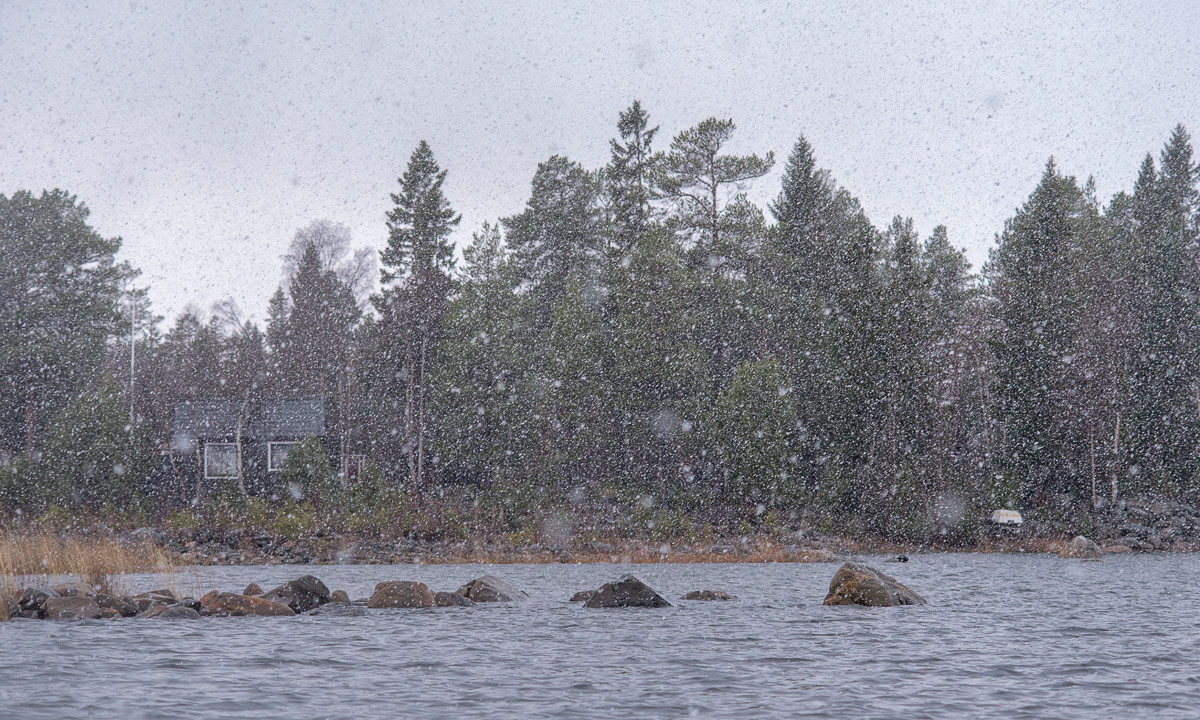
Finally it’s snowing again

After two weeks with warmer temperatures, rain and a lot of fog it has become colder again and last night it started to snow. 15 cm fresh snow has already fallen.

Thursday, 16:55: -7.6 °C and it’s still snowing. Looks like I need gloves and a cap for jogging. And of course a headlamp, because sunset was already three hours ago.

Addendum

One hour later. 40 minutes of (slow) jogging through the wintry landscapein the dark. Exhausting, but beautiful!

My car tracks from this morning are mostly snowed over. The latest tracks are not from a car, but a snowmobile. Now I hope, that the great people of the Friluftsfrämjandet Skelleftehamn soon prepare the illuminated ski track. I’m longing for some afterwork cross-country skiing.

A very wintry November weekend

It’s 9th and 10th of November. That sounds like autumn but it’s full winter in Skelleftehamn, although there is little snow. The temperatures this weekend are between -8 °C and -9 °C but the lively gusty wind makes it feel more like -18 °C.¹

I was out several times to check how long the winter has come.

Saturday

1 – Boat harbour Tjuvkistan

When I paddled by Tjuvkistan last Sunday I’m sure that there was open water. Now the whole harbour is covered with dark ice and snow is drifting over the frozen surface.

2 – Next to Tjuvkistan

Outside the harbour the sea is open, but each time a waves rolls ashore it leaves a bit of ice round the rocks and stones. The waves also have formed ice balls that drift back and forth in the cold water.

3 – Storgrundet

Last Sunday I had first to slide over the ice with my kayak, but then there was open water. Not anymore – the Sea between the island Storgrundet and the beach Storgrundet is completely icebound.

4 – River Skellefteälven

Right before the bridge, where the current is greatest, the water is open. The rest of the river seems to be covered with ice as well. (On Sunday I even see the first people on the ice, pretty far away from shore.)

5 – Näsgrundet

The sea water level is quite low: -50 cm. The slowly dropping water level and the waves leave icicles in different forms around the larger rocks. Days ago they were surrounded by water, now they are on dry land.

Sunday

6 – Näsgrundet

Yesterday there was mostly open water, not there are ice floes, turning and colliding in the waves. They build the so-called pancake ice. When it stays cold, it will freeze together.

7 – Away game: Bureå beach

The shallow bay by the camping ground in Bureå is partly covered with thick ice. It snows and the wind tugs at my fur-trimmed hood. 100 Meter away I see waves splashing against the ice shield building small hills of ice.

8 – Home game: Kallholmsfjärden

It’s round 18:00 and it would be pitch black if the industry of Rönnskär would not illuminate the low hanging snow clouds. I kneel in the water to make photos from the ice covered rocks and jetsam. The last photos of the weekend.

Here’s a map of the locations. Bureå is further south and not on the map.

¹ Skelleftehamn: -9 °C. If you think, that’s cold for early November check out that: Karesuando yesterday: -29.4 °C. That was surpassed today: Nikkaluokta: -34.5 °C!


Redesigning my living room

I redesigned my living room this morning. Low it look’s like this:

Why I have a kayak in my house? There’s an easy explanation:

After my paddle tour last Sunday I already had suspected, that the ice sheet on the kayak would not melt. And I was right. How should it with temperatures between – 4 °C and -13 °C during the whole week.

Therefore I put it in to thaw and to dry. I was a bit surprised that it fitted round the corner by the door. Now it lies on a mat and a plastic sheet and almost all ice already thawed away. It shall two or three days until I oil the moving parts and put it into the garage to hibernate.

… or take another winter paddling tour as long there’s open water and not too much wind.


Closing the bathing season in Skelleftehamn?

7 o’clock. The sun was still below the horizon but already colourised sky and sea at Storgrundet.

Some minutes later – looking into the opposite direction revealed another colour impression.

There was thin ice on this bay. It was partially broken. You may already guess, why. I’ll tell you.

I love bathing in the sea and this bay is my favourite beach and bathing place. In mid-August the water temperature had been 18 °C, in September it had fallen below 10 °C and this morning it was only around 0.7 °C.

Anyhow, time for another bath.

I undressed and started wading through the ice. First I stalked like a stork, than the water got deeper and thinner and I just walked normally, breaking the ice with my thighs.

Soon I reached both open water and swimming depth. I love bathing in cold water and think it’s invigorating and refreshing. Bathing before sunrise with these beautiful morning colours is an extra bonus.

Ouchie ;-)After a bit of bathing and some swimming strokes I waded back to the beach. I already had expected cutting my legs at the sharp thin ice and so I did.

As long as the skin is cold, you hardly feel such scratches.

Being still wet I started freezing because the air was not warm neither. -9 °C the car thermometer had shown. Then the great moment came where I realised, that I had forgot to take a towel with me!

I dried myself a bit with my hands and slipped – wet as I was – into my clothes. And warm clothes it was!

This worked much better than expected and I decided to drive to the office directly. Arriving there only the tips of the socks felt a bit damp, the rest (outdoor pants and woollen sweater) felt warm and dry again.

Since the ice will get thicker and thicker every day I guess that this was the end of my bathing season 2019. At least at Storgrundet.

Some random comments

  • It has been quite cold for late October the last days. In some parts of Finnish lapland temperatures had dropped below -25 °C.
  • Later this morning I realised that I had got many more cuts and scratches from the ice than excepted.
  • The definition of a winter bath is a bath in water colder than 10 °C. According this definition I took my first winter bath this season on 9 September. But it was today that I took my first ice bath of the season.
  • While I am writing this blog article I realise that I had a roll of kitchen paper in my car. So I could have dried myself this morning.

Welcome, winter 2019!

Today was the first “real” winter day. Some more snow fell last night and today it was subzero the whole day with temperatures round -5 °C and a lot of sun.

Now I’m longing for the start of the ski season.

The second image with the blue sky and the snow covered trees is a bit special: it’s made through the window of my current office. What you cannot see: behind the trees is the European Route E4. But anyway,  there are worse views.

Greeting the winter – a kayak tour shorter than planned

I had planned it for days: today I wanted to paddle kayak – that’s a thing that I do much less often than I would like. The conditions for paddling were – well …

The sky was cloudy and it was snowing at temperatures around freezing. At least it was not too windy. Already at home I had put on my dry suit and neoprene boots. At the coast I completed my outfit with the mandatory life jacket plus neoprene gloves and hood. I even had ski goggles with me.

The sea between the island Storgrundet and mainland was calm as usual. I could however hear the loud noise of waves breaking at the outside of Storgrundet. I assumed, that the open sea could be rough – and so it was. As soon as I paddled around the western tip of the island I could see turf and breaking waves everywhere. The waves were steep and too short to lift the kayak. I just paddled through them – a wet pleasure and each wave tried to turn my boat parallel. I realised that the conditions were to hard for my kayaking abilities, managed to turn around and reach calm waters again.

Therefore I took a shorter tour round the island Brambärsgrundet where the sea was calm. I knew that paddling around the eastern tip could be a challenge. When I saw the waves and turf I decided to get off the kayak and pull it around wading through knee deep water. It was hard enough.

But the rest was easy as pie and I could make some photos from the boat without fearing of capsizing. Another snow shower approached.

The second photo is made through the ski goggles, that I didn’t need on this short tour. It was only 3½ km. But as always: I never regretted having been outside.

At the coast the snow on the grass and my car had started to melt away. Some hours later I drove into town. There it was slightly colder and 5 cm of wet snow had fallen. When I drove home in the evening the temperature had dropped to – 2 °C and the formerly wet snow in town had frozen and was crunching under my feet. Now it’s time again for winter boots.

Extreme low water in Skelleftehamn

When I was a child we used to drive to Cuxhaven, a coastal town in Northern Germany. We never checked the tidal calendar in advance, so it was always a surprise what we got: high tide or low tide. Bathing or mud walking.

Here in Skelleftehamn at the Bothian Bay the situation is much simpler. The tidal effect is insignificant. Low water and high water may occur, but they are mostly caused by wind and independent from the gravitational effects of the moon.

The last two days the water level was extremely low. Yesterday evening the relative water level was -103 cm. Last time that this happened was in 1998 – 21 years ago.

Where ice fishers sat on the ice of the Kallholmsfjärden only weeks ago was now a wide area of wet sand and stones. A very unusual view. I went there twice and made some photos. They are not particularly beautiful but a memory of a special situation I’d like to share.

I would have loved to explore other bays as Harrbäckssand or the Innervikfjärden but these are still completely covered by ice. Perhaps another time. Perhaps in 21 years …

By ferry to Vaasa

It’s true what some friends say: I travelled a lot this winter. It wasn’t the one long journey but several small ones. To Kirkenes, to Trondheim by Hurtigruten, the ski tour with Annika and last not least the journey to Murmansk.

On Monday Annika and I started another journey, this time to one of Umeå’s neighbour towns. This town is in the east and you have to cross the Baltic Sea. I’m talking about Vaasa in Finland. How good, that there’s a ferry from Umeå’s seaport Holmsund.

After I parked the car in the ship we went on the upper deck. To my disappointment the whole Baltic Sea was free of ice.

At 12 o’clock the ferry started its journey across the Baltic Sea to Finland. First along some skerries and islets. Even Holmön, where we have been last December was visible on the horizon.

Then we reached the open sea. Nothing much to see and a good time to have lunch. Quite expensive but especially the starters were delicious.

After a while I could spot the Finnish coastline. It seemed to be surrounded by ice – and so it was. One minute the ship drove through open water, the next minute through ice floes.

Now there was a lot more to see – at least for winter and ice lovers. There was ice to both sides and behind the stern of the boat you could watch the open water closing within a minute.

The structures and textures of the ice changed every minute.

We passed a ship that was surrounded by ice. First it looked like it could have been there for months, but there was an open waterway, probably it hadn’t been there for long.

The Finnish coast came nearer and nearer. Harbour and industrial plants came into view. Some last photos, than we had to enter the car. The ferry docked and we left it.

Finland – another country, another time zone and a language that is completely unknowable to most non-Finnish people.

Late March at the coast

The last few days it was quite warm with maximum temperatures round 10 °C. The warmth of the sun warmed the rocks and made the ice melt around them. Today it was very windy and the water level was 50 cm above average. Therefore the sea ice rose while the coastal ice has still been frozen solid to the shore. That has resulted in large cracks in the ice which made the high water flow up through the cracks and cover the coastal ice.

This turquoise blue water almost looks Caribbean, but of course the water is still literally ice cold. And while the air is warm at daytime, the ground is still so cold, that ice needles grow on the undercooled water puddles.

Spring equinox was a week ago, now the days are longer here than in Central Europe. Sunrise tomorrow will be already at 5:00. I hope that sun and wind will remove the ice cover on the Baltic Sea soon. I’m longing for opening the kayak season 2019.

A view from the rock dump

The peninsula Näsgrundet is one of my favourite places for photographing in Skelleftehamn. There are many motifs especially in wintertime. The snowy rocky coast, the ice covered Baltic Sea or the island Gåsören on the horizon. Probably you have seen some of the motifs here in my blog.

Mostly I take the car. I drive along the street Näsuddsvägen. To the left there are the huge cisterns for storing oil and other chemicals, part of Oljehamn, the oil port of Skellefteå. To the right, on the other side of the bay Kallholmsfjärden there’s the peninsula Rönnskär, home to several industrial facilities. Most prominent is Boliden Rönnskär, one of the world most efficient copper smelters.

There are several rock dumps beside the street. Since last year there’s a huge one between street and bay. Today I went up the slope and watched the sunset. These are perhaps not the photos I normally made home in Skelleftehamn, but the industry is part of this coastal region, too.

Have a look at the last photo: It looks like the peninsula Näsgrundet with its red houses and the tug boat to the left would almost touch the island Gåsören with its lighthouse. The distance between them however is more than 1.5 km. It’s the telephoto lens that makes the distance shrink, at least visually.

By the way: if you live here and wonder why my car is so dirty – one of the reasons is this huge water puddle that I have to “ford” when going to eller coming from Näsgrundet.