Far and near

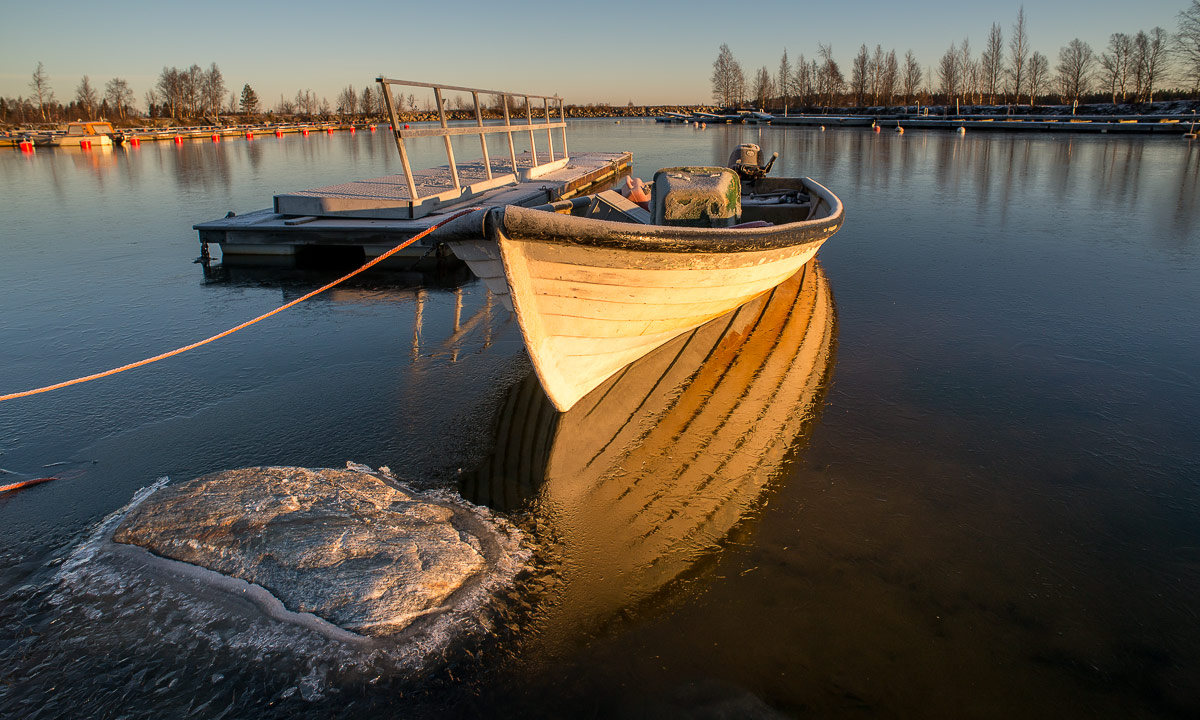
Two photos from yesterday morning: The Baltic Sea seen from the peninsula Näsgrundet some minutes after sunrise. The frost covered blossom of the autumn hawkbit in my garden.

Today it’s the last day of September. This week brought the first snow to the fjäll and the northernmost parts of the country. Even in Skellefteå and Ursviken some single snow flakes had been spotted some days ago! And according to SHMI it is officially winter in Stekenjokk since 23 September.

From Wikipedia: The Swedish meteorological institute (SMHI) define winter as when the daily mean temperatures go below 0 °C (32 °F) for five consecutive days.


Autumn, meet winter

When I woke up this morning it was still dark outside. It snowed. Big snow flakes fluttered downwards, where most of them melted instantly. They felt however comfortable on my car and started to cover it with a wet layer of snow – the first snow of the season.

It snowed in Skellefteå, too and I took a short stroll along the river before job. Temperatures were slightly above zero, so the falling snow was wet and didn’t last long. Anyhow it managed to cover the leaves, the grass and things made from wood.

I’ve been living in Sweden for more than eight years now. The earliest snowfall in Skellefteå/Skelleftehamn I experienced before was on a 14 October, but normally the first snow comes round the end of October or even later. So this year it’s quite early.

I do not long for the winter yet, because of all the coloured trees and bushes. They are so beautiful. But as soon they will become leafless I’ll be eager for the first cold days and snow that doesn’t melt away instantly.

Autumnal high water

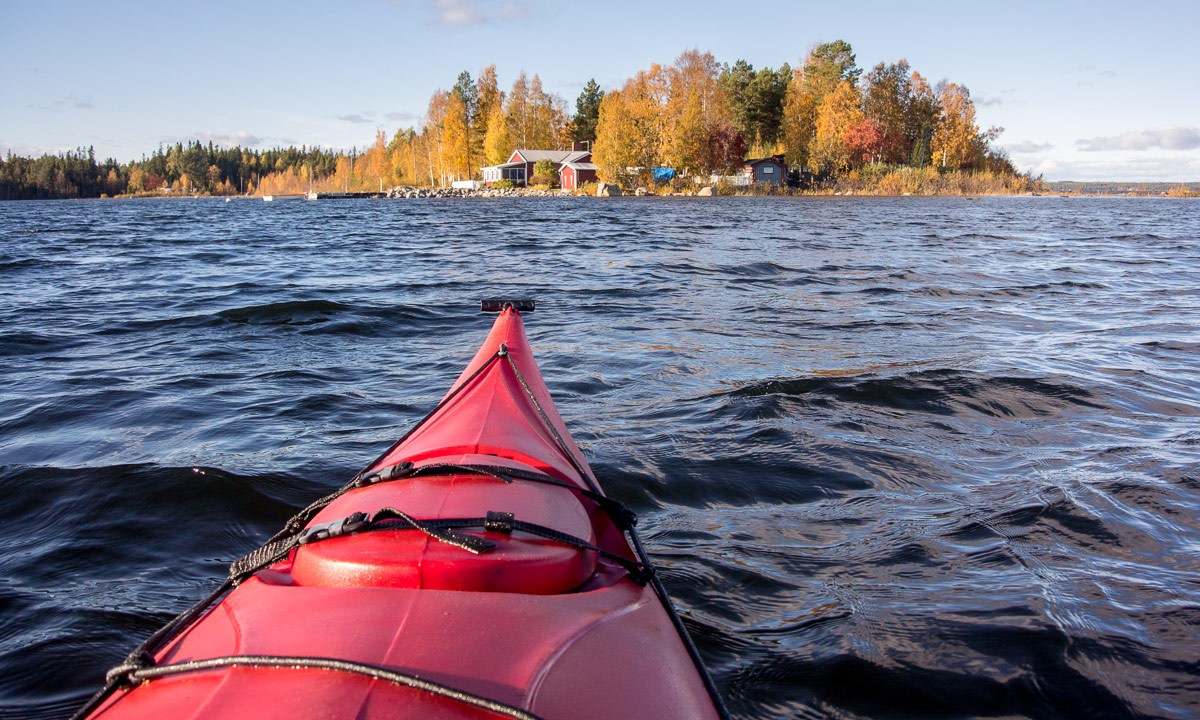
It had been more than three month, since I used my kayak the last time. It’s a shame, especially since the kayak has been lying at a small beach right at the Baltic Sea and it would have been so easy to make a short trip in the evening.

Yesterday however I finally found time to make a small tour again. The small beach had almost disappeared because the water level was 60 cm above normal. That’s quite a lot for the Bay of Bothnia. The kayak was partly filled with rainwater and I was glad about my little hand pump with which I could quickly remove the water. Soon I was on the sea again.

My first idea was heading south-east but the wind came from the north-west and I prefer paddling against the wind when I start. I kayaked along the shore to an island I thought was Björkskär. While I tried to paddle around this island I realised, that it was not an island. Accidentally I had entered the bay Djupviken (“the deep bay”) which is anything but deep.

Because of the high water level I could go on paddling much longer than usual. I decided not to return but to carry the boat across small gravel road. Normally it’s more than 100 metres to walk, this time it was only round 20.


I definitely prefer paddling before carrying a 27 kilo boat over land. A gust of wind almost brought me down. A five meter long kayak has quite a large sail area, when you carry it. So I was glad to sit in the boat again this time heading for Björkskär and the bay Harrbäckssand.

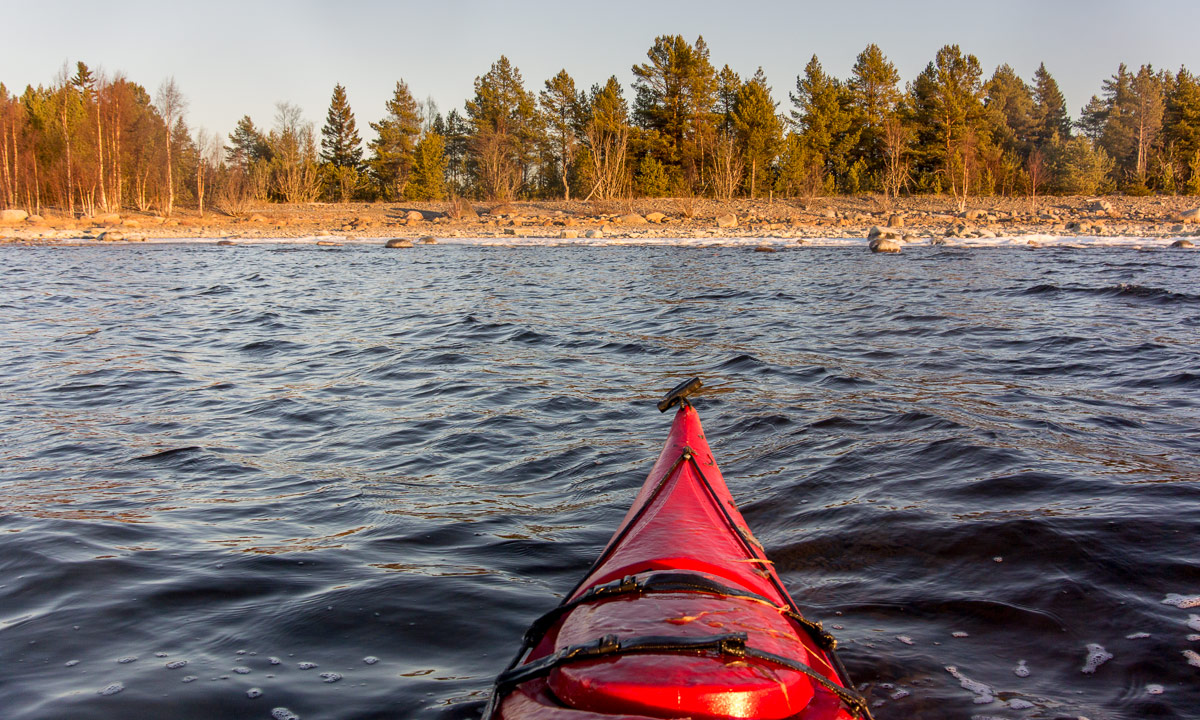
Here I turned. This time I paddled along the outer coast of the island and then back across the open sea. It was too windy and wavy to stop paddling and make any photos. Within seconds the wind would have turned the kayak across the wind, making it quite unstable.

When I approached the island Storgrundet (which is almost home again) I decided to continue my tour. It was fun to sit in my kayak again, i wanted to head the small island with the coloured trees and furthermore I wanted to take the opportunity to cross the island by boat.

Crossing an island by boat? Well, many parts of the islands that lie off the coast of Skelleftehamn are quite flat. Storgrundet has such a part, too. It’s just a passage of rocks that connect the main part of the island with an extra part. Normally you can go there (at least with rubber boots), yesterday it was possible to cross this part by kayak.

From this point it was near to the islet Brottören where I could catch the last sun before clouds approached.

The rest of the kayak tour is quickly told: I went around the island Storgrundet, met a man in a small motorboat (until then I had been completely alone), paddled along the tiny beach where I use to bath (it was mostly flooded) and finally arrived at the starting point again.

No, it’s not winter yet, but …

No, it’s not winter yet. It’s autumn. Look at the coloured trees that I photographed in Skelleftehamn yesterday morning.

No, it’s not winter yet. Well, it snowed in Lövånger – 40 km south – some days before. Yes, in the shadow of the forests there are still patches of snow. Ok, the shallow parts of the lake Gårdefjärden had started to freeze over, but it’s not winter yet.

No, it’s not winter yet. But it’s dark. And when it’s dark, there could be polar lights. Annika rang me at 19:40 and told me that strong polar lights covered the sky. And so it was. I took my camera, hopped into the car and drove to the beach Storgrundet. First mistake: no memory card in the camera – good to have a spare one. Second mistake: en empty battery – good to have a spare one. When I was ready to take pictures, the most impressive polar lights already had gone but I made some pictures anyway.

No, it’s not winter yet. But the winter will come with frost and snow – sooner or later. And hopefully with a lot of sunny days. And more polar lights.

Almost like summer

The weather forecast was right: today it was warm and sunny. Really warm considering that it is mid-October and that it snowed last week. 20 °C we had in Skelleftehamn today! Probably the last opportunity to bicycle in a T-shirt this year.

I followed a way through the forest that I already knew but hardly recognised: The illuminated ski track between Skelleftehamn and Ursviken. (That’s what it looks like in winter.)

After a while I left this path and walked the bike along a trail marked with red crosses. Red crosses mean, that it’s a winter way and following such in summer may send you into swamps, bogs or even lakes. Although the ground was wet I was lucky. Some makeshift bridges, probably made by snowmobile drivers helped me over some boggy passages and soon I was on the other side of the lake with the creative name “Sjön” (The lake).

I continued to the right, already heading home but with some detours.

Detour 1: A short walk up the mountain Örberget. Despite of its incredible height of more than 40 meters – that’s almost 10 meters higher than the gravel road – you have a view of the Baltic Sea. The rocks were quite wet, probably because they were much colder than the air so that the moisture condensed on the surface.

Detour 2: Down to the cabins by the bay Djupviken. The photo may be silly, but it’s a reminiscence of the kayak tour last week where I carried the kayak cross the road at the very same place.

Soon I was home again where the thermometer showed temperatures betwwen 19 °C and 20 °C. Two hours later I was at the local beach, ready for a bath. After the air felt like summer and the beach looked like autumn I expected the water to feel like winter. It was cold but warmer than expected: 9 °C. Refreshing!

Slowly it gets colder

Today the temperatures were slightly above zero, but the ground stayed more or less frosty the whole day. The image above is taken at 5 o’clock in the afternoon and the temperatures were already a bit below zero.

According to the weather forecasts the temperature will stay below 5 °C for the rest of the week. But that doesn’t effect me, because tomorrow I’ll fly to Paris for some days. See you later!

Nordis 6/2018

Nordis 6/2018I think many of the German blog readers know the Magazine Nordis. From today issue 6/2018 is available in many newsagent’s and bookshops. This issue is very special to me, because it contains my first printed travel report ever.

While I have written more than a thousand articles online I never tried to write for magazines. Until this year.

In January – just days before I started my six-week winter journey – I asked Nordis if they were interested in an article about the Varanger peninsula. I got a positive response and an offer to write a four-pager the very same day.

In summer I started to chose and edit pictures, planned the content and finally started writing my debut article in the world of print. It got the title “Winterliches Varanger” (wintery Varanger).

Quite a challenge when outside temperatures approach +30 °C. Anyway I had many photos and a lot of memories to cool me down.

So, if you want to read an article of mine, that’s (a) offline and (b) in German you’re welcome to buy the new Nordis and tell me what you think.

Did I read the article in the Nordis by myself? To be honest, not yet. I read it too many times while editing and proof-reading. I had the same when recording as a jazz pianist. It took some time until I could listen to the result.


What a difference four days make …

That’s how my house had looked like on Wednesday, just before I took the car to the airport.

That’s how my house looked like tonight – just four and a half days later – just after I had arrived from the airport.

When I left Skelleftehamn the temperatures were round 0 °C. When I arrived at Skellefteå airport this evening, the temperatures had dropped to -12 °C and my car was covered with 8 cm of snow. The snow was partly frozen and it took me half an hour before I could drive home. Home in Skelleftehamn it was slightly warmer (-8 °C) yet 10 cm of snow covered my backyard, too.

What a nice welcome home after I have been in a town, both beautiful and stressful (at least for my feelings) for some days: Paris!

Side note: Never ever did I see so many warm jackets as on the huge flea markets in the north. Mostly counterfeit products of The North Face, Canada Goose and others. Since I neither believe in a French ice age coming soon nor in million of French people wanting to visit “La Laponie” (French for Lapland) I guess that the Parisians just have another sense for temperature (and fashion, too).

Almost like winter …

Today we had a wonderful early winter day. The sky was clear this morning and the temperatures were around -10 °C. Some protected parts of the Baltic Sea had started to freeze over, the ground was snow covered and the river Skellefteälven was steaming in the cold.

However, one should not forget that it is still autumn. It is late October and some birch still partly leafy. Although I experienced the first ice day today (temperatures below zero all day) this weather will not last for long.

Just now the Swedish Meteorological Institute issued a snow warning (5 – 10 cm) for tomorrow afternoon, but the next day warmer weather and a lot of rain is expected. I guess the frozen streets and roads will become extremely slippery when the rain starts to fall. Time to put the broddar – the traction devices – under the shoes.

Jogging through Skelleftehamn

During the ski tour last winter I realised that I have neither strength nor condition. The ski tour was quite exhausting. During the summer I did nothing to change this fact.

Two weeks ago however I started something new: I went jogging. Me! Voluntary! The first 500 meters I felt like an elephant on a unicycle but then I started to enjoy the jogging. Not because I love training but because I love being outdoors.

My chosen trail is a nice circular route through the forest. Ten days ago (my 2nd jogging) however I had to change the route for good reasons:

I definitely do not want to jog through the forest during an ongoing moose hunt. So I returned and jogged the same distance twice.

Today (my 3rd jogging) I could go round again. Weather and terrain conditions however were a bit different:

I made a small detour to the lake Snesviken. It surprised me to see it completely covered with ice. (Sorry for the mediocre photo, just an iPhone snapshot.)

I think it’s funny to jog through the snow. It’s even snowing right now. Unfortunately it will get warmer tonight and tomorrow. The snow will turn into rain and melt the snow. I guess it will be slippery as hell the next days. Time to buy some jogging shoes with spikes.

A short kayak tour

The rain of the last days has washed winter away and all snow that had covered my backyard has melted already. When I parked my car in town two days ago the whole parking place was covered with wet ice. I was very glad about my shoe spikes that prevented me from slipping.

Today it cleared up during the morning. I took advantage of the nice weather and made a kayak tour. The tiny bay where I started was still covered with 2 cm of ice but it was so soft that I could paddle through. The rest of the Baltic Sea was open. It was quite windy and so the kayak tour was quite short, but fun anyway.

I measured the water temperature at the beach: +2.8 °C. I considered taking a bath but decided against it. It was less the water temperatures but the vivid wind that discouraged me. Perhaps tomorrow …

Sauna raft in Bureå

My friend Hans has not only a Lego shop and a camping site in Bureå but also three rafts, two of them with cabins. You can hire them for an overnight stay and then can use the sauna on the third raft. I’ve been there several times, when they still floated in the bay Kågefjärden north of Skelleftehamn. Not for staying overnight but for having a sauna. This week Hans moved the rafts to the boat harbour in Bureå which is south from Skelleftehamn.

The weather is still quite boring: Some degrees plus, day and night – thick clouds, day and night – fog and drizzle – day and night. I was quite eager to have a sauna and therefore invited myself to Bureå this weekend after Hans told me, that he and two friends would be there.

First we took the motorboat to move the floating rafts a bit farther, while his friends Stefan and Kenneth helped from the rafts. Then we took fika while the sauna was heated up. Before the sauna we all took a bath in the sea. As you can see, I look less relaxed than on the photo from Monday. Hans took these photos right after I climbed into the ice cold water and I hadn’t started to relax (it always takes five or ten seconds for that.) After that we all had a sauna together (with a non-alcoholic beer and chorizo sausages grilled on the sauna oven!)

Cold bath and hot sauna – a good combination to cheer up when the weather is hardly inviting. I’m longing for snow and colder weather but I guess I have to wait a while.

(Hans made photo 3, 5, and 6)

“Vargavinter”

Vargavinter – “wolf winter” – that’s an especially cold and harsh winter. And that’s what the newspaper Expressen warned about yesterday:

“Long time forecast · prepare for the wolf winter · cold for several months · snow from arctic.”

As a winter maniac I would love to believe Expressen, but I have my doubts. Let’s the when Expressen warned about vargavinter the last years …

As you can see, especially extreme winters seem to be quite common in Sweden, at least in the headlines of the tabloid press.


Finally a bit of frost

After a long period of plus degrees, one and a half days of light frost were enough to lay the first cover of ice onto the sheltered parts of the Baltic Sea. Two photos of Storgrundet, Skelleftehamn from this morning.

Closing the kayak season 2018

I was stuck. I couldn’t go straight ahead, I couldn’t go backwards, I couldn’t turn. And I definitely couldn’t go sidewards because I sat in a kayak on the Baltic Sea and was surrounded by ice.

Back to the beginning of the day: I took a day off today because of the nice weather and decided to make a kayak tour. My goal was to sea the sunrise from the open sea. When I came to the tiny beach were my kayak has been lying since June it was still dim. The sea between the island Storgrundet and the mainland was covered with a fresh layer of clear ice. Two days ago these parts had been free of ice.

I already changed into paddling clothes at home: Woollen underwear, a drysuit that would keep me dry when falling into the ice cold water, a waterproof face mask and neoprene boots. It just took some minutes to take of the warm anorak – it was about -7 °C – and put some stuff into the cargo hatches of the kayak. I put on my woollen mittens and the long, waterproof overmittens, then I was ready to start the tour.

The question was: How thick is the ice? Would the kayak slide onto it or break through?

I sat in the kayak and pushed myself backwards, first with the paddle, then with the hands. The ice didn’t break. Anyway I was still quite near the shore. I continued pushing myself backwards until I came to the area of new ice. The ice didn’t break.

It is both exhausting and very ineffective to sit in a kayak and push yourself over bare ice with waterproof mittens. You just don’t get a grip. I realised that I wouldn’t come long. I returned ashore, got out of the kayak, went to the car and drove home.

At home I got my isdubbar – my ice claws. They look like a jumping rope with nail attached to the handles and are used for self-rescue, if your break into the ice. I changed also into winter boot, because my feet were freezing. The neoprene boots are not the warmest. Ah, that feels better! I got into the car and drove back to my kayak. Second try!

It was still exhausting to move the kayak over the ice, but with an ice claw in each hand I could pull my kayak forward with a speed up to 5 – 6 km/h. The sun had not risen yet and the air was calm and chilly. The horizon started to turn pink.

I found a bit of open water at the narrow passage between island and mainland. Then I came to another sheltered bay that was frozen, too. First the ice was quite thick, then it started to become thinner.

Here my problems started. The kayak went through the ice and floated. The ice was too weak for using the ice claws, but too thick to use the paddle. After some metres I was stuck! Every time when I used the paddle to move forward another meter I was surrounded by ice and couldn’t use it anymore. During the seconds that it took for changing from paddle to ice claws the kayak drifted back and I was surrounded by open water again, making the ice claws completely useless. Finally I started some kind of dog paddling with hands and arms, still the ice claws at hand until I could reach ice again, pull me forward another meter and break through the ice again. The sun had already risen minutes ago. (Goal missed!)

These are the situations where I learn a lot about my lack of patience …

Anyhow the island Storgrundet was near and with some efforts I reached a spot where I could go ashore. I just wanted to check the water and ice conditions on the outer side of the island.

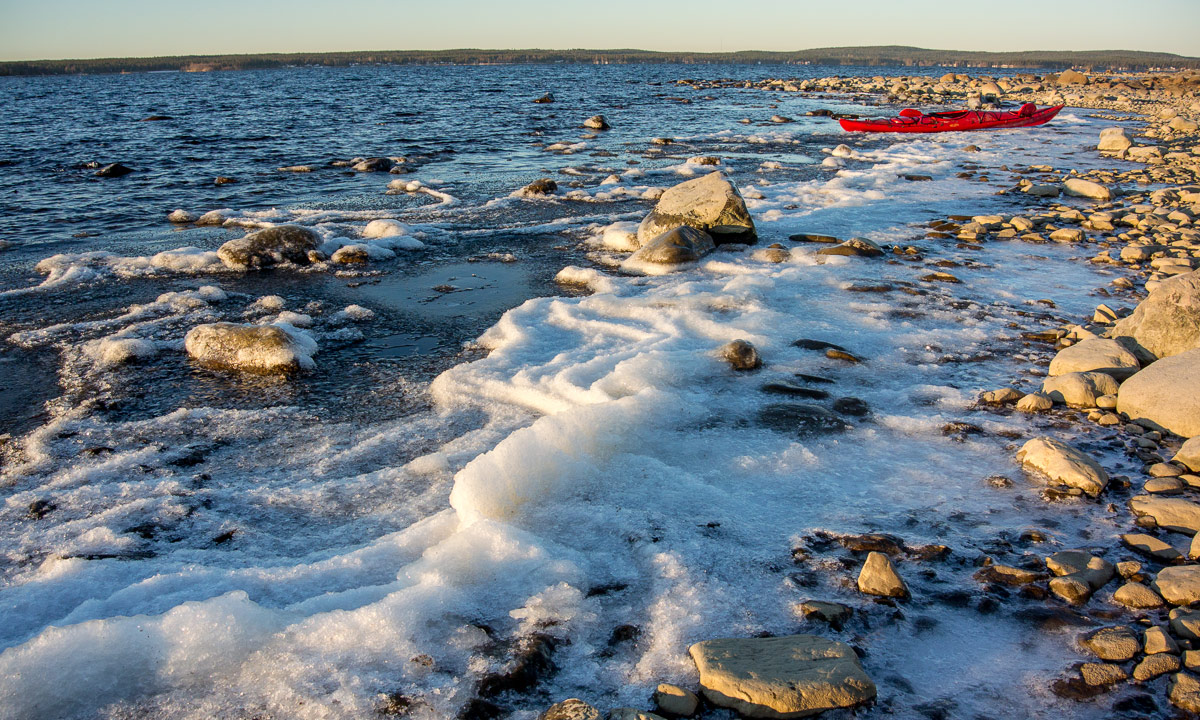
Beside of some pancake ice near the shore the Baltic Sea was completely clear of ice, exactly as excepted. I returned to my kayak and went along the stony shore pulling it nearer to the open water. The sea was still covered with ice but it was thinner and I could hack my paddle through it. Small patches of open water were enclosed in the icy surface and tiny waves vibrated in the rhythm of my paddling. Very funny to look at! And then, some curses later, I finally reached open water – almost two hours later than my first arrival at the beach this morning.

What a relief to put the paddle blades into normal water. Ice cold water, but just normal, liquid water. Delighting. Where should I go? To Finland …?

Soon I spotted a possible destination: Nordlundsstenarna a.k.a. Själagrundet, more a gravel bank than an island, 1.6 km from shore. When I arrived there I looked at the next island Medgrundet, which would be much more attractive for taking a break than this pile of stones. I continued paddling. The wind increased slightly and it got a bit chilly, but it’s only 1.1 km from Själagrundet to Medgrundet so I arrived there quite soon.

The first think I did when I was at land was to put on my winter anorak. Then I explored the island. Some photos:

Actually I could have spend the whole day on this island, but I made a huge mistake: I didn’t bring any food with me. (Don’t try that at home, kids!) So after a stroll over the island I returned to my kayak that was as ice covered as the rock nearby.

What I did bring with me were my sunglasses. I was really glad having them because the trip back was straight against the sun. Ok, time for some selfies …

The way back was nice and beautiful and not very spectacular. I enjoyed the sun and the colours of the sea – it could be covered with ice and snow quite soon.

Since I hardly could recognise anything on land I went a bit wrong but the detour was small. After a while I reached Storgrundet and then the ice covered parts again. This time it was much easier because I could follow the ice-free channel that I had cut into the ice on the way there. But when I had to use the ice claws on the more solid ice again to pull myself forward I realised something: There are many things I lack, one of them is strong chest muscles. They will ache for certain tomorrow.


Zooming into the ice

This morning I stood on the lake Snesviken to watch and take pictures of the moonset. You read right – I stood on the lake. The ice is already at least 5 cm thick and bore my weight. Beside of that the water wasn’t deep at that spot.

After the moon disappeared behind the line of trees at the opposite side of the lake I looked for other motives. No snow has fallen the last weeks and the ice was transparent and clear. I spotted cracks and bubbles of air in the ice and even a lily pad, dotted with many tiny bubbles.

One of the cracks fascinated me. Looking from the side the tiny air bubbles looked like vertical dotted strokes, like another world.

I tried to get nearer with my macro lens to explore this little world, but if was quite complicated to take a photo of this small crack. The best snapshot:

And that’s how it looked like, when I made these photos: