Båtsfjord – Ørnes by Hurtigruten

This article is part of the series “2018-03: Varanger peninsula”.

Days 41 to 44 of my winter journey 2018

13 March at 19:45 the Hurtigruten ship MS Nordnorge docked in Båtsfjord. Annika went on board with all our luggage that we would need the next days, while I drove the car into the elevator. The next 59 hours we would travel many miles but stay in the same cabin. Cabin number 305. Kind of luxury. We would even get breakfast because of a campaign. On 16 March round 7:00 we would leave the ship in Ørnes and drive home.

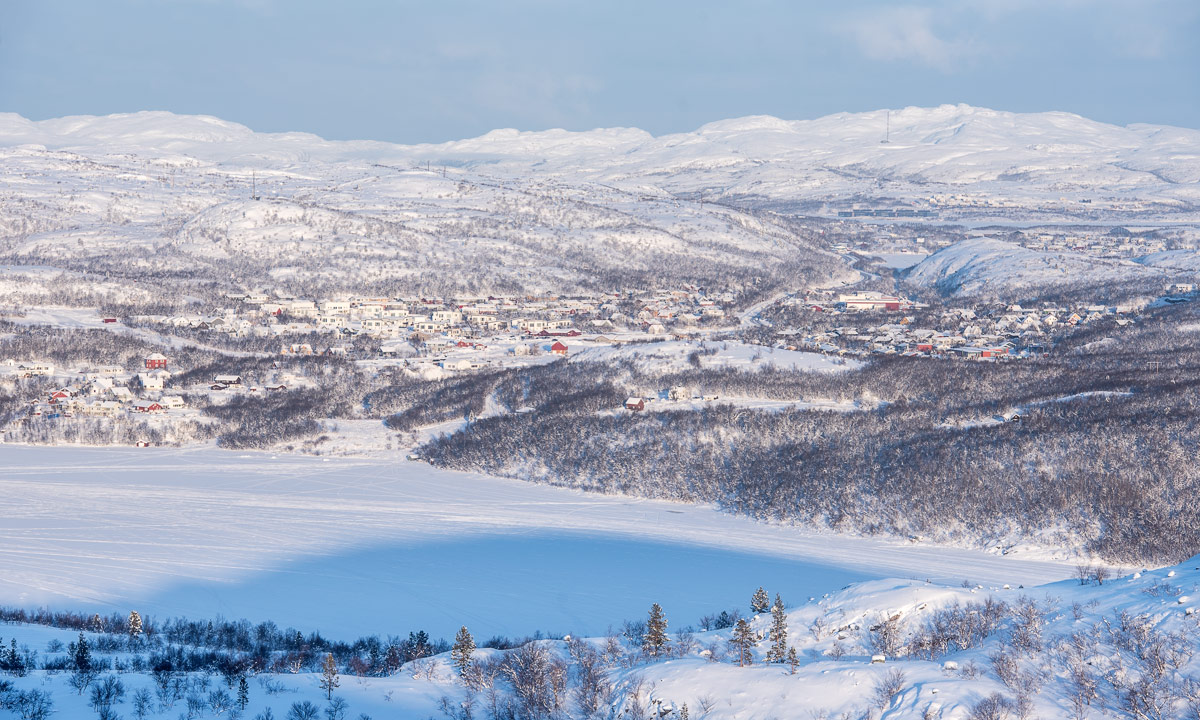
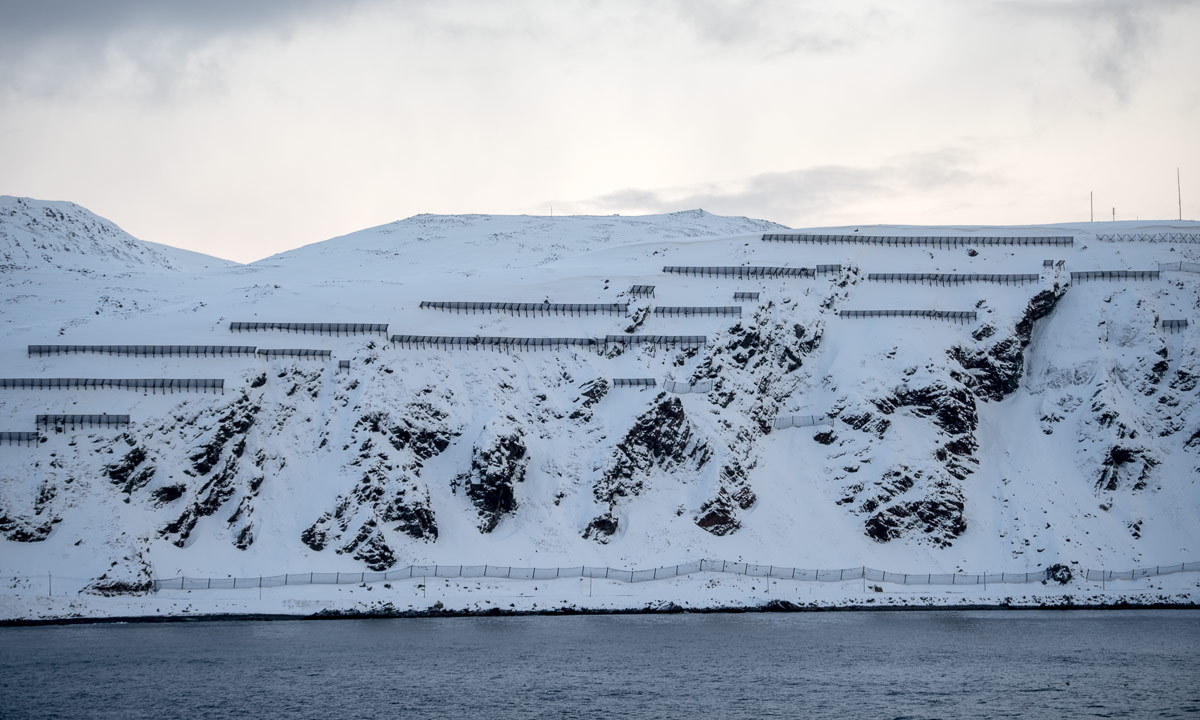
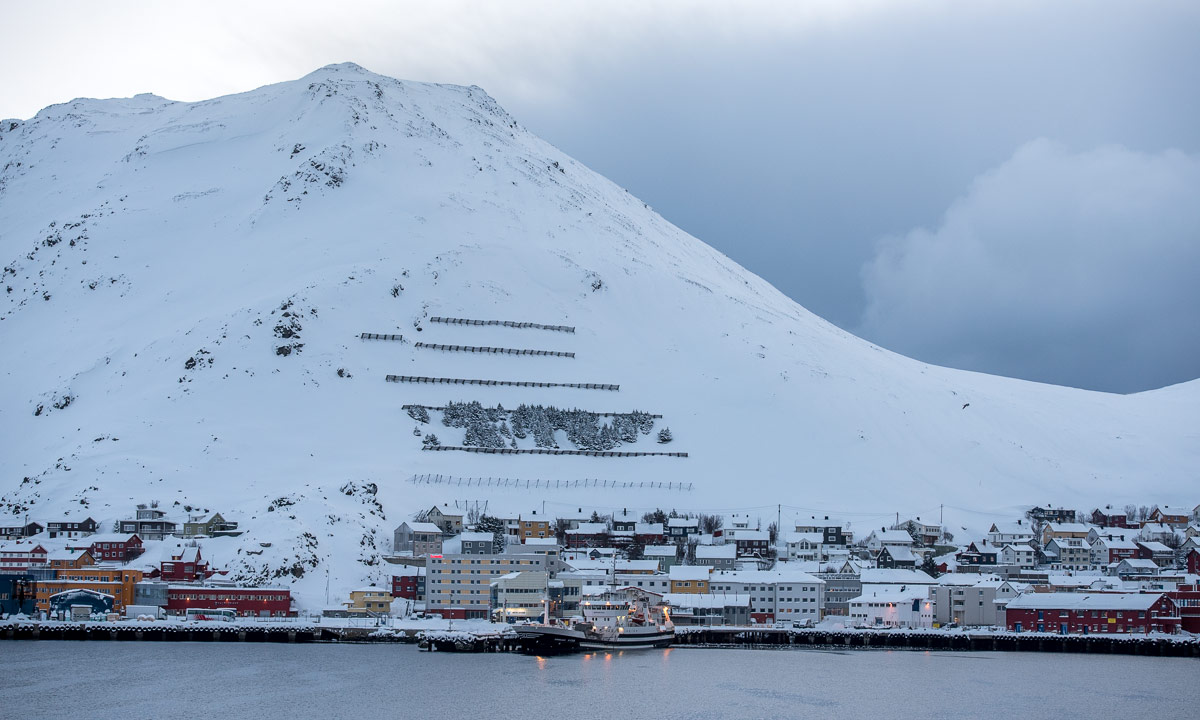
I will not write much about this part of the winter journey but showing photos from the Hurtigruten trip with some comments.

13 March 20:30 – finally on the Hurtigruten. Shop, reception, restaurant and people cruising.

13 March 22:00 Berlevåg – the westernmost of the four Hurtigruten stops Vadsø, Vardø, Båtsfjord and Berlevåg. Some days ago we stood on the breakwater to see the ships coming in, now I stand outside on the bow of the ship to see the very same breakwater passing as we approached the peer.

14 March 05:25 – very early and quite cold in the wind. I’m the only one outside beside of people working.

14 March 05:40 – approaching Honningsvåg on the island Magerøya. Main attraction of that island: the North Cape.

14 March 06:35 – I stay outside and look at the constantly changing weather.

14 March 08:25 – two ships pass. First a smaller boat, twenty minutes later the Hurtigruten ship Kong Harald. It’s snowing.

14 March 11:15 – we approach Hammerfest. Normally the ship will lie there for two hours, but today the ship is late.

14 March 15:45 – I’m outside for some hours and enjoy the view at the landscape. Everything is constantly changing: The mountains, the perspective, the light.

14 March 20:15 – strong polar lights cover the sky. Many people are outside and so are we. I already showed some photos in the article Aurora on the Hurtigruten.

14 March 23:45 – we approach Tromsø. Annika and I are already in our cabin and ready for sleep, but I can see the Tromsø Cathedral through our porthole. (We booked a cabin with limited view to save money and our porthole is more like a tube.)

15 March 07:30 – it’s not cold but very windy on the bow of the ship. My advise for such a winter journey: take the warmest jacket you have.

15 March 07:35 – we approach Harstad.

15 March 10:20 – we reach Risøyrenna – the Risøy Channel, build between 1911 and 1922 to enable bigger ships pass between the islands Andøya and Hinnøya. Only seven meters deep.

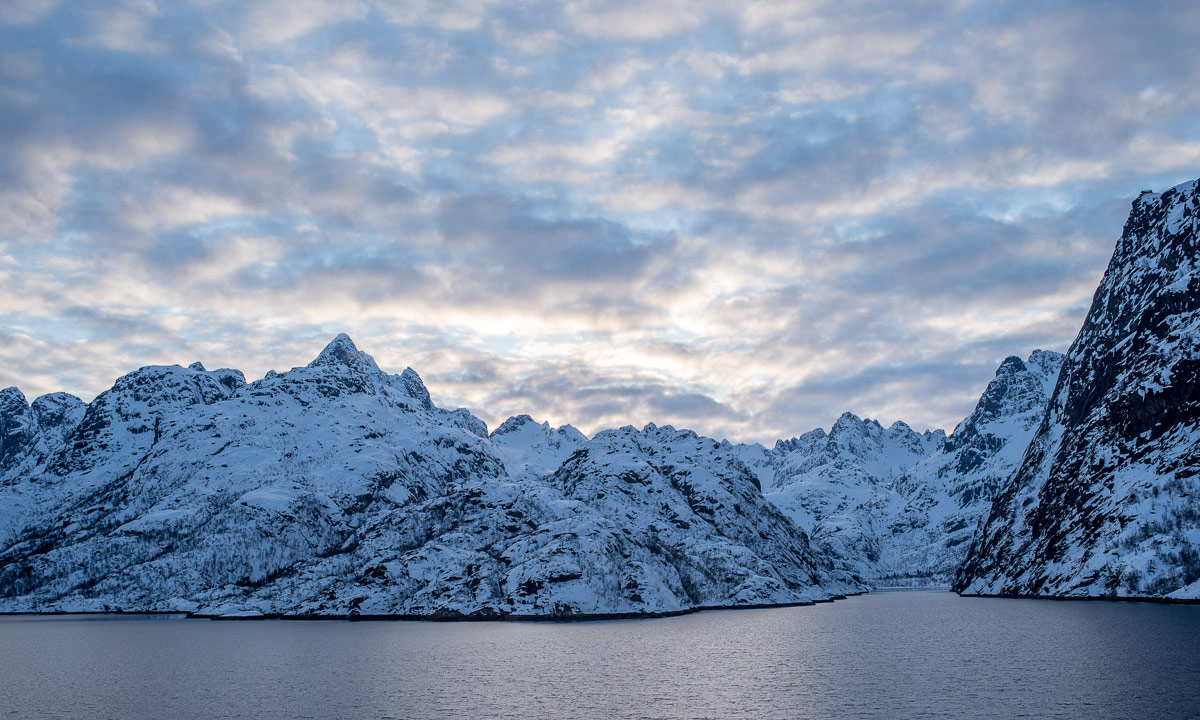
15 March 17:00 – we approach the quite famous Trollfjord. In winter however the Hurtigruten ships do not enter it.

15 March 18:30 – we arrive in Svolvær, largest town on the Lofoten. It’s a longer stop and Annika and I leave the boat for looking around.

16 March 06:00 – the alarm clock rings. At 7 o’clock we will arrive in Ørnes, leave the ferry and drive to Skelleftehamn. 583 km by car then I’ll be home again after more than six weeks of travelling.

Stopover in Kongsfjord

This article is part of the series “2018-03: Varanger peninsula”.

Day 38 of my winter journey 2018

After our lonely drive over the kalfjell we approached the coast again. First we spotted small forests, then quite a lot of cabins and finally the Kongsfjorden. The landscape looked much wilder and rougher with steeper mountains and quite inaccessible coast lines than the eastern coast of the Varanger Peninsula, that we just left two days ago.

After some kilometres we approached the village Kongsfjord.

Although this village has hardly more than 30 inhabitants it has however a grocery, that acts as a museum and a café as well. After it had been closed for some time, the new owners had opened it last August and keep it open all the year.

We went round the small town a bit too but continued then to Kjølnes Fyr, 5 km before Berlevåg where we planned to stay for one or two nights. Some impressions of Kongsfjord’s harbour area in wintertime:

By the way: Now it’s two days later and Annika and I are actually sitting in the very same café in Kongsfjord while writing this blog article. We’re waiting, but that’s another story …


Ekkerøy and Nesseby

This article is part of the series “2018-03: Varanger peninsula”.

Day 34 and 35 of my winter journey 2018

After some days in Ytre Kiberg Annika and I travelled to the next place: Ekkerøy. This village, 50 km southwest from Kiberg lies on the peninsula Ekkerøya that is connected to land by a natural dam with sandy beaches on each side. We already had taken a short walk at one of the beaches last week, where we had met H., one of the locals.

We arrived in Ekkerøy three days ago. The day before yesterday I took a morning promenade with my camera. I made some photos, but the light was a bit dull.

After breakfast Annika and I started a tour round the island, partly with snowshoes, partly on foot. There’s a cliff at the southern shore that looks quite impressive. At the eastern tip there’s an old wooden sea mark. The northern shore is quite flat and was more snowy. Outgoing tide already had started so we walked the last meters on the beach until we came to our wonderful house, that we’ve rented for four days.

As you might have noticed almost all photos shown in this blog have a landscape format. I have a project however that might involve having portrait format photos as well. Therefore I walked to the beach yesterday morning to find a motif fitting portrait format, not too easy in a landscape that’s extensive and mainly quite flat. It was almost high tide and it was quite cold – -12 °C and very windy. The water at the beach was almost of a slushy consistency and each wave flushed new liquid slush to the beach where it froze to a wavy line of ice. That motif went quite well in portrait format, I just have to practise my view.

(I have to think over the design of my blog, these portrait format images are way too large.)

It cleared up more and more and the sun shone from a blue sky. We took the car to Nesseby, 50 km away, where I planned to make some photos of the Nesseby Church. The more we came to the more sheltered parts of the fjord, the colder it got and the open water of the Barents Sea smoked. This phenomenon is called sea smoke and happens, when cold air lies over the open sea.

From the harbour Nesseby Church could be seen through the foggy sea smoke. It is located quite exposed at the thinnest part of a peninsula and can be spotted from long, when weather is good. After looking from the harbour we continued to the church and had a closer look.

We took a short detour to Varangerbotn. There it was even colder with -19 °C but fair weather and hardly any wind.

It’s fascinating to have a look at the fjord of the same name. At the end it’s completely frozen with many icy humps, but on the way back (and north again) it opened and sea smoke appeared again.

In Vadsø I took a promenade on the island Vadsøya to have a look at the airship mast. Since I’ve been a child I’m a huge fan of balloons and airships and it was interesting to see this mast, built in 1926 and only used twice: by Umberto Nobile and Roald Amundsen for their expedition over the North Pole with the airship Norge in the same year and on Nobile’s flight with the airship Italia two years later.

Home again we remembered that H. who we’d met the week before had asked us in for coffee some day. At 4 o’clock we knocked at the door of her house and met her husband T. who directly invited us to come in. H. was visiting a friend and would join us later. We talked and talked, about languages, life in Northern Norway in general and Ekkerøy in special and we had a good time (and got coffee, cakes, cheese, grapes and red wine). When we left H. and T. – two of the round twenty permanent residents in Ekkerøy – it was already 9 pm and sky was dark … beside of a beautiful aurora dancing above the northern shore.

It took some minutes to walk home, put on warmer clothes, get camera and tripod and the aurora already had weakened a lot when I took the photo below. So it is with northern lights: intensity can change very fast, often within seconds.

Today we have another day in Ekkerøy. Our plans so far: not any. That’s nice, too!


A tour to the easternmost point of mainland Norway

This article is part of the series “2018-03: Varanger peninsula”.

Day 29 and 30 of my winter journey 2018

Yesterday we continued our journey to Ytre Kiberg which is 13 south of Vardø, one of the Hurtigruten stops. We started in Vadsø – another Hurtigruten stop – after a breakfast with our host Nils, bought a basis of food for the next days and took the E75 northwards. We made a stopover in Ekkerøy, a village on a peninsula near Vadsø. We like this place and will try to stay there for some nights next week.

At lunchtime we reached Cape East Arctic Adventure, our stay for four nights. We were welcomed by Trond, the owner and operator of Cape East Arctic Adventure and were shown our cozy bedroom, the kitchen and the homely living room. After making ourselves at home we went along the beach to the village and the harbour.

In the evening we were invited to a three course dinner based on freshly caught cod: Fish soup – cod with potatoes and carrots and finally cod roe. Everything was extremely tasty and it was Annika’s and my first time where we tasted cod roe. Yummy!

In Kiberg you are as east as you can be in the Central European Timezone, therefore sun is rising already at 6:24. I was awake very early and took a morning walk round 6 o’clock. Some snow drifts had been created by snow and wind over night but now the weather was less windy and quite sunny. At least for a short time. While I went the way to Indre Kiberg clouds approached, wind increased and it started to snow. It was hardly imaginable that it was sunny just a short time before. Weather changes here quite often as Annika and I should find out later.

After breakfast Annika and I took the car to the other side of the village, put on our snow shoes and started a hike to Kibergsneset, easternmost point of mainland Norway. This place is more east than e.g. St. Petersburg, Kairo or Istanbul! It was windy but quite sunny, when we started our tour but weather changes fast on the Varanger Peninsula:

Actually this hike is just a promenade but the weather may transform it into a small expedition. We were exposed to wind and snow and grateful, that we didn’t experienced a full storm. The weather was rough anyway and I was glad about my windproof jacket and two pairs of mittens.

We continued on a small hiking trail, first with, then without snowshoes because the thin snow layer was hardened by the wind and easy to walk onto. There’s a coastal fortress build by Germans in WW2 on Kibergsneset but we couldn’t see it in the snow weather. Instead of looking for it we continued to the small lighthouse at Kibergsneset that marks the easternmost point of mainland Norway (and most of Europe). Shortly before we reached it the sun came out and we continued the last metres in full sun. While I made some photos a small snow shower approached with the sun still shining.

From the lighthouse there was an amazing view over the arctic coast of the Barents Sea, but only for some moments. Soon the next snow shower came by and hid most of the view onto both the coast and the sea.

The way back was much shorter because we knew the way and went downwards. Even though the view was limited by the snow showers Ytre Kiberg came into view again soon and surprisingly the weather was nice and sunny again.

After this very windy promenade we were glad to find shelter in my car. We took the car to Vardø to eat something and after that we tried the road to Hamningberg. We knew that the road was closed in winter but we curious how long we would come.

Well, not very long. We managed to get to Smelror, some kilometres north from Vardø.

The main road however was definitely closed as you can see. There are no people living in Hamningberg permanently and the only motorised way to reach it in wintertime is by snowmobile. For car it is open less than half the year.

We took the car back to Kiberg, enjoyed the incredible and unbelievable colours of the sky and were surprised by a strange weather phenomenon: -6 °C and rain (including a faint rainbow!)

The rest of the day? -10 °C and wind outside, no more photos, no more excursions.

Fun fact: We took the E75 northwards. If you would take it southwards you could travel more than 4000 km and finally would arrive on Crete, Greece.

Three trips round Tromsø

This article is part of the series “2017-07: Tromsø”.

It’s me who is thrilled by the North, who loves to travel to places like Tromsø or Kirkenes. It’s my mother however who has been much northerly than I was. She was in Spitsbergen/Svalbard with a cruise ship many years ago. But on the way back the route had to be changed due to fields of drifting ice and therefore the travellers couldn’t leave the ship in Tromsø. So my mother missed Tromsø on that cruise.

This year we managed to close this gap: three weeks ago my mother took a plane to Munich, another plane to Oslo and a third plane to Tromsø, where Annika and I picked her up from the airport. That’s why we’d travelled to Tromsø by car two days before.

We had four days in Tromsø, I will write mostly about the first two:

Monday, 10 July

Weather was better than forecasted and so the first thing we did after breakfast was taking the car, crossing the Tromsøysundet on the Tromsø Bridge and taking the Fjellheisen on the other side of the town. Fjellheisen is a cable car up the mountain Storsteinen (approx. 420 m), where you have an incredible view over the town Tromsø, the island Tromsøya and the mountain ranges on the neighbouring islands.

We stayed there the whole morning, enjoying the view, walking around, eating ice cream and looking at the arctic flowers that grew everywhere.

Finally we went down with the cable car again driving back to Tromsø and since the weather was sunny and nice we just continued driving, leaving Tromsøya again, this time using the Sandnessund Bridge. We continued our trip on the island Kvaløya (Whale island), Norway’s fifth largest island. At the western end there’s a bridge leading to the island Sommarøya which sometimes looks like like a caribbean island with it’s turquoise blue bays.

Annika and I were very keen to take a bath, but we all were hungry too, so we took a lunch first. While we were eating our fried fish, clouds approached and soon it started to rain. So much to our summer bath plans …

After looking around on Hillesøya (another bridge, another island) we drove back, this time taking the coastal way in the south of Kvaløya. Finally even the sun came back and illuminated the bright yellow blossoms of Lotus corniculatus, or common bird’s-foot trefoil that covered the sides of the narrow road.

Have a look at the beach photo above. It’s not sand, it’s corals covering this beach, which makes them looking even more caribbean – at least as long it’s sunny.

Late in the afternoon we arrived at our hotel after our first day together.

Tuesday, 11 July

After the rainfalls of the night sun came out again. Time for another trip to the surroundings – this time the island Senja, Norway’s second largest island (beside of Svalbard).

The first part of the tour was the same as the trip to Sommarøya the day before, but instead of turning right the last T-junction we turned left to Brensholmen and waited for the ferry to Botnhamn/Senja. Annika downloaded an app to pay the passage, since it was much cheaper than paying cash. As in Sweden it has become quite unusual to pay cash. The idea to start early was a good one, we were one of the last cars to fit on the ferry. Some others were unlucky – they had to wait for many hours or change plans.

Hour plan was to take a round trip on Senja using the roads 862, 86 and 861. In addition to that we planned to take some side trips.

The first side trip was special, since it led through a dark tunnel cut into the rock, that much too narrow for two cars to pass. In addition to that it was curved and bent so that you couldn’t see other approaching cars in advance. There were lay-bys were you could try to squeeze in and let others pass and I was really glad that the regular bus had left the tunnel minutes ago.

But when we left the tunnel we got “Norway in a nutshell”: Wide bogs, birch and pine forests, clear blue lakes, green meadows and fields and most impressive: big snow covered mountains, some of them looking unreachable by foot, so steep and harsh they were.

But it wouldn’t be Norway without the fjords. Sometimes the coast is as rocky as the mountains, sometimes it provides sandy beaches in beautiful bays. And finally we came to our bath, all three of us. Of course the water was cold, but the air was warm and we stayed in the water quite a long time.

We continued our round trip, again some clouds approached and again some rain drops fell. I thought we’d have to wait an hour for the ferry back, the ferry arrived simultaneously. I realised that I looked wrong when I checked the timetable, but we were lucky and found a place on the ship anyway.

On the way back we didn’t stop for taking pictures any longer. First of all the weather had become grey and dull and then we were tired and hungry. So we stopped only at the supermarket to buy some food for the dinner.

The other days

We did it right, making the larger trips in the beginning, because the other two days it was cloudy and rainy. Time for some sight seeing and indoor activities in the city that we hardly touched the last two days.

We visited the Polarmuseet – we went shopping (kind of) – we tried to visit the Tromsø Cathedral (in vain, it was closed).  We visited a photo exhibition in the Universitetsmuseet – we were on board of the seal hunting ship Polstjerna (another museum) – we strolled around in the beautiful botanical garden (hard to find!). We ate lunch or dinner at the harbour – we visited the park Prestvannet – we visited the Hurtigruten ship Trollfjord, the very same ship Annika and I travelled with last winter. Did I forgot something? Certainly!

On friday we started our road trip back to Skelleftehamn were I live, but that’s another story.

Travelling to Tromsø

This article is part of the series “2017-07: Tromsø”.

Sometimes I’m just too lazy to blog and so was I the last weeks. Today however I finally want to write about a great trip to Tromsø, that Annika and I started on 7 July, almost three weeks ago.

Tromsø is in located in the North. Very far north. It lies 344 km north of the polar circle and is the northernmost town of the world with more than 50,000 inhabitants. It has the northernmost university, both the northernmost cathedral and mosque, the northernmost brewery and probably some more northernmost things of the world.

The shortest route by car from Skelleftehamn to Tromsø leads over Luleå, Pajala, Kilpisjärvi (Finland) and Nordkjosbotn (Norway) and that’s the route Annika and I took.  We had a lot of time and planned to stay overnight twice, but didn’t plan where.

The first part of the route, the E4 leading north, is kind of boring. At least you’re allowed to drive 110 km/h – the maximum allowed speed of the whole journey. In Töre we left the E4, took a break and ate in the Restaurang Roady – the first KRAV-certified sidewalk restaurant.

After lunch we continued northwards. After 50 km we reached Holgers Traktor Museum in Svartbyn, which is always worth a visit. Since it was late – we started our trip in the afternoon – we just made a short stop to take a picture and then continued our trip.

Where to stay? Perhaps we could stay with Katharina whom I met last winter. She lives in Miekojärvi between Överkalix and Övertorneå. We tried to ring her, but she didn’t answer the call. Anyway it’s just a detour of 30 kilometres so we just gave it a try. Katharina has round 20 huskies and someone has to feed them. When we arrived at her house, a man left the shed, looked at us and we were quite surprised to meet Sascha whom we met before in Solberget several times. What a lucky coincidence! So we found not only our first overnight stay but great company, too! Thank you, Katharina (abroad) and Sascha for your hospitality!

The next day we continued our tour after a nice and rich breakfast. We crossed the arctic circle and watched the reindeers.

First stop: Pajala, where a big market took place. Here you could buy a lot of things between tradition and modern age.

After two hours we left the hurly-burly and entered the car again. We crossed the Swedish–Finnish border and followed the E8 which was more construction site than main road. We passed Karesuvanto, where I was sure to meet a food store. All stores however are on the Swedish side, in Karesuando. Not a problem, if you have bread with you and then are given butter, cheese and salami as a present on the super-nice camping ground Lätäsenon Majat near Enontekiö, where we stayed overnight.

Next day we passed Kilpisjärvi near the border triangle, where Sweden, Finland, and Norway meet and soon we were in Norway. Norway is my favourite country in summer because the landscape is so varying and beautiful that even I make photos from within the car:

In Skibotn we saw the first fjord – the Lnygen – and made a break. Annika used it for jogging and I for looking around and taking pictures. I love to stand at the shore, the feet in the water, the view either on the shells or on the fjord and the still snow covered mountains. But the seagulls didn’t like me standing there and they flew some feint attacks, luckily in vain. They don’t dare to come really close.

In Nordkjosbotn we ate hamburgers for lunch. It’s not easy to get anything other than burgers and pizza in Northern Norway outside the cities, but sometimes I like fast food, especially when travelling. From Nordkjosbotn it’s only another hour to Tromsø, where we arrived in the afternoon.

Here we would stay for four whole days with … but that’s another story for another blog article. Stay tuned!


Winter on the Vesterålen

This article is part of the series “2017-02: Northern Norway”.

I’m sitting in a small mobile home in Nordnes near Røkland, Saltdalen, Norway. This morning Annika and I left Haukenes on the Vesterålen, where we had visited friends for some days. It had been gorgeous days, not only because it’s always fun to visit friends, but because of the fabulous winter weather we got those days.

Arrival

Last friday we left the Hurtigruten ship in Stokmarknes that we entered in Vardø two days before. My friends told us that there hadn’t been any snow one week before, but since then almost half a meter snow had fallen and snowfall hadn’t stopped yet.

Saturday

It snowed another ten centimetres the night and it continued snowing in the morning.

Sometimes the Norwegian weather forecast is right and so it was this day: As predicted it cleared up and promised to be a nice and sunny day later on. Annika and I took our skis and joined J. and B. together with Frits, the dog, on a ski promenade right behind their house . J. and B. returned after a while, we continued through the forest to the boggy valley Dalmyra over which we returned. Two small streams we had to cross with our skis but they were narrow enough to be crossable without problems.

Back again I looked at the snowy mountain range of the Lofoten that you can see from my friends house. The sinking sun changed colours of the snowy peaks every moment, from bright white to pale yellow, to “peach”, to orange, to colour shades I’m not able to name.

Sunday

Another sunny day awaited us. Annika and I planned to ascend the Hovden, a mountain, not high (285 – 323 m) but steep. So we left home our skis and took snowshoes, first to hike on snow covered ways and paths to Marka, were we went up the Hovden. Phew, that was quite exhausting.

Annika went back while I continued a bit, first along the waymarks, then using my GPS.

I just love being above the treeline in Norway, where the view is wide and includes snow covered mountains and solitary trees just as blue coloured open fjords.

I descended the top and came to the small lake, where I took a break with water and „Kvikk Lunsj“ chocolate.

The descend from the lake was far from being optimal, I chose a very steep passage and it took a while and some concentration until I was on sea level again, were I walked back to my friends house, first on a minor road, than across a snow covered bog.

Monday

I might bore you, but even this day the weather was fantastic. Annika and I followed a tip of J., took the car to Sandnes and skied to Årneset, a place by the bay Årnesbukta. Here’s a cosy cabin were you can seek shelter, when weather is bad and a row of beautiful sandy beaches. I never ever skied along sandy beaches and open water and I really enjoyed this ski premiere.

Tuesday

Our last day on the Vesterålen and guess what: Weather was great again! Anyway I was quite lazy, so Annika and I didn’t use skis or snow shoes but the car to drive round the southern part of the island Langøya on which my friends – now our friends – live. Some impressions:

That was our last day on the Vesterålen. Thank you, J. and R. for your hospitality. I hope, you’ll visit us in Sweden someday. You’re more than welcome!

Tomorrow we’ll continue our return journey, first 40 km to the Norwegian—Swedish border, than round 380 km home to Skelleftehamn.


Two days on the Hurtigruten

This article is part of the series “2017-02: Northern Norway”.

On Wednesday we left Kirkenes and started our journey to the next destination: Stokmarknes on the Vesterålen where we planned to visit good friends of mine.

KirkenesStokmarknes would be 1000 km by car and take at least 14 hours, if you take the faster way through Finland and Sweden. Anyway there’s an alternative: The Hurtigruten express route, which connects many coastal towns, among others Kirkenes and Stokmarknes. That’s why we took the Hurtigruten ship instead of driving for at least two days. In Vardø we entered the vessel Trollfjord and 16:45 we started our two day long tour.

The first night we went to bed quite early and I only took some pictures in Berlevåg. Since the ship already was moving again I decided to make a longer exposure with the camera on a tripod. That’s Berlevåg by night seen from the Hurtigruten:

We missed Mehamn, Kjøllefjord, Honningsvåg. The first place with a landing stage I saw was Havøysund, were we anchored from 7:45 to 8:00. Shortly after we met the Lofoten, the oldest and smallest ship of the Hurtigruten fleet today. It was tiny compared to the much bigger Trollfjord (which is tiny compared to modern cruise ships).

I tried to be as much outside as possible. It was cold and quite windy, not only because of the airflow, but the gusty wind, too. First I thought, that I would be extremely overdressed in my Canada Goose expedition parka, but soon I found it quite comfortable to wear it in the chilly weather.

In Hammerfest we left the Hurtigruten, looked round in town and bought food. In Øksfjord it started to get dark and the black-white mountain ranges became blue.

… and blurred if you wanted to …

… and it got darker …

Then it started to snow. Sometimes the snowfall was quite heavy especially with the wind and I was even more glad about my warm parka.

In Tromsø we arrived at 23:35 and I made some night shots of this favourite town of me.

We could have left the ship for a visit of Tromsø but we preferred sleeping. We’ll probably visit Tromsø this summer.

The next morning came and the last day aboard began. Good for me, because even if I was glad to slip the car ride it’s not my world to be on a large ship looking at the landscape rolling by. Last night snow fall has brought much snow on the top deck. I never waded through snow drifts on a ship before.

At the same time the Trollfjord anchored in Harstad, a town on the island Hinnøya.

On our way to the next destination Risøyhamn it got extremely windy, the stabilised ship started to roll and to pitch and heavy snow showers appeared, reducing the view to some hundred metres.

Suddenly the wind calmed down, the snow showers were left behind and for the first time of the whole cruise patches of blue sky and finally the sun came out. We approached Sortland, the last stop before our destination Stokmarknes where I gazed at the beautiful mountains of the Lofoten archipelago in the south.

I generally dislike the last 30 minutes of transportation, if it’s by train or by plane. I just want to arrive, and so it was on the Hurtigruten. Impatiently I waited in the inside of the Trollfjorden for its arrival in Stokmarknes, then another fifteen minutes for the allowance to enter the car deck and another ten until I was allowed to drive the car onto the very same car elevator which I used to enter the ship almost 46 hours ago.

I could write a lot more about the Hurtigruten and its passengers, but that’s another story. Short résumé: I love those ships for transportation, but cruising is not my cup of tea. (Anyway, the outside jacuzzi on the top deck is really great!)

4×4 winter impressions of Kirkenes

This article is part of the series “2017-02: Northern Norway”.

Kirkenes – the harbour

While Annika and our friends in Kirkenes enjoyed their breakfast in the Hotel Thon I took a short promenade along the Johan Knudtzens gata to take some pictures. Already the view from the hotel terrace over the fjord is quite impressive and shows the beauties of the arctic nature while the harbour shows the more practical sides of living here: fishing, both commercially and just for fun.

A hike onto the top of the Lyngberget

After the breakfast we took the car to Jakobsnes and a bit further to take a promenade up the mountain Lyngberget, which lies on the other side of the Bøkfjorden. Here you can have a wide view over the whole town of Kirkenes – at least as long it doesn’t snow, as it did on our way back. I just love these wintry landscapes where you have views over fjell and fjord, but the wind was quite chilly and soon we looked like the participants of an arctic expedition.

The Huskies of the Kirkenes Snowhotel

Today we played tourists and visited the Kirkenes Snowhotel, which is just some hundred metres away. The Snowhotel has 180 Huskies including the seniors plus 30 puppies. The huskies are like we humans – some are working, some are resting, some are curious and some are shy. But they are all very kind and friendly.

Inside the Kirkenes Snowhotel

I slept in tents, in igloos and outside in wintertime. I even slept in the Kirkenes Snowhotel two years ago. This time Annika and I enjoy sleeping in the inside of our friends house (Thank you for your great hospitality, Christine and Ørjan) but gave the Snowhotel a visit. And it was worth it – especially the lounge with it carved ice blocks is very impressive.

Tomorrow we’ll leave this fine place, take the car to Vardø in the North (yes, that’s still possible!) and take the Hurtigruten from there to our next destination.

Crossing and not crossing borders

This article is part of the series “2017-02: Northern Norway”.

Hardly believable that Annika and I started our holiday trip just three days ago when we looked at the arctic landscape today.

On Tuesday we started in Skelleftehamn, Sweden and crossed the first border to Köngäs, Finland. 481 km.

On Friday we continued in Köngäs, Finland and crossed the second border to Kirkenes, Norge, where we’re visiting Christine and Ørjan. Another 387 km.

Yesterday on Saturday we took it easy and relaxed after the two day road trip.

Last night I got sick. (That’s another story but the reason, why we cancelled our ski tour today.) Instead of that we took a short road trip to the Russian border, a border that we cannot cross without a valid visa.

The only border checkpoint between Norway and Russia is at the E105, the road to Murmansk. This checkpoint is only 10 km away from Kirkenes. I’ve been there two years ago.

In Elvenes there’s another small road to Skafferhullet. This place lies at the Russian border, too. There’s no checkpoint, the small road just ends and a fence with some signs marks the border to Russia and warns of crossing it. Here I really had the impression, that the world – as known to me – had come to its end and another kind of secret part of our planet begins right after that wire mesh fence.

Only wild animals can cross borders without any harm. They don’t share my memories of the inner German border, they don’t know anything about the cold war, they don’t have to care borders at all. Lucky them!

Perhaps I’ll witness the day, when the border to Russia is as open as many inner European borders today. Who knows …?

Just before the border checkpoint on the E105 there’s the road 886 to Grense Jakobselv – another place located at the Russian border. Most of the road is closed in winter time, but the first part is open. And this way is quite beautiful. We followed it until the barrier, where only snowmobiles are able to continue. There we took the minor road to Lanabukt located at the Jarfjorden.

Some photos:

What a great day with fantastic winter weather and temperatures round -17 °C. On the way back we stopped at the petrol station to buy me salted sticks and a Coke because unlike in Sweden super markets are closed in Norway on Sundays.