Where is the pack ice?

Today I wanted to take more photos of the pack ice covering the Baltic Sea, this time in sunlight. Unfortunately the weather didn’t follow the forecast. (Yes, this happens!) Instead of the predicted sun and clear sky it was cloudy.

When I was brushing by teeth I noticed a light in the west. A huge honey yellow full moon hung in the western sky and shone into my bathroom. Apparently western winds had started to blow the cloud layer eastward.

I took my camera equipment and my winter parka and drove to the beach to take pictures from the full moon. Here’s one of those pictures:

To be honest, I think this is a boring picture. It says more about the pros and cons of my telephoto lens than showing an interesting scenery. The photo could have been taken anywhere. Everywhere where there are power lines and a bit of sky.

I took the car and headed for another place. Hopefully I would find a better motive. To make a long story short: I didn’t. Even the photo with the three islands (two of them are seen above the horizon) looks pale and featureless.

Suddenly I heard birdcalls. Three white whooper swans flew along the coast, heading south. Looks like a good idea, because when the Baltic Sea is frozen they will have hard times finding food. I was lucky: camera at hand, telephoto lens mounted, time to increase ISO and activate the VR. Click!

I continued to Näsgrundet, the place where I photoed the pack ice two nights ago. The ice however was gone! Probably the very same wind that pushed the clouds to the east blew also the ice floes into the open sea. Beside of some grounded ice floes the sea was open again. I decided to continue using my telephoto lens, both for motives farther away and quite near.

I got attracted by a rock covered with a humpback ice pattern. Looking at the results I’m quite content with the lens for this type of motive. I cannot decide which of the two photos I prefer, the first one showing the whole rock or the second one that focuses more on the icy details. What do you think?

When I was home, the temperature had dropped from -9.5 °C to -14 °C.

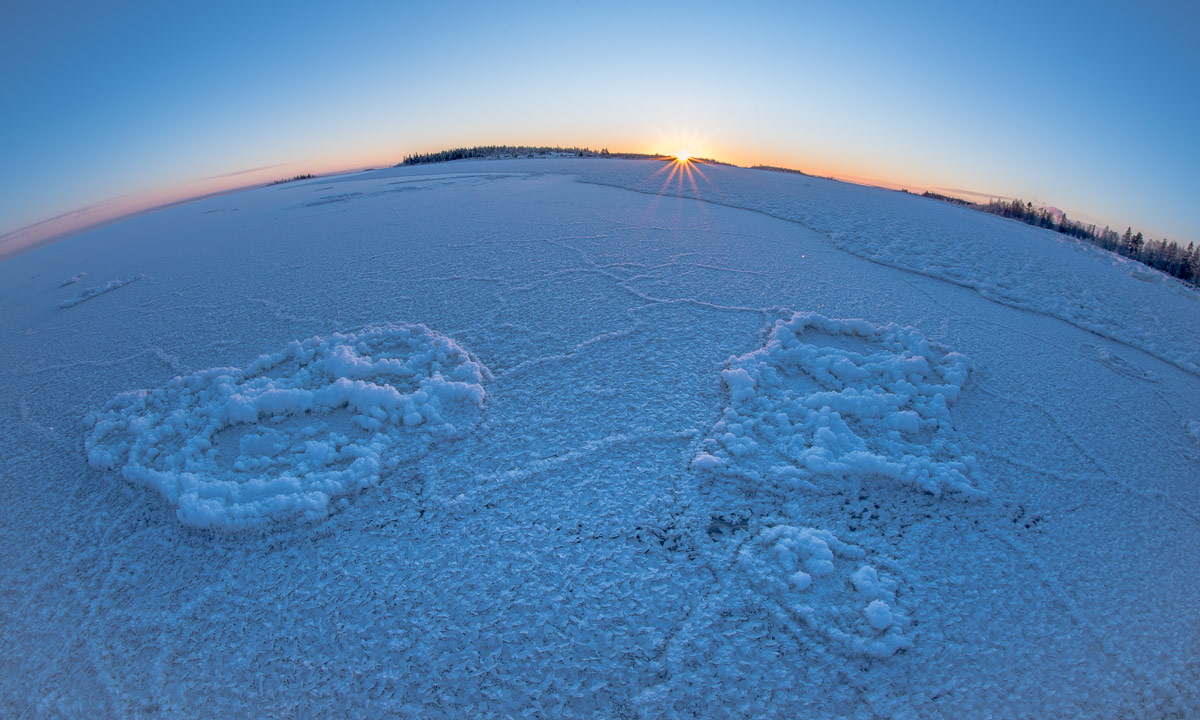
Some hours later: The sun is setting. The air is chilly but the colours are warm. The Baltic Sea is steaming with cold. One wide-angle photo, taken at 13:07 at the same place.

Home again the sun has set but it’s still light. I decide to go for a jog. It’s fun to hear the snow crunching under the studded soles of my new running shoes. And I do not need my headlights because the sunset is so slow. The air is cold, round -15 °C. My fitness it not the best and I have to breath a lot to keep my pace. Good to have a buff for warming up the cold air a bit.

Two photos from today: (1) me photographing, (2) me jogging. Keep in mind, that it was warmer on the first photo.

P.S.: When I look at the whole blog article I’m more content with the photo of the full moon. The isolated photo may be pointless but in the article it has its place.

Zooming into the ice

This morning I stood on the lake Snesviken to watch and take pictures of the moonset. You read right – I stood on the lake. The ice is already at least 5 cm thick and bore my weight. Beside of that the water wasn’t deep at that spot.

After the moon disappeared behind the line of trees at the opposite side of the lake I looked for other motives. No snow has fallen the last weeks and the ice was transparent and clear. I spotted cracks and bubbles of air in the ice and even a lily pad, dotted with many tiny bubbles.

One of the cracks fascinated me. Looking from the side the tiny air bubbles looked like vertical dotted strokes, like another world.

I tried to get nearer with my macro lens to explore this little world, but if was quite complicated to take a photo of this small crack. The best snapshot:

And that’s how it looked like, when I made these photos:

The first frost

The first frost this autumn · temperature minimum last night: -3.9 °C · air temperature this morning: -2.5 °C


Mårdseleforsen

Two days ago Annika and I made a trip to Mårdseleforsen (Mårdsele rapids). It’s a two hour trip by car from Skelleftehamn and it’s absolutely worth it.

At Mårdsele the river Vindelälven branches into several parts. Several chain bridges allow to cross them.

Behind the second chain bridge there is a planked footpath that leads to a third bridge, this time a wooden one. Here starts a short circular track through the Nature Reserve of Mårdseleforsen round many inviting looking freshwater pools. Many other families were there too,  taking a walk, bathing or sunbathing on the flat rocks. Unfortunately we had left our bathing things in the car.

After the short walkabout we returned to the parking place. Actually, we wanted to eat something but the restaurant Wild River was fully booked. Fortunately we could buy some burgers that we consumed sitting outside in the sun.

After the lunch we were so eager for a bath, that we got the bathing things out of the car and returned to the freshwater pools. Chain bridge one – across the island again – chain bridge two – to the left – along the planked footpath – to the right – over the long wooden bridge and again we reached the river islands. There were some people left when we arrived but after a while we were completely alone. The weather was perfect: Some sun, some clouds, warm but not too hot.

Soon we found a nice place to stay and took the first swimming tour. Right into a rocky pool, swimming into the current of a small stream that transported us under the bridge where the current broadened and the current weakened. Almost like using a water slide! It was not easy to come ashore again because the algae made the flat rocks very slippery. But with mutual help we finally managed it.

You realise that strange mask I was wearing? It’s a snorkel-google combination, perhaps more a toy than professional diving equipment but it works extremely well and is much more comfortable to wear than the usual snorkel. In addition to that it works quite well with my underwater camera. I snorkelled several times and observed the underwater life: Water insects, freshwater snails, small fishes and river mussels lived in them.

The “making of” (Photos: Annika Kramer):

Even after more than eight years living here I’m still amazed that there are so many incredibly beautiful and interesting places to discover and explore that I’ve never been to before. Mårdseleforsen is one of them.


The shortest night of the year

Sunset on the 21st of July: 23:27 – sunset on the 22nd of July: 01:47. It’s the shortest night of the year and the night is bright.

Although we were quite tired, Annika and I took the car to Långhällan last night because I wanted to make some “night images”. When we arrived the sun had set just 10 minutes ago. The sky was quite clear and the sky above the northwestern horizon glowed in an intense orange.

The sky above the eastern horizon had a completely different colouring. It was of a pale purple hue and the colours were reflected by the surfaces of the many small ponds.

I went down to the rocky shore and looked at the Baltic Sea. Both rocks and the sea were bathed in purple. The darkest minute of the brightest night had arrived.

When I looked back to the north the horizon was still coloured orange. The darkest moment had passed and the sun would already rise again an hour later.

Tired we returned home. When we arrived in Skelleftehamn sunset was just minutes away. We decided anyhow that it would be totally ok to miss the sunset and went to sleep.

There’s a reason why I hardly make any photos in June. The most beautiful light is simultaneously with my deepest sleep. From now on the days will become shorter, but it will take weeks until the first stars are visible again in Skelleftehamn.


Travel remainders

This article is part of the series “2018-03: Varanger peninsula”.

Some unpublished photos from my winter journey. I want to show them as long it is still wintry here.

2 February – Jokkmokk

While the grown-up huskies are doing their job the puppies have to wait in the trailer. I guess it is very boring for them. There are curious and seek contact.

21 February – Kirkenes

While Chris, Annika, Ørjan and I are enjoying the gorgeous breakfast in the hotel Thon an asian tourist is waiting outside. She seems to be well protected against the elements but why has the fur to be pink …?

1 Mars – Ekkerøy

On the way to Kiberg Annika and I make a stopover in Ekkerøy where we enjoy a beach walk. Here we meet H. who invites us to visit her. We will make that true some days later. I take a photo of Annika’s and H.’s footwear. Tradition, meet modern world.

1 Mars – Ytre Kiberg

Cape East Arctic Adventure, our stay lies directly at the beach. I could spend weeks with only watching the tides and the changing weather.

4 Mars – Ytre Kiberg

There’s hardly any commercial fishing left in the small former fisher villages and the large drying racks for drying cod remain empty. Some people however still dry cod for personal usage.

5 Mars – Ytre Kiberg

A view through the window of Cape East Arctic Adventure. Today we will continue our journey.

10 Mars – Berlevåg

We hardly have the time to explore Berlevåg, we only buy food. Two images of Berlevåg anyway. Just for the records …

11 Mars – Kjølnes Fyr

This snowstorm shaken rocky shore appears more arctic than many other places of this journey.

14 Mars – Hurtigruten, near Øksfjord

A woman has found a wind protected place and watches the Norwegian winter landscape.

16 Mars – Saltstraumen

On our long car trip back from Ørnes to Skelleftehamn we pass Saltstraumen, a small strait with one of the strongest tidal currents in the world. We are too early to see the strongest maelstroms and I’m too eager to continue home. It’s still 500 km to drive.

Now I finally can erase my “later” folder on the computer.


#escapism – an icy camp site

Yesterday

Yesterday at 17:40 my tent was set up on a snowy plane near the sea ice where I planned to stay for the night.

The dinner was part luxury (a really cold coke), part pragmatism (some instant curry chicken of dubious consistency) and part necessity (chocolate!). After the dinner I walked along the shore, which was completely covered with ice and snow. First I walked on land, then on the sea ice. You may think, that a landscape that solely consists of snow and ice must be quite colourless, but no, when there’s light there are colours!

When I came back to my tent, it already had become dark and the almost full moon hovered over the tent. And that was my view from the tent, too: The moon, some stars, snow, ice and the icebound sea.

You might wonder, where I am. Good point, I’ll explain. Let’s go back half a day.

Yesterday I worked only half a day and was home early. I had a plan in my mind: as long as the sea ice is as thick as just now, why shouldn’t I ski over the Baltic Sea to the island Gåsören and spend the night there. I’ve done that in summer twice by kayak but never in wintertime. So I picked myself up, packed skis and pulka and took the car to the small harbour Tjuvkistan.

While the Baltic Sea was open one year ago it is still covered with thick ice this year. Instead of open water one can spot only a snow covered plane and some tracks – made by hare, a moose, another skier, but mostly by snowmobiles, the favourite winter vehicle of many locals. I however do not own such a snöskoter but prefer skiing anyway.

The linear distance between Tjuvkistan and  Gåsören is only 2,3 km and so I arrived at the island soon. In summer it’s hard to find a tenting place (I know only one), since almost the whole island is covered with stones and rocks. This winter however Gåsören is covered with at least 50 cm of snow and so it was easy to find a good place to tent. Scroll up to the first photo and you see it.

OK, back to the story …

At nine a clock it was quite dark and a layer of clouds approached. Good arguments for cuddling up in my warm down sleeping bag and go to sleep. Good night, world.

Today

At five a clock I woke up and felt fairly well rested. I got up for taking some photos. Although it’s already the end of March the nights can be quite chilly and I guess that we had temperatures round -10 °C. I put on more or less all clothes that I had with me and made some photos. The moon had wandered on its orbit to the west and hovered above Gåsören’s old lighthouse.

That photo looks like being shot at the dead of night, doesn’t it? So let’s turn around and look to the east:

It’s less than 8 minutes between the previous two images and it’s more the cardinal direction than the time difference that is responsible for the different light and colours. I walked around for two hours and was just happy to be there at that fantastic place that fantastic morning and to experience all these different kinds of ice and light.

I became hungry so I returned to the tent. or tried … . Just a photo of the lighthouses behind the ice. And another one of my camp site.

But now: finally breakfast. Water, crisp bread and cheese. That may not be the most exciting food, but I didn’t care, I enjoyed the  incredible view over the icebound Baltic Sea in winter.

After breakfast I walked around another time and took some more photos.

Another break. This time just pure luxury. Since I wasn’t in a hurry the tent was still set up. So I could cuddle up in my cozy sleeping bag again and took a long daytime nap. The temperature was still below zero but the sun was high up in the sky and warmed the tent. And there was even chocolate left. Just “gemütlich”!

When I woke up an hour later a layer of stratus clouds had approached and the light had become dull. A good time to pack anything back into the pulka, to put on my skis again and to start the “long” way home. Good bye, Gåsören. Next time when I visit you it will probably be with the kayak. I love winter, but paddling in summertime is great, too.

When I had arrived at the car after Jonas’ and my previous ski tour, it was in Kvikkjokk, 400 km from home. This time the car was parked less than 3 km from my house. I’ve been living in Skelleftehamn for many years now but still I’m happy about the beautifulness of it.

This article is the first one of the new series #escapism. It’s about being outdoors and leaving civilisation behind in excursions that take less than 24 hours. Everyone should have time for such!

My packing list (excerpt)

tent with snow pegs · inflatable camping mat · down sleeping back (a warm one!) · clothes for skiing · spare clothes · winter anorak · thermal pants · warm boots · woollen cap · 2 pairs of gloves · down west · skis with poles and boots · pulka with hip belt · water (both cool and hot) · food (a lot!) · knife · camping stove · matches · kitchen stuff · mobile phone · power bank · headlamp · sunglasses · thermometer (it broke) · compass · isdubbar (essential emergency equipment in case of breaking into the ice) · toilet paper · snow shovel · camera equipment · tripod · grand piano (just kidding)


Checking the winter …

This winter has been quite lagom yet. It hadn’t been too warm for a longer period, nor it was it really cold. We got snow several times, but we didn’t get any lake effect snow neither as e.g. five years ago where it snowed more than 80 cm within 24 hours.

Yesterday and today it snowed round 20 cm. Since we already had round half a meter of snow, the fence of my garden is about to disappear in the snow.

I took the photo above through the window of my living room. It shows my (and the neighbours) backyard. The fence is round 80 cm high.

Today I took the car to the Näsgrundet, one of my favourite places in Skelleftehamn. When I had been at the same place 12 days ago, the Baltic Sea was covered with ice as far as the eye could see. When I arrived today I was really surprised to see the Baltic Sea clear of ice again.


The photo above shows a small bay beside of Näsgrundet. The ice had been broken by wind and the floodwater two days ago. The wind was pushing the ice floes slowly offwards and some of them already had started to drift seawards.

That was the view to the northeast. The view to the southwest is completely different: there is the peninsula Rönnskär with the copper smelter of the same name. It snowed but the low sun managed to peek through the airy cloud layer. Temperature was -9 °C and the chimneys smoked.

In front of the industrial plant is the “cape” of Näsgrundet, which is a peninsula as well. I took a short discovery tour and found another motive. When I was standing up, Rönnskär and some trees were visible but when I knelt down I was able to hide the background and to make a completely different photo:

I intensified both contrast and colours to give this photo a more irreal appeal. The motive itself however is unchanged.

What type of winter comes next? I could take a look at the weather forecast of SMHI, but I have difficulties to take it seriously. Beside of the overall temperature and wind direction trends the web forecasts for Skelleftehamn are quite bad. The 20 cm of snow for example weren’t forecasted at all.

But in the back of my mind I know that lake effect snow could be possible again as long as the Baltic Sea is open and wind comes from eastern directions …


Blue hour – golden hour

Some winter days are grey and colourless. The photos taken on such dull days appear almost look black and white as long you don’t have a colourful motive.

Some other winter days are clear and colourful. There are two colours, that are especially prominent: orange and blue.

Orange is not only the colour of candlelight and cozy fires, but of the golden hour, too. The golden hour is defined by the time, when the sun’s altitude is between -4° (thus below the horizon) and 6°.

Blue is the complementary colour of orange. If you look at snow in the shadow you may realise, that it’s not of perfect white but looks a bit blueish. And the whole landscape gets a blue tinge when the sun’s altitude is between -6° and -4°. This period has a name, too, it’s called the blue hour.

Both images are made today. The first one at 09:32 (sun ±0°), the second one at 08:30 (sun -4.5°). If you have a closer look to the 2nd photo you can see the first sunrise colours on the left part of the sky. I should have make it a bit earlier.

It’s a good thing for such to live way up north. In Skelleftehamn the sun won’t rise more than 6 °C for two months, that’s golden hour even at lunchtime! And since the path of the sun is quite flat, these time periods are quite long. Today I didn’t need to rise up very early since the days are still short, but this will change soon:

Sunrise was 09:35 on 1 January and will be 08:20 on 1 February and 06:44 on 1 March. Then it’s time to get out of bed really early! Or to travel even more north, but that’s another story …

Links

Wintry still live at the coast

This image was taken with my iPhone SE, not with my Nikon camera that I usually take with me. I just forgot it home today. I don’t think, that the iPhone SE has or is a great camera because I’m quite picky when it comes to image quality. But it’s a great backup if you manage to keep it warm in the winter and some of the photos look quite nice.