Mårdseleforsen

Two days ago Annika and I made a trip to Mårdseleforsen (Mårdsele rapids). It’s a two hour trip by car from Skelleftehamn and it’s absolutely worth it.

At Mårdsele the river Vindelälven branches into several parts. Several chain bridges allow to cross them.

Behind the second chain bridge there is a planked footpath that leads to a third bridge, this time a wooden one. Here starts a short circular track through the Nature Reserve of Mårdseleforsen round many inviting looking freshwater pools. Many other families were there too,  taking a walk, bathing or sunbathing on the flat rocks. Unfortunately we had left our bathing things in the car.

After the short walkabout we returned to the parking place. Actually, we wanted to eat something but the restaurant Wild River was fully booked. Fortunately we could buy some burgers that we consumed sitting outside in the sun.

After the lunch we were so eager for a bath, that we got the bathing things out of the car and returned to the freshwater pools. Chain bridge one – across the island again – chain bridge two – to the left – along the planked footpath – to the right – over the long wooden bridge and again we reached the river islands. There were some people left when we arrived but after a while we were completely alone. The weather was perfect: Some sun, some clouds, warm but not too hot.

Soon we found a nice place to stay and took the first swimming tour. Right into a rocky pool, swimming into the current of a small stream that transported us under the bridge where the current broadened and the current weakened. Almost like using a water slide! It was not easy to come ashore again because the algae made the flat rocks very slippery. But with mutual help we finally managed it.

You realise that strange mask I was wearing? It’s a snorkel-google combination, perhaps more a toy than professional diving equipment but it works extremely well and is much more comfortable to wear than the usual snorkel. In addition to that it works quite well with my underwater camera. I snorkelled several times and observed the underwater life: Water insects, freshwater snails, small fishes and river mussels lived in them.

The “making of” (Photos: Annika Kramer):

Even after more than eight years living here I’m still amazed that there are so many incredibly beautiful and interesting places to discover and explore that I’ve never been to before. Mårdseleforsen is one of them.


Opening the bicycle saison in Skellefteå

Today it was the first day where I used the bicycle from home to Skellefteå. That’s about 19 km per direction and I want to use the bicycle at least twice a week on my way to the job. Let’s see if I can do it. At least a first beginning is made.

Skelleftehamn – Skellefteå:

Skellefteå – Skelleftehamn:

Tour rules: Use a complete different way back to Skelleftehamn.

Photo rules: Take only photos from the bike, cycling or standing. Do not crop any photo. Use only basic corrections.

Båtsfjord – Ørnes by Hurtigruten

This article is part of the series “2018-03: Varanger peninsula”.

Days 41 to 44 of my winter journey 2018

13 March at 19:45 the Hurtigruten ship MS Nordnorge docked in Båtsfjord. Annika went on board with all our luggage that we would need the next days, while I drove the car into the elevator. The next 59 hours we would travel many miles but stay in the same cabin. Cabin number 305. Kind of luxury. We would even get breakfast because of a campaign. On 16 March round 7:00 we would leave the ship in Ørnes and drive home.

I will not write much about this part of the winter journey but showing photos from the Hurtigruten trip with some comments.

13 March 20:30 – finally on the Hurtigruten. Shop, reception, restaurant and people cruising.

13 March 22:00 Berlevåg – the westernmost of the four Hurtigruten stops Vadsø, Vardø, Båtsfjord and Berlevåg. Some days ago we stood on the breakwater to see the ships coming in, now I stand outside on the bow of the ship to see the very same breakwater passing as we approached the peer.

14 March 05:25 – very early and quite cold in the wind. I’m the only one outside beside of people working.

14 March 05:40 – approaching Honningsvåg on the island Magerøya. Main attraction of that island: the North Cape.

14 March 06:35 – I stay outside and look at the constantly changing weather.

14 March 08:25 – two ships pass. First a smaller boat, twenty minutes later the Hurtigruten ship Kong Harald. It’s snowing.

14 March 11:15 – we approach Hammerfest. Normally the ship will lie there for two hours, but today the ship is late.

14 March 15:45 – I’m outside for some hours and enjoy the view at the landscape. Everything is constantly changing: The mountains, the perspective, the light.

14 March 20:15 – strong polar lights cover the sky. Many people are outside and so are we. I already showed some photos in the article Aurora on the Hurtigruten.

14 March 23:45 – we approach Tromsø. Annika and I are already in our cabin and ready for sleep, but I can see the Tromsø Cathedral through our porthole. (We booked a cabin with limited view to save money and our porthole is more like a tube.)

15 March 07:30 – it’s not cold but very windy on the bow of the ship. My advise for such a winter journey: take the warmest jacket you have.

15 March 07:35 – we approach Harstad.

15 March 10:20 – we reach Risøyrenna – the Risøy Channel, build between 1911 and 1922 to enable bigger ships pass between the islands Andøya and Hinnøya. Only seven meters deep.

15 March 17:00 – we approach the quite famous Trollfjord. In winter however the Hurtigruten ships do not enter it.

15 March 18:30 – we arrive in Svolvær, largest town on the Lofoten. It’s a longer stop and Annika and I leave the boat for looking around.

16 March 06:00 – the alarm clock rings. At 7 o’clock we will arrive in Ørnes, leave the ferry and drive to Skelleftehamn. 583 km by car then I’ll be home again after more than six weeks of travelling.

Crossing three borders

Day 19 of my winter journey 2018

Whilst I still haven’t finished the blog articles about my ski tour with Jonas, life (and holidays) went on. Jonas and I had arrived at Solberget on Thursday evening and Jonas went home yesterday (on Sunday). This morning I packed the last things, stuffed them into the car and went to Nattavaara Station, where Annika arrived with the 7:38 train. With this reunion another stage of my six and a half week winter journey had begun. Destination: Kirkenes and Varanger, the easternmost parts of Norway.

Today we started with a travel day by car. We travelled 600 kilometres and crossed three borders.

Stage one: (Solberget) – NattavaaraGällivareSvappavaaraVittangiÖvre SopperoKaresuando.
And the first border: Sweden – Finland.

Stage two: Karesvanto (Finland) – Palojoensuu (Finland) – road 93 …
Second border: Finland – Norway.

Stage 3: … road 93 – Kautokeino (Norway) – Karasjok (Norway) – Karigasniemi (Finland).
The third border Norway – Finland. And since it was dark and I was tired we directly continued to our destination for an overnight stay: Giellajohka (Finland).

The temperatures had been between -20 °C and -28 °C for the last hours and the weather was bright and clear. The new fingernail moon shone above the eastern horizon and the first stars came out. Good conditions for polar lights. And we had polar lights actually here in Giellajohka but unfortunately a thin layer of clouds approached and therefore the aurora was less impressive. A photo anyway:

Tomorrow we will continue to Kirkenes to visit friends. It’s a smaller distance to travel than today, just 209 kilometres.

A ski tour in the Kvikkjokk mountains – day 2 and 3

This article is part of the series “2018-02: Ski tour near Kvikkjokk”.

Day 8 and 9 of my winter journey 2018

After the first night in the tent (it was a cold one!) we were eager to continue the tour. The tent was packed and so were the pulkas. We started by skiing through powder snow – a slow movement. I guess I hardly reached 2 km/h in average and I definitely was much slower when I had to go uphills. We looked for a good place to access the river again since it was much easier to follow the stable snow on the snowmobile tracks. After a while we found a good place to enter the river bed. Mostly the winter trail followed the river, only twice it continued on land where the river is narrow and had open water.

After some kilometres the river bent southwards and our trail left the river to continue more westwards. We continued the snowmobile tracks that led through forests and over smaller bogs.

We started to think about reaching the mountain hut Njunjes but weren’t at all sure if we would reach it before darkness. Anyhow, we didn’t had any pressure, since we had anything with us which we need for tenting:

  • a tent (of course)
  • down filled camping mats
  • very warm sleeping bags and vapour barrier lines
  • warm clothes from head to foot
  • a lot of food
  • a paraffin oil driven cooker
  • … and much more …

The way was easy but the pulkas were heavy loaded and after hours of walking I started to get tired and exhausted. That’s one of the reasons why I hardly made any photos. Another reason was that both my cameras refused to work in the morning with temperatures round -30 °C. It became warmer, but it was still round -25 °C, although it had become cloudy and overcast that day quite early.

Beside of a longer and a shorter rest we continued skiing, now with the defined goal to reach the hut. It started to get dark but we knew that we only had to go another hour or a bit more to make it.

After a while it went so dark that we skied with headlights. The buildings of Njunjes had come into view but they were on the other side of the river. When we were on a level with Njunjes we realised that the river became a quite deep ravine, probably with open water and quite impossible to cross …

… but we were really lucky: there was a metal chain bridge that led over that very ravine. It was quite a fight to climb up the slope after crossing the bridge, but with a lot of pulling (and without our skis) we managed it.

Soon Jonas found the open winter room with was made for people like us who like to travel off-season. A stove, wood, a bunk bed for two people, hooks for drying clothes, a table and two stools – anything to stay here for a night or two.

Day three was a day off. It was warmer than the day before and mostly dim and cloudy. I took pictures of the chain bridge, the mountain hut and the landscape (as far as it was visible)


After breakfast we attached new climbing skins to my skis and took a ski tour. First cross the river again and right to the sun. Then up some minor hills through sparse birch forests and eastwards to meet the branch to the hut that we had missed the day before. The skins worked well but it was almost a pity to have them attached to my skis since they slowed me down when skiing downhills through the loose powder snow. The sun was hardly visible through the clouds and the landscape almost looked sepia – like an old black and white photo.

First it only snowed a bit but when we finished our tour and arrived at “our” mountain hut snowfall increased. While Jonas was busy sawing and chopping wood I took a small nap.

In the evening we planned to continue to Tarrekaisestugan the next day – the next mountain hut in the west – and probably to continue and tent again in the wintry forests.

Photo #2 in this blog article is made by Jonas Balbasus.

28 August: Kungsleden day 9 – Vistas—Alesjaure (18 km)

This article is part of the series “2017-08: Kungsleden hike”.

Today Katrin, Annika, Andi and I would continue to Alesjaure, the longest distance to walk so far.

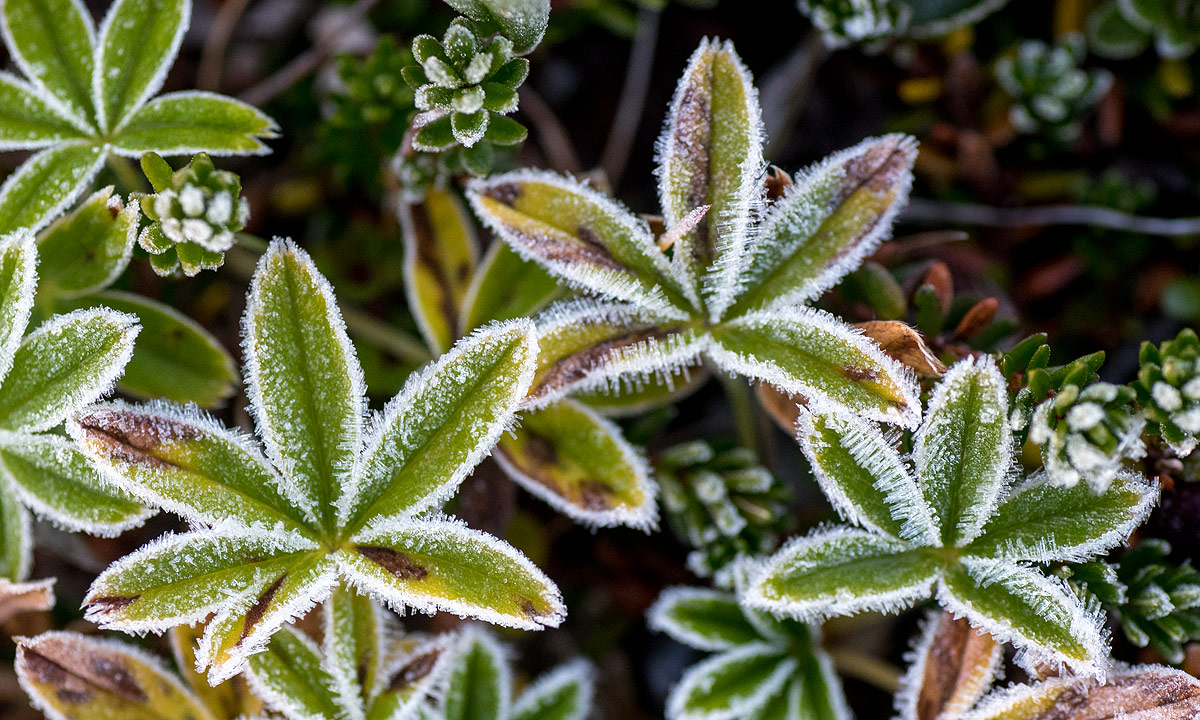
The morning was frosty with -2 °C and the petals of the flowers called rallarros (rosebay willowherb or fireweed) were covered with ice.

The sky was blue, the sun was shining, we had picture-book weather. As a photographer I would have preferred to hike two weeks later when leaf coloration would be in progress, but you can’t have everything. Anyway, the photo of the bridge over the Visttasjohka right at the Vistasstugan looks like a postcard motif:

This spot looked quite Canadian or Alaskan to me. I almost expected to spot some huge grizzly bears catching salmon in the river. But we’re still in Sweden where bears are brown bears and (luckily) very shy.

The first kilometres of the trail to Alesjaure lead through dense birch forest. Then gradually the forest got less and less dense and the snow covered mountains that frame the valley Visttasvággi were revealed.

The first kilometres were said to be muddy and they were, but not more than many other passages that we walked the days before. Unfortunately the trail continued to be both rocky and muddy and therefore wasn’t easy to walk.

After we left the birch forest the landscape became more rocky again. We found the resting place I remembered from two years ago. Someone had used a plank and some stones to build a bench in front of a huge block of stone. Still the sun was shining but gradually the sky become cloudy. Will we manage to arrive before the rain comes? We still hadn’t walked half of the distance.

We continued our tour until we reached the bridge over the stream Moarhmmájohka. Andi and I went down to refill out water bottles, then we took only a short rest since we were eager to arrive not too late.

After having crossed the bridge we had to go uphills quite steeply and we all slowed down more or less. Then we arrived at the plateau and looked back a last time into the beautiful valley Visttasvággi.

The clouds became denser, the wind increased but still it was dry. We passed the lakes Vuolip Čazajávri and Bajip Čazajávri. We went on and the sami village Alisjávri, located by the lake of the same name came into view. Now it was only 1.5 km left to the Alesjaurestugorna, our destination. As the day before we spotted the sauna first.

At 4 o’clock we arrived at Alesjaure and we stayed dry. Alesjaure is the largest mountain hut that we would stay at. It has as much as 86 regular beds (and more place if needed.)

I already found out, that stugvärd J. would be here, he whom Annika and I met in Nallo two years before and I again on my winter tour in Singi for some days. And really, he indeed was there and I was very glad to meet him again.

To meet J. means also to meet Simba, his kingsize dog. Simba dosed in the outside, stoically ignoring the mosquitoes in her eyes and on her nose. I said hello and started to pet her, which she apparently liked: she sighed and slumped onto her side. The photos I made before and afterwards:

Alesjaure has several houses, which appear more like a youth hostel than a mountain hut. That may look less cozy but we all enjoyed our big beds in our own four-bed-room. Katrin and Annika went to the sauna and after that we cooked one kilo (!) of pasta with goulash soup as a sauce. No, we didn’t manage to eat it all, the rest would follow us to Abiskojaure the next day.

Alesjaure would the last place in the kalfjäll above the treeline on this tour. Tomorrow we would continue to Abiskojaure, which is round 22 km away. This could be the longest day’s march, but we took a shortcut …


24 August: Kungsleden day 5 – Singi—Sälka (12 km)

This article is part of the series “2017-08: Kungsleden hike”.

The morning in Singi was cold. The temperature was just above freezing point and again it had snowed onto the higher mountain tops.

Good to have a stove to fire and a gas burner to prepare hot tea!

Each day we got out of our beds earlier and earlier. This day we stood up way before seven and started our hiking day already at half past eight. Hejdå, Singi!

It’s only twelve kilometres to the Sälkastugorna, so we could take it easy. We planned to take a rest in the small emergency shelter Kuoperjåkka which is 6 km away from Singi but it was already occupied. So we rested outside. Despite to the cold weather there were many mosquitoes that tried to bite us. Some succeeded, some died …

We continued our trail to the north and crossed many small mountain rivers and alpine brooks. All of them were bridged. The smaller ones with wooden planks, the larger ones with metal chain bridges.

First the sky was grey and the air chilly but little by little it was clearing up and the mountain tops that first were hidden by clouds and haze started to reappear.

At 13:30 we arrived in Sälka where one of the three stugvärdar – the mountain-lodge keepers – gave us four beds in a 10-bed-room. A lot of people stayed overnight and some of the latecomers had to sleep on mattresses on the floor or in the sauna.

I took an afternoon stroll and peeked into the Stuor Reaiddávággi, the valley that we would hike through the following day.

The kitchen was both too small and designed in the most impractical way. So we moved into our room after dinner and avoided that kitchen. Quite early we climbed in our beds (it’s always bunk beds with two or in some huts even three beds on top of each other), but we didn’t get much sleep that night. Eleven people were sleeping in that room and it was noisy and the air was hot and fuggy. Anyway I managed to fall asleep after a while.

In the night some of us were woken up by a bright flashing light. It held on for minutes without stopping and I realised, that it came from the outside. The light was attached on an antenna on top of a roof and illuminated the whole area. I put on some clothes, went outside and woke up a stugvärd by knocking at the window. He told me, that the police would call. (Every hut on the Kungsleden has a satellite telephone, but only the police can phone the huts from the outside.) I went into bed again, realising once more the bad air  in the room, but I didn’t dare to open a window since it was cold outside. Finally I managed to fall asleep again.

Next day the stugvärd thanked me for waking up him. The police was asked to look for a hiker, that indeed had been in Sälka the day before but already had continued his trip.

There are summer trails and winter trails. Partly they are united and partly they run differently. Summer trails mostly are marked with piles of stones. The upper stone is often painted red to increase the visibility of the waymark. Winter trails are marked with red crosses sitting on the top of long poles. Nowadays many of those crosses are made of plastic. That’s a shame since they are ugly, probably less ecological and quite fragile, too.

Don’t follow a winter trail in summer if you don’t want to swim through lakes or find yourself sinking deeply into the mud of a bog.

21 August: Kungsleden day 2 – Teusajaure—Kaitumjaure (9 km)

This article is part of the series “2017-08: Kungsleden hike”.

One of the less adorable things when you’re hiking from hut to hut is going to the toilet. You have to go to the utedass, the outdoor earth toilet, which is always a bit away. You need to slip in your boots or sandals, put on a jacket to stay warm and dry and in the night you even need a flashlight to find the right way. At least the toilet seats are made of styrofoam which isolates quite well. And there’re always some nice outdoor photos pinned to the wooden walls.

After I already took the camera to my early morning loo visit I stayed outside and took some more photos. It was chilly and cloudy but at least yesterday’s rain had stopped.

After a breakfast (Wasa bread with cheese and muesli with milk made from milk powder) we started our day’s march. It was much easier than the day before since it’s only 9 km to the next hut. We had to climb up round about 250 meters through forest until we reached the kalfjäll above the tree line. And finally the sun managed to find some holes in the clouds and illuminated parts of the alpine landscape.

It didn’t take very long until we crossed the river Kaitumjåkka (sami: Gáidumjohka) using the large chain bridge.

Leaving the river behind us we descended again through green birch forests …

… and arrived at the Kaitumjaure huts at 14:45. I cut up some logs and chipped wood for the sauna but it happened to be so crowded, that Annika and I left it soon. Katrin and Andi didn’t even managed to enter the sauna and the water for cleaning was still cold.

But even without a hot water “shower” day two felt much better than the day before. Now we looked forward to the next day that finally would lead us to the treeless kalfjäll for several days.

Back to the toilets: If you think that using the utedass is quite uncomfortable to use in summer, you won’t like it in winter either. Then you sometimes have to dress like for an arctic expedition just to reach it without hypothermia. Check the second photo in the article Kungsleden ski tour: Singi – from blizzard to clear sky to get an impression.


20 August: Kungsleden day 1 – Vakkotavare—Teusajaure (16 km)

This article is part of the series “2017-08: Kungsleden hike”.

The idea to walk the Kungsleden with my sister Katrin and my brother-in-law Andi had been existing several years. This year we put our plan into action and went this famous Swedish long-distance trail from Vakkotavare to Abisko, which is round about 110 kilometres. Fortunately Annika had time to join us.

We started our tour on 20 August, exactly two weeks ago. As many hikes our tour started with public transport: The bus 93 from Gällivare to Ritsem. The last 130 km of that route are famous for being Sweden’s longest dead-end road.

We however left the bus at Vakkotavare where we immediately started the tour. We had no time to loose since our destination – the Teusajaure hut – is located on the other side of the lake Teusajaure and we hoped for a lift with the motor boat at 19:15 to avoid rowing cross the lake.

The first part of the trail is quite steep and leads along a mountain brook with some waterfalls. 500 metres in altitude can be exhausting, when it’s the first day and the backpacks are still packed with some extra food.

Finally we were on the plateau on the “kalfjäll”, the alpine region above the tree line. I really love that bleak but wide landscape where you can look so far.

Until then we were quite lucky with the weather. It wasn’t sunny but at least it didn’t rain. But the weather worsened. The clouds became darker and it started to rain, first lightly then gradually intensifying. We could see some patches of old snow far away but soon all mountain peaks vanished in the thick layer of clouds.

The last part of the trail descends again. This was probably the most dreadful stage of our whole hike: it rained more and more and the steep stony path downwards was muddy and slippery. Despite of the rain there was not a single wisp of wind. So every second we stopped we were immediately surrounded by clouds of mosquitoes that landed in our eyes and nostrils or tried to get into our ears to suck our blood. Anyway we hardly rested anyhow since we tried to reach the boat.

We managed to reach the landing stage at the lake Teusajaure in time, wound up the signal for the boat (a white plastic jerry can) and waited. At least we were glad that the hut Teusajaure was in sight.

I felt disappointed and frustrated. It was the first hiking tour in Sweden for Katrin and Andi. What would happen if the weather would stay like that? And the muddy trails? And the mosquito clouds? Would we continue or abandon the tour? What would they think about hiking in Lapland? Would they ever come again …?

Soon we could see the boat leaving the other side of the lake. Minutes later it arrived. We put the backpacks onboard, jumped in, put on live wests and soon brought across the lake.

On the other side we unpacked the wet trunks and the stugvärd – the mountain-lodge keeper – gave us four beds to sleep. While Annika and I had hiked in Sweden many times it was brand new to Katrin and Andi and felt like a culture shock:

No electricity, no water tap and no water toilet neither! Instead of that: candles, a wood fired oven, two gas cookers and some buckets with water – partly fresh, partly used. And the earth closet somewhere out in the dusk. Again I felt a bit guilty that I persuaded Katrin and Andi into that Kungsleden hike.

Anyway the first tour day that was long away from being ideal came to a nice end: We had pasta, fresh chanterelle mushrooms and sour cream with us for the first day and therefore could enjoy a dinner far above standard. Now we only hoped for the rain to stop. It didn’t take long until we went to bed and soon we all slept.

What do you do if you don’t want to get a motor boat lift? You row by yourself. That’s round 1 km one way.

There are three rowing boats total. If you have two boats on your side, you’re lucky: Just take the boat and row across the lake.

If you have only one boat on your side, you have to row three times: First you take the boat and cross the lake. Then you row back with the same boat and a second boat in tow. Then you leave that second boat and row again a third time. So it’s ensured that there’s always at least one boat on each side.

Three trips round Tromsø

This article is part of the series “2017-07: Tromsø”.

It’s me who is thrilled by the North, who loves to travel to places like Tromsø or Kirkenes. It’s my mother however who has been much northerly than I was. She was in Spitsbergen/Svalbard with a cruise ship many years ago. But on the way back the route had to be changed due to fields of drifting ice and therefore the travellers couldn’t leave the ship in Tromsø. So my mother missed Tromsø on that cruise.

This year we managed to close this gap: three weeks ago my mother took a plane to Munich, another plane to Oslo and a third plane to Tromsø, where Annika and I picked her up from the airport. That’s why we’d travelled to Tromsø by car two days before.

We had four days in Tromsø, I will write mostly about the first two:

Monday, 10 July

Weather was better than forecasted and so the first thing we did after breakfast was taking the car, crossing the Tromsøysundet on the Tromsø Bridge and taking the Fjellheisen on the other side of the town. Fjellheisen is a cable car up the mountain Storsteinen (approx. 420 m), where you have an incredible view over the town Tromsø, the island Tromsøya and the mountain ranges on the neighbouring islands.

We stayed there the whole morning, enjoying the view, walking around, eating ice cream and looking at the arctic flowers that grew everywhere.

Finally we went down with the cable car again driving back to Tromsø and since the weather was sunny and nice we just continued driving, leaving Tromsøya again, this time using the Sandnessund Bridge. We continued our trip on the island Kvaløya (Whale island), Norway’s fifth largest island. At the western end there’s a bridge leading to the island Sommarøya which sometimes looks like like a caribbean island with it’s turquoise blue bays.

Annika and I were very keen to take a bath, but we all were hungry too, so we took a lunch first. While we were eating our fried fish, clouds approached and soon it started to rain. So much to our summer bath plans …

After looking around on Hillesøya (another bridge, another island) we drove back, this time taking the coastal way in the south of Kvaløya. Finally even the sun came back and illuminated the bright yellow blossoms of Lotus corniculatus, or common bird’s-foot trefoil that covered the sides of the narrow road.

Have a look at the beach photo above. It’s not sand, it’s corals covering this beach, which makes them looking even more caribbean – at least as long it’s sunny.

Late in the afternoon we arrived at our hotel after our first day together.

Tuesday, 11 July

After the rainfalls of the night sun came out again. Time for another trip to the surroundings – this time the island Senja, Norway’s second largest island (beside of Svalbard).

The first part of the tour was the same as the trip to Sommarøya the day before, but instead of turning right the last T-junction we turned left to Brensholmen and waited for the ferry to Botnhamn/Senja. Annika downloaded an app to pay the passage, since it was much cheaper than paying cash. As in Sweden it has become quite unusual to pay cash. The idea to start early was a good one, we were one of the last cars to fit on the ferry. Some others were unlucky – they had to wait for many hours or change plans.

Hour plan was to take a round trip on Senja using the roads 862, 86 and 861. In addition to that we planned to take some side trips.

The first side trip was special, since it led through a dark tunnel cut into the rock, that much too narrow for two cars to pass. In addition to that it was curved and bent so that you couldn’t see other approaching cars in advance. There were lay-bys were you could try to squeeze in and let others pass and I was really glad that the regular bus had left the tunnel minutes ago.

But when we left the tunnel we got “Norway in a nutshell”: Wide bogs, birch and pine forests, clear blue lakes, green meadows and fields and most impressive: big snow covered mountains, some of them looking unreachable by foot, so steep and harsh they were.

But it wouldn’t be Norway without the fjords. Sometimes the coast is as rocky as the mountains, sometimes it provides sandy beaches in beautiful bays. And finally we came to our bath, all three of us. Of course the water was cold, but the air was warm and we stayed in the water quite a long time.

We continued our round trip, again some clouds approached and again some rain drops fell. I thought we’d have to wait an hour for the ferry back, the ferry arrived simultaneously. I realised that I looked wrong when I checked the timetable, but we were lucky and found a place on the ship anyway.

On the way back we didn’t stop for taking pictures any longer. First of all the weather had become grey and dull and then we were tired and hungry. So we stopped only at the supermarket to buy some food for the dinner.

The other days

We did it right, making the larger trips in the beginning, because the other two days it was cloudy and rainy. Time for some sight seeing and indoor activities in the city that we hardly touched the last two days.

We visited the Polarmuseet – we went shopping (kind of) – we tried to visit the Tromsø Cathedral (in vain, it was closed).  We visited a photo exhibition in the Universitetsmuseet – we were on board of the seal hunting ship Polstjerna (another museum) – we strolled around in the beautiful botanical garden (hard to find!). We ate lunch or dinner at the harbour – we visited the park Prestvannet – we visited the Hurtigruten ship Trollfjord, the very same ship Annika and I travelled with last winter. Did I forgot something? Certainly!

On friday we started our road trip back to Skelleftehamn were I live, but that’s another story.