Dark, windy and wet

This article is part of the series “2020-10: New in Tromsø”.

Perhaps you saw the photos that I took on my way to work five weeks ago. The sky was blue, it was quite warm and the sun was shining.

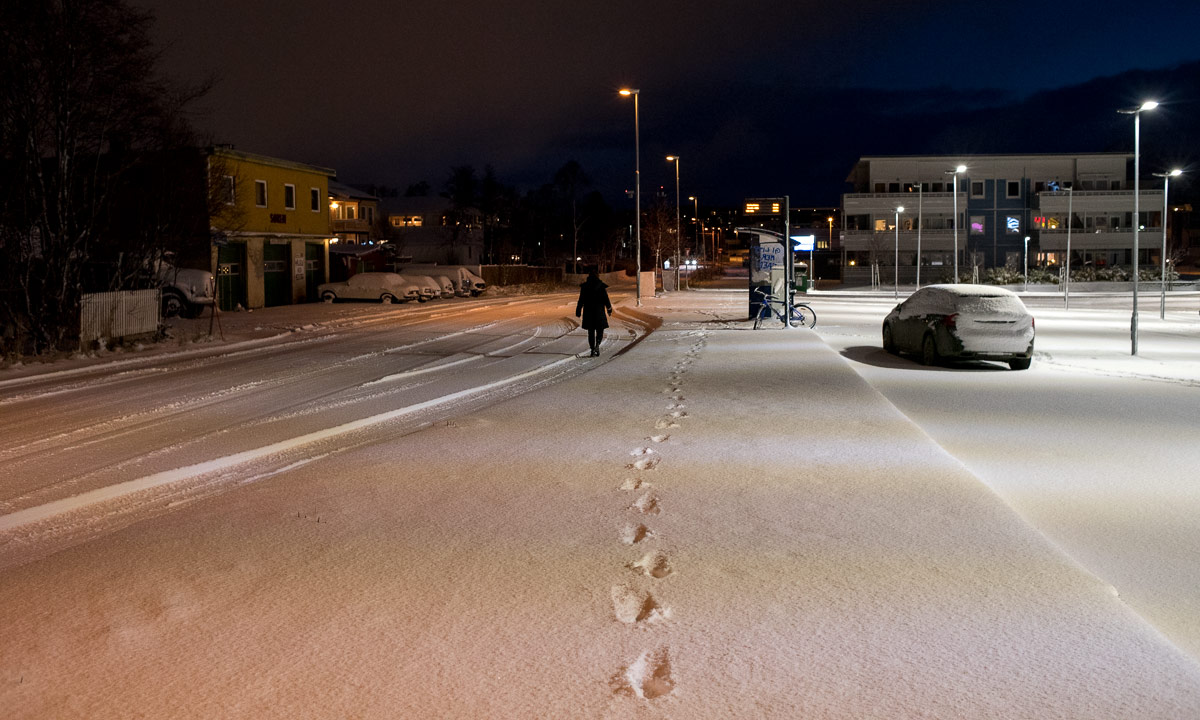
Today it was completely different. For the first it was dark. Dark on my way to work and dark again on my way back. Sunrise was at 8:33 and sunset already at 14:21.

Then it was quite windy and very rainy the whole day. Sometimes it just rained a bit, sometime it was bucketing down huge amounts.

Here are some photos from my way to work. Taken with my iPhone and black-and-white again.

The way back was more exciting. When I went round the Framsenteret – the marina to my left – I first thought I was totally lost in the dark. I didn’t know that there was a huge artificial lake to the right. I never saw it before. Carefully I tested with my rubber boot, it was 25 cm deep. Then I realised that this was no lake but the parking place. It was completely flooded. Did it really rain so much? Apparently.

I continued stomping through huge water puddles. My outfit: rubber boots – rain pants — waterproof parka – reflective vest to be seen by others – headlamp (in one of the parka pockets)

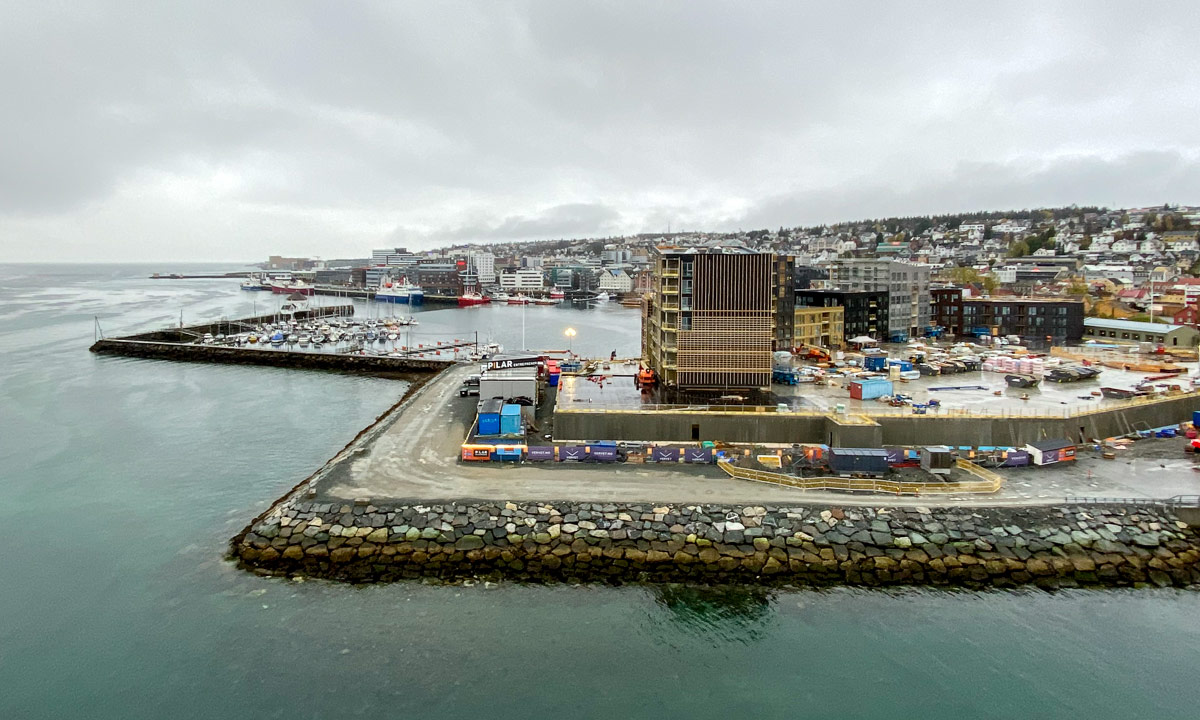
Then I realised that even the sea water level was exceptionally high. Would I be able to go back the very same gravel path you can see on the second photo? That path lies quite low and in the morning I could see a chain of seaweed lying on the side facing land. When I arrived, the way was completely gone. I could only see the water of the sea up to the site fence.

To make a long story short: I continued the path. Mostly it was 30 cm of sea water covering the gravel. That still worked with my rubber boots, but it shouldn’t have been more. I was really glad to have a bright LED lamp. Probably I wouldn’t have dared without it. And not it beacme clear that there will come a day where this part of my favourite way to work will be impassable without offshore survival equipment.

Appendix one: and the sun?

Tromsø is located at the latitude of 69° 39′ N, almost 350 km north from the polar circle. That means, that the days not only get shorter and shorter but that there’ll be a time where the sun doesn’t rise and set at all. This time is quite near: In three weeks it will be the last time you’ll be able to see the sun and then again in January.

To illustrate this I made some charts. The y axis of each chart shows the dates from 1 January (top) to 31 December (bottom). Each row shows the solar altitude for that day by color.

From left to right: München, Germany – Obbola, Sweden (my home) – Tromsø, Norway (my current workplace)

Sun | Sun (golden hour) | civil twilight | nautical twilight | astronomical twilight | deep night

These are the main differences:

München has sun each day, but a real dark night, too.

In Obbola in Northern Sweden there’s always at least 4 hours of sun (if the clouds allow it) but it hardly gets dark in summer.

Tromsø has the most extreme changes of sun altitude during the year: Round seven weeks of polar night in winter and almost ten weeks of polar days with midnight sun between May and July.

So there’s much to experience here. The next experience will be the technique sea kayak course this weekend. Probably with a lot of rain at 3 °C and on Saturday even gusty winds round 14 m/s.


Winter sneak preview – the first snow hike

This article is part of the series “2020-10: New in Tromsø”.

This weekend I planned to take the Fjellheisen. Fjell is Norwegian for mountain(s) and heis for lift or elevator. Fjellheisen however is not a vertical lift but a cable car up to the mountain Storsteinen (421 m above sea level) where you can have an incredible view on Tromsø, visit the café and most of all can start countless hiking tours.

Today morning I took the bus and changed to another bus near the polar museum. The second bus crossed the large bridge Tromsøbrua over the strait Tromsøysundet and ascended to the bus stop Fjellheisen. I planned to buy a multiple ticket (much cheaper) but the payment failed three times. To my delight I got a free return ticket. Soon the cable car arrived, two other guests and I entered it and Fjellheisen started its way up while I was looking down to the autumnal town Tromsø.

I got of the cable car, walked up some stairs, went through the door and then there it was: Winter ❄︎!

First I just strolled around. The snow was 10–20 cm deep and it was quite easy to walk. Few others people were around although the weather was quite fine – even though not as sunny as I expected. I decided to start my hiking tour by hiking up the nearest summit Fløya (671 m). Sometimes I had to cross knee deep snow, but mostly it was less. I followed some footprints – I wasn’t first this day – and soon arrived at the landmark – whatever it is – on a small pre-summit of Fløya and then on the near summit.

That didn’t take much time. So I continued in direction of the summit Romssavákkivárri (Sami) or Bønntuva (Norwegian) (776 m). Parts of the slopes looked steep but still it was relatively easy to ascend beside of the fact that the snow was deeper here. In the lee it was mostly knee deep and wind-pressed. This type of snow it quite easy to sink in and then you have to take the leg up the very same way it went down, since the snow is way too hard to plunge through. Sometimes I felt like a stork with balance problems.

On the way there were many heaps of stones which are used as waymarks. But you should be very cautious to follow these waymarks strictly in this part of the mountains because there are many tourists how just love to build heaps of stones everywhere. Anyhow, they are nice photo motives.

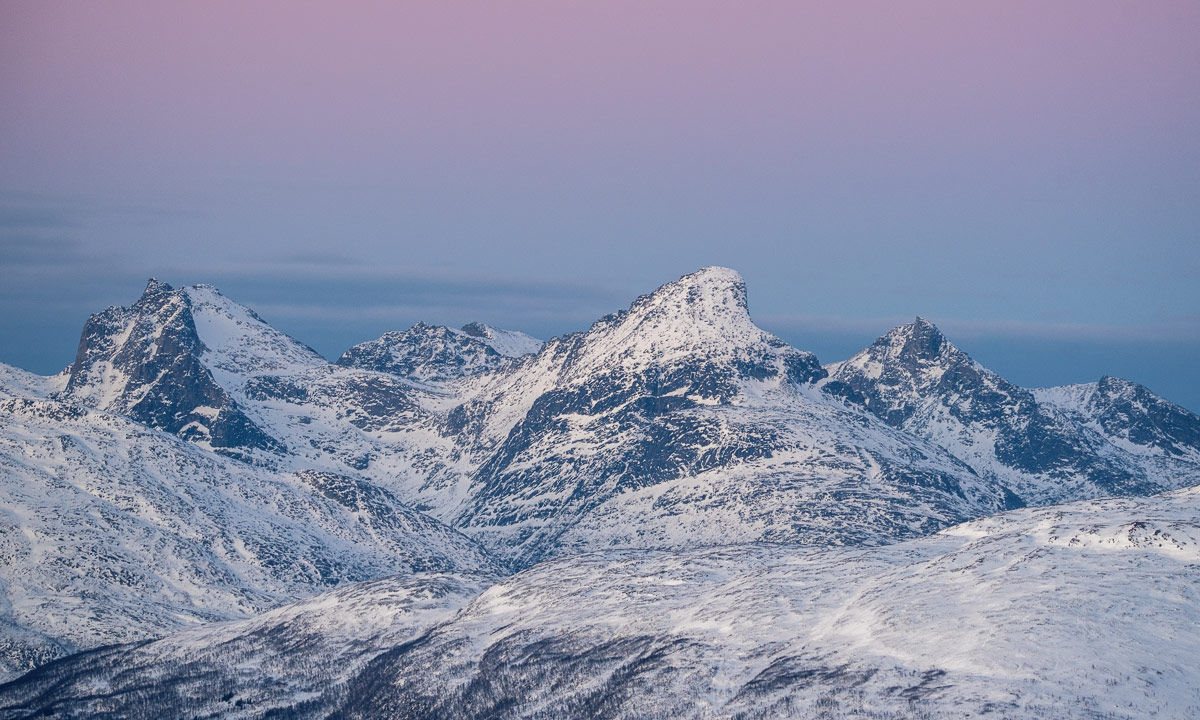
And so are the mountain ranges in the southeast. It could be the famous Lyngen Alps, but I’m not sure.

On the summit of the Romssavákkivárri I took a selfie. It was sub-zero (my Cola froze) and windy and I was glad about my winter anorak. Next time I’ll take warmer pants with me as well as woollen mittens.

What you may forget when you see these photos is the surroundings. All the snowy mountains are surrounded by straits and fjords of the Norwegian Sea. Here’s a panorama photo taken from the summit.

If you take the telephoto lens (most photos were made with it) you also see the snow line, which is quite low but not low enough to cover the lowlands with snow, too. That have to wait probably some more weeks.

After a while of photographing, eating cookies, drinking, watching, resting and enjoying I started my way back. Some other hikers had passed by and left tracks in the snow that made it easier to walk most of the time. I looked down at Tromsø and watched the weather worsen. From the north clouds with dense snow showers approached.

Several times I stopped. Once to talk to a skier – the only one I met today. He was British, lived in the Netherlands and was in Scandinavia quite often. Later I would meet him again at the cable car and he would give me a lift back to Tromsø. Thanks a lot!

Mostly however I stopped to take more photos.

Up here it was quite sunny and when finally the first snow flakes fell down I already was near the summit station of the Fjellheisen, where I had vegetarian lasagne for a late lunch in the café. It was a quite small portion and of course expensive as almost everything in Norway, but it was tasty. After that I went out again. The sun has started to set and the western sky was orange.

When I looked east I looked into a void. A huge shower cloud had approached and it started to snow. Seven minutes the same motive looked like this:

At 17:00 I took the cable car down, got the mentioned lift of the British man and was back in central Tromsø where I hardly could believe, that I just made my first winter hiking tour. Down in the city everything was just wet and just a bit slippery.

Conclusion: That was a great day with hiking through a winter’s sneak preview. I’m lucky since the snow will probably last for half a year, at least in the mountains.

As usual I made most of the photos with my Nikon D750 DLSR and different lenses. Today however I had another “camera” with me, my new iPhone 11 that I got from my employer, the Norwegian Polar Institute. It’s a huge improvement to my old iPhone SE. First of all the camera is much better and it has a real wide angle lens. Then the phone works in the cold! My iPhone SE would hardly have survived this day while the iPhone 11 was still ⅔ loaded when I ended my tour. Having these advantages I can live with the fact, that the iPhone 11 is bigger and feels twice as heavy than the SE. No ad, just my two cents.

iPhone photos today (all edited with Adobe Lightroom): The 1st one, the panorama and the last one.

Hooooot! Hooooot! Hooooot!

This article is part of the series “2020-10: New in Tromsø”.

Today it was the 5th day I worked for the Norwegian Polar Institute in their office at the Framsenteret in Tromsø. But it was the first day where I was distracted by three loud hoots of a ship. I left my office to walk to a gangway with a view to the seaside. And as I already guessed a Hurtigruten ship was in the process of docking. The Polarlys. I took a photo with my iPhone for this blog.

Normally two Hurtigruten ships should dock in Tromsø each day. A northbound at 14:15 and a southbound at 23:45. A map of today however shows that the Polarlys is the only Hurtigruten ships north from Trondheim at the moment.

(Map source: https://global.hurtigruten.com/map/#norway)

This is of course because of – guess what! – Corona.

After work I left the office and could already see the ship because the landing stage is near the office. I went there to take two more photos, then I went home. Weekend!

I would love to continue with my photo series “bevegelse” (motion), that I started on a Hurtigruten journey in winter 2016. However the next northbound departure on a Saturday is not before 31. October and then the days have become quite short. Probably I’ll must have some patience.

To the photo series “bevegelse” >

My way to work

This article is part of the series “2020-10: New in Tromsø”.

Today I got the test result: corona negative. So I was allowed to go to work at the Norwegian Polar Institute. It’s a bit more than 2 km to walk and I did walk.

Here are 16 photos, from the street where I live to the entrance of the Framsenteret.

As usual: A click will enlarge the photo, then you can navigate by clicking or using the left and right cursor arrows on your keyboard.

Different ways of kayaking

Since Annika doesn’t have a kayak yet I use to paddle alone. Mostly it’s short tours as for example the day before yesterday. I paddled to the beach Bredviks havsbad to join the yoga group at 8:30. To my surprise it’s shorter to paddle than to take the bicycle or car and so I was 20 minutes early.

After yoga I took a small tour – first north and then along the coast of Obbola.

Then I took an early lunch at the boat harbour since I didn’t had any breakfast. The kiosk there has not only hamburgers but tasty dishes as hummus or ćevapčići and Annika and I eat there quite often. After lunch I slowly paddled home. Slowly, because (a) being stuffed with food, (b) being lazy and (c) the increasing wind from the front.

Yesterday afternoon Annika and I got guests. Corry and Mark from Germany have written on Facebook about the difficulty of finding good tenting places at Västerbottens coast. They have been on a long kayak tour that they started in Haparanda four weeks ago. A common friend commented on the post asking us whether we wouldn’t have a nice meadow for tenting in our garden. Well, we have, and we even have our own little guest house, that Mark and Corry gladly accepted after they had arrived here yesterday afternoon. Last weekend Svitlanda and Ebbe (almost) came by sailing yacht, now we got our first guests that landed by sea directly at our house. It’s fun to live by the sea!

We had a nice evening together with outdoor cooking over open fire and inspiring conversations yesterday. This morning Corry and Mark continued their sea kayak tour. I had the honour to join them a bit.

At 8:15 we started by setting in the kayaks and paddling south. Since they have inflatable kayaks they have to be more careful of rocks and shallows. So we paddled further away from the coast than I use to do. I got some technique tipps about paddling more effortlessly and I really enjoyed the company.

Anyhow I decided to say farewell after an hour. Mark and Corry started crossing more open water and I wouldn’t dare to return the same route alone. Thanks a lot, Corry and Mark for nice company!

While the adventurers headed for the horizon I circled the island Tarv and slowly headed back. To my amazement the whole tour took only 2½ hours; I’ve miscalculated.

Now I know, that there are many destinations to be discovered by kayak and that they are not far away. It’s fun to live by the sea!

Past – present – future

About ten years in Sweden and what will happen next

← Past

Have a look at this photo. It’s a special one:

This photo I took the morning of 23 April 2010, exactly ten years ago. It was the very first day of a new chapter in my life: Living in Sweden.

So today it’s my tenth Sweden anniversary. What a great life I’ve had all those years!

I’m especially grateful that I got to know Martine and Lasse right from the beginning. It was the balcony of their former house in Skellefteå where I took this photo from. Lasse and Martine not only gave me a room to stay for the first weeks but much more. They introduced me to many great people and showed me the surroundings, among others Skelleftehamn.

When I took these photos on 24 April 2010 I didn’t know that I would buy a house in Skelleftehamn only a month later and move there in summer 2010.

☉Present

The month of April uses to be the month between winter and spring. It still may snow intensely but the snow won’t last. And so it is this year, too. The rivers are mostly open and only the lakes are still covered with old ice.

But this April is special. Although the weather is really fine I’m inside quite a lot. It’s not because of corona or work but …

… because I pack my things. I’m moving. I’ll leave Skelleftehamn after almost ten years! The removal van will come in three weeks and I have a lot of stuff. The 35 banana boxes on the photo are filled with books and I didn’t even start to pack my winter equipment. Down jackets, sleeping bags, pulka, skies, winter boots …

→ Future

I’m going to move 148 km south. Annika and I have bought a house in Obbola near Umeå, the largest town in Northern Sweden. In two weeks Annika and I will finally become sambor. Sambo (sam = together-, bo = to live) – is the common Swedish term for people in a relationship living together without being married. Oh, how I’m looking forward to live together with Annika after years of a weekend relationship with many car rides on the boring E4 between Skelleftehamn and Umeå.

I’m also looking forward to something else. The house is located by the Baltic Sea. It’s only sixty metres from our terrace to the shore and I’ll be able to see the sea from my “office room”. There will be no excuse why I shouldn’t take a ten minute kayak trip before breakfast, when the weather is nice.

It’s hard to make photos from the future. The photos below I made three weeks ago.

The photo I couldn’t take three weeks ago was of the mink strolling along the shore. Wrong lens …

On the road IV and V

Back to Sweden · Sneringsvika—Rötviken – 315 km

Have I told you, that the weather in Norway is constantly changing? So it was as well when I continued my road trip the day before yesterday.

It wasn’t cold, but most of the precitipation came as snow and even by the sea everything was white.

In Hofles I waited for the ferry to Lund which takes 25 minutes. I love standing onboard and watch the snow covered hills and mountains pass.

On the other side there was first less snow, …

… but as soon as the road climbed up a bit everything was white again. Here are two photos from a barbecue hut by the road 74 to Sweden. The first one from now, the other made in August 2016.

This time I have booked a cabin in advance. It is in Rötviken, 20 km behind the Norwegian-Swedish border. Although the campsite is by the road it is really quiet. Hardly any car uses this road.

I was tired from all the driving of the last days and fell fast asleep. The next day I would take it easy.

Arrival · Rötviken—Orrviken – 139 km

What a beautiful morning! The sun came out the first time since I left Solberget four days ago. Two dogs were barking. Did they bark at me? Now, it was the two moose that were about to cross the road but then turned too the the lake Hotagen.

This day I didn’t have to go far, just 140 km along broad roads through the Swedish forest. Easy to drive but a bit boring to look at.

I made a short stopover in Östersund, the largest town in the county Jämtland.

Then I continued to Orrviken.

Today I will spend my day here and repack my things for a ski tour that I will start with two friends tomorrow. Then I’ll be offline for about two weeks.

Vi hörs – see ya.

A wintry weekend in Saxnäs

If the mountain won’t come to Muhammad, Muhammad must go to the mountain.

While the coastal weather has still much too warm (last night it rained again onto the icy roads) you can still seek winter in the Swedish mountains. Annika and I used the long weekend to visit Saxnäs (and my piano tuner who owns a house there). Some days ago it had rained even there but fortunately it snowed afterwards and everything was white when we arrived there Friday evening.

Seven impressions of Saxnäs

1 – wind and snow

The night and the first day in Saadteskenjuana/Saxnäs was very windy with squalls round 20 m/s. That’s why we chose the car to look around, not the skies. The bay Faepmienloekte/Fatmomakkeviken, part of the large lake Gåaltoe/Kultsjön was partly open. Maybe because of the current of the stream Jeanoe/Ransarån, maybe because of the stormy wind and the warm weather. In the back the wind blew the new snow over the ice and highly into the air. It was not cold, but windproof clothes were necessary to feel comfortable.

A comment on the naming of the locations: The first part is the Sámi name, the second the Swedish name. The headlines and repetitions have only the Swedish names to keep it short.

2 – Fatmomakke

Faepmie/Fatmomakke is an old Sámi meeting point. In 1781 the Swedes erected a first chapel. Both Sámi and Swedish people lived here. Since 2014 it is a “kulturreservat” – an area to protect the culture of that place. I loved the old wooden houses by the lake Gåaltoe/Kultsjön.

3 – lake and mountains

When we drove back we still could see snow blowing over the lake. Above the whirling snow dust the risen sun had started to illuminate the mountains of the Marsfjäll.

Step by step we drove back to Saxnäs and I used every parking place to take pictures.

4 – polar stratospheric clouds

A rare phenomenon had been observed the last days: polar stratospheric clouds. I already could see some the days before on my way from Skelleftehamn to Umeå. Now in Saxnäs they were spread over half the afternoon sky. If they are near the sun the light is diffracted and the clouds are very colourful. I have seen such clouds before but never as intense and colourful as that day.

5 – skiing through the dark

In 2005 I bought my first fjällskidor – backcountry skis with steel edges. I had used them on many tours – from short half-day trips to multi-day winter tours with pulka and tent. They had become quite worn and battered, therefore I bought a new pair some weeks ago, including new boots. Now it was time to test them.

The test went very well, but the ski track around the lake we didn’t find. So we went cross-country and returned after a while. The way back was much faster because we could follow our own tracks and didn’t have to navigate.

6 – cross country skiing

The next day was grey but quite calm. We took the car to the Bagarstugan, starting point of the ski tracks in Saxnäs. The ski tracks weren’t prepared yet but some minutes later we met a man that was about to start the preparation. The classical tracks are prepared by snow mobile, the broader skating tracks by snowcat. So finally we were lucky to have our cross country ski premiere on a freshly cut track. Great!

7 – Saxnäs by night

Annika invited me to dinner and we decided to walk the 2 km from my piano tuner’s house to the hotel. Good to have some motion before and after dinner. We passed the closed village shop and soon approached the hotel. Urgently recommended: reflex vests to be seen by the cars.

Beside of the employees we were completely alone in the large hotel restaurant. It’s still pre-season.

Now I’m back in Skelleftehamn. The road is icy and wet from last night’s rain. The average of the max temperature forecast for the next 9 days: +1.3 °C. Come on, winter, where are you!?

Translation:

EnglishGerman
polar stratospheric cloudPerlmuttwolke

Thaw

After spending Christmas in Southern Germany I started travelling back to Skelleftehamn in several stages.

28.12. – Augsburg—Bremen

First a local train to Ingolstadt, then a 1st class seat to Bremen, where I spent the night. In the North German Plain it was really foggy.

Both trains were in time and the journey was comfortable. Sorry folks, no Deutsche Bahn bashing.

29.12. – Bremen—Mölndal

The next day my friend Delle picked me up by car. He wanted to visit me in Skelleftehamn and I took the opportunity for getting a lift home. The first day we travelled to Flensburg, through Denmark and then to Mölndal near Gothenburg, where we took a hotel room.

30.12. – Mölndal—Umeå

Why Mölndal? There is a tyre dealer where you can hire winter tyres with spikes. After breakfast we drove to the garage and Delle’s car got spiked tyres. Then we headed east to Gävle and then north to Umeå which took the whole day.

Did we need the tyres? Not yet – the temperatures were extremely high. 10.5 °C in Vesterås and 6.5 °C in Sundsvall. Especially the first half of the journey was quite boring. Trees to the left, trees to the right. A house. A bus stop and again. Trees to the left, trees to the right. Later there was more to see – even in the darkness.

I think it was 22:30 when we arrived in Umeå, but I’m not sure. I was soo tired!

31.12. – Umeå

Finally a nice day with sun and even a bit of frost! First Annika, Delle and I bought some side dishes for the lamb chops that Delle brought from home. Then we took a short tour to catch some wintry impressions before it would get warm again.

And then: New Year’s Eve – A happy new year to you all!

1.1. – Umeå—Skelleftehamn

The last stage of the journey was short – just 130 km and I was home again after eleven days with seven different overnight stays. I’m very glad about being home again but also disappointed.

The weather is just awful. It is warm and grey, last night it rained. The roads are extremely icy and slippery. Today I took a bend on a minor road and the car just slid sideways despite the four-wheel-drive and the “Nokian Hakkapeliitta 9” – one of the best spiked winter tyres you can buy. Luckily nothing happened to the car since I took the bend quite slow (but apparently still too fast).

The whole of Scandinavia is much too warm – up to 16 °C warmer than normal and Norway broke several warmth records. It was warmest in Åndalsnes with 18.6 °C! Even though it will become a bit colder there is no stable cold winter weather in sight.

We know that the man-made climate change will lead to much warmer winter weather in Scandinavia. Maybe we have already started to witness the effects. It might be only the beginning of more drastic changes in the future.

Addendum (3.1.)

Another record: 19 °C were measured in Sunndalsøra, Norway yesterday. This is the highest winter temperature ever measured in all of Scandinavia.