Period of fine weather

I guess, this week has been the ice fisher’s delight. Nightly temperatures between round -8 °C (good for the ice), afternoon temperatures round +8 °C, hardly any wind and no clouds hiding the sun (good for oneself).

It’s really hard for me to focus on my work when weather is as nice as it has been the last weeks. I would prefer having holidays in the mountains enjoying the fabulous late winter weather. I guess however that there are times when I have to earn money, too …

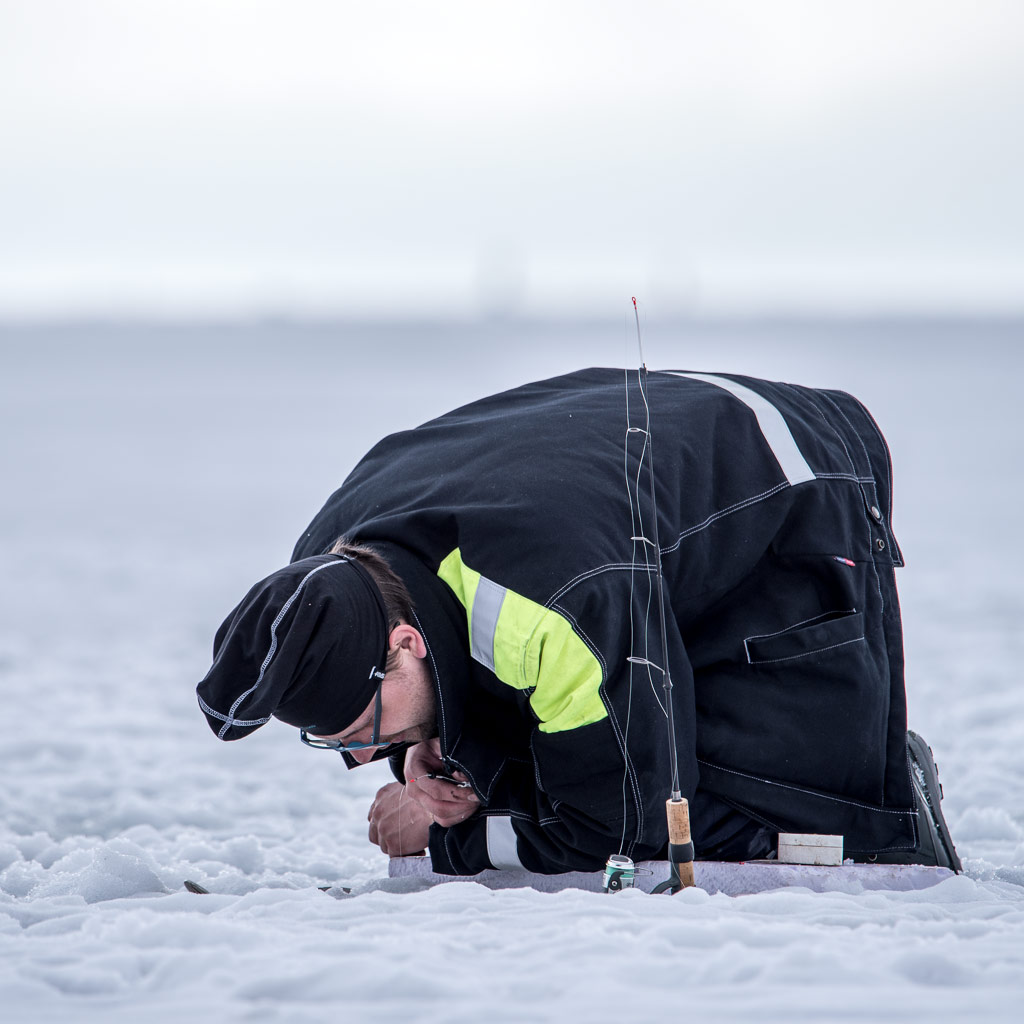
Already at 8 o’clock I saw five ice fishers standing, sitting or lying on the ice with their tiny plastic fishing rods. Although it was -6 °C it was warm in the sun. In the background the icebreaker Baus circuited around to break the ice for the next ship to come.

I knelt on the ice to make the photos above and heard it cracking. Was it thin ice? Not at all, it is still thick and safe. I guess it was the waves caused by the Baus that made the ice swing and crack. A strange experience. Good to now however that the water is quite shallow where I went.

But now I have to continue my work …

Addendum

I didn’t work much more today, sometimes there are spontaneous opportunities to seize  …

Skitour to Bergskäret

Today I took advantage of the marvellous weather and joined a ski tour over the frozen bay Kågefjärden to the island Bergskäret. Bergskäret is the island in the Kågefjärden that is nearest to the open sea. We were four: Hans and Stefan, with whom I have already made some trips, Kenneth and myself.

We took the car to Kågehamn where we started the tour. Round 5 kilometres over the snow covered frozen Baltic Sea and we arrived at the island. We were not the only ones. We looked for a good spot on the sunny south bank of the island where Hans made a fire with fire steel and we grilled the sausages that Kenneth had bought. I had a light down jacket with me but instead of putting that on I put off my soft shell because I felt so warm. Although it was hardly more than +2 °C the sun warmed us and the island protected us from the wind. After barbecuing, eating and resting a bit we went round the island and skied back to Kågehamn. Round 11 kilometres in the finest weather. A good way to spend the Sunday!

Tack för turen Hans, Stefan, and Kenneth.

Postscript 1

On the way back we saw the first whooper swan of the season. Another spring sign.

Postscript 2

While the snow and ice on the Baltic Sea are still beautiful the minor streets are in a very poor condition. The ice on the street is so deeply rutted that I’m quite glad about the high ground clearance of my Subaru. Anyway I learned that even a car with permanent all-wheel drive can spin out although driving slow.

Travel remainders

This article is part of the series “2018-03: Varanger peninsula”.

Some unpublished photos from my winter journey. I want to show them as long it is still wintry here.

2 February – Jokkmokk

While the grown-up huskies are doing their job the puppies have to wait in the trailer. I guess it is very boring for them. There are curious and seek contact.

21 February – Kirkenes

While Chris, Annika, Ørjan and I are enjoying the gorgeous breakfast in the hotel Thon an asian tourist is waiting outside. She seems to be well protected against the elements but why has the fur to be pink …?

1 Mars – Ekkerøy

On the way to Kiberg Annika and I make a stopover in Ekkerøy where we enjoy a beach walk. Here we meet H. who invites us to visit her. We will make that true some days later. I take a photo of Annika’s and H.’s footwear. Tradition, meet modern world.

1 Mars – Ytre Kiberg

Cape East Arctic Adventure, our stay lies directly at the beach. I could spend weeks with only watching the tides and the changing weather.

4 Mars – Ytre Kiberg

There’s hardly any commercial fishing left in the small former fisher villages and the large drying racks for drying cod remain empty. Some people however still dry cod for personal usage.

5 Mars – Ytre Kiberg

A view through the window of Cape East Arctic Adventure. Today we will continue our journey.

10 Mars – Berlevåg

We hardly have the time to explore Berlevåg, we only buy food. Two images of Berlevåg anyway. Just for the records …

11 Mars – Kjølnes Fyr

This snowstorm shaken rocky shore appears more arctic than many other places of this journey.

14 Mars – Hurtigruten, near Øksfjord

A woman has found a wind protected place and watches the Norwegian winter landscape.

16 Mars – Saltstraumen

On our long car trip back from Ørnes to Skelleftehamn we pass Saltstraumen, a small strait with one of the strongest tidal currents in the world. We are too early to see the strongest maelstroms and I’m too eager to continue home. It’s still 500 km to drive.

Now I finally can erase my “later” folder on the computer.


Beginning of spring 2018

According to the meteorologists spring already had started on 1 March. They love to calculate in whole months. Astronomically the beginning of spring is just today.

Well, kind of …

Today I didn’t work but enjoyed the marvellous weather. Bright blue sky and sun, a good day to go to the beach.

Well kind of …

The temperatures were between -10 °C and -5 °C and the Baltic Sea is still covered with a thick layer of ice up to the horizon. Sometimes it’s solid ice, sometimes it’s packed ice. No open water is in sight and therefore no sea birds neither. Just snow and ice and the blue sky.

I left the mainland at the boat harbour Tjuvkistan and crossed the ice to the islands Norrskär and Bredskär. Now I walk along the eastern shore of Bredskär and then to the island Gråsidan.

At the eastern shore there’s a long wall of ice, up to two meters high.

I walk along the shore and look at the fantastical landscape of ice and snow. Sometimes I feel like being in an open air museum. I call the exhibitions “below zero, above sea”. Here’s one of my favourite exhibits:

I go round half the island and then cross it. Although the snow feels solid – like that green floral foam used for flower arranging – I mostly sink knee deep into it. I walk back along the western shore and then cross the ice to the southern edge of Bredskär. The island has a ice wall at the eastern shore as well, partly up to four meters high. Where shall I go? Right beside of the ice wall there are snow drifts, knee deep or even deeper. A bit farther there’s water between the solid ice and the covering layer of snow. Good to have rubber boots.

I cannot decide for the best way to go. So I’m walking king of zig-zag, constantly watching the ice edge. Sometimes there’s a long line of icicles …

… and once there’s even a quite large ice cave. A pity that it will melt within the next weeks (or months?).

I continue my walk, sometimes plunging through deep snow, sometimes just walking on solid ice, sometimes breaking through the snow into water and slush (don’t worry, there’s always a thick layer of ice beneath). I cross the natural gravel bank between the islands Bredskär and Norrskär and talk the same way back to Tjuvkistan.

Today I walked only round seven kilometres, but it was good to be outside, breathing air, letting my eyes wander, catching some sun and the colours of the sky. At 12:30 I reach the car. It’s very warm in the sun and I’m dressed too warm, but the air temperature is still -5 °C. It’s a season between winter and spring which is called vårvinter – spring-winter. A suitable name.

And here comes my favourite picture of today’s exhibition-expedition. I call it “layers of ice”.

Side note: did you notice the huge rubber boots I’m wearing on the first photo? I bought them in Murmansk a month ago. They are made for ice fishing and they are lightweight, comfortable, very warm and of course waterproof. And they were quite cheap. The only drawback: They have spikes that do the opposite of what they are made for. Instead of improving the grip the spikes just slide on the ice making the boots incredibly slippery on ice. I have to check if I can remove the spikes.


A ski tour in the Kvikkjokk mountains – day 7 to 9

This article is part of the series “2018-02: Ski tour near Kvikkjokk”.

Day 13 to 15 of my winter journey 2018

(finally the last part about Jonas’ and my ski tour five weeks ago)

Tuesday, 13 February

I woke up in the cabin Tarrekaisestuga at 7:20. Some more centimetres of fluffy snow had fallen over night and it was still snowing slightly.

While Jonas and I had breakfast the snowfall intensified so that the mountains and the opposite shore of the lake Darrávrre were hidden by the falling snowflakes. Even the deep tracks of our pulkas from the day before had been snowed over and we couldn’t spot them anymore. We planned to gradually walk back on the other side of the lake and find a tenting place there. After breakfast we packed our equipment into the pulkas, cleaned up the cabin and started our tour by crossing the lake. It was still snowing quite heavily and on the lake it was quite windy, too.

It was not easy to find a path on the other side of the lake. The snow was soft and deep, some parts were forested quite densely and some passages were quite steep. At least for me, who lacked both power and general fitness for dragging a heavy pulka uphill through this sort of powdery snow where you sink in 20 to 40 cm with every step – with skis on!

Slowly and with many small detours we managed to ascent the southern hills until we reached the treeline where the terrain is more open and less hilly. We found a boulder where we found shelter against the wind. Here we took a snack: Chocolate, trail mix and hot tea.

We continue skiing slowly going uphill heading east. It stopped snowing and the wind dropped but the weather was still grey and dull. At least we could see the mountains again.

Suddenly we came to an abrupt stop. We stood at the edge of a deep, steep ravine impossible to cross. Such can happen if you do not make a detailed tour planning but just have a general idea of where to go.

After a while we started to look for a place to tent. First we followed the ravine that the river Áhkalmgårttje had cut into the landscape then we descended a bit to find a sheltered place between some birch trees. The snow was really deep and without skiers I sank up to my stomach into the fluffy snow.

Fortunately the snow was stable enough to build up the tent after we had trampling down it thoroughly with our skis.

Later in the evening: I wonder, why it is never completely dark. Is it still lights of civilisation reflected by the clouds? Suddenly something was flickering between the clouds. Is it a strong aurora? No, it’s just too vivid. But what is it? It was two snow mobiles that illuminated half the mountain landscape with their strong full beams. Slowly they passed on the lake below us.

Temperatures were round -10 °C, quite warm for a February night in the Kvikkjokk mountains. Soon I fell asleep.

Wednesday, 14 February

As usual I was awake quite early and I had a challenge: going on the loo. I just slipped into my warm mukluk boots, put on the down jacket and took toilet paper plus snow shovel with me. I went back on our track from our day before thinking it would bear my weight. It went well a few steps then I just fell through the snow and stood there, again up to my stomach in powder snow. This plan didn’t went so well. I climbed out of the hole, brushed off the snow of my long johns and looked for a better place. (I found it.)

This morning was even warmer with only -8 °C and quite foggy. Both wide angle lenses were completely fogged and it would take most of the day until I could make clear photos again. That’s what the morning  looked like:

As usual we took it easy and started only at 11 o’clock. We descended through the hilly open woodland until we met the winter trail. Snowmobiles had used this trail not long ago and now it was quite easy – even if a bit boring – to get ahead. And after some time even the sun tried to twinkle between the clouds. The first time after many cloudy days we casted shadows again. And it was snowing at the same time.

I skied fast on the snowmobile trail where I could use cross country skiing techniques. Too fast for Jonas and too fast for myself, too. I couldn’t hold the tempo and after some time I was really exhausted – not for the first time on this tour. On the other side it was already afternoon and we were already quite near Kvikkjokk, where I had parked the car. Jonas found a nice clearing in the forest were we tented the last time on this tour. And even the sky cleared up a bit.

Thursday, 15 February

We do not know if we missed northern lights while we slept. The morning however the sky was grey and overcast again and half a centimetre of dust-like snow covered the tent. (And my green anorak that I had forgot to put into the pulka.) Today we would have it easy. Just some kilometres skiing on the winter trail that means, following the snowmobile tracks, mostly on the river.

We passed the place where we had left the very same river the very first afternoon to find our tenting place. Here, in the “valley” much less snow had fallen and our deep tracks climbing up the steep riverside were still visible. Now it wasn’t long to the private shortcut that we had used on our tour start. When we came to this place, a snowmobile approached from that very shortcut, a man waved at us and made a turn to talk to us. It was Björn, the very same local that we met when we started our tour! He was quite eager to hear about our experiences even though he was a bit in a hurry. He also told us about two other Germans that he just had met at the very same parking place where I had parked my car.

The last kilometres, crossing a small frozen river …

… following the shortcut (which is quite long for being a shortcut) and finally we arrived at the parking place. We hadn’t much luck with the weather, we didn’t ski long distances, but it was an awesome tour anyway. Thank you, Jonas!

Plans for the next ski tour:

  • be better trained and exercised (!!!)
  • have less equipment (!!)
  • have (partly) better equipment (!)

Photo #6 and #9 in this blog article are made by Jonas Balbasus.

At the parking place we met Dan and Helen, also from Germany, who just were on the point of starting a much longer tour within less than two weeks: Following the Padjelanta, crossing the Sarek, returning on the Kungsleden. A very ambitious tour in my opinion. But they made it as you can read in Helen’s blog:
Winter ski tour through Sarek National Park – Sápmi / Swedish Lapland


Båtsfjord – Ørnes by Hurtigruten

This article is part of the series “2018-03: Varanger peninsula”.

Days 41 to 44 of my winter journey 2018

13 March at 19:45 the Hurtigruten ship MS Nordnorge docked in Båtsfjord. Annika went on board with all our luggage that we would need the next days, while I drove the car into the elevator. The next 59 hours we would travel many miles but stay in the same cabin. Cabin number 305. Kind of luxury. We would even get breakfast because of a campaign. On 16 March round 7:00 we would leave the ship in Ørnes and drive home.

I will not write much about this part of the winter journey but showing photos from the Hurtigruten trip with some comments.

13 March 20:30 – finally on the Hurtigruten. Shop, reception, restaurant and people cruising.

13 March 22:00 Berlevåg – the westernmost of the four Hurtigruten stops Vadsø, Vardø, Båtsfjord and Berlevåg. Some days ago we stood on the breakwater to see the ships coming in, now I stand outside on the bow of the ship to see the very same breakwater passing as we approached the peer.

14 March 05:25 – very early and quite cold in the wind. I’m the only one outside beside of people working.

14 March 05:40 – approaching Honningsvåg on the island Magerøya. Main attraction of that island: the North Cape.

14 March 06:35 – I stay outside and look at the constantly changing weather.

14 March 08:25 – two ships pass. First a smaller boat, twenty minutes later the Hurtigruten ship Kong Harald. It’s snowing.

14 March 11:15 – we approach Hammerfest. Normally the ship will lie there for two hours, but today the ship is late.

14 March 15:45 – I’m outside for some hours and enjoy the view at the landscape. Everything is constantly changing: The mountains, the perspective, the light.

14 March 20:15 – strong polar lights cover the sky. Many people are outside and so are we. I already showed some photos in the article Aurora on the Hurtigruten.

14 March 23:45 – we approach Tromsø. Annika and I are already in our cabin and ready for sleep, but I can see the Tromsø Cathedral through our porthole. (We booked a cabin with limited view to save money and our porthole is more like a tube.)

15 March 07:30 – it’s not cold but very windy on the bow of the ship. My advise for such a winter journey: take the warmest jacket you have.

15 March 07:35 – we approach Harstad.

15 March 10:20 – we reach Risøyrenna – the Risøy Channel, build between 1911 and 1922 to enable bigger ships pass between the islands Andøya and Hinnøya. Only seven meters deep.

15 March 17:00 – we approach the quite famous Trollfjord. In winter however the Hurtigruten ships do not enter it.

15 March 18:30 – we arrive in Svolvær, largest town on the Lofoten. It’s a longer stop and Annika and I leave the boat for looking around.

16 March 06:00 – the alarm clock rings. At 7 o’clock we will arrive in Ørnes, leave the ferry and drive to Skelleftehamn. 583 km by car then I’ll be home again after more than six weeks of travelling.

Why travelling in Northern Norway can take time

This article is part of the series “2018-03: Varanger peninsula”.

Day 40 of my winter journey 2018

At 11 o’clock we left Kjølnes Fyr and started our car trip to Båtsfjord. First we had to take the road 890 to Kongsfjord and over the Kongsfjordfjellet, then we had to continue on road 891 over the Båtsfjordfjellet to Båtsfjord.

I wasn’t sure if we would manage it due to the severe stormy and snowy weather. Another guest staying at Kjølnes Fyr had a hard time driving the 5 km from Berlevåg with very bad visibility. The roads however were still open though marked with a warning “difficult driving conditions because of snowstorm”.

And yes, it was stormy and it snowed a lot. The sight on the road however was still quite good. While I focussed on the road Annika took some photos of the coast beside of the road:

Some parts however were very hard to drive, since the visibility was extremely bad. It was hard to see whether there were snowdrifts on the road and how deep they were and several times I had to stop completely to find out, where the road continued.

I started to doubt if it was possible to cross the mountain passages but we would make it at least to Kongsfjord where we could stay overnight if continuing became impossible. Annika tried to check the traffic information of Vegvesen – the Norwegian Public Roads Administration – but there was no mobile internet available.

I continued driving along the E 890 and the only other vehicle we met was a snow plough. The street behind it however seemed as snowy as before.

Shortly before Kongsfjord Annika’s smartphone was online again and she informed me about the updated traffic information: The mountain sections of both the 890 and the 891 where restricted to kolonnekjøring which means that you cannot drive alone but have to follow a convoy guided by a snowplough. The kolonnekjøring was scheduled to 14:30. The good thing: Driving in a convoy would be much easier than driving alone.

When we arrived in Kongsfjord it was 12:10, so the 28 km drive from Kjølnes Fyr had taken more than an hour. We were lucky that there is a landhandel – a grocery – in Kungsfjord that is open all year. We entered the landhandel, told about the kolonnekjøring and were invited to coffee and cookies straightaway. A big thank you to the owner for the warm welcome!

While we sipped our coffee and waited we constantly checked the traffic informations. After a short while we learned that the start of the kolonnekjøring was postponed to 17:00. That meant more waiting, but we were not the only ones. Other men in work clothes – mostly fishermen – waited as well. They told stories, laughed out loudly while drinking coffee or eating fast food. Anyway we all were still lucky. While we only had to wait some more hours many other roads were completely closed due to the weather, among others the way to Mehamn, the passage between Kiberg and Vardø and the only way to the North Cape.

Hours later: We said goodbye, cleared the car of snow and drove the short way to the boom gate. Here some other vehicles, mostly trucks waited for the convoy to start. One of the truck drivers attached snow chains to his truck.

Dusk had already been falling when our convoy started some minutes after 5 o’clock. My job for the next time was following the rear lights of the car in front.

Some passages were quite easy to drive, some passages were hard to follow due to the blowing and driving snow. (Sorry, no photos.) After 35 minutes we arrived at the T-junction, where the 890 from Kongsfjord, the 890 from Tana Bru in the south and the 891 from Båtsfjord meet. A long queue of cars coming from Tana Bru already waited. Some minutes later the convoy from Båtsfjord arrived as well. The snowplough leading the convoy to Kongsfjord passed and seconds later our queue of cars started to approach the intersection were we turned left to follow the convoy to Båtsfjord.

This part of the trip was extremely exhausting. It was dark, the convoy was slow and mostly the visibility was really bad. I just tried to follow the red lights in front and it felt like hours and hours until the snowplough turned right and we suddenly arrived in Båtsfjord. Here it seemed to snow as much as in the mountains and I was very relieved when I finally parked the car at our overnight stay. Phew – that was no easy ride and I’m really grateful that convoys led us over the mountains under the snowstorm conditions.

The rest of the day? Buying foodstuff at REMA 1000, eating fast food, falling asleep quite fast while the snow squalls over Båtsfjord continued. According to our host 30 cm of snow already had fallen that day and more was expected.

At least we arrived in Båtsfjord, probably our last overnight stay on land. The next evening we would take the Hurtigruten to Ørnes, were we would drive home to Skelleftehamn and Umeå.

(The first five photos were shot by Annika. I did the editing.)

+++ breaking news +++ aurora on the Hurtigruten +++

Day 42 of my winter journey 2018

Just one hour ago: Aurora on the Hurtigruten ship MS Nordnorge just behind Skervøy, and what a nice one!

I was glad to find a place for me and my tripod because there were a lot of other travellers – mostly tourists – out and watched the northern lights. They made photos with any camera they had; from smart phone to DSLR camera with tripod.

I used ISO 1600, ƒ 1/2.8 and an exposure time of 4 seconds. To my surprise some of the photos were quite sharp although the ship was moving.

The Sea Sami Collections in Byluft

This article is part of the series “2018-03: Varanger peninsula”.

Day 37 of my winter journey 2018

When we left Kirkenes last year we got the tip to visit the Sjøsamiske samlinger – the Sea Sami Collections in Byluft. We went there and were amazed at the huge collection of showpieces. This year we visited the museum again, this time with more time and a warmer winter jacket, since the exhibition rooms are not heated.

Helmer Losoa, who runs the museum gave us a warm welcome and asked us in to coffee, where he talked about the museum’s and his personal history.

Helmer was born and grew up in Byluft. Aged 15 he went to sea on the training ship M/S Gann. That was in the ’50s. He travelled for many years and lived in Oslo a long time. When he moved back to Byluft in 1990 much had changed. Everything was motorised and many things were made of plastic. Helmer wondered what had happened to the old things of the Sea Sami in this region and started to collect many items, mostly from the years 1830 – 1950. He got support for building the museum but not for running it. A part of the items were donated to the collections, but most things Helmer bought himself from his own money.

After drinking coffee and listening to Helmer we went to the museum and Helmer showed us around.

There are many facets that make the Sea Sami Collections especially interesting:

  • While many other museums focus on the Mountain Sami who herded reindeers, this museum focuses on the more unknown Sea Sami who lived by the Norwegian coast of fishing, farming and hunting.
  • The exhibition is huge! I guess you could build at least ten new museums all over Northern Norway from all the exhibits that Helmer collected under the last 28 years.
  • Helmer can tell many stories about the showpieces in his collection. Some of them belonged to his relatives and he knows a lot about the history behind.
  • There are no glass boxes. You can have a close look at everything and with Helmer’s permission you are allowed to touch some of the items.
  • The museum reflects the everyday life of the Sea Sami in older times. Beside of wooden boats or fishing equipment you will find old coffeepots or radios, too.

We stayed in the museum quite a long time. It probably would take weeks to look at all the showpieces in detail. We looked around, asked questions to Helmer and listened to his stories. After some time we left the museum and said goodbye to Helmer.

Thank you so very much, Helmer! It was a pleasure to meet you again and to be guided through your Sea Sami Collections. Hopefully we’ll meet again sometime.

The Sea Sami Collections are located in Byluft, 29 km east from Varangerbotn.

Eight times Ytre Kiberg and around

This article is part of the series “2018-03: Varanger peninsula”.

Day 31 and 32 of my winter journey 2018

1. Yesterday, Ytre Kiberg – the morning

Two days ago two other guests arrived at Cape East Arctic Adventure, our cozy stay in Ytre Kiberg. They came from Utrecht in the Netherlands and were on a three week car trip from Utrecht to the North Cape and back – 8500 kilometres in total!

Trond, our fantastic host made a special breakfast for them: King crabs, locally caught in the Barents Sea. Annika and I got our share, too. King crabs are probably my favourite seafood but it was the first time I got such for breakfast.

After breakfast Trond had some work to do: clearing the snow with his rotary snow plough. Last days had been very windy with some short but intense snow showers. The snowploughs had to work a lot to keep the roads clear of snow and Trond had to clear the snow on his property several times a day. This morning the snow drifts were especially high and Trond had to work hard to get through with his snowblower.

2. Yesterday, Vardø – a private guide tour by Trond

After the driveway was cleared, Trond invited the Dutch guests and us to a short private guided tour in Vardø. We entered his all-wheel drive car and he drove us the short way to Vardø – a town with 2100 inhabitants located on an island – where he showed us some of his favourite places. There is a lot of street art in Vardø and next time I have to take a closer look to all the graffiti and more conceptual artworks. But you cannot do all in a single journey.

There’s a mountain pass between Vardø and Ytre Kiberg called Domen. It’s quite exposed to the elements and when we crossed it waves of driving slow covered the road.

3. Yesterday, Skallelv – a short visit

Soon after we arrived in Kiberg, the Dutch guests left and Annika and I made a car ride to Skallelv, 30 km south of Ytre Kiberg. The weather was really nice: sunny and hardly any wind. We went round a bit and I made some photos. I had however problems with some lenses, they got moisture inside that tends to freeze when being outside. Hopefully they will dry within the next days.

4. Yesterday, Vardø – the Vardøhus Fortress

After a rest we took a tour to Vardø again, this time we wanted to focus on two local attractions: The fortress and the witch memorial.

The Vardøhus Fortress (Vardøhus festning) was built round 1300 and is the northernmost fortress of the world. Beside of being a museum it is used today as a school for the Norwegian marine. Shortly after we arrived there, the Trollfjord, a Hurtigruten ship landed in Vardø and shortly after many tourist rushed through the fortress. In contrary to us they only had litte time.

5. Yesterday, Vardø – Steilneset Memorial

After visiting the fortress we went on to visit the witch memorial. It’s not easy to reach. First of all you have to know that it is called Steilneset Memorial (or find it visually), then you have to plunge through deep snow, because there are no cleared ways to the memorial.

In 1621 91 people, mostly women and Sami people had been executed for witchcraft. This memorial, created in 2011, shows the history of all 91 people and lists the confessions made. It is a shocking and touching place about the cruelty of mankind and worth to visit, if you are in Vardø and have the time.

After this long and eventful day we were quite exhausted and decided to take it a bit more easy the next day.

6. Today, Ytre Kiberg – a promenade in Ytre Kiberg

Today morning it was quite warm (-4 °C) and almost windless. 10 cm of new snow had been fallen over night. After breakfast we took a medium short promenade along the beach and into the village and back. The weather was changeable as it uses to be here. It could change from sun to snow within less than a minute.

Snow fall intensified and it became a bit windier, too.

7. Today, Ytre Kiberg – a private tour though the partisan museum

At 15:30 we had an appointment: we were invited to visit the Partisanmuseet – the partisan museum in Ytre Kiberg. We would get a personal guided tour from Steinar Borch Jensen – expert for the history of Kiberg and around – who would open the museum for us.

Trond took a huge spade, we entered the car, drove the short way to the museum, plunged through the snow to the entrance, where Steinar already had started to clear the outer stairs. Trond joined him shovelling.

The museum is not the biggest and the showpieces maybe not the most special, it’s the stories behind the showpieces that matter. Steinar had a lot to tell about the partisans in Northern Norway that fought on the Soviets side against the National Socialists in World War II. Beside of Steinar’s huge knowledge about that time there was another facet, that made our visit in the museum very special. Both Trond and Steinar have personal relations to the partisans. They know their relatives and they know the places where they lived. For many Norwegians the history of WWII is not just an academic interest but personal history. Soon the last witnesses of the past will be gone.

I felt very touched by the visit and was glad that we got the opportunity to get involved into the local history, but it made me thoughtful, too and reinforced my personal pacifistic worldview.

8 .Today, Ytre Kiberg – the first Varanger polar lights

Actually I planned only seven stories in this long blog article, but well …

I was out after a great two course dinner: reindeer (provided by Trond), pancakes (provided by Annika) and me doing the dishes. I wanted to make a photo of Cape East Arctic Adventure, Trond’s house, where Annika and I had such a good time. Then I spotted faint polar lights. I wore only a t-shirt and got in to fetch my Canada Goose parka. I was outside quite a while since the polar lights gradually became stronger. They constantly changed place making it hard to take any good pictures. It was -10 °C, quite windy and more and more I closed the zipper of the parka to prevent freezing. After a while the aurora weakened and I went in to look at the photos. I’m not content with the image above, but it’s a nice remembrance of our fantastic stay at Cape East Arctic Adventure in Ytre Kiberg.

Tomorrow we will leave and stay in Ekkerøy for some days.

Tusen takk, Trond, for your kindness and your great hospitality!