3×2 weekend images
Still summer weather – blue sky, temperatures not too hot and the last rain seems to be away like ages. Flowers are blooming, the Baltic Sea is blue and the cows are left on the green pastures for the first time of the year.


Still summer weather – blue sky, temperatures not too hot and the last rain seems to be away like ages. Flowers are blooming, the Baltic Sea is blue and the cows are left on the green pastures for the first time of the year.
Today I had two visitors in my backyard. They apparently enjoyed the high growing grass on my lawn (most neighbours already cut it). It was two hedgehogs.
The smaller one seemed to be cautious. He stayed mostly on one place and ducked into the grass. The bigger one however walked zig-zag through the grass, visited all three willow bushes and sniffed curiously around. I sat in my backyard and followed him with the tele lens of my camera.

Thanks for the visit, hedgehogs and welcome back.
This article is part of the series “2018-05: Gotland”.
It’s Thursday, our 4th full day on Gotland. Today we want to hire a car, meet Ingrid again and explore Fårö, an island northeast from Gotland.
We return our e-bikes, that we used the last two days and walk to Mickes biluthyrning, where we rent a VW Passat from 1995. Annika drives. We fill up the car and drive to Lärbro, where we meet Ingrid. She has been living on Gotland for a year and will guide us around.
In Fårösund we drive on the free ferry; the ferry crossing takes only 8 minutes. Then we are on Fårö.


First stop: Fårö kyrka. Beside this church used to be a tourist information, but it doesn’t exist anymore. It’s not a big problem, since Ingrid knows all these places she wants to show us.

The next stop however is a request of Annika and me: a real bakery! With a few exceptions, there are no bakeries in Northern Sweden and we enjoy visiting this one. We buy bread and cake and take a break to eat the latter.

We drive through the landscapes of Fårö, which are as varied as Gotland’s landscapes. Sometimes you think, you are in Spain or Greece, sometimes you believe being in Northern Germany and (only) sometimes in Sweden. Now I understand the Swedish people better, who say that Gotland is not Sweden.
Next stop Fårö Fyr, the lighthouse of Fårö, located at the easternmost point of Fårö. There’s a beautiful rock coast, but we do not stay very long, there’s a lot to see.


Next stop Skärsändan, a beautiful sandy beach that is several kilometres long. Annika and I take a bath (the water is quite shallow) and then Ingrid, Annika and I walk barefooted along the beach.


After a longer promenade we continue our Fårö exploration trip. On the way to Langhammars Raukar we make a stopover. Here we find many things typical for Gotland and Fårö: grey sheep, windmills, thatched houses, braided fences and dry stone walls.


Next stop is Langhammars Raukar, one of the famous spots with rauks – steep limestone formations formed by the waves of the sea. On of them reminds me on the stone statues of the Easter Island.


We continue to another fascinating spot, three kilometres away: Helgumannen, an old abandoned fishing village. This group of tiny wooden houses located on a rocky beach that seems to be endless looks really remote and I ask myself what kind of live the inhabitants had.


The last stop on Fårö for today: Gamle Hamn, another spot well-known for raukar. The last photo shows the “coffee pot”. Personally it reminds me more of Buckbeak, the hippogriff in Harry Potter.


I has become late, we are hungry and a bit tired. Ingrid drives the way back to the ferry and soon we are on Gotland again. Here we take the first restaurant and get something to eat, before we drive back to Lärbro and say goodbye to Ingrid.
Tusen takk, Ingrid for a wonderful day!
When Annika and I arrive in Visby it’s so late that the sun sets and the ice cream shop is already closed.
Valborgsmässoafton is the last day of April. On this days many people set fire to big bonfires, partly as an event being celebrated with friends, partly for burning last years gardening rubbish (and more …).
This year I was invited by A. and M. who I’d got to know exactly eight years ago on another valborgsmässoafton. They are among my oldest friends in Sweden and I’m very happy that they exist. Their stuga – or summer cottage – is located in Bygdeträsk south of Skellefteå.
This time I come from Umeå, where I spent the weekend. I try to avoid the larger roads and prefer the small gravel roads. Mostly they are in good conditions, only some parts are quite muddy and have deep ruts in the clayey ground. Less and less snow can be seem, but there’s still snow left.


There is still ice on the lakes as well, but it looks soft and grey and near the shore there are more and more open patches. You can still see the snowmobile tracks, a vague reminder of the winter.
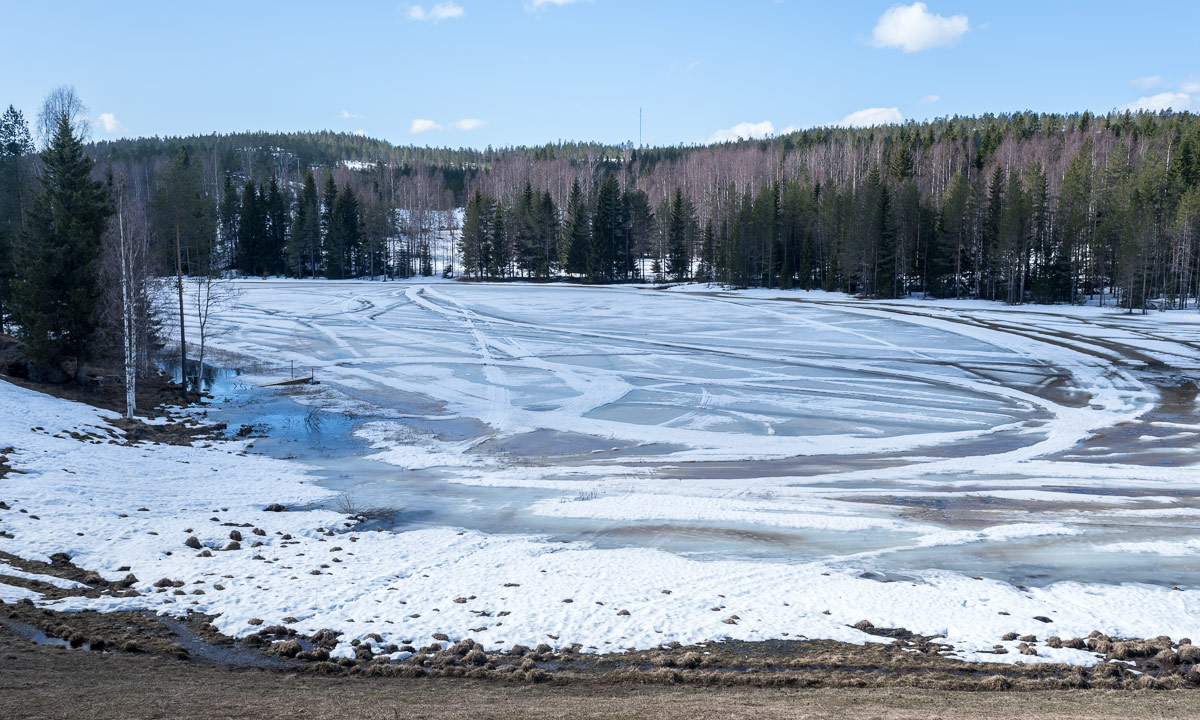
Some hours later: I’ve arrived in Bygdeträsk and with the help of A. I manage to park my car without getting stuck in the soft clay of the property (which happened to a craftsman recently). The other guests have arrived, too and – of course – the bonfire is burning!

But what about the hot tub? Wouldn’t it be nice to take a hot bath outside later in the evening? That of course needs some preparations. While M. cautiously tries to split the thick ice block in the hot tub with an axe I put on chest waders to wade a bit into the lake with a long hose attached to the water pump. First I thought I had to chop away ice, but near the shore the lake is just filled with knee-deep slush. Soon the pump starts to fill the hot tub with ice cold water heated by the wood stove.


To make a long story short: it will take eight hours until the water is hot enough for a relaxing bath and I will have fallen fast asleep when the only two people still being awake will start their bath.
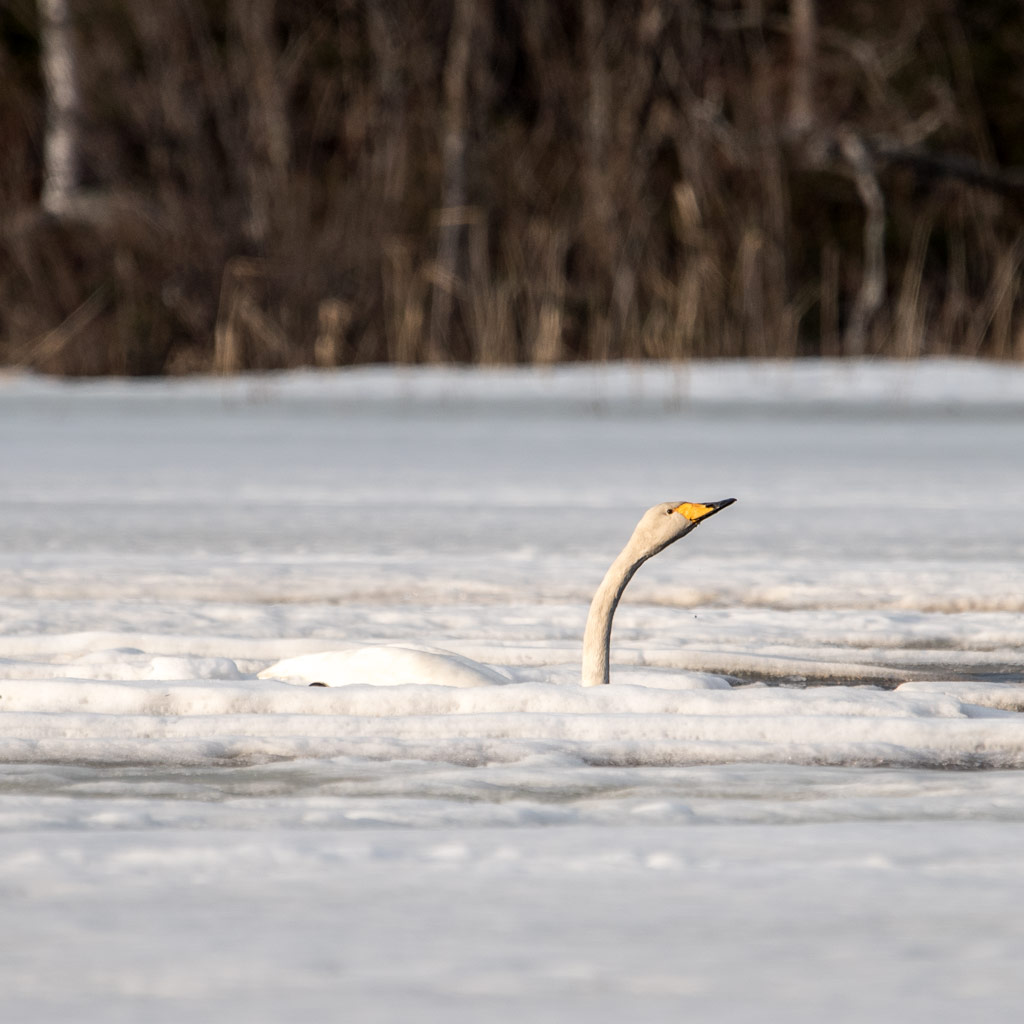
Anyway, there are other things to do as e.g. watching the whooper swans on the ice and in the water.




Then there is a lot of eating (M. is a great cook and grandmaster of barbecuing) and talking and playing games. Every half an hour someone goes out, adds wood to the oven and checks the water temperature, that sloooowly increases. I become more and more tired but I want to have a bath. At 1 o’clock in the night however I give up. I’m just too tired! I pump up my camping mat in the workshop, unroll the sleeping bag and soon I’m fast asleep.
After a late breakfast I say thank you and goodbye to the others, jump into the car and head home, again with many detours. I see some cranes, some reindeers and a black grouse (called orre in Swedish) that flies away before I can slow down the car for taking a picture.

Many gravel paths lead through forests. Left and right are old walls of snow that the sun has not melted yet. Leftovers from last winter’s snow clearing.

Again some patches are rutted, some are wet and muddy but no problem, until …


Luckily I see this obstacle in time and manage to drive around this hole in the street. (My car is the red one in the background.) One of the rare opportunities where I’m glad to have a car with all wheel drive.
One hour later I’m home again and I hardly can believe my eyes. Five days ago my backyard was still covered with 30 centimetres of snow, now the snow on the lawn is almost gone and beside of some small white patches brown grass is everywhere! Even though I’ve been living in Sweden for eight years I’m astonished again how fast snow melts in springtime.
Two hours later heavy raining is pouring down. Hej då, vinter!
Two days ago I took the car to Umeå, 130 km south from Skellefteå. Last time I was there in January and it was winter. This time it was springtime. Nevertheless, more than half of the ground was still snow covered in Skelleftehamn and Bureå. But while I was driving southwards the scenery slowly changed. More and more snow free meadows and grasslands showed up. The grass is still brown and huge water puddles cover the lower parts.
In Lövånger I saw a lot of birds on the meadows and made a short stop to photo some of them. No great shots but it shows some of the most common migratory birds that already had arrived here.


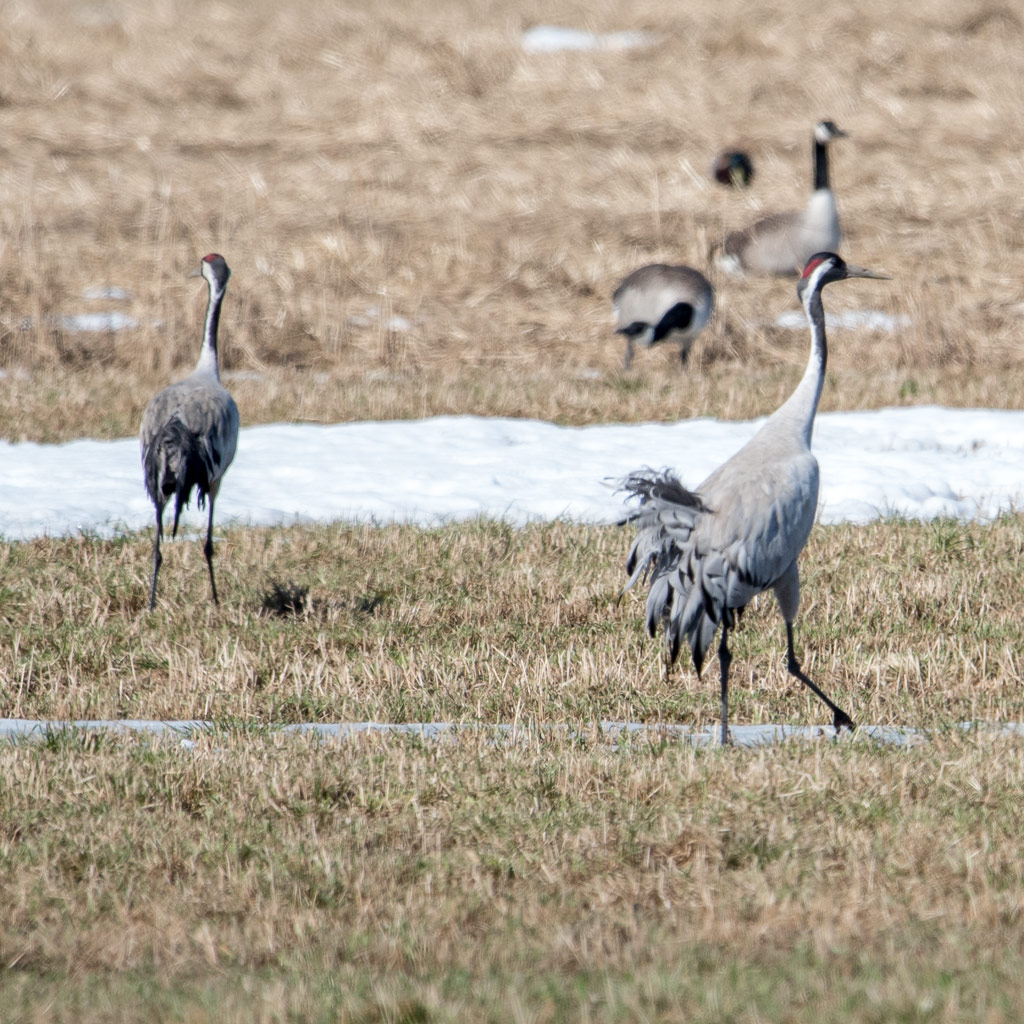


(click on the images to see the bird’s names in English, Swedish, and German.)
South from Lövånger there was hardly any snow left, it remained only in ditches, in the shadow of forests and on some northern slopes – everywhere where there’s less sun. Still the landscape looked a bit dull, for nor the birches neither the other plants had got leaves.
Some hours later. Annika has ended her working day and we walk along the river Umeälven, which is free of ice. Only some small ice floes drift on the surface that mirrors the blue sky.

On the other side of the way along the river there’s a southwards slope. And here many spring flowers, not only tussilago are blooming. I counted six different flower types on the walk into the center of Umeå. Here they come:


(again, click on the images to see the flower names. Hopefully there are correct)
Yesterday I saw the first butterfly of the season on the icebreaker Baus. It was a small tortoiseshell. Today I saw another one fluttering in my sunny front yard. It rested on one of the wooden panels and I wondered if and how it can survive after such a long winter with no flowers around.
I sneaked into the house, fetched the camera (it still had the telephoto lens on) and made a shot for this blog. I made it from the street with a distance of 5 metres because I didn’t want to disturb this little fellow. The photo is a 100% crop of the original image, otherwise you would see only a small orange spot.

Small tortoiseshell · nässelfjäril · Kleiner Fuchs · Aglais urticae
It’s not often that I see eagles in Skelleftehamn as near as today. it’s even rarer that I have my camera with mounted telephoto lens with me. And it was poor luck, when the eagle decides to wheel an extra round, so that I can take another shot when the first one is out of focus.
Today was such a day.

White-tailed eagle · havsörn · Seeadler · Haliaeetus albicilla
This article is part of the series “2018-03: Varanger peninsula”.
Some unpublished photos from my winter journey. I want to show them as long it is still wintry here.
While the grown-up huskies are doing their job the puppies have to wait in the trailer. I guess it is very boring for them. There are curious and seek contact.

While Chris, Annika, Ørjan and I are enjoying the gorgeous breakfast in the hotel Thon an asian tourist is waiting outside. She seems to be well protected against the elements but why has the fur to be pink …?

On the way to Kiberg Annika and I make a stopover in Ekkerøy where we enjoy a beach walk. Here we meet H. who invites us to visit her. We will make that true some days later. I take a photo of Annika’s and H.’s footwear. Tradition, meet modern world.

Cape East Arctic Adventure, our stay lies directly at the beach. I could spend weeks with only watching the tides and the changing weather.


There’s hardly any commercial fishing left in the small former fisher villages and the large drying racks for drying cod remain empty. Some people however still dry cod for personal usage.

A view through the window of Cape East Arctic Adventure. Today we will continue our journey.

We hardly have the time to explore Berlevåg, we only buy food. Two images of Berlevåg anyway. Just for the records …


This snowstorm shaken rocky shore appears more arctic than many other places of this journey.

A woman has found a wind protected place and watches the Norwegian winter landscape.

On our long car trip back from Ørnes to Skelleftehamn we pass Saltstraumen, a small strait with one of the strongest tidal currents in the world. We are too early to see the strongest maelstroms and I’m too eager to continue home. It’s still 500 km to drive.

Now I finally can erase my “later” folder on the computer.
I woke up from a bad dream tonight and stood up to get something to drink. I peeked though the kitchen window, it was snowing. On the snow wall in front of the neighbours front yard I could see a large snowball. It was moving. What?! I looked again and saw a mountain hare sitting on top of the snow wall. I spotted even two other pairs of white ears behind the snow wall.
Luckily I still had the big telephoto lens on my camera, so I adjusted the ISO value to 256000 (!) and tried to make some photos of the hare. The best one:

It’s not raining on the photo, it’s snowing, but even with this extreme ISO value I had to expose ⅛ second.
Then I got my tripod to get better images but the mountain hare seemed to spot me through the window and all hares run away in a flash. But only to hide on the street behind the snow wall in my front yard. (We still have at least 85 cm of snow in Skelleftehamn.) Some minutes later I spotted two of the hares in the street again but only for seconds before they ran away once more, this time for good.
This hare is a mountain hare. In Sweden this species is called Skogshare (“forest hare”) while in Germany its name is Schneehase (“snow hare”).
Now I’ll continue to sleep …
This article is part of the series “2018-03: Varanger peninsula”.
Days 41 to 44 of my winter journey 2018
13 March at 19:45 the Hurtigruten ship MS Nordnorge docked in Båtsfjord. Annika went on board with all our luggage that we would need the next days, while I drove the car into the elevator. The next 59 hours we would travel many miles but stay in the same cabin. Cabin number 305. Kind of luxury. We would even get breakfast because of a campaign. On 16 March round 7:00 we would leave the ship in Ørnes and drive home.
I will not write much about this part of the winter journey but showing photos from the Hurtigruten trip with some comments.
13 March 20:30 – finally on the Hurtigruten. Shop, reception, restaurant and people cruising.


13 March 22:00 Berlevåg – the westernmost of the four Hurtigruten stops Vadsø, Vardø, Båtsfjord and Berlevåg. Some days ago we stood on the breakwater to see the ships coming in, now I stand outside on the bow of the ship to see the very same breakwater passing as we approached the peer.

14 March 05:25 – very early and quite cold in the wind. I’m the only one outside beside of people working.

14 March 05:40 – approaching Honningsvåg on the island Magerøya. Main attraction of that island: the North Cape.
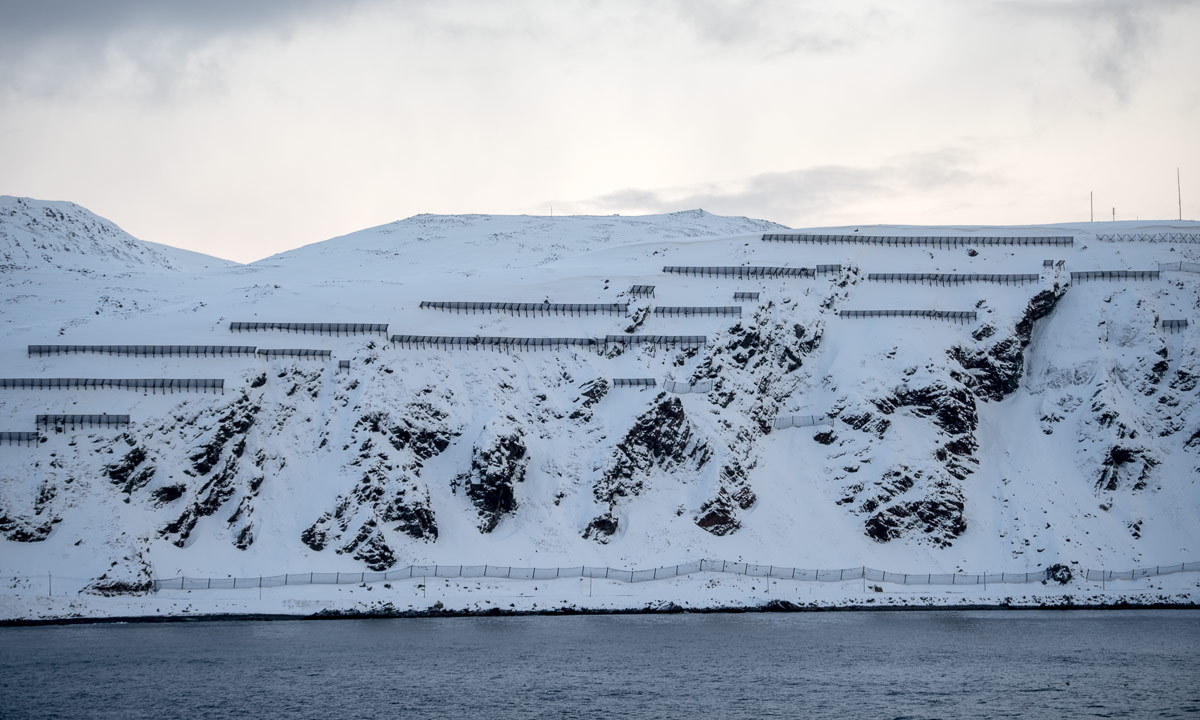

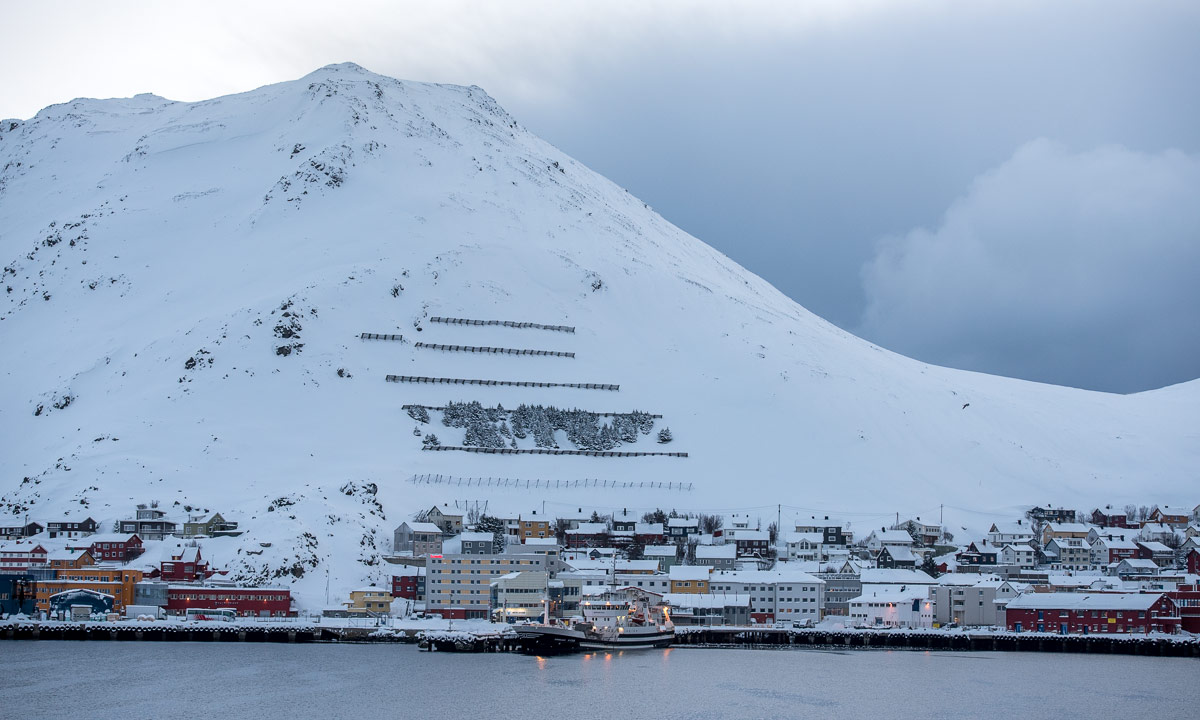


14 March 06:35 – I stay outside and look at the constantly changing weather.


14 March 08:25 – two ships pass. First a smaller boat, twenty minutes later the Hurtigruten ship Kong Harald. It’s snowing.


14 March 11:15 – we approach Hammerfest. Normally the ship will lie there for two hours, but today the ship is late.


14 March 15:45 – I’m outside for some hours and enjoy the view at the landscape. Everything is constantly changing: The mountains, the perspective, the light.


14 March 20:15 – strong polar lights cover the sky. Many people are outside and so are we. I already showed some photos in the article Aurora on the Hurtigruten.
14 March 23:45 – we approach Tromsø. Annika and I are already in our cabin and ready for sleep, but I can see the Tromsø Cathedral through our porthole. (We booked a cabin with limited view to save money and our porthole is more like a tube.)

15 March 07:30 – it’s not cold but very windy on the bow of the ship. My advise for such a winter journey: take the warmest jacket you have.

15 March 07:35 – we approach Harstad.


15 March 10:20 – we reach Risøyrenna – the Risøy Channel, build between 1911 and 1922 to enable bigger ships pass between the islands Andøya and Hinnøya. Only seven meters deep.


15 March 17:00 – we approach the quite famous Trollfjord. In winter however the Hurtigruten ships do not enter it.
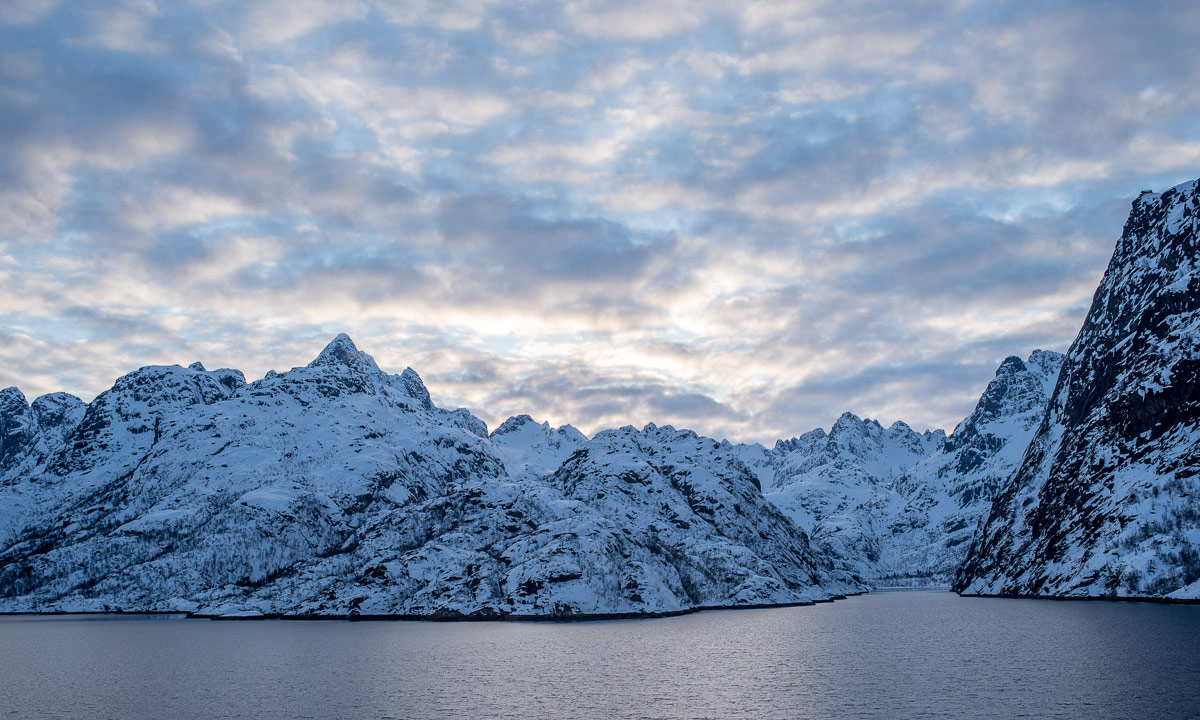
15 March 18:30 – we arrive in Svolvær, largest town on the Lofoten. It’s a longer stop and Annika and I leave the boat for looking around.


16 March 06:00 – the alarm clock rings. At 7 o’clock we will arrive in Ørnes, leave the ferry and drive to Skelleftehamn. 583 km by car then I’ll be home again after more than six weeks of travelling.