Skiing from Hemavan to the Viterskalet Fjällstuga

This article is part of the series “2019-03: Ski tour Vindelfjällen”.

Sunday, 3 March

A perfect day for a ski tour awaits us when Annika and I wake up in Hemavan, where we arrived the evening before. The ski is blue, the air is calm and the outside thermometer at Hemavans Fjällcenter shows -23 °C.

Today Annika and I will start our first ski tour together. We are going to be in the Vindelfjällen mountains for four days and stay overnight in two mountain cabins of the Swedish tourist association: Viterskalet and Syter. Annika is going to use a backpack and I a pulka sledge. Hopefully Annika’s backpack will hold, she already had to fix a friable strap the day before. After a breakfast we take my car and drive up the slope to park it near the Kungsleden sign.

Here the Northern Kungsleden starts, Sweden’s most popular hiking trail which is 450 km in total. We will follow the Kungsleden for two days and then turn west to Umasjö or south to Solberg back to civilisation.

At half past nine we are ready to start the tour. An employee of the ski area takes some pictures of us, wishes us a good tour, sits down on his snowmobile and drives away.

Now we have to climb up the ski slope, luckily not directly. Anyway we have climbing skins under our skis that prevent slipping back when ascending slopes. It’s no fun at all to use a pulka without them. We ski on broad prepared ski trails. It doesn’t take long and the fixed strap of Annika’s backpack breaks again. At the small hut of a ski lift she replaces it provisionally by another strap. Luckily this makeshift solution will work for the rest of the tour.

Although the sport holidays started the day before the ski resort is anything but crowded. When we however leave the ski resort behind us we are really alone for a while. Only another pair of skiers faster than us overtakes us at the steepest slope of the day. We are above the tree line. Only some solitary birch trees interrupt the snowy kalfjäll.

After a while we meet the snowmobile track. This track is quite popular because the Viterskalet cabin serves waffles – a welcome destination for snowmobile enthusiasts. For us as skiers it is a bit boring to walk on a five to ten meter broad “snowmobile Autobahn” and the exhaust fumes of the less modern snöskoter stink terribly.

We pass the summer bridge over the Västra Syterbäcken. Here’s even a toilet in the middle of the snow covered mountains. Only four other kilometres to go.

The whole winter trail is marked with red wooden crosses and there are many of them. In nice weather this seems a bit overdone but all people who followed such a winter trail in snow storm know that it can be very hard to find the next mark even when it is near.

Another hour of skiing and we arrive at the Viterskalet cabin. The stugvärd who is responsible for the mountain cabin greets us. There are two larger buildings: The cabin of the stugvärd with shop and even a small café and the guest cottage. The shop is tiny but has everything you need. Therefore we can buy most food in the shops and do not need to bear everything for four days.

We allow ourselves the luxury of a cold coke and a waffle. Then we move into the guest cottage. It is huge and hasn’t been heated for a while. Our sleeping room is heated by gas and temperature is at least over 10 °C but the huge kitchen has only 1 °C and it will take hours to warm it up some centigrades. The other guests have left. We will be the only ones to stay overnight.

I stroll around and take photos while the sun is slowly going down.

Annika and I still have garlic bread bought in Hamavan and eat it with a goulash soup bought in the shop. It doesn’t take long and we cuddle ourselves in our sleeping bags. Soon we fall asleep. Mountain air makes you tired!

I however have to pee in the night. For that I have to go outside. That means putting on boots, mittens and a down parka, because it’s -20 °C. This seems to be very uncomfortable but it has its advantages. I can watch an incredible starry night in the Swedish mountains. It is so bright and clear that it only takes seconds to spot the milky way. I just have to go in to fetch my camera and tripod. The green lights over the horizon is a Northern light, but a very weak one.

A snowshoe tour over the snaufjell

This article is part of the series “2019-02: Northern Norway”.

After some very lazy days I decided to make a snowshoe tour today. I just had to move! I’m here without my own car and therefore with quite limited baggage, but I was lucky to be able to get snowshoes from the Snowhotel Kirkenes.

First I followed a marked snowshoe route. It was -8 °C and in contradiction to the forecast the sun was shining. After some time I left the trampled path and made my own tracks. That’s what snowshoes are made for.

I went around and up some of the higher hills. First I love the view and then I love the snaufjell, the part of the mountains above the treeline. In Swedish it is called kalfjäll, but both words mean the same: bare fell. And soon I got my views.

One thing is special: There are boulders everywhere. I guess it’s leftovers from the last ice age but I don’t know why you hardly find those round-shaped boulders at other places on the bare fell.

The sun had vanished behind a layer of clouds and it started to snow. Sometimes the snow underneath my feet was of such a perfect white that I could not see whether it was going up or down. At least the sight was good and the terrain is easily accessible.

I navigated only by sight, therefore I cannot give you the name of the mountain top that was marked with a pile of stones and a wooden stick.

After some time I started my way back and descended from the snaufjell until trees got more common again.

I walked down through the fresh white snow – sometimes knee deep even with snowshoes – until I came to the trampled path again. Here the snow was so firm that I unmounted the snowshoes and went the rest of the tour without. Three hours later I was back in my host’s house.

It doesn’t happen often that I have a clear photo favourite of a certain day. Today I have:

Going by snowcat

This article is part of the series “2019-02: Northern Norway”.

It’s dark outside. I’m in the cozy house, where Chris and Ørjan live and reading. But what’s that blinking orange light outside? I peek through the door and what I see is a snowcat.

Ørjan is about to start a tour to prepare trails, both for his employer, the Snowhotel Kirkenes and for the local skiers. Preparing trails for the latter is a dugnad, that means voluntary work. Dugnad is very popular in Norway.

I ask Ørjan if I could join him on the tour and I am allowed to. Time to take some handheld pictures.

It’s fun to go by snowcat through the dark. I looks quite easy to operate and I would like to have my own snowcat. But neither do I need one nor could I pay it.

Takk for turen, Ørjan!

#escapism – skiing through the landscapes

When I walked home from an early meeting today it snowed at -12 °C. I trudged through the fresh snow like a small child.

Actually, I wanted to work with my online shop for my photo website. Outside it continued snowing. It took less than a minute to change plans. I took my skis, the backpack with the camera equipment, ski pants and my old Norrøna-jacket and went outside. I went down the snowy stairs, put on my skis and started a local ski tour. I skied 300 meter and was in the …

Forest

First I followed a snowy snowmobile track (with a detour to a small wetland) and then paw prints of a hare.

Following the paw prints led me to a …

Swamp

In winter however these swampy areas are frozen – no problem with skis.

The snow was round 30 cm deep and quite fluffy so that I sank down even with the skis. Perhaps my 240 cm long wooden Tegsnäs skis would have been the better choice. I crossed a small pond and a small ridge – probably formed in the last ice age – and then I came to a larger …

Lake

The lake Snesviken had been frozen already in November. Now it was just a snowy plain with a small island in the middle.

I took a selfie …

…crossed the lake and came to a …

Dense forest

I knew that this forest was dense with a lot of underwood and many rocks, but I forgot how hard it is to find a way through it on skis. Now I was quite glad that I didn’t take the Tegsnäs skis.

I fought my way through birch thickets and rocky passages. It took a long time until I left the forest and reached a snowy road, part of a …

Cottage area

I followed the road to its end. Skiing was easy and effortless after the dense forest.

As in the whole of Sweden there are many summer cottages in Skelleftehamn, too. This cottage – as most of them – was by the …

Sea

I crossed the small thicket at the rocky shore …

… then I stood on the frozen Baltic Sea. I started skiing leaving the mainland behind. It was much windier and I was glad about my fur-trimmed hood. The field of view however is limited. Looking down I saw the fur, the skis and a white featureless surface. Almost whiteout conditions. Parts of the landscape were featureless as well.

It may look like I was in the middle of the Arctic, but no, right behind me there was an …

Island

The Island Storgrundet is the nearest island from the mainland. Here I had looked at the sea ice 10 days ago, here I watched the lunar eclipse last week.

I followed the coastal line, crossed a frozen bay and arrived at the old boat shed that probably had been there for ages.

Then I crossed the island through the forest.

The island is not very wide. After 200 meter I could see the mainland’s …

Coast

This part of the coast is one of my favourite places in Skelleftehamn. In summer it has a nice sandy beach, in winter it’s the first part of the sea that freezes. In summer I use to paddle kayak, but most locals prefer small motorboats. Now all boats lie upside down on the shore.

Where there are boats are also houses. Where there are houses there’s also a …

Road

And this road is special, because it leads …

Home

Here I arrived three hours later. I put off the skis, shock of the snow and went in.

Oh, I love winter!

Rime at the Bergsbyn dam

After photoing the lunar eclipse this very early morning I went into bed again and took a long nap. After that I actually wanted to work but the weather was so fine that I took the car looking for photo motives. Temperatures below -20 °C, a clear blue sky and all birch trees covered with rime – that’s ingredients for a beautiful winter day. While I was looking at the white birch trees I got an idea. How would it look like at the dam in Bergsbyn where there’s always open water downstream.

I drove there and parked the car. Indeed the trees by the river were covered even more with hoarfrost and rime. I walked along the river through knee-deep snow. Beside of some animal tracks the snow was untouched. Strange, that I was the first one that went along the riverside since the last snow one week ago.

The open water was smoking with cold and frozen fog blowed along the river. It covered the opposite riverside and partly the sun as well. Small ice floes drifted by. The river is quite fast here. Hardly imaginable that the river upstream is completely frozen over.

I experimented with the fisheye lens. It will take some time until I get used to it, especially when the light situations are as difficult as they were today. I do not like these white spots where the sun is but today it was hardly avoidable.

Kayak season is over

Two days ago I considered to go kayaking a last time before the sea freezes over. Large parts of the inshore Baltic Sea were still open but it was hard to reach the open water without bearing the heavy kayak over the icy, rocky shore or walking on unstable ice. So I decided against paddling.

When I arrived at the seashore this morning it was clear that the kayak season would be over for a while.

Temperatures between -15°C and -20 °C have made the Baltic Sea freeze. It almost looks like one could walk to the island Gåsören, but that wouldn’t work. That, what looks like a solid surface of ice is actually a pattern of floating ice floes. It’s not visible to the naked eye, but comparing photos shows, that there are still tiny waves under the ice floes that make them go up and down.

Snowshoe tour on the Vyöhtjage

The situation is like three years ago: it’s the days after Christmas and there is not much snow in Skelleftehamn. As in 2015 Annika and I decide to make a tour to Arvidsjaur.

Arvidsjaur lies northwest of Skelleftehamn, two hours drive away in the inland. It is located in Norrbotten, Sweden most northern county, is part of the historical province Lappland and part of Sapmí, the region of the Sámi people. Arvidsjaur is well known by German Sweden fans since there are direct flights in wintertime from several German cities.

Arvidsjaur has a nice mountain called Vyöhtjage (Sámi) or Vittjåkk (Swedish). The Vyöhtjage is too steep for us to use skis so we used snow shoes to go up to the mountain top (650 m).

Here some photos of yesterdays tour:

It’s funny that we did almost the same tour (with another route) to the Vyöhtjage as exactly three years ago with the same weather (sunny and not too cold) and snow conditions (half a meter of snow). This nice place however is worth to be visited several times, especially because it is quite near to Skelleftehamn.

We had an overnight stay in Arvidsjaur. Today we will drive back but take a stopover in the village Kusfors to visit friends.

Where is the pack ice?

Today I wanted to take more photos of the pack ice covering the Baltic Sea, this time in sunlight. Unfortunately the weather didn’t follow the forecast. (Yes, this happens!) Instead of the predicted sun and clear sky it was cloudy.

When I was brushing by teeth I noticed a light in the west. A huge honey yellow full moon hung in the western sky and shone into my bathroom. Apparently western winds had started to blow the cloud layer eastward.

I took my camera equipment and my winter parka and drove to the beach to take pictures from the full moon. Here’s one of those pictures:

To be honest, I think this is a boring picture. It says more about the pros and cons of my telephoto lens than showing an interesting scenery. The photo could have been taken anywhere. Everywhere where there are power lines and a bit of sky.

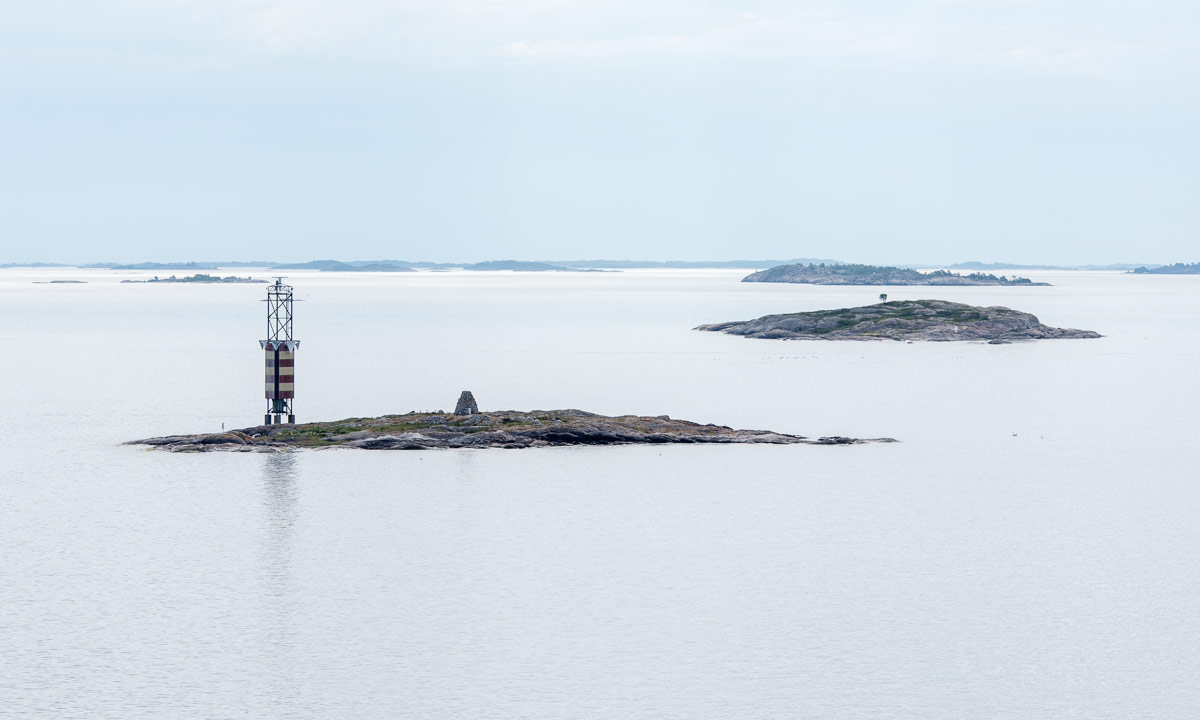
I took the car and headed for another place. Hopefully I would find a better motive. To make a long story short: I didn’t. Even the photo with the three islands (two of them are seen above the horizon) looks pale and featureless.

Suddenly I heard birdcalls. Three white whooper swans flew along the coast, heading south. Looks like a good idea, because when the Baltic Sea is frozen they will have hard times finding food. I was lucky: camera at hand, telephoto lens mounted, time to increase ISO and activate the VR. Click!

I continued to Näsgrundet, the place where I photoed the pack ice two nights ago. The ice however was gone! Probably the very same wind that pushed the clouds to the east blew also the ice floes into the open sea. Beside of some grounded ice floes the sea was open again. I decided to continue using my telephoto lens, both for motives farther away and quite near.

I got attracted by a rock covered with a humpback ice pattern. Looking at the results I’m quite content with the lens for this type of motive. I cannot decide which of the two photos I prefer, the first one showing the whole rock or the second one that focuses more on the icy details. What do you think?

When I was home, the temperature had dropped from -9.5 °C to -14 °C.

Some hours later: The sun is setting. The air is chilly but the colours are warm. The Baltic Sea is steaming with cold. One wide-angle photo, taken at 13:07 at the same place.

Home again the sun has set but it’s still light. I decide to go for a jog. It’s fun to hear the snow crunching under the studded soles of my new running shoes. And I do not need my headlights because the sunset is so slow. The air is cold, round -15 °C. My fitness it not the best and I have to breath a lot to keep my pace. Good to have a buff for warming up the cold air a bit.

Two photos from today: (1) me photographing, (2) me jogging. Keep in mind, that it was warmer on the first photo.

P.S.: When I look at the whole blog article I’m more content with the photo of the full moon. The isolated photo may be pointless but in the article it has its place.