3rd Ice Swimming World Championship in Murmansk – preparations

This article is part of the series “2019-03: Redex Murmansk”.

I was in Murmansk with Barents Press with a project called Redex 2019. The project goal is to establish contacts between sports journalists and exchange experiences.

Thursday, 14 March

Tomorrow, 15 Mars 2019 the 3rd Ice Swimming World Championship will start. 400 swimmers from 33 countries will participate in this competition and will swim distances up to 1000 metres. The event is organised by the IISA and the town of Murmansk.

The first contact to this event we got yesterday, 13 March in the swimming bath. We met Davaadorj Shagdarsuren, a professional swimmer from Mongolia and only participator of his country. His traditional clothes were really eye-catching and according to himself much too warm for Murmansk. He’s more used to winter temperatures between -35 °C and -50 °C.

Later we had an appointment with Irina Andreeva, leader of the municipal Sport Committee and member of the organising committee. She gave us interesting details about the ice swimming championship and the organisation.

When we went back we passed the Five Corners Square we heard loud music. There a rehearsal for the closing ceremony was in full swing. Heroic music sounded from the PA system and young people were marching to it with huge flags. Half of them in some kind of winter uniforms and flags with the logos of the IISA, the city of Murmansk and Аспол, the association of polar explorers. The others with the national flags of all participants. A nice gesture to all countries. I have however to admit that such kind of parade looks quite odd from my German-Swedish perspective. I’m not used to marching and parading.

Today at 1 o’clock was the press conference for the championship. It hold place in the hotel Azimut. 13 officials talked a bit about the event and invited the journalists to ask questions. Since there came hardly any question they started to ask each other instead. Quite funny situation.

After that we got our press accreditations. Now I have a press badge and I’m quite curious how freely I’m allowed to move the next two days to take pictures of this event.

Links

A trip to Murmansk with Barents Press

This article is part of the series “2019-03: Redex Murmansk”.

Last year a friend of mine told me he would travel to Murmansk and asked me if I wanted to follow. The friend finally did not have the time, bit I got the opportunity of a Murmansk trip thanks to Barents Press, a journalist network in the Barents Region. I became a member as a photographer this year.

The project called Redex 2019 has a strong focus on sport journalism and sport events in Murmansk. People who know me may know that I do not care about sport competitions. In this case however there’s a large sport event I’m interested in: the 3rd Ice Swimming World Championship. I’m very glad that I was invited to travel and my thanks go to Barents Press for the invitation, for taking all the costs and for the great organisation.

Monday 11 March, 7:00. I just finished my breakfast in a hotel in the Comfort Hotel Arctic in Luleå and we are ready to travel to Murmansk. We, that is five journalists, me, and Sergei, our Russian chauffeur. He came from Murmansk with a Mercedes 15 seater minibus the day before. Good to have a bit of comfort, for we will travel about 840 km which will take the whole day.

Off we go. To Finland it’s only 130 km.

And – swoosh, are we in Finland. You hardly realise that you just crossed a border.

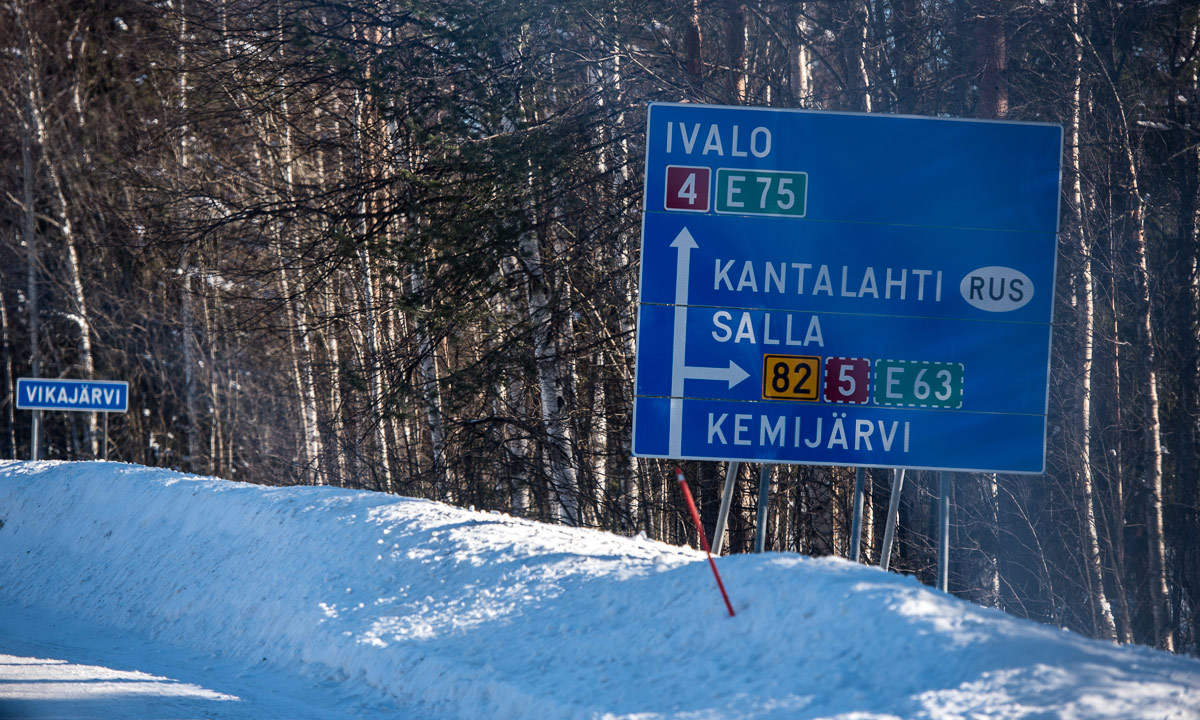
There are different ways to Murmansk. We will take the way via Salla. We make a lunch break in Kemijärvi where we got an extraordinary delicious lunch at Mestarin Kievari with a lot of salat and side dishes and even two different desserts.

At 15:30 Finish time (1 hour ahead) we arrive at the Finnish side of the Finnish-Russian border. Sergei has to make some paperwork and we have to wait, then we all show our passports before we enter the bus again to drive to the near Russian border.

The first check is before we exit the bus: A Russian official gets on the bus, counts us and checks our visas. Then we drive to the custom office where we leave the bus and have to fill out a form, that we have to keep with our passport the whole stay in Russia. It takes some time to fill the form, especially since it’s so tiny.

Then we go through the control, one by one. I’m first. There’s a minor problem with my form but Tim who speaks Russian can help. I wait on the other side where there’s a small exhibition of war memorials found at the border. I say one of the few sentences I know in Russian: Можно фотографировать? Yes, I may take pictures.

Then we are i Russia. Another check of the officials, that we are complete and have our stamps on the forms and in the passports. 20 other km and we have travelled half the distance. The Russian roads and landscapes are very similar to the Finish ones. It’s not easy to take landscape photographs from a bus driving on a bumpy road with a lot of windows reflecting the light. I start to doze.

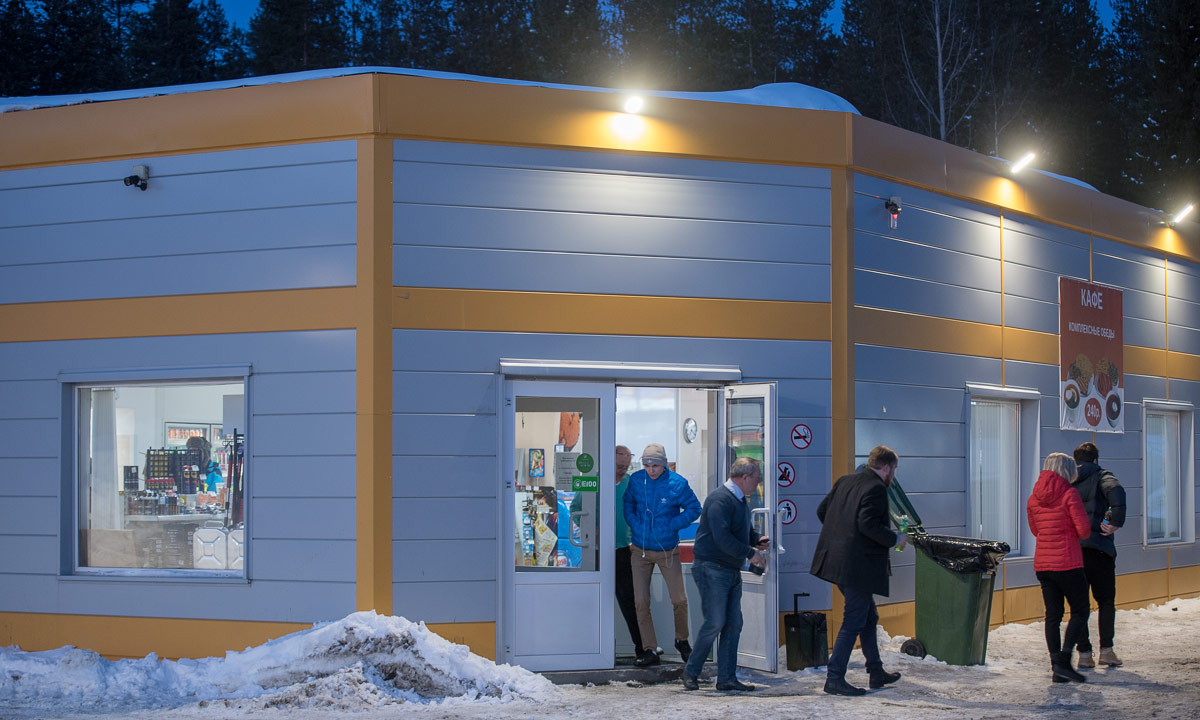
We stop in Алакуртти/Alakurtti to refuel the bus. We have to wait, because the gas station itself is being refuelled and that takes some time. Anyway it feels good to stretch my legs and to get some fresh air.

After half an hour we continue our trip. We make a short stopover at a petrol station in Кандалакша/Kandalaksha, then we drive on.

It starts getting dark and I try to sleep a bit. It’s still 250 km to Murmansk and our trip takes some more hours, but finally we approach the city.

On the sign stands: “Murmansk, Hero City”, an honorary title from the Soviet times for outstanding heroism during WWII.

Just before 22:00 local time (+ 2 hours) i enter room 838 at the Park Inn Hotel, where I’ll stay the next five nights. So the whole ride took almost 13 hours and I’m really tired. But before going to bed we meet at the lobby and go to a restaurant nearby to get a late dinner. (I remember the food was tasty, but I’m not sure because my brain already had turned on the autopilot.)

The whole route: LuleåHaparanda/TornioRovaniemiKemijärviSallaКандалакша/KandalakshaМурманск/Murmansk.

Inside the Snowhotel Kirkenes

This article is part of the series “2019-02: Northern Norway”.

After two great snowshoes tours I took it easy today. I went to the Snowhotel Kirkenes nearby, took some photos of the huskies, that didn’t have to work, visited an acquaintance who works in one of the restaurants and went inside the Snowhotel itself. I’ve been there before, but since the hotel is rebuild from scratch every year it looks always different.

Which photo of the lobby do you prefer? The first one, where the room is empty or the last one with the blurred people in it?

Going by snowcat

This article is part of the series “2019-02: Northern Norway”.

It’s dark outside. I’m in the cozy house, where Chris and Ørjan live and reading. But what’s that blinking orange light outside? I peek through the door and what I see is a snowcat.

Ørjan is about to start a tour to prepare trails, both for his employer, the Snowhotel Kirkenes and for the local skiers. Preparing trails for the latter is a dugnad, that means voluntary work. Dugnad is very popular in Norway.

I ask Ørjan if I could join him on the tour and I am allowed to. Time to take some handheld pictures.

It’s fun to go by snowcat through the dark. I looks quite easy to operate and I would like to have my own snowcat. But neither do I need one nor could I pay it.

Takk for turen, Ørjan!

The ice road in Avan

Today I had a meeting in Norrbotten, Sweden’s northernmost län (county). It was the annual general meeting of Barents Press International, a joint network of journalists in the Barents Region. I joined this organisation a few weeks ago and took the meeting as an opportunity to meet members of Barents Press in real live.

The projects presented at the meeting were really impressing. In addition to that the people were both very friendly and extremely interesting.

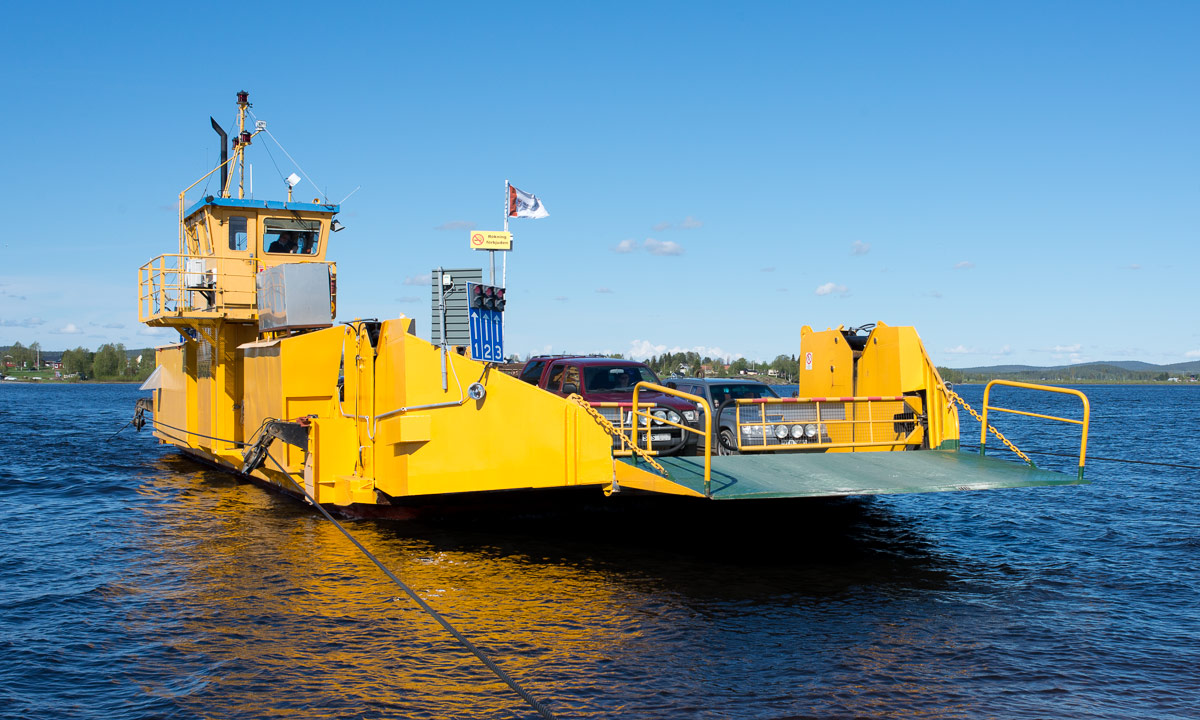
The meeting was in Avan near Luleå, 150 km from here or as the Swedes say: 15 miles. The name Avan rang a bell, but it took a look on the map to remember that it’s the place where Annika and I had used the ferry to cross the river Luleälven in May 2015. And later that day we had been forced to wait before a bridge, where people tried to get out a ship with a crane. (It didn’t work.) After a long time of waiting we had been able to continue the tour.

But back to today. It’s 2 February, -18 °C and the Luleälven had been frozen for many weeks.

I had left the E4 and drove the road to Avan. It was picture-perfect weather. Everything was covered with soft snow. It was snowing gently and since it was quite early, the snow looked still a bit blueish.

Some hours later – we had finished the meeting and went upstairs to have fika. This Swedish coffee break took at least twice the time of the official meeting, but fika is anything between 15-30 minutes (most common) and open end …

While we were holding fika and it was still snowing the sun came out. The sunlight made the scenery look even more beautiful. What a gorgeous view the house owners have!

Half past twelve I thanked the hosts and left Avan. I had got an idea: I remembered that there was an ice road crossing the river in wintertime. I was not sure if it was open but it was not far away. I drove there and right, the ice road over the Luleälven was open.

It had stopped snowing and the sun was shining. I parked the car and took some pictures (and was annoyed with myself that I only took the small camera with me).

I saw other cars using the ice road, otherwise I wouldn’t have dared to cross the river, which still is a river with water under the ice. Flowing water. Ok, let’s go …

And so I have got my ice road premiere today. Check ✔︎. I took some photos on the other side and decided to drive back again because I prefer the southern road which I came from.

It was still sunny but clouds had started gathering in the south. While I drove back south it got more and more cloudy. When I made a stopover at my favourite Thai restaurant in Skellefteå it was quite windy and my mobile phone displayed a message:

Warning class 1 snowfall Västerbottens … Snowfall which from Sunday morning to night to Monday can give 20-30 cm. In coastal areas in combination with fresh northeast wind. Snowfall contin…

Later there were the first snow showers. Let’s see, what will happen tomorrow.

A special place in the Highlands of Iceland

This article is part of the series “2018-08: Iceland”.

Thursday, 30 August

When Annika and I were in Hveravellir waiting for the bus back to Reykjavík, we met Matti whom we got to know some days ago. We gladly accepted his invitation not to take the bus but to follow him and his friend by car.

First Matti followed the very same way that the bus would have taken, but soon he turned in another gravel road that led us up a slope. The path got worse and worse and I was glad that Matti has an old Nissan Patrol and knows how to handle it when crossing a ford or driving through deep clay mud. The gravel track ended in a parking place with a tiny toilet. From this point we had to walk.

I stood at the rim of the parking place and was stunned by the iconic view.

I could see coloured mountains everywhere as in the Landmannalaugar, many of them covered with old snow fields or small glaciers. The scenery was partly covered with steam that emerged from fumaroles as in Hveravellir, but here were hundreds of them.

We followed the path and descended the clayey slope on some ridiculously steep looking steps. This geothermic area is very active and constantly changing. Sometimes a fumarole is less than a footstep away. We crossed a bridge, partly hidden in the steam emitted by boiling water pools, were Matti cooked some eggs.

We continued our hike and ascended another clay hill. From here we could see many other hills and stairs leading up and down.

We came nearer and nearer to an old snow field. Here the normal path came to it’s end.

One path led up the slope over the snow. We continued another path that led to the top of a slope. From here we could see huge snow blocks that had slid down the clayey slope. Matti, his friend and I went down that slope. The ground was extremely slippery and when I arrived down in the valley my rain pants were completely covered with wet clay. The weather worsened: First it drizzled, then it even snowed a bit and in addition of that the steam of the fumaroles was everywhere. The following photos of the snowy ice blocks were the last ones before I gave up making pictures, because camera and lenses became too wet and muddy.

It took I while until I managed to crawl up the slippery clay slope again. We started heading back. The wind had increased and on the last crest-like hilltops it was really stormy. Luckily the storm was not strong enough to blow us over. Anyway I was glad to be in the shelter of the car again.

This place is really special. Not too easy to hike when it’s wet, but both interesting, varying and extremely beautiful. Of course other people know this place as well but at least there are no commercially guided tours yet. To keep it that way, I promised not to reveal the location of that place although Iceland experts probably have recognised it already.

Thank you, Matti for this experience, the long drive back to Reykjavík and the lift to our guesthouse!

Icelandic letters

This article is part of the series “2018-08: Iceland”.

While the latin alphabet has 26 letters, the Icelandic alphabet has 32. C, W, Q and Z are not included. So the Icelandic alphabet has ten extra letters that are not part of the latin alphabet.

The first 6 letters are vowels with an accent that changes the pronunciation. It’s ÁÉÍÓÚ, and Ý. Two others are vowels, too: Æ/æ and Ö/ö. The letter Æ is also used in Danish and Norwegian, while Ö is used in e.g. the Swedish and German language.

There are two letters however, that are a bit special: Ð/ð and Þ/þ. The letter Рis called eth and its pronunciation resembles the th in that. The letter Þ comes from the runic alphabet Elder Fuþark and is called thorn. It is pronounced like the th in thing.

When Annika and I took the bus to Landmannalaugar some days ago I spotted a sign on front of a house. It contains 5 of the special letters: The Ö, the Æ, the Ð, the Þ and the Ó.

What does the word Lögfræðiþjónusta mean? Lögfræð means law and þjónusta means service, so the whole world means “legal services”.

A two-day journey to Stora Fjäderägg

There are so many wonderful and special locations to stay overnight in Northern Scandinavia. Many of them are quite far away as e.g. Låktatjåkko (590 km) or Kjølnes Fyr (970 km). Others are quite near.

Two days ago Annika and I started a two-day journey to such a place, unknown to both of us. Already the journey was interesting, since you cannot reach the destination by land. We started in Umeå and drove to Norrfjärden, where we parked the car and waited for the 8 o’clock ferry to the island Holmön. This ferry is operated by the Trafikverket (Swedish Transport Administration) and free of charge.

We had four hours to explore this island, part of the island group Holmöarna, that have 75 year-round inhabitants. The small village Byviken, where we arrived has a boat museum and a small shop, that is open all year. We went for a walk and discovered a nice place: Bergudden. There’s a lighthouse and you can rent rooms, on request even in wintertime.

We arrived back in time to wait for the departure of our next vehicle: Holmöslupen.

Holmöslupen is a chalupa, an old cutter-like sail boat which is a reconstruction of an old boat type as commonly used 100 years ago. It takes up to 12 passengers and you are allowed (and asked) to help with e.g. hoisting the sails. Life vests available, sailing experience not needed. This boat would bring us to our final destination.

The wind was so weak, that we sailed only a part and mostly used the motor. Otherwise the trip (planned to take 40 to 60 minutes) would have taken several hours. We passed the islands Trappskär and Lill-Fjäderägg before we arrived at our travel destination Stora Fjäderägg, an island of 1.8 km × 1.3 km.  Here’s a hostel driven by the STF (Swedish Tourist Association). The story of this hostel is worth to tell:

After people of the boat museum were done with the building the Holmöslupen they asked themselves what to do with such a fine and seaworthy ship. It was them who had the idea to install a hostel on the uninhabited island Stora Fjäderägg just to give the chalupa a purpose. That’s why there is a hostel on a desert island in the Northern Baltic Sea and a wooden boat that transport the guests.

Some images of the island:

There is electricity on the island, there is mobile internet and there is drinking water. The latter comes from a well and especially this year you have to be economical with it due to the long period of dryness. Luckily it rained some days ago and the rain barrels were filled to the brim. The rain water is used for washing oneself and for the dishes. The hostel has a fully equipped kitchen, but you have to bring all food with you.

Annika and I had decided for one of the all-time travel dinners: spaghetti with pesto and parmesan cheese. It was very warm but not too hot to sit outside. We enjoyed our meal and watched the barn swallow feeding its six children that begged for food with open beaks. They seemed to be almost grown-up and hardly fitted into the small nest any more.

We were told, that there are many seals round Stora Fjäderägg and where to find them. Together with Annika I doubtfully followed the tiny path through the heath – I’ve never seen a single seal in the Swedish Baltic Sea since I moved here eight years ago. The ground became rocky and we had a view of the sea. First I saw a black spot on top of a grey spot. A seal on a rock? Then we saw round black spots floating back and forth – definitely seals, I never heard of swimming rocks … . I used a small tree for cover and creeped nearer. The back spot was a seal too and other seals were lying along a headland a bit farther away.

I took the camera, ducked and tried to creep nearer to a large boulder to hide behind. The seal however saw me and *splash* jumped into the water and dived away. I waited behind the rock and I was lucky. After some minutes a seal approached the same rock and crawled onto it. I was so near that I could hear the flippers splashing.

After having taken these photos I returned to Annika and the seal – seeing me – dived again. This rock kept empty for the next time but along the headland more and more seals appeared and seemed to cover the rocks completely. Next time I’ll definitely will take my huge tele photo lens with me.

We both sat there for a while – on a big rock, both listening and watching. The sun had already set, zillions of small insects hummed and buzzed around and we watched the many grey seals, at least 40 of them. Finally we decided to walk back as long it was light. Some of the small paths are not easy to walk on. On our way back I stopped because I saw something moving. It was a young hare. No, it was two of them. No, even more.

Three young hares were hopping around, eating a bit of grass and completely ignoring us. I was able to get close to three meters and still they didn’t seem to be frightened at all. I increased the ISO of my camera to 3200 and took some photos of these cute furry animals. (Don’t ask me what they do in photo 3 and 4, I’m not a hare expert.)

When we arrived at the hostel nightfall had intensified. Frog hopped around everywhere and the blue hour invited for taking more pictures. I however was tired and only took a photo of the old lighthouse before going to bed.

The next day: After a nice outside breakfast Annika and I took another walk over the island. Stora Fjäderägg has a lot of historical places, anything between the not-so-old lighthouse and ancient heaps of stones only readable for archeologists. Here are some of them:

Again it was warm or even hot at midday. Passing the lighthouse we returned to the hostel longing for water to drink.

Apropos lighthouse: We were ten people on the island that had stayed overnight: The host family (3), Annika and I (2), a family from Örnsköldsvik (4) and a man that had bought that old lighthouse. He showed Annika and me around and told us about his plans to renovate the lighthouse and to build a flat into it. A great project that probably will take some years, because it’s just a summer project.

We already had packed our backpacks and cleaned our rooms, now we were ready to go back to the small harbour waiting for the Holmöslupen. This time we were lucky, we could use both mainsail and foresail to sail back to Holmön.

Step by step we came back to civilisation: Holmön – the grocery shop (ice cream!) – the ferry to the mainland – the parked car – driving the E4 to Umeå – a Thai restaurant – home at Annika.

Conclusion: Absolutely worth it! I’m sure it wasn’t the last time, that Annika and I travelled to this very special place.

More info:


Midsummer impressions 2018

The last night the weather was fantastic, as you can see on the photos. Today the Swedish weather service unfortunately was completely right with its forecast: It rained, rained and it rained at temperatures around 10 °C. Not very comfortable.

Rain however is never an obstacle when it comes to celebrating midsommar – one of Sweden’s most important feast days. Use any clothes you like, but don’t stay home! As you can see a lot of people were celebrating midsummer in Bonnstan, the old Church Town of Skellefteå. And of course the song of the little frogs was sung and danced, this time not only with frogs and pigs (the normal one’s) but with elephants and lions as well.

Some impressions:

Some hours later: Annika and I enjoy our midsummer meal. The rain patters on the plastic roof of the winter garten. The place is dry but has no heating so that the temperature is only 13 °C. Annika has put on a light down jacket, I myself a warm fleece. But it’s so cozy to sit there, enjoying potatoes, salmon, eggs with roe, pickled herring and strawberry cake. Yummy!