A two-day journey to Stora Fjäderägg

There are so many wonderful and special locations to stay overnight in Northern Scandinavia. Many of them are quite far away as e.g. Låktatjåkko (590 km) or Kjølnes Fyr (970 km). Others are quite near.

Two days ago Annika and I started a two-day journey to such a place, unknown to both of us. Already the journey was interesting, since you cannot reach the destination by land. We started in Umeå and drove to Norrfjärden, where we parked the car and waited for the 8 o’clock ferry to the island Holmön. This ferry is operated by the Trafikverket (Swedish Transport Administration) and free of charge.

We had four hours to explore this island, part of the island group Holmöarna, that have 75 year-round inhabitants. The small village Byviken, where we arrived has a boat museum and a small shop, that is open all year. We went for a walk and discovered a nice place: Bergudden. There’s a lighthouse and you can rent rooms, on request even in wintertime.

We arrived back in time to wait for the departure of our next vehicle: Holmöslupen.

Holmöslupen is a chalupa, an old cutter-like sail boat which is a reconstruction of an old boat type as commonly used 100 years ago. It takes up to 12 passengers and you are allowed (and asked) to help with e.g. hoisting the sails. Life vests available, sailing experience not needed. This boat would bring us to our final destination.

The wind was so weak, that we sailed only a part and mostly used the motor. Otherwise the trip (planned to take 40 to 60 minutes) would have taken several hours. We passed the islands Trappskär and Lill-Fjäderägg before we arrived at our travel destination Stora Fjäderägg, an island of 1.8 km × 1.3 km.  Here’s a hostel driven by the STF (Swedish Tourist Association). The story of this hostel is worth to tell:

After people of the boat museum were done with the building the Holmöslupen they asked themselves what to do with such a fine and seaworthy ship. It was them who had the idea to install a hostel on the uninhabited island Stora Fjäderägg just to give the chalupa a purpose. That’s why there is a hostel on a desert island in the Northern Baltic Sea and a wooden boat that transport the guests.

Some images of the island:

There is electricity on the island, there is mobile internet and there is drinking water. The latter comes from a well and especially this year you have to be economical with it due to the long period of dryness. Luckily it rained some days ago and the rain barrels were filled to the brim. The rain water is used for washing oneself and for the dishes. The hostel has a fully equipped kitchen, but you have to bring all food with you.

Annika and I had decided for one of the all-time travel dinners: spaghetti with pesto and parmesan cheese. It was very warm but not too hot to sit outside. We enjoyed our meal and watched the barn swallow feeding its six children that begged for food with open beaks. They seemed to be almost grown-up and hardly fitted into the small nest any more.

We were told, that there are many seals round Stora Fjäderägg and where to find them. Together with Annika I doubtfully followed the tiny path through the heath – I’ve never seen a single seal in the Swedish Baltic Sea since I moved here eight years ago. The ground became rocky and we had a view of the sea. First I saw a black spot on top of a grey spot. A seal on a rock? Then we saw round black spots floating back and forth – definitely seals, I never heard of swimming rocks … . I used a small tree for cover and creeped nearer. The back spot was a seal too and other seals were lying along a headland a bit farther away.

I took the camera, ducked and tried to creep nearer to a large boulder to hide behind. The seal however saw me and *splash* jumped into the water and dived away. I waited behind the rock and I was lucky. After some minutes a seal approached the same rock and crawled onto it. I was so near that I could hear the flippers splashing.

After having taken these photos I returned to Annika and the seal – seeing me – dived again. This rock kept empty for the next time but along the headland more and more seals appeared and seemed to cover the rocks completely. Next time I’ll definitely will take my huge tele photo lens with me.

We both sat there for a while – on a big rock, both listening and watching. The sun had already set, zillions of small insects hummed and buzzed around and we watched the many grey seals, at least 40 of them. Finally we decided to walk back as long it was light. Some of the small paths are not easy to walk on. On our way back I stopped because I saw something moving. It was a young hare. No, it was two of them. No, even more.

Three young hares were hopping around, eating a bit of grass and completely ignoring us. I was able to get close to three meters and still they didn’t seem to be frightened at all. I increased the ISO of my camera to 3200 and took some photos of these cute furry animals. (Don’t ask me what they do in photo 3 and 4, I’m not a hare expert.)

When we arrived at the hostel nightfall had intensified. Frog hopped around everywhere and the blue hour invited for taking more pictures. I however was tired and only took a photo of the old lighthouse before going to bed.

The next day: After a nice outside breakfast Annika and I took another walk over the island. Stora Fjäderägg has a lot of historical places, anything between the not-so-old lighthouse and ancient heaps of stones only readable for archeologists. Here are some of them:

Again it was warm or even hot at midday. Passing the lighthouse we returned to the hostel longing for water to drink.

Apropos lighthouse: We were ten people on the island that had stayed overnight: The host family (3), Annika and I (2), a family from Örnsköldsvik (4) and a man that had bought that old lighthouse. He showed Annika and me around and told us about his plans to renovate the lighthouse and to build a flat into it. A great project that probably will take some years, because it’s just a summer project.

We already had packed our backpacks and cleaned our rooms, now we were ready to go back to the small harbour waiting for the Holmöslupen. This time we were lucky, we could use both mainsail and foresail to sail back to Holmön.

Step by step we came back to civilisation: Holmön – the grocery shop (ice cream!) – the ferry to the mainland – the parked car – driving the E4 to Umeå – a Thai restaurant – home at Annika.

Conclusion: Absolutely worth it! I’m sure it wasn’t the last time, that Annika and I travelled to this very special place.

More info:


Midsummer impressions 2018

The last night the weather was fantastic, as you can see on the photos. Today the Swedish weather service unfortunately was completely right with its forecast: It rained, rained and it rained at temperatures around 10 °C. Not very comfortable.

Rain however is never an obstacle when it comes to celebrating midsommar – one of Sweden’s most important feast days. Use any clothes you like, but don’t stay home! As you can see a lot of people were celebrating midsummer in Bonnstan, the old Church Town of Skellefteå. And of course the song of the little frogs was sung and danced, this time not only with frogs and pigs (the normal one’s) but with elephants and lions as well.

Some impressions:

Some hours later: Annika and I enjoy our midsummer meal. The rain patters on the plastic roof of the winter garten. The place is dry but has no heating so that the temperature is only 13 °C. Annika has put on a light down jacket, I myself a warm fleece. But it’s so cozy to sit there, enjoying potatoes, salmon, eggs with roe, pickled herring and strawberry cake. Yummy!


Lazy sightseeing in Visby

This article is part of the series “2018-05: Gotland”.

After four days of cycling and driving Annika and I use the Friday to take it easy and stroll through the old town of Visby, including sightseeing and visiting restaurants. It is our last day on Gotland, tomorrow we’ll fly back.

We have fallen in love with Gotland a bit, both with the varying landscape and with the beautiful old town. We were incredible lucky with the weather: Sun from morning to night and day temperatures between 20 and 24 °C.

I won’t tell much more about Visby, I just show some photos, all made on Friday:

Sunday afternoon, 13 May: I’m back in Skelleftehamn. No snow is left in my garden and the Baltic Sea before Skelleftehamn is completely free of ice. And finally the birch trees have got fresh green leaves. That’s more spring than one year ago!

Some thoughts about e-bikes

This article is part of the series “2018-05: Gotland”.

It was interesting to try out e-bikes for two days. Even though they have advantages I have to admit that I didn’t become a fan of riding e-bike, at least not on the model we used.

The e-bikes we rented have three gears and a motor, that supports cycling in three levels. The motor has a range of 50 km and the supported speed is limited to 24 km/h. The motor switches off as soon one stops pedalling. An e-bike is not a moped that moves by its own.

Pros and cons of our e-bikes:

Pros:

  • the feeling of freedom. We chose many side paths just to have a look. If we would be tired we could use the motor.
  • you get good support when you cycle against the wind
  • you get very good support when the road goes up
  • you can accelerate faster in many cases
  • the range is larger than 50 km since you don’t use the motor the whole time

Cons:

  • Our bikes only had three gears. Too little for the terrain on Gotland when cycling without motor
  • The bikes are heavy and hard to carry over obstacles. One is bound to good ways
  • Each “motor gear” is made for a certain speed. It’s hard to vary that speed
  • For this reason it’s hard to drive next to each other
  • It’s hard to find a rhythm. The harder you pedal the less support you get
  • It feels strange however to pedal without using any strength
  • When you’re speed is round 24 km/h, the motor will switch on and off due to the speed limit
  • And last not least: the training effect of course is almost zero

I played a lot with the different combinations of gear and motor support and sometimes my lazy self was glad about the motor. My bicycle self however was glad when I switched off the motor and used the e-bike just as an ordinary bicycle, even though three gears were too few.

Next week I want to start cycling to work. That’s 2×19 kilometres a day. I guess I will curse when cycling against the wind. But hey, that’s part of the story when you use a bicycle.

Three bicycle tours on Gotland – Wednesday

This article is part of the series “2018-05: Gotland”.

A bicycle tour in seven scenes

1. To Ihre by bus

It’s Wednesday. As yesterday we’ve planned a bicycle tour, this time north from Visby again. Today we want to try to take the bus and cycle back. We have to get up early, the bus leaves at 7:55. As we hoped, the bus driver will transport our bikes. The way however is a bit unexpected: Two bus drivers lift the heavy bikes on a transport rack attached to the back of the bus. It doesn’t look very stable. The bus driver however observes the back camera to check the bikes and it works, we arrive in Ihre without any problems.

2. The beach at Irevik

This stone beach is one of the beaches, where you can find fossils, e.g. Rugosa. There are so many fossils that I find them though hardly looking. (I found fossils however on almost every beach in Gotland.) As a child I collected fossils and it would have been almost impossible to remove my from these beaches. Now I love to look at the white swans as well, but I have many stones in my pockets.

3. Lickershamn

Probably the highlight of the day: Lickershamn, a cute old fishing town where you can buy both smoked fish and ice cream (a good combination if not eaten simultaneously!). We sit outside, it is warm as if it were summer and we enjoy the smoked salmon pieces and the shrimp salad.

4. Raukar near Lickershamn

We saw them already on the way to the sea: The raukar near Lickershamn. A rauk or sea stack is a steep rock formation formed by wave erosion. Due to the post-glacial rebound these rauks are quite far away from the Baltic Sea that formed them.

5. Lickershamn fornborg

Quite near there lies a fornborg, an ancient refuge castle. If you are not into archeology it’s hard to find the leftovers from the iron age in the forest. So I decided to take a picture of the blue flowers that bloomed everywhere in the light pine forest.

6. Ungemiss gård

We pass a farm, now café and art atelier, too. A chicken comes closer curiously. We however want to reach the Krusmyntagården before the kitchen closes and do not take a longer break.

7. Krusmyntagården

We’ve been there two days ago; Krusmyntagården is a wonderful place with great food, even though Annika and I do not fall in love with the saffron pancakes, a speciality from Gotland. It’s really nice to sit outside, have an ice cream, a lemonade and relaxing.

Extra: Brissund bathing place

Next stop: the near sandy beach in Brissund. The water feels much colder than the day before and is hardly more than knee deep. Refreshing however since the air is so warm.

After the bath we head home, first along the main road, then along the beach promenade, then through the old town. The dinner (taken on the roof terrace of our apartment): green asparagus with ham and potatoes.

Three bicycle tours on Gotland – Tuesday

This article is part of the series “2018-05: Gotland”.

Today is Tuesday and the day starts as Monday did: with a breakfast on the roof terrace under a blue sky. The air is calm and warm and we want to make a bicycle tour again, this time with e-bikes. At the bike rental we hand back our normal bikes and get our e-bikes which we want to test for two days. Yesterday we cycled north, today we’ll head southwards.

Right south from Visby we leave the main road and enter the Södra Hällarna, a natural reserve.

The ground is dry and the vegetation looks more Mediterranean than Swedish. To the right there are cliffs by the sea.

With a normal bike we could follow the minor paths, but the e-bikes are too heavy to carry. We keep left and land on the main road again. The next stop is a bit special.

No, it’s not the tree houses, even though they look both interesting and beautiful. It’s this:

Here, in a amusement park in Kneippbyn stands the Villa Villekulla, the house of Pippi Longstocking! Everyone who knows the series from 1969 and the two films of 1970 also knows this house, that was used for the outdoor shots of the series and films.

The amusement park is closed – it is still off-season – but the door is open and we are able to creep in to take some photos. Pure children memories!

Some other nice spots nearby: Fridhem and Högklint.

Now we try to choose smaller ways for our bicycle tour but we do not succeed. South of Kneippbyn lies Tofta Skjutfält, a military training area and the ways that Google Maps proposes are blocked by fences or serious prohibition signs. So we stick to the main road, which is a bit boring. But at least there’re possibilities to get food, e.g. in the Suderby Herrgård.

We continue to Gnisvärd. On the way there we see the large stone ships, old graves from the later Bronze Age surrounded by stones in the form of a ship.

And much more is to see, from ancient rune stones to cozy cabins by the sea.

Later we follow a small path to Tofta Strand, a sandy beach. It’s more than 20 °C and it feels even warmer in the sun. Hardly imaginable that I photoed ice and snow less than a week ago. Annika and I take a bath. The water is still cold, but the sun warms us after the bath.

Later: Annika and I are back in Visby and take a stop at Glassmagasinet, “Swedens biggest ice cream shop”. And they do have a huge amount of different sorts of ice cream, anything from dark chocolate with 78% cocoa to bright blue Smurf ice. The best thing is not the assortment, it’s the taste. The ice cream is real Italian ice cream and tastes fantastical! Attention: This place can be very crowded even off-season.

It’s seven a clock. We cycle to the beach, sit down on a breakwater and look at the sun going down. It will take almost two hours until it has sunken down at the western horizon. A rare experience when you live in Umeå or Skelleftehamn, where the Baltic Sea is in the east.

A last photo from our roof terrace. We won’t sit here for long. It has been a long day and we are tired. Soon we fall asleep. Tomorrow: Another cycle tour.


First impressions of Visby, Gotland

This article is part of the series “2018-05: Gotland”.

And now to something completely different after all that snow and ice.

Yesterday Annika and I took the plane. First to Stockholm Arlanda and then to Gotland – Swedens largest island –  where we’ll stay in the Visby – Gotland’s main town – for a week.

Some first impressions from our yesterday’s walk through this wonderful medieval town:


Valborgsmässoafton 2018

30 April

Valborgsmässoafton is the last day of April. On this days many people set fire to big bonfires, partly as an event being celebrated with friends, partly for burning last years gardening rubbish (and more …).

This year I was invited by A. and M. who I’d got to know exactly eight years ago on another valborgsmässoafton. They are among my oldest friends in Sweden and I’m very happy that they exist. Their stuga – or summer cottage – is located in Bygdeträsk south of Skellefteå.

This time I come from Umeå, where I spent the weekend. I try to avoid the larger roads and prefer the small gravel roads. Mostly they are in good conditions, only some parts are quite muddy and have deep ruts in the clayey ground. Less and less snow can be seem, but there’s still snow left.

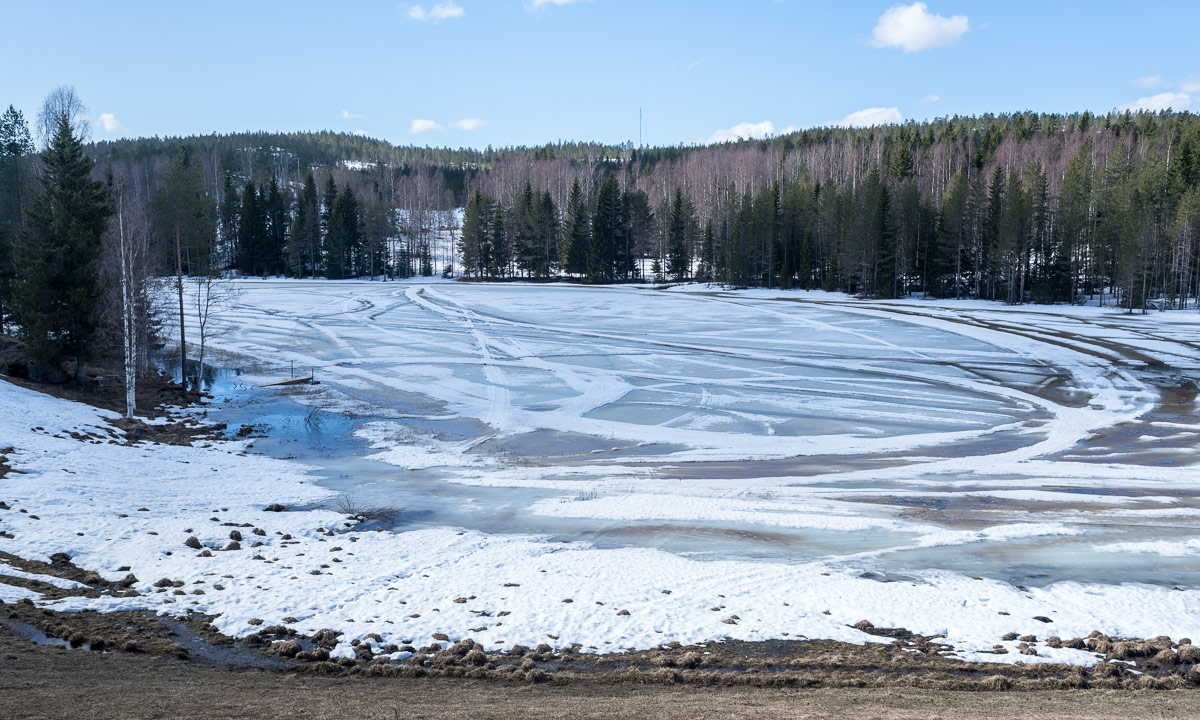
There is still ice on the lakes as well, but it looks soft and grey and near the shore there are more and more open patches. You can still see the snowmobile tracks, a vague reminder of the winter.

Some hours later: I’ve arrived in Bygdeträsk and with the help of A. I manage to park my car without getting stuck in the soft clay of the property (which happened to a craftsman recently). The other guests have arrived, too and – of course – the bonfire is burning!

But what about the hot tub? Wouldn’t it be nice to take a hot bath outside later in the evening? That of course needs some preparations. While M. cautiously tries to split the thick ice block in the hot tub with an axe I put on chest waders to wade a bit into the lake with a long hose attached to the water pump. First I thought I had to chop away ice, but near the shore the lake is just filled with knee-deep slush. Soon the pump starts to fill the hot tub with ice cold water heated by the wood stove.

To make a long story short: it will take eight hours until the water is hot enough for a relaxing bath and I will have fallen fast asleep when the only two people still being awake will start their bath.

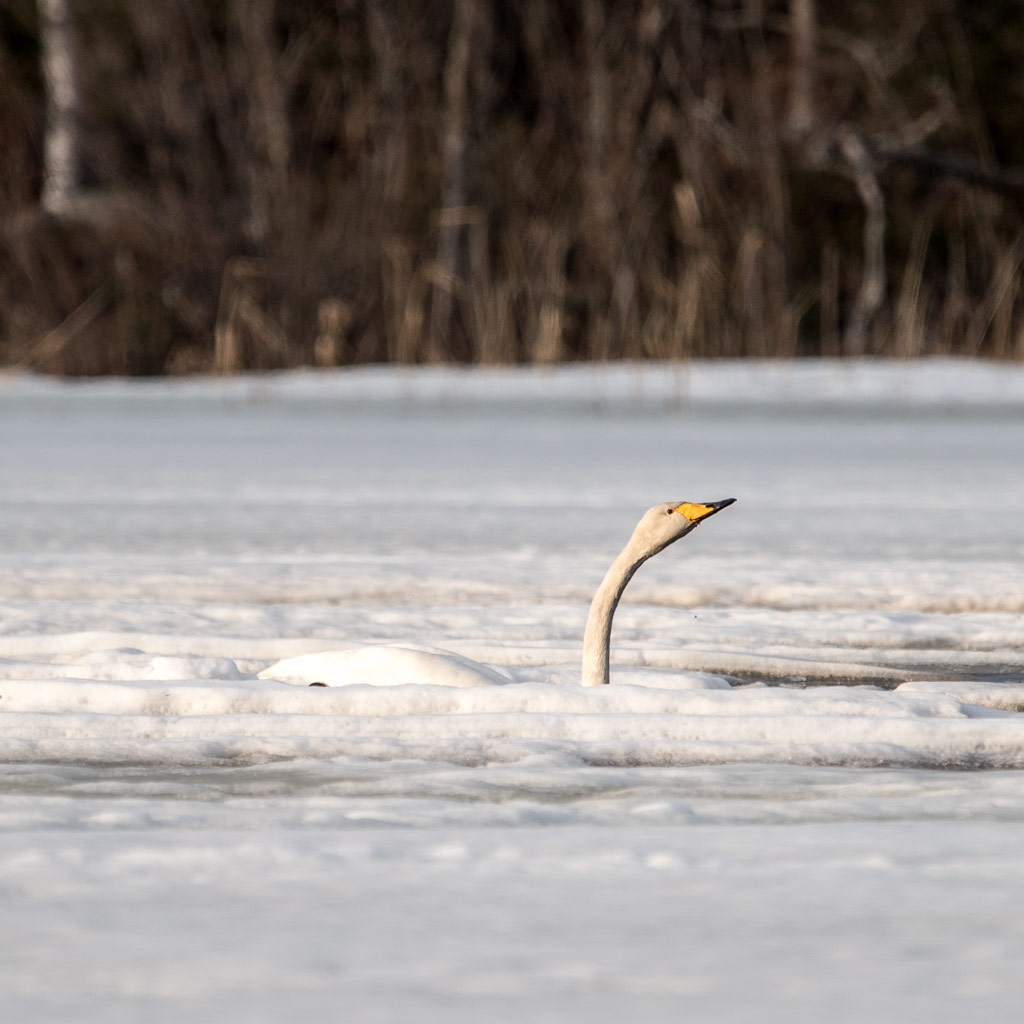
Anyway, there are other things to do as e.g. watching the whooper swans on the ice and in the water.

Then there is a lot of eating (M. is a great cook and grandmaster of barbecuing) and talking and playing games. Every half an hour someone goes out, adds wood to the oven and checks the water temperature, that sloooowly increases. I become more and more tired but I want to have a bath. At 1 o’clock in the night however I give up. I’m just too tired! I pump up my camping mat in the workshop, unroll the sleeping bag and soon I’m fast asleep.

1 May 2018

After a late breakfast I say thank you and goodbye to the others, jump into the car and head home, again with many detours. I see some cranes, some reindeers and a black grouse (called orre in Swedish) that flies away before I can slow down the car for taking a picture.

Many gravel paths lead through forests. Left and right are old walls of snow that the sun has not melted yet. Leftovers from last winter’s snow clearing.

Again some patches are rutted, some are wet and muddy but no problem, until …

Luckily I see this obstacle in time and manage to drive around this hole in the street. (My car is the red one in the background.) One of the rare opportunities where I’m glad to have a car with all wheel drive.

One hour later I’m home again and I hardly can believe my eyes. Five days ago my backyard was still covered with 30 centimetres of snow, now the snow on the lawn is almost gone and beside of some small white patches brown grass is everywhere! Even though I’ve been living in Sweden for eight years I’m astonished again how fast snow melts in springtime.

Two hours later heavy raining is pouring down. Hej då, vinter!

Ice fishing in Skelleftehamn

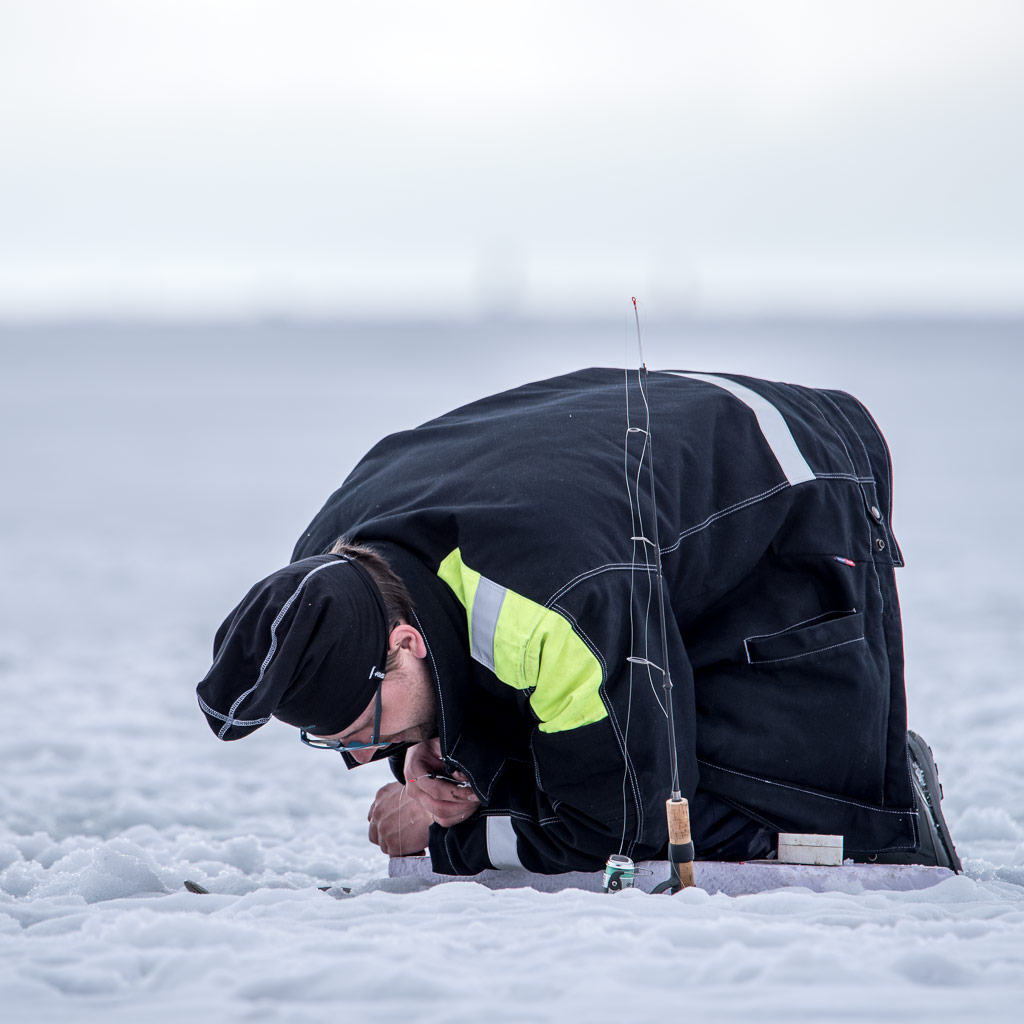
Still going on: ice fishing on the bay Kallholmsfjärden in Skelleftehamn. Sometimes the positions of the ice fishermen look to me like modern dance-theatre.


Breaking the spring ice

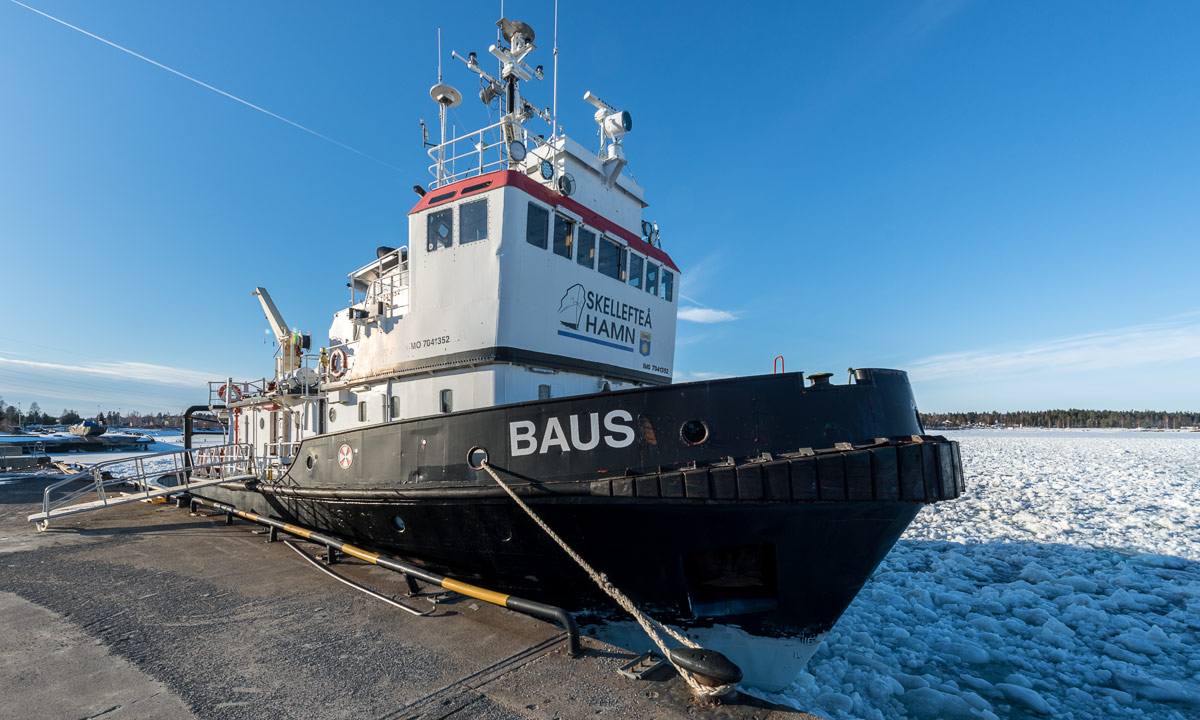
This morning I saw not only the ice fishermen, but also the icebreaker Baus clearing the ice in the port of Skellefteå in Skelleftehamn. In the afternoon I remembered, that I had come into contact with K., one of the crew members on Facebook some weeks ago. I had asked if it was possible to go with the Baus to take photos sometime. K. had answered that I should just go there and ask the people. And so I did today.

I met a guy who works on the icebreaker and learned that it’s hard to make some kind of appointment. In winter no one knows exactly, when ships will arrive or depart due to the weather and the ice conditions and therefore neither when the Baus would start. But they would actually leave in twenty minutes to clear the ice for the ship Ice Star and I was allowed to join …

Sixteen minutes later I was at the dock again, this time with better clothes and my camera equipment that I got from home. How good that I live so close.

I was allowed to enter the Baus and say hello to the captain on the bridge.

He welcomed me, showed me some of the controls to steer the boat and allowed me just to go round everywhere to take photos. I didn’t want to disturb him, because he had to focus on his work and my plan was to make photos, not to interview the crew. At first I went up onto the top deck.

The water was completely covered with crushed ice. Some of the ice floes were at least half a metre thick. Slowly the Baus departed from the dock and I went down to the bottom deck to be closer to the icy sea.

While the Baus was slowly moving back and forth I went on every possible deck. I really enjoyed that freedom that you never can have on bigger ships as e.g. the Hurtigruten ships.

After some time of waiting and some time of moving around the way was clear for the Ice Star. Slowly it departed and followed the cleared channels between the solid ice where it with increasing speed left “Skellefteå Hamn”, the port of Skellefteå in Skelleftehamn.

While my eyes followed the Ice Star I spotted something blue at the horizon. Water! Somewhere behind the island Gåsören the ice had started to break and now open water covered the Baltic Sea behind Gåsören. Maybe the next paddle tour is closer than I think.

The Baus already had started to turn around (the previous photo shows the funnel at the rear) and return to the dock. I enjoyed watching the different types of ice.

Until now, the trip was extremely calm, now it started to get more rumbling, because Baus now went through packed ice – crushed ice that had frozen together and now was split into large irregular chunks. Great channel-like cracks developed in the ice, which soon closed again.

After some more minutes the Baus arrived and after thanking the captain for the opportunity to follow I left the icebreaker. The whole trip took less than 90 minutes, but felt much longer. I’ve been living in Skelleftehamn for almost eight years and it was a great experience to see my place of residence from a completely new perspective.

Thanks a lot, crew of icebreaker Baus!

Seeing the blue open water was a welcome spring sign. I saw two others today:

The first butterfly of the season, a small tortoiseshell that fluttered around the top deck of the Baus and (perhaps less romantic) the first teenager in shorts in front of ICA, the grocery store. I’m still waiting however for the first wild spring flower in Skelleftehamn.