Skiing and tenting in Jämtland – part 2

This article is part of the series “2020-02: Ski tour Jämtland I”.

Wednesday, 19 February – tenting in the kalfjäll

The night in the mountain cabin Vålåstugan was stormy, but in the morning the wind has calmed down. We leave Vålåstugan behind and head southeast.

Our way leads to Helags, the highest mountain in Jämtland. The Helags Mountain Station is about 23 km away, but we don’t have to go the whole way today since want to camp. The way leads up and there are less and less birch trees. Soon we are above the timberline in the kalfjäll – the bare mountains.

We take a break at Ljungan, one of Jämtlands emergency huts. For once it is not windy but it’s cozy to sit inside anyway.

Now we are already halfway to Helags. We decide to continue since the weather is supposed to get worse tomorrow. It would be nice to have just a short distance to the mountain station tomorrow. Ljungan lies in the valley of the river of the same name. Now we have to ski up again. We continue skiing the whole afternoon. On the one side I consider it quite exhausting, on the other side it’s so beautiful watching the light changing in the setting sun. White – yellow – orange – “peach” – purple and finally white again, but a cold one.

It’s already dark when we have found our campground for tonight. It is hardly protected again wind and storm but according to the weather forecast this night is supposed to be relatively calm.

If people ask me why I love winter tenting although it can be uncomfortable and sometimes even troublesome, have a look at the next photo. Can you imagine standing there? With an itching nose in the cold but the down parka keeps you warm? Looking at the milky way and zillions of stars? Hearing nothing than the crunch of snow underfoot and your own breath? Feeling how you calm down and find a deep satisfaction inside? That’s why I love winter tenting!

Thursday, 20 February – visiting Helags Fjällstation

Two o’clock. Suddenly we are all awake. It has got stormy again and tent was shaken by some stormy gusts. Is another storm approaching? No, soon it calms down again.

The next morning it is cloudy but calm. Through some gaps we can see the colours of the sunrise.

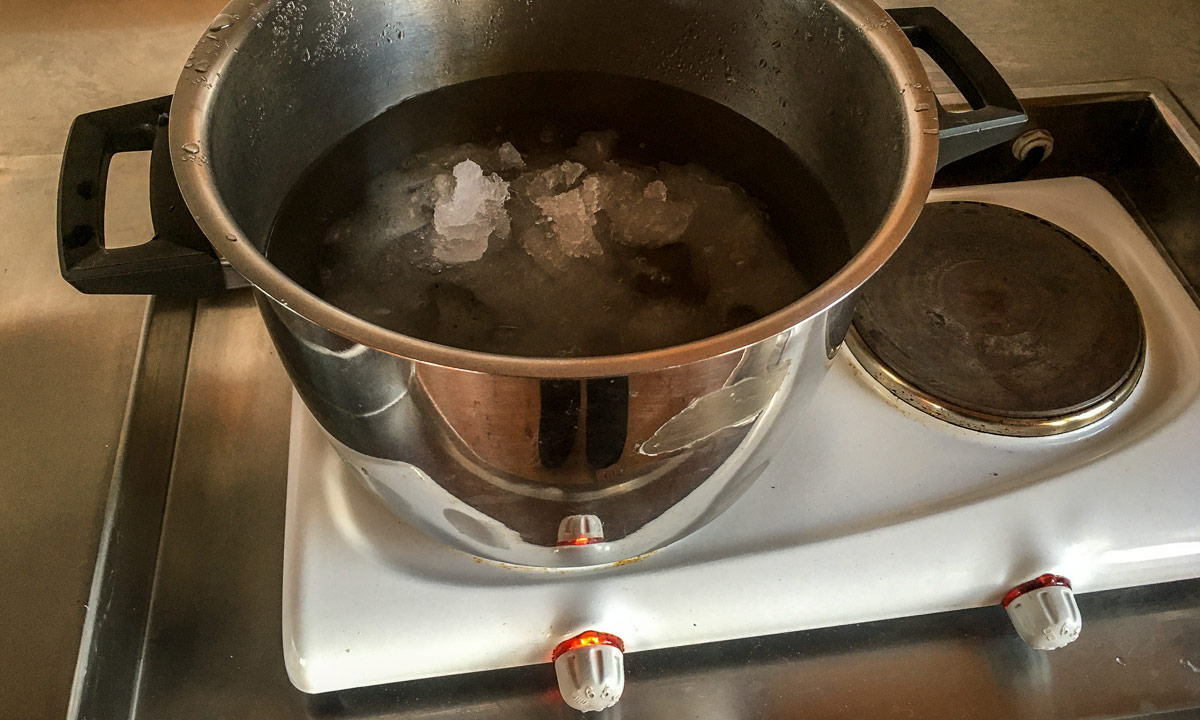
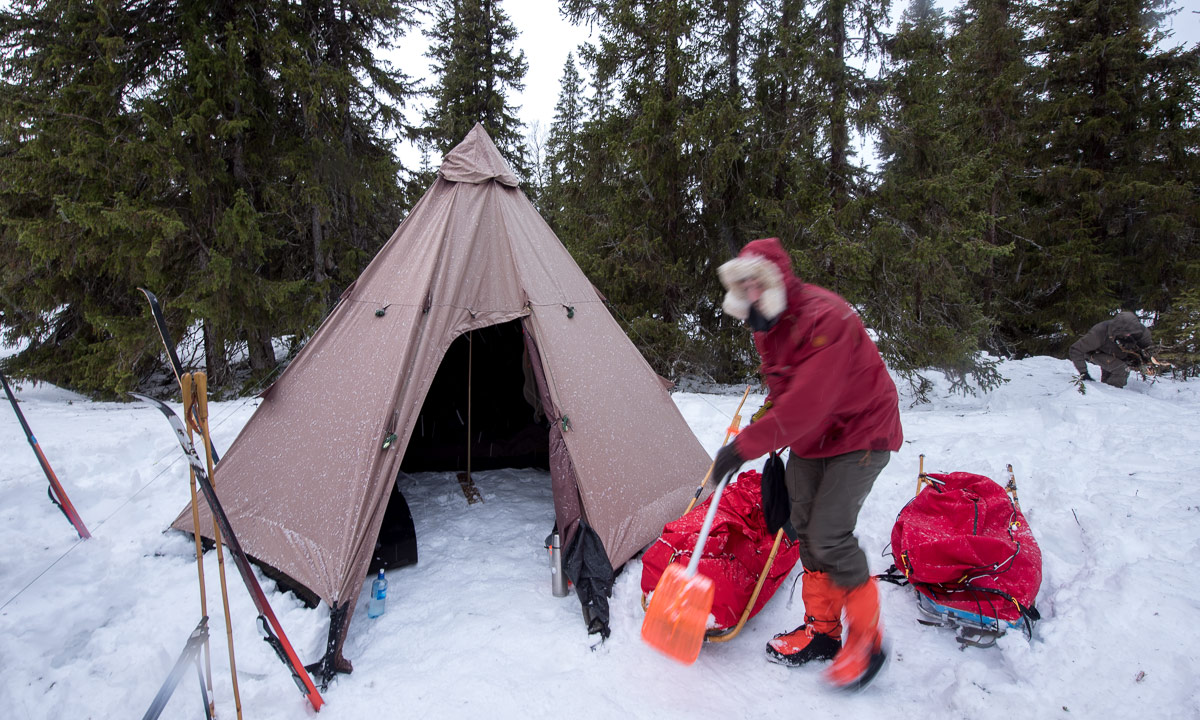
Some of the daily morning routines: melting snow – dissolving milk powder for the muesli – having breakfast – packing our things – dismantling the tent – putting on skis and the harnesses for the pulkas. It always takes a while, but we are not in a hurry, Helags is less than 7 km away. We leave at 9:40, ski to the winter trail that we left yesterday evening and follow the waymarks.

The wooden red crosses are our friends! Sometimes it seems quite boring following these waymarks, especially if you can see dozens of them standing in a straight line. But there’s a reason, that the distance between the red crosses is quite small. The weather can by very rough in the mountains and the visibility very poor. And the weather in the mountains can change very fast.

And so it happens to us. Within short the wind increases more and more. First it’s easy to continue but soon we are skiing in full storm. You hardly see more than the next red cross while the storm tries to knock you over. I manage to take some last snapshots with my smartphone.

Then I have to stop taking pictures because it would be too dangerous. We could loose each other or I could loose a mitten and get frostbite. There is hardly anything to see anyway because the visibility is extremely poor. I can spot a Arne, who is in the lead, my skis and sometimes the next red cross, that’s all. It’s very demanding to ski in storm, both physically and mentally and I’m really glad when we finally arrive at Helags. How long it took? I don’t know. I loose any sense of time in this kind of weather.

There are people at the Helags Fjällstation. Some craftsmen fixing things and two women working for the STF preparing Helags for the opening in eight days. After a bit of confusion we are shown the way to the emergency shelter, where we push the pulkas and ourselves inside. Arrived and protected from the storm.

We are safe and sound but disappointed. The cabin has eight beds and even electricity but no possibility to cook. I talk to one of the STF people who reacts with a mixture of confusion and ignorance. The only answer I get: it’s pre season and everything is closed. I tell them, that the mountain cabins as Lunndörren and Vålåstugan do provide everything even off-season but I get the same answer again. Quite disappointing.

Two other skiers have arrived. They manage to persuade one of the women to open another cabin with a kitchen until tomorrow. But the chaos continues. First Arne is locked in while using the indoor toilet in the main building and all STF people have left by snowmobile. Then they arrive again and want to lock the cabin with the kitchen already now, while we’re using it.

I never felt more unwelcome in Sweden since I moved here ten years ago. Actually we wanted to take a day off at Helags but it’s clear that this is not the place to be. We will leave tomorrow morning.

Friday, 21 February – finding shelter in Hulke

The next morning the storm has calmed down a bit and it promises to be a sunny day.

The kitchen is still open. Jonas fetches snow to melt on the electric(!) stove.

The utedass, the outdoor toilet is more than 100 m away from our cabin and lacks waymarks. I wouldn’t have dared to use it in full storm. But now I do. Things to bring: A warm jacket and a head lamp.

Although the storm subsided, it is still windy and the blown snow glistens in the sun.

Our departure is delayed a bit: A mitten I accidentally have dropped is blown away 20 metres. Jonas can fetch it before it is blown away even further. I pull on the glove and we can start.

The Helags massif is incredible beautiful and only reluctantly I break up. I would have loved a resting day but as I mentioned above not here.

Easily we continue. We have the wind behind us. First we slide down, then we have to cross the saddle between the mountains Miesehketjahke and Soenehketjärra.

From there we can spot the emergency hut Hulke. We only have to slide down the mountain saddle and we are there. Quickly we decide to stay here for the night because again hard winds are excepted for the night.

Most emergency huts have signs that restrict overnight stays to emergency situations. Not Hulke, so we feel safe to use it. Of course the firewood stays untouched. It is provided to save lives, not to increase comfort. We use our camping stove to cook and our warm clothes and sleeping bags to stay warm.

It doesn’t take long and it’s stormy again. I have to go to the utedass. After I have finished I open the door of the utedass from the inside. It is blown open so violently that the handle pulls me out of the building before I realise what happened. Jonas happens the same with the hut. From now on we open the doors only a bit and squeeze ourselves through the gap. And I wear ski goggles outside. My Nikon cameras dislike this weather and I only make some snapshots with my smartphone.

We sit on our inflated camping mats on top of the wooden benches. Mukluk boots warm our feet, warm jackets our body. After dinner we lie down. Jonas and I on a bench, Arne on the floor between us. Storm squalls howl in the stovepipe and make the hut vibrate. Will the stormy weather stop one day or will it continue forever?

Continue with part 3 >


Skiing and tenting in Jämtland – part 1

This article is part of the series “2020-02: Ski tour Jämtland I”.

This year I’m lucky. I did two ski tours in a row, that’s spending more than three weeks in the beautiful mountains of Jämtland. Let’s start with the ski tour number one.

We are three people: Jonas, with whom I already did three ski tours before, Arne, who is doing his first ski tour and me.

Saturday, 15 February – shelter from the storm

Jonas and Arne live in Northern Germany. They arrive in Östersund by train at 6:37 in the morning. 23 minutes later we enter the large shop ICA Maxi to buy food for eleven days. It takes an hour to decide what to choose and find these items in the large shop. After we have managed to stuff the shopping bags into the packed car we drive to Vålådalen. There’s a parking place that we use as the starting point for our tour in the fjäll. It takes some time until we have packed our pulka sleds with all our stuff and they are quite heavy loaded.

At 13:15 we leave the parking behind and start our ski tour. It starts with a challenge. Although we have a tent we need to reach Lunndörren, the first mountain cabin tonight. Just now the weather is calm but according to the Swedish weather service a storm will approach tonight with gusts of wind up to 30 m/s. That’s more than 100 km/h or wind force 11 (violent storm)! Definitely not the night to spend in a tent, if you have the choice. Although it’s only 14 km to the cabin, it takes us more than 5 hours. There’s the heavy pulka sleds, some short but steep slopes to climb, pinching boots and much more that slows us down. Exhausting or not – it’s great to be outside in the winter again.

Sun down is round 17:00. For the last part we use our head lamps. In darkness we arrive at Lunndörren at 18:30. As usual, one cabin is opened for out-of-season hikers as us. Here you have all you need. There’s a table and stools, bunk beds and most important: a wood stove. Firewood is found in the vedbod, the woodshed. The water? Probably there’s a place to get water from the lake. We however go outside with a bucket and fetch snow to melt on the wood stove.

The sky is still clear and the night is starry but it already has started to blow more and more.

Sunday, 16 February – camping by the river

It’s 5:30 in the morning. Storm gusts howl around the house. Violently they blow snow from here to there and I have to pee. Not my favourite combination. I manage to open the door but have to crawl over the icy patch to prevent being blown away. Every mountain hut has it’s outhouse but I prefer the nearest tree. That spares me 20 meters to brace myself against the storm. I have to hold tight on the tree to avoid being blown over. Back in the cabin I can hear the storm but a mountain cabin is a great shelter and soon I fall asleep again.

Fortunately the storm has weakened, when we get up.

Today we don’t want to go far and look for a nice place to tent. So we take it really easy in the morning and it’s already 11:45 when we start our second tour day. Slowly we gain height and there are less and less trees.

Hardly three hours later we have found a nice tenting place. It’s in the forest to be protected against storm and wind and by the small river Lunndörrsån. Jonas tests crossing the river to fetch water – it works. Fresh water is a luxury in winter. It takes less energy to warm up than snow and it tastes much better!

You see the orange shovel? We have two snow shovels with us and we use them both to dig a large hole for a camp fire. The dead wood that we find is soaking wet and it takes Arne some time until it burns.

Where there is a fire there is no boredom.

Later Jonas, how is the tour cook is preparing food. Today it’s köttbullar with mashed potatoes and chanterelle sauce. Tasty! Already a quarter to eight we lie in our warm sleeping bags and soon we fall asleep.

Monday, 17 February – warm weather in the forest

Of course I did not sleep well. I always need two or three days until I got used to sleeping in a sleeping bag in winter time. One of the reasons is the reduced freedom of movement, one other the VBL.

A vapour barrier liner (VBL) is used to prevent moisture getting into the down filling of the sleeping bag. There the moisture would freeze and so reduce the isolating effect of the down feathers. So far so good. In practise it has the same comfort as sleeping in a huge plastic trash bag and although there are good reasons to use a VBL I dislike them.

But I shouldn’t complain. I had it warm and I got enough sleep. Some storm gusts have shaken the tent but all in all it was a quite night. And so is the morning by the river. Even the sun tries to peek through the clouds.

At 10:40 we move on. First we have to cross a small plateau called Finnångelflätet. It is quite exposed to the wind and hardly covered by snow.

One hour later the view is completely different. The ground is white again. The wind has intensified and gets stormy. At the same time it’s warm – slightly above zero – which makes the snow very sticky. Sometimes it feels like half the hill sticks under my skis.

The good thing with tenting is that you are flexible. We do not have to get to a cabin or hut, we just need a sufficient campsite. Right after crossing the river Tronnan (we ignore the bridge and cross the ice) Arne and Jonas start looking for a good place to camp. And find it. The snow is loose and we trample on the snow to harden it. At some places we sink knee deep in the snow. It has started snowing and when we look out of the tent we see the snow covering the skis used as huge tent pegs and the pulkas.

Tuesday, 18 February – arrival at the Vålåstugan

Phew – my sleeping has been much too warm. It is made for -25 °C, not for 0 °C. My wool underwear is wet but still does it’s job anyway: keeping me warm.

As the day before we move on at 10:40. The tent has become quite heavy due to the wet snow and the warm temperatures. Now it’s both wet and frozen. We have decided to reach the mountain cabin Vålåstugan today. I find it exhausting to ski. I have to take tiny breaks to catch my breath on every slope. Perhaps it’s because it’s the third tour day but I may be wrong.

Luckily Vålåstugan is not far away and we arrive already at 13:30. There are several buildings. The main cabin, surrounded by huge snow drifts won’t be opened before 21 February but the other cabin is open. Again we are alone, we haven’t seen a single person the last days.

This cabin is of a well known type. It’s a Fjällstuga 65, also known as Abrahamssonstugan. A corridor, one room to the left, one to the right with ten beds each. It works quite well with up to eight people, then it starts to get a bit crowed. We use the whole space to dry our sleeping bags, jackets, boots, gloves and other clothes. As I mentioned we are alone.

Wrrrr—wroooom—wrooooom! Not anymore. Snowmobiles are approaching with people dressed in bright colours. They park in front of our house. Who are they? It’s an official party of the mountain rescue (probably training), the police (checking the emergency phones), way markers and later two snowmobiles with people from the Swedish Tourist Association STF. They pull trailers in which people sit. It turns out that they are the wardens of Vålåstugan and Gåsen Fjällstuga, that will open these cabins in three days. The wardens of Vålåstugan directly start to dig out the main house (that will take some time), the others leave a bit later.

I haven’t had internet access for two days. So I’m glad to ask the police for a weather update: wind this night, sunny round -10 °C the next day, then wind in the night again. Looks like this tour is a stormy one.

It’s cloudy but the sun manages to peek though from time to time. The birch branches are bent by the wind.

And later that evening we even get a bit of polar lights. The only ones I’ll see the next weeks.

Continue with part 2 >

Between two ski tours

Since last Thursday evening I’ve been back from a two week ski tour with two German friends in the mountains of Jämtland.

Tomorrow I’ll start another ski tour, so no time to blog.

Some photos of the last tour which was a quite stormy one:

Back in the online world in about ten days …


Starting my winter journey – Solberget

I have stopped counting how often I’ve been at the wilderness retreat Solberget in Swedish lapland. First of all it’s a nice place with great people, then it’s the week of the winter market in Jokkmokk, which is round 90 km away. Finally I just had to make a stopover here since my stove that I need for a ski tour was stored here.

Wednesday – a small ski tour

On the top of the hill Solberget I get to know Steffen who has spent some days in the mountain hut. It’s his last day and we ski down together. The way back is not long and so we extend our tour. Do we stand on a small bog or a frozen lake, when I make this photo? I don’t know.

Thursday – winter market in Jokkmokk

I’ve been here several times. This time I only stroll over the market and hardly make any photos. The only exception: The artist Yana Mangi, who gave a phantastic concert in the small old church in Jokkmokk.

Older photos from the winter market for example here, here and here.

Friday – ski tour on the Vihtukkajankka

It’s been long since I’ve been on the Vihtukkajankka. Together with Steffen I make a ski tour onto this mountain. First it’s cloudy but soon it clears up. Skiing through the snowy forest is sometime like visiting an art exhibition.

And here I have slept the last days:

Saturday – a foggy day

Acually I just wanted to be lazy but the fog was so beautiful that I skied down to the large bog Päivävuoma/Solmyran to make some “bog fog” photos.

This is my favourite photo from that day:

I close this article with a small riddle. The next photo is no photomontage but a single shot. Where am I?

30 cm snow

This week finally it snows. There is 30 cm of snow in my backyard and if the forecasts are right, it’ll be 45–50 cm at the end of the week. At last it looks wintry, even though the open Baltic Sea is still free of ice.

After taking the photo above I took the car to Tjuvkiskan, another place by the sea. The gravel road was covered with snowdrifts that became higher when I approached the sea. I could easily drive through the first ones but finally I was stuck in a half-metre-high and several metre long snowdrift. My Subaru was grounded and even with the “X-Mode” program I could neither continue nor put back the car. Fortunately it took only some minutes to shovel away the snow round the tires and then I was able to back the car out of the snow drift. The last metres to Tjuvkistan I walked …

When I looked at the photo above I realised how big the tyres are. It’s really half a metre of snow around my car.

Enough about cars – I wanted to enjoy winter and be outdoors.

There’s a very nice cross-country ski run in Skelleftehamn. It hadn’t been prepared this year due to the warm and rainy weather. Now snow had come and the snow on the track will be compacted but not yet prepared for cross-country as long it continues snowing.

Yesterday I took my fjällski – my “mountain skis” and made a tour through 10-15 cm deep snow. I was really slow and it was quite exhausting.

Today I took my fjällski again and now the snow was packed. I was faster and although the tour was longer it was less exhausting. And the descents were more fun. The last kilometre the wind increased and it started snowing again.

Temperature -6 °C. Wind. Snow. Fur hood. Woollen mittens. Ski boots. Almost like winter.


A wintry weekend in Saxnäs

If the mountain won’t come to Muhammad, Muhammad must go to the mountain.

While the coastal weather has still much too warm (last night it rained again onto the icy roads) you can still seek winter in the Swedish mountains. Annika and I used the long weekend to visit Saxnäs (and my piano tuner who owns a house there). Some days ago it had rained even there but fortunately it snowed afterwards and everything was white when we arrived there Friday evening.

Seven impressions of Saxnäs

1 – wind and snow

The night and the first day in Saadteskenjuana/Saxnäs was very windy with squalls round 20 m/s. That’s why we chose the car to look around, not the skies. The bay Faepmienloekte/Fatmomakkeviken, part of the large lake Gåaltoe/Kultsjön was partly open. Maybe because of the current of the stream Jeanoe/Ransarån, maybe because of the stormy wind and the warm weather. In the back the wind blew the new snow over the ice and highly into the air. It was not cold, but windproof clothes were necessary to feel comfortable.

A comment on the naming of the locations: The first part is the Sámi name, the second the Swedish name. The headlines and repetitions have only the Swedish names to keep it short.

2 – Fatmomakke

Faepmie/Fatmomakke is an old Sámi meeting point. In 1781 the Swedes erected a first chapel. Both Sámi and Swedish people lived here. Since 2014 it is a “kulturreservat” – an area to protect the culture of that place. I loved the old wooden houses by the lake Gåaltoe/Kultsjön.

3 – lake and mountains

When we drove back we still could see snow blowing over the lake. Above the whirling snow dust the risen sun had started to illuminate the mountains of the Marsfjäll.

Step by step we drove back to Saxnäs and I used every parking place to take pictures.

4 – polar stratospheric clouds

A rare phenomenon had been observed the last days: polar stratospheric clouds. I already could see some the days before on my way from Skelleftehamn to Umeå. Now in Saxnäs they were spread over half the afternoon sky. If they are near the sun the light is diffracted and the clouds are very colourful. I have seen such clouds before but never as intense and colourful as that day.

5 – skiing through the dark

In 2005 I bought my first fjällskidor – backcountry skis with steel edges. I had used them on many tours – from short half-day trips to multi-day winter tours with pulka and tent. They had become quite worn and battered, therefore I bought a new pair some weeks ago, including new boots. Now it was time to test them.

The test went very well, but the ski track around the lake we didn’t find. So we went cross-country and returned after a while. The way back was much faster because we could follow our own tracks and didn’t have to navigate.

6 – cross country skiing

The next day was grey but quite calm. We took the car to the Bagarstugan, starting point of the ski tracks in Saxnäs. The ski tracks weren’t prepared yet but some minutes later we met a man that was about to start the preparation. The classical tracks are prepared by snow mobile, the broader skating tracks by snowcat. So finally we were lucky to have our cross country ski premiere on a freshly cut track. Great!

7 – Saxnäs by night

Annika invited me to dinner and we decided to walk the 2 km from my piano tuner’s house to the hotel. Good to have some motion before and after dinner. We passed the closed village shop and soon approached the hotel. Urgently recommended: reflex vests to be seen by the cars.

Beside of the employees we were completely alone in the large hotel restaurant. It’s still pre-season.

Now I’m back in Skelleftehamn. The road is icy and wet from last night’s rain. The average of the max temperature forecast for the next 9 days: +1.3 °C. Come on, winter, where are you!?

Translation:

EnglishGerman
polar stratospheric cloudPerlmuttwolke

Skiing from Syter Fjällstuga to Umasjö

This article is part of the series “2019-03: Ski tour Vindelfjällen”.

Wednesday, 6 March

Today we will have the longest distance of our ski tour: round 22 km from the Syter Mountain Cabin to Umasjö. We get up at 5:45 and start our tour at 7:30 to have enough time before sunset.

G., the stugvärd recommended to go on the small river Voehpejoeke or Svärfarbäcken, it would be easier to ski. We however do not dare and follow the marked winter trail. That turns out to be a quite bad idea. The trail seems to connect all existing hilltops around. The hilltops are exposed to the wind so that they are free of snow. There is vegetation, rocks and a lot of bare ice where neither the skis nor the poles get any hold. We barely make any progress and our frustration grows. After a while we decide to follow G.’s advice and ski down to the winding river.

You have to know, that there is ice and water under your feet for all we can see is snow, a bit of vegetation and some rocks. We feel safe and we are at least three times faster than before. After some time we come to a wide plain where I make the first tour photo of the day.

The morning had been cold again with temperatures below -20 °C, but it quickly became warmer and clouds have approached, covering the mountain peaks. Despite to the forecasts it is windy and the drifting snow makes the view hazy.

After 5 km we pass a Sámi dwelling, marked in the map as a black triangle.

Then we approach a narrow passage and the frontal wind increases. First I think it is snowing but it’s just the snow driven by the wind. We avoid making smaller breaks because there is no shelter in the valley and we would have to put on down jackets to avoid hypothermia.

The way is long but navigation is easy. We just have to follow the red crosses. Visibility is not the best but still we can see at least the next three or four crosses. After the valley we have to ascent a pass but the ascent is so slow that we hardly realise, that it’s already the pass. I check our position with the GPS but take the wrong number. I know that it has to be wrong but we continue anyway. What shall happen: we are on the trail and it feels like we are in time. It was only the first stage that slowed us down.

Even though the way is long it is a great tour. Snowmobiles are prohibited and we ski through the untouched snow landscape, completely alone. I do not take many pictures because I don’t want to loose too much time.

It’s still windy. When Annika goes ahead parts of her ski tracks are snow covered after already half a minute. At least it’s not cold, probably between -5 °C and -10 °C.

I check the GPS again, this time more properly. We have come further than expected and are faster than thought. Sometimes we stop to drink a bit and eat chocolate (mostly me) but we try to minimise the breaks.

We are on a plateau now, where the wind is calmer and it’s easy to ski. But we know that we have to descend 300 – 400 metres. And soon we have to ski downhills which is not our most outstanding skill. At least the slopes are wide and there are no trees around.

The trees appear a bit later but still it’s easy to ski. And then we finally meet the first snowmobile trail. It is descending through the forest but it’s so wide that it’s easy to ski down, either directly on the tracks or on the sides through untouched snow. Then we come to the “snowmobile main road”. The signpost says, that 17 km lie behind us and 5 other km to go.

This part is both boring and tiring. The track goes up and down which doesn’t matter for snowmobile drivers but for us. We curse every hill we have to ski up.

But finally we reach our final destination of today’s ski tour. The road E12 in Umasjö.

Our four-day ski tour is over but neither the journey nor the day.

Annika’s colleague F. is staying on her mountain cottage in Umasjö. It is she who comes shortly after our arrival and gives us a lift to Hemavan, where I parked my car three days ago. We buy some food and drink (rich in calories!) and drive back to Umasjö where we meet F. again in her cottage together with her family. We sit in the living room and report from our ski tour. After that we continue our journey to Norway, where we visit friends of Annika in Mo I Rana. The road conditions are not the best and I’m tired but luckily it’s only a one-hour drive from Umasjö.

That has been a long day and an exhausting one as well, but – more important – a great one. Now I’m looking forward to the next ski tour together with Annika.

Skiing from Viterskalet Fjällstuga to Syter Fjällstuga

This article is part of the series “2019-03: Ski tour Vindelfjällen”.

Monday, 4 March

I wake up early in our four-bed room. Annika and I are in the Viterskalet Mountain Cabin in the Vindelfjällen, part of the Swedish mountains. I get up, take tripod and camera and go out. The temperature in the kitchen has dropped to 7 °C, but that’s almost 30 °C warmer than outside, where it’s -22 °C according to the outdoor thermometers at the windows.

I love it when the rising sun colours the snowy mountains in purple, pink, orange and yellow until it stands so high, that the snow looks white.

At ten o’click we start our tour: 12 or 13 km to Syter Fjällstuga, the next mountain cabin. We follow the winter trail that slowly bends eastwards into the valley Syterskalet.

Here we walk in the shadow of the mountains. First it’s a nameless top (1603 m), then the Södra Sytertoppen (1685 m) that blocks the sun. Round a kilometre before the emergency cots– also named Syterskalet – we leave the shadow and walk into bright sunlight. We take a break at Syterskalet, both for eating and drinking and for attaching the climbing skins to our skis.

After the rest we have to climb a bit, round 100 metres in altitude. That’s why we mounted the climbing skins. With them the ascend is easier than expected.

When we reach the peak I remove the skins. Although I’m a lousy downhill skier I want to try anyway. The terrain is difficult for me, because parts of it are icy and others are hardly covered with snow. With large bends and a bit of luck I manage to ski downhill the slope. Annika skis downhill with climbing skins that slow down her skis. Because of that she can use the snowmobile tracks that are to steep for me. We meet at the chain bridge over the stream or Svärfarbäcken. The Syter Mountain Cabin is on the other side. We don’t have to use the bridge to cross the stream, it is completely frozen. There’s only a marked hole in the ice for fetching drinking water.

We arrive at the cabin and the stugvärd – the host – welcomes us with hot juice; a nice tradition on the mountain cabins. We realise that we met before in Nallo, a small cozy cabin in August 2017, when we took a day off.

We get a cozy room with a bunk bed and take it easy the rest of the day.

Of course I have to go to the toilet again in the night and the sky is as starry as the night before. I made some photos and due to the long exposure you even can see polar lights on the photos. These polar lights however were hardly visible to the naked eye.

Tuesday, 5 March

Today we are going to take a day off and stay at the Syter Fjällstuga. I’m an early bird and get up before sunrise. Again it’s -22 °C and the temperature will not rise above -15 °C for the whole day.

After a breakfast (we have crisp bread, butter and cheese plus hot cocoa) we start a small day trip on skis. We want to go up the slopes north from Syter. It is fun to go without pulka. Flocks of ptarmigans (snow grouses) are overall. First you hear them, then you can see them as white spots. If you come closer they fly away and you realise that you hardly spotted half of them.

Today we do not follow any marks, we make our own tracks. The tour is shorter than expected. Annika still has climbing skins under the skis and does not have any problem with the many icy patches on the slope, but I have. Instead of descending any further we turn right and make our way to the Kungsleden that continues to the northeast. Here we ski back to the cabin.

The rest of the day we stay in and round the cabin. It’s awesome to ski through the incredible beautiful winter landscapes but it’s just as great to meet interesting people.

  • Stugvärd G. with whom we talk a lot. She travelled a lot in the whole world.
  • Myra de Rooy, who is going to go the 440 km to Abisko, the first week with a friend. She writes books, mostly about her adventures in Tibet and Nepal.
  • the man who temporary helps with the cabin. He seems to know every path and every rock of the Vindelfjällen, where we are.

Annika realised that today is fettisdagen, the day in the year where the Swedes eat en semla, a barm filled with marzipan and cream. And right – the man mentioned above prepares semlor for him and his family. We are invited to take one and gladly accept. The rest of the day is a lot of talking, resting, eating and Annika making pancakes. But we even start to pack our things. Tomorrow we are going to Umasjö and that’s 22 km to go. We want to get up at 6 o’clock to start the tour as early as possible.

The last photo shows a typical situation in the Swedish mountains in wintertime: Sitting on the loo. It is dark, so you need a headlight to go there. It is cold (-23 °C), so you need a warm jacket, too. You think, that’s uncomfortable? Then you never tented in wintertime where you long for such a utedass (the Swedish word for this type of outdoor toilet).

Skiing from Hemavan to the Viterskalet Fjällstuga

This article is part of the series “2019-03: Ski tour Vindelfjällen”.

Sunday, 3 March

A perfect day for a ski tour awaits us when Annika and I wake up in Hemavan, where we arrived the evening before. The ski is blue, the air is calm and the outside thermometer at Hemavans Fjällcenter shows -23 °C.

Today Annika and I will start our first ski tour together. We are going to be in the Vindelfjällen mountains for four days and stay overnight in two mountain cabins of the Swedish tourist association: Viterskalet and Syter. Annika is going to use a backpack and I a pulka sledge. Hopefully Annika’s backpack will hold, she already had to fix a friable strap the day before. After a breakfast we take my car and drive up the slope to park it near the Kungsleden sign.

Here the Northern Kungsleden starts, Sweden’s most popular hiking trail which is 450 km in total. We will follow the Kungsleden for two days and then turn west to Umasjö or south to Solberg back to civilisation.

At half past nine we are ready to start the tour. An employee of the ski area takes some pictures of us, wishes us a good tour, sits down on his snowmobile and drives away.

Now we have to climb up the ski slope, luckily not directly. Anyway we have climbing skins under our skis that prevent slipping back when ascending slopes. It’s no fun at all to use a pulka without them. We ski on broad prepared ski trails. It doesn’t take long and the fixed strap of Annika’s backpack breaks again. At the small hut of a ski lift she replaces it provisionally by another strap. Luckily this makeshift solution will work for the rest of the tour.

Although the sport holidays started the day before the ski resort is anything but crowded. When we however leave the ski resort behind us we are really alone for a while. Only another pair of skiers faster than us overtakes us at the steepest slope of the day. We are above the tree line. Only some solitary birch trees interrupt the snowy kalfjäll.

After a while we meet the snowmobile track. This track is quite popular because the Viterskalet cabin serves waffles – a welcome destination for snowmobile enthusiasts. For us as skiers it is a bit boring to walk on a five to ten meter broad “snowmobile Autobahn” and the exhaust fumes of the less modern snöskoter stink terribly.

We pass the summer bridge over the Västra Syterbäcken. Here’s even a toilet in the middle of the snow covered mountains. Only four other kilometres to go.

The whole winter trail is marked with red wooden crosses and there are many of them. In nice weather this seems a bit overdone but all people who followed such a winter trail in snow storm know that it can be very hard to find the next mark even when it is near.

Another hour of skiing and we arrive at the Viterskalet cabin. The stugvärd who is responsible for the mountain cabin greets us. There are two larger buildings: The cabin of the stugvärd with shop and even a small café and the guest cottage. The shop is tiny but has everything you need. Therefore we can buy most food in the shops and do not need to bear everything for four days.

We allow ourselves the luxury of a cold coke and a waffle. Then we move into the guest cottage. It is huge and hasn’t been heated for a while. Our sleeping room is heated by gas and temperature is at least over 10 °C but the huge kitchen has only 1 °C and it will take hours to warm it up some centigrades. The other guests have left. We will be the only ones to stay overnight.

I stroll around and take photos while the sun is slowly going down.

Annika and I still have garlic bread bought in Hamavan and eat it with a goulash soup bought in the shop. It doesn’t take long and we cuddle ourselves in our sleeping bags. Soon we fall asleep. Mountain air makes you tired!

I however have to pee in the night. For that I have to go outside. That means putting on boots, mittens and a down parka, because it’s -20 °C. This seems to be very uncomfortable but it has its advantages. I can watch an incredible starry night in the Swedish mountains. It is so bright and clear that it only takes seconds to spot the milky way. I just have to go in to fetch my camera and tripod. The green lights over the horizon is a Northern light, but a very weak one.

Last preparations

This article is part of the series “2019-03: Ski tour Vindelfjällen”.

Yesterday SkellefteåUmeå by car (130 km).
Today UmeåHemavan with Annika by car (400 km).
Tomorrow HemavanViterskalet with Annika (12 km). Not by car but by ski, start of our short ski tour on the Vindelfjäll.

Last preparations in Hemavan: repairing Annika’s backpack · packing backpack and pulka · Annika preparing the fur trim for her new Anorak · putting climbing skins under the skis for tomorrow we’ll have to ascend the Stoere Vaerie or Norra Storfjället.

I’ll be offline for some days. Travelogue will follow next week.