The snow returns

I dislike thaw. When it’s winter I want to see white snow, not brownish slush and drizzle falling from low-hanging clouds.

The latter was the weather that we got for four days. The snow slid from the roofs and melted away and under many water puddles sheer ice covered the roads. But alas, yesterday the weather changed and it started to snow. Today it has been quite windy and it has been constantly snowing. The strong winds glue the wet snow to the houses, the cars, and the windows.

I guess, we got round 20 cm of snow the last 24 hours and it continues snowing. The thick brown half-frozen chunks of wet snow, that framed all streets start to get a fresh white snow blanket and small snow drifts cover the roadways.

Yes snow – that’s more my cup of tea. I hope however, that the wind gusts will stop soon, since tomorrow the Winter Swimming World Cup and Scandinavian
Championship 2016 will take place in Skellefteå and I guess it won’t be much fun for the swimmers standing in some kind of “snow storm” dressed only with a swimsuit and a warm cap. And neither for me, who is going to take pictures of this event.

A little expedition to the island Gåsören

Disclaimer: Don’t try this at home. Unknown sea ice can be dangerous just as very cold temperatures.

Today I had the plan to cross the ice and go to the island Gåsören which is one of my favourite places nearby. The challenge: Parts of the Baltic Sea were open five days ago due to the low water. How thick would the ice be and would I be able to go to the island?

I started at the little boat harbour Tjuvkistan and planned to go to the island Bredskär where I’ve been with Annika two days ago. This time I chose snow shoes and pulka to transport all clothes and equipment. I changed plans and didn’t head to Bredskär, but followed the ski tracks to the island Klubben instead – a better direction. In the dim light of the daybreak I could see Gåsören ahead.

It was quite cold, round -27 °C and I was glad about my fur rimmed hood, that protects the face against wind and cold air.

I continued to the next island Flottgrundet, which is hardly 300 meters away. A tiny ice rim encircled the island and I took a small break. Normally I take breaks mainly for taking pictures, but this time I had another reason, too:

Beside of the tracks of a lonely hare I couldn’t see any track or trail to Gåsören. Is the ice safe and will it bear me? Since I already expected such, I brought along my survival suit, which is completely waterproof and has attached socks, gloves and hood, so that only the face would be exposed to the ice cold water in case of breaking through the ice. All other equipment such as camera, extra clothes and food was in waterproof bags.

I looked like a Teletubbie, (and probably moved like one too) but I felt safe. Round my head I had my camera bag and so-called isdubbar, that’s ice picks, that would help me to pull myself on land, if I had broken though. I put the snow shoes into the pulka and started crossing the ice.

Round 700 meters later I reached Gåsören. I went ashore and was quite glad that the ice bore me without any problem. I unmounted the pulka but continued wearing the survival suit. I wanted to discover the ice rim on the eastern side of Gåsören and didn’t dare to do that without it. First of all I climbed onto the two meter high ice to get an overview. The risen sun started to light parts of the landscape in warm colours, while the snow in the shadows still looked cold and bluish.

The next two hours I strolled around east from the island to take pictures from the amazing ice formations round the island. Some of them were up to three meters high. It’s interesting to see, how many different colours ice can have, both the ice itself and the sun light as the day progresses. While I walked round I could see the light houses of Gåsören, the new one (the red tower to the left) and the new one (the house to the right).

Meanwhile I protected even my nose that started to get cold. The danger is that you won’t realise, when the nose gets too cold and you really have to be careful to avoid frostbite. The neoprene survival suit is surprisingly warm, but not comfortable at all. Since it’s not breathable I started to sweat and become wet. I longed for warm tea and other clothes. I went back to the pulka, undressed the suit and slipped into the cold boots. Then I took tea, crackers, camera and a huge bin bag that wrapped my down coverall. I went to the other side of the island, this time on land and put on the coverall over the other jacket. Now I really looked like a polar explorer, but was just 5 kilometres away from home. It took a while, until I got warm again and another while to realise, that this suit is almost to warm for temperatures between -26 and -28 °C. But at least I got my hot tea, some cookies and I didn’t freeze at all.

Of course I continued making photos on land. I went round, took images of the big welcome-sign, the red-white light tower and even more ice. But after a while clouds came in and started to cover the sun.

So I undressed my down coverall, went back to the pulka, packed all stuff into it and started my walk back to main land. I chose almost the same way to be sure, that the ice is stable. The sun vanished behind a layer of clouds, only a bright orange light pillar was left.

When I looked left I got reminded, that this fantastic tour was not in the arctic wilderness, but near home. The smelting works on the peninsula Rönnskär was within sight. The chimneys gave off clouds of smoke that racked southwards below the inversion boundary, but northwards above. When I was almost back on the main land I could see the red solar disk setting behind Rönnskär.

When I entered the car, it was still -26 °C below – one of the coldest days that I experienced in Skelleftehamn until now.

Conclusion: a great tour with a touch of expedition due to the coldness and the unsafe ice. Should be repeated when ice is safer and weather is warmer.

Addendum (2016-01-20)

This tour was more dangerous than I suspected. Not because of the weak ice but because the rubber gloves of the survival suit didn’t isolate good enough. Today – two days after – I got small blisters on all fingers but the thumbs, a clear sign for a second degree frostbite. My nose is a bit reddish and itches, probably a first degree frostbite.

I have full tactile sense in all parts of the fingers and the nose, but it probably will take some time until the skin heals completely.

The danger was, that I didn’t feel any pain in the fingers while being out. I just felt the cold when I removed the wool mittens. I never will make such an extended photo tour in the survival suit when it’s so cold.

Take care, photographers. Don’t risk your health for just some nice photos. It’s not worth it.


Hunting the cold – day #2

This article is part of the series “2016-01: Hunting the cold”.

Yesterday I travelled to Pajala to search the cold. With a minimum of -39.6 °C i missed the -40 °C.

Day #2 I stood up quite early, took a short breakfast and drove again to Käymäjärvi, where I measured the coldest temperature yesterday. It seemed to be colder than last night and directly after I turned left into the small road to Käymäjärvi, the thermometer showed -40.3 °C. First time below -40 °C – yay! At 08:37, nine minutes later it showed -40.7 °C , which turned out to be the coldest temperature I measured this day.

I continued the road to the end. Here a couple of lonely wooden building stand beside the road, obviously uninhabited, at least in the winter.

But now it was time to pack the pulka – a transportation sledge – and mount the skis. I wanted to make a ski tour, at least a short one. I parked the car at the place where I saw the aurora the day before.

I filled the pulka with warm clothes, hot tea, a bit of food, the camera equipment and such. Then I dressed for skiing. Here it was -37 °C and I dressed carefully to stay warm and avoid frostbite.

One of the telescope tracking poles was not possible to fix. I tried a workaround with the result, that it broke after 5 meters. I’ll have to buy new ones.

First skiing was easy, even with only one ski pole. The snow on the frozen swamp was hard and it was easy to pull the pulka behind.

But then I entered the forest. Of course pulkas are not made for woodland and this forest was like a thicket of birches which sometimes bend down and build low hanging arcs.

I tried to turn left to find more open land (I was quite unprepared and hadn’t any map with me) and had to cross several small brooks. One of them was a bit larger, a bit deeper and I could here water floating under the ice. I had to unmount me skis and was quite nervous crossing the brook that I probably would jump over easily in summer but all went well.

I continued and wanted to make another photo, but not the camera. It didn’t work any longer. The D-800 just showed an ERR on the display, that was all. Now I was a bit of fed up: Only one ski pole in the midst of a thicket of birch trees and the camera not working. I turned and went back. This probably was one of the shortest ski tours ever.

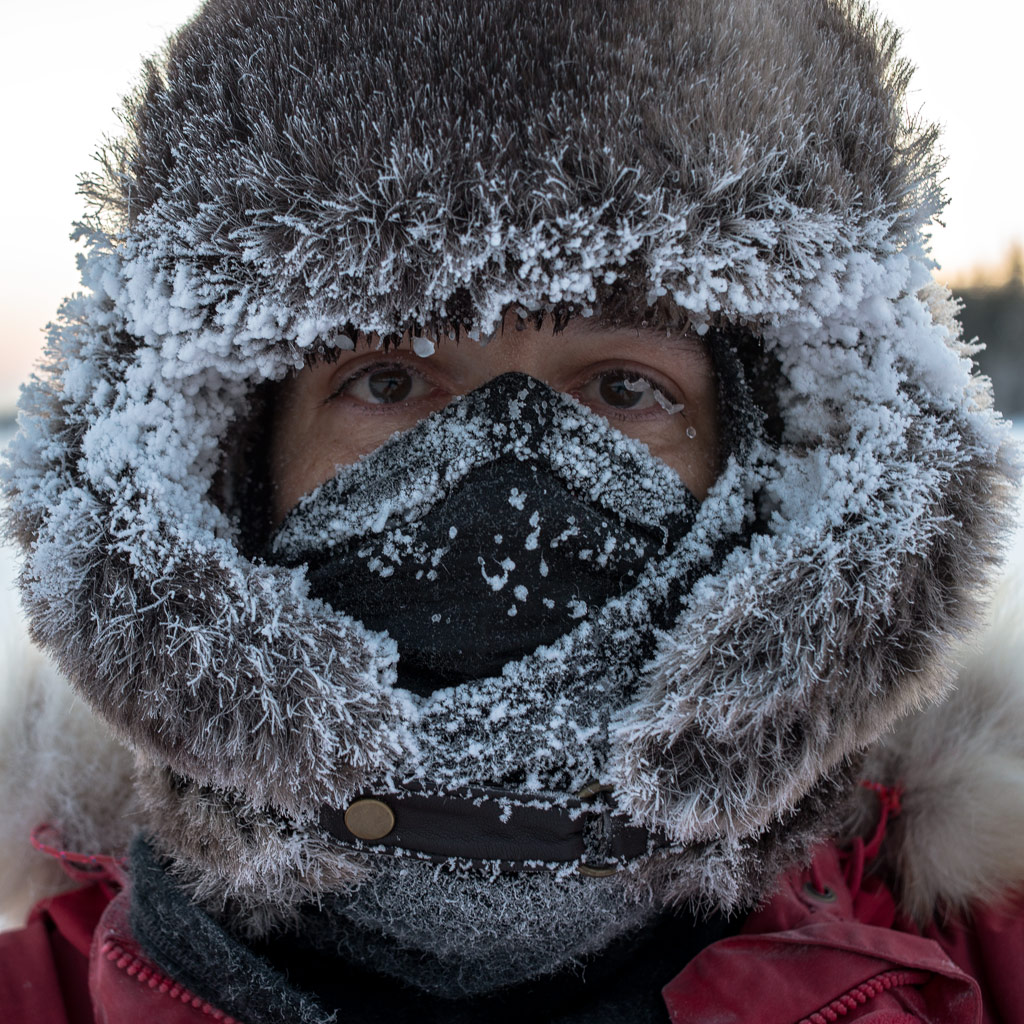
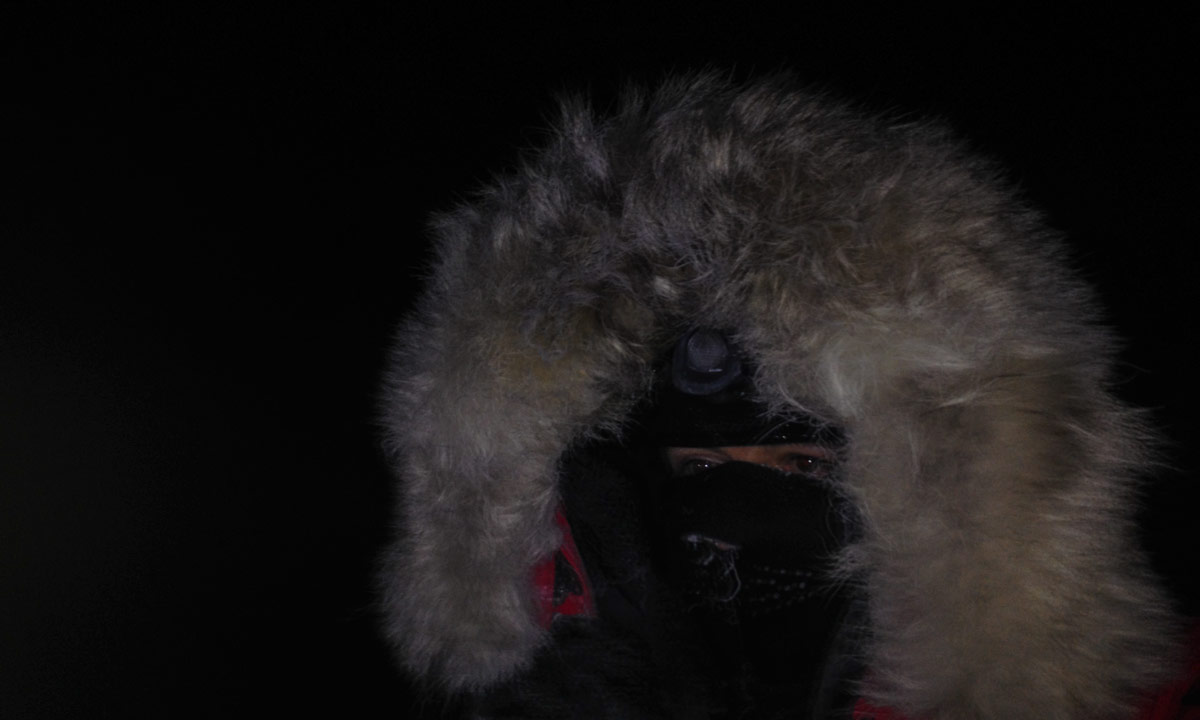
That’s what I looked like. The first photo is taken 10 minutes after beginning, the second right after the end of the tour. That was not easy: The Nikon D-800 was out of order, the iPhone is not made for cold temperatures and the batteries of my auxiliary camera were left in the car and didn’t work neither. But at last I found a battery that worked for the moment.

You see the fur cap? Some equipment that I have is really expensive, for example by Canada Goose down parka (not on the photos above). The fur cap however is from H&M and costed only 10 Euros. You can hardly call this professional equipment but it worked extremely well.

When you exhale in this cold the air flickers as it does over open fire. No surprise, the temperature difference is round 75 °C. When you inhale you should wear a buff or a scarf to protect your lungs. Remember the temperature difference?

I was so glad that the car copes with the cold. It was -36.9 °C outside and -35.1 °C inside when I started the car after the tour. It took only two seconds and the motor was running. Only changing gears is heavy as long the system is so cold.

On the way back temperatures dropped again below -40 °C. Time to many another selfie – a ridiculous one: The camera inside, holden by a long arm, me outside in front of the car. To my big relief the Nikon camera worked again. The motive: The temperature at the left, me outside with my parka at the right. It didn’t work as excepted. Where’s my face?!

Back in Pajala I admired the fragile birch trees covered with frost beside of the river Torneälven. In the background the clear sky with colours from pink to azure. It seemed to be even colder on the bridge that led over the river back into the city. I could feel the wind through my gloves and mittens and even the nose started to freeze together with the camera when taking photos! I closed my hood completely which looks a bit ridiculous, but I stayed warm.

I took my anemometer (A birthday present to myself) and measured the wind: 20 km/h. The temperature: -36 °C. That makes a wind chill of -51 °C! That’s what I call coldness!

I took a lunch and headed home since weather in this region should worsen, while the forecast for Skelleftehamn looked quite good. It was hardly warmer than -25 °C on the whole journey back home.

At 7 o’clock I arrived home. -28 °C outside – time for a hot bath!

Hunting the cold – day #1

This article is part of the series “2016-01: Hunting the cold”.

Two days ago it looked like that it could by quite cold in Northern Sweden yesterday and today. I checked several places and their weather forecasts and Pajala with a forecasted temperature of -40.4 °C won. That’s good news, since Pajala is only 350 km away. Nikkaluokta for example is one of the coldest places in Sweden, is 537 km away and it will take more than 6 hours to travel to (when conditions are good).

Yesterday – 6 Jan, 2016 – I packed kamera, very warm clothes and all you need for ski tours into my Saab and started the trip. In Skelleftehamn it was -17 °C, but already 20 km away the temperature dropped to -20 °C.

I made a stop in Jävre. I’ve passed this place several times and every time I planned a future stop. Well, future was yesterday. Jävre -23.3 °C.

I continued the trip and the temperature continued dropping. Round half past ten I could see the sun – it was bright red (the camera couldn’t catch this) and because of the higher latitude it was even lower above the horizon. -27 °C.

Now I continued driving to avoid arriving too late. Right after Svartbyn (E10) the thermometer dropped below -30 °C the first time. Round 40 km later I turned right. Here temperatures dropped below -33 °C. Near Pentäsjärvi – 25 km before Pajala – it got even colder: -36.9 °C. I probably experienced colder temperatures, but never saw such low numbers on a thermometer.

I found a quite low-priced room in the Hotell Smedjan but I continued driving around looking for nice (and cold!) places.

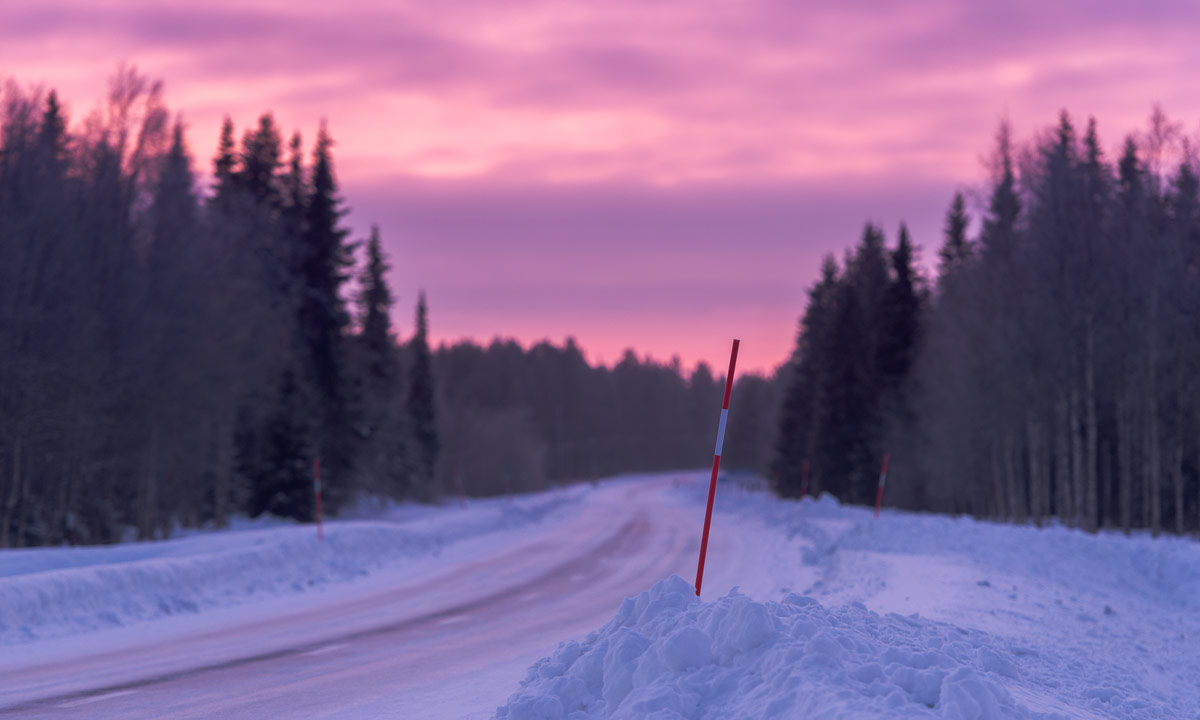
One of the most fascinating things in my opinion is the light in wintertime. Twilight may last hours or even the whole short morning, day, and evening and there are always soft pink colours in the sky. Just beautiful, but cold to take pictures of if you don’t have warm clothes. But when I have one thing, it’s cold weather equipment.

I looked for the airport, which is a bit out of town and quite tiny. It was closed. It’s the first airport I saw with an own parking place for reindeers. Good to know!

On my way back to Pajala I found a side road that headed to a small national park. I parked the car and walked the 700 meters to the cabin and the grill place in darkness. Of course it wasn’t pitch black, the snow and some thin clouds reflected the light of the city, giving enough light to see and walk. (The selfie is made with the iPhone which can take two photos until it will shut down because of the cold.

On the way back it was even colder: -38.8 °C. Now I got really hungry, drove back to the hotel and walked to the pizza restaurant. (Pizza and burger bars rule the Scandinavian north). Pajala by night:

Then I went home. I was glad that I have all I need for such a trip: A camera, food and a warm winter parka.

After a while I considered if I could catch the -40 °C now. It was warmer than expected, but let’s give it a try.

This time I took the road to Käymäjärvi (the name proofs, that Finland is not far away). Yes, here it was quite cold – below -39 °C. Between a swamp and the lake I stopped, since these low lands can be cold traps. I didn’t get lower temperatures but a view on the village and northern light (quite strong until I was ready to take pictures …)

On the way back to the main road I got my new personal cold record: -39.6 °C (sorry, no -40 °C)! When it’s really cold in Northern Sweden people take pictures of thermometers and show them in the internet. I will join this tradition. Voilà:

>>> read about day 2 of the journey >>>

Another polar light

Just three-quarters of an hour ago on the near lake Snesviken.

Some notes: -12 °C outside of the house, probably colder on the lake. The jacket was not too warm. First time this winter, that I made some steps onto the ice of the lake. I just dared because of the many other footprints and the knowledge, that water is less than a meter deep at this place.

Flood along the Skellefteälven

The river Skellefteälven had much water today. Water level was 87 cm above normal according to a hiker I met at the river today. The hiker had to turn because parts of the way were still under water just as the ground besides.

It was funny walking on this “way” – the ground was frozen, 15 cm water above, slightly frozen over, too. I even saw a fish fleeing my rubber boots under the thin ice cover. And I was so glad about my crampon-like spikes, that I had with me, since the ground was almost frictionless.

After a grey morning the weather was nice with blue sky and sun, but still much too warm for the season. I really wonder how the river succeeds in freezing over when it’s hardly frosty. I also wonder why the river ice can rise almost 90 centimetres without getting any visible cracks. Probably it’s quite soft.

Ten, fifteen centimeters above water level you could see ice round the branches and twigs of the smaller trees and bushes, marking the high water peak of last night. I had to crouch and lie down to make the next picture.

It was easier to make pictures of the beautiful frost patterns that covered the ground. By the way: These are colour photographs.

Spying the land

Tomorrow I thought about paddling through the freshly snowy winter landscape. Is it realistic? Let’s check:

A: the snow warning

smhi (Swedish Meteorological and Hydrological Institute) released a class 1 warning for tonight: 10 – 15 cm snow should fall at the coastal areas of Västerbotten. But actually it’s too warm, most of the precipitation has come as sleet and rain. Probably we will have a centimeter of wet snow tomorrow, not much more.

B: the sea ice cover

smhi has another warning, this time for the sea: “higher than 80 cm above mean sea level.” – I took the car to Storgrundet and smhi was right: Parts of the beach are submarine now. But unfortunately the high water didn’t break the sea ice. The ice near the shore is quite soft, I could paddle through. But the rest? Will I manage to break through or do I have to give up?

C: the forecast

At 7:00 it will be clear sky and -6 °C. Nice weather, but at this time it’ll be pitch dark; sun rise is round 9:15. According to the forecast it will be cloudy at 9:00 and start to rain at 13:00. Not enough with that, smhi had another warning for tomorrow: wind will be round 30 knots, that’s round 60 km/h – too much for my kayaking abilities.

Let’s summarise: Hardly any snow, the ice maybe to thick to break, windy + cloudy + some rain later on. I guess, my kayak will stay in the garage tomorrow.

Strange skies

Three days ago Aurora Alerts by Soft Serve News showed a forecast for very strong polar lights, first for last night, than for tonight.

That’s why I took camera and tripod with me when I drove to the rehearsal with the Chamber Choir. When we had finished and I left the building it was cloudy – as expected – but you could see the green light of a quite strong aurora shining through the spots were clouds were less dense.

I hoped for the sky to clear up and drove to Långhällan – a favourite place at the seaside. Unfortunately however the sky hardly cleared up and finally the clouds became even denser. Suddenly I could spot a bright red light at the horizon. Is it a strong spotlight of a ship? But why is it so red? It took a minute until I realised that it’s really the moon rising above the horizon. I cannot remember seeing the moon in such an extreme red colour – even redder than at the total lunar eclipse five weeks ago.

The next photo is a bit special. It is much more edited than I use to edit photos to show the colder green colours of the Northern lights behind the clouds and the warm, now bright orange colour of the moon. I lit the foreground with a flashlight to make it visible. Not very easy to light it evenly without overexposing it. Even here I had to edit some spots that were too bright or too dark.

There may be less clouds at 4 or 5 o’clock. Ant perhaps still polar lights. But I guess I’ll be sound asleep … .